

ASTM D6021-22
(Test Method)Standard Test Method for Measurement of Total Hydrogen Sulfide in Residual Fuels by Multiple Headspace Extraction and Sulfur Specific Detection
General Information
- Abstract
SIGNIFICANCE AND USE
5.1 Residual fuel oils can contain H2S in the liquid phase, and this can result in hazardous vapor phase levels of H2S in storage tank headspaces. The vapor phase levels can vary significantly according to the headspace volume, fuel temperature, and agitation. Measurement of H2S levels in the liquid phase provides a useful indication of the residual fuel oil’s propensity to form high vapor phase levels, and lower levels in the residual fuel oil will directly reduce risk of H2S exposure. It is critical, however, that anyone involved in handling fuel oil, such as vessel owners and operators, continue to maintain appropriate safety practices designed to protect the crew, tank farm operators and others who can be exposed to H2S.
5.1.1 The measurement of H2S in the liquid phase is appropriate for product quality control, while the measurement of H2S in the vapor phase is appropriate for health and safety purposes.
5.2 This test method was developed so refiners, fuel terminal operators and independent testing laboratory personnel can analytically measure the amount of H2S in the liquid phase of residual fuel oils.
Note 1: Test Method D6021 is one of three test methods for quantitatively measuring H2S in residual fuels:
1) Test Method D5705 is a simple field test method for determining H2S levels in the vapor phase.
2) Test Method D7621 is a rapid test method to determine H2S levels in the liquid phase.
5.3 H2S concentrations in the liquid and vapor phase attempt to reach equilibrium in a static system. However, this equilibrium and the related liquid and vapor concentrations can vary greatly depending on temperature and the chemical composition of the liquid phase. A concentration of 1 mg/kg (μg/g) (ppmw) of H2S in the liquid phase of a residual fuel can typically generate an actual gas concentration of >50 μL/L(ppmv) to 100 μL/L(ppmv) of H2S in the vapor phase, but the equilibrium of the vapor phase is disrupted the moment a vent or access point is opened ...
SCOPE
1.1 This test method covers a method suitable for measuring the total amount of hydrogen sulfide (H2S) in heavy distillates, heavy distillate/residual fuel blends, or residual fuels as defined in Specification D396 Grade 4, 5 (Light), 5 (Heavy), and 6, when the H2S concentration in the fuel is in the 0.01 μg/g (ppmw) to 100 μg/g (ppmw) range.
1.2 The values stated in SI units are to be regarded as standard. No other units of measurement are included in this standard.
1.3 This standard does not purport to address all of the safety concerns, if any, associated with its use. It is the responsibility of the user of this standard to establish appropriate safety, health, and environmental practices and determine the applicability of regulatory limitations prior to use. For specific warning statements, see 7.5, 8.2, 9.2, 10.1.4, and 11.1.
1.4 This international standard was developed in accordance with internationally recognized principles on standardization established in the Decision on Principles for the Development of International Standards, Guides and Recommendations issued by the World Trade Organization Technical Barriers to Trade (TBT) Committee.
- Status
- Published
- Publication Date
- 31-Mar-2022
- Technical Committee
- D02 - Petroleum Products, Liquid Fuels, and Lubricants
- Drafting Committee
- D02.14 - Stability, Cleanliness and Compatibility of Liquid Fuels
Buy Documents
ASTM D6021-22 - Standard Test Method for Measurement of Total Hydrogen Sulfide in Residual Fuels by Multiple Headspace Extraction and Sulfur Specific Detection
REDLINE ASTM D6021-22 - Standard Test Method for Measurement of Total Hydrogen Sulfide in Residual Fuels by Multiple Headspace Extraction and Sulfur Specific Detection
Overview
ASTM D6021-22: Standard Test Method for Measurement of Total Hydrogen Sulfide in Residual Fuels by Multiple Headspace Extraction and Sulfur Specific Detection provides a reliable laboratory procedure for determining the total hydrogen sulfide (H₂S) content in heavy distillates, heavy distillate/residual blends, and residual fuel oils. Developed by ASTM International, this standard is crucial for ensuring the safety, quality, and regulatory compliance of residual fuels as defined in ASTM D396 Grades 4, 5 (Light), 5 (Heavy), and 6.
Hydrogen sulfide is a toxic and potentially hazardous compound present both in the liquid and vapor phases of residual fuel oils. Accurate measurement of H₂S in fuel helps mitigate health and safety risks associated with its handling, storage, and transportation. This test method enables refiners, fuel terminal operators, and independent laboratories to assess and control H₂S levels efficiently, thereby supporting safer operational practices in the petroleum industry.
Key Topics
- Test Methodology: Utilizes multiple headspace extraction (MHE) and sulfur-specific detection to quantitatively determine total H₂S concentration in residual fuels within the range of 0.01 μg/g (ppmw) to 100 μg/g (ppmw).
- Scope of Application: Covers heavy distillates, blends, and residual fuels as per ASTM D396, ensuring broad applicability across common industrial fuel types.
- Safety Considerations: Highlights the importance of rigorous safety, health, and environmental procedures when handling fuels with H₂S content due to its toxicity.
- Product Quality and Safety: Measurement of H₂S in the liquid phase is suitable for product quality control, while vapor phase measurement serves health and safety assessments.
- Analytical Precision: Incorporates repeated extractions and detector response calibration to provide accurate and verifiable H₂S concentration values.
Applications
ASTM D6021-22 is vital for industries and operations involving residual fuels, including:
- Oil Refineries: Supports quality control and specification compliance for residual fuel oil production.
- Fuel Terminal Operations: Ensures safe storage, transfer, and blending of heavy fuels by monitoring H₂S content.
- Shipping and Marine Operations: Assists vessel owners and operators in managing H₂S exposure risks during bulk fuel transport.
- Laboratories and Testing Facilities: Provides a standardized approach for precise analytical determination of H₂S in fuel samples.
- Regulatory Compliance: Facilitates adherence to safety regulations for hazardous materials and supports fulfillment of industry best practices.
Accurate determination of hydrogen sulfide content is essential to reduce hazard potential, prevent exposure during fuel handling, and minimize the risk to human health and environmental safety.
Related Standards
Several ASTM standards complement the implementation and broader context of ASTM D6021-22:
- ASTM D5705 - Test Method for Measurement of Hydrogen Sulfide in the Vapor Phase Above Residual Fuel Oils (a field method for vapor phase measurement).
- ASTM D7621 - Test Method for Determination of Hydrogen Sulfide in Fuel Oils by Rapid Liquid Phase Extraction (an alternative rapid assessment of liquid phase H₂S).
- ASTM D396 - Specification for Fuel Oils (defines relevant fuel grades).
- ASTM D4057 - Practice for Manual Sampling of Petroleum and Petroleum Products (procedures for proper sample collection).
- ASTM D5504 - Test Method for Determination of Sulfur Compounds in Natural Gas and Gaseous Fuels by Gas Chromatography and Chemiluminescence.
- ASTM D4175 - Terminology Relating to Petroleum Products, Liquid Fuels, and Lubricants (reference for definitions).
Adopting ASTM D6021-22 helps industry professionals enhance workplace safety, maintain product quality, and comply with international fuel regulations through the accurate measurement of hydrogen sulfide in residual fuels. For effective hazard control and compliance, regular testing following this standard is recommended.
Relations
- Refers
ASTM D4175-23a - Standard Terminology Relating to Petroleum Products, Liquid Fuels, and Lubricants - Effective Date
- 15-Dec-2023
- Refers
ASTM D4175-23e1 - Standard Terminology Relating to Petroleum Products, Liquid Fuels, and Lubricants - Effective Date
- 01-Jul-2023
- Effective Date
- 15-Dec-2019
- Effective Date
- 01-May-2019
- Effective Date
- 01-Oct-2018
- Effective Date
- 01-May-2018
- Effective Date
- 01-Dec-2017
- Effective Date
- 01-Jul-2017
- Effective Date
- 01-Oct-2016
- Effective Date
- 01-Oct-2016
- Effective Date
- 01-Dec-2015
- Effective Date
- 01-Oct-2015
- Effective Date
- 01-Oct-2015
- Effective Date
- 01-Jun-2015
- Effective Date
- 15-Apr-2015
Buy Documents
ASTM D6021-22 - Standard Test Method for Measurement of Total Hydrogen Sulfide in Residual Fuels by Multiple Headspace Extraction and Sulfur Specific Detection
REDLINE ASTM D6021-22 - Standard Test Method for Measurement of Total Hydrogen Sulfide in Residual Fuels by Multiple Headspace Extraction and Sulfur Specific Detection
Get Certified
Connect with accredited certification bodies for this standard

DNV
DNV is an independent assurance and risk management provider.

Lloyd's Register
Lloyd's Register is a global professional services organisation specialising in engineering and technology.
DNV Energy Systems
Energy and renewable energy certification.
Sponsored listings
Frequently Asked Questions
ASTM D6021-22 is a standard published by ASTM International. Its full title is "Standard Test Method for Measurement of Total Hydrogen Sulfide in Residual Fuels by Multiple Headspace Extraction and Sulfur Specific Detection". This standard covers: SIGNIFICANCE AND USE 5.1 Residual fuel oils can contain H2S in the liquid phase, and this can result in hazardous vapor phase levels of H2S in storage tank headspaces. The vapor phase levels can vary significantly according to the headspace volume, fuel temperature, and agitation. Measurement of H2S levels in the liquid phase provides a useful indication of the residual fuel oil’s propensity to form high vapor phase levels, and lower levels in the residual fuel oil will directly reduce risk of H2S exposure. It is critical, however, that anyone involved in handling fuel oil, such as vessel owners and operators, continue to maintain appropriate safety practices designed to protect the crew, tank farm operators and others who can be exposed to H2S. 5.1.1 The measurement of H2S in the liquid phase is appropriate for product quality control, while the measurement of H2S in the vapor phase is appropriate for health and safety purposes. 5.2 This test method was developed so refiners, fuel terminal operators and independent testing laboratory personnel can analytically measure the amount of H2S in the liquid phase of residual fuel oils. Note 1: Test Method D6021 is one of three test methods for quantitatively measuring H2S in residual fuels: 1) Test Method D5705 is a simple field test method for determining H2S levels in the vapor phase. 2) Test Method D7621 is a rapid test method to determine H2S levels in the liquid phase. 5.3 H2S concentrations in the liquid and vapor phase attempt to reach equilibrium in a static system. However, this equilibrium and the related liquid and vapor concentrations can vary greatly depending on temperature and the chemical composition of the liquid phase. A concentration of 1 mg/kg (μg/g) (ppmw) of H2S in the liquid phase of a residual fuel can typically generate an actual gas concentration of >50 μL/L(ppmv) to 100 μL/L(ppmv) of H2S in the vapor phase, but the equilibrium of the vapor phase is disrupted the moment a vent or access point is opened ... SCOPE 1.1 This test method covers a method suitable for measuring the total amount of hydrogen sulfide (H2S) in heavy distillates, heavy distillate/residual fuel blends, or residual fuels as defined in Specification D396 Grade 4, 5 (Light), 5 (Heavy), and 6, when the H2S concentration in the fuel is in the 0.01 μg/g (ppmw) to 100 μg/g (ppmw) range. 1.2 The values stated in SI units are to be regarded as standard. No other units of measurement are included in this standard. 1.3 This standard does not purport to address all of the safety concerns, if any, associated with its use. It is the responsibility of the user of this standard to establish appropriate safety, health, and environmental practices and determine the applicability of regulatory limitations prior to use. For specific warning statements, see 7.5, 8.2, 9.2, 10.1.4, and 11.1. 1.4 This international standard was developed in accordance with internationally recognized principles on standardization established in the Decision on Principles for the Development of International Standards, Guides and Recommendations issued by the World Trade Organization Technical Barriers to Trade (TBT) Committee.
SIGNIFICANCE AND USE 5.1 Residual fuel oils can contain H2S in the liquid phase, and this can result in hazardous vapor phase levels of H2S in storage tank headspaces. The vapor phase levels can vary significantly according to the headspace volume, fuel temperature, and agitation. Measurement of H2S levels in the liquid phase provides a useful indication of the residual fuel oil’s propensity to form high vapor phase levels, and lower levels in the residual fuel oil will directly reduce risk of H2S exposure. It is critical, however, that anyone involved in handling fuel oil, such as vessel owners and operators, continue to maintain appropriate safety practices designed to protect the crew, tank farm operators and others who can be exposed to H2S. 5.1.1 The measurement of H2S in the liquid phase is appropriate for product quality control, while the measurement of H2S in the vapor phase is appropriate for health and safety purposes. 5.2 This test method was developed so refiners, fuel terminal operators and independent testing laboratory personnel can analytically measure the amount of H2S in the liquid phase of residual fuel oils. Note 1: Test Method D6021 is one of three test methods for quantitatively measuring H2S in residual fuels: 1) Test Method D5705 is a simple field test method for determining H2S levels in the vapor phase. 2) Test Method D7621 is a rapid test method to determine H2S levels in the liquid phase. 5.3 H2S concentrations in the liquid and vapor phase attempt to reach equilibrium in a static system. However, this equilibrium and the related liquid and vapor concentrations can vary greatly depending on temperature and the chemical composition of the liquid phase. A concentration of 1 mg/kg (μg/g) (ppmw) of H2S in the liquid phase of a residual fuel can typically generate an actual gas concentration of >50 μL/L(ppmv) to 100 μL/L(ppmv) of H2S in the vapor phase, but the equilibrium of the vapor phase is disrupted the moment a vent or access point is opened ... SCOPE 1.1 This test method covers a method suitable for measuring the total amount of hydrogen sulfide (H2S) in heavy distillates, heavy distillate/residual fuel blends, or residual fuels as defined in Specification D396 Grade 4, 5 (Light), 5 (Heavy), and 6, when the H2S concentration in the fuel is in the 0.01 μg/g (ppmw) to 100 μg/g (ppmw) range. 1.2 The values stated in SI units are to be regarded as standard. No other units of measurement are included in this standard. 1.3 This standard does not purport to address all of the safety concerns, if any, associated with its use. It is the responsibility of the user of this standard to establish appropriate safety, health, and environmental practices and determine the applicability of regulatory limitations prior to use. For specific warning statements, see 7.5, 8.2, 9.2, 10.1.4, and 11.1. 1.4 This international standard was developed in accordance with internationally recognized principles on standardization established in the Decision on Principles for the Development of International Standards, Guides and Recommendations issued by the World Trade Organization Technical Barriers to Trade (TBT) Committee.
ASTM D6021-22 is classified under the following ICS (International Classification for Standards) categories: 27.060.10 - Liquid and solid fuel burners. The ICS classification helps identify the subject area and facilitates finding related standards.
ASTM D6021-22 has the following relationships with other standards: It is inter standard links to ASTM D4175-23a, ASTM D4175-23e1, ASTM D396-19a, ASTM D396-19, ASTM D396-18a, ASTM D396-18, ASTM D396-17a, ASTM D396-17, ASTM D396-16e1, ASTM D396-16, ASTM D7621-15b, ASTM D396-15c, ASTM D7621-15a, ASTM D396-15b, ASTM D7621-15. Understanding these relationships helps ensure you are using the most current and applicable version of the standard.
ASTM D6021-22 is available in PDF format for immediate download after purchase. The document can be added to your cart and obtained through the secure checkout process. Digital delivery ensures instant access to the complete standard document.
Standards Content (Sample)
This international standard was developed in accordance with internationally recognized principles on standardization established in the Decision on Principles for the
Development of International Standards, Guides and Recommendations issued by the World Trade Organization Technical Barriers to Trade (TBT) Committee.
Designation:D6021 −22
Standard Test Method for
Measurement of Total Hydrogen Sulfide in Residual Fuels
by Multiple Headspace Extraction and Sulfur Specific
Detection
This standard is issued under the fixed designation D6021; the number immediately following the designation indicates the year of
original adoption or, in the case of revision, the year of last revision.Anumber in parentheses indicates the year of last reapproval.A
superscript epsilon (´) indicates an editorial change since the last revision or reapproval.
1. Scope* D3609Practice for Calibration Techniques Using Perme-
ation Tubes
1.1 Thistestmethodcoversamethodsuitableformeasuring
D4057Practice for Manual Sampling of Petroleum and
thetotalamountofhydrogensulfide(H S)inheavydistillates,
Petroleum Products
heavydistillate/residualfuelblends,orresidualfuelsasdefined
D4084Test Method for Analysis of Hydrogen Sulfide in
in Specification D396 Grade 4, 5 (Light), 5 (Heavy), and 6,
Gaseous Fuels (Lead Acetate Reaction Rate Method)
when the H S concentration in the fuel is in the 0.01µg⁄g
D4175Terminology Relating to Petroleum Products, Liquid
(ppmw) to100µg⁄g (ppmw) range.
Fuels, and Lubricants
1.2 The values stated in SI units are to be regarded as
D4323TestMethodforHydrogenSulfideintheAtmosphere
standard. No other units of measurement are included in this
by Rate of Change of Reflectance
standard.
D5504TestMethodforDeterminationofSulfurCompounds
1.3 This standard does not purport to address all of the in Natural Gas and Gaseous Fuels by Gas Chromatogra-
safety concerns, if any, associated with its use. It is the
phy and Chemiluminescence
responsibility of the user of this standard to establish appro- D5705Test Method for Measurement of Hydrogen Sulfide
priate safety, health, and environmental practices and deter-
in the Vapor Phase Above Residual Fuel Oils
mine the applicability of regulatory limitations prior to use. D7621Test Method for Determination of Hydrogen Sulfide
For specific warning statements, see 7.5, 8.2, 9.2, 10.1.4, and
in Fuel Oils by Rapid Liquid Phase Extraction
11.1.
3. Terminology
1.4 This international standard was developed in accor-
dance with internationally recognized principles on standard- 3.1 Definitions:
3.1.1 For definitions of terms used in this test method, refer
ization established in the Decision on Principles for the
Development of International Standards, Guides and Recom- to Terminology D4175.
3.1.2 heavy distillate, n—a fuel produced from the distilla-
mendations issued by the World Trade Organization Technical
Barriers to Trade (TBT) Committee. tion of crude oil which has a kinematic viscosity at 40°C
2 2
between 5.5mm /s and 24.0 mm /s, inclusive.
2. Referenced Documents
3.1.3 heavy distillate/residual fuel blend, n—a blend of
heavydistillateandresidualfueloilhavingaviscosityat40°C
2.1 ASTM Standards:
2 2
between 5.5mm /s and 24.0 mm /s, inclusive.
D396Specification for Fuel Oils
D1193Specification for Reagent Water
3.1.4 multiple headspace extraction, n—a technique to de-
D2420Test Method for Hydrogen Sulfide in Liquefied
termine the total concentration of a gas trapped in a liquid by
Petroleum (LP) Gases (Lead Acetate Method)
analysis of successive gas extractions from the vapor space of
a closed vessel containing a known amount of the sample.
3.1.5 residual fuel oil, n—any liquid or liquefiable petro-
This test method is under the jurisdiction of ASTM Committee D02 on
leum product having a kinematic viscosity at 100°C between
Petroleum Products, Liquid Fuels, and Lubricants and is the direct responsibility of
2 2
5.0mm /sand50.0mm /s,inclusive,burnedforthegeneration
Subcommittee D02.14 on Stability, Cleanliness and Compatibility of Liquid Fuels.
ofheatinafurnaceorfireboxorforthegenerationofpowerin
Current edition approved April 1, 2022. Published May 2022. Originally
approved in 1996. Last previous edition approved in 2017 as D6021–12 (2017).
an engine.
DOI: 10.1520/D6021-22.
For referenced ASTM standards, visit the ASTM website, www.astm.org, or 4. Summary of Test Method
contact ASTM Customer Service at service@astm.org. For Annual Book of ASTM
4.1 A representative sample of residual fuel oil is obtained
Standards volume information, refer to the standard’s Document Summary page on
the ASTM website. in sufficient quantity to completely fill the sample container.
*A Summary of Changes section appears at the end of this standard
Copyright © ASTM International, 100 Barr Harbor Drive, PO Box C700, West Conshohocken, PA 19428-2959. United States
D6021−22
NOTE 1—Test Method D6021 is one of three test methods for
The sample is taken to the laboratory preferably within one to
quantitatively measuring H S in residual fuels:
4h,within24hmaximumandplacedinarefrigeratoruntilthe
1) Test Method D5705 is a simple field test method for determining H S
hydrogen sulfide analysis can be run.At that time, the sample
levels in the vapor phase.
is removed from the refrigerator and allowed to sit at ambient
2) Test Method D7621 is a rapid test method to determine H S levels in
temperature until it flows freely.
the liquid phase.
5.3 H S concentrations in the liquid and vapor phase at-
4.2 A 0.05g to 5.0 g test specimen (aliquot) is placed in a
headspace vial and heated in an oven at 60°C for more than tempt to reach equilibrium in a static system. However, this
equilibriumandtherelatedliquidandvaporconcentrationscan
five but less than 15 min. The headspace gas is sampled and
injected into either of two types of apparatus capable of vary greatly depending on temperature and the chemical
composition of the liquid phase. A concentration of 1 mg/kg
measuring the hydrogen sulfide concentration in the gaseous
sample. The two types of apparatus are those using the (µg/g)(ppmw)ofH Sintheliquidphaseofaresidualfuelcan
typically generate an actual gas concentration of
reaction of lead acetate with H S (see Test Method D4084 or
Test Method D4323) and those based on chemiluminescence >50µL⁄L(ppmv) to 100 µL/L(ppmv) of H S in the vapor
phase, but the equilibrium of the vapor phase is disrupted the
(see Test Method D5504).
moment a vent or access point is opened to collect a sample.
4.3 Theremainingcontentsoftheheadspacevialarecooled
for 5 min, then again heated in the oven. The headspace
NOTE 2—Because of the reactivity, absorptivity, and volatility of H S
any measurement method only provides an H S concentration at a given
contents are again transferred to the hydrogen sulfide measur- 2
moment in time.
inginstrument.Theprocedureisrepeatedforathirdtime.This
is known as multiple headspace extraction procedure (MHE).
6. Apparatus
4.4 Alinearplotofthenaturallogarithmoftheareaorpeak
6.1 Aschematic of the headspace sampling system required
height difference of the instrument reading against the number
for this analysis is shown in Fig. 1. It consists of:
of injections is indicative of the correctness of the extraction
6.1.1 Sampling On/Off Valve, with 3.2 mm o.d. connector
procedure.Thedifferenceinareaorpeakheightofthefirsttwo
(Valve 1).
injections is used to calculate a total area or total peak height
6.1.2 Six-Port External Loop Injection Valve, made with
difference. The total area or total peak height difference is
316stainlesssteel,resistanttoattackbysulfurcompoundsand
multiplied by a response factor determined from a direct gas
having 3.2 mm o.d. tubing from each port (Valve 2).
calibration mixture and divided by the weight of the test
6.1.3 Polytetrafluoroethylene (PTFE) Sample Loops, of
specimentodeterminetheconcentrationofH Sintheresidual
0.5mL, 2.5mL, and 10 mL are used for H S content of
fuel in µg/g (ppmw).
1ppmw to 100ppmw, 0.1ppmw to 50ppmw, and 0.01ppmw
to 10 ppmw, respectively.
5. Significance and Use
6.1.4 Pressure/Vacuum Gauge, 6.3 mm diameter dial type
5.1 Residual fuel oils can contain H S in the liquid phase,
with range of −100kPag to 200kPag, 5kPa divisions from
and this can result in hazardous vapor phase levels of HSin
−100kPag to 0kPag and 10kPa divisions from 0kPag to
storage tank headspaces. The vapor phase levels can vary
200kPag.
significantly according to the headspace volume, fuel
6.1.5 Vacuum On/Off Valve, 3.2mm o.d. connector (Valve
temperature, and agitation. Measurement of H S levels in the
3).
liquid phase provides a useful indication of the residual fuel
6.1.6 Sulfur Selective Detector, any H S specific detector
oil’s propensity to form high vapor phase levels, and lower
capable of measuring H S in the gas from 1 ppmv to
levels in the residual fuel oil will directly reduce risk of H S
10000ppmv with a repeatability of 62% of full scale.
exposure. It is critical, however, that anyone involved in
NOTE 3—Good performance has been obtained with a lead acetate tape
handlingfueloil,suchasvesselownersandoperators,continue
detector and a sulfur chemiluminescence detector.
tomaintainappropriatesafetypracticesdesignedtoprotectthe
crew, tank farm operators and others who can be exposed to 6.1.7 Fluorocarbon Tubing, 0.6 m long by 3.2 mm o.d. to
H S. connect components together.
5.1.1 The measurement of H S in the liquid phase is
6.2 Vacuum pump, 3.2 mm o.d. outlet, capable of achieving
appropriateforproductqualitycontrol,whilethemeasurement
a 0.2 kPa vacuum and with a capacity of 100 mL/min.
of H S in the vapor phase is appropriate for health and safety
6.3 Headspace Oven, capable of operating at 60°C 6
purposes.
0.5°C with internal dimensions of 30cm by 30cm by 30cm.
5.2 This test method was developed so refiners, fuel termi-
An optional vent line is recommended in case a vial leaks.
nal operators and independent testing laboratory personnel can
6.4 Analytical Balance, sensitivity of 0.01 mg, maximum
analytically measure the amount of H S in the liquid phase of
weight of 250 g.
residual fuel oils.
6.5 Data Handling System, such as electronic integrator or
3 any computer unit that can work with a chromatographic
DeterminationofH SinResidualFuelOilsbyMultipleHeadspaceExtraction:
A Critical Evaluation of Available Analytical Methods. Silva, B., Carvajal, N., signal.
Gonzalez, A., Eastern Analytical Symposium, sponsored by American Chemical
6.6 If sulfur specific detectors are used instead of an H S
Society and the American Microchemical Society, November 16–20, 1992, 2
Somerset, N.J. analyzer then a chromatographic system equipped with a
D6021−22
FIG. 1 Schematic of Headspace Analysis System
suitable column and oven is required to separate H S from 7.5 Hydrogen Sulfide Gas Calibration Standard, 1µL⁄L,
other sulfur compounds (see Test Method D5504). 10µL⁄L,and100µL/LH Sinheliumornitrogenhighpressure
cylinders (obtain from gas supply company). (Warning—
6.7 Hand Crimper, to crimp 20 mm diameter aluminum
Hydrogen sulfide is an extremely toxic gas.)
seals.
7.6 Gases, helium or nitrogen (H S free), chemically pure
7. Reagents and Materials
grade or purified, as carrier gas to sweep sample into the
7.1 Purity of Reagents—Reagent grade chemicals shall be detector.
used in all tests. Unless otherwise indicated, it is intended that
7.7 Lead Acetate Sensing Paper—Prepare in accordance
all reagents conform to the specifications of the Committee on
with Test Method D2420, using appropriate size strips and
Analytical Reagents of theAmerican Chemical Society where
drying in an H S-free environment. Commercially available
such specifications are available. Other grades may be used,
test paper has been found satisfactory.
provided it is first ascertained that the reagent is of sufficiently
high purity to permit its use without lessening the accuracy of
NOTE 4—Reagents from 7.2 and 7.7 are only needed if using an H S
lead acetate tape detector.
the determination.
7.2 Acetic Acid Solution—Add 50 mLof glacial acetic acid
7.8 Nuts and Ferrules, Polytetrafluoroethylene (PTFE) and
(CH COOH) toa1L volumetric flask and then add Type II stainless steel (3.2 mm).
distilled water, as specified in Specification D1193,tothe1L
7.9 Septas, 20 mm diameter PTFE silicone/fluorocarbon to
mark to make a 5% acetic acid solution.
seal headspace sample vials.
7.3 Aluminum Seals, 20 mm diameter to seal septas to
7.10 Side Port Needles,forpressurelock,A-gasseries(with
headspace sample vials.
reduction union 3.2 mm to 1.6 mm).
7.4 Headspace Vials,30mL,60mL,or120mLborosilicate
7.11 Syringe Needles, common dischargeable (dosing
glass vials with 20 mm mouth diameter.
needle).
ACS Reagent Chemicals, Specifications and Procedures for Reagents and
8. Sampling
Standard-Grade Reference Materials, American Chemical Society, Washington,
DC. For suggestions on the testing of reagents not listed by theAmerican Chemical
8.1 Using a suitable H S inert container of 250mL to
Society, see Analar Standards for Laboratory Chemicals, BDH Ltd., Poole, Dorset,
500mL, collect a representative sample by Practice D4057.
U.K., and the United States Pharmacopeia and National Formulary, U.S. Pharma-
copeial Convention, Inc. (USPC), Rockville, MD. Suitable containers can be made of borosilicate glass or
D6021−22
FIG. 2 Gas Calibration Standard Preparation
aluminum. If the sample temperature is below 60°C then a 10.1.2 Insertasilicone/fluorocarbonseptum,withthePTFE
high density polyethylene bottle can be used. side pointing inwards, into the headspace vial, cover it with an
aluminum seal, and crimp the aluminum s
...
This document is not an ASTM standard and is intended only to provide the user of an ASTM standard an indication of what changes have been made to the previous version. Because
it may not be technically possible to adequately depict all changes accurately, ASTM recommends that users consult prior editions as appropriate. In all cases only the current version
of the standard as published by ASTM is to be considered the official document.
Designation: D6021 − 12 (Reapproved 2017) D6021 − 22
Standard Test Method for
Measurement of Total Hydrogen Sulfide in Residual Fuels
by Multiple Headspace Extraction and Sulfur Specific
Detection
This standard is issued under the fixed designation D6021; the number immediately following the designation indicates the year of
original adoption or, in the case of revision, the year of last revision. A number in parentheses indicates the year of last reapproval. A
superscript epsilon (´) indicates an editorial change since the last revision or reapproval.
1. Scope Scope*
1.1 This test method covers a method suitable for measuring the total amount of hydrogen sulfide (H S) in heavy distillates, heavy
distillate/residual fuel blends, or residual fuels as defined in Specification D396 Grade 4, 5 (Light), 5 (Heavy), and 6, when the
H S concentration in the fuel is in the 0.01 μg ⁄g (ppmw) to 100 μg ⁄g (ppmw) range.
1.2 The values stated in SI units are to be regarded as standard. No other units of measurement are included in this standard.
1.3 This standard does not purport to address all of the safety concerns, if any, associated with its use. It is the responsibility
of the user of this standard to establish appropriate safety, health, and environmental practices and determine the applicability of
regulatory limitations prior to use. For specific warning statements, see 7.5, 8.2, 9.2, 10.1.4, and 11.1.
1.4 This international standard was developed in accordance with internationally recognized principles on standardization
established in the Decision on Principles for the Development of International Standards, Guides and Recommendations issued
by the World Trade Organization Technical Barriers to Trade (TBT) Committee.
2. Referenced Documents
2.1 ASTM Standards:
D396 Specification for Fuel Oils
D1193 Specification for Reagent Water
D2420 Test Method for Hydrogen Sulfide in Liquefied Petroleum (LP) Gases (Lead Acetate Method)
D3609 Practice for Calibration Techniques Using Permeation Tubes
D4057 Practice for Manual Sampling of Petroleum and Petroleum Products
D4084 Test Method for Analysis of Hydrogen Sulfide in Gaseous Fuels (Lead Acetate Reaction Rate Method)
D4175 Terminology Relating to Petroleum Products, Liquid Fuels, and Lubricants
D4323 Test Method for Hydrogen Sulfide in the Atmosphere by Rate of Change of Reflectance
D5504 Test Method for Determination of Sulfur Compounds in Natural Gas and Gaseous Fuels by Gas Chromatography and
Chemiluminescence
D5705 Test Method for Measurement of Hydrogen Sulfide in the Vapor Phase Above Residual Fuel Oils
D7621 Test Method for Determination of Hydrogen Sulfide in Fuel Oils by Rapid Liquid Phase Extraction
This test method is under the jurisdiction of ASTM Committee D02 on Petroleum Products, Liquid Fuels, and Lubricants and is the direct responsibility of Subcommittee
D02.14 on on Stability, Cleanliness and Compatibility of Liquid Fuels.
Current edition approved Oct. 1, 2017April 1, 2022. Published November 2017May 2022. Originally approved in 1996. Last previous edition approved in 20122017 as
D6021D6021 – 12 (2017).–12. DOI: 10.1520/D6021-12R17.10.1520/D6021-22.
For referenced ASTM standards, visit the ASTM website, www.astm.org, or contact ASTM Customer Service at service@astm.org. For Annual Book of ASTM Standards
volume information, refer to the standard’s Document Summary page on the ASTM website.
*A Summary of Changes section appears at the end of this standard
Copyright © ASTM International, 100 Barr Harbor Drive, PO Box C700, West Conshohocken, PA 19428-2959. United States
D6021 − 22
3. Terminology
3.1 Definitions:
3.1.1 For definitions of terms used in this test method, refer to Terminology D4175.
3.1.2 heavy distillate, n—a fuel produced from the distillation of crude oil which has a kinematic viscosity at 40 °C between
2 2
5.5 mm /s and 24.0 mm /s, inclusive.
3.1.3 heavy distillate/residual fuel blend, n—a blend of heavy distillate and residual fuel oil having a viscosity at 40 °C between
2 2
5.5 mm /s and 24.0 mm /s, inclusive.
3.1.4 multiple headspace extraction, n—a technique to determine the total concentration of a gas trapped in a liquid by analysis
of successive gas extractions from the vapor space of a closed vessel containing a known amount of the sample.
3.1.5 residual fuel oil, n—any liquid or liquefiable petroleum product having a kinematic viscosity at 100 °C between 5.0 mm /s
and 50.0 mm /s, inclusive, burned for the generation of heat in a furnace or firebox or for the generation of power in an engine.
4. Summary of Test Method
4.1 A representative sample of residual fuel oil is obtained in sufficient quantity to completely fill the sample container. The sample
is taken to the laboratory preferably within one to 4 h, within 24 h maximum and placed in a refrigerator until the hydrogen sulfide
analysis can be run. At that time, the sample is removed from the refrigerator and allowed to sit at ambient temperature until it
flows freely.
4.2 A 0.05 g to 5.0 g test specimen (aliquot) is placed in a headspace vial and heated in an oven at 60 °C for more than five but
less than 15 min. The headspace gas is sampled and injected into either of two types of apparatus capable of measuring the
hydrogen sulfide concentration in the gaseous sample. The two types of apparatus are those using the reaction of lead acetate with
H S (see Test Method D4084 or Test Method D4323) and those based on chemiluminescence (see Test Method D5504).
4.3 The remaining contents of the headspace vial are cooled for 5 min, then again heated in the oven. The headspace contents are
again transferred to the hydrogen sulfide measuring instrument. The procedure is repeated for a third time. This is known as
multiple headspace extraction procedure (MHE).
4.4 A linear plot of the natural logarithm of the area or peak height difference of the instrument reading against the number of
injections is indicative of the correctness of the extraction procedure. The difference in area or peak height of the first two injections
is used to calculate a total area or total peak height difference. The total area or total peak height difference is multiplied by a
response factor determined from a direct gas calibration mixture and divided by the weight of the test specimen to determine the
concentration of H S in the residual fuel in μg/g (ppmw).
5. Significance and Use
5.1 Residual fuel oils can contain H S in the liquid phase, and this can result in hazardous vapor phase levels of H S in storage
2 2
tank headspaces. The vapor phase levels can vary significantly according to the headspace volume, fuel temperature, and agitation.
Measurement of H S levels in the liquid phase provides a useful indication of the residual fuel oil’s propensity to form high vapor
phase levels, and lower levels in the residual fuel oil will directly reduce risk of H S exposure. It is critical, however, that anyone
involved in handling fuel oil, such as vessel owners and operators, continue to maintain appropriate safety practices designed to
protect the crew, tank farm operators and others who can be exposed to H S.
5.1.1 The measurement of H S in the liquid phase is appropriate for product quality control, while the measurement of H S in the
2 2
vapor phase is appropriate for health and safety purposes.
5.2 This test method was developed so refiners, fuel terminal operators and independent testing laboratory personnel can
analytically measure the amount of H S in the liquid phase of residual fuel oils.
Determination of H S in Residual Fuel Oils by Multiple Headspace Extraction: A Critical Evaluation of Available Analytical Methods. Silva, B., Carvajal, N., Gonzalez,
A., Eastern Analytical Symposium, sponsored by American Chemical Society and the American Microchemical Society, November 16–20, 1992, Somerset, N.J.
D6021 − 22
FIG. 1 Schematic of Headspace Analysis System
NOTE 1—Test Method D6021 is one of three test methods for quantitatively measuring H S in residual fuels:
1) Test Method D5705 is a simple field test method for determining H S levels in the vapor phase.
2) Test Method D7621 is a rapid test method to determine H S levels in the liquid phase.
5.3 H S concentrations in the liquid and vapor phase attempt to reach equilibrium in a static system. However, this equilibrium
and the related liquid and vapor concentrations can vary greatly depending on temperature and the chemical composition of the
liquid phase. A concentration of 1 mg/kg (μg/g) (ppmw) of H S in the liquid phase of a residual fuel can typically generate an actual
gas concentration of >50 μL ⁄L(ppmv) to 100 μL/L(ppmv) of H S in the vapor phase, but the equilibrium of the vapor phase is
disrupted the moment a vent or access point is opened to collect a sample.
NOTE 2—Because of the reactivity, absorptivity, and volatility of H S any measurement method only provides an H S concentration at a given moment
2 2
in time.
6. Apparatus
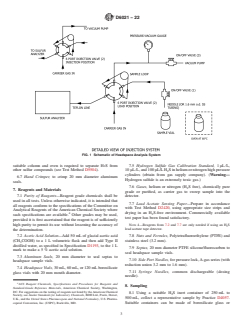
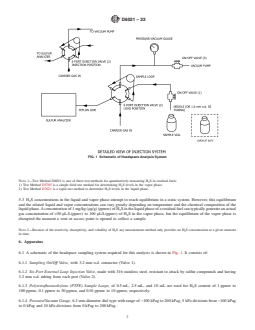
6.1 A schematic of the headspace sampling system required for this analysis is shown in Fig. 1. It consists of:
6.1.1 Sampling On/Off Valve, with 3.2 mm o.d. connector (Valve 1).
6.1.2 Six-Port External Loop Injection Valve, made with 316 stainless steel, resistant to attack by sulfur compounds and having
3.2 mm o.d. tubing from each port (Valve 2).
6.1.3 Polytetrafluoroethylene (PTFE) Sample Loops, of 0.5 mL, 2.5 mL, and 10 mL are used for H S content of 1 ppmw to
100 ppmw, 0.1 ppmw to 50 ppmw, and 0.01 ppmw to 10 ppmw, respectively.
6.1.4 Pressure/Vacuum Gauge, 6.3 mm diameter dial type with range of −100 kPag to 200 kPag, 5 kPa divisions from −100 kPag
to 0 kPag and 10 kPa divisions from 0 kPag to 200 kPag.
D6021 − 22
6.1.5 Vacuum On/Off Valve, 3.2 mm o.d. connector (Valve 3).
6.1.6 Sulfur Selective Detector, any H S specific detector capable of measuring H S in the gas from 1 ppmv to 10 000 ppmv with
2 2
a repeatability of 62 % of full scale.
NOTE 3—Good performance has been obtained with a lead acetate tape detector and a sulfur chemiluminescence detector.
6.1.7 Fluorocarbon Tubing, 0.6 m long by 3.2 mm o.d. to connect components together.
6.2 Vacuum pump, 3.2 mm o.d. outlet, capable of achieving a 0.2 kPa vacuum and with a capacity of 100 mL/min.
6.3 Headspace Oven, capable of operating at 60 °C 6 0.5 °C with internal dimensions of 30 cm by 30 cm by 30 cm. An optional
vent line is recommended in case a vial leaks.
6.4 Analytical Balance, sensitivity of 0.01 mg, maximum weight of 250 g.
6.5 Data Handling System, such as electronic integrator or any computer unit that can work with a chromatographic signal.
6.6 If sulfur specific detectors are used instead of an H S analyzer then a chromatographic system equipped with a suitable column
and oven is required to separate H S from other sulfur compounds (see Test Method D5504).
6.7 Hand Crimper, to crimp 20 mm diameter aluminum seals.
7. Reagents and Materials
7.1 Purity of Reagents—Reagent grade chemicals shall be used in all tests. Unless otherwise indicated, it is intended that all
reagents conform to the specifications of the Committee on Analytical Reagents of the American Chemical Society where such
specifications are available. Other grades may be used, provided it is first ascertained that the reagent is of sufficiently high purity
to permit its use without lessening the accuracy of the determination.
7.2 Acetic Acid Solution—Add 50 mL of glacial acetic acid (CH COOH) to a 1 L volumetric flask and then add Type II distilled
water, as specified in Specification D1193, to the 1 L mark to make a 5 % acetic acid solution.
7.3 Aluminum Seals, 20 mm diameter to seal septas to headspace sample vials.
7.4 Headspace Vials, 30 mL, 60 mL, or 120 mL borosilicate glass vials with 20 mm mouth diameter.
7.5 Hydrogen Sulfide Gas Calibration Standard, 1 μL ⁄L, 10 μL ⁄L, and 100 μL/L H S in helium or nitrogen high pressure cylinders
(obtain from gas supply company). (Warning—Hydrogen sulfide is an extremely toxic gas.)
7.6 Gases, helium or nitrogen (H S free), chemically pure grade or purified, as carrier gas to sweep sample into the detector.
7.7 Lead Acetate Sensing Paper—Prepare in accordance with Test Method D2420, using appropriate size strips and drying in an
H S-free environment. Commercially available test paper has been found satisfactory.
NOTE 4—Reagents from 7.2 and 7.7 are only needed if using an H S lead acetate tape detector.
7.8 Nuts and Ferrules, Polytetrafluoroethylene (PTFE) and stainless steel (3.2 mm).
Reagent Chemicals, American Chemical Society Specifications,ACS Reagent Chemicals, Specifications and Procedures for Reagents and Standard-Grade Reference
Materials, American Chemical Society, Washington, DC. For suggestions on the testing of reagents not listed by the American Chemical Society, see Analar Standards for
Laboratory Chemicals, BDH Ltd., Poole, Dorset, U.K., and the United States Pharmacopeia and National Formulary, U.S. Pharmacopeial Convention, Inc. (USPC),
Rockville, MD.
D6021 − 22
7.9 Septas, 20 mm diameter PTFE silicone/fluorocarbon to seal headspace sample vials.
7.10 Side Port Needles, for pressure lock, A-gas series (with reduction union 3.2 mm to 1.6 mm).
7.11 Syringe Needles, common dischargeable (dosing needle).
8. Sampling
8.1 Using a suitable H S inert container of 250 mL to 500 mL, collect a representative sample by Practice D4057. Suitable
containers can be made of borosilicate glass or aluminum. If the sample temperature is below 60 °C then a high density
polyethylene bottle can be used.
8.2 Fill the container completely to the top so that there is no headspace in the container. Cap immediately. (Warning— At no
time sho
...