

ASTM D7275-07(2018)
(Test Method)Standard Test Method for Tensile Properties of Bituminous Geomembranes (BGMs)
General Information
- Abstract
SIGNIFICANCE AND USE
4.1 This method is used to evaluate the tensile properties of BGMs. It can be used for manufacturing quality control or acceptance testing.
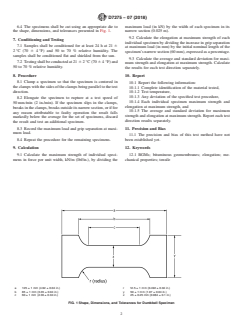
4.2 This test method uses a dumbbell specimen. The shape and dimensions of the specimen are defined in this standard. No other shape or dimensions are allowed. Other mechanical properties of BGMs may be measured using different test methods. Refer to Guide D6455.
4.3 The reported properties are the maximum strength and elongation at maximum strength.
SCOPE
1.1 This test method is used to measure the tensile properties of bituminous geomembranes (BGMs) using a dumbbell-shaped specimen.
1.2 The values stated in SI units are to be regarded as standard. The values given in parentheses are for information only.
1.3 This standard does not purport to address all of the safety concerns, if any, associated with its use. It is the responsibility of the user of this standard to establish appropriate safety, health, and environmental practices and determine the applicability of regulatory limitations prior to use.
1.4 This international standard was developed in accordance with internationally recognized principles on standardization established in the Decision on Principles for the Development of International Standards, Guides and Recommendations issued by the World Trade Organization Technical Barriers to Trade (TBT) Committee.
- Status
- Published
- Publication Date
- 31-Jan-2018
- Technical Committee
- D35 - Geosynthetics
- Drafting Committee
- D35.10 - Geomembranes


Overview
ASTM D7275-07(2018), Standard Test Method for Tensile Properties of Bituminous Geomembranes (BGMs), is an internationally recognized test method developed by ASTM International. This standard provides a systematic approach for measuring the tensile properties of bituminous geomembranes, commonly used as barriers in environmental, civil, and geotechnical engineering projects. Tensile property evaluation is a critical aspect of quality control and acceptance testing for BGMs, ensuring their proper performance in construction and containment applications.
Key Topics
Purpose and Scope:
- Evaluates the tensile properties of prefabricated bituminous geomembranes (BGMs).
- Applicable for both manufacturing quality control and acceptance testing.
- Utilizes a specific dumbbell-shaped specimen with defined shape and dimensions; no other shape is permitted.
- Focuses on reporting maximum tensile strength and elongation at maximum strength.
Testing Protocols:
- Tests conducted at controlled temperature and relative humidity to ensure repeatability.
- Specimen preparation, including sampling parallel to both the machine and cross-machine directions.
- Use of standardized grips and clamping methods to avoid sample damage and ensure accuracy.
Safety Precautions:
- The standard emphasizes the responsibility of users to establish proper safety, health, and environmental protocols.
- Regulatory considerations must be addressed before using the test method.
Reporting Requirements:
- Detailed documentation of material identification, test conditions, specimen results, and any deviations from test procedures.
- Separate reporting for different test directions to capture comprehensive data.
Applications
Testing the tensile properties of bituminous geomembranes as outlined in ASTM D7275-07(2018) offers important benefits across multiple domains:
Quality Control in Manufacturing:
Regular testing helps manufacturers verify that BGMs meet project specifications and perform as expected under tensile stress.Construction and Engineering Projects:
Engineers and contractors rely on tensile property data for material selection, ensuring that BGMs provide reliable containment and barrier functions in landfills, reservoirs, canals, and various foundation systems.Acceptance Testing:
Project owners and stakeholders can assess delivered BGMs for compliance with contractual requirements before installation, minimizing the risk of material failure.Research and Development:
Research teams in material science and geotechnical engineering use this standardized method to compare the performance of different bituminous geomembrane formulations and improve product designs.
Related Standards
ASTM D7275-07(2018) references and complements several related ASTM standards, enhancing its utility in the broader context of geosynthetic and geomembrane testing:
- ASTM D638:
Test Method for Tensile Properties of Plastics - supplies guidelines for tensile instrumentation and procedures. - ASTM D4354:
Practice for Sampling of Geosynthetics and Rolled Erosion Control Products (RECPs) for Testing - ensures representative sampling for accurate testing outcomes. - ASTM D4439:
Terminology for Geosynthetics - provides definitions and terminology for clarity throughout the industry. - ASTM D6455:
Guide for the Selection of Test Methods for Prefabricated Bituminous Geomembranes (PBGMs) - assists in identifying appropriate test methods for BGMs’ mechanical properties.
Summary
ASTM D7275-07(2018) serves as a fundamental standard for the tensile testing of bituminous geomembranes, supporting quality control, durability assessment, and compliance verification in a range of engineering applications. By adhering to this standard, manufacturers and end-users can ensure BGMs meet stringent performance criteria, enhancing reliability and long-term project success. For comprehensive geosynthetics testing, refer to this and related ASTM standards to maintain best practices in material evaluation.
Relations
- Replaces
ASTM D7275-07(2012) - Standard Test Method for Tensile Properties of Bituminous Geomembranes (BGM) - Effective Date
- 01-Feb-2018
- Effective Date
- 01-Feb-2024
- Effective Date
- 01-May-2020
- Effective Date
- 15-Apr-2018
- Effective Date
- 01-Feb-2018
- Effective Date
- 01-Aug-2017
- Effective Date
- 01-Sep-2015
- Effective Date
- 01-Jul-2015
- Effective Date
- 01-Mar-2014
- Effective Date
- 01-Jul-2012
- Effective Date
- 01-Oct-2011
- Effective Date
- 01-Feb-2011
- Effective Date
- 15-May-2010
- Effective Date
- 15-Jan-2009
- Effective Date
- 01-Jun-2005
Get Certified
Connect with accredited certification bodies for this standard

Control Union Certifications
Global certification for agriculture and sustainability.

Hohenstein Institut
Textile testing and certification.

Bureau Veritas Bangladesh
Bureau Veritas certification services in Bangladesh.
Sponsored listings
Frequently Asked Questions
ASTM D7275-07(2018) is a standard published by ASTM International. Its full title is "Standard Test Method for Tensile Properties of Bituminous Geomembranes (BGMs)". This standard covers: SIGNIFICANCE AND USE 4.1 This method is used to evaluate the tensile properties of BGMs. It can be used for manufacturing quality control or acceptance testing. 4.2 This test method uses a dumbbell specimen. The shape and dimensions of the specimen are defined in this standard. No other shape or dimensions are allowed. Other mechanical properties of BGMs may be measured using different test methods. Refer to Guide D6455. 4.3 The reported properties are the maximum strength and elongation at maximum strength. SCOPE 1.1 This test method is used to measure the tensile properties of bituminous geomembranes (BGMs) using a dumbbell-shaped specimen. 1.2 The values stated in SI units are to be regarded as standard. The values given in parentheses are for information only. 1.3 This standard does not purport to address all of the safety concerns, if any, associated with its use. It is the responsibility of the user of this standard to establish appropriate safety, health, and environmental practices and determine the applicability of regulatory limitations prior to use. 1.4 This international standard was developed in accordance with internationally recognized principles on standardization established in the Decision on Principles for the Development of International Standards, Guides and Recommendations issued by the World Trade Organization Technical Barriers to Trade (TBT) Committee.
SIGNIFICANCE AND USE 4.1 This method is used to evaluate the tensile properties of BGMs. It can be used for manufacturing quality control or acceptance testing. 4.2 This test method uses a dumbbell specimen. The shape and dimensions of the specimen are defined in this standard. No other shape or dimensions are allowed. Other mechanical properties of BGMs may be measured using different test methods. Refer to Guide D6455. 4.3 The reported properties are the maximum strength and elongation at maximum strength. SCOPE 1.1 This test method is used to measure the tensile properties of bituminous geomembranes (BGMs) using a dumbbell-shaped specimen. 1.2 The values stated in SI units are to be regarded as standard. The values given in parentheses are for information only. 1.3 This standard does not purport to address all of the safety concerns, if any, associated with its use. It is the responsibility of the user of this standard to establish appropriate safety, health, and environmental practices and determine the applicability of regulatory limitations prior to use. 1.4 This international standard was developed in accordance with internationally recognized principles on standardization established in the Decision on Principles for the Development of International Standards, Guides and Recommendations issued by the World Trade Organization Technical Barriers to Trade (TBT) Committee.
ASTM D7275-07(2018) is classified under the following ICS (International Classification for Standards) categories: 59.080.70 - Geotextiles. The ICS classification helps identify the subject area and facilitates finding related standards.
ASTM D7275-07(2018) has the following relationships with other standards: It is inter standard links to ASTM D7275-07(2012), ASTM D4439-24, ASTM D4354-12(2020), ASTM D4439-18, ASTM D6455-11(2018), ASTM D4439-17, ASTM D4439-15a, ASTM D4439-15, ASTM D4439-14, ASTM D4354-12, ASTM D4439-11, ASTM D6455-11, ASTM D638-10, ASTM D4354-99(2009), ASTM D6455-05. Understanding these relationships helps ensure you are using the most current and applicable version of the standard.
ASTM D7275-07(2018) is available in PDF format for immediate download after purchase. The document can be added to your cart and obtained through the secure checkout process. Digital delivery ensures instant access to the complete standard document.
Standards Content (Sample)
This international standard was developed in accordance with internationally recognized principles on standardization established in the Decision on Principles for the
Development of International Standards, Guides and Recommendations issued by the World Trade Organization Technical Barriers to Trade (TBT) Committee.
Designation: D7275 − 07 (Reapproved 2018)
Standard Test Method for
Tensile Properties of Bituminous Geomembranes (BGMs)
This standard is issued under the fixed designation D7275; the number immediately following the designation indicates the year of
original adoption or, in the case of revision, the year of last revision. A number in parentheses indicates the year of last reapproval. A
superscript epsilon (´) indicates an editorial change since the last revision or reapproval.
1. Scope 3.2 For definitions of other terms used in this test method,
refer to Terminology D4439.
1.1 This test method is used to measure the tensile proper-
ties of bituminous geomembranes (BGMs) using a dumbbell-
4. Significance and Use
shaped specimen.
4.1 This method is used to evaluate the tensile properties of
1.2 The values stated in SI units are to be regarded as
BGMs. It can be used for manufacturing quality control or
standard. The values given in parentheses are for information
acceptance testing.
only.
4.2 This test method uses a dumbbell specimen. The shape
1.3 This standard does not purport to address all of the
and dimensions of the specimen are defined in this standard.
safety concerns, if any, associated with its use. It is the
No other shape or dimensions are allowed. Other mechanical
responsibility of the user of this standard to establish appro-
properties of BGMs may be measured using different test
priate safety, health, and environmental practices and deter-
methods. Refer to Guide D6455.
mine the applicability of regulatory limitations prior to use.
1.4 This international standard was developed in accor-
4.3 The reported properties are the maximum strength and
dance with internationally recognized principles on standard-
elongation at maximum strength.
ization established in the Decision on Principles for the
Development of International Standards, Guides and Recom-
5. Apparatus
mendations issued by the World Trade Organization Technical
5.1 Tensile instrumentation shall meet the requirements
Barriers to Trade (TBT) Committee.
outlined in Test Method D638.
2. Referenced Documents
5.2 Grips—One of the grips must be self-aligning to com-
pensate for uneven distribution of force across the specimen.
2.1 ASTM Standards:
The clamping force and the clamp surfaces shall hold the
D638 Test Method for Tensile Properties of Plastics
specimen firmly without causing damage.
D4354 Practice for Sampling of Geosynthetics and Rolled
Erosion Control Products (RECPs) for Testing
5.3 Grip Faces—Grip faces shall be a minimum of 50 mm
D4439 Terminology for Geosynthetics
(2 in.) wide and a minimum of 50 mm (2 in.) in length. Smooth
D6455 Guide for the Selection of Test Methods for Prefab-
rubber, fine serrated, or coarse serrated grip faces have all been
ricated Bituminous Geomembranes (PBGMs)
found to be suitable for testing BGMs. If needed, the use of a
silicone-coated paper to help holding the specimen ends into
3. Terminology
the grips is recommended. The silicone-coated side is to be
3.1 Definitions of Terms Specific to This Standard:
used in contact with the specimen.
3.1.1 prefabricated bituminous geomembrane (BGM), n—a
material fabricated in a plant and consisting principally of
6. Sampling and Test Specimens
nonwoven geotextile, impregnated by a blend of oxidized or
6.1 Sampling shall be conducted according to Practice
polymer-modified bitumen incorporating filler.
D4354.
6.2 Take a sample that will exclude material from the outer
This test method is under the jurisdiction of ASTM Committee D35 on
wrap of the roll or the inner wrap around the core. In the case
Geosynthetics and is the direct responsibility of Subcommittee D35.10 on Geomem-
branes.
where the sample is taken at the production site, material from
Current edition approved Feb. 1, 2018. Published February 2018. Originally
the outer wrap may be used if it is undamaged.
approved in 2006. Last previous edition approved in 2012 as D7275 – 07 (2012).
DOI: 10.1520/D7275-07R18.
6.3 Test Specimens—Prepare five specimens with the length
For referenced ASTM standards, visit the ASTM website, www.astm.org, or
ofthespecimenparalleltothemachinedirection(MD)andfive
contact ASTM Customer S
...