

ASTM F2753-21
(Practice)Standard Practice to Evaluate the Effect of Dynamic Rolling Load over Resilient Floor Covering System
General Information
- Abstract
SIGNIFICANCE AND USE
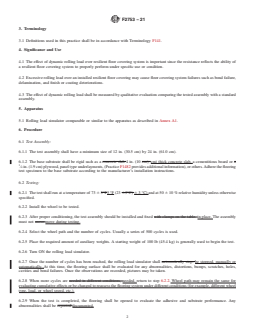
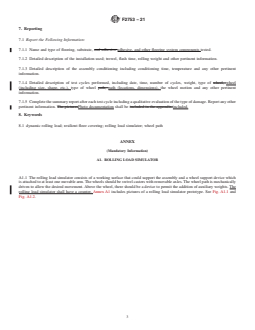
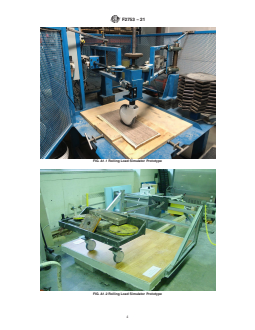
4.1 The effect of dynamic rolling load over resilient floor covering system is important since the resistance reflects the ability of a resilient floor covering system to properly perform under specific use or condition.
4.2 Excessive rolling load over an installed resilient floor covering may cause floor covering system failures such as bond failure, delamination, and finish or coating deteriorations.
4.3 The effect of dynamic rolling load shall be measured by qualitative evaluation comparing the tested assembly with a standard assembly.
SCOPE
1.1 This practice covers the determination of the effect of dynamic rolling load over a resilient floor covering.
1.2 This practice is intended to be used by resilient, adhesive and underlayment manufacturers to measure the impact of a dynamic rolling load over a specific product or a combination of products.
1.3 This practice may be used to evaluate the performance of joints (sealed or welded) in the resilient floor covering.
1.4 This practice may be used to aid in the diagnosis of a specific assembly performance and provide comparative evaluation.
1.5 The values stated in inch-pound units are to be regarded as standard. The values given in parentheses are mathematical conversions to SI units that are provided for information only and are not considered standard.
1.6 This standard does not purport to address all of the safety concerns, if any, associated with its use. It is the responsibility of the user of this standard to establish appropriate safety, health, and environmental practices and determine the applicability of regulatory limitations prior to use.
1.7 This international standard was developed in accordance with internationally recognized principles on standardization established in the Decision on Principles for the Development of International Standards, Guides and Recommendations issued by the World Trade Organization Technical Barriers to Trade (TBT) Committee.
- Status
- Published
- Publication Date
- 31-Jul-2021
- Technical Committee
- F06 - Resilient Floor Coverings
- Drafting Committee
- F06.40 - Practices
Buy Documents

ASTM F2753-21 - Standard Practice to Evaluate the Effect of Dynamic Rolling Load over Resilient Floor Covering System
REDLINE ASTM F2753-21 - Standard Practice to Evaluate the Effect of Dynamic Rolling Load over Resilient Floor Covering System
Overview
ASTM F2753-21 is the Standard Practice to Evaluate the Effect of Dynamic Rolling Load over Resilient Floor Covering System, published by ASTM International. This standard outlines procedures for assessing how resilient floor coverings perform under dynamic rolling loads, such as those created by carts, wheelchairs, or machinery. The primary focus is to determine the ability of a floor covering system-comprising the floor material, adhesives, and underlayment-to withstand repeated rolling without failure or excessive deterioration.
Dynamic rolling loads are a key factor in real-world environments where resilient flooring is used, including healthcare, commercial, and industrial settings. The outcomes of evaluation using this standard help manufacturers, specifiers, and end users select products that meet performance requirements and avoid issues such as bond failure, delamination, or surface damage.
Key Topics
- Dynamic Rolling Load Testing: The core topic is the qualitative assessment of resilient floor coverings’ resistance to damage when subjected to rolling loads. The method compares a test assembly to a standard or reference assembly.
- Flooring System Performance: The practice addresses the entire system: resilient flooring, adhesives, underlayments, and the performance of sealed or welded joints.
- Failure Detection: Potential issues identified by this method include bond failure, delamination, and surface finish or coating deterioration.
- Test Method Consistency: The standard prescribes control over test conditions (temperature, humidity, test assembly size, wheel characteristics, load, and number of cycles), ensuring reliable and reproducible results.
- Safety and Units: Guidance is provided regarding safety practices in testing and the use of inch-pound units as the default, with SI units for reference.
Applications
ASTM F2753-21 is widely applicable for:
- Manufacturers of Resilient Flooring, Adhesives, and Underlayments: Enables testing and validation of new products or product combinations, ensuring they meet durability requirements under repeated rolling loads.
- Quality Control and Product Development: Supports comparison of various assemblies and diagnoses of performance problems in existing installations.
- Performance Evaluation of Joints: Evaluates the integrity of sealed or welded joints in products subjected to rolling stresses.
- Specification and Purchasing: Assists architects, facility managers, and purchasers in choosing flooring systems suited to environments with expected rolling traffic, reducing long-term maintenance and failure risks.
- Comparative Evaluation: Allows stakeholders to benchmark different flooring assemblies under identical test conditions, providing performance data for product selection or improvement.
Related Standards
- ASTM F141 - Terminology Relating to Resilient Floor Coverings: Provides the essential definitions for terms used within ASTM F2753-21.
- ASTM F1482 - Practice for Installation and Preparation of Panel Type Underlayments to Receive Resilient Flooring: Offers detailed installation guidelines relevant to preparing test assemblies.
- Other Standards: The principles align with internationally recognized standardization guidelines set by the World Trade Organization Technical Barriers to Trade (TBT) Committee.
Practical Value
Implementing ASTM F2753-21 enhances the reliability and durability of resilient flooring installations in environments that experience frequent rolling loads. By adhering to standardized testing methods, manufacturers and end users minimize the risks of flooring failures, optimize material choices, and extend the lifespan of resilient floor systems.
Keywords: dynamic rolling load, resilient floor covering, floor covering performance, rolling load simulator, ASTM F2753-21, flooring system testing, commercial flooring standards, bonding failure, delamination, surface deterioration, floor system evaluation
Relations
- Effective Date
- 01-Aug-2023
- Effective Date
- 15-Jan-2020
- Effective Date
- 01-Mar-2012
- Effective Date
- 01-Dec-2011
- Effective Date
- 01-May-2009
- Effective Date
- 01-Dec-2008
- Effective Date
- 01-Nov-2008
- Effective Date
- 01-Nov-2004
- Effective Date
- 01-Mar-2004
- Effective Date
- 10-Jun-2003
- Effective Date
- 10-Feb-2003
- Effective Date
- 10-Aug-2001
- Effective Date
- 10-Aug-2001
- Effective Date
- 10-Aug-2001
- Effective Date
- 10-Aug-2001
Buy Documents
ASTM F2753-21 - Standard Practice to Evaluate the Effect of Dynamic Rolling Load over Resilient Floor Covering System
REDLINE ASTM F2753-21 - Standard Practice to Evaluate the Effect of Dynamic Rolling Load over Resilient Floor Covering System
Frequently Asked Questions
ASTM F2753-21 is a standard published by ASTM International. Its full title is "Standard Practice to Evaluate the Effect of Dynamic Rolling Load over Resilient Floor Covering System". This standard covers: SIGNIFICANCE AND USE 4.1 The effect of dynamic rolling load over resilient floor covering system is important since the resistance reflects the ability of a resilient floor covering system to properly perform under specific use or condition. 4.2 Excessive rolling load over an installed resilient floor covering may cause floor covering system failures such as bond failure, delamination, and finish or coating deteriorations. 4.3 The effect of dynamic rolling load shall be measured by qualitative evaluation comparing the tested assembly with a standard assembly. SCOPE 1.1 This practice covers the determination of the effect of dynamic rolling load over a resilient floor covering. 1.2 This practice is intended to be used by resilient, adhesive and underlayment manufacturers to measure the impact of a dynamic rolling load over a specific product or a combination of products. 1.3 This practice may be used to evaluate the performance of joints (sealed or welded) in the resilient floor covering. 1.4 This practice may be used to aid in the diagnosis of a specific assembly performance and provide comparative evaluation. 1.5 The values stated in inch-pound units are to be regarded as standard. The values given in parentheses are mathematical conversions to SI units that are provided for information only and are not considered standard. 1.6 This standard does not purport to address all of the safety concerns, if any, associated with its use. It is the responsibility of the user of this standard to establish appropriate safety, health, and environmental practices and determine the applicability of regulatory limitations prior to use. 1.7 This international standard was developed in accordance with internationally recognized principles on standardization established in the Decision on Principles for the Development of International Standards, Guides and Recommendations issued by the World Trade Organization Technical Barriers to Trade (TBT) Committee.
SIGNIFICANCE AND USE 4.1 The effect of dynamic rolling load over resilient floor covering system is important since the resistance reflects the ability of a resilient floor covering system to properly perform under specific use or condition. 4.2 Excessive rolling load over an installed resilient floor covering may cause floor covering system failures such as bond failure, delamination, and finish or coating deteriorations. 4.3 The effect of dynamic rolling load shall be measured by qualitative evaluation comparing the tested assembly with a standard assembly. SCOPE 1.1 This practice covers the determination of the effect of dynamic rolling load over a resilient floor covering. 1.2 This practice is intended to be used by resilient, adhesive and underlayment manufacturers to measure the impact of a dynamic rolling load over a specific product or a combination of products. 1.3 This practice may be used to evaluate the performance of joints (sealed or welded) in the resilient floor covering. 1.4 This practice may be used to aid in the diagnosis of a specific assembly performance and provide comparative evaluation. 1.5 The values stated in inch-pound units are to be regarded as standard. The values given in parentheses are mathematical conversions to SI units that are provided for information only and are not considered standard. 1.6 This standard does not purport to address all of the safety concerns, if any, associated with its use. It is the responsibility of the user of this standard to establish appropriate safety, health, and environmental practices and determine the applicability of regulatory limitations prior to use. 1.7 This international standard was developed in accordance with internationally recognized principles on standardization established in the Decision on Principles for the Development of International Standards, Guides and Recommendations issued by the World Trade Organization Technical Barriers to Trade (TBT) Committee.
ASTM F2753-21 is classified under the following ICS (International Classification for Standards) categories: 97.150 - Floor coverings. The ICS classification helps identify the subject area and facilitates finding related standards.
ASTM F2753-21 has the following relationships with other standards: It is inter standard links to ASTM F141-23, ASTM F141-12(2020), ASTM F141-12, ASTM F141-11, ASTM F1482-04(2009)e1, ASTM F141-08a, ASTM F141-08, ASTM F141-04, ASTM F1482-04, ASTM F141-03, ASTM F1482-03, ASTM F141-00B, ASTM F141-01, ASTM F141-01a, ASTM F141-00A. Understanding these relationships helps ensure you are using the most current and applicable version of the standard.
ASTM F2753-21 is available in PDF format for immediate download after purchase. The document can be added to your cart and obtained through the secure checkout process. Digital delivery ensures instant access to the complete standard document.
Standards Content (Sample)
This international standard was developed in accordance with internationally recognized principles on standardization established in the Decision on Principles for the
Development of International Standards, Guides and Recommendations issued by the World Trade Organization Technical Barriers to Trade (TBT) Committee.
Designation: F2753 − 21
Standard Practice to
Evaluate the Effect of Dynamic Rolling Load over Resilient
Floor Covering System
This standard is issued under the fixed designation F2753; the number immediately following the designation indicates the year of
original adoption or, in the case of revision, the year of last revision. A number in parentheses indicates the year of last reapproval. A
superscript epsilon (´) indicates an editorial change since the last revision or reapproval.
1. Scope F1482 Practice for Installation and Preparation of Panel
Type Underlayments to Receive Resilient Flooring
1.1 This practice covers the determination of the effect of
dynamic rolling load over a resilient floor covering.
3. Terminology
1.2 This practice is intended to be used by resilient, adhe-
3.1 Definitions used in this practice shall be in accordance
sive and underlayment manufacturers to measure the impact of
with Terminology F141.
a dynamic rolling load over a specific product or a combination
of products.
4. Significance and Use
1.3 This practice may be used to evaluate the performance
4.1 The effect of dynamic rolling load over resilient floor
of joints (sealed or welded) in the resilient floor covering.
covering system is important since the resistance reflects the
1.4 This practice may be used to aid in the diagnosis of a
ability of a resilient floor covering system to properly perform
specific assembly performance and provide comparative evalu- under specific use or condition.
ation.
4.2 Excessive rolling load over an installed resilient floor
1.5 The values stated in inch-pound units are to be regarded covering may cause floor covering system failures such as
as standard. The values given in parentheses are mathematical
bond failure, delamination, and finish or coating deteriorations.
conversions to SI units that are provided for information only
4.3 The effect of dynamic rolling load shall be measured by
and are not considered standard.
qualitative evaluation comparing the tested assembly with a
1.6 This standard does not purport to address all of the
standard assembly.
safety concerns, if any, associated with its use. It is the
responsibility of the user of this standard to establish appro- 5. Apparatus
priate safety, health, and environmental practices and deter-
5.1 Rolling load simulator comparable or similar to the
mine the applicability of regulatory limitations prior to use.
apparatus as described in Annex A1.
1.7 This international standard was developed in accor-
dance with internationally recognized principles on standard-
6. Procedure
ization established in the Decision on Principles for the
6.1 Test Assembly:
Development of International Standards, Guides and Recom-
6.1.1 The test assembly shall have a minimum size of 12 in.
mendations issued by the World Trade Organization Technical
(30.5 cm) by 24 in. (61.0 cm).
Barriers to Trade (TBT) Committee.
6.1.2 The base substrate shall be rigid such as a 4 in. (10
cm) thick concrete slab, a cementitious board or ⁄4 in. (1.9 cm)
2. Referenced Documents
plywood, panel type underlayments, (Practice F1482 provides
2.1 ASTM Standards:
additional information), or others. Adhere the flooring test
F141 Terminology Relating to Resilient Floor Coverings
specimen to the base substrate according to the manufacturer’s
installation instructions.
This practice is under the jurisdiction of ASTM Committee F06 on Resilient
6.2 Testing:
Floor Coverings and is the direct responsibility of Subcommittee F06.40 on
6.2.1 The test shall run at a temperature of 73 6 5 °F (23 6
Practices.
3 °C) and at 50 6 10 % relative humidity unless otherwise
Current edition approved Aug. 1, 2021. Published September 2021. Originally
specified.
approved in 2010. Last previous edition approved in 2015 as F2573-10 (2015). DOI.
10.1520/F2753–21.
6.2.2 Install the wheel to be tested.
For referenced ASTM standards, visit the ASTM website, www.astm.org, or
6.2.3 After proper conditioning, the test assembly should be
contact ASTM Customer Service at service@astm.org. For Annual Book of ASTM
installed and fixed in place. The assembly must not move
Standards volume information, refer to the standard’s Document Summary page on
th
...
This document is not an ASTM standard and is intended only to provide the user of an ASTM standard an indication of what changes have been made to the previous version. Because
it may not be technically possible to adequately depict all changes accurately, ASTM recommends that users consult prior editions as appropriate. In all cases only the current version
of the standard as published by ASTM is to be considered the official document.
Designation: F2753 − 10 (Reapproved 2015) F2753 − 21
Standard Practice to
Evaluate the Effect of Dynamic Rolling Load over Resilient
Floor Covering System
This standard is issued under the fixed designation F2753; the number immediately following the designation indicates the year of
original adoption or, in the case of revision, the year of last revision. A number in parentheses indicates the year of last reapproval. A
superscript epsilon (´) indicates an editorial change since the last revision or reapproval.
1. Scope
1.1 This practice covers the determination of the effect of dynamic rolling load over a resilient floor covering.
1.2 This practice is intended to be used by resilient, adhesive and underlayment manufacturers to measure the impact of a dynamic
rolling load over a specific product or a combination of products.
1.3 This practice may be used to evaluate the performance of joints (sealed or welded) in the resilient floor covering.
1.4 This practice may be used to aid in the diagnosis of a specific assembly performance and provide comparative evaluation.
1.5 The values stated in inch-pound units are to be regarded as standard. The values given in parentheses are mathematical
conversions to SI units that are provided for information only and are not considered standard.
1.6 This standard does not purport to address all of the safety concerns, if any, associated with its use. It is the responsibility of
the user of this standard to establish appropriate safety and health practices and determine the applicability of regulatory
limitations prior to use.
1.6 This standard does not purport to address all of the safety concerns, if any, associated with its use. It is the responsibility
of the user of this standard to establish appropriate safety, health, and environmental practices and determine the applicability of
regulatory limitations prior to use.
1.7 This international standard was developed in accordance with internationally recognized principles on standardization
established in the Decision on Principles for the Development of International Standards, Guides and Recommendations issued
by the World Trade Organization Technical Barriers to Trade (TBT) Committee.
2. Referenced Documents
2.1 ASTM Standards:
F141 Terminology Relating to Resilient Floor Coverings
F1482 Practice for Installation and Preparation of Panel Type Underlayments to Receive Resilient Flooring
This practice is under the jurisdiction of ASTM Committee F06 on Resilient Floor Coverings and is the direct responsibility of Subcommittee F06.40 on Practices.
Current edition approved May 1, 2015Aug. 1, 2021. Published July 2015September 2021. Originally approved in 2010. Last previous edition approved in 20102015 as
F2573-10. F2573-10 (2015). DOI. 10.1520/F2753–10R15.10.1520/F2753–21.
For referenced ASTM standards, visit the ASTM website, www.astm.org, or contact ASTM Customer Service at service@astm.org. For Annual Book of ASTM Standards
volume information, refer to the standard’s Document Summary page on the ASTM website.
Copyright © ASTM International, 100 Barr Harbor Drive, PO Box C700, West Conshohocken, PA 19428-2959. United States
F2753 − 21
3. Terminology
3.1 Definitions used in this practice shall be in accordance with Terminology F141.
4. Significance and Use
4.1 The effect of dynamic rolling load over resilient floor covering system is important since the resistance reflects the ability of
a resilient floor covering system to properly perform under specific use or condition.
4.2 Excessive rolling load over an installed resilient floor covering may cause floor covering system failures such as bond failure,
delamination, and finish or coating deteriorations.
4.3 The effect of dynamic rolling load shall be measured by qualitative evaluation comparing the tested assembly with a standard
assembly.
5. Apparatus
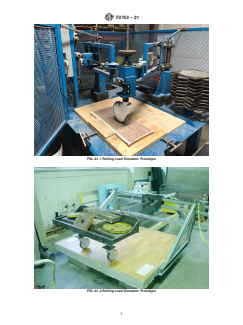
5.1 Rolling load simulator comparable or similar to the apparatus as described in Annex A1.
6. Procedure
6.1 Test Assembly:
6.1.1 The test assembly shall have a minimum size of 12 in. (30.5 cm) by 24 in. (61.0 cm).
6.1.2 The base substrate shall be rigid such as a concrete slab 4 in. (10 cm), cm) thick concrete slab, a cementitious board or a
⁄4 in. (1.9 cm) plywood, panel type underlayments, (Practice F1482 provides additional information), or others. Adhere the flooring
test specimen to the base substrate according to the manufacturer’s
...