

ASTM E1848-20
(Guide)Standard Guide for Selecting and Using Ecological Endpoints for Contaminated Sites
General Information
- Abstract
ABSTRACT
This guide deals with an approach to identification, selection, and use of ecological endpoints (both assessment and measurement endpoints) that are susceptible to the direct and indirect effects of both chemical and non-chemical stressors and agents associated with wastes and contaminated media at specific sites under current and future land uses. It does not address assessment and measurement endpoints for non-site specific studies (for example, chemical specific or regional risk assessments) or measurements in abiotic media (soil, water, or air). Conditions of the site and risk assessment that should be considered in identifying and selecting assessment and measurement endpoints include stressor characteristics, ecosystem types, spatial scale, temporal scale, ecological organization, and functionality/values. The following subsections present a partial listing of representative measurement endpoints: measurement endpoints representing ecosystem assessment endpoints, measurement endpoints representing community assessment endpoints, measurement endpoints representing population assessment endpoints, and measurement endpoints representing individual organism assessment endpoints. Other general considerations, desirable characteristics of assessment and measurement endpoints, candidate site-related ecological receptors, candidate assessment endpoints, specific steps in identifying, selecting and using assessment and measurement endpoints, addressing uncertainties in the identification and selection of assessment and measurement endpoints, documenting the selection of assessment and measurement endpoints.
SIGNIFICANCE AND USE
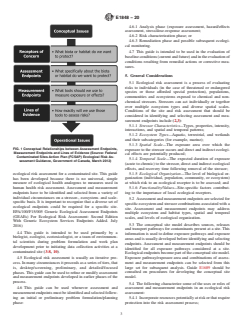
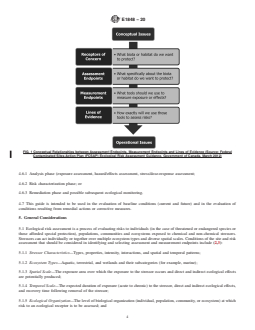
4.1 This guide assumes that a decision has been made that an ecological risk assessment is required for a contaminated site. In some cases, this decision could be made before any site data are collected. See Fig. 1.
FIG. 1 Conceptual Relationships between Assessment Endpoints, Measurement Endpoints and Lines of Evidence (Source: Federal Contaminated Sites Action Plan (FCSAP) Ecological Risk Assessment Guidance, Government of Canada, March 2012)
4.2 The selection of assessment endpoints (defined as ecological values to be protected) and measurement endpoints (ecological characteristics related to the assessment endpoints) is a critical step in conducting an ecological risk assessment. Endpoint selection identifies those effects which are ecologically significant and not merely those that are adverse, thus providing a more rational and defensible basis for making risk and remedial decisions.
4.3 This guide provides an approach for identifying, selecting and using assessment and measurement endpoints in an ecological risk assessment for a contaminated site. This guide has been developed because there is no universal, simple measure of ecological health analogous to measures used in human health risk assessment. Assessment and measurement endpoints have to be identified and selected from a variety of individual circumstances on a stressor-, ecosystem- and scale-specific basis. It is important to recognize that a diverse set of ecological endpoints could be required for a specific site. EPA/100/F15/005 Generic Ecological Assessment Endpoints (GEAEs) For Ecological Risk Assessment: Second Edition With Generic Ecosystem Services Endpoints Added. July 2016)
4.4 This guide is intended to be used primarily by a biologist, ecologist, ecotoxicologist, or a team of environmental scientists during problem formulation and work plan development prior to initiating data collection activities at a contaminated site (3-8, 10).
4.5 Ecological risk assessment is usually an...
SCOPE
1.1 This guide covers an approach to identification, selection, and use of ecological endpoints (both assessment and measurement endpoints) (1-8)2 that are susceptible to the direct and indirect effects of both chemical and non-chemical stressors or agents associated with wastes and contaminated media at spe...
- Status
- Published
- Publication Date
- 31-Oct-2020
- Technical Committee
- E50 - Environmental Assessment, Risk Management and Corrective Action
- Drafting Committee
- E50.04 - Corrective Action
Buy Documents
ASTM E1848-20 - Standard Guide for Selecting and Using Ecological Endpoints for Contaminated Sites
REDLINE ASTM E1848-20 - Standard Guide for Selecting and Using Ecological Endpoints for Contaminated Sites
Overview
ASTM E1848-20 – Standard Guide for Selecting and Using Ecological Endpoints for Contaminated Sites provides best practices for identifying, selecting, and applying ecological endpoints during ecological risk assessments at contaminated sites. Developed by ASTM International, this guide helps environmental professionals choose appropriate assessment and measurement endpoints to evaluate the ecological impacts of chemical and non-chemical stressors related to wastes and contaminated media, factoring in current and future land uses. The standard is designed for biologists, ecologists, ecotoxicologists, and other environmental scientists engaged in work plan development and problem formulation prior to data collection at contaminated locations.
Key Topics
Ecological Endpoints: Focuses on both assessment endpoints (ecological values to be protected) and measurement endpoints (quantifiable ecological characteristics related to assessment endpoints).
Types of Stressors: Addresses endpoints affected by chemical (e.g., contaminants, radionuclides) and non-chemical (e.g., physical disturbance, invasive species) site stressors.
Site-specific Approach: Endpoints are selected based on factors such as stressor characteristics, ecosystem type, spatial and temporal scale, ecological organization, and receptor functionality/values.
Levels of Biological Organization:
- Individual organisms (e.g., physiological changes, growth, reproduction)
- Populations (e.g., abundance, reproductive success)
- Communities (e.g., species diversity, food web structure)
- Ecosystems (e.g., productivity, nutrient cycling)
General Considerations for Endpoint Selection:
- Relevance to decision-making and to the site’s ecosystems
- Potential for adverse effects from contaminants or stressors
- Alignment with exposure pathways and conceptual site models
- Suitability for hypothesis formulation and measurement
- Clear definition and measurability
Uncertainty Management: The guide discusses how to identify and address uncertainties in endpoint selection, such as gaps in data, extrapolation limitations, and natural variability.
Applications
ASTM E1848-20 is used to establish robust foundations for ecological risk assessments at contaminated sites, supporting more rational and defensible decision-making regarding site remediation and risk management. Practical applications include:
- Problem Formulation: Lays out clear ecological objectives and hypotheses for the risk assessment relating to site stressors and receptors.
- Endpoint Selection: Enables practitioners to choose relevant and scientifically defensible endpoints for a given site, which serve as the focus for subsequent field and laboratory studies.
- Work Plan Development: Guides the integration of selected endpoints into assessment work plans, suitable for regulatory and stakeholder review.
- Remediation and Monitoring: Provides a framework for establishing baseline and post-remediation conditions, measuring recovery and assessing the efficacy of remedial actions.
- Risk Communication: Facilitates transparent dialogues among risk assessors, managers, stakeholders, and the public by clearly documenting endpoint choices and their rationale.
Related Standards
ASTM E1848-20 works in conjunction with other key environmental standards and guidance documents, such as:
- ASTM E943: Terminology Relating to Biological Effects and Environmental Fate
- ASTM E1689: Guide for Developing Conceptual Site Models for Contaminated Sites
- EPA/100/F15/005: Generic Ecological Assessment Endpoints (GEAEs) for Ecological Risk Assessment
- Federal Contaminated Sites Action Plan (FCSAP) Guidance: Provides conceptual frameworks supporting endpoint selection and use
These standards together enhance the accuracy, transparency, and scientific validity of ecological risk assessments at contaminated sites.
Keywords: ecological endpoints, ecological risk assessment, contaminated sites, assessment endpoint, measurement endpoint, ASTM E1848-20, site remediation, environmental standard.
Relations
- Effective Date
- 01-Mar-2008
- Refers
ASTM E1689-95(2008) - Standard Guide for Developing Conceptual Site Models for Contaminated Sites - Effective Date
- 01-Feb-2008
Buy Documents
ASTM E1848-20 - Standard Guide for Selecting and Using Ecological Endpoints for Contaminated Sites
REDLINE ASTM E1848-20 - Standard Guide for Selecting and Using Ecological Endpoints for Contaminated Sites
Get Certified
Connect with accredited certification bodies for this standard

BSI Group
BSI (British Standards Institution) is the business standards company that helps organizations make excellence a habit.

Bureau Veritas
Bureau Veritas is a world leader in laboratory testing, inspection and certification services.

DNV
DNV is an independent assurance and risk management provider.
Sponsored listings
Frequently Asked Questions
ASTM E1848-20 is a guide published by ASTM International. Its full title is "Standard Guide for Selecting and Using Ecological Endpoints for Contaminated Sites". This standard covers: ABSTRACT This guide deals with an approach to identification, selection, and use of ecological endpoints (both assessment and measurement endpoints) that are susceptible to the direct and indirect effects of both chemical and non-chemical stressors and agents associated with wastes and contaminated media at specific sites under current and future land uses. It does not address assessment and measurement endpoints for non-site specific studies (for example, chemical specific or regional risk assessments) or measurements in abiotic media (soil, water, or air). Conditions of the site and risk assessment that should be considered in identifying and selecting assessment and measurement endpoints include stressor characteristics, ecosystem types, spatial scale, temporal scale, ecological organization, and functionality/values. The following subsections present a partial listing of representative measurement endpoints: measurement endpoints representing ecosystem assessment endpoints, measurement endpoints representing community assessment endpoints, measurement endpoints representing population assessment endpoints, and measurement endpoints representing individual organism assessment endpoints. Other general considerations, desirable characteristics of assessment and measurement endpoints, candidate site-related ecological receptors, candidate assessment endpoints, specific steps in identifying, selecting and using assessment and measurement endpoints, addressing uncertainties in the identification and selection of assessment and measurement endpoints, documenting the selection of assessment and measurement endpoints. SIGNIFICANCE AND USE 4.1 This guide assumes that a decision has been made that an ecological risk assessment is required for a contaminated site. In some cases, this decision could be made before any site data are collected. See Fig. 1. FIG. 1 Conceptual Relationships between Assessment Endpoints, Measurement Endpoints and Lines of Evidence (Source: Federal Contaminated Sites Action Plan (FCSAP) Ecological Risk Assessment Guidance, Government of Canada, March 2012) 4.2 The selection of assessment endpoints (defined as ecological values to be protected) and measurement endpoints (ecological characteristics related to the assessment endpoints) is a critical step in conducting an ecological risk assessment. Endpoint selection identifies those effects which are ecologically significant and not merely those that are adverse, thus providing a more rational and defensible basis for making risk and remedial decisions. 4.3 This guide provides an approach for identifying, selecting and using assessment and measurement endpoints in an ecological risk assessment for a contaminated site. This guide has been developed because there is no universal, simple measure of ecological health analogous to measures used in human health risk assessment. Assessment and measurement endpoints have to be identified and selected from a variety of individual circumstances on a stressor-, ecosystem- and scale-specific basis. It is important to recognize that a diverse set of ecological endpoints could be required for a specific site. EPA/100/F15/005 Generic Ecological Assessment Endpoints (GEAEs) For Ecological Risk Assessment: Second Edition With Generic Ecosystem Services Endpoints Added. July 2016) 4.4 This guide is intended to be used primarily by a biologist, ecologist, ecotoxicologist, or a team of environmental scientists during problem formulation and work plan development prior to initiating data collection activities at a contaminated site (3-8, 10). 4.5 Ecological risk assessment is usually an... SCOPE 1.1 This guide covers an approach to identification, selection, and use of ecological endpoints (both assessment and measurement endpoints) (1-8)2 that are susceptible to the direct and indirect effects of both chemical and non-chemical stressors or agents associated with wastes and contaminated media at spe...
ABSTRACT This guide deals with an approach to identification, selection, and use of ecological endpoints (both assessment and measurement endpoints) that are susceptible to the direct and indirect effects of both chemical and non-chemical stressors and agents associated with wastes and contaminated media at specific sites under current and future land uses. It does not address assessment and measurement endpoints for non-site specific studies (for example, chemical specific or regional risk assessments) or measurements in abiotic media (soil, water, or air). Conditions of the site and risk assessment that should be considered in identifying and selecting assessment and measurement endpoints include stressor characteristics, ecosystem types, spatial scale, temporal scale, ecological organization, and functionality/values. The following subsections present a partial listing of representative measurement endpoints: measurement endpoints representing ecosystem assessment endpoints, measurement endpoints representing community assessment endpoints, measurement endpoints representing population assessment endpoints, and measurement endpoints representing individual organism assessment endpoints. Other general considerations, desirable characteristics of assessment and measurement endpoints, candidate site-related ecological receptors, candidate assessment endpoints, specific steps in identifying, selecting and using assessment and measurement endpoints, addressing uncertainties in the identification and selection of assessment and measurement endpoints, documenting the selection of assessment and measurement endpoints. SIGNIFICANCE AND USE 4.1 This guide assumes that a decision has been made that an ecological risk assessment is required for a contaminated site. In some cases, this decision could be made before any site data are collected. See Fig. 1. FIG. 1 Conceptual Relationships between Assessment Endpoints, Measurement Endpoints and Lines of Evidence (Source: Federal Contaminated Sites Action Plan (FCSAP) Ecological Risk Assessment Guidance, Government of Canada, March 2012) 4.2 The selection of assessment endpoints (defined as ecological values to be protected) and measurement endpoints (ecological characteristics related to the assessment endpoints) is a critical step in conducting an ecological risk assessment. Endpoint selection identifies those effects which are ecologically significant and not merely those that are adverse, thus providing a more rational and defensible basis for making risk and remedial decisions. 4.3 This guide provides an approach for identifying, selecting and using assessment and measurement endpoints in an ecological risk assessment for a contaminated site. This guide has been developed because there is no universal, simple measure of ecological health analogous to measures used in human health risk assessment. Assessment and measurement endpoints have to be identified and selected from a variety of individual circumstances on a stressor-, ecosystem- and scale-specific basis. It is important to recognize that a diverse set of ecological endpoints could be required for a specific site. EPA/100/F15/005 Generic Ecological Assessment Endpoints (GEAEs) For Ecological Risk Assessment: Second Edition With Generic Ecosystem Services Endpoints Added. July 2016) 4.4 This guide is intended to be used primarily by a biologist, ecologist, ecotoxicologist, or a team of environmental scientists during problem formulation and work plan development prior to initiating data collection activities at a contaminated site (3-8, 10). 4.5 Ecological risk assessment is usually an... SCOPE 1.1 This guide covers an approach to identification, selection, and use of ecological endpoints (both assessment and measurement endpoints) (1-8)2 that are susceptible to the direct and indirect effects of both chemical and non-chemical stressors or agents associated with wastes and contaminated media at spe...
ASTM E1848-20 is classified under the following ICS (International Classification for Standards) categories: 13.020.40 - Pollution, pollution control and conservation. The ICS classification helps identify the subject area and facilitates finding related standards.
ASTM E1848-20 has the following relationships with other standards: It is inter standard links to ASTM E943-08, ASTM E1689-95(2008). Understanding these relationships helps ensure you are using the most current and applicable version of the standard.
ASTM E1848-20 is available in PDF format for immediate download after purchase. The document can be added to your cart and obtained through the secure checkout process. Digital delivery ensures instant access to the complete standard document.
Standards Content (Sample)
This international standard was developed in accordance with internationally recognized principles on standardization established in the Decision on Principles for the
Development of International Standards, Guides and Recommendations issued by the World Trade Organization Technical Barriers to Trade (TBT) Committee.
Designation: E1848 − 20
Standard Guide for
Selecting and Using Ecological Endpoints for Contaminated
Sites
This standard is issued under the fixed designation E1848; the number immediately following the designation indicates the year of
original adoption or, in the case of revision, the year of last revision. A number in parentheses indicates the year of last reapproval. A
superscript epsilon (´) indicates an editorial change since the last revision or reapproval.
1. Scope 1.5 This guide (including Appendix X1) consists of a series
of options or instructions and does not recommend a specific
1.1 This guide covers an approach to identification,
course of action or provide detailed guidelines to be followed
selection,anduseofecologicalendpoints(bothassessmentand
2 at all sites. See 2.2.2 of Regulations Governing ASTM Techni-
measurementendpoints) (1-8) thataresusceptibletothedirect
cal Committees.
and indirect effects of both chemical and non-chemical stress-
1.6 This standard does not purport to address all of the
orsoragentsassociatedwithwastesandcontaminatedmediaat
safety concerns, if any, associated with its use. It is the
specific sites under current and future land uses. It does not
responsibility of the user of this standard to establish appro-
address assessment and measurement endpoints for non-site
priate safety, health, and environmental practices and deter-
specificstudies(forexample,chemical-specificorregionalrisk
mine the applicability of regulatory limitations prior to use.
assessments) or measurements in abiotic media (soil, water, or
1.7 This international standard was developed in accor-
air).
dance with internationally recognized principles on standard-
1.2 This guide addresses only the identification, selection,
ization established in the Decision on Principles for the
and use of assessment and measurement endpoints, not the full
Development of International Standards, Guides and Recom-
range of activities that occur in an ecological assessment or
mendations issued by the World Trade Organization Technical
ecological risk assessment at a contaminated site (1, 3-8).
Barriers to Trade (TBT) Committee.
These activities are addressed in other ASTM guides and
references provided at the end of this guide.
2. Referenced Documents
1.3 This guide is intended to identify assessment and
4,5
2.1 ASTM Standards:
measurement endpoints to be used for screening, preliminary,
E943 Terminology Relating to Biological Effects and Envi-
focused, detailed, and quantitative ecological risk assessments
ronmental Fate
conductedinalinearoriterativefashion (3, 8).Thisisapartial,
E1689 Guide for Developing Conceptual Site Models for
incomplete listing of possible levels of assessment. In a tiered
Contaminated Sites
ecological risk assessment, it may be necessary to redefine
2.2 Other Documents:
ecological endpoints when planning to collect more data or
EPA/100/F15/005 Generic Ecological Assessment End-
when additional site data are obtained and evaluated.
points (GEAEs)For Ecological Risk Assessment: Second
1.4 This guide is intended to be used by trained biologists,
Edition With Generic Ecosystem Services Endpoints
ecologists, and ecotoxicologists familiar with risk assessment,
Added, July 2016
and ecological and ecotoxicological concepts.
1 3
ThisguideisunderthejurisdictionofASTMCommitteeE50onEnvironmental Available from ASTM International Headquarters and the ASTM website,
Assessment, Risk Management and CorrectiveAction and is the direct responsibil- www.astm.org.
ity of Subcommittee E50.04 on Corrective Action. For referenced ASTM standards, visit the ASTM website, www.astm.org, or
Current edition approved Nov. 1, 2020. Published January 2021. Originally contact ASTM Customer Service at service@astm.org. For Annual Book of ASTM
approved in 1996. Last previous edition approved in 2014 as E1848 – 96(2014). Standards volume information, refer to the standard’s Document Summary page on
DOI: 10.1520/E1848-20. the ASTM website.
2 5
The boldface numbers given in parentheses refer to a list of references at the A bibliography of related references and documents is provided in Appendix
end of the text. X2.
Copyright © ASTM International, 100 Barr Harbor Drive, PO Box C700, West Conshohocken, PA 19428-2959. United States
E1848 − 20
Federal Contaminated Sites Action Plan (FCSAP) Ecologi- of a stressor on another ecological receptor (for example,
cal Risk Assessment Guidance, Government of Canada, reduction in food supply or habitat).
March 2012
3.2.9 indicator species—an organism that is typically com-
mon and represents a broad class of species present at the site
3. Terminology
or in surrounding areas, or both.
3.2.9.1 Discussion—There is sufficient information on its
3.1 Definitions—Definitions are provided specifically for
life history and response to contaminants to construct a model
use with this guide. Many of the terms listed in this section
to predict (with uncertainty) the potential for effects.
have been modified from those defined in other publications
(1-8). 3.2.10 measurement endpoint—a measurable response to a
stressor (measure, metric, or index) that is quantifiably related
3.2 Definitions of Terms Specific to This Standard:
to the valued characteristic chosen as the assessment endpoint
3.2.1 assessment endpoint—an explicit expression of an
(3).
environmental value (ecological, not monetary) to be protected
3.2.10.1 Discussion—Examples of a measurement endpoint
(3).
are the reduction in the growth, survival, or reproduction of
3.2.1.1 Discussion—An assessment endpoint is an ecologi-
minnows in a standard laboratory toxicity test.These examples
cal condition of potential concern or effect experienced by an
ofmeasurementendpointswouldbeappropriateforassessment
ecological receptor with ecological and societal value that
endpoints defined as specific predefined reductions in the
drives risk-based decision-making at a contaminated site (for
growth, survival, or reduction in a forage fish population in a
example, a specific reduction in the abundance of a fish
stream, river, or lake at the site (2-4, 8).
population or the disruption of the structure of benthic com-
3.2.10.2 Discussion—A measurement endpoint may serve
munity). It is a qualitative, quantitative, or quantifiable
as an assessment endpoint if the measurement endpoint (mea-
expression, measure, metric, or index involving an ecological
sured value) is the ecological value to be protected. See related
receptor at risk. Under some circumstances, assessment end-
term measure of effect(9).
points may be measured and used directly for assessment
3.2.11 non-chemical stressor—a biological agent, physical
purposes. Assessment endpoints are the ultimate focus in risk
disturbance, condition, or non-chemical characteristic of a
characterization and link measurement endpoints (see below)
waste material, substrate, or source associated with a contami-
to policy goals and the risk management process (1-3, 5, 6, 8).
nated site and corrective actions that is known or suspected to
3.2.2 chemical stressor—a chemical, chemical mixture or
interfere with the normal functioning of an ecological receptor
radionuclide present in an environmental medium that is
(3).
known or suspected to induce an adverse biological, toxico-
3.2.11.1 Discussion—Non-native species, biologically engi-
logical or ecological response in an exposed ecological recep-
neered organisms, and pathogens are examples of non-
tor (3-8).
chemical biological stressors. Radiation other than that asso-
3.2.2.1 Discussion—Achemical stressor is often referred to
ciated with specific radionuclides, erosion, dredging,
as an “ecological contaminant of concern.”
impounding, grading, vegetation removal and similar
alterations/disruptions, altered particle size distribution, sub-
3.2.3 exposure area—a geographic location in which one or
strate instability, temperature and pH extremes, dissolved
more site-related stressors are present and ecological receptors
oxygen content, water-holding capacity, organic content,
are potentially exposed.
physical effects of oil, and similar site characteristics unrelated
3.2.4 direct effect—an adverse impact on an exposed eco-
to specific chemicals are non-chemical stressors. No specific
logical receptor (for example, increased mortality or reduced
termisproposedfornon-chemicalstressorsthatcorrespondsto
growth) as a result of the action of a site-related stressor.
“ecological contaminant of concern” for chemical stressors.
3.2.5 ecological endpoint—a general term to refer to an
assessment or measurement endpoint in an ecological risk
4. Significance and Use
assessment (2, 3).
4.1 This guide assumes that a decision has been made that
3.2.5.1 Discussion—Measurement of chemical concentra-
an ecological risk assessment is required for a contaminated
tions in soil, water, or air are not ecological endpoints; these
site. In some cases, this decision could be made before any site
measurements indicate exposure levels that may be used to
data are collected. See Fig. 1.
evaluate the potential for an ecological response.
4.2 The selection of assessment endpoints (defined as eco-
3.2.6 ecological receptor—ecosystems, habitats,
logical values to be protected) and measurement endpoints
communities, populations, and individual organisms (except
(ecological characteristics related to the assessment endpoints)
humans) that can be exposed directly or indirectly to site
is a critical step in conducting an ecological risk assessment.
stressors (3, 4, 7, 8).
Endpoint selection identifies those effects which are ecologi-
3.2.7 endpoint—an ecological characteristic (measure, cally significant and not merely those that are adverse, thus
metric, or index) that may be adversely affected by a site-
providing a more rational and defensible basis for making risk
related stressor (4). and remedial decisions.
3.2.8 indirect effect—an adverse impact on an ecological 4.3 This guide provides an approach for identifying, select-
receptor (for example, predator) resulting from the direct effect ing and using assessment and measurement endpoints in an
E1848 − 20
4.6.1 Analysis phase (exposure assessment, hazard/effects
assessment, stress/dose-response assessment;
4.6.2 Risk characterization phase; or
4.6.3 Remediation phase and possible subsequent ecologi-
cal monitoring.
4.7 This guide is intended to be used in the evaluation of
baselineconditions(currentandfuture)andintheevaluationof
conditions resulting from remedial actions or corrective mea-
sures.
5. General Considerations
5.1 Ecological risk assessment is a process of evaluating
risks to individuals (in the case of threatened or endangered
species or those afforded special protection), populations,
communities and ecosystems exposed to chemical and non-
chemical stressors. Stressors can act individually or together
over multiple ecosystem types and diverse spatial scales.
Conditions of the site and risk assessment that should be
considered in identifying and selecting assessment and mea-
surement endpoints include (2,3):
5.1.1 Stressor Characteristics—Types, properties, intensity,
interactions, and spatial and temporal patterns;
5.1.2 Ecosystem Types—Aquatic, terrestrial, and wetlands
and their subcategories (for example, marine);
5.1.3 Spatial Scale—The exposure area over which the
FIG. 1 Conceptual Relationships between Assessment Endpoints,
exposure to the stressor occurs and direct and indirect ecologi-
Measurement Endpoints and Lines of Evidence (Source: Federal
cal effects are potentially produced;
Contaminated Sites Action Plan (FCSAP) Ecological Risk As-
5.1.4 Temporal Scale—The expected duration of exposure
sessment Guidance, Government of Canada, March 2012)
(acute to chronic) to the stressor, direct and indirect ecological
effects, and recovery time following removal of the stressor;
5.1.5 Ecological Organization—The level of biological or-
ecological risk assessment for a contaminated site. This guide
has been developed because there is no universal, simple ganization (individual, population, community, or ecosystem)
at which risk to an ecological receptor is to be assessed; and
measure of ecological health analogous to measures used in
human health risk assessment. Assessment and measurement 5.1.6 Functionality/Values—Site-specific factors contribut-
ing to the importance of local ecological receptors.
endpoints have to be identified and selected from a variety of
individual circumstances on a stressor-, ecosystem- and scale-
5.2 Assessment and measurement endpoints are selected for
specific basis. It is important to recognize that a diverse set of
specific ecosystem and stressor combinations associated with a
ecological endpoints could be required for a specific site.
site. Assessment and measurement endpoints may address
EPA/100/F15/005 Generic Ecological Assessment Endpoints
multiple ecosystem and habitat types, spatial and temporal
(GEAEs) For Ecological Risk Assessment: Second Edition
scales, and levels of ecological organization.
With Generic Ecosystem Services Endpoints Added. July
5.3 The conceptual site model describes sources, releases
2016)
and transport pathways for contaminants present at a site. This
4.4 This guide is intended to be used primarily by a
information is used to define exposure pathways and exposure
biologist, ecologist, ecotoxicologist, or a team of environmen-
areas and is usually developed before identifying and selecting
tal scientists during problem formulation and work plan
endpoints. Assessment and measurement endpoints should be
development prior to initiating data collection activities at a
identified for all exposure pathways considered at a site.
contaminated site (3-8, 10).
Ecologicalendpointsbecomepartoftheconceptualsitemodel.
4.5 Ecological risk assessment is usually an iterative pro- Exposure pathway/exposure area and combinations of assess-
cess.Inmanycircumstancesitproceedsasaseriesoftiers,that ment and measurement endpoints can be selected from this
is, desktop/screening, preliminary, and detailed/focused large set for subsequent analysis. Guide E1689 should be
phases. This guide can be used to refine or modify assessment consulted on procedures for developing the conceptual site
model.
and measurement endpoints developed in earlier phases of the
process.
5.4 The following characterize some of the uses or roles of
4.6 This guide can be used whenever assessment and assessment and measurement endpoints in an ecological risk
measurement endpoints must be identified and selected follow- assessment:
ing an initial or preliminary problem formulation/planning 5.4.1 Incorporate resources potentially at risk or that require
phase: protection into the risk assessment process;
E1848 − 20
5.4.2 Complete development of a conceptual site model and 7.1.1 Candidate species that can serve as ecological recep-
problem formulation; tors at the individual organism and population level include,
but are not limited to:
5.4.3 Design field and laboratory studies, toxicity tests, and
other data collection requirements; 7.1.1.1 Endangered, threatened, or rare species known or
suspected to be present in the vicinity of the site;
5.4.4 Focus site remediation/corrective actions;
7.1.1.2 Federal or state protected species;
5.4.5 Evaluate potential efficacy of remedial alternatives/
technologies; and 7.1.1.3 Species in which populations have recreational,
commercial, or other aesthetic or spiritual value to humans;
5.4.6 Evaluate recovery of impacted populations,
7.1.1.4 Species that contribute to the creation of important
communities, and ecosystems.
habitat for other species;
7.1.1.5 Species that show mutualistic behavior that en-
6. Desirable Characteristics of Assessment and
hances the reproduction or dispersal of other species;
Measurement Endpoints
7.1.1.6 Consumers (for example, parasites and predators)
6.1 Desirable characteristics of assessment endpoints
that are known or suspected to strongly regulate populations of
include, but are not limited to, the following (2,3):
other species associated with the site and surrounding area to
6.1.1 Relevant to decision-making, local public concerns,
theextentthattheirabsencewouldleadtoadecreaseinspecies
and ecological considerations (societal or ecological relevance,
diversity, changes in community composition, or relative
or both);
abundance of species; and
6.1.2 Relevanttothesiteorsurroundingarea,orboth,under
7.1.1.7 Other indicator species.
current or future land uses, or both (current and future
7.2 Candidate assemblages of organisms, communities, and
endpoints may be different);
habitats that can serve as ecological receptors include, but are
6.1.3 Potentially susceptible to adverse effects from expo-
not limited to (3, 4, 8, 10,11):
sure to one or more site contaminants or stressors;
7.2.1 Fish communities,
6.1.4 Consistent with the spatial and temporal scale of the
7.2.2 Benthic communities,
action of stressors present at the site;
7.2.3 Avian communities,
6.1.5 Address ecological receptors that are expected to
7.2.4 Feeding guilds,
receive higher exposure to site contaminants or stressors
7.2.5 Wetland plant communities,
relative to other ecological receptors;
7.2.6 Terrestrial relict or protected communities and
6.1.6 Amenable to hypothesis formulation, evaluation, and
habitats,
prediction; and
7.2.7 Soil invertebrate and microbial communities, and
6.1.7 Value to be protected is clearly defined.
7.2.8 Other guilds, communities, and habitats of unique
6.2 Desirable characteristics of measurement endpoints
importance to the site.
include, but are not limited to (2,3):
7.3 If used, indicator species should be selected on the basis
6.2.1 Correlated with or can be used to predict or infer
of potential effects, contaminant exposure, local abundance,
changes in an assessment endpoint;
habitat requirements, and trophic position (for example,
6.2.2 Relevant to the site and/or surrounding area under
herbivore, piscivorous bird) in the community, habitat or
current or future land uses, or both;
ecosystem being studied (3, 4, 8, 11). Indicator species can be
6.2.3 Consistent with the spatial and temporal scale of the
selected on the basis of site characteristic for all potentially
action of stressors present at the site;
complete exposure pathways, exposure areas, and a variety of
6.2.4 Capable of detecting an adverse effect of concern in
trophic positions, as appropriate.
the presence of one or more site stressors;
6.2.5 Amenable to hypothesis formulation, measurement
7.4 Mobility, seasonal migration and extent of exposure to
and prediction;
the site and exposure areas associated with site releases should
6.2.6 Clearly defined; and
be considered, as appropriate, in selecting each receptor for the
6.2.7 Known range of expected variability. assessment.
7. Candidate Site-Related Ecological Receptors
8. Candidate Assessment Endpoints
7.1 In general terms, ecological receptors that are subjects 8.1 Assessment endpoints may be stated qualitatively or
of assessment and measurement endpoints include, but are not quantitatively. Criteria for quantitative changes in specific
limited to, individuals and populations of a particular species, candidateassessmentendpointsareestablishedduringproblem
assemblages of species and communities, and habitats and formulation through a dialog between the risk assessor and the
ecosystems potentially exposed at or in the area surrounding risk manager. The list of possible ways to express assessment
the site. All organisms within the exposure area are potential endpoints is potentially quite long (1-6,8, 9, 12, 13). The
receptors. Information should be available to indicate that following subsections provide examples of assessment end-
organisms selected are potentially affected in an adverse way points and examples of how to state them (in quotes following
bysitestressors (4).Thismayrequiretheuseofdataonrelated each list). Documentation of specific assessment endpoint
or surrogate species if data on indigenous species cannot be statements is discussed in Section 12. Ecological significance
located (4). relatingtoassessmentendpointsisdiscussedinReference (14).
E1848 − 20
8.2 Candidate assessment endpoints at the ecosystem level cause a decrease in survival, growth or reproduction.”Adverse
of biological organization may include, but are not limited to: effects include behavioral abnormalities, cancer, genetic
mutation, physical malformation and disease, and other ad-
8.2.1 Significant or a specific level of or percentage reduc-
tion in ecosystem productivity; verse unspecified effects. Specific criteria for these assessment
endpoints are established during problem formulation.
8.2.2 Significant or specific adverse changes in nutrient
regeneration and cycling; and
8.2.3 Significant or specific adverse changes in energy flow. 9. Selecting Measurement Endpoints for Specific
Assessment Endpoints
8.2.4 An ecosystem-level assessment endpoint can be stated
as “loss or diminishment of a specific ecological function (for
9.1 One or more measurement endpoints may be selected
example, nitrogen cycling)” or “degradation or destruction of a
for each assessment endpoint (2, 3) if the assessment endpoint
specific habitat associated with a site or release.” The extent of
is not amenable to direct measurement. Measurement end-
loss of function or degree of change is established during
points usually involve data or results from a combination of
problem formulation for the specific site characteristics, recep-
laboratory and field investigations (2-6, 8, 9, 12, 13, 15).These
tor species, and, if appropriate, reference site conditions.
data and results are evaluated relative to the relationships
between measurement and assessment endpoints defined dur-
8.3 Candidate assessment endpoints at the community level
of biological organization include, but are not limited to: ing problem formulation. Decision criteria for their evaluation
are established on a site-specific basis. Accordingly, the rela-
8.3.1 A significant (or specific percentage) reduction in
species diversity/richness; tionship between measurement and assessment endpoints must
be clearly described as part of the measurement endpoint
8.3.2 Significant (or specific) adverse changes in the struc-
selection process. Variability in parameters and characteristics
ture of a specific food web or plant community;
mustbeaddressedindefiningmeasurementendpointsandtheir
8.3.3 A significant (or specific) reduction in the market
relationships to assessment endpoints (1-3, 5-8).The following
value of a specific sport or recreational fishery; and
subsections present a partial listing of representative measure-
8.3.4 A significant (or specific) reduction in aesthetic value
ment endpoints. Others could be appropriate at a specific site
of a habitat or community.
(2-6, 8, 10, 12, 13, 15).
8.3.5 Community-level assessment endpoints can be stated
9.1.1 Measurement Endpoints Representing Ecosystem As-
as “a significant (or specific) reduction in the species richness
sessment Endpoints—Field measurements of biomass,
of a benthic community” or “a significant (or specific) reduc-
productivity, and nutrient dynamics are the preferred endpoints
tion in the yield and quality of a stream fishery.” A specific
at this level of organization (2, 12, 16). Laboratory microcosm
reduction criterion can be established during problem formu-
and mesocosm studies using site media or species, or both, can
lation.
also serve as measurement endpoints for the assessment
8.4 Candidate assessment endpoints at the population level
endpoints at the ecosystem level.
of biological organization include, but are not limited to:
9.2 Measurement Endpoints Representing Community As-
8.4.1 A significant (or specific) reduction in population
sessment Endpoints—Biomass, productivity/respiration, num-
abundance;
ber of species, measures of species evenness, dominance and
8.4.2 A significant (or specific) lowering of reproductive
diversity, guild structure, relative abundance, community qual-
success;
ity indices, and changes in community type are appropriate
8.4.3 Changes in age, sex, and size structure that could lead
measurement endpoints (2). Laboratory microcosms using site
to significant (or specific) reductions in population abundance;
media/species can also serve as measurement endpoints for the
and
assessment endpoints at the community level. Population
8.4.4 Local extinction in a defined area.
studies may be used to support community-level assessment
8.4.5 Population-level assessment endpoints can be stated
endpoints.
as “absence of a species normally expected to occur in the
vicinity of the site” or “reduction of a population or subpopu-
9.3 Measurement Endpoints Representing Population As-
lation by pre-defined criteria attributable to contaminants
sessment Endpoints—Presence/absence of indicator species,
associated with the site.” Specific criteria for the changes listed
abundance, biomass, plant cover (not habitat), basal area,
above are developed during problem formulation.
age/sex/size distributions, reproductive performance, yield,
productivity, morbidity, and mass mortality are acceptable
8.5 Candidate assessment endpoints for individual organ-
measurement endpoints at this level of biological organization.
isms include, but are not limited to, specific adverse changes in
Bioassays and toxicity tests using site media also can serve as
the following:
measurement endpoints for the assessment endpoints at the
8.5.1 Physiological status,
population level.
8.5.2 Reproduction,
8.5.3 Growth/biomass change,
9.4 Measurement Endpoints Representing Individual Or-
8.5.4 Development, ganism Assessment Endpoints:
8.5.5 Morbidity and mortality, and
9.4.1 Death, growth, fecundity, overt symptomology
8.5.6 Behavior. (disease, physical deformity), biomarkers, tissue
8.5.7 An organism-level assessment endpoint can be stated concentrations, and behavioral changes are acceptable mea-
as “adverse effects on an individual organism sufficient to surement endpoints at this level of biological organization.
E1848 − 20
With proper interpretation, bioassay and toxicity test results 10.4 If necessary, select suitable reference locations for
using site media can also serve as measurement endpoints for collecting appropriate control data for measurement endpoints
the assessment endpoints at the individual organism level. (4, 17). The complexity of community dynamics, particularly
9.4.2 Responses of individual organisms to stressors could in terrestrial system, must be considered in selecting reference
be extrapolated to the population level to permit the estimation locations. Reference location comparisons are always useful in
of stress effects on natality, mortality, net reproductive detailed assessments, although they may not be necessary in
potential, and other demographic characteristics. screening assessments.
10.5 Conduct a literature review on toxicity and potential
10. Specific Steps in Identifying, Selecting and Using
adverse ecological effects observed at other sites and situations
Assessment and Measurement End
...
This document is not an ASTM standard and is intended only to provide the user of an ASTM standard an indication of what changes have been made to the previous version. Because
it may not be technically possible to adequately depict all changes accurately, ASTM recommends that users consult prior editions as appropriate. In all cases only the current version
of the standard as published by ASTM is to be considered the official document.
Designation: E1848 − 96 (Reapproved 2014) E1848 − 20
Standard Guide for
Selecting and Using Ecological Endpoints for Contaminated
Sites
This standard is issued under the fixed designation E1848; the number immediately following the designation indicates the year of
original adoption or, in the case of revision, the year of last revision. A number in parentheses indicates the year of last reapproval. A
superscript epsilon (´) indicates an editorial change since the last revision or reapproval.
1. Scope
1.1 This guide covers an approach to identification, selection, and use of ecological endpoints (both assessment and measurement
endpoints) (1-8) that are susceptible to the direct and indirect effects of both chemical and non-chemical stressors or agents
associated with wastes and contaminated media at specific sites under current and future land uses. It does not address assessment
and measurement endpoints for non-site specific studies (for example, chemical-specific or regional risk assessments) or
measurements in abiotic media (soil, water, or air).
1.2 This guide addresses only the identification, selection, and use of assessment and measurement endpoints, not the full range
of activities that occur in an ecological assessment or ecological risk assessment at a contaminated site (1, 3-8). These activities
are addressed in other ASTM guides and references provided at the end of this guide.
1.3 This guide is intended to identify assessment and measurement endpoints to be used for screening, preliminary, focused,
detailed, and quantitative ecological risk assessments conducted in a linear or iterative fashion (3, 8). This is a partial, incomplete
listing of possible levels of assessment. In a tiered ecological risk assessment, it may be necessary to redefine ecological endpoints
when planning to collect more data or when additional site data are obtained and evaluated.
1.4 This guide is intended to be used by trained biologists, ecologists, and ecotoxicologists familiar with risk assessment, and
ecological and ecotoxicological concepts.
1.5 This guide (including Appendix X1) consists of a series of options or instructions and does not recommend a specific course
of action or provide detailed guidelines to be followed at all sites. See 2.2.2 of Regulations Governing ASTM Technical
Committees.
1.6 This standard does not purport to address all of the safety concerns, if any, associated with its use. It is the responsibility
of the user of this standard to establish appropriate safety safety, health, and healthenvironmental practices and determine the
applicability of regulatory limitations prior to use.
1.7 This international standard was developed in accordance with internationally recognized principles on standardization
established in the Decision on Principles for the Development of International Standards, Guides and Recommendations issued
by the World Trade Organization Technical Barriers to Trade (TBT) Committee.
This guide is under the jurisdiction of ASTM Committee E50 on Environmental Assessment, Risk Management and Corrective Action and is the direct responsibility
of Subcommittee E50.05 on Environmental Risk Management.
Current edition approved Jan. 1, 2014Nov. 1, 2020. Published March 2014January 2021. Originally approved in 1996. Last previous edition approved in 20082014 as
E1848 – 96(2008).(2014). DOI: 10.1520/E1848-96R14.10.1520/E1848-20.
The boldface numbers given in parentheses refer to a list of references at the end of the text.
Available from ASTM International Headquarters and the ASTM website, www.astm.org.
Copyright © ASTM International, 100 Barr Harbor Drive, PO Box C700, West Conshohocken, PA 19428-2959. United States
E1848 − 20
2. Referenced Documents
4,5
2.1 ASTM Standards:
E943 Terminology Relating to Biological Effects and Environmental Fate
E1689 Guide for Developing Conceptual Site Models for Contaminated Sites
2.2 Other Documents:
EPA/100/F15/005 Generic Ecological Assessment Endpoints (GEAEs)For Ecological Risk Assessment: Second Edition With
Generic Ecosystem Services Endpoints Added, July 2016
Federal Contaminated Sites Action Plan (FCSAP) Ecological Risk Assessment Guidance, Government of Canada, March 2012
3. Terminology
3.1 Definitions—Definitions are provided specifically for use with this guide. Many of the terms listed in this section have been
modified from those defined in other publications (1-8).
3.2 Definitions of Terms Specific to This Standard:
3.2.1 assessment endpoint—an explicit expression of an environmental value (ecological, not monetary) to be protected (3).
3.2.1.1 Discussion—
An assessment endpoint is an ecological condition of potential concern or effect experienced by an ecological receptor with
ecological and societal value that drives risk-based decision-making at a contaminated site (for example, a specific reduction in
the abundance of a fish population or the disruption of the structure of benthic community). It is a qualitative, quantitative, or
quantifiable expression, measure, metric, or index involving an ecological receptor at risk. Under some circumstances, assessment
endpoints may be measured and used directly for assessment purposes. Assessment endpoints are the ultimate focus in risk
characterization and link measurement endpoints (see below) to policy goals and the risk management process (1-3, 5, 6, 8).
3.2.2 chemical stressor—a chemical, chemical mixture or radionuclide present in an environmental medium that is known or
suspected to induce an adverse biological, toxicological or ecological response in an exposed ecological receptor (3-8).
3.2.2.1 Discussion—
A chemical stressor is often referred to as an “ecological contaminant of concern.”
3.2.3 exposure area—a geographic location in which one or more site-related stressors are present and ecological receptors are
potentially exposed.
3.2.4 direct effect—an adverse impact on an exposed ecological receptor (for example, increased mortality or reduced growth) as
a result of the action of a site-related stressor.
3.2.5 ecological endpoint—a general term to refer to an assessment or measurement endpoint in an ecological risk assessment (2,
3).
3.2.5.1 Discussion—
Measurement of chemical concentrations in soil, water, or air are not ecological endpoints; these measurements indicate exposure
levels that may be used to evaluate the potential for an ecological response.
3.2.6 ecological receptor—ecosystems, habitats, communities, populations, and individual organisms (except humans) that can be
exposed directly or indirectly to site stressors (3, 4, 7, 8).
3.2.7 endpoint—an ecological characteristic (measure, metric, or index) that may be adversely affected by a site-related stressor
(4).
3.2.8 indirect effect—an adverse impact on an ecological receptor (for example, predator) resulting from the direct effect of a
stressor on another ecological receptor (for example, reduction in food supply or habitat).
For referenced ASTM standards, visit the ASTM website, www.astm.org, or contact ASTM Customer Service at service@astm.org. For Annual Book of ASTM Standards
volume information, refer to the standard’s Document Summary page on the ASTM website.
A bibliography of related references and documents is provided in Appendix X2.
E1848 − 20
3.2.9 indicator species—an organism that is typically common and represents a broad class of species present at the site or in
surrounding areas, or both.
3.2.9.1 Discussion—
There is sufficient information on its life history and response to contaminants to construct a model to predict (with uncertainty)
the potential for effects.
3.2.10 measurement endpoint—a measurable response to a stressor (measure, metric, or index) that is quantifiably related to the
valued characteristic chosen as the assessment endpoint (3).
3.2.10.1 Discussion—
Examples of a measurement endpoint are the reduction in the growth, survival, or reproduction of minnows in a standard laboratory
toxicity test. These examples of measurement endpoints would be appropriate for assessment endpoints defined as specific
predefined reductions in the growth, survival, or reduction in a forage fish population in a stream, river, or lake at the site (2-4,
8).
3.2.10.2 Discussion—
A measurement endpoint may serve as an assessment endpoint if the measurement endpoint (measured value) is the ecological
value to be protected. See related term measure of effect(9).
3.2.11 non-chemical stressor—a biological agent, physical disturbance, condition, or non-chemical characteristic of a waste
material, substrate, or source associated with a contaminated site and corrective actions that is known or suspected to interfere with
the normal functioning of an ecological receptor (3).
3.2.11.1 Discussion—
Non-native species, biologically engineered organisms, and pathogens are examples of non-chemical biological stressors.
Radiation other than that associated with specific radionuclides, erosion, dredging, impounding, grading, vegetation removal and
similar alterations/disruptions, altered particle size distribution, substrate instability, temperature and pH extremes, dissolved
oxygen content, water-holding capacity, organic content, physical effects of oil, and similar site characteristics unrelated to specific
chemicals are non-chemical stressors. No specific term is proposed for non-chemical stressors that corresponds to “ecological
contaminant of concern” for chemical stressors.
4. Significance and Use
4.1 This guide assumes that a decision has been made that an ecological risk assessment is required for a contaminated site. In
some cases, this decision could be made before any site data are collected. See Fig. 1.
4.2 The selection of assessment endpoints (defined as ecological values to be protected) and measurement endpoints (ecological
characteristics related to the assessment endpoints) is a critical step in conducting an ecological risk assessment. Endpoint selection
identifies those effects which are ecologically significant and not merely those that are adverse, thus providing a more rational and
defensible basis for making risk and remedial decisions.
4.3 This guide provides an approach for identifying, selecting and using assessment and measurement endpoints in an ecological
risk assessment for a contaminated site. This guide has been developed because there is no universal, simple measure of ecological
health analogous to measures used in human health risk assessment. Assessment and measurement endpoints have to be identified
and selected from a variety of individual circumstances on a stressor-, ecosystem- and scale-specific basis. It is important to
recognize that a diverse set of ecological endpoints could be required for a specific site. EPA/100/F15/005 Generic Ecological
Assessment Endpoints (GEAEs) For Ecological Risk Assessment: Second Edition With Generic Ecosystem Services Endpoints
Added. July 2016)
4.4 This guide is intended to be used primarily by a biologist, ecologist, ecotoxicologist, or a team of environmental scientists
during problem formulation and work plan development prior to initiating data collection activities at a contaminated site (3-8, 10).
4.5 Ecological risk assessment is usually an iterative process. In many circumstances it proceeds as a series of tiers, that is,
desktop/screening, preliminary, and detailed/focused phases. This guide can be used to refine or modify assessment and
measurement endpoints developed in earlier phases of the process.
4.6 This guide can be used whenever assessment and measurement endpoints must be identified and selected following an initial
or preliminary problem formulation/planning phase:
E1848 − 20
FIG. 1 Conceptual Relationships between Assessment Endpoints, Measurement Endpoints and Lines of Evidence (Source: Federal
Contaminated Sites Action Plan (FCSAP) Ecological Risk Assessment Guidance, Government of Canada, March 2012)
4.6.1 Analysis phase (exposure assessment, hazard/effects assessment, stress/dose-response assessment;
4.6.2 Risk characterization phase; or
4.6.3 Remediation phase and possible subsequent ecological monitoring.
4.7 This guide is intended to be used in the evaluation of baseline conditions (current and future) and in the evaluation of
conditions resulting from remedial actions or corrective measures.
5. General Considerations
5.1 Ecological risk assessment is a process of evaluating risks to individuals (in the case of threatened or endangered species or
those afforded special protection), populations, communities and ecosystems exposed to chemical and non-chemical stressors.
Stressors can act individually or together over multiple ecosystem types and diverse spatial scales. Conditions of the site and risk
assessment that should be considered in identifying and selecting assessment and measurement endpoints include (2,3):
5.1.1 Stressor Characteristics—Types, properties, intensity, interactions, and spatial and temporal patterns;
5.1.2 Ecosystem Types—Aquatic, terrestrial, and wetlands and their subcategories (for example, marine);
5.1.3 Spatial Scale—The exposure area over which the exposure to the stressor occurs and direct and indirect ecological effects
are potentially produced;
5.1.4 Temporal Scale—The expected duration of exposure (acute to chronic) to the stressor, direct and indirect ecological effects,
and recovery time following removal of the stressor;
5.1.5 Ecological Organization—The level of biological organization (individual, population, community, or ecosystem) at which
risk to an ecological receptor is to be assessed; and
E1848 − 20
5.1.6 Functionality/Values—Site-specific factors contributing to the importance of local ecological receptors.
5.2 Assessment and measurement endpoints are selected for specific ecosystem and stressor combinations associated with a site.
Assessment and measurement endpoints may address multiple ecosystem and habitat types, spatial and temporal scales, and levels
of ecological organization.
5.3 The conceptual site model describes sources, releases and transport pathways for contaminants present at a site. This
information is used to define exposure pathways and exposure areas and is usually developed before identifying and selecting
endpoints. Assessment and measurement endpoints should be identified for all exposure pathways considered at a site. Ecological
endpoints become part of the conceptual site model. Exposure pathway/exposure area and combinations of assessment and
measurement endpoints can be selected from this large set for subsequent analysis. Guide E1689 should be consulted on procedures
for developing the conceptual site model.
5.4 The following characterize some of the uses or roles of assessment and measurement endpoints in an ecological risk
assessment:
5.4.1 Incorporate resources potentially at risk or that require protection into the risk assessment process;
5.4.2 Complete development of a conceptual site model and problem formulation;
5.4.3 Design field and laboratory studies, toxicity tests, and other data collection requirements;
5.4.4 Focus site remediation/corrective actions;
5.4.5 Evaluate potential efficacy of remedial alternatives/technologies; and
5.4.6 Evaluate recovery of impacted populations, communities, and ecosystems.
6. Desirable Characteristics of Assessment and Measurement Endpoints
6.1 Desirable characteristics of assessment endpoints include, but are not limited to, the following (2,3):
6.1.1 Relevant to decision-making, local public concerns, and ecological considerations (societal or ecological relevance, or both);
6.1.2 Relevant to the site or surrounding area, or both, under current or future land uses, or both (current and future endpoints may
be different);
6.1.3 Potentially susceptible to adverse effects from exposure to one or more site contaminants or stressors;
6.1.4 Consistent with the spatial and temporal scale of the action of stressors present at the site;
6.1.5 Address ecological receptors that are expected to receive higher exposure to site contaminants or stressors relative to other
ecological receptors;
6.1.6 Amenable to hypothesis formulation, evaluation, and prediction; and
6.1.7 Value to be protected is clearly defined.
6.2 Desirable characteristics of measurement endpoints include, but are not limited to (2,3):
6.2.1 Correlated with or can be used to predict or infer changes in an assessment endpoint;
6.2.2 Relevant to the site and/or surrounding area under current or future land uses, or both;
6.2.3 Consistent with the spatial and temporal scale of the action of stressors present at the site;
E1848 − 20
6.2.4 Capable of detecting an adverse effect of concern in the presence of one or more site stressors;
6.2.5 Amenable to hypothesis formulation, measurement and prediction;
6.2.6 Clearly defined; and
6.2.7 Known range of expected variability.
7. Candidate Site-Related Ecological Receptors
7.1 In general terms, ecological receptors that are subjects of assessment and measurement endpoints include, but are not limited
to, individuals and populations of a particular species, assemblages of species and communities, and habitats and ecosystems
potentially exposed at or in the area surrounding the site. All organisms within the exposure area are potential receptors.
Information should be available to indicate that organisms selected are potentially affected in an adverse way by site stressors (4).
This may require the use of data on related or surrogate species if data on indigenous species cannot be located (4).
7.1.1 Candidate species that can serve as ecological receptors at the individual organism and population level include, but are not
limited to:
7.1.1.1 Endangered, threatened, or rare species known or suspected to be present in the vicinity of the site;
7.1.1.2 Federal or state protected species;
7.1.1.3 Species in which populations have recreational, commercial, or other aesthetic or spiritual value to humans;
7.1.1.4 Species that contribute to the creation of important habitat for other species;
7.1.1.5 Species that show mutualistic behavior that enhances the reproduction or dispersal of other species;
7.1.1.6 Consumers (for example, parasites and predators) that are known or suspected to strongly regulate populations of other
species associated with the site and surrounding area to the extent that their absence would lead to a decrease in species diversity,
changes in community composition, or relative abundance of species; and
7.1.1.7 Other indicator species.
7.2 Candidate assemblages of organisms, communities, and habitats that can serve as ecological receptors include, but are not
limited to (3, 4, 8, 10,11):
7.2.1 Fish communities,
7.2.2 Benthic communities,
7.2.3 Avian communities,
7.2.4 Feeding guilds,
7.2.5 Wetland plant communities,
7.2.6 Terrestrial relict or protected communities and habitats,
7.2.7 Soil invertebrate and microbial communities, and
7.2.8 Other guilds, communities, and habitats of unique importance to the site.
7.3 If used, indicator species should be selected on the basis of potential effects, contaminant exposure, local abundance, habitat
requirements, and trophic position (for example, herbivore, piscivorous bird) in the community, habitat or ecosystem being studied
E1848 − 20
(3, 4, 8, 11). Indicator species can be selected on the basis of site characteristic for all potentially complete exposure pathways,
exposure areas, and a variety of trophic positions, as appropriate.
7.4 Mobility, seasonal migration and extent of exposure to the site and exposure areas associated with site releases should be
considered, as appropriate, in selecting each receptor for the assessment.
8. Candidate Assessment Endpoints
8.1 Assessment endpoints may be stated qualitatively or quantitatively. Criteria for quantitative changes in specific candidate
assessment endpoints are established during problem formulation through a dialog between the risk assessor and the risk manager.
The list of possible ways to express assessment endpoints is potentially quite long (1-6,8, 9, 12, 13). The following subsections
provide examples of assessment endpoints and examples of how to state them (in quotes following each list). Documentation of
specific assessment endpoint statements is discussed in Section 12. Ecological significance relating to assessment endpoints is
discussed in Reference (14).
8.2 Candidate assessment endpoints at the ecosystem level of biological organization may include, but are not limited to:
8.2.1 Significant or a specific level of or percentage reduction in ecosystem productivity;
8.2.2 Significant or specific adverse changes in nutrient regeneration and cycling; and
8.2.3 Significant or specific adverse changes in energy flow.
8.2.4 An ecosystem-level assessment endpoint can be stated as “loss or diminishment of a specific ecological function (for
example, nitrogen cycling)” or “degradation or destruction of a specific habitat associated with a site or release.” The extent of loss
of function or degree of change is established during problem formulation for the specific site characteristics, receptor species, and,
if appropriate, reference site conditions.
8.3 Candidate assessment endpoints at the community level of biological organization include, but are not limited to:
8.3.1 A significant (or specific percentage) reduction in species diversity/richness;
8.3.2 Significant (or specific) adverse changes in the structure of a specific food web or plant community;
8.3.3 A significant (or specific) reduction in the market value of a specific sport or recreational fishery; and
8.3.4 A significant (or specific) reduction in aesthetic value of a habitat or community.
8.3.5 Community-level assessment endpoints can be stated as “a significant (or specific) reduction in the species richness of a
benthic community” or “a significant (or specific) reduction in the yield and quality of a stream fishery.” A specific reduction
criterion can be established during problem formulation.
8.4 Candidate assessment endpoints at the population level of biological organization include, but are not limited to:
8.4.1 A significant (or specific) reduction in population abundance;
8.4.2 A significant (or specific) lowering of reproductive success;
8.4.3 Changes in age, sex, and size structure that could lead to significant (or specific) reductions in population abundance; and
8.4.4 Local extinction in a defined area.
8.4.5 Population-level assessment endpoints can be stated as “absence of a species normally expected to occur in the vicinity of
the site” or “reduction of a population or subpopulation by pre-defined criteria attributable to contaminants associated with the
site.” Specific criteria for the changes listed above are developed during problem formulation.
E1848 − 20
8.5 Candidate assessment endpoints for individual organisms include, but are not limited to, specific adverse changes in the
following:
8.5.1 Physiological status,
8.5.2 Reproduction,
8.5.3 Growth/biomass change,
8.5.4 Development,
8.5.5 Morbidity and mortality, and
8.5.6 Behavior.
8.5.7 An organism-level assessment endpoint can be stated as “adverse effects on an individual organism sufficient to cause a
decrease in survival, growth or reproduction.” Adverse effects include behavioral abnormalities, cancer, genetic mutation, physical
malformation and disease, and other adverse unspecified effects. Specific criteria for these assessment endpoints are established
during problem formulation.
9. Selecting Measurement Endpoints for Specific Assessment Endpoints
9.1 One or more measurement endpoints may be selected for each assessment endpoint (2, 3) if the assessment endpoint is not
amenable to direct measurement. Measurement endpoints usually involve data or results from a combination of laboratory and field
investigations (2-6, 8, 9, 12, 13, 15). These data and results are evaluated relative to the relationships between measurement and
assessment endpoints defined during problem formulation. Decision criteria for their evaluation are established on a site-specific
basis. Accordingly, the relationship between measurement and assessment endpoints must be clearly described as part of the
measurement endpoint selection process. Variability in parameters and characteristics must be addressed in defining measurement
endpoints and their relationships to assessment endpoints (1-3, 5-8). The following subsections present a partial listing of
representative measurement endpoints. Others could be appropriate at a specific site (2-6, 8, 10, 12, 13, 15).
9.1.1 Measurement Endpoints Representing Ecosystem Assessment Endpoints—Field measurements of biomass, productivity, and
nutrient dynamics are the preferred endpoints at this level of organization (2, 12, 16). Laboratory microcosm and mesocosm studies
using site media or species, or both, can also serve as measurement endpoints for the assessment endpoints at the ecosystem level.
9.2 Measurement Endpoints Representing Community Assessment Endpoints—Biomass, productivity/respiration, number of
species, measures of species evenness, dominance and diversity, guild structure, relative abundance, community quality indices,
and changes in community type are appropriate measurement endpoints (2). Laboratory microcosms using site media/species can
also serve as measurement endpoints for the assessment endpoints at the community level. Population studies may be used to
support community-level assessment endpoints.
9.3 Measurement Endpoints Representing Population Assessment Endpoints—Presence/absence of indicator species, abundance,
biomass, plant cover (not habitat), basal area, age/sex/size distributions, reproductive performance, yield, productivity, morbidity,
and mass mortality are acceptable measurement endpoints at this level of biological organization. Bioassays and toxicity tests using
site media also can serve as measurement endpoints for the assessment endpoints at the population level.
9.4 Measurement Endpoints Representing Individual Organism Assessment Endpoints:
9.4.1 Death, growth, fecundity, overt symptomology (disease, physical deformity), biomarkers, tissue concentrations, and
behavioral changes are acceptable measurement endpoints at this level of biological organization. With proper interpretation,
bioassay and toxicity test results using site media can also serve as measurement endpoints for the assessment endpoints at the
individual organism level.
9.4.2 Responses of individual organisms to stressors could be extrapolated to the population level to permit the estimation of stress
effects on natality, mortality, net reproductive potential, and other demographic characteristics.
E1848 − 20
10. Specific Steps in Identifying, Selecting and Using Assessment and Measurement Endpoints
10.1 This section summarizes the activities associated with identifying and selecting endpoints for a contaminated site. Appendix
X1 contains instructions for a checklist to assist in identifying assessment and measurement endpoints appropriate for specific site
conditions. Appendix X2contains a bibliography of supporting ecological information. Uses of endpoints following problem
formulation are discussed briefly.
10.2 Planning/Problem Formulation Phase:
10.2.1 Obtain clear statements of policy or socie
...