

ASTM B194-22
(Specification)Standard Specification for Copper-Beryllium Alloy Plate, Sheet, Strip, and Rolled Bar
General Information
- Abstract
ABSTRACT
This specification establishes the requirements for plates, sheets, strips, and rolled bars of copper-beryllium alloy with Copper Alloy UNS Nos. C17000 and C17200. Materials shall be processed by the following conditions: solution heat treatment, solution heat treatment and cold working, precipitation heat treatment, and mill hardening. Specimens shall adhere to specified chemical composition, grain size, and grain count requirements. Alloys shall also undergo tensile and bend tests to evaluate their conformance to tensile strength, yield strength, elongation, and Rockwell hardness requirements.
SIGNIFICANCE AND USE
A1.3 Significance and Use
A1.3.1 These test methods are primarily intended to test for compliance with composition specifications. It is assumed that all who use these test methods will be trained analysts capable of performing common laboratory procedures skillfully and safely. It is expected that work will be performed in a properly equipped laboratory.
SCOPE
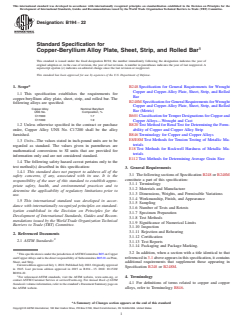
1.1 This specification establishes the requirements for copper-beryllium alloy plate, sheet, strip, and rolled bar. The following alloys are specified:
Copper Alloy
Nominal Beryllium
UNS No.
Composition, %
C17000
1.7
C17200
1.9
1.2 Unless otherwise specified in the contract or purchase order, Copper Alloy UNS No. C17200 shall be the alloy furnished.
1.3 Units—The values stated in inch-pound units are to be regarded as standard. The values given in parentheses are mathematical conversions to SI units that are provided for information only and are not considered standard.
1.4 The following safety hazard caveat pertains only to the test method(s) described in this specification:
1.4.1 This standard does not purport to address all of the safety concerns, if any, associated with its use. It is the responsibility of the user of this standard to establish appropriate safety, health, and environmental practices and to determine the applicability of regulatory limitations prior to use.
1.5 This international standard was developed in accordance with internationally recognized principles on standardization established in the Decision on Principles for the Development of International Standards, Guides and Recommendations issued by the World Trade Organization Technical Barriers to Trade (TBT) Committee.
- Status
- Published
- Publication Date
- 30-Jun-2022
- Technical Committee
- B05 - Copper and Copper Alloys
- Drafting Committee
- B05.01 - Plate, Sheet, and Strip
Buy Documents
ASTM B194-22 - Standard Specification for Copper-Beryllium Alloy Plate, Sheet, Strip, and Rolled Bar

REDLINE ASTM B194-22 - Standard Specification for Copper-Beryllium Alloy Plate, Sheet, Strip, and Rolled Bar
Overview
ASTM B194-22: Standard Specification for Copper-Beryllium Alloy Plate, Sheet, Strip, and Rolled Bar is a vital standard published by ASTM International. This specification outlines requirements for the manufacture, chemical composition, mechanical properties, and testing of copper-beryllium flat products. Specifically, it covers alloys designated as Copper Alloy UNS Nos. C17000 and C17200. These materials are commonly used where high strength, electrical and thermal conductivity, and durability are needed. The specification is widely referenced by manufacturers, suppliers, and engineers for quality assurance and industry compliance.
Key Topics
- Material Scope: Applies to copper-beryllium alloys in plate, sheet, strip, and rolled bar forms.
- Applicable Alloys: Covers C17000 (1.7% nominal beryllium) and C17200 (1.9% nominal beryllium); C17200 is the default unless otherwise specified.
- Processing Conditions:
- Solution heat treatment
- Cold working
- Precipitation heat treatment
- Mill hardening
- Chemical Composition: Strict limits on elements like beryllium, nickel, cobalt, iron, aluminum, and silicon to ensure material consistency and performance.
- Mechanical Properties: Requirements for tensile strength, yield strength, elongation, and Rockwell hardness after specified processing.
- Grain Size and Count: Specifications to ensure uniformity in microstructure, which affects workability and performance.
- Testing Requirements:
- Chemical analysis for compliance
- Tensile and bend testing for mechanical properties
- Hardness tests for product acceptance
- Grain size/count analysis
Applications
ASTM B194-22 serves industries that require copper-beryllium materials with high reliability and consistent performance, including:
- Electronics: Used in connectors, relays, and switch components due to excellent electrical conductivity and fatigue strength.
- Aerospace: Suitable for critical components such as diaphragms, springs, and bushings where weight and strength are pivotal.
- Automotive: Employed in electrical terminals and sensors for their durability, stress relaxation resistance, and corrosion resistance.
- Industrial and Instrumentation: Used for high-precision equipment, tools, and measurement devices that demand dimensional stability and long service life.
By conforming to ASTM B194-22, suppliers and manufacturers can ensure reliable and consistent copper-beryllium flat products, meeting both customer requirements and regulatory compliance needs.
Related Standards
Several ASTM standards complement or are referenced by ASTM B194-22 for copper-beryllium products:
- ASTM B248/B248M: General requirements for wrought copper and copper-alloy plate, sheet, strip, and rolled bar.
- ASTM B601: Classification for temper designations for copper and copper alloys - both wrought and cast.
- ASTM B820: Bend test method for copper and copper alloy strip formability.
- ASTM B846: Terminology for copper and copper alloys.
- ASTM E8/E8M: Test methods for tension testing of metallic materials.
- ASTM E18: Test methods for Rockwell hardness of metallic materials.
- ASTM E112: Test methods for determining average grain size.
- ASTM E527: Practice for numbering metals and alloys in the Unified Numbering System (UNS).
Practical Value
Adherence to ASTM B194-22 provides:
- Quality Assurance: Standardizes production and verification methods, reducing variability in copper-beryllium products.
- Supplier-Customer Confidence: Enables transparent communication of requirements and quality expectations.
- Compliance: Facilitates meeting industry and governmental regulations, especially for defense and aerospace applications.
- Performance Optimization: Ensures mechanical, chemical, and structural characteristics are maintained throughout the supply chain, supporting long-term durability and reliability.
Keywords
Copper-beryllium, ASTM B194-22, C17000, C17200, copper alloy plate, copper strip, copper rolled bar, mechanical properties, chemical composition, industrial standards, copper-beryllium applications.
Relations
- Effective Date
- 01-Jan-2024
- Effective Date
- 01-Nov-2023
- Effective Date
- 01-Aug-2019
- Effective Date
- 01-Jan-2019
- Effective Date
- 01-Oct-2018
- Effective Date
- 01-Jul-2018
- Effective Date
- 01-Mar-2018
- Effective Date
- 01-Mar-2018
- Effective Date
- 01-Sep-2017
- Effective Date
- 01-Jul-2017
- Effective Date
- 01-Oct-2016
- Effective Date
- 01-Aug-2016
- Effective Date
- 15-Jul-2016
- Effective Date
- 01-Feb-2015
- Effective Date
- 01-Sep-2014
Buy Documents
ASTM B194-22 - Standard Specification for Copper-Beryllium Alloy Plate, Sheet, Strip, and Rolled Bar
REDLINE ASTM B194-22 - Standard Specification for Copper-Beryllium Alloy Plate, Sheet, Strip, and Rolled Bar
Get Certified
Connect with accredited certification bodies for this standard

Element Materials Technology
Materials testing and product certification.

Inštitut za kovinske materiale in tehnologije
Institute of Metals and Technology. Materials testing, metallurgical analysis, NDT.
Sponsored listings
Frequently Asked Questions
ASTM B194-22 is a technical specification published by ASTM International. Its full title is "Standard Specification for Copper-Beryllium Alloy Plate, Sheet, Strip, and Rolled Bar". This standard covers: ABSTRACT This specification establishes the requirements for plates, sheets, strips, and rolled bars of copper-beryllium alloy with Copper Alloy UNS Nos. C17000 and C17200. Materials shall be processed by the following conditions: solution heat treatment, solution heat treatment and cold working, precipitation heat treatment, and mill hardening. Specimens shall adhere to specified chemical composition, grain size, and grain count requirements. Alloys shall also undergo tensile and bend tests to evaluate their conformance to tensile strength, yield strength, elongation, and Rockwell hardness requirements. SIGNIFICANCE AND USE A1.3 Significance and Use A1.3.1 These test methods are primarily intended to test for compliance with composition specifications. It is assumed that all who use these test methods will be trained analysts capable of performing common laboratory procedures skillfully and safely. It is expected that work will be performed in a properly equipped laboratory. SCOPE 1.1 This specification establishes the requirements for copper-beryllium alloy plate, sheet, strip, and rolled bar. The following alloys are specified: Copper Alloy Nominal Beryllium UNS No. Composition, % C17000 1.7 C17200 1.9 1.2 Unless otherwise specified in the contract or purchase order, Copper Alloy UNS No. C17200 shall be the alloy furnished. 1.3 Units—The values stated in inch-pound units are to be regarded as standard. The values given in parentheses are mathematical conversions to SI units that are provided for information only and are not considered standard. 1.4 The following safety hazard caveat pertains only to the test method(s) described in this specification: 1.4.1 This standard does not purport to address all of the safety concerns, if any, associated with its use. It is the responsibility of the user of this standard to establish appropriate safety, health, and environmental practices and to determine the applicability of regulatory limitations prior to use. 1.5 This international standard was developed in accordance with internationally recognized principles on standardization established in the Decision on Principles for the Development of International Standards, Guides and Recommendations issued by the World Trade Organization Technical Barriers to Trade (TBT) Committee.
ABSTRACT This specification establishes the requirements for plates, sheets, strips, and rolled bars of copper-beryllium alloy with Copper Alloy UNS Nos. C17000 and C17200. Materials shall be processed by the following conditions: solution heat treatment, solution heat treatment and cold working, precipitation heat treatment, and mill hardening. Specimens shall adhere to specified chemical composition, grain size, and grain count requirements. Alloys shall also undergo tensile and bend tests to evaluate their conformance to tensile strength, yield strength, elongation, and Rockwell hardness requirements. SIGNIFICANCE AND USE A1.3 Significance and Use A1.3.1 These test methods are primarily intended to test for compliance with composition specifications. It is assumed that all who use these test methods will be trained analysts capable of performing common laboratory procedures skillfully and safely. It is expected that work will be performed in a properly equipped laboratory. SCOPE 1.1 This specification establishes the requirements for copper-beryllium alloy plate, sheet, strip, and rolled bar. The following alloys are specified: Copper Alloy Nominal Beryllium UNS No. Composition, % C17000 1.7 C17200 1.9 1.2 Unless otherwise specified in the contract or purchase order, Copper Alloy UNS No. C17200 shall be the alloy furnished. 1.3 Units—The values stated in inch-pound units are to be regarded as standard. The values given in parentheses are mathematical conversions to SI units that are provided for information only and are not considered standard. 1.4 The following safety hazard caveat pertains only to the test method(s) described in this specification: 1.4.1 This standard does not purport to address all of the safety concerns, if any, associated with its use. It is the responsibility of the user of this standard to establish appropriate safety, health, and environmental practices and to determine the applicability of regulatory limitations prior to use. 1.5 This international standard was developed in accordance with internationally recognized principles on standardization established in the Decision on Principles for the Development of International Standards, Guides and Recommendations issued by the World Trade Organization Technical Barriers to Trade (TBT) Committee.
ASTM B194-22 is classified under the following ICS (International Classification for Standards) categories: 77.150.30 - Copper products. The ICS classification helps identify the subject area and facilitates finding related standards.
ASTM B194-22 has the following relationships with other standards: It is inter standard links to ASTM E8/E8M-24, ASTM B820-23, ASTM B846-19a, ASTM B846-19, ASTM B601-18a, ASTM E18-18, ASTM B601-18, ASTM B820-18, ASTM E50-17, ASTM E18-17, ASTM B601-16, ASTM E50-11(2016), ASTM E8/E8M-16, ASTM E8/E8M-15, ASTM B820-14a. Understanding these relationships helps ensure you are using the most current and applicable version of the standard.
ASTM B194-22 is available in PDF format for immediate download after purchase. The document can be added to your cart and obtained through the secure checkout process. Digital delivery ensures instant access to the complete standard document.
Standards Content (Sample)
This international standard was developed in accordance with internationally recognized principles on standardization established in the Decision on Principles for the
Development of International Standards, Guides and Recommendations issued by the World Trade Organization Technical Barriers to Trade (TBT) Committee.
Designation:B194 −22
Standard Specification for
Copper-Beryllium Alloy Plate, Sheet, Strip, and Rolled Bar
This standard is issued under the fixed designation B194; the number immediately following the designation indicates the year of
original adoption or, in the case of revision, the year of last revision. A number in parentheses indicates the year of last reapproval. A
superscript epsilon (´) indicates an editorial change since the last revision or reapproval.
This standard has been approved for use by agencies of the U.S. Department of Defense.
1. Scope* B248 Specification for General Requirements for Wrought
Copper and Copper-Alloy Plate, Sheet, Strip, and Rolled
1.1 This specification establishes the requirements for
Bar
copper-beryllium alloy plate, sheet, strip, and rolled bar. The
B248M SpecificationforGeneralRequirementsforWrought
following alloys are specified:
Copper and Copper-Alloy Plate, Sheet, Strip, and Rolled
Copper Alloy Nominal Beryllium
Bar (Metric)
UNS No. Composition, %
C17000 1.7 B601 Classification forTemper Designations for Copper and
C17200 1.9
Copper Alloys—Wrought and Cast
1.2 Unless otherwise specified in the contract or purchase
B820 Test Method for Bend Test for Determining the Form-
order, Copper Alloy UNS No. C17200 shall be the alloy ability of Copper and Copper Alloy Strip
furnished.
B846 Terminology for Copper and Copper Alloys
E8/E8M Test Methods for Tension Testing of Metallic Ma-
1.3 Units—The values stated in inch-pound units are to be
terials
regarded as standard. The values given in parentheses are
E18 Test Methods for Rockwell Hardness of Metallic Ma-
mathematical conversions to SI units that are provided for
terials
information only and are not considered standard.
E112 Test Methods for Determining Average Grain Size
1.4 The following safety hazard caveat pertains only to the
test method(s) described in this specification:
3. General Requirements
1.4.1 This standard does not purport to address all of the
3.1 The following sections of Specification B248 or B248M
safety concerns, if any, associated with its use. It is the
constitute a part of this specification:
responsibility of the user of this standard to establish appro-
3.1.1 Terminology
priate safety, health, and environmental practices and to
3.1.2 Materials and Manufacture
determine the applicability of regulatory limitations prior to
3.1.3 Dimensions, Weights, and Permissible Variations
use.
3.1.4 Workmanship, Finish, and Appearance
1.5 This international standard was developed in accor-
3.1.5 Sampling
dance with internationally recognized principles on standard-
3.1.6 Number of Tests and Retests
ization established in the Decision on Principles for the
3.1.7 Specimen Preparation
Development of International Standards, Guides and Recom-
3.1.8 Test Methods
mendations issued by the World Trade Organization Technical
3.1.9 Significance of Numerical Limits
Barriers to Trade (TBT) Committee.
3.1.10 Inspection
3.1.11 Rejection and Rehearing
2. Referenced Documents
3.1.12 Certification
2.1 ASTM Standards:
3.1.13 Test Reports
3.1.14 Packaging and Package Marking.
3.2 In addition, when a section with a title identical to that
ThisspecificationisunderthejurisdictionofASTMCommitteeB05onCopper
referencedin3.1aboveappearsinthisspecification,itcontains
andCopperAlloysandisthedirectresponsibilityofSubcommitteeB05.01onPlate,
Sheet, and Strip.
additional requirements that supplement those appearing in
Current edition approved July 1, 2022. Published July 2022. Originally approved
Specification B248 or B248M.
in 1945. Last previous edition approved in 2015 as B194 – 15. DOI: 10.1520/
B0194-22.
For referenced ASTM standards, visit the ASTM website, www.astm.org, or 4. Terminology
contact ASTM Customer Service at service@astm.org. For Annual Book of ASTM
4.1 For definitions of terms related to copper and copper
Standards volume information, refer to the standard’s Document Summary page on
the ASTM website. alloys, refer to Terminology B846.
*A Summary of Changes section appears at the end of this standard
Copyright © ASTM International, 100 Barr Harbor Drive, PO Box C700, West Conshohocken, PA 19428-2959. United States
B194−22
5. Ordering Information 6.2 These composition limits do not preclude the presence
of other elements. By agreement between manufacturer and
5.1 Include the following specified choices when placing
purchaser, limits may be established and analysis required for
orders for product under this specification as applicable:
unnamed elements.
5.1.1 ASTM designation and year of issue,
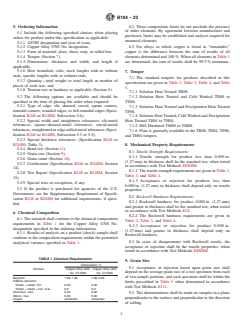
5.1.2 Copper Alloy UNS No. designation, 6.3 For alloys in which copper is listed as “remainder,”
5.1.3 Form of material: plate, sheet, strip, or rolled bar, copper is the difference between the sum of results of all
5.1.4 Temper (Section 7), elements determined and 100 %. When all elements in Table 1
5.1.5 Dimensions: thickness and width, and length if are determined, the sum of results shall be 99.5 % minimum.
applicable,
5.1.6 How furnished: coils, stock lengths with or without 7. Temper
ends, specific lengths with or without ends,
7.1 The standard tempers for products described in this
5.1.7 Quantity—total weight or total length or number of
specification are given in Table 2, Table 3, Table 4, and Table
pieces of each size, and
5.
5.1.8 Tension test or hardness as applicable (Section 8).
7.1.1 Solution Heat Treated TB00.
5.2 The following options are available and should be
7.1.2 Solution Heat Treated and Cold Worked TD00 to
specified at the time of placing the order when required:
TD04.
5.2.1 Type of edge: slit, sheared, sawed, square corners,
7.1.3 Solution Heat Treated and Precipitation Heat Treated
rounded corners, rounded edges, or full-rounded edges (Speci-
TF00.
fication B248 or B248M, Subsection 5.6),
7.1.4 Solution Heat Treated, Cold Worked and Precipitation
5.2.2 Special width and straightness tolerances: slit-metal
Heat Treated TH01 to TH04.
tolerances, square-sheared-metal tolerances, sawed-metal
7.1.5 Mill Hardened TM00 to TM08.
tolerances,straightenedoredge-rolled-metaltolerances(Speci-
7.1.6 Plate is generally available in the TB00, TD04, TF00,
fication B248 or B248M, Subsection 5.3 or 5.5),
and TH04 tempers.
5.2.3 Special thickness tolerances: (Specification B248 or
B248M, Table 3),
8. Mechanical Property Requirements
5.2.4 Bend test (Section 11),
8.1 Tensile Strength Requirements:
5.2.5 Grain size (Section 9),
8.1.1 Tensile strength for product less than 0.050 in.
5.2.6 Grain count (Section 10),
(1.27 mm) in thickness shall be the standard test, when tested
5.2.7 Certification (Specification B248 or B248M, Section
in accordance with Test Methods E8/E8M.
14),
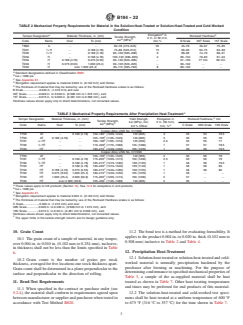
8.1.2 The tensile strength requirements are given in Table 2,
5.2.8 Test Report (Specification B248 or B248M, Section
Table 3, and Table 4.
15),
8.1.3 Acceptance or rejection for products less than
5.2.9 Special tests or exceptions, if any.
0.050 in. (1.27 mm) in thickness shall depend only on tensile
5.3 If the product is purchased for agencies of the U.S.
properties.
Government, see the Supplementary Requirement of Specifi-
8.2 Rockwell Hardness Requirements:
cation B248 or B248M for additional requirements, if speci-
8.2.1 Rockwell hardness for product 0.050 in. (1.27 mm)
fied.
and greater in thickness shall be the standard test, when tested
in accordance with Test Methods E18.
6. Chemical Composition
8.2.2 The Rockwell hardness requirements are given in
6.1 The material shall conform to the chemical composition
Table 2, Table 3, and Table 4.
requirements in Table 1 for the Copper Alloy UNS No.
8.2.3 Acceptance or rejection for product 0.050 in.
designation specified in the ordering information.
(1.27 mm) and greater in thickness shall depend only on
6.1.1 Results of analysis on a product (check) sample shall
Rockwell hardness.
conform to the composition requirements within the permitted
8.3 In cases of disagreement with Rockwell results, the
analytical variance specified in Table 1.
acceptance or rejection shall be the tensile properties, when
tested in accordance with Test Methods E8/E8M.
TABLE 1 Chemical Requirements
9. Grain Size
Composition, %
9.1 Acceptance or rejection based upon grain size shall
Element
Copper Alloy UNS Copper Alloy UNS
depend on the average grain size of a test specimen from each
No. C17000 No. C17200
of two sample portions, and each specimen shall be within the
Beryllium 1.60–1.85 1.80–2.00
Additive elements:
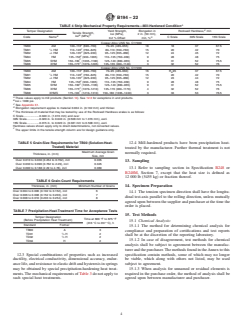
limits prescribed in Table 5 when determined in accordance
Nickel + cobalt, min 0.20 0.20
with Test Methods E112.
Nickel + cobalt + iron, max 0.6 0.6
Aluminum, max 0.20 0.20
9.2 The determinations shall be made on samples in a plane
Silicon, max 0.20 0.20
perpendicular to the surface and perpendicular to the direction
Copper remainder remainder
of rolling.
B194−22
TABLE 2 Mechanical Property Requirements for Material in the Solution-Heat-Treated or Solution-Heat-Treated and Cold-Worked
Condition
A D E
Elongation in
Temper Designation Material Thickness, in. (mm) Rockwell Hardness
Tensile Strength,
2 in. or 50 mm,
B C
ksi (MPa)
Code Name Over To (incl) min,% B Scale 30T Scale 15T Scale
TB00 A . . 60–78 (415–540) 35 45–78 46–67 75–85
TD01 ⁄4 H . 0.188 (4.78) 75–88 (520–610) 15 68–90 62–75 83–89
TD02 ⁄2 H . 0.188 (4.78) 85–100 (585–690) 9 88–96 74–79 88–91
TD04 H . 0.188 (4.78) 100–130 (690–895) 2 96–104 79–83 91–94
TD04 H 0.188 (4.78) 0.375 (9.53) 90–130 (620–895) . 91–103 77 min 90 min
TD04 H 0.375 (9.53) 1.000 (25.4) 90–120 (620–825) . 90–102 . .
TD04 H over 1.000 (25.4) 85–115 (585–790) 8 88–102 . .
A
Standard designations defined in Classification B601.
B
ksi = 1000 psi.
C
See Appendix X1.
D
Elongation requirement applies to material 0.004 in. (0.102 mm) and thicker.
E
The thickness of material that may be tested by use of the Rockwell hardness scales is as follows:
B Scale.0.040 in. (1.016 mm) and over
30T Scale.0.020 in. to 0.040 in. (0.508 mm to 1.016 mm), excl.
15T Scale.0.015 in. to 0.020 in. (0.381 mm to 0.508 mm), excl.
Hardness values shown apply only to direct determinations, not converted values.
A
TABLE 3 Mechanical Property Requirements After Precipitation Heat-Treatment
E
Yield Strength, Elongation in
Temper Designation Material Thickness, in. (mm) Rockwell Hardness, min
Tensile Strength,
ksi (MPa), min, 2 in. (50 mm),
B C
ksi (MPa)
D
Code Name Over To (incl) C Scale 30N Scale 15N Scale
0.2 % Offset min, %
Copper Alloy UNS No. C17000
F
TF00 AT . 0.188 (4.78) 150–180 (1035–1240) 130 (895) 3 33 53 76.5
F
TF00 AT 0.188 (4.78) . 165–195 (1140–1345) 130 (895) 3 36 56 78
F
TH01 ⁄4 HT . . 160–190 (1105–1310) 135 (930) 2.5 35 55 77
F
TH02 ⁄2 HT . . 170–200 (1170–1380) 145 (1000) 1 37 57 78.5
F
TH04 HT . . 180–210 (1240–1450) 155 (1070) 1 38 58 79.5
Copper Alloy UNS No. C17200
F
TF00 AT . . 165–195 (1140–1345) 140 (965) 3 36 56 78
F
TH01 ⁄4 HT . 0.188 (4.78) 175–205 (1205–1415) 150 (1035) 2.5 36 56 79
F
TH02 ⁄2 HT . 0.188 (4.78) 185–215 (1275–1480) 160 (1105) 1 38 58 79.5
F
TH04 HT . 0.188 (4.78) 190–220 (1310–1520) 165 (1140) 1 38 58 80
F
TH04 HT 0.188 (4.78) 0.375 (9.53) 180–215 (1240–1480) 160 (1105) 1 38 58 80
F
TH04 HT 0.375 (9.53) 1.000 (25.4) 180–210 (1240–1450) 155 (1070) 1 38 . .
F
TH04 HT 1.000 (25.4) 2.000 (50.8) 175–205 (1205–1415) 150 (1035) 2 37 . .
F
TH04 HT over 2.000 (50.8) 165–200 (1140–1380) 130 (895) 2 36 . .
A
These values apply to mill products (Section 14). See 12.3 for exceptions in end products.
B
ksi = 1000 psi.
C
See Appendix X1.
D
Elongation requirement applies to material 0.004 in. (0.102 mm) and thicker.
E
The thickness of material that may be tested by use of the Rockwell Hardness scales is as follows:
C Scale.0.040 in. (1.016 mm) and over
30N Scale.0.020 in. to 0.040 in. (0.508 mm to 1.016 mm), excl.
15N Scale.0.015 in. to 0.02 in. (0.381 mm to 0.508 mm), excl.
Hardness values shown apply only to direct determinations, not converted values.
F
The upper limits in the tensile strength column are for design guidance only.
10. Grain Count 11.2 The bend test is a method for evaluating formability. It
applies to the product 0.004 in. to 0.020 in. thick (0.102 mm to
10.1 The grain count of a sample of material, in any temper,
0.508 mm) inclusive in Table 2 and Table 4.
over 0.004 in. to 0.010 in. (0.102 mm to 0.254 mm), inclusive,
in thickness shall not be less than the limits specified in Table
12. Precipitation Heat-Treatment
6.
12.1 Solution-heat-treated or solution-heat-treated and cold-
10.2 Grain count is the number of grains per stock
worked material is normally precipitation hardened by the
thickness,averagedforfivelocationsonestockthicknessapart.
purchaser after forming or machining. For the purpose of
Grain count shall be determined in a plane perpendicular to the
determining conformance to specified mechanical properties of
surface and perpendicular to the direction of rolling.
Table 3, a sample of the as-supplied material shall be heat
11. Bend-Test Requirements treated as shown in Table 7. Other heat treating temperatures
and times may be preferred for end products of this material.
11.1 When specified in the contract or purchase order (see
5.2.4), the material shall conform to requirements agreed upon 12.2 The solution-heat-treated and cold-worked test speci-
betweenmanufacturerorsupplierandpurchaserwhentestedin mens shall be heat treated at a uniform temperature of 600 °F
accordance with Test Method B820. to 675 °F (316 °C to 357 °C) for the time shown in Table 7.
B194−22
A
TABLE 4 Strip Mechanical Property Requirements—Mill-Hardened Condition
E
Yield Strength, Elongation in
Temper Designation Rockwell Hardness, min
Tensile Strength,
ksi (MPa), 2 in. (50 mm),
B C
B ksi (MPa)
D
Code Name C Scale 30N Scale 15N Scale
0.2 % Offset min, %
Copper Alloy UNS No. C17000
F
TM00 AM 100–110 (690–760) 70–95 (485–655) 18 18 37 67.5
F
TM01 ⁄4 HM 110–120 (760–825) 80–110 (550–760) 15 20 42 70
F
TM02 ⁄2 HM 120–135 (825–930) 95–125 (655–860) 12 24 45 72
F
TM04 HM 135–150 (930–1035) 110–135 (760–930) 9 28 48 75
F
TM05 SHM 150–160 (1035–1100) 125–140 (860–965) 9 31 52 75.5
F
TM06 XHM 155–175 (1070–1205) 135–165 (930–1140) 3 32 52 76
Copper Alloy UNS No. C17200
F
TM00 AM 100–110 (690–760) 70–95 (485–660) 16 R 95 37 67.5
B
F
TM01 ⁄4 HM 110–120 (760–825) 80–110 (550–760) 15 20 42 70
F
TM02 ⁄2 HM 120–135 (825–930) 95–125 (655–860) 12 23 44 72
F
TM04 HM 135–150 (930–1035) 110–135 (760–930) 9 28 48 75
F
TM05 SHM 150–160 (1035–1105) 125–140 (860–965) 9 31 52 75.5
F
TM06 XHM 155–175 (1070–1210) 135–170 (930–1170) 4 32 52 76
F
TM08 XHMS 175–190 (1210–1310) 150–180 (1035–1240) 3 33 53 76.5
A
These values apply to mill products (Section 14). See 12.3 for exceptions in end products.
B
ksi = 1000 psi.
C
See Appendix X1.
D
Elongation requirement applies to material 0.004 in. (0.102 mm) and thicker.
E
The thickness of material that may be tested by use of the Rockwell Hardness scales is as follows:
C Scale.0.040 in. (1.016 mm) and over
30N Scale.0.020 in. to 0.040 in. (0.508 mm to 1.016 mm), excl.
15N Scale.0.015 in. to 0.020 in. (0.381 mm to 0.508 mm), excl.
Hardness values shown apply only to direct determinations, not converted values.
F
The upper limits in the tensile strength column are for design guidance only.
TABLE 5 Grain-Size Requirements for TB00 (Solution-Heat-
12.4 Mill-hardened products have been precipitation heat-
Treated) Material
treated by the manufacturer. Further thermal treatment is not
Maximum Average Grain
normally required.
Thickness, in. (mm)
Size, mm
Over 0.010 to 0.030 (0.254 to 0.762), incl 0.035
13. Sampling
Over 0.030 to 0.090 (0.762 to 2.29), incl 0.045
Over 0.090 to 0.188 (2.29 to 4.78), incl 0.060 13.1 Refer to sampling section in Specification B248 or
B248M, Section 7, except that the heat size is defined as
12 000 lb (5455 kg) or fraction thereof.
TABLE 6 Grain-Count Requirements
14. Specimen Preparation
Thickness, in. (mm) Minimum Number of Grains
Over 0.004 to 0.006 (0.102 to 0.152), incl 6
14.1 The tension specimen direction shall have the longitu-
Over 0.006 to 0.008 (0.152 to 0.203), incl 7
dinal test-axis parallel to the rolling direction, unless mutually
Over 0.008 to 0.010 (0.203 to 0.254), incl 8
agreed upon between the supplier and purchaser at the time the
order is placed.
TABLE 7 Precipitation-Heat-Treatment Time for Acceptance Tests
15. Test Methods
Temper Designation
Time at 600 °F to 675 °F
(Before Precipitation Heat Treatment)
15.1 Chemical Analysis:
(316 °C to 357 °C), h
Standard Former
15.1.1 The method for determining chemical analysis for
TB00 A 3
compliance and preparation of certifications and test reports
TD01 ⁄4H2
shall be at the discretion of the reporting laboratory.
TD02 ⁄2H2
15.1.2 In case of disagreement, test methods for chemical
TD04 H 2
analysis shall be subject to agreement between the manufac-
turerandthepurchaser.ThemethodsfoundintheAnnextothis
12.3 Special combinations of properties such as increased specification contain methods, some of which may no longer
ductility, electrical conductivity, dimensional accuracy, endur- be viable, which along with others not listed, may be used
ancelife,andresistancetoelasticdriftandhysteresisinsprings subject to agreement.
may be obtained by special precipitation-hardening heat treat- 15.1.3 When analysis for unnamed or residual elements is
ments.The mechanical requirements of Table 3 do not apply to required in the purchase order, the method of analysis shall be
agreed upon between manufacturer and purchaser.
such special heat treatments.
B194−22
15.2 Other Tests: 15.2.2 In case of dispute, the intercept method of Test
15.2.1 The product furnished shall conform to specified Methods E112 shall be followed
requirements when subjected to test in accordance with the
following table:
16. Keywords
Test Method
16.1 C17000; C17200; copper-beryllium; copper plate; cop-
Formability B820
per rolled bar; copper strip; flat products
Tension Properties E8/E8M
Hardness E18
Grain Size E112
ANNEX
(Mandatory Information)
A1. TEST METHODS FOR DETERMINATION OF COMPLIANCE WITH COPPER-BERYLLIUM ALLOYS—CHEMICAL
COMPOSITION REQUIREMENTS
A1.1 Scope A1.4 Apparatus, Reagents, and Photometric Practice
A1.1.1 These test methods establish the procedure(s) for the
A1.4.1 Apparatus and reagents required for each determi-
determination of chemical composition of copper-beryllium
nation are listed in separate sections preceding the procedure.
alloys.
The apparatus, standard solutions, and certain other reagents
A1.1.2 The analytical procedures appear in the following are referred to by number and shall conform to the require-
order: ments prescribed in Practices E50.
Procedure Sections
A1.4.2 Flame atomic-absorption spectrophotometric prac-
Test Method A—Copper by the Electrolytic Method A1.8 to A1.15
Test Method B—Aluminum, Beryllium, Cobalt, Iron, A1.16 to A1.24 tice prescribed in these test methods shall conform to the
and Nickel by the Flame Atomic Absorption
requirements prescribed in Practice E663 and Guide E1024.
Spectrophotometric Method
Test Method C—Silicon by the Ammonium Molybdate A1.25 to A1.35
A1.4.3 Spectrophotometric practice prescribed in these test
Spectrophotometric Method
methods shall conform to requirements prescribed in Practice
A1.2 Referenced Documents
E60.
A1.2.1 ASTM Standards:
A1.5 Hazards
E29 Practice for Using Significant Digits in Test Data to
Determine Conformance with Specifications
A1.5.1 This test method involves the use of concentrated
E50 Practices for Apparatus, Reagents, and Safety Consid-
acids. Read and follow all label precautions and Safety Data
erations for Chemical Analysis of Metals, Ores, and
Sheet (SDS) information. Also refer to Practices E50 for
Related Materials
handling nitric acid and the use of certain other reagents in this
E60 Practice for Analysis of Metals, Ores, and Related
test method.
Materials by Spectrophotometry
E255 Practice for Sampling Copper and Copper Alloys for
A1.5.2 Processing beryllium and beryllium-containing ma-
the Determination of Chemical Composition
terials poses a health risk if safe handling practices are not
E663 Practice for FlameAtomicAbsorptionAnalysis (With-
followed. Inhalation of airborne beryllium may cause a serious
drawn 1997)
lung disorder in some individuals. Occupational safety and
E1024 Guide for Chemical Analysis of Metals and Metal
health regulatory agencies have set mandatory limits on
Bearing Ores by Flame Atomic Absorption Spectropho-
occupational respiratory exposures. Read and follow the guid-
tometry (Withdrawn 2004)
ance in the SDS before working with these materials.
A1.3 Significance and Use
A1.6 Sampling
A1.3.1 These test methods are primarily intended to test for
compliance with composition specifications. It is assumed that
A1.6.1 Sampling shall conform to the requirements of
all who use these test methods will be trained analysts capable
Practice E255.
of performing common laboratory procedures skillfully and
safely. It is expected that work will be performed in a properly
A1.7 Rounding Off Calculated Values
equipped laboratory.
A1.7.1 Calculated values shall be rounded off to the proper
3 number of places in accordance with the method given in 3.4
The last approved version of this historical standard is referenced on
www.astm.org. and 3.5 of Practice E29.
B194−22
TEST METHOD A—COPPER BY ELECTROLYTIC acid, cover the beaker, and allow to stand until the reaction
DEPOSITION AND ATOMIC-ABSORPTION subsides. Heat at 80 °C to 90 °C until dissolution is complete
SPECTROPHOTOMETRY and brown fumes have been expelled. Cool and wash down
cover glass and inside of beaker. Add 1.0 mL of HF (1 + 9)
A1.8 Scope
from a plastic pipet and dilute to about half volume.
A1.8.1 This test method establishes a procedure for the
A1.13.2 Insert the electrodes and dilute to submerge the
determination of copper in copper-beryllium alloys with silver
cathode. Cover the beaker with a pair of split cover glasses and
reported as copper.
electrolyze at a current density of about 0.6 A/dm for about
16 h.
A1.9 Summary of Test Methods
A1.13.3 Wash the cover glasses, the electrode stems, and
A1.9.1 The sample is dissolved in an acid mixture. A small
amount of fluorohydric acid (HF) is added to minimize inside the beaker with water, then continue the electrolysis for
a minimum of 15 min. Should copper plate-out on the newly
possibleinterferences.Copperiselectrolyticallydepositedona
tared platinum cathode. Copper remaining in the electrolyte is exposed cathode surface, dilute a second time and continue
electrolysis for an additional 15 min. Copper deposition shall
determined by atomic absorption spectrophotometry.
be considered completed, when no copper is deposited on a
A1.10 Interferences
newly exposed surface.
A1.10.1 Elements normally present do not interfere.
A1.13.4 Quickly withdraw the cathode from the electrolyte
while maintaining current flow (should the electrolysis system
A1.11 Apparatus
permit), and direct a gentle stream of water from a wash bottle
A1.11.1 Electrodes for Electrolysis—Apparatus No. 9, in
over its surface. Rinse the cathode in a water bath and then dip
Practices E50.
intwosuccessivebathsofethanoloracetone.Dryat110 °Cfor
A1.11.2 AtomicAbsorption Spectrophotometer—Determine
3 min to 5 min, cool at balance room temperature, and weigh.
the instrument to be suitable for use as directed in Guide
A1.13.5 Transfer the spent electrolyte into individual 1 L
E1024. Instrument response must permit estimation of copper
volumetric flask, dilute to volume, and mix.
concentration to within 1 mg/L.
A1.13.6 Set the atomic-absorption instrument parameters
A1.11.3 Operating Parameters—Wavelength, fuel/oxidant,
according to Practice E663 and the manufacturer’s recommen-
and flame conditions are as follows:
dations. Ignite the burner and aspirate water until the instru-
Wavelength, nm Fuel/Oxidant Flame Condition
ment reaches thermal equilibrium.
Copper 327.5 Acetylene/air Oxidizing
A1.13.7 Adjust the wavelength, lamp position, fuel,
oxidizer,burner,andnebulizertoobtainmaximumabsorbance,
A1.12 Reagents
while aspirating the highest cal
...
This document is not an ASTM standard and is intended only to provide the user of an ASTM standard an indication of what changes have been made to the previous version. Because
it may not be technically possible to adequately depict all changes accurately, ASTM recommends that users consult prior editions as appropriate. In all cases only the current version
of the standard as published by ASTM is to be considered the official document.
Designation: B194 − 15 B194 − 22
Standard Specification for
Copper-Beryllium Alloy Plate, Sheet, Strip, and Rolled Bar
This standard is issued under the fixed designation B194; the number immediately following the designation indicates the year of
original adoption or, in the case of revision, the year of last revision. A number in parentheses indicates the year of last reapproval. A
superscript epsilon (´) indicates an editorial change since the last revision or reapproval.
This standard has been approved for use by agencies of the U.S. Department of Defense.
1. Scope*
1.1 This specification establishes the requirements for copper-beryllium alloy plate, sheet, strip, and rolled bar. The following
alloys are specified:
Copper Alloy Previously Used
Commercial
UNS No. Designations
C17000 Alloy 165
C17200 Alloy 25
Copper Alloy Nominal Beryllium
UNS No. Composition, %
C17000 1.7
C17200 1.9
1.2 Unless otherwise specified in the contract or purchase order, Copper Alloy UNS No. C17200 shall be the alloy furnished.
1.3 Units—Values The values stated in inch-pound units are to be regarded as standard. The values given in parentheses are
mathematical conversions to SI units that are provided for information only and are not considered standard.
1.4 The following safety hazard caveat pertains only to the test method(s) described in the annex of this specification:
1.4.1 This standard does not purport to address all of the safety concerns, if any, associated with its use. It is the responsibility
of the user of this standard to establish appropriate safety safety, health, and healthenvironmental practices and to determine the
applicability of regulatory limitations prior to use.
1.5 This international standard was developed in accordance with internationally recognized principles on standardization
established in the Decision on Principles for the Development of International Standards, Guides and Recommendations issued
by the World Trade Organization Technical Barriers to Trade (TBT) Committee.
2. Referenced Documents
2.1 ASTM Standards:
This specification is under the jurisdiction of ASTM Committee B05 on Copper and Copper Alloys and is the direct responsibility of Subcommittee B05.01 on Plate,
Sheet, and Strip.
Current edition approved July 1, 2015July 1, 2022. Published August 2015July 2022. Originally approved in 1945. Last previous edition approved in 20082015 as
B194 – 08.B194 – 15. DOI: 10.1520/B0194-15.10.1520/B0194-22.
For referenced ASTM standards, visit the ASTM website, www.astm.org, or contact ASTM Customer Service at service@astm.org. For Annual Book of ASTM Standards
volume information, refer to the standard’sstandard’s Document Summary page on the ASTM website.
*A Summary of Changes section appears at the end of this standard
Copyright © ASTM International, 100 Barr Harbor Drive, PO Box C700, West Conshohocken, PA 19428-2959. United States
B194 − 22
B248 Specification for General Requirements for Wrought Copper and Copper-Alloy Plate, Sheet, Strip, and Rolled Bar
B248M Specification for General Requirements for Wrought Copper and Copper-Alloy Plate, Sheet, Strip, and Rolled Bar
(Metric)
B601 Classification for Temper Designations for Copper and Copper Alloys—Wrought and Cast
B820 Test Method for Bend Test for Determining the Formability of Copper and Copper Alloy Strip
B846 Terminology for Copper and Copper Alloys
E8/E8M Test Methods for Tension Testing of Metallic Materials
E18 Test Methods for Rockwell Hardness of Metallic Materials
E112 Test Methods for Determining Average Grain Size
E527 Practice for Numbering Metals and Alloys in the Unified Numbering System (UNS)
3. General Requirements
3.1 The following sections of Specification B248 or B248M constitute a part of this specification:
3.1.1 Terminology
3.1.2 Materials and Manufacture
3.1.3 Dimensions, Weights, and Permissible Variations
3.1.4 Workmanship, Finish, and Appearance
3.1.5 Sampling
3.1.6 Number of Tests and Retests
3.1.7 Specimen Preparation
3.1.8 Test Methods
3.1.9 Significance of Numerical Limits
3.1.10 Inspection
3.1.11 Rejection and Rehearing
3.1.12 Certification
3.1.13 Test ReportReports
3.1.14 Packaging and Package Marking.
3.2 In addition, when a section with a title identical to that referenced in 3.1 above appears in this specification, it contains
additional requirements that supplement those appearing in Specification B248 or B248M.
4. Terminology
4.1 For definitions of terms relatingrelated to copper and copper alloys, refer to Terminology B846.
5. Ordering Information
5.1 Include the following specified choices when placing orders for product under this specification as applicable.applicable:
5.1.1 ASTM designation and year of issue,
5.1.2 Copper [Alloy]Alloy UNS No. designation (designation,1.1),
B194 − 22
5.1.3 Form of material: plate, sheet, strip, or rolled bar,
5.1.4 Temper ((Section 7.17),
5.1.5 Dimensions: thickness and width, and length if applicable.applicable,
5.1.6 How furnished: rolls,coils, stock lengths with or without ends, specific lengths with or without ends,
5.1.7 Quantity: total Quantity—total weight or total length or number of pieces of each size, and
5.1.8 Type of edge, if required: slit, sheared, sawed, square corners, rounded corners, rounded edges, or full-rounded edges
(Specification B248, Section 5.6),
5.1.9 Type of width and straightness tolerances, if required: slit-metal tolerances, square-sheared-metal tolerances, sawed-metal
tolerances, straightened or edge-rolled-metal tolerances (Specification B248, Section 5.3),
5.1.10 Special thickness tolerances, if required (Specification B248, Table 3),
5.1.8 Tension test or hardness as applicable (Section 8),).
5.2 The following options are available but may not be included unless and should be specified at the time of placing of the order
when required:
5.2.1 Type of edge: slit, sheared, sawed, square corners, rounded corners, rounded edges, or full-rounded edges (Specification
B248 or B248M, Subsection 5.6),
5.2.2 Special width and straightness tolerances: slit-metal tolerances, square-sheared-metal tolerances, sawed-metal tolerances,
straightened or edge-rolled-metal tolerances (Specification B248 or B248M, Subsection 5.3 or 5.5),
5.2.3 Special thickness tolerances: (Specification B248 or B248M, Table 3),
5.2.4 Bend test, if required test (Section 11),
5.2.5 Grain size or grain count, if required (Section 9 or 10),
5.2.6 Grain count (Section 10),
5.2.7 Certification, if requiredCertification (Specification B248 (see Specification or B248B248M, Section 14),
5.2.8 Test Report, if requiredReport (Specification B248 (see Specification or B248B248M, Section 15),
5.2.9 Special tests or exceptions, if any.
5.3 If the product is purchased for agencies of the U.S. Government, see the Supplementary Requirement of Specification B248
or B248M for additional requirements, if specified.
6. Chemical Composition
6.1 The material shall conform to the chemical composition requirements specified in Table 1 for the copper [alloy]Copper Alloy
UNS No. designation specified in the ordering information.
6.1.1 Results of analysis on a product (check) sample shall conform to the composition requirements within the permitted
analytical variance specified in Table 1.
6.2 These composition limits do not preclude the presence of other elements. By agreement between manufacturer and purchaser,
limits may be established and analysis required for unnamed elements.
B194 − 22
TABLE 1 Chemical Requirements
Composition, %
Element
Copper Alloy UNS Copper Alloy UNS
No. C17000 No. C17200
Beryllium 1.60–1.85 1.80–2.00
Additive elements:
Nickel + cobalt, min 0.20 0.20
Nickel + cobalt + iron, max 0.6 0.6
Aluminum, max 0.20 0.20
Silicon, max 0.20 0.20
Copper remainder remainder
6.3 These composition limits do not preclude the presence of other elements. By agreement between manufacturer and purchaser,
limits may be established and analysis required for unnamed elements. Copper For alloys in which copper is listed as “remainder,”
and may be taken as copper is the difference between the sum of results of all elements analyzeddetermined and 100 %. When all
elements in Table 1 are determined, the sum of the results shall be 99.5 % minimum.
7. Temper
7.1 The standard tempers for products described in this specification are given in Table 2, Table 3, Table 4, and Table 5.
7.1.1 Solution Heat Treated TB00.
7.1.2 Solution Heat Treated and Cold Worked TD00 to TD04.
7.1.3 Solution Heat Treated and Precipitation Heat Treated TF00.
7.1.4 Solution Heat Treated, Cold Worked and Precipitation Heat Treated TH01 to TH04.
7.1.5 Mill Hardened TM00 to TM08.
7.1.6 Plate is generally available in the TB00, TD04, TF00, and TH04 tempers.
8. Mechanical Property Requirements
8.1 For product less than 0.050 in. (1.27 mm) in thickness:Tensile Strength Requirements:
8.1.1 Tensile test results strength for product less than 0.050 in. (1.27 mm) in thickness shall be the product acceptance criteria,
standard test, when tested in accordance with Test Methods E8/E8M.
TABLE 2 Mechanical Property Requirements for Material in the Solution-Heat-Treated or Solution-Heat-Treated and Cold-Worked
Condition
A D E
Elongation in
Temper Designation Material Thickness, in. (mm) Rockwell Hardness
Tensile Strength,
2 in. or 50 mm,
B C
ksi (MPa)
Code FormerName Over InclTo (incl) min,% B Scale 30T Scale 15T Scale
TB00 A . . 60–78 (415–540) 35 45–78 46–67 75–85
TD01 ⁄4 H . 0.188 (4.78) 75–88 (520–610) 15 68–90 62–75 83–89
TD02 ⁄2 H . 0.188 (4.78) 85–100 (585–690) 9 88–96 74–79 88–91
TD04 H . 0.188 (4.78) 100–130 (690–895) 2 96–104 79–83 91–94
TD04 H 0.188 (4.78) 0.375 (9.53) 90–130 (620–895) . 91–103 77 min 90 min
TD04 H 0.375 (9.53) 1.000 (25.4) 90–120 (620–825) . 90–102 . .
TD04 H over 1.000 (25.4) 85–115 (585–790) 8 88–102 . .
A
Standard designations defined in Classification B601.
B
ksi = 1000 psi.
C
See Appendix X1.
D
Elongation requirement applies to material 0.004 in. (0.102 mm) and thicker.
E
The thickness of material that may be tested by use of the Rockwell hardness scales is as follows:
B Scale.0.040 in. (1.016 mm) and over
30T Scale.0.020Scale.0.020 in. to 0.040 in. (0.508(0.508 mm to 1.016 mm), excl.
15T Scale.0.015Scale.0.015 in. to 0.020 in. (0.381(0.381 mm to 0.508 mm), excl.
Hardness values shown apply only to direct determinations, not converted values.
B194 − 22
A
TABLE 3 Mechanical Property Requirements After Precipitation Heat-Treatment
E
Yield Strength, Elongation in
Temper Designation Material Thickness, in. (mm) Rockwell Hardness, min
Tensile Strength,
ksi (MPa), min, 2 in. (50 mm),
B C
ksi (MPa)
D
Code FormerName Over InclTo (incl) C Scale 30N Scale 15N Scale
0.2 % Offset min, %
Copper Alloy UNS No. C17000
F
TF00 AT . 0.188 (4.78) 150–180 (1035–1240) 130 (895) 3 33 53 76.5
F
TF00 AT 0.188 (4.78) . 165–195 (1140–1345) 130 (895) 3 36 56 78
F
TH01 ⁄4 HT . . 160–190 (1105–1310) 135 (930) 2.5 35 55 77
F
TH02 ⁄2 HT . . 170–200 (1170–1380) 145 (1000) 1 37 57 78.5
F
TH04 HT . . 180–210 (1240–1450) 155 (1070) 1 38 58 79.5
Copper Alloy UNS No. C17200
F
TF00 AT . . 165–195 (1140–1345) 140 (965) 3 36 56 78
F
TH01 ⁄4 HT . 0.188 (4.78) 175–205 (1205–1415) 150 (1035) 2.5 36 56 79
F
TH02 ⁄2 HT . 0.188 (4.78) 185–215 (1275–1480) 160 (1105) 1 38 58 79.5
F
TH04 HT . 0.188 (4.78) 190–220 (1310–1520) 165 (1140) 1 38 58 80
F
TH04 HT 0.188 (4.78) 0.375 (9.53) 180–215 (1240–1480) 160 (1105) 1 38 58 80
F
TH04 HT 0.375 (9.53) 1.000 (25.4) 180–210 (1240–1450) 155 (1070) 1 38 . .
F
TH04 HT 1.000 (25.4) 2.000 (50.8) 175–205 (1205–1415) 150 (1035) 2 37 . .
F
TH04 HT over 2.000 (50.8) 165–200 (1140–1380) 130 (895) 2 36 . .
A
These values apply to mill products (Section 14). See 12.3 for exceptions in end products.
B
ksi = 1000 psi.
C
See Appendix X1.
D
Elongation requirement applies to material 0.004 in. (0.102 mm) and thicker.
E
The thickness of material that may be tested by use of the Rockwell Hardness scales is as follows:
C Scale.0.040 in. (1.016 mm) and over
30N Scale.0.020Scale.0.020 in. to 0.040 in. (0.508(0.508 mm to 1.016 mm), excl.
15N Scale.0.015Scale.0.015 in. to 0.02 in. (0.381(0.381 mm to 0.508 mm), excl.
Hardness values shown apply only to direct determinations, not converted values.
F
The upper limits in the tensile strength column are for design guidance only.
A
TABLE 4 Strip Mechanical Property Requirements—Mill-Hardened Condition
E
Yield Strength, Elongation in
Temper Designation Rockwell Hardness, min
Tensile Strength,
ksi (MPa), 2 in. (50 mm),
B C
B ksi (MPa)
D
Code FormerName C Scale 30N Scale 15N Scale
0.2 % Offset min, %
Copper Alloy UNS No. C17000
F
TM00 AM 100–110 (690–760) 70–95 (485–655) 18 18 37 67.5
F
TM01 ⁄4 HM 110–120 (760–825) 80–110 (550–760) 15 20 42 70
F
TM02 ⁄2 HM 120–135 (825–930) 95–125 (655–860) 12 24 45 72
F
TM04 HM 135–150 (930–1035) 110–135 (760–930) 9 28 48 75
F
TM05 SHM 150–160 (1035–1100) 125–140 (860–965) 9 31 52 75.5
F
TM06 XHM 155–175 (1070–1205) 135–165 (930–1140) 3 32 52 76
Copper Alloy UNS No. C17200
F
TM00 AM 100–110 (690–760) 70–95 (485–660) 16 R 95 37 67.5
B
F
TM01 ⁄4 HM 110–120 (760–825) 80–110 (550–760) 15 20 42 70
F
TM02 ⁄2 HM 120–135 (825–930) 95–125 (655–860) 12 23 44 72
F
TM04 HM 135–150 (930–1035) 110–135 (760–930) 9 28 48 75
F
TM05 SHM 150–160 (1035–1105) 125–140 (860–965) 9 31 52 75.5
F
TM06 XHM 155–175 (1070–1210) 135–170 (930–1170) 4 32 52 76
F
TM08 XHMS 175–190 (1210–1310) 150–180 (1035–1240) 3 33 53 76.5
A
These values apply to mill products (Section 14). See 12.3 for exceptions in end products.
B
ksi = 1000 psi.
C
See Appendix X1.
D
Elongation requirement applies to material 0.004 in. (0.102 mm) and thicker.
E
The thickness of material that may be tested by use of the Rockwell Hardness scales is as follows:
C Scale.0.040 in. (1.016 mm) and over
30N Scale.0.020Scale.0.020 in. to 0.040 in. (0.508(0.508 mm to 1.016 mm), excl.
15N Scale.0.015Scale.0.015 in. to 0.020 in. (0.381(0.381 mm to 0.508 mm), excl.
Hardness values shown apply only to direct determinations, not converted values.
F
The upper limits in the tensile strength column are for design guidance only.
8.1.2 The tensile strength requirements are given in Table 2, Table 3, and Table 4.
8.1.3 Acceptance or rejection for products less than 0.050 in. (1.27 mm) in thickness shall depend only on tensile properties.
8.2 For product 0.050 in. (1.27 mm) and greater in thickness.Rockwell Hardness Requirements:
8.2.1 Rockwell hardness is the product acceptance criteria, when tested in accordance with Test Methods E18.
B194 − 22
TABLE 5 Grain-Size Requirements for TB00 (Solution-Heat-
Treated) Material
Grain Size
Thickness, in. (mm) Maximum Average Grain Size, mm
Specified
Over 0.010 to 0.030 (0.254 to 0.762), incl OS035 0.035
Over 0.030 to 0.090 (0.762 to 2.29), incl OS045 0.045
Over 0.090 to 0.188 (2.29 to 4.78), incl OS060 0.060
TABLE 5 Grain-Size Requirements for TB00 (Solution-Heat-
Treated) Material
Maximum
Thickness, in. (mm) Average Grain
Size, mm
Over 0.010 to 0.030 (0.254 to 0.762), incl 0.035
Over 0.030 to 0.090 (0.762 to 2.29), incl 0.045
Over 0.090 to 0.188 (2.29 to 4.78), incl 0.060
8.2.1 The referee product rejection criteria shall be tensile test results,Rockwell hardness for product 0.050 in. (1.27 mm) and
greater in thickness shall be the standard test, when tested in accordance with Test Methods E8/E8ME18.
8.2.2 The Rockwell hardness and tensile strength requirements are given in Table 2, Table 3, and Table 4.
8.2.3 Acceptance or rejection for product 0.050 in. (1.27 mm) and greater in thickness shall depend only on Rockwell hardness.
8.3 Product, as specified inIn cases of disagreement 7.1, shall conform to the requirements specified in with Rockwell results, the
acceptance Table 2, in the solution heat-treated, or solution heat-treated and cold-worked conditions, and in or rejection shall be
Table 3, after precipitation heat-treatment or Table 4 in the mill-hardened condition. Precipitation heat-treatment parameters for
the tensile properties, when tested Table 2 and Table 3 are shown in Sectionaccordance 12with Test Methods E8/E8M.
9. Grain Size
9.1 Acceptance or rejection based upon grain size shall depend on the average grain size of a test specimen from each of two
sample portions, and each specimen shall be within the limits prescribed in Table 5 when determined in accordance with Test
Methods E112.
9.2 Material over 0.010 in. (0.254 mm) in thickness shall have an average grain size in accordance with Test Methods E112, not
exceeding the limits specified in Table 5. The determinations are shall be made on the separate samples and in a plane
perpendicular to the surface and perpendicular to the direction of rolling.
10. Grain Count
10.1 The grain count of a sample of material, in any temper, over 0.0040.004 in. to 0.010 in. (0.102(0.102 mm to 0.254 mm),
inclusive, in thickness shall not be less than the limits specified in Table 6.
10.2 Grain count is the number of grains per stock thickness, averaged for five locations one stock thickness apart. Grain count
shall be determined in a plane perpendicular to the surface and perpendicular to the direction of rolling.
11. Bend-Test Requirements
11.1 When specified in the contract or purchase order (see 5.2.4), the material shall conform to requirements agreed upon between
manufacturer or supplier and purchaser when tested in accordance with Test Method B820.
TABLE 6 Grain-Count Requirements
Thickness, in. (mm) Minimum Number of Grains
Over 0.004 to 0.006 (0.102 to 0.152), incl 6
Over 0.006 to 0.008 (0.152 to 0.203), incl 7
Over 0.008 to 0.010 (0.203 to 0.254), incl 8
B194 − 22
11.2 The optional bend test is a method for evaluating the ductility of precipitation heat-treated copper-beryllium strip in
thinformability. It applies to the product 0.004 in. to 0.020 in. thick (0.102 mm to 0.508 mm) inclusive in Table 2 gages.and Table
4.
11.2 When specified in the order (see 5.1.6), material in any temper 0.004 to 0.020 in. (0.102 to 0.508 mm), inclusive, in thickness
shall conform to the requirements specified in Table 7, when tested in accordance with 14.2.
3 1
11.3 Five specimens, ⁄8 6 ⁄16 in. (9.53 6 1.59 mm) in width, of any convenient length, with the rolling direction parallel to the
⁄8-in. dimension, shall be precipitation heat-treated in accordance with 12.2. To pass the bend test, at least four specimens out of
five, and at least 80 % of the total specimens tested from a lot shall withstand the 90° bend without visible crack or fracture, when
tested in accordance with 15.3.
12. Precipitation Heat-Treatment
12.1 Solution-heat-treated or solution-heat-treated and cold-worked material is normally precipitation hardened by the purchaser
after forming or machining. For the purpose of determining conformance to specified mechanical properties of Table 3, a sample
of the as-supplied material shall be heat treated as shown in Table 87. Other heat treating temperatures and times may be preferred
for end products of this material.
12.2 The solution-heat-treated and cold-worked test specimens shall be heat treated at a uniform temperature of 600600 °F to
675°F (316675 °F (316 °C to 357°C)357 °C) for the time shown in Table 87.
12.3 Special combinations of properties such as increased ductility, electrical conductivity, dimensional accuracy, endurance life,
and resistance to elastic drift and hysteresis in springs may be obtained by special precipitation-hardening heat treatments. The
mechanical requirements of Table 3 do not apply to such special heat treatments.
12.4 Mill-hardened products have been precipitation heat-treated by the manufacturer. Further thermal treatment is not normally
required.
13. Sampling
13.1 Sampling shall be in accordance with Refer to sampling section in Specification B248 or B248M, Section 7, except that the
heat size is defined as 12 000 lbs (5455 kg) 12 000 lb (5455 kg) or fraction thereof.
14. Specimen Preparation
14.1 The tension specimen direction shall have the longitudinal test-axis parallel to the rolling direction, unless mutually agreed
upon between the supplier and purchaser at the time the order is placed.
3 1
14.2 When required, five bend-test specimens per test set shall be cut ⁄8 6 ⁄16 in. (9.53 6 1.59 mm) in width and any convenient
length. Specimens shall be precipitation heat-treated after cutting and prior to testing. Precipitation heat-treatment parameters for
these bend tests shall be in accordance with 12.2.
TABLE 87 Precipitation-Heat-Treatment Time for Acceptance
Tests
Time at 600600 °F to
Temper Designation
675°F675 °F
(Before Precipitation Heat Treatment)
(316(316 °C to
Standard Former
357°C),357 °C), h
TB00 A 3
TD01 ⁄4 H 2
TD02 ⁄2 H 2
TD04 H 2
B194 − 22
15. Test Methods
15.1 The method for determining chemical analysis for compliance and preparation of certifications and test reports shall be at
the discretion of the reporting laboratory.
15.1 In case of dispute, the test methods found in the Annex shall be used for determining chemical requirements for the elements
and ranges shown in Table 1.Chemical Analysis:
15.1.1 The method for determining chemical analysis for compliance and preparation of certifications and test reports shall be at
the discretion of the reporting laboratory.
15.1.2 In case of disagreement, test methods for chemical analysis shall be subject to agreement between the manufacturer and
the purchaser. The methods found in the Annex to this specification contain methods, some of which may no longer be viable,
which along with others not listed, may be used subject to agreement.
15.1.3 When analysis for unnamed or residual elements is required in the purchase order, the method of analysis shall be mutually
agreed upon between manufacturer or supplier and purchaser.
B194 − 22
15.2 Bend-test specimens, shall be tested by clamping them firmly between a flat jaw and the test radius, as shown in Fig. 1. The
test specimen shall be bent approximately 90° around the test radius, using a tangential wiping motion with adequate radial
pressure to ensure continuous contact between the specimen and the test radius. Test specimens shall be bent to the full 90° bend
position. The test radius shall be within 66 % of the nominal radius up to 0.010 in. (0.254 mm), exclusive, and within 64 % for
radii 0.010 in. (0.254 mm) and over.Other Tests:
15.2.1 The product furnished shall conform to specified requirements when subjected to test in accordance with the following
table:
Test Method
Formability B820
Tension Properties E8/E8M
Hardness E18
Grain Size E112
15.2.2 In case of dispute, the intercept method of Test Methods E112 shall be followed
16. Keywords
16.1 C17000; C17200; copper-beryllium; flat products; copper plate; copper rolled bar; copper stripstrip; flat products
ANNEX
(Mandatory Information)
A1. TEST METHODS FOR DETERMINATION OF COMPLIANCE WITH COPPER-BERYLLIUM ALLOYS—CHEMICAL
COMPOSITION REQUIREMENTS
A1.1. Scope
A1.1.1 These test methods establish the procedure(s) for the determination of chemical composition of copper-beryllium alloys.
A1.1.2 The analytical procedures appear in the following order:
Procedure Sections
Test Method A—Copper by the Electrolytic Method A1.8 to A1.15
Test Method B—Aluminum, Beryllium, Cobalt, Iron, A1.16 to A1.24
and Nickel by the Flame Atomic Absorption
Spectrophotometric Method
Test Method C—Silicon by the Ammonium Molybdate A1.25 to A1.35
Spectrophotometric Method
A1.2. Referenced Documents
A1.2.1 ASTM Standards:
E29 Practice for Using Significant Digits in Test Data to Determine Conformance with Specifications
E50-00E50 Practices for Apparatus, Reagents, and Safety Considerations for Chemical Analysis of Metals, Ores, and Related
Materials
E60 Practice for Analysis of Metals, Ores, and Related Materials by Spectrophotometry
E255 Practice for Sampling Copper and Copper Alloys for the Determination of Chemical Composition
B194 − 22
E663 Practice for Flame Atomic Absorption Analysis (Withdrawn 1997)
E1024 Guide for Chemical Analysis of Metals and Metal Bearing Ores by Flame Atomic Absorption Spectrophotometry
(Withdrawn 2004)
A1.3. Significance and Use
A1.3.1 These test methods are primarily intended to test for compliance with composition specifications. It is assumed that all who
use these test methods will be trained analysts capable of performing common laboratory procedures skillfully and safely. It is
expected that work will be performed in a properly equipped laboratory.
A1.4 Apparatus, Reagents, and Photometric Practice
A1.4.1 Apparatus and reagents required for each determination are listed in separate sections preceding the procedure. The
apparatus, standard solutions, and certain other reagents are referred to by number and shall conform to the requirements prescribed
in Practices E50-00E50.
A1.4.2 Flame atomic-absorption spectrophotometric practice prescribed in these test methods shall conform to the requirements
prescribed in Practice E663 and Guide E1024.
A1.4.3 Spectrophotometric practice prescribed in these test methods shall conform to requirements prescribed in Practice E60.
A1.5. Hazards
A1.5.1 For precautions to be observed in these test methods,This test method involves the use of concentrated acids. Read and
follow all label precautions and Safety Data Sheet (SDS) information. Also refer to Practices E50-00E50. for handling nitric acid
and the use of certain other reagents in this test method.
A1.5.2 BothProcessing beryllium metal and its compounds may be toxic. Exercise care to prevent contact of beryllium-containing
solutions with the skin. Especially avoid the inhalation of any beryllium-containing substance, either as a volatile compound or
as a finely divided powder. The proper precautions are to be observed in the disposition of beryllium-containing residues, especially
ignited oxide.and beryllium-containing materials poses a health risk if safe handling practices are not followed. Inhalation of
airborne beryllium may cause a serious lung disorder in some individuals. Occupational safety and health regulatory agencies have
set mandatory limits on occupational respiratory exposures. Read and follow the guidance in the SDS before working with these
materials.
A1.6. Sampling
A1.6.1 Sampling shall conform to the requirements of Practice E255.
A1.7 Rounding Off Calculated Values
A1.7.1 Calculated values shall be rounded off to the proper number of places in accordance with the method given in 3.4 and 3.5
of Practice E29.
The last approved version of this historical standard is referenced on www.astm.org.
B194 − 22
TEST METHOD A—COPPER BY ELECTROLYTIC DEPOSITION AND ATOMIC-ABSORPTION
SPECTROPHOTOMETRY
A1.8 Scope
A1.8.1 This test method establishes a procedure for the determination of copper in copper-beryllium alloys with silver reported
as copper.
A1.9 Summary of Test Methods
A1.9.1 The sample is dissolved in an acid mixture. A small amount of fluorohydric acid (HF) is added to minimize possible
interferences. Copper is electrolytically deposited on a tared platinum cathode. Copper remaining in the electrolyte is determined
by atomic absorption spectrophotometry.
A1.10 Interferences
A1.10.1 Elements normally present do not interfere.
A1.11 Apparatus
A1.11.1 Electrodes for Electrolysis—Apparatus No. 9, in Practices E50-00E50.
A1.11.2 Atomic Absorption Spectrophotometer—Determine the instrument to be suitable for use as directed in Guide E1024.
Instrument response must permit estimation of copper concentration to within 1 mg/Litre.mg/L.
A1.11.3 Operating Parameters—Wavelength, fuel/oxidant, and flame conditions are as follows:
Wavelength, nm Fuel/Oxidant Flame Condition
Copper 327.5 Acetylene/air Oxidizing
A1.12 Reagents
A1.12.1 Sul
...