


ASTM G31-21
(Guide)Standard Guide for Laboratory Immersion Corrosion Testing of Metals
Standard Guide for Laboratory Immersion Corrosion Testing of Metals
SIGNIFICANCE AND USE
4.1 Corrosion testing by its very nature precludes complete standardization. This standard, rather than a standardized procedure, is presented as a guide so that some of the pitfalls of such testing may be avoided.
4.2 Experience has shown that all metals and alloys do not respond alike to the many factors that affect corrosion and that accelerated corrosion tests give indicative results only, or may even be entirely misleading. It is impractical to propose an inflexible standard laboratory corrosion testing procedure for general use, except for material qualification tests where standardization is required. One purpose for this guide is to promote better correlation of results in the future and the reduction of conflicting reports through a more detailed recording of meaningful factors and conditions.
4.3 In designing any corrosion test, consideration should be given to the various factors discussed in this guide, because these factors have been found to affect the results obtained.
SCOPE
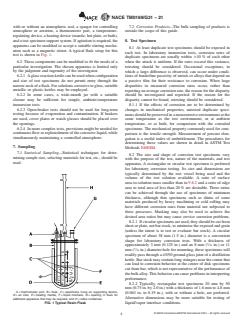
1.1 This guide covers and describes the factors that influence laboratory immersion corrosion tests, particularly mass loss tests. These factors include apparatus, sampling, test specimen, test conditions (test solution composition, temperature, gas sparging, fluid motion, solution volume, method of supporting test specimens, duration of test), methods of cleaning test specimens, interpretation of results, and calculation of corrosion rates. This guide also emphasizes the importance of recording all pertinent data and provides a checklist for reporting test data.
1.2 The specific evaluation of localized attack, environmentally assisted cracking, and effects of solution flow are not within the scope of this guide.
1.3 This guide is intended to be used by those designing laboratory immersion tests who may not be familiar with all of the variables to consider and the pitfalls that could be encountered when designing and conducting this kind of testing. It should be used as a reference to ensure that the test will allow generation of data relevant to the application with the minimum of interferences.
1.4 The values stated in SI units are to be regarded as standard. The values given in parentheses after SI units are provided for information only and are not considered standard.
1.5 This standard does not purport to address all of the safety concerns, if any, associated with its use. It is the responsibility of the user of this standard to establish appropriate safety, health, and environmental practices and determine the applicability of regulatory limitations prior to use.
1.6 This international standard was developed in accordance with internationally recognized principles on standardization established in the Decision on Principles for the Development of International Standards, Guides and Recommendations issued by the World Trade Organization Technical Barriers to Trade (TBT) Committee.
General Information
- Status
- Published
- Publication Date
- 31-Dec-2020
- Technical Committee
- J01 - Joint ASTM/NACE Committee on Corrosion
- Drafting Committee
- J01.01 - Working Group on Laboratory Immersion Tests
Relations
- Effective Date
- 15-Jan-2024
- Effective Date
- 01-Jan-2024
- Effective Date
- 01-Dec-2023
- Effective Date
- 01-Dec-2023
- Effective Date
- 01-May-2019
- Effective Date
- 15-Feb-2019
- Effective Date
- 01-Oct-2018
- Effective Date
- 15-Jul-2016
- Effective Date
- 01-Feb-2015
- Effective Date
- 01-May-2014
- Effective Date
- 01-Jun-2013
- Effective Date
- 01-May-2013
- Effective Date
- 01-May-2013
- Effective Date
- 01-May-2013
- Effective Date
- 01-May-2013
Overview
ASTM G31-21, Standard Guide for Laboratory Immersion Corrosion Testing of Metals, is a widely referenced standard developed by ASTM International. This guide provides comprehensive instructions for conducting laboratory immersion corrosion tests on metals, with a strong focus on factors that influence test results and best practices for reporting. Rather than prescribing a rigid methodology, ASTM G31-21 serves as a flexible framework to help engineers, researchers, and quality assurance specialists obtain reliable, consistent, and meaningful corrosion data from mass loss immersion tests.
Laboratory immersion corrosion testing, as guided by ASTM G31-21, is vital for understanding the corrosion behavior of metals and alloys under controlled conditions. The standard highlights the importance of considering all variables that can impact outcomes and emphasizes detailed documentation, which helps reduce conflicting reports and improves correlation of results across different studies or organizations.
Key Topics
ASTM G31-21 covers several essential elements for successful immersion corrosion testing:
Apparatus Selection
Describes suitable equipment such as kettles, flasks, and support systems, including recommendations for modifications based on test requirements.Sampling and Specimens
Includes guidelines for specimen preparation, duplication for statistical reliability, size/shape recommendations, and cleaning methods to ensure uniformity and representativeness.Test Conditions
Outlines critical test variables:- Test solution composition (including preparation, pH, and density)
- Temperature control and gradients
- Gas sparging and atmosphere control
- Fluid motion and solution volume
- Duration and methods of supporting specimens
Cleaning and Measurement
Emphasizes the significance of proper cleaning, drying, and mass determination to achieve accurate corrosion rate calculations.Result Interpretation
Advises on interpretation and reporting, with guidance to avoid misrepresentation due to test limitations or outlier results. Suggests including full details of conditions and all potentially impacting variables.Limits and Exclusions
Notes that specialized corrosion mechanisms such as localized attack (pitting, crevice corrosion), environmentally assisted cracking, and specific solution flow effects are not addressed in depth. It refers users to related standards for these topics.
Applications
ASTM G31-21 is used across industries where corrosion resistance is critical, including:
Material Qualification:
Screening and comparison of metals and alloys for suitability in corrosive environments.Research and Development:
Designing new alloys or protective coatings, validating improvements with repeatable mass loss measurements.Quality Control:
Routine assessment of batch-to-batch consistency in metallic product corrosion resistance.Process Optimization:
Simulating service environments (e.g., adjusting oxygen levels, temperature, or fluid motion) to evaluate materials before real-world deployment.
Professionals utilizing this guide include corrosion engineers, metallurgists, laboratory technicians, and those responsible for compliance and quality within manufacturing, chemical processing, oil and gas, water treatment, and construction.
Related Standards
ASTM G31-21 refers to and is complemented by a broad range of related corrosion testing standards, including:
- ASTM G1 – Preparing, Cleaning, and Evaluating Corrosion Test Specimens
- ASTM A262, G28, G110 – Corrosion susceptibility tests for specific alloys
- ASTM G46, G48 – Pitting and crevice corrosion assessment
- ASTM G71, G82 – Galvanic corrosion
- ASTM G170, G184, G185 – Corrosion inhibitor performance in oilfield/refinery environments
- ISO 11845, ISO 3651, ISO 8407, ISO 6509 – International corrosion testing practices
For specialized corrosion forms, consult standards such as ASTM G78 (crevice), ASTM G107 (corrosion data formats), and others referenced within ASTM G31-21.
Keywords: ASTM G31-21, laboratory immersion corrosion testing, mass loss test, corrosion rate, metal alloys, corrosion test standard, ASTM International, corrosion data reporting, specimen preparation, corrosion resistance, quality control, material qualification, industrial corrosion testing.
Buy Documents
ASTM G31-21 - Standard Guide for Laboratory Immersion Corrosion Testing of Metals
REDLINE ASTM G31-21 - Standard Guide for Laboratory Immersion Corrosion Testing of Metals
Get Certified
Connect with accredited certification bodies for this standard

Element Materials Technology
Materials testing and product certification.

Inštitut za kovinske materiale in tehnologije
Institute of Metals and Technology. Materials testing, metallurgical analysis, NDT.
Sponsored listings
Frequently Asked Questions
ASTM G31-21 is a guide published by ASTM International. Its full title is "Standard Guide for Laboratory Immersion Corrosion Testing of Metals". This standard covers: SIGNIFICANCE AND USE 4.1 Corrosion testing by its very nature precludes complete standardization. This standard, rather than a standardized procedure, is presented as a guide so that some of the pitfalls of such testing may be avoided. 4.2 Experience has shown that all metals and alloys do not respond alike to the many factors that affect corrosion and that accelerated corrosion tests give indicative results only, or may even be entirely misleading. It is impractical to propose an inflexible standard laboratory corrosion testing procedure for general use, except for material qualification tests where standardization is required. One purpose for this guide is to promote better correlation of results in the future and the reduction of conflicting reports through a more detailed recording of meaningful factors and conditions. 4.3 In designing any corrosion test, consideration should be given to the various factors discussed in this guide, because these factors have been found to affect the results obtained. SCOPE 1.1 This guide covers and describes the factors that influence laboratory immersion corrosion tests, particularly mass loss tests. These factors include apparatus, sampling, test specimen, test conditions (test solution composition, temperature, gas sparging, fluid motion, solution volume, method of supporting test specimens, duration of test), methods of cleaning test specimens, interpretation of results, and calculation of corrosion rates. This guide also emphasizes the importance of recording all pertinent data and provides a checklist for reporting test data. 1.2 The specific evaluation of localized attack, environmentally assisted cracking, and effects of solution flow are not within the scope of this guide. 1.3 This guide is intended to be used by those designing laboratory immersion tests who may not be familiar with all of the variables to consider and the pitfalls that could be encountered when designing and conducting this kind of testing. It should be used as a reference to ensure that the test will allow generation of data relevant to the application with the minimum of interferences. 1.4 The values stated in SI units are to be regarded as standard. The values given in parentheses after SI units are provided for information only and are not considered standard. 1.5 This standard does not purport to address all of the safety concerns, if any, associated with its use. It is the responsibility of the user of this standard to establish appropriate safety, health, and environmental practices and determine the applicability of regulatory limitations prior to use. 1.6 This international standard was developed in accordance with internationally recognized principles on standardization established in the Decision on Principles for the Development of International Standards, Guides and Recommendations issued by the World Trade Organization Technical Barriers to Trade (TBT) Committee.
SIGNIFICANCE AND USE 4.1 Corrosion testing by its very nature precludes complete standardization. This standard, rather than a standardized procedure, is presented as a guide so that some of the pitfalls of such testing may be avoided. 4.2 Experience has shown that all metals and alloys do not respond alike to the many factors that affect corrosion and that accelerated corrosion tests give indicative results only, or may even be entirely misleading. It is impractical to propose an inflexible standard laboratory corrosion testing procedure for general use, except for material qualification tests where standardization is required. One purpose for this guide is to promote better correlation of results in the future and the reduction of conflicting reports through a more detailed recording of meaningful factors and conditions. 4.3 In designing any corrosion test, consideration should be given to the various factors discussed in this guide, because these factors have been found to affect the results obtained. SCOPE 1.1 This guide covers and describes the factors that influence laboratory immersion corrosion tests, particularly mass loss tests. These factors include apparatus, sampling, test specimen, test conditions (test solution composition, temperature, gas sparging, fluid motion, solution volume, method of supporting test specimens, duration of test), methods of cleaning test specimens, interpretation of results, and calculation of corrosion rates. This guide also emphasizes the importance of recording all pertinent data and provides a checklist for reporting test data. 1.2 The specific evaluation of localized attack, environmentally assisted cracking, and effects of solution flow are not within the scope of this guide. 1.3 This guide is intended to be used by those designing laboratory immersion tests who may not be familiar with all of the variables to consider and the pitfalls that could be encountered when designing and conducting this kind of testing. It should be used as a reference to ensure that the test will allow generation of data relevant to the application with the minimum of interferences. 1.4 The values stated in SI units are to be regarded as standard. The values given in parentheses after SI units are provided for information only and are not considered standard. 1.5 This standard does not purport to address all of the safety concerns, if any, associated with its use. It is the responsibility of the user of this standard to establish appropriate safety, health, and environmental practices and determine the applicability of regulatory limitations prior to use. 1.6 This international standard was developed in accordance with internationally recognized principles on standardization established in the Decision on Principles for the Development of International Standards, Guides and Recommendations issued by the World Trade Organization Technical Barriers to Trade (TBT) Committee.
ASTM G31-21 is classified under the following ICS (International Classification for Standards) categories: 77.060 - Corrosion of metals. The ICS classification helps identify the subject area and facilitates finding related standards.
ASTM G31-21 has the following relationships with other standards: It is inter standard links to ASTM G67-24, ASTM E8/E8M-24, ASTM G34-23, ASTM G66-23, ASTM G71-81(2019), ASTM G135-95(2019), ASTM G67-18, ASTM E8/E8M-16, ASTM E8/E8M-15, ASTM G71-81(2014), ASTM E8/E8M-13, ASTM G34-01(2013), ASTM A262-13, ASTM G66-99(2013), ASTM G135-95(2013). Understanding these relationships helps ensure you are using the most current and applicable version of the standard.
ASTM G31-21 is available in PDF format for immediate download after purchase. The document can be added to your cart and obtained through the secure checkout process. Digital delivery ensures instant access to the complete standard document.
Standards Content (Sample)
This international standard was developed in accordance with internationally recognized principles on standardization established in the Decision on Principles for the
Development of International Standards, Guides and Recommendations issued by the World Trade Organization Technical Barriers to Trade (TBT) Committee.
Designation: NACE TM0169/G31 − 21
Standard Guide for
Laboratory Immersion Corrosion Testing of Metals
This standard is issued under the fixed designation NACE TM0169/G31; the number immediately following the designation indicates
the year of original adoption or, in the case of revision, the year of last revision. A number in parentheses indicates the year of last
reapproval. A superscript epsilon (´) indicates an editorial change since the last revision or reapproval.
1. Scope 2. Referenced Documents
1.1 This guide covers and describes the factors that influ- 2.1 ASTM Standards:
ence laboratory immersion corrosion tests, particularly mass A262 Practices for Detecting Susceptibility to Intergranular
loss tests. These factors include apparatus, sampling, test Attack in Austenitic Stainless Steels
specimen, test conditions (test solution composition, D1193 Specification for Reagent Water
temperature, gas sparging, fluid motion, solution volume, E8/E8M Test Methods for Tension Testing of Metallic Ma-
methodofsupportingtestspecimens,durationoftest),methods terials
of cleaning test specimens, interpretation of results, and E300 Practice for Sampling Industrial Chemicals
calculation of corrosion rates. This guide also emphasizes the G1 Practice for Preparing, Cleaning, and Evaluating Corro-
importance of recording all pertinent data and provides a sion Test Specimens
checklist for reporting test data. G28 Test Methods for Detecting Susceptibility to Inter-
granular Corrosion in Wrought, Nickel-Rich, Chromium-
1.2 The specific evaluation of localized attack, environmen-
Bearing Alloys
tally assisted cracking, and effects of solution flow are not
G34 Test Method for Exfoliation Corrosion Susceptibility in
within the scope of this guide.
2XXX and 7XXX Series Aluminum Alloys (EXCO Test)
1.3 This guide is intended to be used by those designing
G46 Guide for Examination and Evaluation of Pitting Cor-
laboratory immersion tests who may not be familiar with all of
rosion
the variables to consider and the pitfalls that could be encoun-
G48 Test Methods for Pitting and Crevice Corrosion Resis-
tered when designing and conducting this kind of testing. It
tance of Stainless Steels and Related Alloys by Use of
should be used as a reference to ensure that the test will allow
Ferric Chloride Solution
generation of data relevant to the application with the mini-
G66 Test Method for Visual Assessment of Exfoliation
mum of interferences.
Corrosion Susceptibility of 5XXX Series Aluminum Al-
loys (ASSET Test)
1.4 The values stated in SI units are to be regarded as
standard. The values given in parentheses after SI units are G67 Test Method for Determining the Susceptibility to
Intergranular Corrosion of 5XXX Series Aluminum Al-
provided for information only and are not considered standard.
loysbyMassLossAfterExposuretoNitricAcid(NAMLT
1.5 This standard does not purport to address all of the
Test)
safety concerns, if any, associated with its use. It is the
G71 Guide for Conducting and Evaluating Galvanic Corro-
responsibility of the user of this standard to establish appro-
sion Tests in Electrolytes
priate safety, health, and environmental practices and deter-
G78 Guide for Crevice Corrosion Testing of Iron-Base and
mine the applicability of regulatory limitations prior to use.
Nickel-Base Stainless Alloys in Seawater and Other
1.6 This international standard was developed in accor-
Chloride-Containing Aqueous Environments
dance with internationally recognized principles on standard-
G82 Guide for Development and Use of a Galvanic Series
ization established in the Decision on Principles for the
for Predicting Galvanic Corrosion Performance
Development of International Standards, Guides and Recom-
G107 Guide for Formats for Collection and Compilation of
mendations issued by the World Trade Organization Technical
Corrosion Data for Metals for Computerized Database
Barriers to Trade (TBT) Committee.
Input
This guide is under the jurisdiction of NACE/ASTM Committee J01, Joint
Committee on Corrosion, and is the direct responsibility of Subcommittee J01.01,
Working Group on Laboratory Immersion Tests. For referenced ASTM standards, visit the ASTM Web site, www.astm.org, or
Current edition approved Jan. 1, 2021. Published February 2021. Originally contact ASTM Customer Service at service@astm.org. For Annual Book of ASTM
approved in 1972. Last previous ASTM edition approved in 2012 as G31–12a. Standards volume information, refer to the standard’s Document Summary page on
NACE edition originally approved in 1969. Last previous NACE edition approved theASTMWeb site. For NACE standards, visit the NACEWeb site, www.nace.org,
in 2012 as TM0169-2012. DOI: 10.1520/G0031-21. or contact NACE First Service at firstservice@nace.org.
© NACE International/ASTM International 2021 – All rights reserved
NACE TM0169/G31 − 21
G108 Test Method for Electrochemical Reactivation (EPR) treatable aluminum alloys
for Detecting Sensitization of AISI Type 304 and 304L ISO 11881 Corrosion of metals and alloys – Exfoliation
Stainless Steels corrosion testing of aluminum alloys
G110 Practice for Evaluating Intergranular Corrosion Resis-
3. Terminology
tance of Heat Treatable Aluminum Alloys by Immersion
in Sodium Chloride + Hydrogen Peroxide Solution 3.1 For definitions of terms used in this guide, see NACE/
G112 Guide for Conducting Exfoliation Corrosion Tests in
ASTM Terminology G193.
Aluminum Alloys
4. Significance and Use
G116 Practice for Conducting Wire-on-Bolt Test for Atmo-
spheric Galvanic Corrosion
4.1 Corrosion testing by its very nature precludes complete
G135 Guide for Computerized Exchange of Corrosion Data
standardization. This standard, rather than a standardized
for Metals
procedure, is presented as a guide so that some of the pitfalls
G170 Guide for Evaluating and Qualifying Oilfield and
of such testing may be avoided.
Refinery Corrosion Inhibitors in the Laboratory
4.2 Experience has shown that all metals and alloys do not
G184 Practice for Evaluating and Qualifying Oil Field and
respond alike to the many factors that affect corrosion and that
Refinery Corrosion Inhibitors Using Rotating Cage
accelerated corrosion tests give indicative results only, or may
G185 Practice for Evaluating and Qualifying Oil Field and
even be entirely misleading. It is impractical to propose an
RefineryCorrosionInhibitorsUsingtheRotatingCylinder
inflexible standard laboratory corrosion testing procedure for
Electrode
general use, except for material qualification tests where
2.2 NACE/ASTM Standard:
standardization is required. One purpose for this guide is to
G193 Terminology and Acronyms Relating to Corrosion
promote better correlation of results in the future and the
2.3 NACE International Standard:
reductionofconflictingreportsthroughamoredetailedrecord-
SP0690 Standard Format for Collection and Compilation of
ing of meaningful factors and conditions.
Data for Computerized Material Corrosion Resistance
4.3 In designing any corrosion test, consideration should be
Database Input
given to the various factors discussed in this guide, because
2.4 International Organization for Standardization (ISO)
these factors have been found to affect the results obtained.
Standards:
ISO 3651-1 Determination of resistance to intergranular 5. Factors Affecting Corrosion Behavior
corrosion of stainless steels – Part 1: Austenitic and
5.1 The methods and procedures described herein represent
ferritic-austenitic (duplex) stainless steels – Corrosion test
the best current practices for conducting laboratory immersion
in nitric acid medium by measurement of loss in mass
corrosion tests as developed by corrosion specialists in the
(Huey test)
process industries. For proper interpretation of the results
ISO 3651-2 Determination of resistance to intergranular
obtained, the specific influence of one or more of the following
corrosion of stainless steels – Part 2: Ferritic, austenitic
variables should be considered.
and ferritic-austenitic (duplex) stainless steels – Corrosion
5.1.1 Metal specimens immersed in a specific hot liquid
test in media containing sulfuric acid
may not corrode at the same rate or in the same manner as in
ISO 6509 Corrosion of metals and alloys – Determination of
equipment where the metal acts as a heat transfer medium in
dezincification resistance of brass
heating or cooling the liquid. If the influence of heat transfer
ISO 8407 Corrosion of metals and alloys – Removal of
effects is specifically of interest, specialized procedures (in
corrosion products from corrosion test specimens
which the corrosion specimen serves as a heat transfer agent)
ISO 8993 Anodizing of aluminum and its alloys – Rating
shall be employed.
system for the evaluation of pitting corrosion – Chart
5.1.2 In laboratory immersion tests, the motion of the
method
environment relative to the specimens will normally be pro-
ISO 8994 Anodizing of aluminum and its alloys – Rating
vided by convection currents, gas sparging, or boiling. If the
system for the evaluation of pitting corrosion – Grid
specific effects of fluid flow are to be studied, special tech-
method
niques shall be employed to create and control the relative
ISO 9400 Nickel-based alloys – Determination of resistance
motion between the environment and the test specimens. This
to intergranular corrosion
may be accomplished by either moving the environment as
ISO 11463 Corrosion of metals and alloys – Guidelines for
through a tube or mechanical stirrer or by moving the speci-
the evaluation of pitting corrosion
mens as by rotation.
ISO 11845 Corrosion of metals and alloys – General prin-
5.1.3 The behavior of certain metals and alloys may be
ciples for corrosion testing
profoundly influenced by the presence of dissolved oxygen. If
ISO 11846 Corrosion of metals and alloys – Determination
this is a factor to be considered in a specific test, the solution
of resistance to intergranular corrosion of solution heat-
should be air saturated at 1 atm or de-aerated, as appropriate.
5.1.4 In some cases, the rate of corrosion may be governed
by other minor constituents in the solution, in which case they
Available from International Organization for Standardization (ISO), ISO
will have to be continually or intermittently replenished by
Central Secretariat, BIBC II, Chemin de Blandonnet 8, CP 401, 1214 Vernier,
Geneva, Switzerland, http://www.iso.org. changing the solution in the test.
© NACE International/ASTM International 2021 – All rights reserved
NACE TM0169/G31 − 21
5.1.5 Corrosion products may have undesirable effects on a 5.1.7.5 Certain metals and alloys are subject to a highly
chemical product. The amount of possible contamination can localized type of attack called pitting corrosion.This cannot be
sometimes be estimated from the loss in mass of the specimen evaluated by mass loss alone. Pitting is a statistical phenom-
or from the changes in the chemical composition of the test enon and the incidence of pitting may be directly related to the
environment. This is discussed in more detail in 9.8.3. area of metal exposed. For example, a small specimen is not as
prone to exhibit pitting as a large one and it is possible to miss
5.1.6 Corrosion products from the specimen may influence
the phenomenon altogether in the corrosion testing of certain
the corrosion rate of the metal itself or of different metals
alloys, such as the AISI Type 300 series stainless steels in
exposed at the same time. For example, the accumulation of
chloride-containing environments. Pitting testing is further
cupric ions in the testing of copper alloys in intermediate
discussed inASTM Guide G46,ASTMTest Methods G48, and
strengths of sulfuric acid will accelerate the corrosion of
ISO 8993, ISO 8994, and ISO 11463.
copper alloys, as compared to the rates that would be obtained
5.1.7.6 Most metals and alloys are subject to environmen-
if the corrosion products were continually removed. It may be
tally assisted cracking under some circumstances. This crack-
necessary to expose only alloys of the same general type in the
ingoccursunderconditionsofappliedorresidualtensilestress,
same testing apparatus unless it is known that no interactions
and it may or may not be visible to the unaided eye or upon
will occur.
casual inspection. A metallographic examination may confirm
5.1.7 Specimen corrosion testing is frequently designed to
thepresenceofenvironmentallyassistedcracking.Thisusually
investigate general corrosion only.There are a number of other
occurs with no significant loss in mass of the test specimen,
forms of corrosion of which one shall be aware in the design
although certain refractory metals are an exception to these
and interpretation of corrosion tests.
observations. Generally, if cracking is observed on the
5.1.7.1 Galvanic corrosion may be investigated by special
specimen, it can be taken as positive indication of
devices that couple one specimen to another in electrical
susceptibility, whereas failure to exhibit this phenomenon
contact. The behavior of the specimens in this galvanic couple
means that it did not occur under the duration and specific
is compared with that of insulated specimens exposed on the
conditions of the test. Separate and special techniques are
same holder. It should be observed, however, that galvanic
employed for the specific evaluation of the susceptibility of
corrosion can be greatly affected by the area ratios of the
metals and alloys to environmentally assisted cracking. Mul-
respective metals, the separation between the metals, and the
tiple standards from many different organizations are available
conductivity of the electrolyte. The coupling of corrosion
to describe stress-corrosion cracking tests.
specimens then yields only qualitative results, as a particular
specimen reflects only the relationship between these two
5.2 The use of welded specimens is sometimes desirable,
metals at the particular area ratio involved. Galvanic corrosion because some welds may be cathodic or anodic to the parent
testing is further discussed inASTM Guide G71,ASTM Guide
metal and may affect the corrosion rate.
G82, and ASTM Practice G116.
5.2.1 The heat-affected zone is also of importance but
should be studied separately because welds on test specimens
5.1.7.2 Crevice corrosion or concentration cell corrosion
may occur where the metal surface is partially blocked from may not adequately reproduce heat input or size effects of
full-size vessels.
the corroding liquid as under a spacer or supporting hook. It is
necessary to evaluate this localized corrosion separately from 5.2.2 Corrosion of a welded specimen is normally localized
the overall mass loss. Crevice corrosion testing is further and not representative of the entire surface and therefore
discussed inASTM Test Methods G48 andASTM Guide G78. separate thickness losses should be determined in the weld
metal, heat-affected zone, and base metal.
5.1.7.3 Selective corrosion at the grain boundaries (for
5.2.3 A complete discussion of corrosion testing of welded
example, intergranular corrosion of sensitized austenitic stain-
specimens or the effect of heat treatment on the corrosion
less steels) will not be readily observable in mass loss
resistance of a metal is not within the scope of this guide.
measurements unless the attack is severe enough to cause grain
However, important factors to be considered include the
dropping, and often requires microscopic examination of the
welding technique to be used, the filler metal chemistry, and
specimens after exposure. This type of corrosion may also
whether the weld will be ground smooth, cleaned, passivated,
result in loss of strength or ductility of materials. Such losses
or left as-welded.
canbeevaluatedbymechanicalpropertydeterminationsbefore
andafterexposuretothetestenvironment.Testingforselective
5.3 Cast and wrought alloys considered equivalent often
corrosion is further discussed in ASTM Practices A262 and
have somewhat different chemical composition and metallur-
G110, ASTM Test Methods G28, G34, G66, G67, G108, and
gical structure, resulting in different corrosion resistances in
ASTM Guide G112 and ISO 3651-1, ISO 3651-2, ISO 9400,
identical service conditions. Therefore, caution should be used
ISO 11846, and ISO 11881.
in selecting representative test materials.
5.1.7.4 Dealloying or “parting” corrosion is a condition in
5.4 Additional discussion of testing considerations is con-
which one constituent is selectively removed from an alloy, as
tained in ISO 11845.
in the dezincification of brass or the graphitization of cast iron.
Close attention and a more sophisticated evaluation than a
6. Apparatus
simple mass loss measurement are required to detect this
phenomenon. Dealloying testing is further discussed in ISO 6.1 Atypical testing apparatus consists of a kettle or flask of
6509. suitable size (usually 500 mL to 5000 mL), a reflux condenser
© NACE International/ASTM International 2021 – All rights reserved
NACE TM0169/G31 − 21
with or without an atmospheric seal, a sparger for controlling 7.2 Corrosion Products—The bulk sampling of products is
atmosphere or aeration, a thermometer port, a temperature- outside the scope of this guide.
regulating device, a heating device (mantle, hot plate, or bath),
and a test specimen support system. If agitation is required, the 8. Test Specimen
apparatus can be modified to accept a suitable stirring mecha-
8.1 At least duplicate test specimens should be exposed in
nism such as a magnetic stirrer. A typical flask setup for this
each test. In laboratory immersion tests, corrosion rates of
test is shown in Fig. 1.
duplicate specimens are usually within 610 % of each other
6.2 These components can be modified to fit the needs of a when the attack is uniform. If the rates exceed this variance,
particular investigation. The chosen apparatus is limited only
retesting should be considered. Occasional exceptions, in
by the judgment and ingenuity of the investigator. which a large difference is observed, can occur under condi-
6.2.1 Aglass reaction kettle can be used when configuration
tions of borderline passivity of metals or alloys that depend on
and size of test specimens do not permit entry through the a passive film for their resistance to corrosion. When large
narrowneckofaflask.Forsolutionscorrosivetoglass,suitable
disparities in measured corrosion rates occur, rather than
metallic or plastic kettles may be employed. reporting an average corrosion rate, the reason for the disparity
6.2.2 In some cases, a wide-mouth jar with a suitable
should be investigated and reported. If the reason for the
closure may be sufficient for simple, ambient-temperature
disparity cannot be found, retesting should be considered.
immersion tests.
8.1.1 If the effects of corrosion are to be determined by
6.2.3 Open-beaker tests should not be used for long-term
changes in mechanical properties, untested duplicate speci-
testing because of evaporation and contamination. If beakers
mensshouldbepreservedinanoncorrosiveenvironmentatthe
are used, cover plates or watch glasses should be placed over
same temperature as the test environment, or at ambient
the openings.
temperature, or at both, for comparison with the corroded
6.2.4 In more complex tests, provisions might be needed for
specimens. The mechanical property commonly used for com-
continuous flow or replenishment of the corrosive liquid, while
parison is the tensile strength. Measurement of percent elon-
simultaneously maintaining a controlled atmosphere.
gation is a useful index of embrittlement. The procedures for
determining these values are shown in detail in ASTM Test
7. Sampling
Methods E8/E8M.
7.1 Statistical Sampling—Statistical techniques for deter-
8.2 The size and shape of corrosion test specimens vary
mining sample size, selecting materials for test, etc., should be
with the purpose of the test, nature of the materials, and test
used.
apparatus. A rectangular or circular test specimen is preferred
for laboratory corrosion testing. Its size and dimensions are
typically determined by the test vessel being used and the
volume of the test solution available. A ratio of surface
area-to-solution mass smaller than in 9.8.2 and a ratio of edge
area to total area of less than 20 % are desirable. These ratios
can be achieved through the use of specimens of minimum
thickness, although thin specimens such as shims of some
materials produced by heavy machining or cold rolling may
have different corrosion rates from material not subjected to
these processes. Masking may also be used to achieve the
desired area ratios but may cause crevice corrosion problems.
8.2.1 Ifcircularspecimensareused,theyshouldbecutfrom
sheet or plate, not bar stock, to minimize the exposed end grain
(unless the intent is to test or evaluate bar stock). A circular
specimen of about 38 mm (1.5 in.) diameter is a convenient
shape for laboratory corrosion tests. With a thickness of
approximately 3 mm (0.125 in.) and an 8 mm ( ⁄16 in.) or 11
mm ( ⁄16 in.) diameter hole for mounting, these specimens will
readily pass through a 45/50 ground-glass joint of a distillation
kettle. Bar stock may contain long stringers near the center that
can lead to corrosion behavior at the center of disk specimens
cut from bar, which is not representative of the performance of
thebulkalloy.Thisbehaviorcancauseproblemsininterpreting
performance.
8.2.2 Typically, rectangular test specimens 20 mm by 50
mm (0.75 in. by 2.0 in.) with a thickness of 1.6 mm to 4.8 mm
A = thermometer port, B = flask, C = specimens hung on supporting device,
(0.063 in. to 0.19 in.), with or without a hole, are preferred.
D = air inlet, E = heating mantle, F = liquid interface, G = opening in flask for
Alternative dimensions may be more suitable for testing of
additional apparatus that may be required, and H = reflux condenser.
FIG. 1 Typical Resin Flask liquid/vapor interface conditions.
© NACE International/ASTM International 2021 – All rights reserved
NACE TM0169/G31 − 21
8.2.3 All specimens should be measured carefully to permit surface of the coupon (for example, by immersion of stainless
accurate calculation of the exposed areas. A geometric area steelcouponsindilutenitricacidfollowingstampingwithsteel
calculation accurate to 61 % is usually adequate.
dies).
8.6.1 The stamp, besides identifying the specimen, intro-
8.3 More uniform results can be expected if a uniform layer
duces stresses and cold work in the specimen that could be
of metal is removed from the specimens to eliminate variations
responsible for localized corrosion or stress-corrosion
in condition of the original metallic surface. This can be done
cracking, or both.
by chemical treatment (pickling), electrolytic removal, or by
grinding with a coarse abrasive paper or cloth such as No. 50, 8.6.2 Environmentally assisted cracking at the identifying
markisapositiveindicationofsusceptibilitytosuchcorrosion.
using care not to work harden the surface. Abrasive materials
may be picked up in the surface if the metal is soft, and may However, the absence of cracking should not be interpreted as
lead to pitting if not removed.At least 0.0025 mm (0.0001 in.) indicating resistance. Additional types of tests should be
2 2 2 2
or 0.016 mg⁄mm to 0.023 mg/mm (5 mg⁄in. to 10 mg/in. ) performed to specifically study the effects of stress.
should be removed. (If clad alloy specimens are to be used,
8.6.3 The relative location of test specimens in the test
special attention shall be given to ensure that excessive metal
apparatus should be recorded prior to testing to permit test
is not removed.) After final preparation of the specimen
specimen identification in the event the identification mark is
surface, the specimens should be stored in a desiccator until
corroded away.
exposure if they are not used immediately. Materials that form
8.7 Test specimens may be scrubbed with a bleach-free
passive films may give different results if exposed after
scouring powder followed by thorough rinsing in water and in
different rest times following polishing. In special cases (for
a suitable solvent (such as acetone, methanol, or a mixture of
example, for aluminum and certain copper alloys), a minimum
50 % methanol and 50 % diethylether), and air dried. For
of 24 h storage in a desiccator is recommended. The choice of
relatively soft metals such as aluminum, magnesium, and
a specific surface treatment shall be considered on the basis of
copper, scrubbing with abrasive powder is not always needed
the alloy to be tested and the reasons for testing.Acommercial
and can mar the surface of the test specimen.
surface may sometimes yield the most significant results. Too
much surface preparation may remove segregated elements,
8.7.1 Proper ultrasonic procedures are an acceptable alter-
surface contamination, and so forth, and therefore not be
nate.
representative of the application.
8.7.2 The use of towels for drying may introduce an error
8.3.1 Final surface treatment of the specimens should in-
through contamination of the specimens with grease or lint.
clude finishing with No. 120 abrasive paper or cloth or the
8.7.3 Test specimens should be handled with gloves,
equivalent, unless the surface is to be used in the mill-finished
tweezers, or tongs to avoid contamination of the surface after
condition. This resurfacing may cause some surface work
cleaning.
hardening, to an extent that will be determined by the vigor of
8.8 The mass of dried test specimens should be determined
the surfacing operation, but is not ordinarily significant. The
on an analytical balance to an accuracy of 1 mg or better. If
surface finish to be encountered in service may be more
appropriate for some testing. cleaning deposits (for example, scouring powder) remain or
lack of complete dryness is suspected, then recleaning and
8.3.1.1 Specimens of different alloy compositions should
drying should be performed until a constant mass is attained.
never be ground on the same cloth.
8.3.1.2 Wet grinding should be used on alloys that work
9. Test Conditions
harden readily, such as austenitic stainless steels.
9.1 Selection of the conditions for a laboratory corrosion
8.4 Sheared edges should be removed unless the purpose of
test shall be determined by the purpose of the test.
the test is to study effects of the shearing operation or unless
the effect of the deformation resulting from shearing is known 9.1.1 Ifthetestistobeaguidefortheselectionofamaterial
to have no effect on corrosion.Asheared edge can be removed for a particular purpose, the limits of the controlling factors in
before testing by wet grinding to a distance from the sheared
service shall be determined. These factors include oxygen
edgeequaltothethicknessofthespecimen.Itmaybedesirable
concentration, temperature, rate of flow, pH value,
totestasurfacerepresentativeofthematerialandmetallurgical
composition, and other important characteristics of the solu-
conditions used in practice.
tion.
8.5 As-laser-cut edges should be removed unless the pur-
9.2 An effort should be made to duplicate all pertinent
pose of the test is to study effects of the laser-cutting process.
service conditions in the corrosion test.
The effects of laser cutting can be removed from an edge
9.3 Test conditions should be controlled throughout the test
beforetestingbysandingorwetgrindingtoadistancefromthe
in order to ensure reproducible results.
cut edge equal to 125 µm (0.005 in.).
9.4 Composition of Solution:
8.6 The specimen may be stamped with an appropriate
identifyingmark.Ifmetalliccontaminationofthestampedarea 9.4.1 Test solutions should be prepared accurately from
chemicals conforming to the la
...
This document is not an ASTM standard and is intended only to provide the user of an ASTM standard an indication of what changes have been made to the previous version. Because
it may not be technically possible to adequately depict all changes accurately, ASTM recommends that users consult prior editions as appropriate. In all cases only the current version
of the standard as published by ASTM is to be considered the official document.
Designation: NACE TM0169/G31 − 12a
NACE TM0169/G31 − 21
Standard Guide for
Laboratory Immersion Corrosion Testing of Metals
This standard is issued under the fixed designation NACE TM0169/G31; the number immediately following the designation indicates
the year of original adoption or, in the case of revision, the year of last revision. A number in parentheses indicates the year of last
reapproval. A superscript epsilon (´) indicates an editorial change since the last revision or reapproval.
1. Scope
1.1 This guide covers and describes the factors that influence laboratory immersion corrosion tests, particularly mass loss tests.
These factors include apparatus, sampling, test specimen, test conditions (test solution composition, temperature, gas sparging,
fluid motion, solution volume, method of supporting test specimens, duration of test), methods of cleaning test specimens,
interpretation of results, and calculation of corrosion rates. This guide also emphasizes the importance of recording all pertinent
data and provides a checklist for reporting test data.
1.2 The specific evaluation of localized attack, environmentally assisted cracking, and effects of solution flow are not within the
scope of this guide.
1.3 This guide is intended to be used by those designing laboratory immersion tests who may not be familiar with all of the
variables to consider and the pitfalls that could be encountered when designing and conducting this kind of testing. It should be
used as a reference to ensure that the test will allow generation of data relevant to the application with the minimum of
interferences.
1.4 The values stated in SI units are to be regarded as the standard. The values given in parentheses are for information only.after
SI units are provided for information only and are not considered standard.
1.5 This standard does not purport to address all of the safety concerns, if any, associated with its use. It is the responsibility
of the user of this standard to establish appropriate safety safety, health, and healthenvironmental practices and determine the
applicability of regulatory limitations prior to use.
1.6 This international standard was developed in accordance with internationally recognized principles on standardization
established in the Decision on Principles for the Development of International Standards, Guides and Recommendations issued
by the World Trade Organization Technical Barriers to Trade (TBT) Committee.
2. Referenced Documents
2.1 ASTM Standards:
A262 Practices for Detecting Susceptibility to Intergranular Attack in Austenitic Stainless Steels
D1193 Specification for Reagent Water
This guide is under the jurisdiction of NACE/ASTM Committee J01, Joint Committee on Corrosion, and is the direct responsibility of Subcommittee J01.01, Working
Group on Laboratory Immersion Tests.
Current edition approved July 1, 2012Jan. 1, 2021. Published October 2012February 2021. Originally approved in 1972. Last previous ASTM edition approved in 2012
as G31–12.–12a. NACE edition originally approved in 1969. Last previous NACE edition approved in 20002012 as TM0169-2000.TM0169-2012. DOI: 10.1520/G0031-12A.
10.1520/G0031-21.
For referenced ASTM standards, visit the ASTM Web site, www.astm.org, or contact ASTM Customer Service at service@astm.org. For Annual Book of ASTM Standards
volume information, refer to the standard’sstandard’s Document Summary page on the ASTM Web site. For NACE standards, visit the NACE Web site, www.nace.org, or
contact NACE First Service at firstservice@nace.org.
© NACE International/ASTM International 2021 – All rights reserved
NACE TM0169/G31 − 21
E8E8/E8M Test Methods for Tension Testing of Metallic Materials [Metric] E0008_E0008M
E300 Practice for Sampling Industrial Chemicals
G1 Practice for Preparing, Cleaning, and Evaluating Corrosion Test Specimens
G28 Test Methods for Detecting Susceptibility to Intergranular Corrosion in Wrought, Nickel-Rich, Chromium-Bearing Alloys
G34 Test Method for Exfoliation Corrosion Susceptibility in 2XXX and 7XXX Series Aluminum Alloys (EXCO Test)
G46 Guide for Examination and Evaluation of Pitting Corrosion
G48 Test Methods for Pitting and Crevice Corrosion Resistance of Stainless Steels and Related Alloys by Use of Ferric Chloride
Solution
G66 Test Method for Visual Assessment of Exfoliation Corrosion Susceptibility of 5XXX Series Aluminum Alloys (ASSET
Test)
G67 Test Method for Determining the Susceptibility to Intergranular Corrosion of 5XXX Series Aluminum Alloys by Mass Loss
After Exposure to Nitric Acid (NAMLT Test)
G71 Guide for Conducting and Evaluating Galvanic Corrosion Tests in Electrolytes
G78 Guide for Crevice Corrosion Testing of Iron-Base and Nickel-Base Stainless Alloys in Seawater and Other Chloride-
Containing Aqueous Environments
G82 Guide for Development and Use of a Galvanic Series for Predicting Galvanic Corrosion Performance
G107 Guide for Formats for Collection and Compilation of Corrosion Data for Metals for Computerized Database Input
© NACE International/ASTM International 2021 – All rights reserved
NACE TM0169/G31 − 21
G108 Test Method for Electrochemical Reactivation (EPR) for Detecting Sensitization of AISI Type 304 and 304L Stainless
Steels
G110 Practice for Evaluating Intergranular Corrosion Resistance of Heat Treatable Aluminum Alloys by Immersion in Sodium
Chloride + Hydrogen Peroxide Solution
G112 Guide for Conducting Exfoliation Corrosion Tests in Aluminum Alloys
G116 Practice for Conducting Wire-on-Bolt Test for Atmospheric Galvanic Corrosion
G135 Guide for Computerized Exchange of Corrosion Data for Metals
G170 Guide for Evaluating and Qualifying Oilfield and Refinery Corrosion Inhibitors in the Laboratory
G184 Practice for Evaluating and Qualifying Oil Field and Refinery Corrosion Inhibitors Using Rotating Cage
G185 Practice for Evaluating and Qualifying Oil Field and Refinery Corrosion Inhibitors Using the Rotating Cylinder Electrode
2.2 NACE/ASTM Standards:Standard:
G193 Terminology and Acronyms Relating to Corrosion
2.3 NACE International Standards:Standard:
SP0690 Standard Format for Collection and Compilation of Data for Computerized Material Corrosion Resistance Database
Input
2.4 International Organization for Standardization (ISO) Standards:
ISO 3651-1 Austenitic Stainless Steels – Determination of resistance to intergranular corrosion of stainless steels – Part I:1:
Austenitic and ferritic-austenitic (duplex) stainless steels – Corrosion test in nitric acid medium by measurement of loss in
mass (Huey test)
ISO 3651-2 Determination of resistance to intergranular corrosion of stainless steels – Part 2: Ferritic, austenitic and
ferritic-austenitic (duplex) stainless steels – corrosionCorrosion test in media containing sulfuric acid
ISO 6509 Corrosion of metals and alloys – Determination of dezincification resistance of brass
ISO 8407 Corrosion of metals and alloys – Removal of corrosion products from corrosion test specimens
ISO 8993 Anodized Anodizing of aluminum and aluminumits alloys – Rating system for the evaluation of pitting corrosion –
Chart method
ISO 8994 Anodized Anodizing of aluminum and aluminumits alloys – Rating system for the evaluation of pitting corrosion –
Grid method
ISO 9400 Nickel-based alloys – Determination of resistance to intergranular corrosion
ISO 11463 Corrosion of metals and alloys – Evaluation Guidelines for the evaluation of pitting corrosion
ISO 11845 Corrosion of metals and alloys – General principles for corrosion testing
ISO 11846 Corrosion of metals and alloys – Determination of resistance to intergranular corrosion of solution heat-treatable
aluminum alloys
ISO 11881 Corrosion of metals and alloys – Exfoliation corrosion testing of aluminum alloys
3. Terminology
3.1 For definitions of terms used in this guide, see NACE/ASTM Terminology G193.
4. Significance and Use
4.1 Corrosion testing by its very nature precludes complete standardization. This standard, rather than a standardized procedure,
is presented as a guide so that some of the pitfalls of such testing may be avoided.
4.2 Experience has shown that all metals and alloys do not respond alike to the many factors that affect corrosion and that
accelerated corrosion tests give indicative results only, or may even be entirely misleading. It is impractical to propose an inflexible
standard laboratory corrosion testing procedure for general use, except for material qualification tests where standardization is
required. One purpose for this guide is to promote better correlation of results in the future and the reduction of conflicting reports
through a more detailed recording of meaningful factors and conditions.
4.3 In designing any corrosion test, consideration should be given to the various factors discussed in this guide, because these
factors have been found to affect the results obtained.
5. Factors Affecting Corrosion Behavior
5.1 The methods and procedures described herein represent the best current practices for conducting laboratory immersion
Available from International Organization for Standardization (ISO), 1, ch. de la Voie-Creuse, Case postale 56, CH-1211, Geneva 20, Switzerland, http://www.iso.ch.ISO
Central Secretariat, BIBC II, Chemin de Blandonnet 8, CP 401, 1214 Vernier, Geneva, Switzerland, http://www.iso.org.
© NACE International/ASTM International 2021 – All rights reserved
NACE TM0169/G31 − 21
corrosion tests as developed by corrosion specialists in the process industries. For proper interpretation of the results obtained, the
specific influence of one or more of the following variables should be considered.
5.1.1 Metal specimens immersed in a specific hot liquid may not corrode at the same rate or in the same manner as in equipment
where the metal acts as a heat transfer medium in heating or cooling the liquid. If the influence of heat transfer effects is specifically
of interest, specialized procedures (in which the corrosion specimen serves as a heat transfer agent) shall be employed.
5.1.2 In laboratory immersion tests, the motion of the environment relative to the specimens will normally be provided by
convection currents, gas sparging, or boiling. If the specific effects of fluid flow are to be studied, special techniques shall be
employed to create and control the relative motion between the environment and the test specimens. This may be accomplished
by either moving the environment as through a tube or mechanical stirrer or by moving the specimens as by rotation.
5.1.3 The behavior of certain metals and alloys may be profoundly influenced by the presence of dissolved oxygen. If this is a
factor to be considered in a specific test, the solution should be air saturated at 1 atm or de-aerated, as appropriate.
5.1.4 In some cases, the rate of corrosion may be governed by other minor constituents in the solution, in which case they will
have to be continually or intermittently replenished by changing the solution in the test.
5.1.5 Corrosion products may have undesirable effects on a chemical product. The amount of possible contamination can
sometimes be estimated from the loss in mass of the specimen or from the changes in the chemical composition of the test
environment. This is discussed in more detail in 9.8.3.
5.1.6 Corrosion products from the specimen may influence the corrosion rate of the metal itself or of different metals exposed at
the same time. For example, the accumulation of cupric ions in the testing of copper alloys in intermediate strengths of sulfuric
acid will accelerate the corrosion of copper alloys, as compared to the rates that would be obtained if the corrosion products were
continually removed. It may be necessary to expose only alloys of the same general type in the same testing apparatus unless it
is known that no interactions will occur.
5.1.7 Specimen corrosion testing is frequently designed to investigate general corrosion only. There are a number of other forms
of corrosion of which one shall be aware in the design and interpretation of corrosion tests.
5.1.7.1 Galvanic corrosion may be investigated by special devices that couple one specimen to another in electrical contact. The
behavior of the specimens in this galvanic couple is compared with that of insulated specimens exposed on the same holder. It
should be observed, however, that galvanic corrosion can be greatly affected by the area ratios of the respective metals, the
separation between the metals, and the conductivity of the electrolyte. The coupling of corrosion specimens then yields only
qualitative results, as a particular specimen reflects only the relationship between these two metals at the particular area ratio
involved. Galvanic corrosion testing is further discussed in ASTM Guide G71, ASTM Guide G82, and ASTM Practice G116.
5.1.7.2 Crevice corrosion or concentration cell corrosion may occur where the metal surface is partially blocked from the
corroding liquid as under a spacer or supporting hook. It is necessary to evaluate this localized corrosion separately from the overall
mass loss. Crevice corrosion testing is further discussed in ASTM Test Methods G48 and ASTM Guide G78.
5.1.7.3 Selective corrosion at the grain boundaries (for example, intergranular corrosion of sensitized austenitic stainless steels)
will not be readily observable in mass loss measurements unless the attack is severe enough to cause grain dropping, and often
requires microscopic examination of the specimens after exposure. This type of corrosion may also result in loss of strength or
ductility of materials. Such losses can be evaluated by mechanical property determinations before and after exposure to the test
environment. Testing for selective corrosion is further discussed in ASTM Practices A262 and G110, ASTM Test Methods G28,
G34, G66, G67, G108, G110, and ASTM Guide G112 and ISO 3651-1, ISO 3651-2, ISO 9400, ISO 11846, and ISO 11881.
5.1.7.4 Dealloying or “parting” corrosion is a condition in which one constituent is selectively removed from an alloy, as in the
dezincification of brass or the graphitization of cast iron. Close attention and a more sophisticated evaluation than a simple mass
loss measurement are required to detect this phenomenon. Dealloying testing is further discussed in ISO 6509.
5.1.7.5 Certain metals and alloys are subject to a highly localized type of attack called pitting corrosion. This cannot be evaluated
by mass loss alone. Pitting is a statistical phenomenon and the incidence of pitting may be directly related to the area of metal
exposed. For example, a small specimen is not as prone to exhibit pitting as a large one and it is possible to miss the phenomenon
© NACE International/ASTM International 2021 – All rights reserved
NACE TM0169/G31 − 21
altogether in the corrosion testing of certain alloys, such as the AISI Type 300 series stainless steels in chloride-containing
environments. Pitting testing is further discussed in ASTM Guide G46, ASTM Test Methods G48, and ISO 8993, ISO 8994, and
ISO 11463.
5.1.7.6 Most metals and alloys are subject to environmentally assisted cracking under some circumstances. This cracking occurs
under conditions of applied or residual tensile stress, and it may or may not be visible to the unaided eye or upon casual inspection.
A metallographic examination may confirm the presence of environmentally assisted cracking. This usually occurs with no
significant loss in mass of the test specimen, although certain refractory metals are an exception to these observations. Generally,
if cracking is observed on the specimen, it can be taken as positive indication of susceptibility, whereas failure to exhibit this
phenomenon means that it did not occur under the duration and specific conditions of the test. Separate and special techniques are
employed for the specific evaluation of the susceptibility of metals and alloys to environmentally assisted cracking. Multiple
standards from many different organizations are available to describe stress-corrosion cracking tests.
5.2 The use of welded specimens is sometimes desirable, because some welds may be cathodic or anodic to the parent metal and
may affect the corrosion rate.
5.2.1 The heat-affected zone is also of importance but should be studied separately because welds on test specimens may not
adequately reproduce heat input or size effects of full-size vessels.
5.2.2 Corrosion of a welded specimen is normally localized and not representative of the entire surface and therefore separate
thickness losses should be determined in the weld metal, heat-affected zone, and base metal.
5.2.3 A complete discussion of corrosion testing of welded specimens or the effect of heat treatment on the corrosion resistance
of a metal is not within the scope of this guide. However, important factors to be considered include the welding technique to be
used, the filler metal chemistry, and whether the weld will be ground smooth, cleaned, passivated, or left as-welded.
5.3 Cast and wrought alloys considered equivalent often have somewhat different chemical composition and metallurgical
structure, resulting in different corrosion resistances in identical service conditions. Therefore, caution should be used in selecting
representative test materials.
5.4 Additional discussion of testing considerations is contained in ISO 11845.
6. Apparatus
6.1 A typical testing apparatus consists of a kettle or flask of suitable size (usually 500500 mL to 5000 mL), 5000 mL), a reflux
condenser with or without an atmospheric seal, a sparger for controlling atmosphere or aeration, a thermometer port, a
temperature-regulating device, a heating device (mantle, hot plate, or bath), and a test specimen support system. If agitation is
required, the apparatus can be modified to accept a suitable stirring mechanism such as a magnetic stirrer. A typical flask setup
for this test is shown in Fig. 1.
6.2 These components can be modified to fit the needs of a particular investigation. The chosen apparatus is limited only by the
judgment and ingenuity of the investigator.
6.2.1 A glass reaction kettle can be used when configuration and size of test specimens do not permit entry through the narrow
neck of a flask. For solutions corrosive to glass, suitable metallic or plastic kettles may be employed.
6.2.2 In some cases, a wide-mouth jar with a suitable closure may be sufficient for simple, ambient-temperature immersion tests.
6.2.3 Open-beaker tests should not be used for long-term testing because of evaporation and contamination. If beakers are used,
cover plates or watch glasses should be placed over the openings.
6.2.4 In more complex tests, provisions might be needed for continuous flow or replenishment of the corrosive liquid, while
simultaneously maintaining a controlled atmosphere.
7. Sampling
7.1 Statistical Sampling—Statistical techniques for determining sample size, selecting materials for test, etc., should be used.
© NACE International/ASTM International 2021 – All rights reserved
NACE TM0169/G31 − 21
NOTE 1—A = thermometer port, B = flask, C = specimens hung on supporting device, D = air inlet, E = heating mantle, F = liquid interface,
G = opening in flask for additional apparatus that may be required, and H = reflux condenser.
A = thermometer port, B = flask, C = specimens hung on supporting device, D = air inlet, E = heating mantle, F = liquid interface, G = opening in flask for additional
apparatus that may be required, and H = reflux condenser.
FIG. 1 Typical Resin Flask
7.2 Corrosion Products—The bulk sampling of products is outside the scope of this guide.
8. Test Specimen
8.1 At least duplicate test specimens should be exposed in each test. In laboratory immersion tests, corrosion rates of duplicate
specimens are usually within 610%610 % of each other when the attack is uniform. If the rates exceed this variance, retesting
should be considered. Occasional exceptions, in which a large difference is observed, can occur under conditions of borderline
passivity of metals or alloys that depend on a passive film for their resistance to corrosion. When large disparities in measured
corrosion rates occur, rather than reporting an average corrosion rate, the reason for the disparity should be investigated and
reported. If the reason for the disparity cannot be found, retesting should be considered.
8.1.1 If the effects of corrosion are to be determined by changes in mechanical properties, untested duplicate specimens should
be preserved in a noncorrosive environment at the same temperature as the test environment, or at ambient temperature, or at both,
for comparison with the corroded specimens. The mechanical property commonly used for comparison is the tensile strength.
Measurement of percent elongation is a useful index of embrittlement. The procedures for determining these values are shown in
detail in ASTM Test Methods E8E8/E8M.
8.2 The size and shape of corrosion test specimens vary with the purpose of the test, nature of the materials, and test apparatus.
A rectangular or circular test specimen is preferred for laboratory corrosion testing. Its size and dimensions are typically
determined by the test vessel being used and the volume of the test solution available. A ratio of surface area-to-solution mass
smaller than in 9.8.2 and a ratio of edge area to total area of less than 20%20 % are desirable. These ratios can be achieved through
the use of specimens of minimum thickness, although thin specimens such as shims of some materials produced by heavy
machining or cold rolling may have different corrosion rates from material not subjected to these processes. Masking may also be
used to achieve the desired area ratios but may cause crevice corrosion problems.
8.2.1 If circular specimens are used, they should be cut from sheet or plate, not bar stock, to minimize the exposed end grain
(unless the intent is to test or evaluate bar stock). A circular specimen of about 38 mm (1.5 in.) diameter is a convenient shape
© NACE International/ASTM International 2021 – All rights reserved
NACE TM0169/G31 − 21
5 7
for laboratory corrosion tests. With a thickness of approximately 3 mm (0.125 in.) and an 8 mm ( ⁄16 in.) or 11 mm ( ⁄16 in.) diameter
hole for mounting, these specimens will readily pass through a 45/50 ground-glass joint of a distillation kettle. Bar stock may
contain long stringers near the center that can lead to corrosion behavior at the center of disk specimens cut from bar, which is
not representative of the performance of the bulk alloy. This behavior can cause problems in interpreting performance.
8.2.2 Typically, rectangular test specimens 20 mm by 50 mm (0.75 in. by 2.0 in.) with a thickness of 1.6 mm to 4.8 mm (0.063
in. to 0.19 in.), with or without a hole, are preferred. Alternative dimensions may be more suitable for testing of liquid/vapor
interface conditions.
8.2.3 All specimens should be measured carefully to permit accurate calculation of the exposed areas. A geometric area calculation
accurate to 61%61 % is usually adequate.
8.3 More uniform results can be expected if a uniform layer of metal is removed from the specimens to eliminate variations in
condition of the original metallic surface. This can be done by chemical treatment (pickling), electrolytic removal, or by grinding
with a coarse abrasive paper or cloth such as No. 50, using care not to work harden the surface. Abrasive materials may be picked
up in the surface if the metal is soft, and may lead to pitting if not removed. At least 0.0025 mm (0.0001 in.) or 0.0160.016 mg ⁄mm
2 2 2
to 0.023 mg/mm (5 mg ⁄in. (5 to 10 mg/in. ) should be removed. (If clad alloy specimens are to be used, special attention shall
be given to ensure that excessive metal is not removed.) After final preparation of the specimen surface, the specimens should be
stored in a desiccator until exposure if they are not used immediately. Materials that form passive films may give different results
if exposed after different rest times following polishing. In special cases (for example, for aluminum and certain copper alloys),
a minimum of 24 h storage in a desiccator is recommended. The choice of a specific surface treatment shall be considered on the
basis of the alloy to be tested and the reasons for testing. A commercial surface may sometimes yield the most significant results.
Too much surface preparation may remove segregated elements, surface contamination, and so forth, and therefore not be
representative of the application.
8.3.1 Final surface treatment of the specimens should include finishing with No. 120 abrasive paper or cloth or the equivalent,
unless the surface is to be used in the mill-finished condition. This resurfacing may cause some surface work hardening, to an
extent that will be determined by the vigor of the surfacing operation, but is not ordinarily significant. The surface finish to be
encountered in service may be more appropriate for some testing.
8.3.1.1 Specimens of different alloy compositions should never be ground on the same cloth.
8.3.1.2 Wet grinding should be used on alloys that work harden readily, such as austenitic stainless steels.
8.4 Sheared edges should be removed unless the purpose of the test is to study effects of the shearing operation or unless the effect
of the deformation resulting from shearing is known to have no effect on corrosion. A sheared edge can be removed before testing
by wet grinding to a distance from the sheared edge equal to the thickness of the specimen. It may be desirable to test a surface
representative of the material and metallurgical conditions used in practice.
8.5 As-laser-cut edges should be removed unless the purpose of the test is to study effects of the laser-cutting process. The effects
of laser cutting can be removed from an edge before testing by sanding or wet grinding to a distance from the cut edge equal to
125 μm (0.005 in.).
8.6 The specimen may be stamped with an appropriate identifying mark. If metallic contamination of the stamped area may
influence the corrosion behavior, chemical cleaning shall be employed to remove any traces of foreign particles from the surface
of the coupon (for example, by immersion of stainless steel coupons in dilute nitric acid following stamping with steel dies).
8.6.1 The stamp, besides identifying the specimen, introduces stresses and cold work in the specimen that could be responsible
for localized corrosion or stress-corrosion cracking, or both.
8.6.2 Environmentally assisted cracking at the identifying mark is a positive indication of susceptibility to such corrosion.
However, the absence of cracking should not be interpreted as indicating resistance. Additional types of tests should be performed
to specifically study the effects of stress.
8.6.3 The relative location of test specimens in the test apparatus should be recorded prior to testing to permit test specimen
identification in the event the identification mark is corroded away.
© NACE International/ASTM International 2021 – All rights reserved
NACE TM0169/G31 − 21
8.7 Test specimens may be scrubbed with a bleach-free scouring powder followed by thorough rinsing in water and in a suitable
solvent (such as acetone, methanol, or a mixture of 50%50 % methanol and 50%50 % diethylether), and air dried. For relatively
soft metals such as aluminum, magnesium, and copper, scrubbing with abrasive powder is not always needed and can mar the
surface of the test specimen.
8.7.1 Proper ultrasonic procedures are an acceptable alternate.
8.7.2 The use of towels for drying may introduce an error through contamination of the specimens with grease or lint.
8.7.3 Test specimens should be handled with gloves, tweezers, or tongs to avoid contamination of the surface after cleaning.
8.8 The mass of dried test specimens should be determined on an analytical balance to an accuracy of 1 mg or better. If cleaning
deposits (for example, scouring powder) remain or lack of complete dryness is suspected, then recleaning and drying should be
performed until a constant mass is attained.
9. Test Conditions
9.1 Selection of the conditions for a laboratory corrosion test shall be determined by the purpose of the test.
9.1.1 If the test is to be a guide for the selection of a material for a particular purpose, the limits of the controlling factors in service
shall be determined. These factors include oxygen concentration, temperature, rate of flow, pH value, composition, and other
important characteristics of the solution.
9.2 An effort should be made to duplicate all pertinent service conditions in the corrosion test.
9.3 Test conditions should be controlled throughout the test in order to ensure reproducible results.
9.4 Composition of Solution:
9.4.1 Test solutions should be prepared accurately from chemicals conforming to the laboratory-grade standards, such as those of
the Committee on Analytical Reagents of the American Chemical Society, and using reage
...
Questions, Comments and Discussion
Ask us and Technical Secretary will try to provide an answer. You can facilitate discussion about the standard in here.
Loading comments...