

ASTM D7192-20
(Test Method)Standard Test Method for High Speed Puncture Properties of Plastic Films Using Load and Displacement Sensors
General Information
- Abstract
SIGNIFICANCE AND USE
4.1 This test method is designed to provide load versus deformation response of plastic films under essentially multi-axial deformation conditions at impact velocities. This test method further provides a measure of the rate sensitivity of the plastic films to impact.
4.2 Multi-axial impact response, while partly dependent on thickness, does not necessarily have a linear correlation with specimen thickness. Therefore, results should be compared only for specimens of essentially the same thickness, unless specific responses versus thickness formulae have been established for the plastic films being tested.
4.3 For many plastic films, it is possible that a specification exists that requires the use of this test method, but with some procedural modifications that take precedence when adhering to the specification. Therefore, it is advisable to refer to that material specification before using this test method. Table 1 of Classification System D4000 lists the ASTM materials standards that currently exist.
4.4 The values obtained by this test method are highly dependent on the method and conditions of film fabrication as well as the type and grade of resin. Results can vary significantly, depending upon sample quality, uniformity of film gage, die marks, contaminants, and so forth.
SCOPE
1.1 This test method covers the determination of puncture properties of plastic films, over a range of test velocities.
1.1.1 ASTM Terminology Standard D883 has defined film as having a thickness not greater than 0.25 mm. Plastic materials having a thickness above this limit are not to be excluded from use unless shown to be rigid (see 3.2.1). Test Method D3763 is the recommended method for instrumented puncture testing of rigid plastics.
1.2 Test data obtained by this test method is relevant and appropriate for use in engineering design.
1.3 The values stated in SI units are to be regarded as standard.
1.4 This standard does not purport to address all of the safety concerns, if any, associated with its use. It is the responsibility of the user of this standard to establish appropriate safety, health, and environmental practices and determine the applicability of regulatory limitations prior to use.
Note 1: This test method does not closely conform to ISO 7765-2. The only similarity between the two tests is that they are both instrumented impact tests. The differences in striker, fixture, specimen geometries and in test velocity can produce significantly different test results.
1.5 This international standard was developed in accordance with internationally recognized principles on standardization established in the Decision on Principles for the Development of International Standards, Guides and Recommendations issued by the World Trade Organization Technical Barriers to Trade (TBT) Committee.
- Status
- Published
- Publication Date
- 31-Jan-2020
- Technical Committee
- D20 - Plastics
- Drafting Committee
- D20.19 - Film, Sheeting, and Molded Products
Buy Documents
ASTM D7192-20 - Standard Test Method for High Speed Puncture Properties of Plastic Films Using Load and Displacement Sensors
REDLINE ASTM D7192-20 - Standard Test Method for High Speed Puncture Properties of Plastic Films Using Load and Displacement Sensors
Overview
ASTM D7192-20 is the Standard Test Method for High Speed Puncture Properties of Plastic Films Using Load and Displacement Sensors, developed by ASTM International. This widely recognized test method is designed to evaluate the mechanical behavior of plastic films during high-speed, multi-axial puncture events. It provides critical data on the load versus deformation response and the rate sensitivity of plastic films at various impact velocities, supporting engineering design and quality control in industries relying on thin film performance.
Plastic films are defined per ASTM D883 as materials with a thickness not greater than 0.25 mm, though this standard may also be used for flexible plastics above this threshold if they are not rigid. For rigid plastics, ASTM D3763 is recommended. Results from this method are relevant for comparing similar specimens and can influence both product development and compliance with industry specifications.
Key Topics
- Load vs. Deformation Behavior: This standard details how to record and interpret the force exerted and the resulting deformation when a plastic film specimen is punctured at high speed.
- Multi-Axial Impact Response: The test replicates real-life conditions by applying force from multiple directions, providing a comprehensive assessment of puncture resistance.
- Rate Sensitivity Measurement: Evaluates how different impact velocities affect the puncture characteristics of plastic films, which is essential for applications exposed to dynamic loading conditions.
- Specimen Conditioning: Testing should be conducted under controlled temperature and humidity, in accordance with ASTM D618, to ensure repeatable and accurate results.
- Data Analysis: Emphasizes calculations including peak load, energy to peak, total energy absorbed, and deflection to determine puncture properties. Results are reported as averages and standard deviations to support statistical analysis.
- Test Apparatus: Involves specialized equipment with a specimen clamp assembly and a plunger driven at controlled velocities, using precise thickness measurement and calibrated load and displacement sensors.
- Result Validity: Highlights the importance of comparing specimens of similar thickness and quality, and outlines criteria for rejecting tests with evidence of slippage or improper clamping.
Applications
This high-speed puncture test serves a number of practical purposes across multiple industries:
- Packaging Industry: Assesses protective features of plastic films against puncture or rupture during transportation, handling, or end-use.
- Product Development: Helps R&D teams to compare materials or formulations for selection based on impact resistance and durability.
- Quality Control: Supports manufacturers in monitoring batch consistency and ensuring products meet performance requirements.
- Material Specification: Used to verify compliance with procurement and application-specific standards where puncture performance is critical.
- Safety Critical Uses: In applications demanding robust containment (e.g., medical packaging or protective barriers), this method provides essential data about the film's failure modes and rate-dependent properties.
It is important to consult underlying material specifications before applying this test to accommodate any procedural adaptations specific to the film type.
Related Standards
For comprehensive evaluation and integration with quality practices, ASTM D7192-20 refers to and should be coordinated with several related ASTM standards, including:
- ASTM D883: Terminology relating to plastics, which provides definitions key to interpreting test applicability.
- ASTM D618: Practice for conditioning plastics prior to testing for consistency and precision.
- ASTM D3763: Test method for high-speed puncture of rigid plastics.
- ASTM D4000: Classification for specifying plastic materials in procurement and compliance documents.
- ASTM D6988: Guide for measuring the thickness of plastic film specimens.
- ASTM E691: Practice for interlaboratory studies on test precision.
Note that ASTM D7192-20 is distinct from ISO 7765-2; differences in test set-up may lead to substantially different results even though both methods assess instrumented impact properties.
Keywords: high speed puncture, plastic film, impact testing, load-displacement, ASTM D7192, material testing, quality control
Relations
- Effective Date
- 01-Feb-2020
- Effective Date
- 01-Feb-2024
- Effective Date
- 01-Nov-2023
- Effective Date
- 01-Nov-2023
- Effective Date
- 01-Apr-2022
- Effective Date
- 01-Jan-2020
- Effective Date
- 01-Aug-2019
- Effective Date
- 15-Apr-2019
- Effective Date
- 01-Feb-2019
- Effective Date
- 01-Dec-2018
- Effective Date
- 01-Nov-2018
- Effective Date
- 01-Nov-2018
- Effective Date
- 01-Oct-2017
- Effective Date
- 01-Oct-2017
- Effective Date
- 15-Aug-2017
Buy Documents
ASTM D7192-20 - Standard Test Method for High Speed Puncture Properties of Plastic Films Using Load and Displacement Sensors
REDLINE ASTM D7192-20 - Standard Test Method for High Speed Puncture Properties of Plastic Films Using Load and Displacement Sensors
Get Certified
Connect with accredited certification bodies for this standard

DIN CERTCO
DIN Group product certification.

Smithers Quality Assessments
US management systems and product certification.
Sponsored listings
Frequently Asked Questions
ASTM D7192-20 is a standard published by ASTM International. Its full title is "Standard Test Method for High Speed Puncture Properties of Plastic Films Using Load and Displacement Sensors". This standard covers: SIGNIFICANCE AND USE 4.1 This test method is designed to provide load versus deformation response of plastic films under essentially multi-axial deformation conditions at impact velocities. This test method further provides a measure of the rate sensitivity of the plastic films to impact. 4.2 Multi-axial impact response, while partly dependent on thickness, does not necessarily have a linear correlation with specimen thickness. Therefore, results should be compared only for specimens of essentially the same thickness, unless specific responses versus thickness formulae have been established for the plastic films being tested. 4.3 For many plastic films, it is possible that a specification exists that requires the use of this test method, but with some procedural modifications that take precedence when adhering to the specification. Therefore, it is advisable to refer to that material specification before using this test method. Table 1 of Classification System D4000 lists the ASTM materials standards that currently exist. 4.4 The values obtained by this test method are highly dependent on the method and conditions of film fabrication as well as the type and grade of resin. Results can vary significantly, depending upon sample quality, uniformity of film gage, die marks, contaminants, and so forth. SCOPE 1.1 This test method covers the determination of puncture properties of plastic films, over a range of test velocities. 1.1.1 ASTM Terminology Standard D883 has defined film as having a thickness not greater than 0.25 mm. Plastic materials having a thickness above this limit are not to be excluded from use unless shown to be rigid (see 3.2.1). Test Method D3763 is the recommended method for instrumented puncture testing of rigid plastics. 1.2 Test data obtained by this test method is relevant and appropriate for use in engineering design. 1.3 The values stated in SI units are to be regarded as standard. 1.4 This standard does not purport to address all of the safety concerns, if any, associated with its use. It is the responsibility of the user of this standard to establish appropriate safety, health, and environmental practices and determine the applicability of regulatory limitations prior to use. Note 1: This test method does not closely conform to ISO 7765-2. The only similarity between the two tests is that they are both instrumented impact tests. The differences in striker, fixture, specimen geometries and in test velocity can produce significantly different test results. 1.5 This international standard was developed in accordance with internationally recognized principles on standardization established in the Decision on Principles for the Development of International Standards, Guides and Recommendations issued by the World Trade Organization Technical Barriers to Trade (TBT) Committee.
SIGNIFICANCE AND USE 4.1 This test method is designed to provide load versus deformation response of plastic films under essentially multi-axial deformation conditions at impact velocities. This test method further provides a measure of the rate sensitivity of the plastic films to impact. 4.2 Multi-axial impact response, while partly dependent on thickness, does not necessarily have a linear correlation with specimen thickness. Therefore, results should be compared only for specimens of essentially the same thickness, unless specific responses versus thickness formulae have been established for the plastic films being tested. 4.3 For many plastic films, it is possible that a specification exists that requires the use of this test method, but with some procedural modifications that take precedence when adhering to the specification. Therefore, it is advisable to refer to that material specification before using this test method. Table 1 of Classification System D4000 lists the ASTM materials standards that currently exist. 4.4 The values obtained by this test method are highly dependent on the method and conditions of film fabrication as well as the type and grade of resin. Results can vary significantly, depending upon sample quality, uniformity of film gage, die marks, contaminants, and so forth. SCOPE 1.1 This test method covers the determination of puncture properties of plastic films, over a range of test velocities. 1.1.1 ASTM Terminology Standard D883 has defined film as having a thickness not greater than 0.25 mm. Plastic materials having a thickness above this limit are not to be excluded from use unless shown to be rigid (see 3.2.1). Test Method D3763 is the recommended method for instrumented puncture testing of rigid plastics. 1.2 Test data obtained by this test method is relevant and appropriate for use in engineering design. 1.3 The values stated in SI units are to be regarded as standard. 1.4 This standard does not purport to address all of the safety concerns, if any, associated with its use. It is the responsibility of the user of this standard to establish appropriate safety, health, and environmental practices and determine the applicability of regulatory limitations prior to use. Note 1: This test method does not closely conform to ISO 7765-2. The only similarity between the two tests is that they are both instrumented impact tests. The differences in striker, fixture, specimen geometries and in test velocity can produce significantly different test results. 1.5 This international standard was developed in accordance with internationally recognized principles on standardization established in the Decision on Principles for the Development of International Standards, Guides and Recommendations issued by the World Trade Organization Technical Barriers to Trade (TBT) Committee.
ASTM D7192-20 is classified under the following ICS (International Classification for Standards) categories: 83.140.10 - Films and sheets. The ICS classification helps identify the subject area and facilitates finding related standards.
ASTM D7192-20 has the following relationships with other standards: It is inter standard links to ASTM D7192-19, ASTM D883-24, ASTM D3763-23, ASTM D883-23, ASTM E456-13a(2022)e1, ASTM D883-20, ASTM D883-19c, ASTM D883-19a, ASTM D883-19, ASTM D883-18a, ASTM D3763-18, ASTM D883-18, ASTM E456-13A(2017)e1, ASTM E456-13A(2017)e3, ASTM D883-17. Understanding these relationships helps ensure you are using the most current and applicable version of the standard.
ASTM D7192-20 is available in PDF format for immediate download after purchase. The document can be added to your cart and obtained through the secure checkout process. Digital delivery ensures instant access to the complete standard document.
Standards Content (Sample)
This international standard was developed in accordance with internationally recognized principles on standardization established in the Decision on Principles for the
Development of International Standards, Guides and Recommendations issued by the World Trade Organization Technical Barriers to Trade (TBT) Committee.
Designation: D7192 − 20
Standard Test Method for
High Speed Puncture Properties of Plastic Films Using Load
and Displacement Sensors
This standard is issued under the fixed designation D7192; the number immediately following the designation indicates the year of
original adoption or, in the case of revision, the year of last revision. A number in parentheses indicates the year of last reapproval. A
superscript epsilon (´) indicates an editorial change since the last revision or reapproval.
1. Scope* D883 Terminology Relating to Plastics
D3763 Test Method for High Speed Puncture Properties of
1.1 This test method covers the determination of puncture
Plastics Using Load and Displacement Sensors
properties of plastic films, over a range of test velocities.
D4000 Classification System for Specifying Plastic Materi-
1.1.1 ASTM Terminology Standard D883 has defined film
als
as having a thickness not greater than 0.25 mm. Plastic
D6988 GuideforDeterminationofThicknessofPlasticFilm
materials having a thickness above this limit are not to be
Test Specimens
excluded from use unless shown to be rigid (see 3.2.1). Test
E456 Terminology Relating to Quality and Statistics
Method D3763 is the recommended method for instrumented
E691 Practice for Conducting an Interlaboratory Study to
puncture testing of rigid plastics.
Determine the Precision of a Test Method
1.2 Test data obtained by this test method is relevant and
3. Terminology
appropriate for use in engineering design.
3.1 Definitions—Terms used in this standard are defined in
1.3 The values stated in SI units are to be regarded as
accordance with Terminology D883, unless otherwise speci-
standard.
fied. For terms relating to precision and bias and associated
1.4 This standard does not purport to address all of the
issues,thetermsusedinthisstandardaredefinedinaccordance
safety concerns, if any, associated with its use. It is the
with Terminology E456.
responsibility of the user of this standard to establish appro-
3.2 Definitions of Terms Specific to This Standard:
priate safety, health, and environmental practices and deter-
mine the applicability of regulatory limitations prior to use. 3.2.1 rigid, adj—any plastic specimen that, when placed on
the support component of the open clamp assembly, does not
NOTE1—ThistestmethoddoesnotcloselyconformtoISO 7765-2.The
deflect into the center of the unsupported region (under its own
only similarity between the two tests is that they are both instrumented
weight)bymorethan0.05mmfromthehorizontalplaneofthe
impact tests. The differences in striker, fixture, specimen geometries and
in test velocity can produce significantly different test results.
support component.
3.2.1.1 Discussion—This definition is provided as a guide-
1.5 This international standard was developed in accor-
line to allow testing of soft, pliable plastic materials that are
dance with internationally recognized principles on standard-
thicker than 0.25 mm.
ization established in the Decision on Principles for the
Development of International Standards, Guides and Recom-
4. Significance and Use
mendations issued by the World Trade Organization Technical
4.1 This test method is designed to provide load versus
Barriers to Trade (TBT) Committee.
deformation response of plastic films under essentially multi-
2. Referenced Documents
axial deformation conditions at impact velocities. This test
method further provides a measure of the rate sensitivity of the
2.1 ASTM Standards:
plastic films to impact.
D618 Practice for Conditioning Plastics for Testing
4.2 Multi-axial impact response, while partly dependent on
thickness, does not necessarily have a linear correlation with
This test method is under the jurisdiction ofASTM Committee D20 on Plastics
specimen thickness. Therefore, results should be compared
and is the direct responsibility of Subcommittee D20.19 on Film, Sheeting, and
Molded Products.
only for specimens of essentially the same thickness, unless
Current edition approved Feb. 1, 2020. Published March 2020. Originally
specific responses versus thickness formulae have been estab-
approved in 2005. Last previous edition approved in 2019 as D7192 - 19. DOI:
lished for the plastic films being tested.
10.1520/D7192-20.
For referenced ASTM standards, visit the ASTM website, www.astm.org, or
4.3 For many plastic films, it is possible that a specification
contact ASTM Customer Service at service@astm.org. For Annual Book of ASTM
exists that requires the use of this test method, but with some
Standards volume information, refer to the standard’s Document Summary page on
the ASTM website. procedural modifications that take precedence when adhering
*A Summary of Changes section appears at the end of this standard
Copyright © ASTM International, 100 Barr Harbor Drive, PO Box C700, West Conshohocken, PA 19428-2959. United States
D7192 − 20
to the specification. Therefore, it is advisable to refer to that 5.1.5.1 Alternatively, displacement shall be permitted to be
material specification before using this test method. Table 1 of calculated as a function of velocity and total available energy
Classification System D4000 lists the ASTM materials stan- at initial impact, along with increments of load versus time,
dards that currently exist. using a microprocessor.
5.1.5.2 Some machines use an accelerometer, whose output
4.4 The values obtained by this test method are highly
is used to calculate both load and displacement.
dependent on the method and conditions of film fabrication as
5.1.6 Display and Recording Instrumentation—Use any
well as the type and grade of resin. Results can vary
suitable means to display and record the data developed from
significantly, depending upon sample quality, uniformity of
the load and displacement-sensing systems, provided its re-
film gage, die marks, contaminants, and so forth.
sponse characteristics are capable of presenting the data
5. Apparatus
sensed, with minimal distortion. The recording apparatus shall
record load and displacement simultaneously. For further
5.1 Thetestingmachineshallconsistoftwoassemblies,one
information, see A1.2.
fixed and the other driven by a suitable method to achieve the
5.1.6.1 The most rudimentary apparatus is a cathode-ray
required impact velocity (that is, hydraulic, pneumatic,
oscilloscope with a camera. This approach also requires a
mechanical, or gravity):
planimeter or other suitable device, capable of measuring the
5.1.1 Specimen Clamp Assembly—This device shall be per-
area under the recorded load-versus-displacement trace of the
mitted to be variable with respect to the holding of the
event with an accuracy of 65%.
specimen material, depending upon specimen characteristics.
5.1.6.2 More sophisticated systems are commercially avail-
The unsupported region of the specimen clamp assembly shall
able. Most of them include computerized data reduction and
haveadiameterof76 63.0mm.Theedgesoftheunsupported
automatic printouts of results.
region shall be rounded to a radius of 0.8 6 0.4 mm. The
holding technique employed on the specimen must not inter-
5.2 Measuring Instrument, accurate to 0.0025 mm in the
fere with the radius edge of the clamp assembly. Specimens
film thickness range defined in 1.1.1 (see Guide D6988).
should be held taut but not stretched so as to cause damage to
the specimen prior to test.
6. Test Specimen
NOTE 2—The following techniques have been successfully employed 6.1 Specimens must be large enough to be adequately
for different types of plastic films:
gripped in the clamp. In general, the minimum lateral dimen-
· Parallel rigid plates clamped together with sufficient force
sion should be at least 13 mm greater than the diameter of the
(mechanically, pneumatically or hydraulically) to prevent slippage of the
hole in the clamp or any clamping gaskets or o-rings incorpo-
specimen in the clamp during impact.
rated into the clamping mechanism (see 5.1.1 and 9.9).
· Rubber-like gaskets or o-rings affixed to the rigid plates to provide
cushioning or gripping of the specimen when clamping force is applied.
6.2 Specimens shall be cut from plastic films produced by
· Removable assemblies, consisting of two concentric rings (one
any suitable process.
slightly larger than the other, similar to an embroidery hoop) that, when
assembled and clamped between two rigid plates, succeed in pulling the
6.3 The specimens shall be free of pinholes, wrinkles, folds
specimentautoverthespecifiedunsupportedregionpriortotesting.Allof
or other obvious imperfection, unless such imperfections
the above techniques must employ the specified unsupported region and
constitute variables under study.
edge radius as noted in 5.1.1.
5.1.2 Plunger Assembly, consisting of a 12.70 6 0.13-mm
7. Conditioning
diameter rod with a hemispherical end of the same diameter
7.1 Conditioning—Condition the test specimens in a room
positioned perpendicular to, and centered on, the clamp hole.
or enclosed space maintained at 23 6 2°C and 50 6 10 %
Plunger assembly shall be of sufficient length so as to allow for
relative humidity, in accordance with Procedure A of Practice
complete puncture of the test specimen. Plunger assembly
D618 unless otherwise specified.
material shall be stainless steel, steel or aluminum. Surface
finish of the plunger assembly shall be 16 µin. (0.4 µm).
7.2 Test Conditions—Conduct tests in the standard labora-
5.1.3 Other Geometries—Thedimensionsgivenin5.1.1and
tory atmosphere of 23 6 2°C and 50 6 10 % relative humidity
5.1.2 shall be the standard geometry. If other plunger or hole
unless otherwise specified. In cases of disagreement, the
sizes are used they shall be highlighted in the report. Correla-
tolerances shall be 61°C and 65 % relative humidity.
tions have not been established between different plunger
7.2.1 By changing the conditioning and test temperature in
geometries, materials, and finishes.
acontrolledmannerforagiventestvelocity,thetemperatureat
5.1.4 Load Sensing System—Aload cell of sufficiently high
which transition from ductile to brittle failure occurs can be
natural resonance frequency, as described in A1.1, used to-
determined for most plastic films.
gether with a calibrating network for adjusting load sensitivity.
5.1.5 Plunger Displacement Measurement System—A
8. Speed of Testing
means of monitoring the displacement of the moving assembly
8.1 For recommended testing speeds, see 9.4.
during the loading and complete penetration of the specimen.
This can be accomplished through the use of a suitable
9. Procedure
transducer or potentiometer attached directly to the system.
Photographic or optical systems can also be utilized for 9.1 Test a minimum of five specimens at each specified
measuring displacement. speed.
D7192 − 20
9.2 Measure and record the thickness of each specimen to 2 ¯ 2
X 2nX
(
S 5S D1/2 (1)
the nearest 0.0025 mm at the center of the specimen.
n 2 1
9.3 Clamp the specimen between the plates of the specimen
where:
holder,takingcaretocenterthespecimenforuniformgripping.
S = estimated standard deviation,
9.4 Set the test speed to the desired value.The testing speed
X = value of a single determination,
(movable-member velocity at the instant before contact with n = number of determinations, and
¯
the specimen) shall be as follows: X = arithmetic mean of the set of determinations.
9.4.1 For single-speed tests, use a velocity of 200 m/min.
11. Report
9.4.1.1 Other speeds are permissible, provided they are
clearly stated in the report.
11.1 Report the following information:
9.4.2 To measure the dependence of puncture properties on
11.1.1 Completeidentificationofthematerialtested,includ-
impact velocity, use a broad range of test speeds. Some
ing type, source, manufacturer’s code number, form and
suggested speeds are 2.5, 25, 125, 200, and 250 m/min.
previous history,
11.1.2 Specimen size and thickness,
9.5 Settheavailableenergysothatthevelocityslowdownis
11.1.3 Method of preparing test specimens (extrusion
no more than 20 % from the beginning of the test to the point
molding, blow molding, and so forth),
of peak load. If the velocity should decrease by more than
11.1.4 Geometry of clamp and plunger, if different from
20 %, discard the results and make additional tests on new
5.1.1 and 5.1.2,
specimens with more available energy.
11.1.5 Source and types of equipment,
NOTE 3—It is observed that when the available energy is at least three
11.1.6 Speed of testing (see 9.4),
timestheabsorbedenergyatthepeakloadvelocityslow-downislessthan
11.1.7 The point on the curve at which total energy was
20 %.
calculated (see 10.1.3.2),
9.6 Make the necessary adjustments to data collection
11.1.8 Average value and standard deviation for each of the
apparatus as required by the manufacturer’s instructions or
properties listed in 10.1,
consult literature such as STP 936 for further information
11.1.9 Whether or not any slippage of the specimens was
regarding setting up data acquisition systems.
detected (see Note 3),
9.7 Conduct the test, following the manufacturer’s
11.1.10 If the effect of testing speeds was studied (see
instructions, for the specific equipment used.
9.4.2),
11.1.11 Type of plunger material used for the test, and
9.8 Remove the specimen and inspect the gripped portion
11.1.12 Test specimen conditioning, if different from 7.1.
for striations or other evidence of slippage. If there is evidence
of slippage, modify the clamping conditions or increase the
NOTE 4—When slippage or cutting of the test specimen occurs at or
specimen size and repeat test procedures. near the edge of the support clamp, the result shall be considered invalid
due to the error in calculated energy absorption caused by the slipping or
9.9 Check plunger assembly for any film debris or residue
cutting of the specimen during the impact test. Alternate clamping
before performing subsequent tests.
techniques, adhering to the requirements of 5.1.1, must be used to prevent
any slippage or cutting of the test specimen.
10. Calculation
12. Precision and Bias
10.1 Using the load-versus-displacement trace and appro-
12.1 The precision of this test method is based on an
priate scaling factors, calculate the following:
interlaboratory study of this standard conducted in 2019. A
10.1.1 Peak load, in Newtons.
single laboratory tested three different materials. Every “test
10.1.2 Deflection, in millimetres, to the point where peak
result” represents an individual measurement. Four replicate
load first occurred.
test results from a single operator were reported by the single
10.1.3 From the area within the trace, calculate:
laboratory. Except for the number of participating laboratories,
10.1.3.1 Energy, in Joules, to the point where peak load first
Practice E691 was followed for the design and analysis of the
occurred.
data; the details are given in ASTM Research Report No.
10.1.3.2 Total energy absorbed. The point for determining
D20-1275.
this has not been standardized. Therefore, the point used for
12.1.1 Warning—The data in Tables 1-4 shall not be
each test must be stated in the report.
rigorously applied to acceptance or rejection of material, as
10.1.4 Load, deflection, energy, or combination thereof, at
those data are specific to the interlaboratory study and are not
any other specific point of interest (see Appendix X1).
necessarily representative of other lots, conditions, materials,
10.2 For each series of tests, calculate the arithmetic mean
or laboratories. Users of this test method shall apply the
for each of the above, to three significant figures.
principles outlined in Practice E691 to generate data specific to
their laboratory and materials, or between specific laboratories.
10.3 Calculate the estimated standard deviations as follows:
Supporting data have been filed at ASTM International Headquarters and may
Instrumented Impact Testing of Plastics and Composite Materials, ASTM STP beobtainedbyrequestingResearchReportRR:D20-1275.ContactASTMCustomer
936, ASTM, 1986. Service at service@astm.org.
D7192 − 20
TABLE 1 Peak Load (Newtons) TABLE 3 Total Energy (Joules)
A A
Material Number of Average Repeatability Repeatability Material Number of Average Repeatability Repeatability
Laboratories Standard Limit Laboratories Standard Limit
Deviation Deviation
nx¯S r nx¯S r
r r
LLDPE 1 15.358 0.255 0.714 LLDPE 1 0.188 0.004 0.011
HDPE 1 7.248 0.231 0.646 HDPE 1 0.019 0.001 0.002
LDPE 1 32.723 0.916 2.565 LDPE 1 0.307 0.008 0.021
A A
The average of the laboratory’s calculated average. The average of the laboratory’s calculated average.
TABLE 2 Energy to Peak Load (Joules) TABLE 4 Deflection (Millimeters)
A A
Material Number of Average Repeatability Repeatability Material Number of Average Repeatability Repeatability
Laboratories Standard Limit Laboratories Standard Limit
Deviation Deviation
nx¯S r nx¯S r
r r
LLDPE 1 0.113 0.002 0.007 LLDPE 1 29.708 0.824 2.308
HDPE 1 0.014 0.001 0.003 HDPE 1 13.343 0.010 0.027
LDPE 1 0.240 0.014 0.038 LDPE 1 19.288 0.212 0.593
A A
The average of the laboratory’s calculated average. The average of the laboratory’s calculated average.
12.3 The precision statement was determined through sta-
tistical examination of 48 results, from one laboratory, on three
materials.
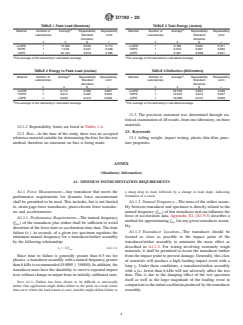
12.1.2 Repeatability limits are listed in Tables 1-4.
13. Keywords
12.2 Bias—At the time of the study, there was no accepted
reference material suitable for determining the bias for this test 13.1 falling weight; impact testing; plastic thin film; punc-
method, therefore no statement on bias is being made. ture properties
ANNEX
(Mandatory Information)
A1. MINIMUM INSTRUMENTATION REQUIREMENTS
a sharp drop in load, followed by a change in load slope, indicating
A1.1 Force Measurement—Any transducer that meets the
formation of a crack.
performance requirement
...
This document is not an ASTM standard and is intended only to provide the user of an ASTM standard an indication of what changes have been made to the previous version. Because
it may not be technically possible to adequately depict all changes accurately, ASTM recommends that users consult prior editions as appropriate. In all cases only the current version
of the standard as published by ASTM is to be considered the official document.
Designation: D7192 − 19 D7192 − 20
Standard Test Method for
High Speed Puncture Properties of Plastic Films Using Load
and Displacement Sensors
This standard is issued under the fixed designation D7192; the number immediately following the designation indicates the year of
original adoption or, in the case of revision, the year of last revision. A number in parentheses indicates the year of last reapproval. A
superscript epsilon (´) indicates an editorial change since the last revision or reapproval.
1. Scope*
1.1 This test method covers the determination of puncture properties of plastic films, over a range of test velocities.
1.1.1 ASTM Terminology Standard D883 has defined film as having a thickness not greater than 0.25 mm. Plastic materials
having a thickness above this limit are not to be excluded from use unless shown to be rigid (see 3.2.1). Test Method D3763 is
the recommended method for instrumented puncture testing of rigid plastics.
1.2 Test data obtained by this test method is relevant and appropriate for use in engineering design.
1.3 The values stated in SI units are to be regarded as standard.
1.4 This standard does not purport to address all of the safety concerns, if any, associated with its use. It is the responsibility
of the user of this standard to establish appropriate safety, health, and environmental practices and determine the applicability of
regulatory limitations prior to use.
NOTE 1—This test method does not closely conform to ISO 7765-2. The only similarity between the two tests is that they are both instrumented impact
tests. The differences in striker, fixture, specimen geometries and in test velocity can produce significantly different test results.
1.5 This international standard was developed in accordance with internationally recognized principles on standardization
established in the Decision on Principles for the Development of International Standards, Guides and Recommendations issued
by the World Trade Organization Technical Barriers to Trade (TBT) Committee.
2. Referenced Documents
2.1 ASTM Standards:
D618 Practice for Conditioning Plastics for Testing
D883 Terminology Relating to Plastics
D1600 Terminology for Abbreviated Terms Relating to Plastics
D3763 Test Method for High Speed Puncture Properties of Plastics Using Load and Displacement Sensors
D4000 Classification System for Specifying Plastic Materials
D6988 Guide for Determination of Thickness of Plastic Film Test Specimens
E456 Terminology Relating to Quality and Statistics
E691 Practice for Conducting an Interlaboratory Study to Determine the Precision of a Test Method
3. Terminology
3.1 Definitions—For definitions see Terms used in this standard are defined in accordance with Terminology D883 and for
abbreviations, see , unless otherwise specified. For terms relating to precision and bias and associated issues, the terms used in this
standard are defined in accordance with Terminology D1600E456.
3.2 Definitions of Terms Specific to This Standard:
3.2.1 rigid, adj—any plastic specimen that, when placed on the support component of the open clamp assembly, does not deflect
into the center of the unsupported region (under its own weight) by more than 0.05 mm from the horizontal plane of the support
component.
This test method is under the jurisdiction of ASTM Committee D20 on Plastics and is the direct responsibility of Subcommittee D20.19 on Film, Sheeting, and Molded
Products.
Current edition approved Sept. 1, 2019Feb. 1, 2020. Published September 2019March 2020. Originally approved in 2005. Last previous edition approved in 20182019
as D7192 - 18.D7192 - 19. DOI: 10.1520/D7192-19.10.1520/D7192-20.
For referenced ASTM standards, visit the ASTM website, www.astm.org, or contact ASTM Customer Service at service@astm.org. For Annual Book of ASTM Standards
volume information, refer to the standard’s Document Summary page on the ASTM website.
*A Summary of Changes section appears at the end of this standard
Copyright © ASTM International, 100 Barr Harbor Drive, PO Box C700, West Conshohocken, PA 19428-2959. United States
D7192 − 20
3.2.1.1 Discussion—
This definition is provided as a guideline to allow testing of soft, pliable plastic materials that are thicker than 0.25 mm.
4. Significance and Use
4.1 This test method is designed to provide load versus deformation response of plastic films under essentially multi-axial
deformation conditions at impact velocities. This test method further provides a measure of the rate sensitivity of the plastic films
to impact.
4.2 Multi-axial impact response, while partly dependent on thickness, does not necessarily have a linear correlation with
specimen thickness. Therefore, results should be compared only for specimens of essentially the same thickness, unless specific
responses versus thickness formulae have been established for the plastic films being tested.
4.3 For many plastic films, it is possible that a specification exists that requires the use of this test method, but with some
procedural modifications that take precedence when adhering to the specification. Therefore, it is advisable to refer to that material
specification before using this test method. Table 1 of Classification System D4000 lists the ASTM materials standards that
currently exist.
4.4 The values obtained by this test method are highly dependent on the method and conditions of film fabrication as well as
the type and grade of resin. Results can vary significantly, depending upon sample quality, uniformity of film gage, die marks,
contaminants, and so forth.
5. Apparatus
5.1 The testing machine shall consist of two assemblies, one fixed and the other driven by a suitable method to achieve the
required impact velocity (that is, hydraulic, pneumatic, mechanical, or gravity):
5.1.1 Specimen Clamp Assembly—This device shall be permitted to be variable with respect to the holding of the specimen
material, depending upon specimen characteristics. The unsupported region of the specimen clamp assembly shall have a diameter
of 76 6 3.0 mm. The edges of the unsupported region shall be rounded to a radius of 0.8 6 0.4 mm. The holding technique
employed on the specimen must not interfere with the radius edge of the clamp assembly. Specimens should be held taut but not
stretched so as to cause damage to the specimen prior to test.
NOTE 2—The following techniques have been successfully employed for different types of plastic films:
· Parallel rigid plates clamped together with sufficient force (mechanically, pneumatically or hydraulically) to prevent slippage of the specimen in the
clamp during impact.
· Rubber-like gaskets or o-rings affixed to the rigid plates to provide cushioning or gripping of the specimen when clamping force is applied.
· Removable assemblies, consisting of two concentric rings (one slightly larger than the other, similar to an embroidery hoop) that, when assembled
and clamped between two rigid plates, succeed in pulling the specimen taut over the specified unsupported region prior to testing. All of the above
techniques must employ the specified unsupported region and edge radius as noted in 5.1.1.
5.1.2 Plunger Assembly, consisting of a 12.70 6 0.13-mm diameter rod with a hemispherical end of the same diameter
positioned perpendicular to, and centered on, the clamp hole. Plunger assembly shall be of sufficient length so as to allow for
complete puncture of the test specimen. Plunger assembly material shall be stainless steel, steel or aluminum. Surface finish of the
plunger assembly shall be 16 μin. (0.4 μm).
5.1.3 Other Geometries—The dimensions given in 5.1.1 and 5.1.2 shall be the standard geometry. If other plunger or hole sizes
are used they shall be highlighted in the report. Correlations have not been established between different plunger geometries,
materials, and finishes.
5.1.4 Load Sensing System—A load cell of sufficiently high natural resonance frequency, as described in A1.1, used together
with a calibrating network for adjusting load sensitivity.
5.1.5 Plunger Displacement Measurement System—A means of monitoring the displacement of the moving assembly during the
loading and complete penetration of the specimen. This can be accomplished through the use of a suitable transducer or
potentiometer attached directly to the system. Photographic or optical systems can also be utilized for measuring displacement.
5.1.5.1 Alternatively, displacement shall be permitted to be calculated as a function of velocity and total available energy at
initial impact, along with increments of load versus time, using a microprocessor.
5.1.5.2 Some machines use an accelerometer, whose output is used to calculate both load and displacement.
5.1.6 Display and Recording Instrumentation—Use any suitable means to display and record the data developed from the load
and displacement-sensing systems, provided its response characteristics are capable of presenting the data sensed, with minimal
distortion. The recording apparatus shall record load and displacement simultaneously. For further information, see A1.2.
5.1.6.1 The most rudimentary apparatus is a cathode-ray oscilloscope with a camera. This approach also requires a planimeter
or other suitable device, capable of measuring the area under the recorded load-versus-displacement trace of the event with an
accuracy of 65 %.
5.1.6.2 More sophisticated systems are commercially available. Most of them include computerized data reduction and
automatic printouts of results.
D7192 − 20
5.2 Measuring Instrument, accurate to 0.0025 mm in the film thickness range defined in 1.1.1 (see Guide D6988).
6. Test Specimen
6.1 Specimens must be large enough to be adequately gripped in the clamp. In general, the minimum lateral dimension should
be at least 13 mm greater than the diameter of the hole in the clamp or any clamping gaskets or o-rings incorporated into the
clamping mechanism (see 5.1.1 and 9.9).
6.2 Specimens shall be cut from plastic films produced by any suitable process.
6.3 The specimens shall be free of pinholes, wrinkles, folds or other obvious imperfection, unless such imperfections constitute
variables under study.
7. Conditioning
7.1 Conditioning—Condition the test specimens in a room or enclosed space maintained at 23 6 2°C and 50 6 10 % relative
humidity, in accordance with Procedure A of Practice D618 unless otherwise specified.
7.2 Test Conditions—Conduct tests in the standard laboratory atmosphere of 23 6 2°C and 50 6 10 % relative humidity unless
otherwise specified. In cases of disagreement, the tolerances shall be 61°C and 65 % relative humidity.
7.2.1 By changing the conditioning and test temperature in a controlled manner for a given test velocity, the temperature at
which transition from ductile to brittle failure occurs can be determined for most plastic films.
8. Speed of Testing
8.1 For recommended testing speeds, see 9.4.
9. Procedure
9.1 Test a minimum of five specimens at each specified speed.
9.2 Measure and record the thickness of each specimen to the nearest 0.0025 mm at the center of the specimen.
9.3 Clamp the specimen between the plates of the specimen holder, taking care to center the specimen for uniform gripping.
9.4 Set the test speed to the desired value. The testing speed (movable-member velocity at the instant before contact with the
specimen) shall be as follows:
9.4.1 For single-speed tests, use a velocity of 200 m/min.
9.4.1.1 Other speeds are permissible, provided they are clearly stated in the report.
9.4.2 To measure the dependence of puncture properties on impact velocity, use a broad range of test speeds. Some suggested
speeds are 2.5, 25, 125, 200, and 250 m/min.
9.5 Set the available energy so that the velocity slowdown is no more than 20 % from the beginning of the test to the point of
peak load. If the velocity should decrease by more than 20 %, discard the results and make additional tests on new specimens with
more available energy.
NOTE 3—It is observed that when the available energy is at least three times the absorbed energy at the peak load velocity slow-down is less than 20 %.
9.6 Make the necessary adjustments to data collection apparatus as required by the manufacturer’s instructions or consult
literature such as STP 936 for further information regarding setting up data acquisition systems.
9.7 Conduct the test, following the manufacturer’s instructions, for the specific equipment used.
9.8 Remove the specimen and inspect the gripped portion for striations or other evidence of slippage. If there is evidence of
slippage, modify the clamping conditions or increase the specimen size and repeat test procedures.
9.9 Check plunger assembly for any film debris or residue before performing subsequent tests.
10. Calculation
10.1 Using the load-versus-displacement trace and appropriate scaling factors, calculate the following:
10.1.1 Peak load, in Newtons.
10.1.2 Deflection, in millimetres, to the point where peak load first occurred.
10.1.3 From the area within the trace, calculate:
10.1.3.1 Energy, in Joules, to the point where peak load first occurred.
10.1.3.2 Total energy absorbed. The point for determining this has not been standardized. Therefore, the point used for each test
must be stated in the report.
10.1.4 Load, deflection, energy, or combination thereof, at any other specific point of interest (see Appendix X1).
Instrumented Impact Testing of Plastics and Composite Materials, ASTM STP 936, ASTM, 1986.
D7192 − 20
10.2 For each series of tests, calculate the arithmetic mean for each of the above, to three significant figures.
10.3 Calculate the estimated standard deviations as follows:
2 ¯ 2
X 2 n X
(
S 5S D1/2 (1)
n 2 1
where:
S = estimated standard deviation,
X = value of a single determination,
n = number of determinations, and
X¯ = arithmetic mean of the set of determinations.
11. Report
11.1 Report the following information:
11.1.1 Complete identification of the material tested, including type, source, manufacturer’s code number, form and previous
history,
11.1.2 Specimen size and thickness,
11.1.3 Method of preparing test specimens (extrusion molding, blow molding, and so forth),
11.1.4 Geometry of clamp and plunger, if different from 5.1.1 and 5.1.2,
11.1.5 Source and types of equipment,
11.1.6 Speed of testing (see 9.4),
11.1.7 The point on the curve at which total energy was calculated (see 10.1.3.2),
11.1.8 Average value and standard deviation for each of the properties listed in 10.1,
11.1.9 Whether or not any slippage of the specimens was detected (see Note 3),
11.1.10 If the effect of testing speeds was studied (see 9.4.2),
11.1.11 Type of plunger material used for the test, and
11.1.12 Test specimen conditioning, if different from 7.1.
NOTE 4—When slippage or cutting of the test specimen occurs at or near the edge of the support clamp, the result shall be considered invalid due to
the error in calculated energy absorption caused by the slipping or cutting of the specimen during the impact test. Alternate clamping techniques, adhering
to the requirements of 5.1.1, must be used to prevent any slippage or cutting of the test specimen.
12. Precision and Bias
12.1 Precision and Bias for The precision of this test method is based on an interlaboratory study of this standard conducted
in 2019. A single laboratory tested three different materials. Every “test result” represents an individual measurement. Four
replicate test results from a single operator were reported by the single laboratory. Except for the number of participating
laboratories, Practice E691are currently under investigation. was followed for the design and analysis of the data; the details are
given in ASTM Research Report No. D20-1275.
12.1.1 Warning—The data in Tables 1-4 shall not be rigorously applied to acceptance or rejection of material, as those data
are specific to the interlaboratory study and are not necessarily representative of other lots, conditions, materials, or laboratories.
Users of this test method shall apply the principles outlined in Practice E691 to generate data specific to their laboratory and
materials, or between specific laboratories.
12.1.2 Repeatability limits are listed in Tables 1-4.
12.2 Bias—At the time of the study, there was no accepted reference material suitable for determining the bias for this test
method, therefore no statement on bias is being made.
12.3 The precision statement was determined through statistical examination of 48 results, from one laboratory, on three
materials.
TABLE 1 Peak Load (Newtons)
A
Material Number of Average Repeatability Repeatability
Laboratories Standard Limit
Deviation
n x S r
r
LLDPE 1 15.358 0.255 0.714
HDPE 1 7.248 0.231 0.646
LDPE 1 32.723 0.916 2.565
A
The average of the laboratory’s calculated average.
Supporting data have been filed at ASTM International Headquarters and may be obtained by requesting Research Report RR:D20-1275. Contact ASTM Customer
Service at service@astm.org.
D7192 − 20
TABLE 2 Energy to Peak Load (Joules)
A
Material Number of Average Repeatability Repeatability
Laboratories Standard Limit
Deviation
n x S r
r
LLDPE 1 0.113 0.002 0.007
HDPE 1 0.014 0.001 0.003
LDPE 1 0.240 0.014 0.038
A
The average of the laboratory’s calculated average.
TABLE 3 Total Energy (Joules)
A
Material Number of Average Repeatability Repeatability
Laboratories Standard Limit
Deviation
n x S r
r
LLDPE 1 0.188 0.004 0.011
HDPE 1 0.019 0.001 0.002
LDPE 1 0.307 0.008 0.021
A
The average of the laboratory’s calculated average.
TABLE 4 Deflection (Millimeters)
A
Material Number of Average Repeatability Repeatability
Laboratories Standard Limit
Deviation
n x S r
r
LLDPE 1 29.708 0.824 2.308
HDPE 1 13.343 0.010 0.027
LDPE 1 19.288 0.212 0.593
A
The average of the laboratory’s calculated average.
13. Keywords
13.1 falling weight; impact testing; plastic thin film; puncture properties
ANNEX
(Mandatory Information)
A1. MINIMUM INSTRUMENTATION REQUIREMENTS
A1.1 Force Measurement—Any transducer that meets the performance req
...