

ASTM F1164-19
(Test Method)Standard Test Method for Evaluation of Transparent Plastics Exposed to Accelerated Weathering Combined with Biaxial Stress
General Information
- Abstract
SIGNIFICANCE AND USE
4.1 The degradation of optical properties of transparent plastics is the single greatest cause for in-service removal and replacement. Some optical qualities are inherent in the geometry, manufacturing process, and materials, and remain relatively unchanged after manufacture, while others are subject to gradual change during exposure to the service environment. Factors having an influence on the crazing of transparent plastics include stress, ultraviolet (UV), moisture, and temperature. Sufficient data has been generated to make it evident that real-world conditioning must be experienced by developmental test specimens, as opposed to testing new unexposed material to determine durability, prior to in-service usage. However, the laboratory simulation of natural weathering, and especially accelerated simulation, is imprecise and correlation of results obtained for different plastics or from using different exposure apparatus must not be attempted until a valid database has been generated for such cross-correlation.
SCOPE
1.1 This test method covers the resistance of transparent plastics exposed to environmental conditioning (accelerated weathering) under a biaxial stress state induced by a pressure cell/test fixture.
1.2 Units—The values stated in SI units are to be regarded as standard. The values given in parentheses after SI units are provided for information only and are not considered standard.
1.3 This standard does not purport to address all of the safety concerns, if any, associated with its use. It is the responsibility of the user of this standard to establish appropriate safety, health, and environmental practices and determine the applicability of regulatory limitations prior to use.
1.4 This international standard was developed in accordance with internationally recognized principles on standardization established in the Decision on Principles for the Development of International Standards, Guides and Recommendations issued by the World Trade Organization Technical Barriers to Trade (TBT) Committee.
- Status
- Published
- Publication Date
- 31-Oct-2019
- Technical Committee
- F07 - Aerospace and Aircraft
- Drafting Committee
- F07.08 - Transparent Enclosures and Materials
Buy Documents

ASTM F1164-19 - Standard Test Method for Evaluation of Transparent Plastics Exposed to Accelerated Weathering Combined with Biaxial Stress
REDLINE ASTM F1164-19 - Standard Test Method for Evaluation of Transparent Plastics Exposed to Accelerated Weathering Combined with Biaxial Stress
Overview
ASTM F1164-19 - Standard Test Method for Evaluation of Transparent Plastics Exposed to Accelerated Weathering Combined with Biaxial Stress - is an internationally recognized method developed by ASTM International. This standard outlines procedures for assessing the resistance of transparent plastics to environmental factors that may degrade their optical properties over time. By subjecting test specimens to both accelerated weathering and biaxial mechanical stress, this method simulates real-world service conditions to predict in-service durability, especially regarding optical clarity and the onset of surface damage such as crazing.
Degradation of optical properties, including increased haze and diminished light transmittance, is a primary reason transparent plastics are removed from service. This standard helps manufacturers, quality control labs, and product developers ensure their products meet key durability requirements before field deployment.
Key Topics
Environmental Conditioning and Biaxial Stress
- Accelerated Weathering: Exposes transparent plastic specimens to simulated environmental factors such as UV light, moisture, and temperature fluctuations. This accelerated process is designed to represent extended periods of natural weathering in a shorter amount of time.
- Biaxial Stress: During accelerated weathering, specimens are held under controlled biaxial stress using a pressure cell fixture, replicating mechanical stresses experienced during actual use.
Measurement of Optical Properties
- Haze and Luminous Transmittance: Before and after aging under stress, specimens are evaluated for haze and luminous transmittance, using referenced procedures (such as ASTM D1003).
- Crazing Detection: The onset and progression of crazing - fine cracks or fissures in plastics - are visually examined to determine material resistance.
Coating Adhesion Testing
- Tape-Peel Test: For coated plastics, the adhesion of surface coatings is measured using a standardized tape test (referencing ASTM D3359), even though adhesion mechanisms in transparent plastics may differ from those in metals.
Safety and Reporting
- Safety Practices: Users are responsible for identifying and addressing safety, health, and environmental practices suitable for their application.
- Reporting Requirements: Detailed reporting includes material identification, specimen details, exposure conditions, and test results for haze, transmittance, and adhesion.
Applications
The ASTM F1164-19 test method is widely used in industries where the optical performance and durability of transparent plastics are critical. Typical applications include:
- Aerospace and Aviation: Ensuring transparency components, such as windows and canopies, retain clarity and do not prematurely degrade due to environmental exposure and mechanical stress.
- Automotive: Evaluating materials for windshields, headlamp covers, and sunroofs, which are regularly exposed to weathering and stress.
- Architectural Glazing: Assessing plastics used in skylights, transparent barriers, or facades.
- Consumer Electronics: Testing display covers and other transparent components for longevity and resistance to environmental factors.
- Quality Control and R&D: Supporting the selection and development of new transparent plastic materials with reliable weathering and mechanical performance.
Related Standards
The following ASTM standards are referenced or relevant to the testing described in ASTM F1164-19:
- ASTM D1003: Test Method for Haze and Luminous Transmittance of Transparent Plastics.
- ASTM D3359: Test Methods for Rating Adhesion by Tape Test.
- ASTM G26: Practice for Operating Light-Exposure Apparatus (Xenon-Arc Type) for Nonmetallic Materials (withdrawn).
- ASTM G53: Practice for Operating Light-and Water-Exposure Apparatus (Fluorescent UV-Condensation Type) for Nonmetallic Materials (withdrawn).
- ASTM G90: Practice for Performing Accelerated Outdoor Weathering of Materials Using Concentrated Natural Sunlight.
These related standards provide supporting test methods and apparatus guidelines crucial to simulating accelerated weathering and evaluating optical performance and coating adhesion.
Keywords: ASTM F1164-19, accelerated weathering, transparent plastics, biaxial stress, haze, luminous transmittance, crazing, coating adhesion, environmental conditioning, optical properties testing.
Relations
- Effective Date
- 01-Nov-2019
- Refers
ASTM D1003-11e1 - Standard Test Method for Haze and Luminous Transmittance of Transparent Plastics - Effective Date
- 15-Apr-2011
- Refers
ASTM D1003-11 - Standard Test Method for Haze and Luminous Transmittance of Transparent Plastics - Effective Date
- 15-Apr-2011
- Effective Date
- 01-Jun-2010
- Effective Date
- 01-Jun-2009
- Effective Date
- 01-Nov-2007
- Refers
ASTM D1003-07 - Standard Test Method for Haze and Luminous Transmittance of Transparent Plastics - Effective Date
- 01-Nov-2007
- Effective Date
- 01-Oct-2005
- Effective Date
- 10-Aug-2002
- Refers
ASTM D1003-00 - Standard Test Method for Haze and Luminous Transmittance of Transparent Plastics - Effective Date
- 10-Jun-2000
- Effective Date
- 10-Dec-1998
- Referred By
ASTM F790-23 - Standard Guide for Testing Materials for Aerospace Plastic Transparent Enclosures - Effective Date
- 01-Nov-2019
- Effective Date
- 01-Nov-2019
Buy Documents
ASTM F1164-19 - Standard Test Method for Evaluation of Transparent Plastics Exposed to Accelerated Weathering Combined with Biaxial Stress
REDLINE ASTM F1164-19 - Standard Test Method for Evaluation of Transparent Plastics Exposed to Accelerated Weathering Combined with Biaxial Stress
Get Certified
Connect with accredited certification bodies for this standard

DIN CERTCO
DIN Group product certification.

Smithers Quality Assessments
US management systems and product certification.
Sponsored listings
Frequently Asked Questions
ASTM F1164-19 is a standard published by ASTM International. Its full title is "Standard Test Method for Evaluation of Transparent Plastics Exposed to Accelerated Weathering Combined with Biaxial Stress". This standard covers: SIGNIFICANCE AND USE 4.1 The degradation of optical properties of transparent plastics is the single greatest cause for in-service removal and replacement. Some optical qualities are inherent in the geometry, manufacturing process, and materials, and remain relatively unchanged after manufacture, while others are subject to gradual change during exposure to the service environment. Factors having an influence on the crazing of transparent plastics include stress, ultraviolet (UV), moisture, and temperature. Sufficient data has been generated to make it evident that real-world conditioning must be experienced by developmental test specimens, as opposed to testing new unexposed material to determine durability, prior to in-service usage. However, the laboratory simulation of natural weathering, and especially accelerated simulation, is imprecise and correlation of results obtained for different plastics or from using different exposure apparatus must not be attempted until a valid database has been generated for such cross-correlation. SCOPE 1.1 This test method covers the resistance of transparent plastics exposed to environmental conditioning (accelerated weathering) under a biaxial stress state induced by a pressure cell/test fixture. 1.2 Units—The values stated in SI units are to be regarded as standard. The values given in parentheses after SI units are provided for information only and are not considered standard. 1.3 This standard does not purport to address all of the safety concerns, if any, associated with its use. It is the responsibility of the user of this standard to establish appropriate safety, health, and environmental practices and determine the applicability of regulatory limitations prior to use. 1.4 This international standard was developed in accordance with internationally recognized principles on standardization established in the Decision on Principles for the Development of International Standards, Guides and Recommendations issued by the World Trade Organization Technical Barriers to Trade (TBT) Committee.
SIGNIFICANCE AND USE 4.1 The degradation of optical properties of transparent plastics is the single greatest cause for in-service removal and replacement. Some optical qualities are inherent in the geometry, manufacturing process, and materials, and remain relatively unchanged after manufacture, while others are subject to gradual change during exposure to the service environment. Factors having an influence on the crazing of transparent plastics include stress, ultraviolet (UV), moisture, and temperature. Sufficient data has been generated to make it evident that real-world conditioning must be experienced by developmental test specimens, as opposed to testing new unexposed material to determine durability, prior to in-service usage. However, the laboratory simulation of natural weathering, and especially accelerated simulation, is imprecise and correlation of results obtained for different plastics or from using different exposure apparatus must not be attempted until a valid database has been generated for such cross-correlation. SCOPE 1.1 This test method covers the resistance of transparent plastics exposed to environmental conditioning (accelerated weathering) under a biaxial stress state induced by a pressure cell/test fixture. 1.2 Units—The values stated in SI units are to be regarded as standard. The values given in parentheses after SI units are provided for information only and are not considered standard. 1.3 This standard does not purport to address all of the safety concerns, if any, associated with its use. It is the responsibility of the user of this standard to establish appropriate safety, health, and environmental practices and determine the applicability of regulatory limitations prior to use. 1.4 This international standard was developed in accordance with internationally recognized principles on standardization established in the Decision on Principles for the Development of International Standards, Guides and Recommendations issued by the World Trade Organization Technical Barriers to Trade (TBT) Committee.
ASTM F1164-19 is classified under the following ICS (International Classification for Standards) categories: 83.080.01 - Plastics in general. The ICS classification helps identify the subject area and facilitates finding related standards.
ASTM F1164-19 has the following relationships with other standards: It is inter standard links to ASTM F1164-97(2014), ASTM D1003-11e1, ASTM D1003-11, ASTM G90-10, ASTM D3359-09e1, ASTM D3359-07, ASTM D1003-07, ASTM G90-05, ASTM D3359-02, ASTM D1003-00, ASTM G90-98, ASTM F790-23, ASTM F942-18(2023)e1. Understanding these relationships helps ensure you are using the most current and applicable version of the standard.
ASTM F1164-19 is available in PDF format for immediate download after purchase. The document can be added to your cart and obtained through the secure checkout process. Digital delivery ensures instant access to the complete standard document.
Standards Content (Sample)
This international standard was developed in accordance with internationally recognized principles on standardization established in the Decision on Principles for the
Development of International Standards, Guides and Recommendations issued by the World Trade Organization Technical Barriers to Trade (TBT) Committee.
Designation: F1164 − 19
Standard Test Method for
Evaluation of Transparent Plastics Exposed to Accelerated
Weathering Combined with Biaxial Stress
This standard is issued under the fixed designation F1164; the number immediately following the designation indicates the year of
original adoption or, in the case of revision, the year of last revision.Anumber in parentheses indicates the year of last reapproval.A
superscript epsilon (´) indicates an editorial change since the last revision or reapproval.
1. Scope paratus (Fluorescent UV-Condensation Type) for Expo-
sure of Nonmetallic Materials (Withdrawn 2000)
1.1 This test method covers the resistance of transparent
G90Practice for Performing Accelerated Outdoor Weather-
plastics exposed to environmental conditioning (accelerated
ing of Materials Using Concentrated Natural Sunlight
weathering) under a biaxial stress state induced by a pressure
cell/test fixture.
3. Summary of Test Method
1.2 Units—The values stated in SI units are to be regarded
3.1 This test method consists of measuring and recording
as standard. The values given in parentheses after SI units are
the haze and light transmittance of an unexposed circular plate
providedforinformationonlyandarenotconsideredstandard.
test specimen, mounting the specimen in the test fixture,
1.3 This standard does not purport to address all of the
pressurizing the fixture to induce the desired biaxial stress in
safety concerns, if any, associated with its use. It is the
the specimen, and exposing the stressed specimen to specific
responsibility of the user of this standard to establish appro-
accelerated weathering conditions. After conditioning, the
priate safety, health, and environmental practices and deter-
specimen is removed and haze/transmittance are measured to
mine the applicability of regulatory limitations prior to use.
determine any changes in value. Coating adhesion is measured
1.4 This international standard was developed in accor-
when applicable.
dance with internationally recognized principles on standard-
3.2 The resistance of the plastic to stress-during-weathering
ization established in the Decision on Principles for the
is determined by the onset of crazing, the change in haze and
Development of International Standards, Guides and Recom-
luminous transmittance, and adhesion of coating.
mendations issued by the World Trade Organization Technical
Barriers to Trade (TBT) Committee.
4. Significance and Use
4.1 The degradation of optical properties of transparent
2. Referenced Documents
plastics is the single greatest cause for in-service removal and
2.1 ASTM Standards:
replacement. Some optical qualities are inherent in the
D1003Test Method for Haze and Luminous Transmittance
geometry, manufacturing process, and materials, and remain
of Transparent Plastics
relatively unchanged after manufacture, while others are sub-
D3359Test Methods for Rating Adhesion by Tape Test
ject to gradual change during exposure to the service environ-
G26 Practice for Operating Light-Exposure Apparatus
ment.Factorshavinganinfluenceonthecrazingoftransparent
(Xenon-Arc Type) With and Without Water for Exposure
plasticsincludestress,ultraviolet(UV),moisture,andtempera-
of Nonmetallic Materials (Discontinued 2001) (With-
ture. Sufficient data has been generated to make it evident that
drawn 2000)
real-worldconditioningmustbeexperiencedbydevelopmental
G53Practice for Operating Light-and Water-Exposure Ap-
test specimens, as opposed to testing new unexposed material
todeterminedurability,priortoin-serviceusage.However,the
laboratory simulation of natural weathering, and especially
This test method is under the jurisdiction of ASTM Committee F07 on
accelerated simulation, is imprecise and correlation of results
Aerospace andAircraft and is the direct responsibility of Subcommittee F07.08 on
obtained for different plastics or from using different exposure
Transparent Enclosures and Materials.
Current edition approved Nov. 1, 2019. Published November 2019. Originally
apparatusmustnotbeattempteduntilavaliddatabasehasbeen
approved in 1988. Last previous edition approved in 2014 as F1164– 97(2014).
generated for such cross-correlation.
DOI: 10.1520/F1164-19.
For referenced ASTM standards, visit the ASTM website, www.astm.org, or
5. Apparatus
contact ASTM Customer Service at service@astm.org. For Annual Book of ASTM
Standards volume information, refer to the standard’s Document Summary page on
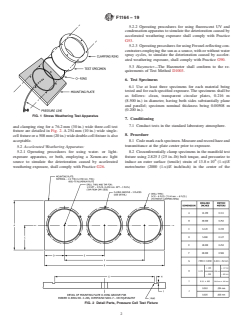
5.1 Manifold Test Fixture—An exploded view of the
the ASTM website.
pressure-cell/test-fixture used to induce a biaxial stress state in
The last approved version of this historical standard is referenced on
www.astm.org. aclampedspecimenisillustratedinFig.1.Themountingplate
Copyright © ASTM International, 100 Barr Harbor Drive, PO Box C700, West Conshohocken, PA 19428-2959. United States
F1164 − 19
5.2.2 Operating procedures for using fluorescent UV and
condensation apparatus to simulate the deterioration caused by
accelerated weathering exposure shall comply with Practice
G53.
5.2.3 OperatingproceduresforusingFresnel-reflectingcon-
centratorsemployingthesunasasource,withorwithoutwater
spray cycles, to simulate the deterioration caused by acceler-
ated weathering exposure, shall comply with Practice G90.
5.3 Hazemeter—The Hazemeter shall conform to the re-
quirements of Test Method D1003.
6. Test Specimens
6.1 Use at least three specimens for each material being
tested and for each specified exposure.The specimens shall be
as follows: clean, transparent circular plates, 0.216 m
(8.500in.) in diameter, having both sides substantially plane
and parallel; specimen nominal thickness being 0.00508 m
(0.200in.).
FIG. 1 Stress Weathering Test Apparatus
7. Conditioning
7.1 Conduct tests in the standard laboratory atmosphere.
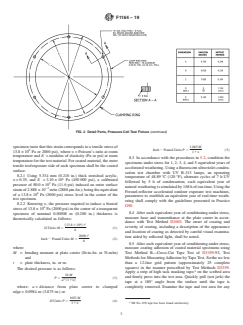
and clamping ring for a 76.2mm (30in.) wide three-cell test
fixture are detailed in Fig. 2. A 254mm (10in.) wide single-
8. Procedure
cellfixtureora508mm(20in.)widedouble-cellfixtureisalso
acceptable. 8.1 Codemarkeachspecimen.Measureandrecordhazeand
transmittance at the plate center prior to exposure.
5.2 Accelerated Weathering Apparatus:
5.2.1 Operating procedures for using water- or light- 8.2 Circumferentially clamp specimens in the manifold test
exposure apparatus, or both, employing a Xenon-arc light fixture using 2.825 J (25 in.-lb) bolt torque, and pressurize to
source to simulate the deterioration caused by accelerated induce an outer surface (tensile) strain of 13.8×10 (1-υ)/E
weathering exposure, shall comply with Practice G26. metre/metre (2000 (1-υ)/E inch/inch) in the center of the
FIG. 2 Detail Parts, Pressure Cell Test Fixture
F1164 − 19
FIG. 2 Detail Parts, Pressure Cell Test Fixture (continued)
specimen(not
...
This document is not an ASTM standard and is intended only to provide the user of an ASTM standard an indication of what changes have been made to the previous version. Because
it may not be technically possible to adequately depict all changes accurately, ASTM recommends that users consult prior editions as appropriate. In all cases only the current version
of the standard as published by ASTM is to be considered the official document.
Designation: F1164 − 97 (Reapproved 2014) F1164 − 19
Standard Test Method for
Evaluation of Transparent Plastics Exposed to Accelerated
Weathering Combined with Biaxial Stress
This standard is issued under the fixed designation F1164; the number immediately following the designation indicates the year of
original adoption or, in the case of revision, the year of last revision. A number in parentheses indicates the year of last reapproval. A
superscript epsilon (´) indicates an editorial change since the last revision or reapproval.
1. Scope
1.1 This test method covers the resistance of transparent plastics exposed to environmental conditioning (accelerated
weathering) under a biaxial stress state induced by a pressure cell/test fixture.
1.2 Units—The values stated in acceptable metric SI units are to be regarded as the standard. The values given in parentheses
after SI units are provided for information only and are not considered standard.
1.3 This standard does not purport to address all of the safety concerns, if any, associated with its use. It is the responsibility
of the user of this standard to establish appropriate safety safety, health, and healthenvironmental practices and determine the
applicability of regulatory limitations prior to use.
1.4 This international standard was developed in accordance with internationally recognized principles on standardization
established in the Decision on Principles for the Development of International Standards, Guides and Recommendations issued
by the World Trade Organization Technical Barriers to Trade (TBT) Committee.
2. Referenced Documents
2.1 ASTM Standards:
D1003 Test Method for Haze and Luminous Transmittance of Transparent Plastics
D3359 Test Methods for Rating Adhesion by Tape Test
G26 Practice for Operating Light-Exposure Apparatus (Xenon-Arc Type) With and Without Water for Exposure of Nonmetallic
Materials (Discontinued 2001) (Withdrawn 2000)
G53 Practice for Operating Light-and Water-Exposure Apparatus (Fluorescent UV-Condensation Type) for Exposure of
Nonmetallic Materials (Withdrawn 2000)
G90 Practice for Performing Accelerated Outdoor Weathering of Materials Using Concentrated Natural Sunlight
3. Summary of Test Method
3.1 This test method consists of measuring and recording the haze and light transmittance of an unexposed circular plate test
specimen;specimen, mounting the specimen in the test fixture;fixture, pressurizing the fixture to induce the desired biaxial stress
in the specimen;specimen, and exposing the stressed specimen to specific accelerated weathering conditions. After conditioning,
the specimen is removed and haze/transmittance are measured to determine any changes in value. Coating adhesion is measured
when applicable.
3.2 The resistance of the plastic to stress-during-weathering is determined by the onset of crazing, the change in haze and
luminous transmittance, and adhesion of coating.
4. Significance and Use
4.1 The degradation of optical properties of transparent plastics is the single greatest cause for in-service removal and
replacement. Some optical qualities are inherent in the geometry, manufacturing process, and materials, and remain relatively
unchanged after manufacture, while others are subject to gradual change during exposure to the service environment. Factors
This test method is under the jurisdiction of ASTM Committee F07 on Aerospace and Aircraft and is the direct responsibility of Subcommittee F07.08 on Transparent
Enclosures and Materials.
Current edition approved Dec. 1, 2014Nov. 1, 2019. Published December 2014November 2019. Originally approved in 1988. Last previous edition approved in 20092014
ε1
as F1164 – 97F1164(2009) – 97(2014). . DOI: 10.1520/F1164-97R14.10.1520/F1164-19.
For referenced ASTM standards, visit the ASTM website, www.astm.org, or contact ASTM Customer Service at service@astm.org. For Annual Book of ASTM Standards
volume information, refer to the standard’s Document Summary page on the ASTM website.
The last approved version of this historical standard is referenced on www.astm.org.
Copyright © ASTM International, 100 Barr Harbor Drive, PO Box C700, West Conshohocken, PA 19428-2959. United States
F1164 − 19
having an influence on the crazing of transparent plastics include stress, ultraviolet (UV), moisture, and temperature. Sufficient data
has been generated to make it evident that real-world conditioning must be experienced by developmental test specimens, as
opposed to testing new unexposed material to determine durability, prior to in-service usage. However, the laboratory simulation
of natural weathering, and especially accelerated simulation, is imprecise and correlation of results obtained for different plastics
or from using different exposure apparatus shouldmust not be attempted until a valid database has been generated for such
cross-correlation.
5. Apparatus
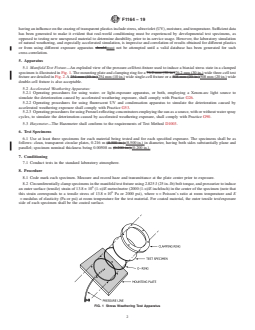
5.1 Manifold Test Fixture—An exploded view of the pressure-cell/test-fixture used to induce a biaxial stress state in a clamped
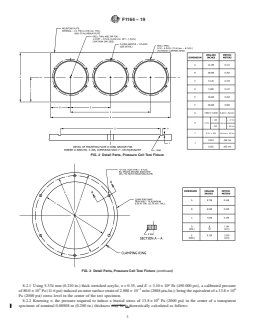
specimen is illustrated in Fig. 1. The mounting plate and clamping ring for a 76.2-mm (30-in.)76.2 mm (30 in.) wide three-cell test
fixture are detailed in Fig. 2. A 254-mm (10-in.)254 mm (10 in.) wide single-cell fixture or a 508-mm (20-in.)508 mm (20 in.) wide
double-cell fixture is also acceptable.
5.2 Accelerated Weathering Apparatus:
5.2.1 Operating procedures for using water- or light-exposure apparatus, or both, employing a Xenon-arc light source to
simulate the deterioration caused by accelerated weathering exposure, shall comply with Practice G26.
5.2.2 Operating procedures for using fluorescent UV and condensation apparatus to simulate the deterioration caused by
accelerated weathering exposure shall comply with Practice G53.
5.2.3 Operating procedures for using Fresnel-reflecting concentrators employing the sun as a source, with or without water spray
cycles, to simulate the deterioration caused by accelerated weathering exposure, shall comply with Practice G90.
5.3 Hazemeter—The Hazemeter shall conform to the requirements of Test Method D1003.
6. Test Specimens
6.1 Use at least three specimens for each material being tested and for each specified exposure. The specimens shall be as
follows: clean, transparent circular plates, 0.216 m (8.500 in.) (8.500 in.) in diameter, having both sides substantially plane and
parallel; specimen nominal thickness being 0.00508 m (0.200 in.).(0.200 in.).
7. Conditioning
7.1 Conduct tests in the standard laboratory atmosphere.
8. Procedure
8.1 Code mark each specimen. Measure and record haze and transmittance at the plate center prior to exposure.
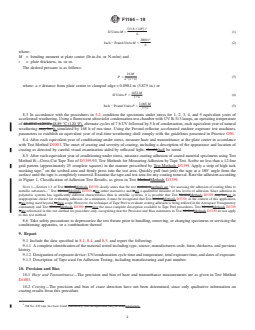
8.2 Circumferentially clamp specimens in the manifold test fixture using 2.825 J (25 in.-lb) bolt torque, and pressurize to induce
an outer surface (tensile) strain of 13.8 × 10 (1-υ)/E metre/metre (2000 (1-υ)/E inch/inch) in the center of the specimen (note that
this strain corresponds to a tensile stress of 13.8 × 10 Pa or 2000 psi), where υ = Poisson’s ratio at room temperature and E
= modulus of elasticity (Pa or psi) a
...