

ASTM F790-23
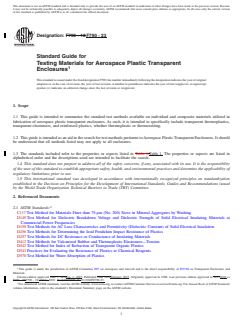
(Guide)Standard Guide for Testing Materials for Aerospace Plastic Transparent Enclosures
General Information
- Abstract
SIGNIFICANCE AND USE
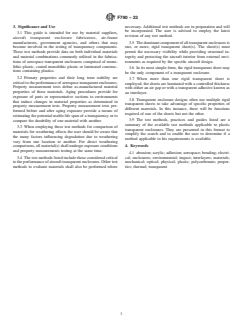
3.1 This guide is intended for use by material suppliers, aircraft transparent enclosure fabricators, air-frame manufacturers, government agencies, and others that may become involved in the testing of transparency components. These test methods provide data on both individual materials and material combinations commonly utilized in the fabrications of aerospace transparent enclosures comprised of monolithic plastic, coated monolithic plastic or laminated constructions containing plastics.
3.2 Primary properties and their long term stability are critical to the performance of aerospace transparent enclosures. Property measurement tests define as-manufactured material properties of these materials. Aging procedures provide for exposure of parts or representative sections to environments that induce changes in material properties as determined in property measurement tests. Property measurement tests performed before and after aging exposure provide a means of estimating the potential usable life span of a transparency or to compare the durability of one material with another.
3.3 When employing these test methods for comparison of materials for weathering effects the user should be aware that the many factors influencing degradation due to weathering vary from one location to another. For direct weathering comparisons, all material(s) shall undergo exposure conditions and property measurements testing at the same time.
3.4 The test methods listed include those considered critical to the performance of aircraft transparent enclosures. Other test methods to evaluate materials shall also be performed where necessary. Additional test methods are in preparation and will be incorporated. The user is advised to employ the latest revision of any test method.
3.5 The dominant component of all transparent enclosures is one, or more, rigid transparent sheet(s). The sheet(s) must permit the necessary visibility while providing structural integrity and protecting the ...
SCOPE
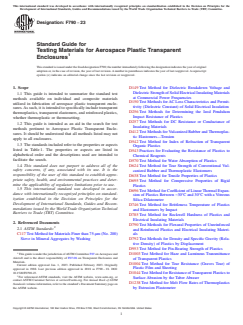
1.1 This guide is intended to summarize the standard test methods available on individual and composite materials utilized in fabrication of aerospace plastic transparent enclosures. As such, it is intended to specifically include transparent thermoplastics, transparent elastomers, and reinforced plastics, whether thermoplastic or thermosetting.
1.2 This guide is intended as an aid in the search for test methods pertinent to Aerospace Plastic Transparent Enclosures. It should be understood that all methods listed may not apply to all enclosures.
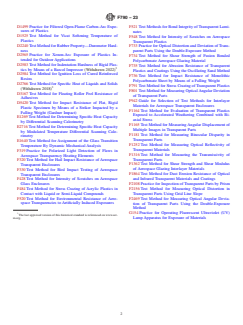
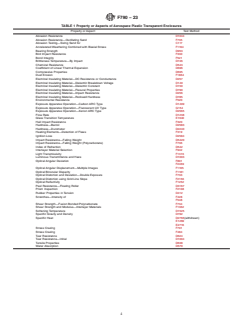
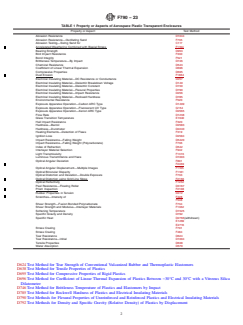
1.3 The standards included refer to the properties or aspects listed in Table 1. The properties or aspects are listed in alphabetical order and the descriptions used are intended to facilitate the search.
1.4 This standard does not purport to address all of the safety concerns, if any, associated with its use. It is the responsibility of the user of this standard to establish appropriate safety, health, and environmental practices and determine the applicability of regulatory limitations prior to use.
1.5 This international standard was developed in accordance with internationally recognized principles on standardization established in the Decision on Principles for the Development of International Standards, Guides and Recommendations issued by the World Trade Organization Technical Barriers to Trade (TBT) Committee.
- Status
- Published
- Publication Date
- 31-Dec-2022
- Technical Committee
- F07 - Aerospace and Aircraft
- Drafting Committee
- F07.08 - Transparent Enclosures and Materials

Overview
ASTM F790-23: Standard Guide for Testing Materials for Aerospace Plastic Transparent Enclosures provides comprehensive guidance on the selection and application of test methods for evaluating the properties of materials used in aerospace transparent enclosures. Developed by ASTM International, this guide is a valuable resource for material suppliers, enclosure fabricators, air-frame manufacturers, and other stakeholders involved in the development, testing, and selection of materials for aircraft windows, canopies, cockpit covers, and other transparent polymer structures.
The guide covers both individual materials and composite combinations, including transparent thermoplastics, elastomers, and reinforced plastics, whether thermoplastic or thermosetting. It emphasizes the importance of verifying both the initial properties and the long-term stability of materials to ensure safety, visibility, and durability in aerospace environments.
Key Topics
Material Property Testing
- Summarizes standard test methods for evaluating critical mechanical, optical, electrical, and environmental properties.
- Includes property measurement before and after accelerated aging to assess usable lifespan and durability.
Aging and Exposure Protocols
- Describes procedures for exposing materials to environmental conditions such as weathering, UV radiation, and temperature extremes.
- Enables comparison of different materials' resistance to long-term degradation.
Comparative Testing Guidelines
- Ensures uniformity in testing by recommending all candidate materials be evaluated under identical conditions.
- Alerts users to regional differences in weathering factors that may affect test outcomes.
Material Combinations and Construction Types
- Applies to monolithic polymers, coated plastics, and laminated constructions utilizing interlayers or multiple sheets.
- Provides a basis for selecting material combinations based on desired enclosure properties.
Safety and Regulatory Compliance
- Emphasizes the user's responsibility to implement appropriate health, safety, and environmental practices in testing and selection.
- Aligns with internationally recognized standardization principles.
Applications
ASTM F790-23 is utilized in the aerospace industry for:
- Aircraft Windows and Canopies: Testing polymer sheets and laminates for clarity, impact resistance, and long-term visibility.
- Cockpit Covers and Transparent Enclosures: Assessing durability, environmental resistance, and optical performance.
- Material Selection and Qualification: Guiding selection of materials based on standardized, comparative data for new or replacement enclosures.
- Regulatory and Compliance Testing: Supporting compliance with safety, performance, and quality requirements in civil and military aviation.
- Research and Development: Facilitating evaluation of new transparent polymers, coatings, or interlayer technologies for aerospace use.
Key properties that may be measured include abrasion resistance, impact resistance (bird, hail, falling weight), chemical and environmental resistance, optical clarity (transmissivity, haze, refraction), hardness, shear, tensile and compressive strength, and thermal properties.
Related Standards
ASTM F790-23 references a wide range of ASTM test methods and standards, commonly used in aerospace material testing. Notable related standards include:
- ASTM D1044 - Resistance of transparent plastics to surface abrasion
- ASTM D542 - Index of refraction of transparent organic plastics
- ASTM D695 - Compressive properties of rigid plastics
- ASTM F330 - Bird impact testing of aerospace transparent enclosures
- ASTM F1164 - Accelerated weathering with biaxial stress
- ASTM F1316 - Measurement of light transmissivity
- ASTM D1003 - Haze and luminous transmittance
- ASTM D257 - DC electrical resistance/conductance of insulating materials
- ASTM G154 - Fluorescent UV lamp apparatus for material exposure
For a complete list of applicable referenced methods, consult the latest version of ASTM F790 and the included Table 1, which organizes test methods by property or aspect.
Keywords: aerospace plastics, transparent enclosures, ASTM F790-23, aircraft windows, material testing, optical properties, weathering, impact resistance, polymer enclosures, standard test methods
Relations
- Effective Date
- 15-Nov-2023
- Refers
ASTM D1238-23a - Standard Test Method for Melt Flow Rates of Thermoplastics by Extrusion Plastometer - Effective Date
- 15-Nov-2023
- Effective Date
- 01-Oct-2023
- Effective Date
- 01-May-2020
- Effective Date
- 01-May-2020
- Effective Date
- 01-Jan-2020
- Refers
ASTM F548-19 - Standard Test Method for Intensity of Scratches on Aerospace Transparent Plastics - Effective Date
- 01-Nov-2019
- Effective Date
- 01-Nov-2019
- Effective Date
- 01-Nov-2019
- Effective Date
- 01-Nov-2019
- Effective Date
- 01-Nov-2019
- Effective Date
- 01-Nov-2019
- Effective Date
- 01-Nov-2019
- Effective Date
- 01-Sep-2019
- Effective Date
- 01-Nov-2018
Get Certified
Connect with accredited certification bodies for this standard

BUREAU VERITAS Certification Germany
Bureau Veritas certification in Germany.

Element Materials Technology
Materials testing and product certification.

AQMS Ltd.
AQMS provides ISO certification to SMEs across the UK.
Sponsored listings
Frequently Asked Questions
ASTM F790-23 is a guide published by ASTM International. Its full title is "Standard Guide for Testing Materials for Aerospace Plastic Transparent Enclosures". This standard covers: SIGNIFICANCE AND USE 3.1 This guide is intended for use by material suppliers, aircraft transparent enclosure fabricators, air-frame manufacturers, government agencies, and others that may become involved in the testing of transparency components. These test methods provide data on both individual materials and material combinations commonly utilized in the fabrications of aerospace transparent enclosures comprised of monolithic plastic, coated monolithic plastic or laminated constructions containing plastics. 3.2 Primary properties and their long term stability are critical to the performance of aerospace transparent enclosures. Property measurement tests define as-manufactured material properties of these materials. Aging procedures provide for exposure of parts or representative sections to environments that induce changes in material properties as determined in property measurement tests. Property measurement tests performed before and after aging exposure provide a means of estimating the potential usable life span of a transparency or to compare the durability of one material with another. 3.3 When employing these test methods for comparison of materials for weathering effects the user should be aware that the many factors influencing degradation due to weathering vary from one location to another. For direct weathering comparisons, all material(s) shall undergo exposure conditions and property measurements testing at the same time. 3.4 The test methods listed include those considered critical to the performance of aircraft transparent enclosures. Other test methods to evaluate materials shall also be performed where necessary. Additional test methods are in preparation and will be incorporated. The user is advised to employ the latest revision of any test method. 3.5 The dominant component of all transparent enclosures is one, or more, rigid transparent sheet(s). The sheet(s) must permit the necessary visibility while providing structural integrity and protecting the ... SCOPE 1.1 This guide is intended to summarize the standard test methods available on individual and composite materials utilized in fabrication of aerospace plastic transparent enclosures. As such, it is intended to specifically include transparent thermoplastics, transparent elastomers, and reinforced plastics, whether thermoplastic or thermosetting. 1.2 This guide is intended as an aid in the search for test methods pertinent to Aerospace Plastic Transparent Enclosures. It should be understood that all methods listed may not apply to all enclosures. 1.3 The standards included refer to the properties or aspects listed in Table 1. The properties or aspects are listed in alphabetical order and the descriptions used are intended to facilitate the search. 1.4 This standard does not purport to address all of the safety concerns, if any, associated with its use. It is the responsibility of the user of this standard to establish appropriate safety, health, and environmental practices and determine the applicability of regulatory limitations prior to use. 1.5 This international standard was developed in accordance with internationally recognized principles on standardization established in the Decision on Principles for the Development of International Standards, Guides and Recommendations issued by the World Trade Organization Technical Barriers to Trade (TBT) Committee.
SIGNIFICANCE AND USE 3.1 This guide is intended for use by material suppliers, aircraft transparent enclosure fabricators, air-frame manufacturers, government agencies, and others that may become involved in the testing of transparency components. These test methods provide data on both individual materials and material combinations commonly utilized in the fabrications of aerospace transparent enclosures comprised of monolithic plastic, coated monolithic plastic or laminated constructions containing plastics. 3.2 Primary properties and their long term stability are critical to the performance of aerospace transparent enclosures. Property measurement tests define as-manufactured material properties of these materials. Aging procedures provide for exposure of parts or representative sections to environments that induce changes in material properties as determined in property measurement tests. Property measurement tests performed before and after aging exposure provide a means of estimating the potential usable life span of a transparency or to compare the durability of one material with another. 3.3 When employing these test methods for comparison of materials for weathering effects the user should be aware that the many factors influencing degradation due to weathering vary from one location to another. For direct weathering comparisons, all material(s) shall undergo exposure conditions and property measurements testing at the same time. 3.4 The test methods listed include those considered critical to the performance of aircraft transparent enclosures. Other test methods to evaluate materials shall also be performed where necessary. Additional test methods are in preparation and will be incorporated. The user is advised to employ the latest revision of any test method. 3.5 The dominant component of all transparent enclosures is one, or more, rigid transparent sheet(s). The sheet(s) must permit the necessary visibility while providing structural integrity and protecting the ... SCOPE 1.1 This guide is intended to summarize the standard test methods available on individual and composite materials utilized in fabrication of aerospace plastic transparent enclosures. As such, it is intended to specifically include transparent thermoplastics, transparent elastomers, and reinforced plastics, whether thermoplastic or thermosetting. 1.2 This guide is intended as an aid in the search for test methods pertinent to Aerospace Plastic Transparent Enclosures. It should be understood that all methods listed may not apply to all enclosures. 1.3 The standards included refer to the properties or aspects listed in Table 1. The properties or aspects are listed in alphabetical order and the descriptions used are intended to facilitate the search. 1.4 This standard does not purport to address all of the safety concerns, if any, associated with its use. It is the responsibility of the user of this standard to establish appropriate safety, health, and environmental practices and determine the applicability of regulatory limitations prior to use. 1.5 This international standard was developed in accordance with internationally recognized principles on standardization established in the Decision on Principles for the Development of International Standards, Guides and Recommendations issued by the World Trade Organization Technical Barriers to Trade (TBT) Committee.
ASTM F790-23 is classified under the following ICS (International Classification for Standards) categories: 49.045 - Structure and structure elements. The ICS classification helps identify the subject area and facilitates finding related standards.
ASTM F790-23 has the following relationships with other standards: It is inter standard links to ASTM C117-23, ASTM D1238-23a, ASTM D2565-23, ASTM F2469-20, ASTM F1165-20, ASTM D149-20, ASTM F548-19, ASTM D953-19, ASTM F1181-19, ASTM F319-19, ASTM F1164-19, ASTM F428-19, ASTM F733-19, ASTM D1044-19, ASTM D953-18. Understanding these relationships helps ensure you are using the most current and applicable version of the standard.
ASTM F790-23 is available in PDF format for immediate download after purchase. The document can be added to your cart and obtained through the secure checkout process. Digital delivery ensures instant access to the complete standard document.
Standards Content (Sample)
This international standard was developed in accordance with internationally recognized principles on standardization established in the Decision on Principles for the
Development of International Standards, Guides and Recommendations issued by the World Trade Organization Technical Barriers to Trade (TBT) Committee.
Designation: F790 − 23
Standard Guide for
Testing Materials for Aerospace Plastic Transparent
Enclosures
This standard is issued under the fixed designation F790; the number immediately following the designation indicates the year of original
adoption or, in the case of revision, the year of last revision. A number in parentheses indicates the year of last reapproval. A superscript
epsilon (´) indicates an editorial change since the last revision or reapproval.
1. Scope D149 Test Method for Dielectric Breakdown Voltage and
Dielectric Strength of Solid Electrical Insulating Materials
1.1 This guide is intended to summarize the standard test
at Commercial Power Frequencies
methods available on individual and composite materials
D150 Test Methods for AC Loss Characteristics and Permit-
utilized in fabrication of aerospace plastic transparent enclo-
tivity (Dielectric Constant) of Solid Electrical Insulation
sures. As such, it is intended to specifically include transparent
D256 Test Methods for Determining the Izod Pendulum
thermoplastics, transparent elastomers, and reinforced plastics,
Impact Resistance of Plastics
whether thermoplastic or thermosetting.
D257 Test Methods for DC Resistance or Conductance of
1.2 This guide is intended as an aid in the search for test
Insulating Materials
methods pertinent to Aerospace Plastic Transparent Enclo-
D412 Test Methods for Vulcanized Rubber and Thermoplas-
sures. It should be understood that all methods listed may not
tic Elastomers—Tension
apply to all enclosures.
D542 Test Method for Index of Refraction of Transparent
1.3 The standards included refer to the properties or aspects
Organic Plastics
listed in Table 1. The properties or aspects are listed in
D543 Practices for Evaluating the Resistance of Plastics to
alphabetical order and the descriptions used are intended to
Chemical Reagents
facilitate the search.
D570 Test Method for Water Absorption of Plastics
1.4 This standard does not purport to address all of the
D624 Test Method for Tear Strength of Conventional Vul-
safety concerns, if any, associated with its use. It is the
canized Rubber and Thermoplastic Elastomers
responsibility of the user of this standard to establish appro-
D638 Test Method for Tensile Properties of Plastics
priate safety, health, and environmental practices and deter-
D695 Test Method for Compressive Properties of Rigid
mine the applicability of regulatory limitations prior to use.
Plastics
1.5 This international standard was developed in accor-
D696 Test Method for Coefficient of Linear Thermal Expan-
dance with internationally recognized principles on standard-
sion of Plastics Between −30°C and 30°C with a Vitreous
ization established in the Decision on Principles for the
Silica Dilatometer
Development of International Standards, Guides and Recom-
D746 Test Method for Brittleness Temperature of Plastics
mendations issued by the World Trade Organization Technical
and Elastomers by Impact
Barriers to Trade (TBT) Committee.
D785 Test Method for Rockwell Hardness of Plastics and
Electrical Insulating Materials
2. Referenced Documents
D790 Test Methods for Flexural Properties of Unreinforced
2.1 ASTM Standards:
and Reinforced Plastics and Electrical Insulating Materi-
C117 Test Method for Materials Finer than 75-µm (No. 200)
als
Sieve in Mineral Aggregates by Washing
D792 Test Methods for Density and Specific Gravity (Rela-
tive Density) of Plastics by Displacement
D953 Test Method for Pin-Bearing Strength of Plastics
D1003 Test Method for Haze and Luminous Transmittance
This guide is under the jurisdiction of ASTM Committee F07 on Aerospace and
Aircraft and is the direct responsibility of F07.08 on Transparent Enclosures and
of Transparent Plastics
Materials.
D1004 Test Method for Tear Resistance (Graves Tear) of
Current edition approved Jan. 1, 2023. Published February 2023. Originally
Plastic Film and Sheeting
approved in 1988. Last previous edition approved in 2018 as F790 – 18. DOI:
10.1520/F0790-23.
D1044 Test Method for Resistance of Transparent Plastics to
For referenced ASTM standards, visit the ASTM website, www.astm.org, or
Surface Abrasion by the Taber Abraser
contact ASTM Customer Service at service@astm.org. For Annual Book of ASTM
D1238 Test Method for Melt Flow Rates of Thermoplastics
Standards volume information, refer to the standard’s Document Summary page on
the ASTM website. by Extrusion Plastometer
Copyright © ASTM International, 100 Barr Harbor Drive, PO Box C700, West Conshohocken, PA 19428-2959. United States
F790 − 23
D1499 Practice for Filtered Open-Flame Carbon-Arc Expo- F521 Test Methods for Bond Integrity of Transparent Lami-
sures of Plastics
nates
D1525 Test Method for Vicat Softening Temperature of
F548 Test Method for Intensity of Scratches on Aerospace
Plastics
Transparent Plastics
D2240 Test Method for Rubber Property—Durometer Hard-
F733 Practice for Optical Distortion and Deviation of Trans-
ness
parent Parts Using the Double-Exposure Method
D2565 Practice for Xenon-Arc Exposure of Plastics In-
F734 Test Method for Shear Strength of Fusion Bonded
tended for Outdoor Applications
Polycarbonate Aerospace Glazing Material
D2583 Test Method for Indentation Hardness of Rigid Plas-
F735 Test Method for Abrasion Resistance of Transparent
tics by Means of a Barcol Impressor (Withdrawn 2022)
Plastics and Coatings Using the Oscillating Sand Method
D2584 Test Method for Ignition Loss of Cured Reinforced
F736 Test Method for Impact Resistance of Monolithic
Resins
Polycarbonate Sheet by Means of a Falling Weight
D2766 Test Method for Specific Heat of Liquids and Solids
F791 Test Method for Stress Crazing of Transparent Plastics
(Withdrawn 2018)
F801 Test Method for Measuring Optical Angular Deviation
D3167 Test Method for Floating Roller Peel Resistance of
of Transparent Parts
Adhesives
F942 Guide for Selection of Test Methods for Interlayer
D5420 Test Method for Impact Resistance of Flat, Rigid
Materials for Aerospace Transparent Enclosures
Plastic Specimen by Means of a Striker Impacted by a
F1164 Test Method for Evaluation of Transparent Plastics
Falling Weight (Gardner Impact)
Exposed to Accelerated Weathering Combined with Bi-
E1269 Test Method for Determining Specific Heat Capacity
axial Stress
by Differential Scanning Calorimetry
F1165 Test Method for Measuring Angular Displacement of
E2716 Test Method for Determining Specific Heat Capacity
Multiple Images in Transparent Parts
by Modulated Temperature Differential Scanning Calo-
F1181 Test Method for Measuring Binocular Disparity in
rimetry
Transparent Parts
E1640 Test Method for Assignment of the Glass Transition
F1252 Test Method for Measuring Optical Reflectivity of
Temperature By Dynamic Mechanical Analysis
Transparent Materials
F319 Practice for Polarized Light Detection of Flaws in
F1316 Test Method for Measuring the Transmissivity of
Aerospace Transparency Heating Elements
Transparent Parts
F320 Test Method for Hail Impact Resistance of Aerospace
F1362 Test Method for Shear Strength and Shear Modulus
Transparent Enclosures
of Aerospace Glazing Interlayer Materials
F330 Test Method for Bird Impact Testing of Aerospace
F1864 Test Method for Dust Erosion Resistance of Optical
Transparent Enclosures
and Infrared Transparent Materials and Coatings
F428 Test Method for Intensity of Scratches on Aerospace
Glass Enclosures F2108 Practic
...
This document is not an ASTM standard and is intended only to provide the user of an ASTM standard an indication of what changes have been made to the previous version. Because
it may not be technically possible to adequately depict all changes accurately, ASTM recommends that users consult prior editions as appropriate. In all cases only the current version
of the standard as published by ASTM is to be considered the official document.
Designation: F790 − 18 F790 − 23
Standard Guide for
Testing Materials for Aerospace Plastic Transparent
Enclosures
This standard is issued under the fixed designation F790; the number immediately following the designation indicates the year of original
adoption or, in the case of revision, the year of last revision. A number in parentheses indicates the year of last reapproval. A superscript
epsilon (´) indicates an editorial change since the last revision or reapproval.
1. Scope
1.1 This guide is intended to summarize the standard test methods available on individual and composite materials utilized in
fabrication of aerospace plastic transparent enclosures. As such, it is intended to specifically include transparent thermoplastics,
transparent elastomers, and reinforced plastics, whether thermoplastic or thermosetting.
1.2 This guide is intended as an aid in the search for test methods pertinent to Aerospace Plastic Transparent Enclosures. It should
be understood that all methods listed may not apply to all enclosures.
1.3 The standards included refer to the properties or aspects listed in Table 1.Table 1. The properties or aspects are listed in
alphabetical order and the descriptions used are intended to facilitate the search.
1.4 This standard does not purport to address all of the safety concerns, if any, associated with its use. It is the responsibility
of the user of this standard to establish appropriate safety, health, and environmental practices and determine the applicability of
regulatory limitations prior to use.
1.5 This international standard was developed in accordance with internationally recognized principles on standardization
established in the Decision on Principles for the Development of International Standards, Guides and Recommendations issued
by the World Trade Organization Technical Barriers to Trade (TBT) Committee.
2. Referenced Documents
2.1 ASTM Standards:
C117 Test Method for Materials Finer than 75-µm (No. 200) Sieve in Mineral Aggregates by Washing
D149 Test Method for Dielectric Breakdown Voltage and Dielectric Strength of Solid Electrical Insulating Materials at
Commercial Power Frequencies
D150 Test Methods for AC Loss Characteristics and Permittivity (Dielectric Constant) of Solid Electrical Insulation
D256 Test Methods for Determining the Izod Pendulum Impact Resistance of Plastics
D257 Test Methods for DC Resistance or Conductance of Insulating Materials
D412 Test Methods for Vulcanized Rubber and Thermoplastic Elastomers—Tension
D542 Test Method for Index of Refraction of Transparent Organic Plastics
D543 Practices for Evaluating the Resistance of Plastics to Chemical Reagents
D570 Test Method for Water Absorption of Plastics
This guide is under the jurisdiction of ASTM Committee F07 on Aerospace and Aircraft and is the direct responsibility of F07.08 on Transparent Enclosures and
Materials.
Current edition approved June 1, 2018Jan. 1, 2023. Published June 2018February 2023. Originally approved in 1988. Last previous edition approved in 20132018 as
F790 – 08F790 – 18.(2013). DOI: 10.1520/F0790-18.10.1520/F0790-23.
For referenced ASTM standards, visit the ASTM website, www.astm.org, or contact ASTM Customer Service at service@astm.org. For Annual Book of ASTM Standards
volume information, refer to the standard’s Document Summary page on the ASTM website.
Copyright © ASTM International, 100 Barr Harbor Drive, PO Box C700, West Conshohocken, PA 19428-2959. United States
F790 − 23
TABLE 1 Property or Aspects of Aerospace Plastic Transparent Enclosures
Property or Aspect Test Method
Abrasion Resistance D1044
Abrasion Resistance—Oscillating Sand F735
Abrasion Testing—Sizing Sand for C117
Accelerated Weathering Combined with Biaxial Stress F1164
Bearing Strength D953
Bird Impact Resistance F330
Bond Integrity F521
Brittleness Temperature—By Impact D746
Chemical Resistance D543
Coefficient of Linear Thermal Expansion D696
Compressive Properties D695
Dust Erosion F1864
Electrical Insulating Material—DC Resistance or Conductance D257
Electrical Insulating Material—Dielectric Breakdown Voltage D149
Electrical Insulating Material—Dielectric Constant D150
Electrical Insulating Material—Flexural Properties D790
Electrical Insulating Material—Impact Resistance D256
Electrical Insulating Material—Rockwell Hardness D785
Environmental Resistance F520
Exposure Apparatus Operation—Carbon ARC Type D1499
Exposure Apparatus Operation—Fluorescent UV Type G154
Exposure Apparatus Operation—Xenon ARC Type D2565
Flow Rate D1238
Glass Transition Temperature E1640
Hail Impact Resistance F320
Hardness—Barcol D2583
Hardness—Durometer D2240
Heating Elements—Detection of Flaws F319
Ignition Loss D2584
Impact Resistance—Falling Weight D5420
Impact Resistance—Falling Weight (Polycarbonate) F736
Index of Refraction D542
Interlayer Material Selection F942
Light Transmissivity F1316
Luminous Transmittance and Haze D1003
Optical Angular Deviation F801
F2469
Optical Angular Displacement—Multiple Images F1165
Optical Binocular Disparity F1181
Optical Distortion and Deviation—Double Exposure F733
Optical Distortion using Grid Line Slope F2156
Optical Reflectivity F1252
Peel Resistance—Floating Roller D3167
Prism Inspection F2108
Rubber Properties in Tension D412
Scratches—Intensity of F428
F548
Shear Strength—Fusion Bonded Polycarbonate F734
Shear Strength and Modulus—Interlayer Materials F1362
Softening Temperature D1525
Specific Gravity and Density D792
Specific Heat D2766(withdrawn)
E1269
E2716
Stress Crazing F791
Stress Crazing F484
Tear Resistance D624
Tear Resistance—Initial D1004
Tensile Properties D638
Water Absorption D570
D624 Test Method for Tear Strength of Conventional Vulcanized Rubber and Thermoplastic Elastomers
D638 Test Method for Tensile Properties of Plastics
D695 Test Method for Compressive Properties of Rigid Plastics
D696 Test Method for Coefficient of Linear Thermal Expansion of Plastics Between −30°C and 30°C with a Vitreous Silica
Dilatometer
D746 Test Method for Brittleness Temperature of Plastics and Elastomers by Impact
D785 Test Method for Rockwell Hardness of Plastics and Electrical Insulating Materials
D790 Test Methods for Flexural Properties of Unreinforced and Reinforced Plastics and Electrical Insulating Materials
D792 Test Methods for Density and Specific Gravity (Relative Density) of Plastics by Displacement
F790 − 23
D953 Test Method for Pin-Bearing Strength of Plastics
D1003 Test Method for Haze and Luminous Transmittance of Transparent Plastics
D1004 Test Method for Tear Resistance (Graves Tear) of Plastic Film and Sheeting
D1044 Test Method for Resistance of Transparent Plastics to Surface Abrasion by the Taber Abraser
D1238 Test Method for Melt Flow Rates of Thermoplastics by Extrusion Plastometer
D1499 Practice for Filtered Open-Flame Carbon-Arc Exposures of Plastics
D1525 Test Method for Vicat Softening Temperature of Plastics
D2240 Test Method for Rubber Property—Durometer Hardness
D2565 Practice for Xenon-Arc Exposure of Plastics Intended for Outdoor Applications
D2583 Test Method for Indentation Hardness of Rigid Plastics by Means of a Barcol Impressor (Withdrawn 2022)
D2584 Test Method for Ignition Loss of Cured Reinforced Resins
D2766 Test Meth
...