

ASTM F330-21
(Test Method)Standard Test Method for Bird Impact Testing of Aerospace Transparent Enclosures
General Information
- Abstract
SIGNIFICANCE AND USE
4.1 This test method shall be used for: bird impact testing of aircraft crew compartment transparencies and supporting structure to verify the design; compilation of test data for use in verification of future transparency and supporting structure design and analytical methods; and comparative evaluation of materials.
SCOPE
1.1 This test method covers conducting bird impact tests under a standard set of conditions by firing a packaged bird at a stationary aerospace transparency (windshield, canopy, or window) mounted in a support structure.
1.2 Units—The values stated in inch-pound units are to be regarded as standard. The values given in parentheses are mathematical conversions to SI units that are provided for information only and are not considered standard.
1.3 This standard does not purport to address all of the safety concerns, if any, associated with its use. It is the responsibility of the user of this standard to establish appropriate safety, health, and environmental practices and determine the applicability of regulatory limitations prior to use. For specific hazard statements, see Section 8.
1.4 This international standard was developed in accordance with internationally recognized principles on standardization established in the Decision on Principles for the Development of International Standards, Guides and Recommendations issued by the World Trade Organization Technical Barriers to Trade (TBT) Committee.
- Status
- Published
- Publication Date
- 30-Apr-2021
- Technical Committee
- F07 - Aerospace and Aircraft
- Drafting Committee
- F07.08 - Transparent Enclosures and Materials
Buy Documents
ASTM F330-21 - Standard Test Method for Bird Impact Testing of Aerospace Transparent Enclosures
REDLINE ASTM F330-21 - Standard Test Method for Bird Impact Testing of Aerospace Transparent Enclosures
Overview
ASTM F330-21: Standard Test Method for Bird Impact Testing of Aerospace Transparent Enclosures details a systematic approach for assessing the impact resistance of aircraft transparencies, such as windshields, canopies, and windows. Developed by ASTM International, this standard specifies testing conditions by propelling a packaged bird at a stationary aerospace transparency mounted in its support structure. The purpose is to verify transparency design, collect comparative data for materials, and support certification processes in aerospace safety.
This standard is vital for manufacturers, regulators, and testing laboratories involved in the design and certification of crew compartment transparencies. Adhering to ASTM F330-21 helps ensure that aircraft can withstand bird strikes, meeting both operational safety and regulatory requirements.
Key Topics
Bird Impact Testing Scope
- Applies to crew compartment transparencies and associated supporting structures of aircraft.
- Testing uses a standardized bird package as the projectile.
- Enclosures tested can include windshields, canopies, and windows.
Test Method & Apparatus
- Utilizes a compressed-gas gun to fire a packaged bird at the target transparency.
- Key apparatus includes the compressed gas gun, velocity measurement system, environmental controls for temperature, and high-speed imaging equipment.
- All test articles should be production parts, mounted with correct angles and rigidity.
Parameters & Controls
- Bird weight and condition, velocity of impact, and instrumentation accuracy are specified.
- Environmental control systems condition the test article within a typical range of -65°F to 250°F (-54°C to 121°C).
- Camera exposure rates and other instrumentation are specified for proper data acquisition.
Safety Considerations
- Clear procedures for personnel safety, including area evacuation and warning systems during testing.
- Post-test sanitation and debris disposal procedures ensure health and environmental compliance.
Reporting & Conformance
- The outcome is evaluated by post-impact examination for vision obstruction, structural integrity, and crew safety proxies.
- Comprehensive reporting of test setup, instrumentation, measurements, and outcomes is required.
Applications
Aerospace Certification
- Supports regulatory compliance for bird strike resistance as required by global civil aviation authorities.
- Used to demonstrate conformity with FAR 23 and FAR 25 requirements for windshields and windows.
Design Verification
- Allows aerospace manufacturers to validate the durability and safety of aircraft transparent enclosures before entering service.
- Comparative material testing aids in selecting robust transparency materials and mounting systems.
Analytical Data Compilation
- Provides a consistent dataset for future design, modeling, or improvements in analytical methods relating to bird impact scenarios.
Quality Assurance
- Used as a quality benchmark for ongoing production lot validation and product improvement.
Related Standards
- FAR 23.775 & FAR 25.775 – U.S. Federal Aviation Regulations for bird impact requirements on windshields and windows.
- MIL-STD-008865 – Airplane strength and rigidity under miscellaneous loads, including bird impacts.
- MIL-W-81752 – General specification for fixed-wing aircraft windshield systems.
- CAADRP (British Civil Airworthiness Requirements), Section D and K – Bird strike resistance for commercial aircraft.
- ASTM F07.08 Committee Standards – Related methods for aerospace transparent enclosure testing.
Keywords: ASTM F330-21, bird impact testing, aerospace transparent enclosures, aircraft windshields, canopy testing, aircraft window safety, aerospace bird strike test, transparency testing standard, aerospace safety compliance.
By implementing ASTM F330-21, aerospace organizations enhance safety, meet international regulations, and ensure robust aircraft transparency designs fit for challenging operational environments.
Buy Documents
ASTM F330-21 - Standard Test Method for Bird Impact Testing of Aerospace Transparent Enclosures
REDLINE ASTM F330-21 - Standard Test Method for Bird Impact Testing of Aerospace Transparent Enclosures
Get Certified
Connect with accredited certification bodies for this standard

BUREAU VERITAS Certification Germany
Bureau Veritas certification in Germany.

Element Materials Technology
Materials testing and product certification.

AQMS Ltd.
AQMS provides ISO certification to SMEs across the UK.
Sponsored listings
Frequently Asked Questions
ASTM F330-21 is a standard published by ASTM International. Its full title is "Standard Test Method for Bird Impact Testing of Aerospace Transparent Enclosures". This standard covers: SIGNIFICANCE AND USE 4.1 This test method shall be used for: bird impact testing of aircraft crew compartment transparencies and supporting structure to verify the design; compilation of test data for use in verification of future transparency and supporting structure design and analytical methods; and comparative evaluation of materials. SCOPE 1.1 This test method covers conducting bird impact tests under a standard set of conditions by firing a packaged bird at a stationary aerospace transparency (windshield, canopy, or window) mounted in a support structure. 1.2 Units—The values stated in inch-pound units are to be regarded as standard. The values given in parentheses are mathematical conversions to SI units that are provided for information only and are not considered standard. 1.3 This standard does not purport to address all of the safety concerns, if any, associated with its use. It is the responsibility of the user of this standard to establish appropriate safety, health, and environmental practices and determine the applicability of regulatory limitations prior to use. For specific hazard statements, see Section 8. 1.4 This international standard was developed in accordance with internationally recognized principles on standardization established in the Decision on Principles for the Development of International Standards, Guides and Recommendations issued by the World Trade Organization Technical Barriers to Trade (TBT) Committee.
SIGNIFICANCE AND USE 4.1 This test method shall be used for: bird impact testing of aircraft crew compartment transparencies and supporting structure to verify the design; compilation of test data for use in verification of future transparency and supporting structure design and analytical methods; and comparative evaluation of materials. SCOPE 1.1 This test method covers conducting bird impact tests under a standard set of conditions by firing a packaged bird at a stationary aerospace transparency (windshield, canopy, or window) mounted in a support structure. 1.2 Units—The values stated in inch-pound units are to be regarded as standard. The values given in parentheses are mathematical conversions to SI units that are provided for information only and are not considered standard. 1.3 This standard does not purport to address all of the safety concerns, if any, associated with its use. It is the responsibility of the user of this standard to establish appropriate safety, health, and environmental practices and determine the applicability of regulatory limitations prior to use. For specific hazard statements, see Section 8. 1.4 This international standard was developed in accordance with internationally recognized principles on standardization established in the Decision on Principles for the Development of International Standards, Guides and Recommendations issued by the World Trade Organization Technical Barriers to Trade (TBT) Committee.
ASTM F330-21 is classified under the following ICS (International Classification for Standards) categories: 49.045 - Structure and structure elements. The ICS classification helps identify the subject area and facilitates finding related standards.
ASTM F330-21 is available in PDF format for immediate download after purchase. The document can be added to your cart and obtained through the secure checkout process. Digital delivery ensures instant access to the complete standard document.
Standards Content (Sample)
This international standard was developed in accordance with internationally recognized principles on standardization established in the Decision on Principles for the
Development of International Standards, Guides and Recommendations issued by the World Trade Organization Technical Barriers to Trade (TBT) Committee.
Designation: F330 − 21
Standard Test Method for
Bird Impact Testing of Aerospace Transparent Enclosures
ThisstandardisissuedunderthefixeddesignationF330;thenumberimmediatelyfollowingthedesignationindicatestheyearoforiginal
adoptionor,inthecaseofrevision,theyearoflastrevision.Anumberinparenthesesindicatestheyearoflastreapproval.Asuperscript
epsilon (´) indicates an editorial change since the last revision or reapproval.
This standard has been approved for use by agencies of the U.S. Department of Defense.
1. Scope 2.1.6 test article, n—the transparency and supporting struc-
ture.
1.1 This test method covers conducting bird impact tests
under a standard set of conditions by firing a packaged bird at
3. Summary of Test Method
a stationary aerospace transparency (windshield, canopy, or
3.1 This test method employs a smooth-bore compressed-
window) mounted in a support structure.
gas gun that fires a chicken carcass so that it impacts a
1.2 Units—The values stated in inch-pound units are to be
stationary aerospace transparency mounted in a supporting
regarded as standard. The values given in parentheses are
structure.
mathematical conversions to SI units that are provided for
3.2 The specific parameters described by this test method
information only and are not considered standard.
are:
1.3 This standard does not purport to address all of the
3.2.1 Bird weight and condition,
safety concerns, if any, associated with its use. It is the
3.2.2 Bird velocity, and
responsibility of the user of this standard to establish appro-
3.2.3 Instrumentation.
priate safety, health, and environmental practices and deter-
mine the applicability of regulatory limitations prior to use.
4. Significance and Use
For specific hazard statements, see Section 8.
1.4 This international standard was developed in accor- 4.1 Thistestmethodshallbeusedfor:birdimpacttestingof
dance with internationally recognized principles on standard- aircraftcrewcompartmenttransparenciesandsupportingstruc-
ization established in the Decision on Principles for the ture to verify the design; compilation of test data for use in
Development of International Standards, Guides and Recom- verification of future transparency and supporting structure
mendations issued by the World Trade Organization Technical design and analytical methods; and comparative evaluation of
Barriers to Trade (TBT) Committee.
materials.
2. Terminology
5. Apparatus
2.1 Definitions:
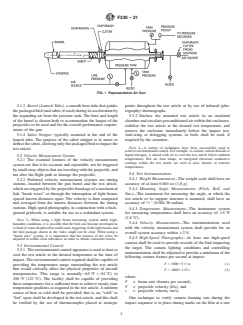
5.1 Gun,compressed-gas,conforminginprincipletoFig.1,
2.1.1 bird, n—the carcass that is used to impact the test
comprising:
article.
5.1.1 Pressure Tank, of capacity and working pressure as
2.1.2 bird package, n—the bird and container that encases
discussed in Note 1.
the bird to prevent flailing and disintegration enroute to target.
NOTE 1—Agun capable of propelling a 4lb (1.81kg) bird in excess of
2.1.3 gun, n—the device that propels the bird toward the
650 knots (334 m/s) has a barrel 60 ft (18.3 m) long, bore of 6 in.
3 3
(153mm), and a pressure tank volume of 30 ft (0.849 m ) with an
target.
allowable working pressure of 250 psi (1.725×10 Pa).
2.1.4 sabot, n—the container that is used to carry the bird
5.1.2 Release Mechanism, comprised of a firing solenoid,
package down the gun barrel.
diaphragm, and a cutter. Upon initiation of the firing sequence,
2.1.5 stripper, n—the device that stops the sabot at the end
the release mechanism allows the compressed gas stored in the
of the gun barrel so that only the bird package impacts the test
pressure tank to flow rapidly into the gun barrel and propel the
article.
projectile.
1 NOTE 2—The most common designs normally use either one or two
This test method is under the jurisdiction of ASTM Committee F07 on
diaphragms in the release mechanism. In the single diaphragm design, the
Aerospace andAircraft and is the direct responsibility of Subcommittee F07.08 on
diaphragm is mechanically ruptured upon firing (see Fig. 1). In the dual
Transparent Enclosures and Materials.
diaphragm system, pressurized gas between the two pressurized gas
Current edition approved May 1, 2021. Published June 2021. Originally
approved in 1979. Last previous edition approved in 2016 as F330–16. DOI: diaphragms is bled to initiate firing by allowing the stored gas to burst
10.1520/F0330-21. each diaphragm in rapid succession.
Copyright © ASTM International, 100 Barr Harbor Drive, PO Box C700, West Conshohocken, PA 19428-2959. United States
F330 − 21
FIG. 1 Representative Air Gun
5.1.3 Barrel (Launch Tube), a smooth bore tube that guides points throughout the test article or by use of infrared (pho-
thepackagedbird(andsabot,ifused)duringitsaccelerationby tography) thermographs.
the expanding air from the pressure tank. The bore and length
5.3.2 Enclose the mounted test article in an insulated
of the barrel is chosen both to accommodate the largest of the
chamberandcirculatepreconditionedairwithinthisenclosure,
projectiles to be used and for the overall performance require-
stabilize the test article at the desired test temperature, and
ments of the gun.
remove the enclosure immediately before the impact test.
5.1.4 Sabot Stripper typically mounted at the end of the
Anti-icing or defogging systems, or both, shall be used, if
launch tube. The purpose of the sabot stripper is to arrest or
required by the customer.
deflectthesabot,allowingonlythepackagedbirdtoimpactthe
NOTE 4—A variety of techniques have been successfully used to
test article.
achieve environmental control. For example:Acoolant, carbon dioxide or
5.2 Velocity Measurement System: liquid nitrogen, is mixed with air to cool the test article below ambient
temperatures. Hot air, heat lamps, or energized electrical conductive
5.2.1 The essential features of the velocity measurement
coatings within the test article are used to raise interior or exterior
system are that it be accurate and repeatable, not be triggered
temperatures.
bysmallstrayobjectsthataretravelingwiththeprojectile,and
5.4 Test Instrumentation:
not alter the flight path or damage the projectile.
5.4.1 Weight Measurement—The weight scale shall have an
5.2.2 Preferred velocity measurement systems use timing
accuracy of at least 0.063 oz (1.8 g).
stations, located between the gun barrel and the test article,
whicharetriggeredbytheprojectilesbreakageofamechanical 5.4.2 Mounting Angle Measurements (Pitch, Roll, and
link “break wires” or through the interruption of light beams Yaw)—The instrument for measuring the angle, at which the
spaced known distances apart. The velocity is then computed test article or its support structure is mounted, shall have an
and averaged from the known distances between the timing accuracy of ⁄4 ° (0.00436 radian).
stations. High-speed photography, in conjunction with a back-
5.4.3 Temperature Measurement—The instrument system
ground gridwork, is suitable for use as a redundant system.
for measuring temperatures shall have an accuracy of 65°F
(2.8°C).
NOTE 3—When using a light beam measuring system under high-
5.4.4 Velocity Measurement—The instrumentation used
humidity conditions, it is possible that the bird can become enveloped in
acloudofwaterdropletsthatcouldcausetriggeringofthelightbeamsand
with the velocity measurement system shall provide for an
the bird package shown in the video might not be clear. When using a
overall system accuracy within 62%.
“break wire” system, it is imperative that the tension of the wires be
5.4.5 High-Speed Photography—At least one high-speed
adjusted to within close tolerances in order to obtain consistent results.
camera shall be used to provide records of the bird impacting
5.3 Environmental Control:
the target. The camera lighting conditions and controlling
5.3.1 Theenvironmentalcontrolapparatusisusedtoheator
instrumentation shall be adjusted to provide a minimum of the
cool the test article to the desired temperature at the time of
following camera frames per second at impact:
impact.Theenvironmentalcontrolrequiredshallbecapableof
F 5 100015 V or (1)
providing the temperature range surrounding the test article
that would critically affect the physical properties of aircraft
F 5 100011.53 v (2)
transparencies. This range is normally−65°F (−54°C) to
where:
250°F (121°C). The facility shall be capable of providing
F = frame rate (frames per second),
these temperatures for a sufficient time to achieve steady-state
V = projectile velocity (ft/s), and
temperature gradients as required in the test article.Auniform
v = projectile velocity (m/s)
source of heat or cold shall be provided; that is, no “cold” or
“hot” spots shall be developed in the test article, and this shall One technique to verify camera framing rate during the
be verified by the use of thermocouples placed at strategic impact sequence is to place timing marks on the film at a rate
F330 − 21
TABLE 2 Bird Projectile Weights
of at least 100/s and at an accuracy of at least 1% (see Table
A B C D
1 for camera frame rate versus impact velocity). WS W W W
NB A P
2.00 ± 0.063 lb 2 lb 0.20 lb 0.20 lb
(0.91 ± 0.028 kg) (0.91 kg) (0.09 kg) (0.09 kg)
6. Materials
4.00 ± 0.125 lb 4 lb 0.40 lb 0.40 lb
6.1 Bird: (1.81 ± 0.057 kg) (1.81 kg) (0.18 kg) (0.18 kg)
8.00 ± 0.250 lb 8 lb 0.80 lb 0.80 lb
6.1.1 The bird combined with the packaging forms the
(3.63 ± 0.113 kg) 3.63 kg) (0.36 kg) (0.36 kg)
projectile that impacts the test article. If a real bird carcass is
A
W = projectile weight including bird and bird container.
S
selected,bothdomesticandwildbirdsarepermitteddepending
B
W = nominal bird weight.
NB
C
ontherequiredweight.Thestandardweightofthebirdusedin
W = maximum allowable weight to be removed from or added to the bird.
A
D
W = maximum allowable weight of the bird container.
this test shall be 4 lb (1.81 kg), unless a different weight is P
required by the certifying authority. Use a chicken as the bird
forthisstandardweight.Eitherfreshlykillthebirdandstorein
a sealed container at 60 to 80°F for up to 8 h, or refrigerate up
6.3.2 The packaged bird remains in the cavity of the sabot
to one day, or freeze immediately after killing for future use.
until the sabot reaches the end of the launcher at which point
For a refrigerated bird, remove the bird from refrigeration and
thesabotisarrestedbythesabotstripperandonlythepackaged
allow it to warm for approximately 6 h (for a 4lb bird) before
birdisallowedtocontinueontoimpactthetestarticle.Asabot
use.Thawafrozenbirdcarcassatnormalroomtemperaturefor
and sabot stripper combination shall be designed so that either
approximately 24 - 48 h (for a 4lb bird) before use. The
all of the sabot is arrested by the stripper or the fragments of
minimum internal bird temperature shall be 60°F (15.5°C) at
sabot which continue past the stripper are not considered to be
the time of use.
detrimental to the test article as observed in high-speed
6.1.2 Weighthebirdjustbeforeuse.Toachievetherequired
photographic records.
weight, th
...
This document is not an ASTM standard and is intended only to provide the user of an ASTM standard an indication of what changes have been made to the previous version. Because
it may not be technically possible to adequately depict all changes accurately, ASTM recommends that users consult prior editions as appropriate. In all cases only the current version
of the standard as published by ASTM is to be considered the official document.
Designation: F330 − 16 F330 − 21
Standard Test Method for
Bird Impact Testing of Aerospace Transparent Enclosures
This standard is issued under the fixed designation F330; the number immediately following the designation indicates the year of original
adoption or, in the case of revision, the year of last revision. A number in parentheses indicates the year of last reapproval. A superscript
epsilon (´) indicates an editorial change since the last revision or reapproval.
This standard has been approved for use by agencies of the U.S. Department of Defense.
1. Scope
1.1 This test method covers conducting bird impact tests under a standard set of conditions by firing a packaged bird at a stationary
transparency aerospace transparency (windshield, canopy, or window) mounted in a support structure.
1.2 Units—The values stated in inch-pound units are to be regarded as standard. The values given in parentheses are mathematical
conversions to SI units that are provided for information only and are not considered standard.
1.3 This standard does not purport to address all of the safety concerns, if any, associated with its use. It is the responsibility
of the user of this standard to establish appropriate safety safety, health, and healthenvironmental practices and determine the
applicability of regulatory limitations prior to use. For specific hazard statements, see Section 8.
1.4 This international standard was developed in accordance with internationally recognized principles on standardization
established in the Decision on Principles for the Development of International Standards, Guides and Recommendations issued
by the World Trade Organization Technical Barriers to Trade (TBT) Committee.
2. Terminology
2.1 Definitions:
2.1.1 bird, n—the carcass that is used to impact the test article.
2.1.2 bird package, n—the bird and container that encases the bird to prevent flailing and disintegration enroute to target.
2.1.3 gun, n—the device that propels the bird toward the target.
2.1.4 sabot, n—the container that is used to carry the bird package down the gun barrel.
2.1.5 stripper, n—the device that stops the sabot at the end of the gun barrel so that only the bird package impacts the test article.
2.1.6 test article, n—the transparency and supporting structure.
3. Summary of Test Method
3.1 This test method employs a smooth-bore birdcompressed-gas gun that fires a chicken carcass so that it impacts a stationary
aerospace transparency mounted in a supporting structure.
This test method is under the jurisdiction of ASTM Committee F07 on Aerospace and Aircraft and is the direct responsibility of Subcommittee F07.08 on Transparent
Enclosures and Materials.
Current edition approved April 1, 2016May 1, 2021. Published April 2016June 2021. Originally approved in 1979. Last previous edition approved in 20102016 as
F330 – 10.F330 – 16. DOI: 10.1520/F0330-16.10.1520/F0330-21.
Copyright © ASTM International, 100 Barr Harbor Drive, PO Box C700, West Conshohocken, PA 19428-2959. United States
F330 − 21
3.2 The specific parameters described by this test method are:
3.2.1 Bird weight and condition,
3.2.2 Bird velocity, and
3.2.3 Instrumentation.
4. Significance and Use
4.1 This test method shall be used for: bird impact testing of aircraft crew compartment transparencies and supporting structure
to verify the design; compilation of test data for use in verification of future transparency and supporting structure design and
analytical methods; and comparative evaluation of materials.
5. Apparatus
5.1 Gun, compressed gas, compressed-gas, conforming in principle to Fig. 1, comprising:
5.1.1 Pressure Tank, of capacity and working pressure as discussed in Note 1.
NOTE 1—A gun capable of propelling a 4-lb (1.81-kg)4 lb (1.81 kg) bird in excess of 650 knots (334 m/s) has a barrel 60 ft (18.3 m) long, bore of 6 in.
3 3 6
(153 mm), and a pressure tank volume of 30 ft (0.849 m ) with an allowable working pressure of 250 psi (1.725 × 10 Pa).
5.1.2 Release Mechanism, comprised of a firing solenoid, diaphragm, and a cutter. Upon initiation of the firing sequence, the
release mechanism allows the compressed gas stored in the pressure tank to flow rapidly into the gun barrel and propel the
projectile.
NOTE 2—The most common designs normally use either one or two diaphragms in the release mechanism. In the single diaphragm design, the diaphragm
is mechanically ruptured upon firing (see Fig. 1). In the dual diaphragm system, pressurized gas between the two pressurized gas diaphragms is bled to
initiate firing by allowing the stored gas to burst each diaphragm in rapid succession.
5.1.3 Barrel (Launch Tube), a smooth bore tube that guides the packaged bird (and sabot, if used) during its acceleration by the
expanding air from the pressure tank. The bore and length of the barrel is chosen both to accommodate the largest of the projectiles
to be used and for the overall performance requirements of the gun.
5.1.4 Sabot Stripper typically mounted at the end of the launcherlaunch tube. The purpose of the sabot stripper is to arrest or
deflect the sabot, allowing only the packaged bird to impact the test article.
5.2 Velocity Measurement System:
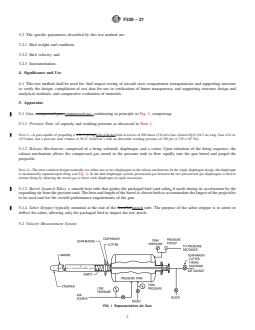
FIG. 1 Representative Air Gun
F330 − 21
5.2.1 The essential features of the velocity measurement system are that it be accurate and repeatable, not be triggered by small
stray objects that are traveling with the projectile, and not alter the flight path or damage the projectile.
5.2.2 Preferred velocity measurement systems use timing stations, located between the gun barrel and the test specimen,article,
which are triggered by the projectiles breakage of a mechanical link “break wire”wires” or through the interruption of a light beam.
light beams spaced known distances apart. The velocity is then computed and averaged from the known distances between the
timing stations. Rapid sequence High-speed photography, in conjunction with a background gridwork, is suitable for use as a
redundant system.
NOTE 3—When using a light beam measuring system under high-humidity conditions, it is possible that the bird can become enveloped in a cloud of water
droplets that could cause triggering of the light beams and the bird package shown in the filmvideo might not be clear. When using a “break wire” system,
it is imperative that the tension of the wires be adjusted to within close tolerances in order to obtain consistent results.
5.3 Environmental Control:
5.3.1 The environmental control apparatus is used to heat or cool the test article to the desired temperature at the time of impact.
The environmental control required shall be capable of providing the temperature range surrounding the test article that would
critically affect the physical properties of aircraft transparencies. This range is normally −65°F (−54°C) to 250°F (121°C).nor-
mally −65 °F (−54 °C) to 250 °F (121 °C). The facility shall be capable of providing these temperatures for a sufficient time to
achieve steady-state temperature gradients as required in the test article. A uniform source of heat or cold shall be provided; that
is, no “cold” or “hot” spots shall be developed in the test article, and this shall be verified by the use of thermocouples placed at
strategic points throughout the test article or by use of infrared (photography) thermographs.
5.3.2 Enclose the mounted test article in an insulated chamber and circulate preconditioned air within this enclosure, stabilize the
test article at the desired test temperature, and remove the enclosure immediately before the impact test. Anti-icing or defogging
systems, or both, shall be used, if required by the customer.
NOTE 4—A variety of techniques have been successfully used to achieve environmental control. For example: A coolant, carbon dioxide or liquid nitrogen,
is mixed with air to cool the test article below ambient temperatures. Hot air, heat lamps, or energized electrical conductive coatings within the test article
are used to raise interior or exterior temperatures.
5.4 Test Instrumentation:
5.4.1 Weight Measurement—The weight scale shall have an accuracy of at least 0.063 oz (1.8 g).
5.4.2 Mounting Angle Measurements (Pitch, Roll, and Yaw)—The instrument for measuring the angle, at which the test article or
its support structure is mounted, shall have an accuracy of ⁄4 ° (0.004 36 radian).
5.4.3 Temperature Measurement—The instrument system for measuring temperatures shall have an accuracy of 65°F
(2.8°C).65 °F (2.8 °C).
5.4.4 Velocity Measurement—The instrumentation used with the velocity measurement system shall provide for an overall system
accuracy within 62 %.
5.4.5 Rapid Sequence, High-Speed Photography—atAt least one high-speed camera shall be used to provide records of the bird
impacting the target. The camera lighting conditions and controlling instrumentation shall be adjusted to provide a minimum of
the following camera frames per second at impact:
F 5 100015 V or (1)
F 5 100011.53 v (2)
where:
F = exposure rate (frames per second),
F = frame rate (frames per second),
V = projectile velocity (ft/s), and
v = projectile velocity (m/s)
F330 − 21
One technique to verify camera exposureframing rate during the impact sequence is to place timing marks on the film at a rate
of at least 100/s and at an accuracy of at least 1 % (see Table 1 for camera exposureframe rate versus impact velocity).
6. Materials
6.1 Bird:
6.1.1 The bird combined with the packaging forms the projectile that impacts the test article. If a real bird carcass is selected, both
domestic and wild birds are permitted depending on the required weight. The standard weight of the bird used in this test shall
be 4 lb (1.81 kg), unless a different weight is required by the certifying authority. Use a chicken as the bird for this standard weight.
Either freshly kill the bird and store in a sealed container at 60 to 80° F 80 °F for up to 8 h, or refrigerate up to one day, or freeze
immediately after killing for future use. For a refrigerated bird, remove the bird from refrigeration and allow it to warm for
approximately 46 h (for a 4-lb4 lb bird) before use. Thaw a frozen bird carcass at normal room temperature for approximately 24
- 48 h (for a 4-lb4 lb bird) before use. The minimum internal bird temperature shall be 60°F (15.5°C)60 °F (15.5 °C) at the time
of use.
6.1.2 Weigh the bird just before use. To achieve the required weight, the carcass shall be either trimmed, trimmed if the bird is
overweight, or water (or gel containing 98 % water) shall be added if the bird is underweight, as long as the carcass’ original weight
does not change more than 10 % (see Table 2). Remove only portions of the bird’s extremities (wings and legs) when a weight
reduction is necessary.
6.2 Bird Container:
6.2.1 The bird container is used to prevent the bird from becoming damaged or grossly deformed before impacting the specimen.
test article. Construct it so as to form a cylindrical projectile and of materials that minimize its effect during impact. Materials
commonly used in fabricating the bird container include nylon, cotton or polyethylene bags, cardboard cartons, and expanded
shapes. The weight of the bird container shall not exceed 10 % of the total projectile weight as indicated in Table 2 for the standard
projectile weights.
6.3 Sabot:
6.3.1 The sabot is used to protect and support t
...