

ASTM F320-21
(Test Method)Standard Test Method for Hail Impact Resistance of Aerospace Transparent Enclosures
General Information
- Abstract
SIGNIFICANCE AND USE
4.1 This test method shall be used to determine the hail impact resistance of windshields for acceptance, design, service, or research purposes. By using this method with the installed windshield angle and velocity of a specific aerospace vehicle, design allowables, criteria, and tolerances can be established for that vehicle's windshield.
SCOPE
1.1 This test method covers the determination of the impact resistance of an aerospace transparent enclosure (windshield, canopy, window, lens cover, etc.), hereinafter called windshield, during hailstorm conditions using simulated hailstones consisting of ice balls molded under tightly controlled conditions. This test shall also be used to meet hail test or performance requirements that are specified by design or contract.
1.2 Units—The values stated in inch-pound units are to be regarded as standard. The values given in parentheses are mathematical conversions to SI units that are provided for information only and are not considered standard.
1.3 This standard does not purport to address all of the safety concerns, if any, associated with its use. It is the responsibility of the user of this standard to establish appropriate safety, health, and environmental practices and determine the applicability of regulatory limitations prior to use. For specific hazard statements, see Section 7.
1.4 This international standard was developed in accordance with internationally recognized principles on standardization established in the Decision on Principles for the Development of International Standards, Guides and Recommendations issued by the World Trade Organization Technical Barriers to Trade (TBT) Committee.
- Status
- Published
- Publication Date
- 30-Apr-2021
- Technical Committee
- F07 - Aerospace and Aircraft
- Drafting Committee
- F07.08 - Transparent Enclosures and Materials
Buy Documents
ASTM F320-21 - Standard Test Method for Hail Impact Resistance of Aerospace Transparent Enclosures
REDLINE ASTM F320-21 - Standard Test Method for Hail Impact Resistance of Aerospace Transparent Enclosures
Overview
ASTM F320-21: Standard Test Method for Hail Impact Resistance of Aerospace Transparent Enclosures is a critical international standard developed by ASTM International. It specifies procedures for evaluating the hail impact resistance of aerospace transparent enclosures, such as windshields, canopies, windows, and lens covers. The test method uses simulated hailstones-specifically, ice balls produced under tightly controlled laboratory conditions-to replicate real-world hailstorm impacts, ensuring transparency products can meet demanding aerospace requirements for design, acceptance, and serviceability.
Key Topics
- Hail Impact Simulation: The standard defines the use of ice balls molded to simulate hailstones, which are launched at transparent enclosures at specified velocities and angles.
- Test Setup and Procedure:
- Selection and preparation of test specimens (full windshields or representative sections)
- Ice ball preparation to meet strict consistency and size requirements
- Use of specialized launching mechanisms capable of achieving high velocities
- Measurement of impact angle and velocity to ensure accurate simulation
- Damage Assessment: Evaluation of damage such as scratches, cracks, delamination, and shattering to determine resistance levels.
- Safety Considerations: Guidance regarding the safe handling of gunpowder, protective measures for personnel, and equipment setup.
- Reporting Requirements: The standard specifies data to record, including test setup, calibration data, ice ball characteristics, impact results, and detailed documentation of observed damage.
Applications
ASTM F320-21 is primarily applied in the aerospace industry, supporting several critical use cases:
- Product Acceptance and Certification: Ensures windshields and transparent components meet contractual and regulatory hail impact requirements.
- Design and Engineering: Enables engineers to establish and validate design tolerances and criteria for new aerospace vehicles or retrofits.
- Quality Assurance: Used by manufacturers and suppliers to verify that transparent enclosures maintain required safety and performance standards.
- Service and Maintenance: Assists operators and maintenance teams in evaluating the ongoing integrity of installed windshields and windows.
- Research and Development: Facilitates materials research and performance benchmarking under simulated severe weather conditions.
The test method allows for flexibility in apparatus and procedure as long as performance equivalence is demonstrated, making it suitable for a range of organizational setups while maintaining rigorous consistency and accuracy in results.
Related Standards
If you work with hail-resistant aerospace transparencies, you may also encounter these relevant ASTM and international standards:
- ASTM F1915 – Standard Practice for Installation of Aircraft Windshields
- ASTM D3763 – Standard Test Method for High-Speed Puncture Properties of Plastics Using Load and Displacement Sensors
- ASTM E330 – Standard Test Method for Structural Performance of Exterior Windows, Doors, Skylights, and Curtain Walls by Uniform Static Air Pressure Difference
- FAA FAR 25.775 – Transport category aircraft windshield and window requirements
- ISO 614 – Impact testing - General test methods
Practical Value
Implementing ASTM F320-21 helps aerospace companies safeguard against hail-related damage, preserve visibility and structural integrity of aircraft canopies and windows, and streamline compliance with international aviation safety regulations. The standard brings critical assurance in the design and operational phases, promoting durability, reliability, and passenger safety for aerospace transparent enclosures.
Keywords: hail impact resistance, aerospace transparent enclosures, windshields, ASTM F320-21, simulated hailstones, impact testing, aerospace standards, transparency testing
Buy Documents
ASTM F320-21 - Standard Test Method for Hail Impact Resistance of Aerospace Transparent Enclosures
REDLINE ASTM F320-21 - Standard Test Method for Hail Impact Resistance of Aerospace Transparent Enclosures
Get Certified
Connect with accredited certification bodies for this standard

BUREAU VERITAS Certification Germany
Bureau Veritas certification in Germany.

Element Materials Technology
Materials testing and product certification.

AQMS Ltd.
AQMS provides ISO certification to SMEs across the UK.
Sponsored listings
Frequently Asked Questions
ASTM F320-21 is a standard published by ASTM International. Its full title is "Standard Test Method for Hail Impact Resistance of Aerospace Transparent Enclosures". This standard covers: SIGNIFICANCE AND USE 4.1 This test method shall be used to determine the hail impact resistance of windshields for acceptance, design, service, or research purposes. By using this method with the installed windshield angle and velocity of a specific aerospace vehicle, design allowables, criteria, and tolerances can be established for that vehicle's windshield. SCOPE 1.1 This test method covers the determination of the impact resistance of an aerospace transparent enclosure (windshield, canopy, window, lens cover, etc.), hereinafter called windshield, during hailstorm conditions using simulated hailstones consisting of ice balls molded under tightly controlled conditions. This test shall also be used to meet hail test or performance requirements that are specified by design or contract. 1.2 Units—The values stated in inch-pound units are to be regarded as standard. The values given in parentheses are mathematical conversions to SI units that are provided for information only and are not considered standard. 1.3 This standard does not purport to address all of the safety concerns, if any, associated with its use. It is the responsibility of the user of this standard to establish appropriate safety, health, and environmental practices and determine the applicability of regulatory limitations prior to use. For specific hazard statements, see Section 7. 1.4 This international standard was developed in accordance with internationally recognized principles on standardization established in the Decision on Principles for the Development of International Standards, Guides and Recommendations issued by the World Trade Organization Technical Barriers to Trade (TBT) Committee.
SIGNIFICANCE AND USE 4.1 This test method shall be used to determine the hail impact resistance of windshields for acceptance, design, service, or research purposes. By using this method with the installed windshield angle and velocity of a specific aerospace vehicle, design allowables, criteria, and tolerances can be established for that vehicle's windshield. SCOPE 1.1 This test method covers the determination of the impact resistance of an aerospace transparent enclosure (windshield, canopy, window, lens cover, etc.), hereinafter called windshield, during hailstorm conditions using simulated hailstones consisting of ice balls molded under tightly controlled conditions. This test shall also be used to meet hail test or performance requirements that are specified by design or contract. 1.2 Units—The values stated in inch-pound units are to be regarded as standard. The values given in parentheses are mathematical conversions to SI units that are provided for information only and are not considered standard. 1.3 This standard does not purport to address all of the safety concerns, if any, associated with its use. It is the responsibility of the user of this standard to establish appropriate safety, health, and environmental practices and determine the applicability of regulatory limitations prior to use. For specific hazard statements, see Section 7. 1.4 This international standard was developed in accordance with internationally recognized principles on standardization established in the Decision on Principles for the Development of International Standards, Guides and Recommendations issued by the World Trade Organization Technical Barriers to Trade (TBT) Committee.
ASTM F320-21 is classified under the following ICS (International Classification for Standards) categories: 49.045 - Structure and structure elements. The ICS classification helps identify the subject area and facilitates finding related standards.
ASTM F320-21 is available in PDF format for immediate download after purchase. The document can be added to your cart and obtained through the secure checkout process. Digital delivery ensures instant access to the complete standard document.
Standards Content (Sample)
This international standard was developed in accordance with internationally recognized principles on standardization established in the Decision on Principles for the
Development of International Standards, Guides and Recommendations issued by the World Trade Organization Technical Barriers to Trade (TBT) Committee.
Designation:F320 −21
Standard Test Method for
Hail Impact Resistance of Aerospace Transparent
Enclosures
ThisstandardisissuedunderthefixeddesignationF320;thenumberimmediatelyfollowingthedesignationindicatestheyearoforiginal
adoption or, in the case of revision, the year of last revision.Anumber in parentheses indicates the year of last reapproval.Asuperscript
epsilon (´) indicates an editorial change since the last revision or reapproval.
This standard has been approved for use by agencies of the U.S. Department of Defense.
1. Scope 2.1.3 impact angle, n—the angle between the ice ball flight
path and the target normal.
1.1 This test method covers the determination of the impact
2.1.4 sabot, n—a plastic carrier used to carry the ice ball
resistance of an aerospace transparent enclosure (windshield,
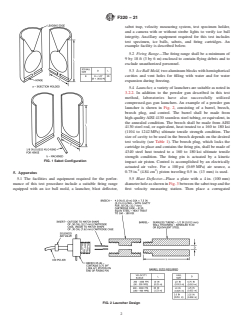
down the launch tube. One type of sabot (see Fig. 1) consists
canopy, window, lens cover, etc.), hereinafter called
of a split polycarbonate rod containing a central cavity for
windshield, during hailstorm conditions using simulated hail-
holding the ice ball. Each sabot half is designed to assure
stones consisting of ice balls molded under tightly controlled
aerodynamic separation from the ice ball after exiting from the
conditions. This test shall also be used to meet hail test or
launch tube.
performance requirements that are specified by design or
contract.
3. Summary of Test Method
1.2 Units—The values stated in inch-pound units are to be
3.1 The test method involves launching a series of ice balls
regarded as standard. The values given in parentheses are
of specified sizes at a sample windshield at a designated
mathematical conversions to SI units that are provided for
velocity and angle and in a specified pattern. Requirements are
information only and are not considered standard.
specified for the ice ball, test specimen, procedure, and data
1.3 This standard does not purport to address all of the
acquisition. The ice ball is photographed in flight to verify its
safety concerns, if any, associated with its use. It is the
integrity.
responsibility of the user of this standard to establish appro-
3.2 Requirements are specified for an example apparatus
priate safety, health, and environmental practices and deter-
andtestprocedure,butoptionsarepermitted.However,itmust
mine the applicability of regulatory limitations prior to use.
be demonstrated that the options used result in an ice ball
For specific hazard statements, see Section 7.
impacting the test panel with the same size, consistency, and
1.4 This international standard was developed in accor-
velocity as with the specified apparatus and procedure. Fol-
dance with internationally recognized principles on standard-
lowing are areas where options are allowed:
ization established in the Decision on Principles for the
3.2.1 Ice Ball Mold Material.
Development of International Standards, Guides and Recom-
3.2.2 Launcher—Any type of launcher is allowable as long
mendations issued by the World Trade Organization Technical
as the ice ball reaches the test specimen intact at the correct
Barriers to Trade (TBT) Committee.
speed. The use of sabots and sabot material and geometry are
2. Terminology optional.
3.2.3 Method of Determining Ice Ball Integrity.
2.1 Definitions:
3.2.4 Ice Ball Speed Measurement, as long as accuracy
2.1.1 damage, n—any modification in visual properties or
standards are met.
integrity of a windshield as a result of hail impact including
3.2.5 Test Specimen Sizes—Those given are minimum.
scratches, crazing, delamination, cracks, penetration, or shat-
3.2.6 Safety—Safety must satisfy the safety standards of the
tering.
test facility being used.
2.1.2 ice ball, n—a frozen sphere of water, with filler, that
simulates a natural hailstone in weight, size, and toughness. 4. Significance and Use
4.1 This test method shall be used to determine the hail
impact resistance of windshields for acceptance, design,
This test method is under the jurisdiction of ASTM Committee F07 on
Aerospace andAircraft and is the direct responsibility of Subcommittee F07.08 on
service, or research purposes. By using this method with the
Transparent Enclosures and Materials.
installed windshield angle and velocity of a specific aerospace
Current edition approved May 1, 2021. Published June 2021. Originally
vehicle, design allowables, criteria, and tolerances can be
approved in 1978. Last previous edition approved in 2016 as F320–16. DOI:
10.1520/F0320-21. established for that vehicle’s windshield.
Copyright © ASTM International, 100 Barr Harbor Drive, PO Box C700, West Conshohocken, PA 19428-2959. United States
F320−21
sabot trap, velocity measuring system, test specimen holder,
and a camera with or without strobe lights to verify ice ball
integrity. Ancillary equipment required for this test includes
test specimen, ice balls, sabots, and firing cartridges. An
example facility is described below.
5.2 Firing Range—The firing range shall be a minimum of
9 by 18 ft (3 by 6 m) enclosed to contain flying debris and to
exclude unauthorized personnel.
5.3 Ice Ball Mold,twoaluminumblockswithhemispherical
cavities and vent holes for filling with water and for water
expansion during freezing.
5.4 Launcher, a variety of launchers are suitable as noted in
3.2.2. In addition to the powder gun described in this test
method, laboratories have also successfully utilized
compressed-gas gun launchers. An example of a powder gun
launcher is shown in Fig. 2, consisting of a barrel, breech,
breech plug, and control. The barrel shall be made from
high-qualityAISI 4130 seamless steel tubing, or equivalent, in
the annealed condition. The breech shall be made from AISI
4130 steel rod, or equivalent, heat treated to a 160 to 180ksi
(1104 to 1242MPa) ultimate tensile strength condition. The
size of cavity to be used in the breech depends on the desired
test velocity (see Table 1). The breech plug, which locks the
cartridge in place and contains the firing pin, shall be made of
4340 steel heat treated to a 160 to 180ksi ultimate tensile
strength condition. The firing pin is actuated by a kinetic
FIG. 1Sabot Configuration
impact air piston. Control is accomplished by an electrically
actuated air valve. For a 100psi (0.69MPa) air source, a
2 2
0.75in. (4.84cm ) piston traveling 0.5 in. (13 mm) is used.
5. Apparatus
5.5 Blast Deflector—Place a plate with a 4in. (100mm)
5.1 The facilities and equipment required for the perfor-
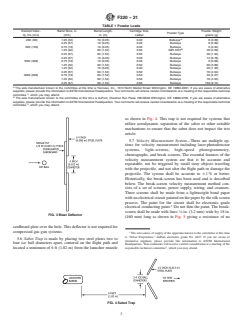
mance of this test procedure include a suitable firing range diameterholeasshowninFig.3betweenthesabottrapandthe
equipped with an ice ball mold, a launcher, blast deflector, first velocity measuring station. Then place a corrugated
FIG. 2Launcher Design
F320−21
TABLE 1 Powder Loads
Desired Veloc- Barrel Bore, in. Barrel Length, Cartridge Size, Powder Weight,
Powder Type
ity, ft/s (m/s) (mm) in. (m) caliber grains (g)
A
200 (60) 1.25 (32) 10 (0.25) 0.30 Bullseye 6 (0.39)
2.25 (57) 10 (0.25) 0.30 Bullseye 6 (0.39)
500 (150) 0.75 (19) 10 (0.25) 0.30 Bullseye 5 (0.32)
B
1.25 (32) 60 (1.52) 0.50 IMR 4227 40 (2.59)
2.25 (57) 60 (1.52) 0.50 Bullseye 30 (1.94)
2.25 (57) 10 (0.25) 0.30 Bullseye 12 (0.78)
1000 (300) 0.75 (19) 10 (0.25) 0.30 Bullseye 9 (0.58)
1.25 (32) 60 (1.52) 0.50 Bullseye 60 (3.89)
1.25 (32) 10 (0.25) 0.30 Bullseye 20 (1.30)
2.25 (57) 60 (1.52) 0.50 Bullseye 70 (4.54)
2000 (600) 0.75 (19) 60 (1.52) 0.50 Bullseye 35 (2.27)
1.25 (32) 60 (1.52) 0.50 Bullseye 70 (4.54)
2.25 (57) 60 (1.52) 0.50 Bullseye 150 (9.72)
A
The sole manufacturer known to the committee at this time is Hercules, Inc., 1313 North Market Street Wilmington, DE 19894-0001. If you are aware of alternative
suppliers, please provide this information toASTM International Headquarters. Your comments will receive careful consideration at a meeting of the responsible technical
committee , which you may attend.
B
The sole manufacturer known to the committee at this time is duPont, Chestnut Run Plaza 705/GS38 Wilmington, DE 19880-0705. If you are aware of alternative
suppliers, please provide this information toASTM International Headquarters. Your comments will receive careful consideration at a meeting of the responsible technical
committee , which you may attend.
as shown in Fig. 4. This trap is not required for systems that
utilize aerodynamic separation of the sabot or other suitable
mechanisms to ensure that the sabot does not impact the test
article.
5.7 Velocity Measurement System—There are multiple op-
tions for velocity measurement including laser-photodetector
systems, light-screens, high-speed photogrammetry,
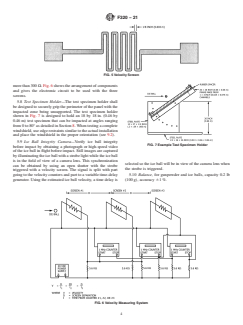
chronographs, and break screens. The essential features of the
velocity measurement system are that it be accurate and
repeatable, not be triggered by small stray objects traveling
with the projectile, and not alter the flight path or damage the
projectile. The system shall be accurate to 61% or better.
Historically, the break-screen has been used and is described
below. The break-screen velocity measurement method con-
sists of a set of screens, power supply, wiring, and counters.
Three screens shall be made from a lightweight bond paper
withanelectricalcircuitpaintedonthepaperbythesilkscreen
process. The paint for the circuit shall be electronic grade
electrical conducting paint. Do not thin the paint. The break-
screen shall be made with lines ⁄8 in. (3.2mm) wide by 18 in.
FIG. 3Blast Deflector
(460 mm) long as shown in Fig. 5 giving a resistance of no
cardboard plate over the hole.This deflector is not required for
compressed-gas gun systems. 2
The sole source of supply of the apparatus known to the committee at this time
is “Silver Preparation,” duPont electronic grade No. 4817. If you are aware of
5.6 Sabot Trap is made by placing two steel plates two to
alternative suppliers, please provide this information to ASTM International
four ice ball diameters apart, centered on the flight path and
Headquarters.Your comments will receive careful consideration at a meeting of the
located a minimum of 6 ft (1.82 m) from the launcher muzzle responsible technical committee , which you may attend.
FIG. 4Sabot Trap
F320−21
FIG. 5Velocity Screen
morethan300Ω.Fig.6showsthearrangementofcomponents
and gives the electronic circuit to be used with the three
screens.
5.8 Test Specimen Holder—The test specimen holder shall
bedesignedtosecurelygriptheperimeterofthepanelwiththe
impacted zone being unsupported. The test specimen holder
shown in Fig. 7 is designed to hold an 18 by 18in. (0.46 by
0.46m) test specimen that can be impacted at angles ranging
from0to80°asdetailedinSection8.Whentestingacomplete
windshield, use edge restraints similar to the actual installation
and place the windshield in the proper orientation (see 9.2).
5.9 Ice Ball Integrity Camera—Verify ice ball integrity
FIG. 7Example Test Specimen Holder
before impact by obtaining a photograph or high-speed video
of the ice ball in flight before impact. Still images are captured
byilluminatingtheiceballwithastrobelightwhiletheiceball
is in the field of view of a camera lens. This synchronization
selectedsotheiceballwillbeinviewofthecameralenswhen
can be obtained by using an open shutter with the strobe
the strobe is triggered.
triggered with a velocity screen. The signal is split with part
going to the velocity counters and part to a variable time-delay 5.10 Balance, for gunpowder and ice balls, capacity 0.2 lb
generator. Using the estimated ice ball velocity, a time delay is (100g), accuracy 61%.
FIG. 6Velocity Measuring System
...
This document is not an ASTM standard and is intended only to provide the user of an ASTM standard an indication of what changes have been made to the previous version. Because
it may not be technically possible to adequately depict all changes accurately, ASTM recommends that users consult prior editions as appropriate. In all cases only the current version
of the standard as published by ASTM is to be considered the official document.
Designation: F320 − 16 F320 − 21
Standard Test Method for
Hail Impact Resistance of Aerospace Transparent
Enclosures
This standard is issued under the fixed designation F320; the number immediately following the designation indicates the year of original
adoption or, in the case of revision, the year of last revision. A number in parentheses indicates the year of last reapproval. A superscript
epsilon (´) indicates an editorial change since the last revision or reapproval.
This standard has been approved for use by agencies of the U.S. Department of Defense.
1. Scope
1.1 This test method covers the determination of the impact resistance of an aerospace transparent enclosure, enclosure
(windshield, canopy, window, lens cover, etc.), hereinafter called windshield, during hailstorm conditions using simulated
hailstones consisting of ice balls molded under tightly controlled conditions. This test shall also be used to meet hail test or
performance requirements that are specified by design or contract.
1.2 Units—The values stated in inch-pound units are to be regarded as standard. The values given in parentheses are mathematical
conversions to SI units that are provided for information only and are not considered standard.
1.3 This standard does not purport to address all of the safety concerns, if any, associated with its use. It is the responsibility
of the user of this standard to establish appropriate safety safety, health, and healthenvironmental practices and determine the
applicability of regulatory limitations prior to use. For specific hazard statements, see Section 7.
1.4 This international standard was developed in accordance with internationally recognized principles on standardization
established in the Decision on Principles for the Development of International Standards, Guides and Recommendations issued
by the World Trade Organization Technical Barriers to Trade (TBT) Committee.
2. Terminology
2.1 Definitions:
2.1.1 damage, n—any modification in visual properties or integrity of a windshield as a result of hail impact including scratches,
crazing, delamination, cracks, penetration, or shattering.
2.1.2 ice ball, n—a frozen masssphere of water, with filler, that simulates a natural hailstone in weight, size, and toughness.
2.1.3 impact angle, n—the angle between the ice ball flight path and the target normal.
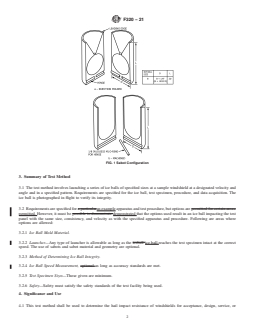
2.1.4 sabot, n—a plastic device for protecting carrier used to carry the ice ball while in down the launch tube. One type of sabot
(see Fig. 1) consists of a split polycarbonate rod containing a central cavity for holding the ice ball. Each sabot half is designed
to assure aerodynamic separation from the ice ball after ejectionexiting from the launch tube.
This test method is under the jurisdiction of ASTM Committee F07 on Aerospace and Aircraft and is the direct responsibility of Subcommittee F07.08 on Transparent
Enclosures and Materials.
Current edition approved April 1, 2016May 1, 2021. Published April 2016June 2021. Originally approved in 1978. Last previous edition approved in 20102016 as
F320 – 10.F320 – 16. DOI: 10.1520/F0320-16.10.1520/F0320-21.
Copyright © ASTM International, 100 Barr Harbor Drive, PO Box C700, West Conshohocken, PA 19428-2959. United States
F320 − 21
FIG. 1 Sabot Configuration
3. Summary of Test Method
3.1 The test method involves launching a series of ice balls of specified sizes at a sample windshield at a designated velocity and
angle and in a specified pattern. Requirements are specified for the ice ball, test specimen, procedure, and data acquisition. The
ice ball is photographed in flight to verify its integrity.
3.2 Requirements are specified for a particularan example apparatus and test procedure, but options are permitted for certain areas.
permitted. However, it must be possible to demonstrate demonstrated that the options used result in an ice ball impacting the test
panel with the same size, consistency, and velocity as with the specified apparatus and procedure. Following are areas where
options are allowed:
3.2.1 Ice Ball Mold Material.
3.2.2 Launcher—Any type of launcher is allowable as long as the iceball ice ball reaches the test specimen intact at the correct
speed. The use of sabots and sabot material and geometry are optional.
3.2.3 Method of Determining Ice Ball Integrity.
3.2.4 Ice Ball Speed Measurement, optional as long as accuracy standards are met.
3.2.5 Test Specimen Sizes—Those given are minimum.
3.2.6 Safety—Safety must satisfy the safety standards of the test facility being used.
4. Significance and Use
4.1 This test method shall be used to determine the hail impact resistance of windshields for acceptance, design, service, or
F320 − 21
research purposes. By couplingusing this method with the installed windshield angle and velocity of a specific aerospace vehicle,
design allowables, criteria, and tolerances can be established for that vehicle’s windshield.
5. Apparatus
5.1 The facilities and equipment required for the performance of this test procedure include a suitable firing range equipped with
an ice ball mold, a launcher, blast deflector, sabot trap, velocity measuring system, test specimen holder, and a camera with or
without strobe lights to verify ice ball integrity. Ancillary equipment required for this test includeincludes test specimen, ice balls,
sabots, and firing cartridges. An example facility is described below.
5.2 Firing Range—The firing range shall be a minimum of 9 by 18 ft (3 by 6 m) enclosed to contain flying debris and to exclude
unauthorized personnel.
5.3 Ice Ball Mold, two aluminum blocks with hemispherical cavities and vent holes for filling with water and for water expansion
during freezing.
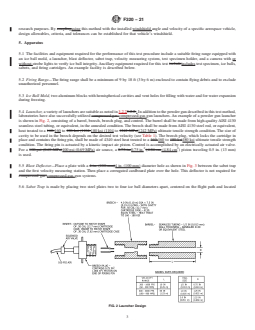
5.4 Launcher, a variety of launchers are suitable as noted in 3.2.23.2.2. In addition to the powder gun described in this test method,
laboratories have also successfully utilized compressed gas compressed-gas gun launchers. An example of a powder gun launcher
is shown in Fig. 2, consisting of a barrel, breech, breech plug, and control. The barrel shall be made from high-quality AISI 4130
seamless steel tubing, or equivalent, in the annealed condition. The breech shall be made from AISI 4130 steel rod, or equivalent,
heat treated to a 160-160 to 180-ksi (1104-180 ksi (1104 to 1242-MPa)1242 MPa) ultimate tensile strength condition. The size of
cavity to be used in the breech depends on the desired test velocity (see Table 1). The breech plug, which locks the cartridge in
place and contains the firing pin, shall be made of 4340 steel heat treated to a 160-160 to 180-ksi180 ksi ultimate tensile strength
condition. The firing pin is actuated by a kinetic impact air piston. Control is accomplished by an electrically actuated air valve.
2 2
For a 100-psi (0.69-MPa)100 psi (0.69 MPa) air source, a 0.75-in.0.75 in. (4.84-cm (4.84 cm ) piston traveling 0.5 in. (13 mm)
is used.
5.5 Blast Deflector—Place a plate with a 4-in. (100-mm)4 in. (100 mm) diameter hole as shown in Fig. 3 between the sabot trap
and the first velocity measuring station. Then place a corrugated cardboard plate over the hole. This deflector is not required for
compressed gas compressed-gas gun systems.
5.6 Sabot Trap is made by placing two steel plates two to four ice ball diameters apart, centered on the flight path and located
FIG. 2 Launcher Design
F320 − 21
TABLE 1 PowerPowder Loads
Desired Veloc- Barrel Bore, in. Barrel Length, Cartridge Size, Powder Weight,
Powder Type
ity, ft/s (m/s) (mm) in. (m) caliber grains (g)
A
200 (60) 1.25 (32) 10 (0.25) 0.30 Bullseye 6 (0.39)
2.25 (57) 10 (0.25) 0.30 Bullseye 6 (0.39)
500 (150) 0.75 (19) 10 (0.25) 0.30 Bullseye 5 (0.32)
B
1.25 (32) 60 (1.52) 0.50 IMR 4227 40 (2.59)
2.25 (57) 60 (1.52) 0.50 Bullseye 30 (1.94)
2.25 (57) 10 (0.25) 0.30 Bullseye 12 (0.78)
1000 (300) 0.75 (19) 10 (0.25) 0.30 Bullseye 9 (0.58)
1.25 (32) 60 (1.52) 0.50 Bullseye 60 (3.89)
1.25 (32) 10 (0.25) 0.30 Bullseye 20 (1.30)
2.25 (57) 60 (1.52) 0.50 Bullseye 70 (4.54)
2000 (600) 0.75 (19) 60 (1.52) 0.50 Bullseye 35 (2.27)
1.25 (32) 60 (1.52) 0.50 Bullseye 70 (4.54)
2.25 (57) 60 (1.52) 0.50 Bullseye 150 (9.72)
A
The sole source of supply of the apparatus manufacturer known to the committee at this time is Hercules, Inc., 1313 North Market Street Wilmington, DE 19894-0001.
If you are aware of alternative suppliers, please provide this information to ASTM International Headquarters. Your comments will receive careful consideration at a meeting
of the responsible technical committee , which you may attend.
B
The sole source of supply of the apparatus manufacturer known to the committee at this time is duPont, Chestnut Run Plaza 705/GS38 Wilmington, DE 19880-0705.
If you are aware of alternative suppliers, please provide this information to ASTM International Headquarters. Your comments will receive careful consideration at a meeting
of the responsible technical committee , which you may attend.
FIG. 3 Blast Deflector
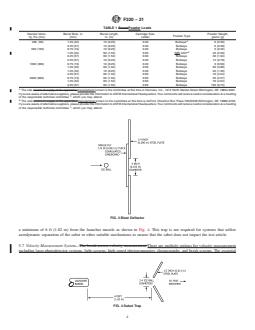
a minimum of 6 ft (1.82 m) from the launcher muzzle as shown in Fig. 4. This trap is not required for systems that utilize
aerodynamic separation of the sabot or other suitable mechanisms to ensure that the sabot does not impact the test article.
5.7 Velocity Measurement System—The break-screen velocity measurement There are multiple options for velocity measurement
including laser-photodetector systems, light-screens, high-speed photogrammetry, chronographs, and break screens. The essential
FIG. 4 Sabot Trap
F320 − 21
features of the velocity measurement system are that it be accurate and repeatable, not be triggered by small stray objects traveling
with the projectile, and not alter the flight path or damage the projectile. The system shall be accurate to 61 % or better.
Historically, the break-screen has been used and is described below. The break-screen velocity measurement method consists of
a set of screens, power supply, wiring, and counters. Three screens shall be made from a lightweight bond paper with an electrical
circuit painted on the paper by the silk screen process. The paint for the circuit shall be electronic grade electrical conducting
paint. Do not thin the paint. The break-screen shall be made with lines ⁄8 in. (3.2 mm) wide by 18 in. (460 mm) long as shown
in Fig. 5 giving a resistance of no more than 300 Ω. Fig. 6 shows the arrangement of components and gives the electronic circuit
to be used with the three screens. The system shall be accurate to 61 % or better. Laser-based photo detector systems and
high-speed-film-based systems are also acceptable, provided the accuracy is 61 %.
5.8 Test Specimen Holder—Use one of two types of test specimen holders. The one The test specimen holder shall be designed
to securely grip the perimeter of the panel with the impacted zone being unsupported. The test specimen holder shown in Fig. 7
is designed to hold an 18-18 by 18-in. (0.46-18 in. (0.46 by 0.46-m)0.46 m) test specimen that can be impacted at angles ranging
from 0 to 80° as detailed in Section 8. When testing a complete windshield, use edge restraints similar to the actual installation
and place the windshield in the proper orientation (see 9.2).
5.9 Ice Ball Integrity Camera—Verify ice ball integrity before impact by obtaining a photograph or high-speed video of the ice
ball in flight before impact. This is accomplished Still images are captured by illuminating the ice ball with a strobe light while
the ice ball is in the field of view of a camera lens. This synchronization can be obtained by using an open shutter with the strobe
triggered at the second with a velocity screen. The signal is split with part going to the velocity counters and part to a variable
time-delay generator. Using the estimated ice ball velocity, a time delay is selected so the ice ball will be in view of the camera
lens when the strobe is triggered.
5.10 Balance, for powdergunpowder and ice balls, capacity 0.2 lb (100 g), accuracy 61 % (1.0 g).61 %.
5.11 Clinometer or Protractor, to measure impact angle, accuracy 6 ⁄4 °.
5.12 Syringe, 100-cm100 cm , for puttinginjecting water into the ice ball mold.
6. Materials
6.1 Sabot—An effective injection molded sabot configuration is shown in F
...