

ASTM B498/B498M-22
(Specification)Standard Specification for Zinc-Coated (Galvanized) Steel Core Wire for Use in Overhead Electrical Conductors
General Information
- Abstract
ABSTRACT
This specification covers round, zinc-coated (galvanized), steel core wire with three classes of zinc coating used for mechanical reinforcement in the manufacture of aluminum conductors, steel-reinforced (ACSR). The wire is furnished in three classes of coating, namely: Class A, Class B, and Class C. The base metal shall be steel produced by the open-hearth, electric-furnace, or basic-oxygen process. The wire shall be cold drawn and coated with zinc to produce the desired properties and the the slab zinc used for coating shall be high-grade or better. The steel shall conform to the chemical composition requirements prescribed for carbon, manganese, phosphorus, sulfur, and silicon, as determined by chemical analysis. The following tests shall be performed: (1) tensile test to determine the mechanical properties such as ultimate tensile strength, elongation, and stress at extension, (2) wrap test, (3) coating test to determine conformity to the specified diameter and area density requirements, and (4) coating adherence test. Requirements for joints which may be made by electric butt-weld or flash-welding are detailed. The density and resistivity of galvanized steel wire are prescribed for the purposes of calculating mass per unit length, cross-sections, and so forth.
SCOPE
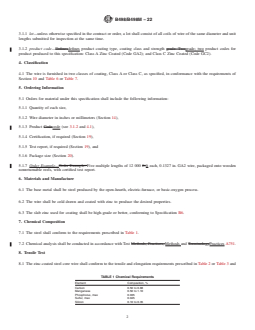
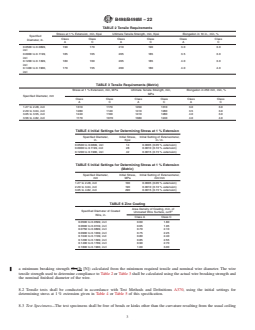
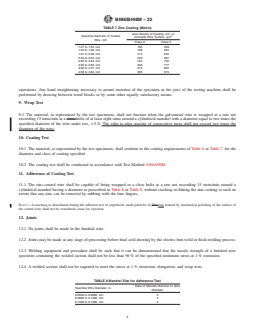
1.1 This specification covers round, zinc-coated, steel core wire with two classes of zinc coating for use in overhead electrical conductors.
1.2 This specification covers wire of diameter from 0.0500 to 0.1900 in. or 1.27 to 4.82 mm, inclusive.
1.3 The values stated in either SI units or inch-pound units are to be regarded separately as standard. The values stated in each system may not be exact equivalents; therefore, each system shall be used independently of the other. Combining values from the two systems may result in non-conformance with the standard.
1.4 This international standard was developed in accordance with internationally recognized principles on standardization established in the Decision on Principles for the Development of International Standards, Guides and Recommendations issued by the World Trade Organization Technical Barriers to Trade (TBT) Committee.
- Status
- Published
- Publication Date
- 30-Sep-2022
- Technical Committee
- B01 - Electrical Conductors
- Drafting Committee
- B01.05 - Conductors of Ferrous Metals
Buy Documents

ASTM B498/B498M-22 - Standard Specification for Zinc-Coated (Galvanized) Steel Core Wire for Use in Overhead Electrical Conductors
REDLINE ASTM B498/B498M-22 - Standard Specification for Zinc-Coated (Galvanized) Steel Core Wire for Use in Overhead Electrical Conductors
Overview
ASTM B498/B498M-22: Standard Specification for Zinc-Coated (Galvanized) Steel Core Wire for Use in Overhead Electrical Conductors establishes requirements for round, zinc-coated steel core wire designed for the mechanical reinforcement of aluminum conductors, specifically aluminum conductor steel-reinforced (ACSR) cables. These steel core wires are critical in overhead electrical transmission and distribution systems, providing durability and structural strength while resisting corrosion due to their galvanized zinc coating.
This specification details the required chemical composition, mechanical properties, zinc coating types, permissible variations in dimensions, and quality control tests. It covers wire diameters from 0.0500 to 0.1900 inches (1.27 to 4.82 mm) and outlines separate requirements for Class A and Class C zinc coating thicknesses.
Key Topics
Material and Manufacturing
- Base steel must be produced using open-hearth, electric-furnace, or basic-oxygen processes.
- The wire is cold drawn and coated with high-grade or better slab zinc.
Classes and Dimensions
- Two classes of zinc coating: Class A (standard) and Class C (heavy).
- Covers wire diameters from 0.0500 to 0.1900 inches (1.27 to 4.82 mm).
- Separate standards for SI and inch-pound units; the two systems are not interchangeable.
Mechanical and Chemical Requirements
- Chemical composition is specified for elements like carbon, manganese, sulfur, phosphorus, and silicon.
- Mechanical properties include requirements for tensile strength, elongation, and stress at extension.
Testing and Quality Assurance
- Mandatory tests: tensile test, wrap test, zinc coating thickness, and coating adherence.
- Procedures for sampling, retesting, and acceptance of lots are included.
- Joints in finished wire are not permitted; any necessary welds must meet strength requirements before final drawing.
Packaging and Identification
- Packaging details (coil, reel, or reelless coil) and unit lengths are agreed upon between purchaser and manufacturer.
- Each package is tagged with diameter, class of coating, length, weight, order number, and producer.
Applications
Zinc-coated steel core wire conforming to ASTM B498/B498M-22 is primarily used in:
- Overhead transmission and distribution lines: Serves as the reinforcing steel core in ACSR conductors, enabling long spans, high strength, and flexibility.
- High-voltage and extra-high-voltage power infrastructure: The wire’s mechanical strength and corrosion-resistant zinc coating ensure reliable performance over extended service life.
- Utility and power grid construction projects: Used where environmental durability and structural integrity are paramount.
The specification’s focus on zinc-coated (galvanized) wire supports enhanced longevity for electrical conductors exposed to atmospheric conditions, making it a preferred choice in harsh or corrosive environments.
Related Standards
The ASTM B498/B498M-22 specification references and aligns with several other key ASTM standards and test methods, including:
- ASTM A90/A90M - Test Method for Weight [Mass] of Coating on Iron and Steel Articles with Zinc or Zinc-Alloy Coatings
- ASTM A370 - Test Methods and Definitions for Mechanical Testing of Steel Products
- ASTM A751 - Test Methods and Practices for Chemical Analysis of Steel Products
- ASTM B6 - Specification for Zinc
- ASTM B193 - Test Method for Resistivity of Electrical Conductor Materials
- ASTM E29 - Practice for Using Significant Digits in Test Data to Determine Conformance with Specifications
These referenced documents ensure consistency in testing, material quality, and dimensional control, helping manufacturers, utilities, and suppliers maintain high standards across the electrical conductor industry.
Keywords: zinc-coated steel wire, galvanized wire, ACSR core wire, overhead conductors, ASTM B498, steel core, electrical transmission wire, Class A zinc coating, Class C zinc coating.
Relations
- Effective Date
- 01-Mar-2024
- Effective Date
- 01-Jul-2019
- Refers
ASTM A370-17a - Standard Test Methods and Definitions for Mechanical Testing of Steel Products - Effective Date
- 15-Nov-2017
- Effective Date
- 01-Jan-2017
- Effective Date
- 01-Apr-2016
- Effective Date
- 01-Nov-2015
- Effective Date
- 15-May-2014
- Effective Date
- 01-Apr-2014
- Effective Date
- 01-Mar-2014
- Effective Date
- 15-Nov-2013
- Effective Date
- 01-Feb-2013
- Refers
ASTM A370-12a - Standard Test Methods and Definitions for Mechanical Testing of Steel Products - Effective Date
- 15-Oct-2012
- Effective Date
- 01-May-2012
- Effective Date
- 15-Mar-2012
- Refers
ASTM A370-11a - Standard Test Methods and Definitions for Mechanical Testing of Steel Products - Effective Date
- 15-Nov-2011
Buy Documents
ASTM B498/B498M-22 - Standard Specification for Zinc-Coated (Galvanized) Steel Core Wire for Use in Overhead Electrical Conductors
REDLINE ASTM B498/B498M-22 - Standard Specification for Zinc-Coated (Galvanized) Steel Core Wire for Use in Overhead Electrical Conductors
Get Certified
Connect with accredited certification bodies for this standard

IMQ S.p.A. (Certification)
Italian electrical product certification.

SLG Prüf- und Zertifizierungs GmbH
German testing and certification body.

UL Solutions
Global safety science company with testing, inspection and certification.
Sponsored listings
Frequently Asked Questions
ASTM B498/B498M-22 is a technical specification published by ASTM International. Its full title is "Standard Specification for Zinc-Coated (Galvanized) Steel Core Wire for Use in Overhead Electrical Conductors". This standard covers: ABSTRACT This specification covers round, zinc-coated (galvanized), steel core wire with three classes of zinc coating used for mechanical reinforcement in the manufacture of aluminum conductors, steel-reinforced (ACSR). The wire is furnished in three classes of coating, namely: Class A, Class B, and Class C. The base metal shall be steel produced by the open-hearth, electric-furnace, or basic-oxygen process. The wire shall be cold drawn and coated with zinc to produce the desired properties and the the slab zinc used for coating shall be high-grade or better. The steel shall conform to the chemical composition requirements prescribed for carbon, manganese, phosphorus, sulfur, and silicon, as determined by chemical analysis. The following tests shall be performed: (1) tensile test to determine the mechanical properties such as ultimate tensile strength, elongation, and stress at extension, (2) wrap test, (3) coating test to determine conformity to the specified diameter and area density requirements, and (4) coating adherence test. Requirements for joints which may be made by electric butt-weld or flash-welding are detailed. The density and resistivity of galvanized steel wire are prescribed for the purposes of calculating mass per unit length, cross-sections, and so forth. SCOPE 1.1 This specification covers round, zinc-coated, steel core wire with two classes of zinc coating for use in overhead electrical conductors. 1.2 This specification covers wire of diameter from 0.0500 to 0.1900 in. or 1.27 to 4.82 mm, inclusive. 1.3 The values stated in either SI units or inch-pound units are to be regarded separately as standard. The values stated in each system may not be exact equivalents; therefore, each system shall be used independently of the other. Combining values from the two systems may result in non-conformance with the standard. 1.4 This international standard was developed in accordance with internationally recognized principles on standardization established in the Decision on Principles for the Development of International Standards, Guides and Recommendations issued by the World Trade Organization Technical Barriers to Trade (TBT) Committee.
ABSTRACT This specification covers round, zinc-coated (galvanized), steel core wire with three classes of zinc coating used for mechanical reinforcement in the manufacture of aluminum conductors, steel-reinforced (ACSR). The wire is furnished in three classes of coating, namely: Class A, Class B, and Class C. The base metal shall be steel produced by the open-hearth, electric-furnace, or basic-oxygen process. The wire shall be cold drawn and coated with zinc to produce the desired properties and the the slab zinc used for coating shall be high-grade or better. The steel shall conform to the chemical composition requirements prescribed for carbon, manganese, phosphorus, sulfur, and silicon, as determined by chemical analysis. The following tests shall be performed: (1) tensile test to determine the mechanical properties such as ultimate tensile strength, elongation, and stress at extension, (2) wrap test, (3) coating test to determine conformity to the specified diameter and area density requirements, and (4) coating adherence test. Requirements for joints which may be made by electric butt-weld or flash-welding are detailed. The density and resistivity of galvanized steel wire are prescribed for the purposes of calculating mass per unit length, cross-sections, and so forth. SCOPE 1.1 This specification covers round, zinc-coated, steel core wire with two classes of zinc coating for use in overhead electrical conductors. 1.2 This specification covers wire of diameter from 0.0500 to 0.1900 in. or 1.27 to 4.82 mm, inclusive. 1.3 The values stated in either SI units or inch-pound units are to be regarded separately as standard. The values stated in each system may not be exact equivalents; therefore, each system shall be used independently of the other. Combining values from the two systems may result in non-conformance with the standard. 1.4 This international standard was developed in accordance with internationally recognized principles on standardization established in the Decision on Principles for the Development of International Standards, Guides and Recommendations issued by the World Trade Organization Technical Barriers to Trade (TBT) Committee.
ASTM B498/B498M-22 is classified under the following ICS (International Classification for Standards) categories: 29.240.20 - Power transmission and distribution lines. The ICS classification helps identify the subject area and facilitates finding related standards.
ASTM B498/B498M-22 has the following relationships with other standards: It is inter standard links to ASTM A370-24, ASTM A370-19, ASTM A370-17a, ASTM A370-17, ASTM B193-16, ASTM A370-15, ASTM A370-14, ASTM B193-02(2014), ASTM A751-14, ASTM A370-13, ASTM B6-13, ASTM A370-12a, ASTM B6-12, ASTM A370-12, ASTM A370-11a. Understanding these relationships helps ensure you are using the most current and applicable version of the standard.
ASTM B498/B498M-22 is available in PDF format for immediate download after purchase. The document can be added to your cart and obtained through the secure checkout process. Digital delivery ensures instant access to the complete standard document.
Standards Content (Sample)
This international standard was developed in accordance with internationally recognized principles on standardization established in the Decision on Principles for the
Development of International Standards, Guides and Recommendations issued by the World Trade Organization Technical Barriers to Trade (TBT) Committee.
Designation:B498/B498M −22
Standard Specification for
Zinc-Coated (Galvanized) Steel Core Wire for Use in
Overhead Electrical Conductors
This standard is issued under the fixed designation B498/B498M; the number immediately following the designation indicates the year
of original adoption or, in the case of revision, the year of last revision. A number in parentheses indicates the year of last reapproval.
A superscript epsilon (´) indicates an editorial change since the last revision or reapproval.
1. Scope B193 Test Method for Resistivity of Electrical Conductor
Materials
1.1 This specification covers round, zinc-coated, steel core
E29 Practice for Using Significant Digits in Test Data to
wire with two classes of zinc coating for use in overhead
Determine Conformance with Specifications
electrical conductors.
1.2 This specification covers wire of diameter from 0.0500
3. Terminology
to 0.1900 in. or 1.27 to 4.82 mm, inclusive.
3.1 Definitions:
1.3 The values stated in either SI units or inch-pound units
3.1.1 lot—unless otherwise specified in the contract or
are to be regarded separately as standard. The values stated in
order, a lot shall consist of all coils of wire of the same
each system may not be exact equivalents; therefore, each
diameter and unit lengths submitted for inspection at the same
system shall be used independently of the other. Combining
time.
values from the two systems may result in non-conformance
3.1.2 product code—defines product coating type, coating
with the standard.
class and strength grade; two product codes for product
1.4 This international standard was developed in accor-
produced to this specification: Class A Zinc Coated (Code
dance with internationally recognized principles on standard-
GA2); and Class C Zinc Coated (Code GC2).
ization established in the Decision on Principles for the
Development of International Standards, Guides and Recom-
4. Classification
mendations issued by the World Trade Organization Technical
4.1 The wire is furnished in two classes of coating, ClassA
Barriers to Trade (TBT) Committee.
or Class C, as specified, in conformance with the requirements
of Section 10 and Table 6 or Table 7.
2. Referenced Documents
2.1 The following documents of the issue in effect on date
5. Ordering Information
of material purchase form a part of this specification to the
5.1 Orders for material under this specification shall include
extent referenced herein.
the following information:
2.2 ASTM Standards:
5.1.1 Quantity of each size,
A90/A90M Test Method for Weight [Mass] of Coating on
5.1.2 Wire diameter in inches or millimeters (Section 14),
Iron and Steel Articles with Zinc or Zinc-Alloy Coatings
5.1.3 Product code (see 3.1.2 and 4.1),
A370 Test Methods and Definitions for Mechanical Testing
5.1.4 Certification, if required (Section 19),
of Steel Products
5.1.5 Test report, if required (Section 19), and
A751 Test Methods and Practices for Chemical Analysis of
5.1.6 Package size (Section 20).
Steel Products
5.1.7 Order Example—Five multiple lengths of 12 000 ft
B6 Specification for Zinc
each, 0.1327 in. GA2 wire, packaged onto wooden nonreturn-
able reels, with certified test report.
This specification is under the jurisdiction of ASTM Committee B01 on 6. Materials and Manufacture
Electrical Conductors and is the direct responsibility of Subcommittee B01.05 on
6.1 The base metal shall be steel produced by the open-
Conductors of Ferrous Metals.
Current edition approved Oct. 1, 2022. Published October 2022. Originally hearth, electric-furnace, or basic-oxygen process.
published as B498 – 69 to replace B245 and B261. Last previous edition approved
6.2 The wire shall be cold drawn and coated with zinc to
in 2019 as B498/B498M – 19. DOI: 10.1520/B0498_B0498M-22.
For referenced ASTM standards, visit the ASTM website, www.astm.org, or produce the desired properties.
contact ASTM Customer Service at service@astm.org. For Annual Book of ASTM
6.3 The slab zinc used for coating shall be high-grade or
Standards volume information, refer to the standard’s Document Summary page on
the ASTM website. better, conforming to Specification B6.
Copyright © ASTM International, 100 Barr Harbor Drive, PO Box C700, West Conshohocken, PA 19428-2959. United States
B498/B498M−22
TABLE 1 Chemical Requirements NOTE 1—Loosening or detachment during the adhesion test of
superficial, small particles of zinc formed by mechanical polishing of the
Element Composition, %
surface of the coated wire shall not be considered cause for rejection.
Carbon 0.50 to 0.88
Manganese 0.50 to 1.10
Phosphorus, max 0.035 12. Joints
Sulfur, max 0.045
12.1 No joints shall be made in the finished wire.
Silicon 0.10 to 0.35
12.2 Joints may be made at any stage of processing before
final cold drawing by the electric butt-weld or flash-welding
7. Chemical Composition
process.
7.1 The steel shall conform to the requirements prescribed
12.3 Welding equipment and procedure shall be such that it
in Table 1.
can be demonstrated that the tensile strength of a finished wire
specimen containing the welded section shall not be less than
7.2 Chemical analysis shall be conducted in accordance
96 % of the specified minimum stress at 1 % extension.
with Test Methods and Practices A751.
12.4 A welded section shall not be required to meet the
8. Tensile Test
stress at 1 % extension, elongation, and wrap tests.
8.1 The zinc-coated steel core wire shall conform to the
tensile and elongation requirements prescribed in Table 2 or
13. Density and Resistivity
Table 3 and a minimum breaking strength (lb [N]) calculated
13.1 For the purposes of calculating mass per unit length,
from the minimum required tensile and nominal wire diameter.
cross-sections, and so forth, the density of galvanized steel
The wire tensile strength used to determine compliance to
3 3
wire at 20 °C shall be taken as 0.281 lb/in. [7780 kg⁄m ].
Table 2 or Table 3 shall be calculated using the actual wire
13.2 A maximum resistivity of galvanized steel wire is not
breaking strength and the nominal finished diameter of the
guaranteed, but a typical value of 0.191 57Ω·mm /m may be
wire.
used for purposes of calculation. For conversion to other units
8.2 Tensile tests shall be conducted in accordance with Test
of conductivity or resistivity, refer to Test Method B193.
Methods and Definitions A370, using the initial settings for
determining stress at 1 % extension given in Table 4 or Table
14. Dimensions and Permissible Variations
5 of this specification.
14.1 The specified diameter of the zinc-coated wire shall be
8.3 Test Specimens—The test specimens shall be free of
expressed in decimal fractions of an inch to four decimal
bendsorkinksotherthanthecurvatureresultingfromtheusual
places, or in millimeters to two decimal places.
coiling operations.Any hand straightening necessary to permit
14.2 TodeterminetheapplicabletolerancerangefromTable
insertion of the specimen in the jaws of the testing machine
10 or Table 11, round the specified diameter to the nearest
shall be performed by drawing between wood blocks or by
0.001in.[0.01mm]inaccordancewiththeroundingmethodof
some other equally satisfactory means.
Practice E29.
9. Wrap Test
14.3 Measure the largest and smallest diameter taken at the
9.1 The material, as represented by the test specimens, shall
same cross section rounded to the nearest 0.001 in. [0.01 mm]
not fracture when the galvanized wire is wrapped at a rate not
in accordance with the rounding method of Practice E29.
exceeding 15 turns/min in a helix of at least eight turns around
Calculate the average of the two measurements.The calculated
a cylindrical mandrel with a diameter equal to two times the
value shall not differ from the specified diameter by more than
specified diameter of the wire under test, 65 %. The edge-to-
the applicable tolerance range shown in Table 10 or Table 11.
edge spacing of consecutive turns shall not exceed two times
the diameter of the wire.
15. Workmanship, Finish, and Appearance
15.1 The zinc coating shall be reasonably smooth,
10. Coating Test
continuous, of reasonably uniform thickness, and free from
10.1 The material, as represented by the test specimens,
imperfections not consistent with good commercial practice.
shall conform to the coating requirements of Table 6 or Table
7. for the diameter and class of coating specified.
16. Number of Tests and Retests
10.2 The coating test shall be conducted in accordance with
16.1 One test specimen shall be taken from each 5000 lb or
Test Method A90/A90M.
2500 kg, or fraction, thereof, in the inspection lot.
11. Adherence of Coating Test 16.2 Each specimen shall be tested for compliance with
Sections 8, 9, 11, and 14. At least half of the specimens shall
11.1 The zinc-coated wire shall be capable of being
be tested for compliance with Section 10.
wrapped in a close helix at a rate not exceeding 15 turns/min
aroundacylindricalmandrelhavingadiameterasprescribedin 16.3 Should one or more of the test specimens fail
...
This document is not an ASTM standard and is intended only to provide the user of an ASTM standard an indication of what changes have been made to the previous version. Because
it may not be technically possible to adequately depict all changes accurately, ASTM recommends that users consult prior editions as appropriate. In all cases only the current version
of the standard as published by ASTM is to be considered the official document.
Designation: B498/B498M − 19 B498/B498M − 22
Standard Specification for
Zinc-Coated (Galvanized) Steel Core Wire for Use in
Overhead Electrical Conductors
This standard is issued under the fixed designation B498/B498M; the number immediately following the designation indicates the year
of original adoption or, in the case of revision, the year of last revision. A number in parentheses indicates the year of last reapproval.
A superscript epsilon (´) indicates an editorial change since the last revision or reapproval.
1. Scope
1.1 This specification covers round, zinc-coated, steel core wire with two classes of zinc coating for use in overhead electrical
conductors.
1.2 This specification covers wire of diameter from 0.0500 to 0.1900 in. or 1.27 to 4.82 mm, inclusive.
1.3 The values stated in either SI units or inch-pound units are to be regarded separately as standard. The values stated in each
system may not be exact equivalents; therefore, each system shall be used independently of the other. Combining values from the
two systems may result in non-conformance with the standard.
1.4 This international standard was developed in accordance with internationally recognized principles on standardization
established in the Decision on Principles for the Development of International Standards, Guides and Recommendations issued
by the World Trade Organization Technical Barriers to Trade (TBT) Committee.
2. Referenced Documents
2.1 The following documents of the issue in effect on date of material purchase form a part of this specification to the extent
referenced herein.
2.2 ASTM Standards:
A90/A90M Test Method for Weight [Mass] of Coating on Iron and Steel Articles with Zinc or Zinc-Alloy Coatings
A370 Test Methods and Definitions for Mechanical Testing of Steel Products
A751 Test Methods and Practices for Chemical Analysis of Steel Products
B6 Specification for Zinc
B193 Test Method for Resistivity of Electrical Conductor Materials
E29 Practice for Using Significant Digits in Test Data to Determine Conformance with Specifications
3. Terminology
3.1 Definitions:
This specification is under the jurisdiction of ASTM Committee B01 on Electrical Conductors and is the direct responsibility of Subcommittee B01.05 on Conductors
of Ferrous Metals.
Current edition approved March 1, 2019Oct. 1, 2022. Published April 2019October 2022. Originally published as B498 – 69 to replace B245 and B261. Last previous
edition approved in 20162019 as B498/B498M – 08 (2016).B498/B498M – 19. DOI: 10.1520/B0498_B0498M-19.10.1520/B0498_B0498M-22.
For referenced ASTM standards, visit the ASTM website, www.astm.org, or contact ASTM Customer Service at service@astm.org. For Annual Book of ASTM Standards
volume information, refer to the standard’s Document Summary page on the ASTM website.
Copyright © ASTM International, 100 Barr Harbor Drive, PO Box C700, West Conshohocken, PA 19428-2959. United States
B498/B498M − 22
3.1.1 lot—unless otherwise specified in the contract or order, a lot shall consist of all coils of wire of the same diameter and unit
lengths submitted for inspection at the same time.
3.1.2 product code—Definesdefines product coating type, coating class and strength grade. Twograde; two product codes for
product produced to this specification: Class A Zinc Coated (Code GA2); and Class C Zinc Coated (Code GC2).
4. Classification
4.1 The wire is furnished in two classes of coating, Class A or Class C, as specified, in conformance with the requirements of
Section 10 and Table 6 or Table 7.
5. Ordering Information
5.1 Orders for material under this specification shall include the following information:
5.1.1 Quantity of each size,
5.1.2 Wire diameter in inches or millimeters (Section 14),
5.1.3 Product Codecode (see 3.1.2 and 4.1),
5.1.4 Certification, if required (Section 19),
5.1.5 Test report, if required (Section 19), and
5.1.6 Package size (Section 20).
5.1.7 Order Example—Order Example: Five multiple lengths of 12 000 ft.ft each, 0.1327 in. GA2 wire, packaged onto wooden
nonreturnable reels, with certified test report.
6. Materials and Manufacture
6.1 The base metal shall be steel produced by the open-hearth, electric-furnace, or basic-oxygen process.
6.2 The wire shall be cold drawn and coated with zinc to produce the desired properties.
6.3 The slab zinc used for coating shall be high-grade or better, conforming to Specification B6.
7. Chemical Composition
7.1 The steel shall conform to the requirements prescribed in Table 1.
7.2 Chemical analysis shall be conducted in accordance with Test Methods, Practices, Methods and TerminologyPractices A751.
8. Tensile Test
8.1 The zinc-coated steel core wire shall conform to the tensile and elongation requirements prescribed in Table 2 or Table 3 and
TABLE 1 Chemical Requirements
Element Composition, %
Carbon 0.50 to 0.88
Manganese 0.50 to 1.10
Phosphorus, max 0.035
Sulfur, max 0.045
Silicon 0.10 to 0.35
B498/B498M − 22
TABLE 2 Tensile Requirements
Stress at 1 % Extension, min, Kpsi Ultimate Tensile Strength, min, Kpsi Elongation in 10 in., min, %
Specified
Class Class Class Class Class Class
Diameter, in.
A C A C A C
0.0500 to 0.0899, 190 170 210 190 3.0 3.0
incl
0.0900 to 0.1199, 185 165 205 185 3.5 3.0
incl
0.1200 to 0.1399, 180 160 205 185 4.0 3.0
incl
0.1400 to 0.1900, 170 155 200 180 4.0 4.0
incl
TABLE 3 Tensile Requirements (Metric)
Stress at 1 % Extension, min, MPa Ultimate Tensile Strength, min, Elongation in 250 mm, min, %
MPa
Specified Diameter, mm
Class Class Class Class Class Class
A C A C A C
1.27 to 2.28, incl 1310 1170 1450 1310 3.0 3.0
2.29 to 3.04, incl 1280 1140 1410 1280 3.5 3.0
3.05 to 3.55, incl 1240 1100 1410 1280 4.0 3.0
3.56 to 4.82, incl 1170 1070 1380 1240 4.0 4.0
TABLE 4 Initial Settings for Determining Stress at 1 % Extension
Specified Diameter, Initial Stress, Initial Setting of Extensometer,
in. Kpsi in./ in.
0.0500 to 0.0899, incl 14 0.0005 (0.05 % extension)
0.0900 to 0.1199, incl 28 0.0010 (0.10 % extension)
0.1200 to 0.1900, incl 42 0.0015 (0.15 % extension)
TABLE 5 Initial Settings for Determining Stress at 1 % Extension
(Metric)
Specified Diameter, Initial Stress, Initial Setting of Extensometer,
mm MPa mm/mm
1.27 to 2.28, incl 100 0.0005 (0.05 % extension)
2.29 to 3.04, incl 190 0.0010 (0.10 % extension)
3.05 to 4.82, incl 290 0.0015 (0.15 % extension)
TABLE 6 Zinc Coating
Area Density of Coating, min, of
Specified Diameter of Coated 2
Uncoated Wire Surface, oz/ft
Wire, in.
Class A Class C
0.0500 to 0.0599, incl 0.60 1.80
0.0600 to 0.0749, incl 0.65 1.95
0.0750 to 0.0899, incl 0.70 2.10
0.0900 to 0.1039, incl 0.75 2.25
0.1040 to 0.1199, incl 0.80 2.40
0.1200 to 0.1399, incl 0.85 2.55
0.1400 to 0.1799, incl 0.90 2.70
0.1800 to 0.1900, incl 1.00 3.00
a minimum breaking strength (lbs(lb [N]) calculated from the minimum required tensile and nominal wire diameter. The wire
tensile strength used to determine compliance to Table 2 or Table 3 shall be calculated using the actual wire breaking strength and
the nominal finished diameter of the wire.
8.2 Tensile tests shall be conducted in accordance with Test Methods and Definitions A370, using the initial settings for
determining stress at 1 % extension given in Table 4 or Table 5 of this specification.
8.3 Test Specimens—The test specimens shall be free of bends or kinks other than the curvature resulting from the usual coiling
B498/B498M − 22
TABLE 7 Zinc Coating (Metric)
Area Density of Coating, min, of
Specified Diameter of Coated 2
Uncoated Wire Surface, g/m
Wire, mm
Class A Class C
1.27 to 1.52, incl 183 549
1.53 to 1.90, incl 198 594
1.91 to 2.28, incl 214 642
2.29 to 2.64, incl 229 687
2.65 to 3.04, incl 244 732
3.05 to 3.55, incl 259 777
3.56 to 4.57, incl 274 822
4.58 to 4.82, incl 305 915
operations. Any hand straightening necessary to permit insertion of the specimen in the jaws of the testing machine shall be
performed by drawing between wood blocks or by some other equally satisfactory means.
9. Wrap Test
9.1 The material, as represented by the test specimens, shall not fracture when the galvanized wire is wrapped at a rate not
exceeding 15 turns/min in a close helix of at least eight turns around a cylindrical mandrel with a diameter equal to two times the
specified diameter of the wire under test, 65 %. The edge-to-edge spacing of consecutive turns shall not exceed two times the
diameter of the wire.
10. Coating Test
10.1 The material, as represented by the test specimens, shall conform to the coating requirements of Table 6 or Table 7. for the
diameter and class of coating specified.
10.2 The coating test shall be conducted in accordance with Test Method A90/A90M.
11. Adherence of Coating Test
11.1 The zinc-coated wire shall be capable of being wrapped in a close helix at a rate not exceeding 15 turns/min around a
cylindrical mandrel having a diameter as prescribed in Table 8 or Table 9, without cracking or flaking the zinc coating to such an
extent that any zinc can be removed by rubbing with the bare fingers.
NOTE 1—Loosening or detachment during the adhesion test of superficial, small p
...