

ASTM B711-22
(Specification)Standard Specification for Concentric-Lay-Stranded Aluminum-Alloy Conductors, Steel Reinforced (AACSR) (6201)
General Information
- Abstract
ABSTRACT
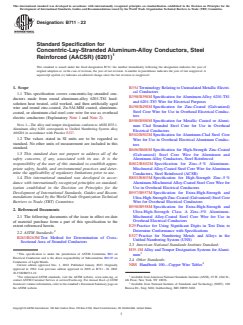
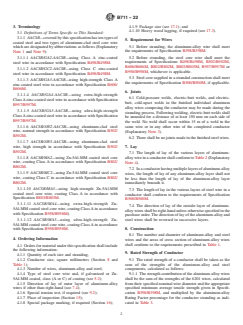
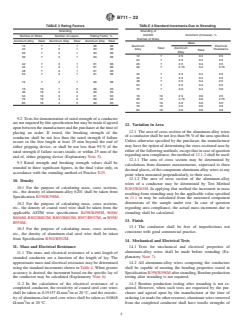
This specification covers concentric-lay-stranded conductors made from round-alloy 6201-T81 hard:solution heat treated, cold worked, and then artificially aged wire and round zinc-coated, Zn-5Al-MM coated, aluminum-coated, or aluminum-clad steel core wire for use as overhead electric conductors. Cold-pressure welds, electric-butt welds, and electric-butt, cold-upset welds in the finished individual aluminum alloy wires composing the conductor may be made during the stranding process. The direction of lay of the outside layer of aluminum-alloy wires shall be right-hand. The direction of lay of the aluminum alloy and steel wires shall be reversed in successive layers. The rated strength of a conductor shall be taken as the sum of the strengths of the aluminum alloy and steel components. The mass and electrical resistance of a unit length of stranded conductor shall be calculated. The ares of cross section may be determined by calculations from diameter measurements of the component aluminum wires at any point when measured perpendicularly to their axes.
SCOPE
1.1 This specification covers concentric-lay-stranded conductors made from round aluminum-alloy 6201-T81 hard: solution heat treated, cold worked, and then artificially aged wire and round zinc-coated, Zn-5Al-MM coated, aluminum-coated, or aluminum-clad steel core wire for use as overhead electric conductors (Explanatory Note 1 and Note 2).
Note 1: The alloy and temper designations conform to ANSI H35.1. Aluminum alloy 6201 corresponds to Unified Numbering System alloy A96201 in accordance with Practice E527.
1.2 The values stated in SI units are to be regarded as standard. No other units of measurement are included in this standard.
1.3 This standard does not purport to address all of the safety concerns, if any, associated with its use. It is the responsibility of the user of this standard to establish appropriate safety, health, and environmental practices and determine the applicability of regulatory limitations prior to use.
1.4 This international standard was developed in accordance with internationally recognized principles on standardization established in the Decision on Principles for the Development of International Standards, Guides and Recommendations issued by the World Trade Organization Technical Barriers to Trade (TBT) Committee.
- Status
- Published
- Publication Date
- 30-Nov-2022
- Technical Committee
- B01 - Electrical Conductors
- Drafting Committee
- B01.07 - Conductors of Light Metals
Buy Documents
ASTM B711-22 - Standard Specification for Concentric-Lay-Stranded Aluminum-Alloy Conductors, Steel Reinforced (AACSR) (6201)
REDLINE ASTM B711-22 - Standard Specification for Concentric-Lay-Stranded Aluminum-Alloy Conductors, Steel Reinforced (AACSR) (6201)
Overview
ASTM B711-22 establishes the requirements for concentric-lay-stranded aluminum-alloy conductors, steel reinforced (AACSR), specifically using aluminum-alloy 6201-T81 wires and various types of steel core wires. These overhead electric conductors are widely used in power transmission and distribution due to their enhanced mechanical strength and reliable electrical performance. The standard, developed by ASTM International, sets out the construction details, marking, testing, and performance criteria essential for safe and efficient use of AACSR (6201) conductors.
Key Topics
- Material Requirements: Specifies the use of hard-drawn aluminum-alloy 6201-T81-solution heat-treated, cold-worked, and artificially aged wires. The steel core may be zinc-coated (galvanized), Zn-5Al-MM alloy coated, aluminum-coated, or aluminum-clad.
- Conductor Construction: Details the concentric-lay stranding, required number and diameters of both aluminum-alloy and steel wires, and how these should be arranged for optimal performance. Includes specific instructions for lay direction and ratios for different strands.
- Joints and Welding: Permits certain joints in aluminum-alloy wires during stranding, like cold-pressure welds and electric-butt welds, with restrictions on weld placement. Joints in finished steel wires are not allowed.
- Strength and Performance: The rated strength of AACSR conductors is calculated as the sum of the strengths of their aluminum-alloy and steel components, based on defined mechanical properties. Mass and electrical resistance of a unit length are also determined according to specified formulas.
- Testing and Inspection: Stipulates mechanical and electrical tests for wire materials before stranding. Post-manufacture inspection, marking, and packaging practices are clearly defined to ensure traceability and compliance.
Applications
AACSR (6201) conductors manufactured according to ASTM B711-22 are primarily used in:
- Overhead Power Transmission & Distribution: Combining high electrical conductivity of aluminum with the mechanical support of a steel core, these conductors are ideal for long spans, heavy load areas, and harsh environments.
- Utility Infrastructure Upgrades: AACSR conductors are selected for upgrading existing lines due to their balance of strength, conductivity, and corrosion resistance.
- Special Engineering Projects: These conductors are applicable where high tensile strength, reduced sag, and improved durability are required, such as river crossings, urban installations, and areas with extreme climate conditions.
The standard ensures consistency and performance reliability, which is essential for utilities, contractors, and manufacturers involved in electrical infrastructure projects.
Related Standards
Users of ASTM B711-22 should be aware of and may need to reference additional standards, including:
- ASTM B398/B398M - For aluminum-alloy 6201-T81 and 6201-T83 wire specifications.
- ASTM B498/B498M - For zinc-coated (galvanized) steel core wire.
- ASTM B502/B502M - For aluminum-clad steel core wire.
- ASTM B606/B606M - For high-strength zinc-coated steel core wire.
- ASTM B802/B802M and B803/B803M - For Zn-5Al-MM alloy-coated steel core wires.
- ASTM B500/B500M - For metallic coated or aluminum-clad stranded steel cores.
- ANSI H35.1M - For alloy and temper designation systems for aluminum.
- ASTM B263/B263M - For determining cross-sectional area of stranded conductors.
- ASTM B354 - For terminology relating to uninsulated metallic electrical conductors.
Practical Value
Complying with ASTM B711-22 ensures:
- Interchangeability and Compatibility: Standardization enables products from different manufacturers to be used interchangeably.
- Safety and Performance: Adherence reduces the risk of failure in high-stress power applications, safeguarding critical infrastructure.
- Regulatory Compliance: The specification aligns with international trade and regulatory requirements, supporting global projects.
For stakeholders seeking reliable, high-strength, and high-conductivity overhead conductors, ASTM B711-22 provides a trusted framework backed by detailed, internationally-recognized criteria.
Keywords: ASTM B711-22, AACSR, overhead conductors, aluminum-alloy, steel-reinforced, power transmission, electrical conductor standards, ASTM conductor specification.
Relations
- Effective Date
- 01-Apr-2024
- Effective Date
- 01-Oct-2023
- Effective Date
- 01-Oct-2023
- Effective Date
- 01-Oct-2023
- Effective Date
- 01-Oct-2023
- Effective Date
- 01-Oct-2023
- Effective Date
- 01-Jan-2020
- Effective Date
- 01-Oct-2019
- Effective Date
- 01-Apr-2017
- Effective Date
- 01-Dec-2016
- Effective Date
- 01-Dec-2016
- Effective Date
- 01-Oct-2016
- Effective Date
- 01-Oct-2016
- Effective Date
- 01-Oct-2016
- Effective Date
- 01-Oct-2016
Buy Documents
ASTM B711-22 - Standard Specification for Concentric-Lay-Stranded Aluminum-Alloy Conductors, Steel Reinforced (AACSR) (6201)
REDLINE ASTM B711-22 - Standard Specification for Concentric-Lay-Stranded Aluminum-Alloy Conductors, Steel Reinforced (AACSR) (6201)
Get Certified
Connect with accredited certification bodies for this standard

IMQ S.p.A. (Certification)
Italian electrical product certification.

SLG Prüf- und Zertifizierungs GmbH
German testing and certification body.

UL Solutions
Global safety science company with testing, inspection and certification.
Sponsored listings
Frequently Asked Questions
ASTM B711-22 is a technical specification published by ASTM International. Its full title is "Standard Specification for Concentric-Lay-Stranded Aluminum-Alloy Conductors, Steel Reinforced (AACSR) (6201)". This standard covers: ABSTRACT This specification covers concentric-lay-stranded conductors made from round-alloy 6201-T81 hard:solution heat treated, cold worked, and then artificially aged wire and round zinc-coated, Zn-5Al-MM coated, aluminum-coated, or aluminum-clad steel core wire for use as overhead electric conductors. Cold-pressure welds, electric-butt welds, and electric-butt, cold-upset welds in the finished individual aluminum alloy wires composing the conductor may be made during the stranding process. The direction of lay of the outside layer of aluminum-alloy wires shall be right-hand. The direction of lay of the aluminum alloy and steel wires shall be reversed in successive layers. The rated strength of a conductor shall be taken as the sum of the strengths of the aluminum alloy and steel components. The mass and electrical resistance of a unit length of stranded conductor shall be calculated. The ares of cross section may be determined by calculations from diameter measurements of the component aluminum wires at any point when measured perpendicularly to their axes. SCOPE 1.1 This specification covers concentric-lay-stranded conductors made from round aluminum-alloy 6201-T81 hard: solution heat treated, cold worked, and then artificially aged wire and round zinc-coated, Zn-5Al-MM coated, aluminum-coated, or aluminum-clad steel core wire for use as overhead electric conductors (Explanatory Note 1 and Note 2). Note 1: The alloy and temper designations conform to ANSI H35.1. Aluminum alloy 6201 corresponds to Unified Numbering System alloy A96201 in accordance with Practice E527. 1.2 The values stated in SI units are to be regarded as standard. No other units of measurement are included in this standard. 1.3 This standard does not purport to address all of the safety concerns, if any, associated with its use. It is the responsibility of the user of this standard to establish appropriate safety, health, and environmental practices and determine the applicability of regulatory limitations prior to use. 1.4 This international standard was developed in accordance with internationally recognized principles on standardization established in the Decision on Principles for the Development of International Standards, Guides and Recommendations issued by the World Trade Organization Technical Barriers to Trade (TBT) Committee.
ABSTRACT This specification covers concentric-lay-stranded conductors made from round-alloy 6201-T81 hard:solution heat treated, cold worked, and then artificially aged wire and round zinc-coated, Zn-5Al-MM coated, aluminum-coated, or aluminum-clad steel core wire for use as overhead electric conductors. Cold-pressure welds, electric-butt welds, and electric-butt, cold-upset welds in the finished individual aluminum alloy wires composing the conductor may be made during the stranding process. The direction of lay of the outside layer of aluminum-alloy wires shall be right-hand. The direction of lay of the aluminum alloy and steel wires shall be reversed in successive layers. The rated strength of a conductor shall be taken as the sum of the strengths of the aluminum alloy and steel components. The mass and electrical resistance of a unit length of stranded conductor shall be calculated. The ares of cross section may be determined by calculations from diameter measurements of the component aluminum wires at any point when measured perpendicularly to their axes. SCOPE 1.1 This specification covers concentric-lay-stranded conductors made from round aluminum-alloy 6201-T81 hard: solution heat treated, cold worked, and then artificially aged wire and round zinc-coated, Zn-5Al-MM coated, aluminum-coated, or aluminum-clad steel core wire for use as overhead electric conductors (Explanatory Note 1 and Note 2). Note 1: The alloy and temper designations conform to ANSI H35.1. Aluminum alloy 6201 corresponds to Unified Numbering System alloy A96201 in accordance with Practice E527. 1.2 The values stated in SI units are to be regarded as standard. No other units of measurement are included in this standard. 1.3 This standard does not purport to address all of the safety concerns, if any, associated with its use. It is the responsibility of the user of this standard to establish appropriate safety, health, and environmental practices and determine the applicability of regulatory limitations prior to use. 1.4 This international standard was developed in accordance with internationally recognized principles on standardization established in the Decision on Principles for the Development of International Standards, Guides and Recommendations issued by the World Trade Organization Technical Barriers to Trade (TBT) Committee.
ASTM B711-22 is classified under the following ICS (International Classification for Standards) categories: 29.240.20 - Power transmission and distribution lines. The ICS classification helps identify the subject area and facilitates finding related standards.
ASTM B711-22 has the following relationships with other standards: It is inter standard links to ASTM B500/B500M-24, ASTM B606/B606M-23, ASTM B957/B957M-23, ASTM B958/B958M-23, ASTM B802/B802M-23, ASTM B502/B502M-23, ASTM B263/B263M-14(2020), ASTM B502/B502M-19, ASTM B502/B502M-10(2017), ASTM B958/B958M-16, ASTM B957/B957M-16, ASTM B498/B498M-08(2016), ASTM B802/B802M-10(2016), ASTM B606/B606M-08(2016), ASTM B803/B803M-08(2016). Understanding these relationships helps ensure you are using the most current and applicable version of the standard.
ASTM B711-22 is available in PDF format for immediate download after purchase. The document can be added to your cart and obtained through the secure checkout process. Digital delivery ensures instant access to the complete standard document.
Standards Content (Sample)
This international standard was developed in accordance with internationally recognized principles on standardization established in the Decision on Principles for the
Development of International Standards, Guides and Recommendations issued by the World Trade Organization Technical Barriers to Trade (TBT) Committee.
Designation: B711 − 22
Standard Specification for
Concentric-Lay-Stranded Aluminum-Alloy Conductors, Steel
Reinforced (AACSR) (6201)
This standard is issued under the fixed designation B711; the number immediately following the designation indicates the year of
original adoption or, in the case of revision, the year of last revision. A number in parentheses indicates the year of last reapproval. A
superscript epsilon (´) indicates an editorial change since the last revision or reapproval.
1. Scope B354 Terminology Relating to Uninsulated Metallic Electri-
cal Conductors
1.1 This specification covers concentric-lay-stranded con-
B398/B398M Specification for Aluminum-Alloy 6201-T81
ductors made from round aluminum-alloy 6201-T81 hard:
and 6201-T83 Wire for Electrical Purposes
solution heat treated, cold worked, and then artificially aged
B498/B498M Specification for Zinc-Coated (Galvanized)
wire and round zinc-coated, Zn-5Al-MM coated, aluminum-
Steel Core Wire for Use in Overhead Electrical Conduc-
coated, or aluminum-clad steel core wire for use as overhead
tors
electric conductors (Explanatory Note 1 and Note 2).
B500/B500M Specification for Metallic Coated or Alumi-
NOTE 1—The alloy and temper designations conform to ANSI H35.1.
num Clad Stranded Steel Core for Use in Overhead
Aluminum alloy 6201 corresponds to Unified Numbering System alloy
Electrical Conductors
A96201 in accordance with Practice E527.
B502/B502M Specification for Aluminum-Clad Steel Core
1.2 The values stated in SI units are to be regarded as
Wire for Use in Overhead Electrical Aluminum Conduc-
standard. No other units of measurement are included in this
tors
standard.
B606/B606M Specification for High-Strength Zinc-Coated
1.3 This standard does not purport to address all of the
(Galvanized) Steel Core Wire for Aluminum and
safety concerns, if any, associated with its use. It is the Aluminum-Alloy Conductors, Steel Reinforced
responsibility of the user of this standard to establish appro-
B802/B802M Specification for Zinc–5 % Aluminum-
priate safety, health, and environmental practices and deter- Mischmetal Alloy-Coated Steel Core Wire for Aluminum
mine the applicability of regulatory limitations prior to use.
Conductors, Steel Reinforced (ACSR)
1.4 This international standard was developed in accor- B803/B803M Specification for High-Strength Zinc–5 %
dance with internationally recognized principles on standard-
Aluminum-Mischmetal Alloy-Coated Steel Core Wire for
ization established in the Decision on Principles for the
Use in Overhead Electrical Conductors
Development of International Standards, Guides and Recom- B957/B957M Specification for Extra-High-Strength and
mendations issued by the World Trade Organization Technical
Ultra-High-Strength Zinc-Coated (Galvanized) Steel Core
Barriers to Trade (TBT) Committee. Wire for Overhead Electrical Conductors
B958/B958M Specification for Extra-High-Strength and
2. Referenced Documents
Ultra-High-Strength Class A Zinc–5% Aluminum-
2.1 The following documents of the issue in effect on date Mischmetal Alloy-Coated Steel Core Wire for Use in
Overhead Electrical Conductors
of material purchase form a part of this specification to the
extent referenced herein. E29 Practice for Using Significant Digits in Test Data to
Determine Conformance with Specifications
2.2 ASTM Standards:
E527 Practice for Numbering Metals and Alloys in the
B263/B263M Test Method for Determination of Cross-
Unified Numbering System (UNS)
Sectional Area of Stranded Conductors
2.3 American National Standards Institute Standard:
H35.1M Alloy and Temper Designation Systems for Alumi-
1 3
This specification is under the jurisdiction of ASTM Committee B01 on
num
Electrical Conductors and is the direct responsibility of Subcommittee B01.07 on
2.4 Other Standards:
Conductors of Light Metals.
NBS Handbook 100—Copper Wire Tables
Current edition approved Dec. 1, 2022. Published January 2023. Originally
approved in 1982. Last previous edition approved in 2018 as B711 – 18. DOI:
10.1520/B0711-22.
2 3
For referenced ASTM standards, visit the ASTM website, www.astm.org, or Available from American National Standards Institute (ANSI), 25 W. 43rd St.,
contact ASTM Customer Service at service@astm.org. For Annual Book of ASTM 4th Floor, New York, NY 10036.
Standards volume information, refer to the standard’s Document Summary page on Available from National Institute of Standards and Technology (NIST), 100
the ASTM website. Bureau Dr., Stop 3460, Gaithersburg, MD 20899-3460.
Copyright © ASTM International, 100 Barr Harbor Drive, PO Box C700, West Conshohocken, PA 19428-2959. United States
B711 − 22
3. Terminology 4.1.9 Package size (see 17.1); and
4.1.10 Heavy wood lagging, if required (see 17.3).
3.1 Definitions of Terms Specific to This Standard:
3.1.1 AACSR—covered by this specification has ten types of
5. Requirement for Wires
coated steel and two types of aluminum-clad steel core wire
5.1 Before stranding, the aluminum-alloy wire shall meet
which are designated by abbreviations as follows (Explanatory
the requirements of Specification B398/B398M.
Note 1 and Note 9):
5.2 Before stranding, the steel core wire shall meet the
3.1.1.1 AACSR/GA2-AACSR—using Class A zinc-coated
requirements of Specifications B498/B498M, B502/B502M,
steel wire in accordance with Specification B498/B498M.
B606/B606M, B802/B802M, B803/B803M, B957/B957M or
3.1.1.2 AACSR/GC2-AACSR—using Class C zinc-coated
B958/B958M, whichever is applicable.
steel wire in accordance with Specification B498/B498M.
5.3 Steel core supplied in a stranded construction shall meet
3.1.1.3 AACSR/GA3-AACSR—using high-strength Class A
the requirements of Specification B500/B500M, if applicable.
zinc-coated steel wire in accordance with Specification B606/
B606M.
6. Joints
3.1.1.4 AACSR/GA4-AACSR—using extra-high-strength
6.1 Cold-pressure welds, electric-butt welds, and electric-
Class A zinc-coated steel wire in accordance with Specification
butt, cold-upset welds in the finished individual aluminum
B957/B957M.
alloy wires composing the conductor may be made during the
3.1.1.5 AACSR/GA5-AACSR—using ultra-high-strength
stranding process. Following welding, electric-butt welds shall
Class A zinc-coated steel wire in accordance with Specification
be annealed for a distance of at least 150 mm on each side of
B957/B957M.
the weld. No weld shall occur within 15 m of a weld in the
3.1.1.6 AACSR/AW2-AACSR—using aluminum-clad steel
same wire or in any other wire of the completed conductor
wire, normal strength in accordance with Specification B502/
(Explanatory Note 3).
B502M.
6.2 There shall be no joints made in the finished steel wires.
3.1.1.7 AACSR/AW3-AACSR—using aluminum-clad steel
wire, high strength in accordance with Specification B502/ 7. Lay
B502M.
7.1 The length of lay of the various layers of aluminum-
3.1.1.8 AACSR/MA2—using Zn-5Al-MM coated steel core
alloy wire in a conductor shall conform to Table 2 (Explanatory
wire, coating Class A in accordance with Specification B802/ Note 4).
B802M.
7.2 In a conductor having multiple layers of aluminum-alloy
3.1.1.9 AACSR/MC2—using Zn-5Al-MM coated steel core
wires, the length of lay of any aluminum-alloy layer shall not
wire, coating Class C in accordance with Specification B802/
be less than the length of lay of the aluminum-alloy layer
B802M.
immediately beneath it.
3.1.1.10 AACSR/MA3—using high-strength Zn-5Al-MM
7.3 The length of lay in the various layers of steel wire in a
coated steel core wire, coating Class A in accordance with
conductor shall conform to the requirements of Specification
Specification B803/B803M.
B500/B500M.
3.1.1.11 AACSR/MA4—using extra-high-strength Zn-
7.4 The direction of lay of the outside layer of aluminum-
5Al-MM coated steel core wire, coating Class A in accordance
alloy wires shall be right-hand unless otherwise specified in the
with Specification B958/B958M).
purchase order. The direction of lay of the aluminum-alloy and
3.1.1.12 AACSR/MA5—using ultra-high-strength Zn- steel wires shall be reversed in successive layers.
5Al-MM coated steel core wire, coating Class A in accordance
8. Construction
with Specification B958/B958M.
8.1 The number and diameter of aluminum-alloy and steel
4. Ordering Information
wires and the areas of cross section of aluminum-alloy wires
shall conform to the requirements prescribed in Table 1.
4.1 Orders for material under this specification shall include
the following information:
9. Rated Strength of Conductor
4.1.1 Quantity of each size and stranding,
4.1.2 Conductor size, square millimetres (Section 8 and 9.1 The rated strength of a conductor shall be taken as the
Table 1); sum of the strengths of the aluminum-alloy and steel
4.1.3 Number of wires, aluminum-alloy and steel; components, calculated as follows:
4.1.4 Type of steel core wire and, if galvanized or Zn- 9.1.1 The strength contribution of the aluminum-alloy wires
5Al-MM coated, class (A or C) of coating (see 5.2); shall be the sum of the strengths of the 6201 wires, calculated
4.1.5 Direction of lay of outer layer of aluminum-alloy from their specified nominal wire diameter and the appropriate
wires if other than right-hand (see 7.4); specified minimum average tensile strength given in Specifi-
4.1.6 Special tension test, if required (see 9.2); cation B398/B398M, and multiplied by the aluminum-alloy
4.1.7 Place of inspection (Section 15); Rating Factor percentage for the conductor stranding as indi-
4.1.8 Special package marking, if required (Section 16); cated in Table 3.
B711 − 22
TABLE 1 Construction Requirements of Aluminum-Alloy Conductors, Steel Reinforced, Concentric-Lay-Stranded
2 A
Conductor Area, mm Stranding and Wire Diameter Diameter, mm
B C
Rated Strength Mass
Alloy Steel
Alloy
Steel Total Conductor Steel Core
Nominal
Number mm Number mm kN kg/km
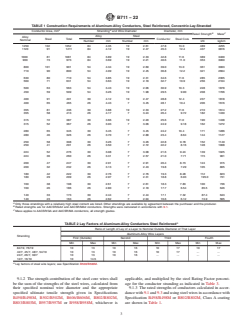
1250 102 1352 84 4.35 19 2.61 47.8 13.0 489 4255
1120 91 1211 84 4.12 19 2.47 45.3 12.4 437 3816
1000 81 1081 84 3.89 19 2.33 42.8 11.6 389 3400
900 73 973 84 3.69 19 2.21 40.6 11.0 353 3060
800 101 901 54 4.34 19 2.60 39.0 13.0 361 3003
710 90 800 54 4.09 19 2.45 36.8 12.2 321 2664
630 80 710 54 3.85 19 2.31 34.6 11.6 285 2365
560 71 631 54 3.63 19 2.18 32.7 10.9 256 2104
500 63 563 54 3.43 19 2.06 30.9 10.3 228 1878
450 59 509 54 3.26 19 1.98 29.5 9.90 208 1706
400 91 491 30 4.12 19 2.47 28.8 12.4 237 1818
400 65 465 26 4.43 7 3.45 28.1 10.4 206 1616
355 81 436 30 3.88 19 2.33 27.2 11.6 210 1614
355 58 413 26 4.17 7 3.24 26.4 9.72 182 1430
315 72 387 30 3.66 19 2.20 25.6 11.0 190 1438
315 52 367 26 3.93 7 3.06 24.9 9.18 162 1272
280 65 345 30 3.45 7 3.45 24.2 10.4 171 1286
280 46 326 26 3.70 7 2.88 23.4 8.64 144 1127
250 58 308 30 3.26 7 3.26 22.8 9.78 152 1149
250 41 291 26 3.50 7 2.72 22.2 8.16 128 1008
224 52 276 30 3.08 7 3.08 21.6 9.24 139 1025
224 36 260 26 3.31 7 2.57 21.0 7.71 115 901
200 47 247 30 2.91 7 2.91 20.4 8.73 124 915
200 32 232 26 3.13 7 2.43 19.8 7.29 105 805
180 42 222 30 2.76 7 2.76 19.3 8.28 112 823
180 29 209 26 2.97 7 2.31 18.8 6.93 195.0 731
160 38 198 30 2.61 7 2.61 18.3 7.83 100 736
160 26 186 26 2.80 7 2.18 17.7 6.54 85.5 646
140 33 173 30 2.44 7 2.44 17.1 7.32 87.4 643
140 23 163 26 2.62 7 2.04 16.6 6.12 74.9 565
A
Only those strandings with a relatively high steel content are listed. Other strandings are available by agreement between the purchaser and the producer.
B
Rated strengths are for AACSR/GA2 and AACSR/MA2 conductors. Strengths were calculated in accordance with 9.1.
C
Mass applies to AACSR/GA and AACSR/MA conductors, all strength grades.
A
TABLE 2 Lay Factors of Aluminum-Alloy Conductors Steel Reinforced
Ratio of Length of Lay of a Layer to Nominal Outside Diameter of That Layer
Aluminum-Alloy Wire Layers
Stranding
First (Outside) Second Third Fourth
Min Max Min Max Min Max Min Max
84/19, 76/19 10 13 10 16 10 17 10 17
42/7, 45/7, 48/7, 54/19 10 13 10 16 10 17 . .
24/7, 26/7, 30/7 10 13 10 16 . . . .
12/7, 16/19 10 14.5
A
Lay factors of steel wire layers; see Specification B500/B500M.
9.1.2 The strength contribution of the steel core wires shall applicable, and multiplied by the steel Rating Factor percent-
be the sum of
...
This document is not an ASTM standard and is intended only to provide the user of an ASTM standard an indication of what changes have been made to the previous version. Because
it may not be technically possible to adequately depict all changes accurately, ASTM recommends that users consult prior editions as appropriate. In all cases only the current version
of the standard as published by ASTM is to be considered the official document.
Designation: B711 − 18 B711 − 22
Standard Specification for
Concentric-Lay-Stranded Aluminum-Alloy Conductors, Steel
Reinforced (AACSR) (6201)
This standard is issued under the fixed designation B711; the number immediately following the designation indicates the year of
original adoption or, in the case of revision, the year of last revision. A number in parentheses indicates the year of last reapproval. A
superscript epsilon (´) indicates an editorial change since the last revision or reapproval.
1. Scope
1.1 This specification covers concentric-lay-stranded conductors made from round aluminum-alloy 6201-T81 hard: solution heat
treated, cold worked, and then artificially aged wire and round zinc-coated, Zn-5Al-MM coated, aluminum-coated, or
aluminum-clad steel core wire for use as overhead electric conductors (Explanatory Note 1 and Note 2).
NOTE 1—The alloy and temper designations conform to ANSI H35.1. Aluminum alloy 6201 corresponds to Unified Numbering System alloy A96201 in
accordance with Practice E527.
1.2 The values stated in SI units are to be regarded as standard. No other units of measurement are included in this standard.
1.3 This standard does not purport to address all of the safety concerns, if any, associated with its use. It is the responsibility of
the user of this standard to establish appropriate safety, health, and environmental practices and determine the applicability of
regulatory limitations prior to use.
1.4 This international standard was developed in accordance with internationally recognized principles on standardization
established in the Decision on Principles for the Development of International Standards, Guides and Recommendations issued
by the World Trade Organization Technical Barriers to Trade (TBT) Committee.
2. Referenced Documents
2.1 The following documents of the issue in effect on date of material purchase form a part of this specification to the extent
referenced herein.
2.2 ASTM Standards:
B263B263/B263M Test Method for Determination of Cross-Sectional Area of Stranded Conductors
B354 Terminology Relating to Uninsulated Metallic Electrical Conductors
B398/B398M Specification for Aluminum-Alloy 6201-T81 and 6201-T83 Wire for Electrical Purposes
B498/B498M Specification for Zinc-Coated (Galvanized) Steel Core Wire for Use in Overhead Electrical Conductors
B500/B500M Specification for Metallic Coated or Aluminum Clad Stranded Steel Core for Use in Overhead Electrical
Conductors
B502B502/B502M Specification for Aluminum-Clad Steel Core Wire for Use in Overhead Electrical Aluminum Conductors
This specification is under the jurisdiction of ASTM Committee B01 on Electrical Conductors and is the direct responsibility of Subcommittee B01.07 on Conductors
of Light Metals.
Current edition approved March 1, 2018Dec. 1, 2022. Published March 2018January 2023. Originally approved in 1982. Last previous edition approved in 20132018 as
B711 – 13.B711 – 18. DOI: 10.1520/B0711-18.10.1520/B0711-22.
For referenced ASTM standards, visit the ASTM website, www.astm.org, or contact ASTM Customer Service at service@astm.org. For Annual Book of ASTM Standards
volume information, refer to the standard’s Document Summary page on the ASTM website.
Copyright © ASTM International, 100 Barr Harbor Drive, PO Box C700, West Conshohocken, PA 19428-2959. United States
B711 − 22
B606B606/B606M Specification for High-Strength Zinc-Coated (Galvanized) Steel Core Wire for Aluminum and Aluminum-
Alloy Conductors, Steel Reinforced
B802/B802M Specification for Zinc–5 % Aluminum-Mischmetal Alloy-Coated Steel Core Wire for Aluminum Conductors,
Steel Reinforced (ACSR)
B803B803/B803M Specification for High-Strength Zinc–5 % Aluminum-Mischmetal Alloy-Coated Steel Core Wire for Use in
Overhead Electrical Conductors
B957B957/B957M Specification for Extra-High-Strength and Ultra-High-Strength Zinc-Coated (Galvanized) Steel Core Wire
for Overhead Electrical Conductors
B958B958/B958M Specification for Extra-High-Strength and Ultra-High-Strength Class A Zinc–5% Aluminum-Mischmetal
Alloy-Coated Steel Core Wire for Use in Overhead Electrical Conductors
E29 Practice for Using Significant Digits in Test Data to Determine Conformance with Specifications
E527 Practice for Numbering Metals and Alloys in the Unified Numbering System (UNS)
2.3 American National Standards Institute Standard:
H35.1M Alloy and Temper Designation Systems for Aluminum
2.4 Other Standards:
NBS Handbook 100—Copper Wire Tables
3. Terminology
3.1 Definitions of Terms Specific to This Standard:
3.1.1 AACSR—covered by this specification has fiveten types of coated steel and one typetwo types of aluminum-clad steel core
wire which are designated by abbreviations as follows (Explanatory Note 1 and Note 9):
3.1.1.1 AACSR/GA2-AACSR—using Class A zinc-coated steel wire in accordance with Specification B498/B498M.
3.1.1.2 AACSR/GC2-AACSR—using Class C zinc-coated steel wire in accordance with Specification B498/B498M.
3.1.1.3 AACSR/GA3-AACSR—using high-strength Class A zinc-coated steel wire in accordance with Specification B606B606/
B606M.
3.1.1.4 AACSR/GA4-AACSR—using extra-high-strength Class A zinc-coated steel wire in accordance with Specification
B957B957/B957M.
3.1.1.5 AACSR/GA5-AACSR—using ultra-high-strength Class A zinc-coated steel wire in accordance with Specification
B957B957/B957M.
3.1.1.6 AACSR/AW2-AACSR—using aluminum-clad steel wire, normal strength in accordance with Specification B502B502/
B502M.
3.1.1.7 AACSR/AW3-AACSR—using aluminum-clad steel wire, high strength in accordance with Specification B502B502/
B502M.
3.1.1.8 AACSR/MA2—using Zn-5Al-MM coated steel core wire, coating Class A in accordance with Specification B802/
B802M.
3.1.1.9 AACSR/MC2—using Zn-5Al-MM coated steel core wire, coating Class C in accordance with Specification B802/
B802M.
3.1.1.10 AACSR/MA3—using high-strength Zn-5Al-MM coated steel core wire, coating Class A in accordance with
Specification B803B803/B803M.
3.1.1.11 AACSR/MA4—using extra-high-strength Zn-5Al-MM coated steel core wire, coating Class A in accordance with
Specification B958B958/B958M).
3.1.1.12 AACSR/AZ-MA5—AACSR/MA5—using ultra-high-strength Zn-5Al-MM coated steel core wire, coating Class A in
accordance with Specification B958B958/B958M.
4. Ordering Information
4.1 Orders for material under this specification shall include the following information:
4.1.1 Quantity of each size and stranding,
4.1.2 Conductor size, square millimetres (Section 8 and Table 1);
Available from American National Standards Institute (ANSI), 25 W. 43rd St., 4th Floor, New York, NY 10036.
Available from National Institute of Standards and Technology (NIST), 100 Bureau Dr., Stop 3460, Gaithersburg, MD 20899-3460.
B711 − 22
TABLE 1 Construction Requirements of Aluminum-Alloy Conductors, Steel Reinforced, Concentric-Lay-Stranded
2 A
Conductor Area, mm Stranding and Wire Diameter Diameter, mm
B C
Rated Strength Mass
Alloy Steel
Alloy
Steel Total Conductor Steel Core
Nominal
Number mm Number mm kN kg/km
1250 102 1352 84 4.35 19 2.61 47.8 13.0 489 4255
1120 91 1211 84 4.12 19 2.47 45.3 12.4 437 3816
1000 81 1081 84 3.89 19 2.33 42.8 11.6 389 3400
900 73 973 84 3.69 19 2.21 40.6 11.0 353 3060
800 101 901 54 4.34 19 2.60 39.0 13.0 361 3003
710 90 800 54 4.09 19 2.45 36.8 12.2 321 2664
630 80 710 54 3.85 19 2.31 34.6 11.6 285 2365
560 71 631 54 3.63 19 2.18 32.7 10.9 256 2104
500 63 563 54 3.43 19 2.06 30.9 10.3 228 1878
450 59 509 54 3.26 19 1.98 29.5 9.90 208 1706
400 91 491 30 4.12 19 2.47 28.8 12.4 237 1818
400 65 465 26 4.43 7 3.45 28.1 10.4 206 1616
355 81 436 30 3.88 19 2.33 27.2 11.6 210 1614
355 58 413 26 4.17 7 3.24 26.4 9.72 182 1430
315 72 387 30 3.66 19 2.20 25.6 11.0 190 1438
315 52 367 26 3.93 7 3.06 24.9 9.18 162 1272
280 65 345 30 3.45 7 3.45 24.2 10.4 171 1286
280 46 326 26 3.70 7 2.88 23.4 8.64 144 1127
250 58 308 30 3.26 7 3.26 22.8 9.78 152 1149
250 41 291 26 3.50 7 2.72 22.2 8.16 128 1008
224 52 276 30 3.08 7 3.08 21.6 9.24 139 1025
224 36 260 26 3.31 7 2.57 21.0 7.71 115 901
200 47 247 30 2.91 7 2.91 20.4 8.73 124 915
200 32 232 26 3.13 7 2.43 19.8 7.29 105 805
180 42 222 30 2.76 7 2.76 19.3 8.28 112 823
180 29 209 26 2.97 7 2.31 18.8 6.93 195.0 731
160 38 198 30 2.61 7 2.61 18.3 7.83 100 736
160 26 186 26 2.80 7 2.18 17.7 6.54 85.5 646
140 33 173 30 2.44 7 2.44 17.1 7.32 87.4 643
140 23 163 26 2.62 7 2.04 16.6 6.12 74.9 565
A
Only those strandings with a relatively high steel content are listed. Other strandings are available by agreement between the purchaser and the producer.
B
Rated strengths are for AACSR/GA2 and AACSR/MA2 conductors. Strengths were calculated in accordance with 9.1.
C
Mass applies to AACSR/GA and AACSR/MA conductors, all strength grades.
4.1.3 Number of wires, aluminumaluminum-alloy and steel;
4.1.4 Type of steel core wire and, if galvanized or Zn-5Al-MM coated, class (A or C) of coating (see 5.2);
4.1.5 Direction of lay of outer layer of aluminumaluminum-alloy wires if other than right-hand (see 7.27.4);
4.1.6 Special tension test, if required (see 9.2);
4.1.7 Place of inspection (Section 15);
4.1.8 Special package marking, if required (Section 16);
4.1.9 Package size (see 17.1); and
4.1.10 Heavy wood lagging, if required (see 17.3).
B711 − 22
5. Requirement for Wires
5.1 Before stranding, the aluminum-alloy wire shall meet the requirements of Specification B398/B398M.
5.2 Before stranding, the steel core wire shall meet the requirements of Specifications B498/B498M, B502B502/B502M,
B606B606/B606M, B802/B802M, B803B803/B803M, B957B957/B957M or B958B958/B958M, whichever is applicable.
5.3 Steel core supplied in a stranded construction shall meet the requirements of Specification B500/B500M, if applicable.
6. Joints
6.1 Cold-pressure welds, electric-butt welds, and electric-butt, cold-upset welds in the finished individual aluminum alloy wires
composing the conductor may be made during the stranding process. Following welding, electric-butt welds shall be annealed for
a distance of at least 150 mm on each side of the weld. No weld shall occur within 15 m of a weld in the same wire or in any
other wire of the completed conductor (Explanatory Note 3).
6.2 There shall be no joints made in the finished steel wires.
7. Lay Factors
7.1 The length of lay inof the various layers of aluminum alloy aluminum-alloy wire in a conductor shall conform to Table 2
(Explanatory Note 4).
7.2 The direction of lay of the outside layer of aluminum-alloy wires shall be right-hand unless otherwise specified in the purchase
order. The direction In a conductor having multiple layers of aluminum-alloy wires, the length of lay of any aluminum-alloy layer
shall not be less than the length of lay of the aluminum alloy and steel wires shall be reversed in successive layers.aluminum-alloy
layer immediately beneath it.
7.3 The length of lay in the various layers of steel wire in a conductor shall conform to the requirements of Specification
B500/B500M.
7.4 In a conductor having multiple layers of aluminum wires, the lay ratio of any aluminum layer shall not be greater than the
lay ratio of the aluminum layer immediately beneath it. Similarly, in a conductor having multiple layers of steel wires in the core,
the lay ratio of a steel layer shall not be greater than the lay ratio of the steel layer immediately beneath it.The direction of lay
of the outside layer of aluminum-alloy wires shall be right-hand unless otherwise specified in the purchase order. The direction
of lay of the aluminum-alloy and steel wires shall be reversed in successive layers.
8. Construction
8.1 The number and diameter of aluminum alloy aluminum-alloy and steel wires and the areas of cross section of aluminum alloy
aluminum-alloy wires shall conform to the requirements prescribed in Table 1.
9. Rated Strength of Conductor
9.1 The rated strength of a conductor shall be taken as the sum of the strengths of the aluminum alloy aluminum-alloy and steel
components, calculated as follows:
A
TABLE 2 Lay Factors of Aluminum-Alloy Conductors Steel Reinforced
Ratio of Length of Lay of a Layer to Nominal Outside Diameter of That Layer
Aluminum-Alloy Wire Layers
Stranding
First (Outside) Second Third Fourth
Min Max Min Max Min Max Min Max
84/19, 76/19 10 13 10 16 10 17 10 17
42/7, 45/7, 48/7, 54/19 10 13 10 16 10 17 . .
24/7, 26/7, 30/7 10 13 10 16 . . . .
12/7, 16/19 10 14.5
A
Lay factors of steel wire layers; see Specification B500/B500M.
B711 − 22
9.1.1 The strength contribution of the aluminum-alloy wires shall be the sum of the strengths of the 6201 wire
...