

ASTM B231/B231M-23
(Specification)Standard Specification for Concentric-Lay-Stranded Aluminum 1350 Conductors
General Information
- Abstract
ABSTRACT
This specification covers aluminum 1350-H19, 1350-H16 or -H26, 1350-H14 or -H24, and 1350-H142 or -H242, bare concentric-lay-stranded conductors constructed with a straight round central wire surrounded by one or more layers of helically layered wires. Conductors are classified as Class AA for bare conductors usually used in overhead lines; Class A for conductors to be covered with weather resistant materials, and for bare conductors where greater flexibility than is afforded by Class AA is required; Class B for conductors to be insulated with various materials such as rubber, paper, varnished cloth, and so forth, and for the conductors indicated under Class A where greater flexibility is required; and Classes C and D for conductors where greater flexibility is required than is provided by Class B conductors. Aluminum wire employed in Classes AA and A conductors shall be 1350-H19, unless otherwise specified. The temper of conductors of Classes B, C and D shall be designated. The direction of lay of the outer layer shall be right-hand for Classes AA and A and left-hand for other classes. The various classes of concentric-lay-stranded conductors shall conform to the required areas of cross section, numbers, and diameters of wires. The rated strength of 1350-H19 conductors shall be taken as the percent of the sum of the strengths of the component wires, calculated using the nominal wire diameters and the specified minimum average tensile strength given in Specification B 230/B 230M for 1350-H19 wire.
SCOPE
1.1 This specification covers aluminum 1350-H19 (extra hard), 1350-H16 or -H26 (3/4 hard), 1350-H14 or -H24 (1/2 hard), and 1350-H142 or -H242 (1/2 hard), bare concentric-lay-stranded conductors constructed with a straight round central wire surrounded by one or more layers of helically layed wires. The conductors are for general use for electrical purposes (Explanatory Note 1 and Note 2).
1.2 The values stated in either SI units or inch-pound units are to be regarded separately as standard. The values stated in each system may not be exact equivalents; therefore, each system shall be used independently of the other. Combining values from the two systems may result in non-conformance with the standard.
1.2.1 For density, resistivity and temperature, the values stated in SI units are to be regarded as standard.
Note 1: Prior to 1975, aluminum 1350 was designated as EC aluminum.
Note 2: The aluminum and temper designations conform to ANSI Standard H35.1/H35.1M. Aluminum 1350 corresponds to Unified Numbering System A91350 in accordance with Practice E527.
Note 3: Sealed conductors that are intended to prevent longitudinal water propagation and are further covered/insulated are also permitted within the guidelines of this specification.
1.3 This international standard was developed in accordance with internationally recognized principles on standardization established in the Decision on Principles for the Development of International Standards, Guides and Recommendations issued by the World Trade Organization Technical Barriers to Trade (TBT) Committee.
- Status
- Published
- Publication Date
- 30-Sep-2023
- Technical Committee
- B01 - Electrical Conductors
- Drafting Committee
- B01.07 - Conductors of Light Metals
Buy Documents
ASTM B231/B231M-23 - Standard Specification for Concentric-Lay-Stranded Aluminum 1350 Conductors
REDLINE ASTM B231/B231M-23 - Standard Specification for Concentric-Lay-Stranded Aluminum 1350 Conductors
Overview
ASTM B231/B231M-23 is the internationally recognized standard specification for concentric-lay-stranded Aluminum 1350 conductors, published by ASTM International. This standard defines the construction, classification, and essential requirements for bare concentric-lay-stranded aluminum conductors comprised of Aluminum 1350-H19, 1350-H16 or -H26, 1350-H14 or -H24, and 1350-H142 or -H242 alloys. These conductors are widely used in electrical power transmission and distribution systems due to their high conductivity and favorable strength-to-weight ratio.
Key Topics
Conductor Construction
- Specifies bare conductors with a central round wire, surrounded by one or more helically laid layers of wires for flexibility and mechanical integrity.
- The conductors are classified by their mechanical application and need for flexibility:
- Class AA: Used for bare overhead lines.
- Class A: Intended for covered conductors or applications needing more flexibility than Class AA.
- Class B: Designed for insulation with materials like rubber or cloth or where further flexibility is needed.
- Classes C and D: Used for applications requiring even greater flexibility.
Material Requirements
- Conductors must use Aluminum 1350 alloy with specific temper designations (mechanical hardness).
- For Classes AA and A, the default temper is 1350-H19, unless otherwise specified.
- Conformance with industry alloy and temper designations is required.
Stranding Configuration
- The standard defines the direction and length of wire lay (helical wrapping) for various classes.
- Right-hand lay for Classes AA and A; left-hand for others unless specified.
- Successive layers may have reversed lay direction for mechanical strength.
Performance and Testing
- Rated minimum strengths are based on the sum of the strengths of individual wires, accounting for conductor class.
- Density, resistivity, and temperature values are standardized in SI units.
- Electrical resistance is standardized and must not exceed maximum allowed values.
- Detailed requirements are specified for mechanical and electrical testing, packaging, and marking.
Applications
- Overhead Transmission Lines: Bare Class AA conductors are optimized for outdoor, overhead power transmission lines due to their excellent conductivity and robustness.
- Insulated Power Cables: Class A, B, C, and D conductors are used in insulated and covered cables, serving urban infrastructures, power distribution networks, and industrial applications.
- Utility and Industrial Use: Due to their flexibility options and reliability, these aluminum conductors are used in substation connections, utility grids, and various large-scale industrial projects.
- Compatibility: Aluminum 1350 conductors are designed for general electrical purposes and are compatible with global standards for both metric and inch-pound unit systems.
Related Standards
- ASTM B230/B230M: Specification for Aluminum 1350–H19 Wire for Electrical Purposes; details requirements for wire used to manufacture stranded conductors under B231/B231M.
- ASTM B609/B609M: Covers aluminum 1350 round wire in annealed and intermediate tempers for electrical purposes.
- ASTM B682: Describes standard metric sizes for electrical conductors.
- ANSI H35.1/H35.1M: System for alloy and temper designation for aluminum.
- ASTM B193: Test method for measuring resistivity of electrical conductor materials.
- ASTM B263: Test method for determining the cross-sectional area of stranded conductors.
By following ASTM B231/B231M-23, manufacturers, engineers, and utilities ensure that concentric-lay-stranded Aluminum 1350 conductors meet the necessary performance, safety, and compatibility requirements for modern electrical grids. This standard supports reliable power transmission and distribution infrastructure, meeting both national and international expectations for quality and interoperability.
Relations
- Effective Date
- 01-Oct-2023
- Effective Date
- 01-Oct-2023
- Referred By
ASTM B1006-17(2023) - Standard Specification for Electrical Overhead Conductor Code Word Names - Effective Date
- 01-Oct-2023
Buy Documents
ASTM B231/B231M-23 - Standard Specification for Concentric-Lay-Stranded Aluminum 1350 Conductors
REDLINE ASTM B231/B231M-23 - Standard Specification for Concentric-Lay-Stranded Aluminum 1350 Conductors
Get Certified
Connect with accredited certification bodies for this standard

IMQ S.p.A. (Certification)
Italian electrical product certification.

SLG Prüf- und Zertifizierungs GmbH
German testing and certification body.

UL Solutions
Global safety science company with testing, inspection and certification.
Sponsored listings
Frequently Asked Questions
ASTM B231/B231M-23 is a technical specification published by ASTM International. Its full title is "Standard Specification for Concentric-Lay-Stranded Aluminum 1350 Conductors". This standard covers: ABSTRACT This specification covers aluminum 1350-H19, 1350-H16 or -H26, 1350-H14 or -H24, and 1350-H142 or -H242, bare concentric-lay-stranded conductors constructed with a straight round central wire surrounded by one or more layers of helically layered wires. Conductors are classified as Class AA for bare conductors usually used in overhead lines; Class A for conductors to be covered with weather resistant materials, and for bare conductors where greater flexibility than is afforded by Class AA is required; Class B for conductors to be insulated with various materials such as rubber, paper, varnished cloth, and so forth, and for the conductors indicated under Class A where greater flexibility is required; and Classes C and D for conductors where greater flexibility is required than is provided by Class B conductors. Aluminum wire employed in Classes AA and A conductors shall be 1350-H19, unless otherwise specified. The temper of conductors of Classes B, C and D shall be designated. The direction of lay of the outer layer shall be right-hand for Classes AA and A and left-hand for other classes. The various classes of concentric-lay-stranded conductors shall conform to the required areas of cross section, numbers, and diameters of wires. The rated strength of 1350-H19 conductors shall be taken as the percent of the sum of the strengths of the component wires, calculated using the nominal wire diameters and the specified minimum average tensile strength given in Specification B 230/B 230M for 1350-H19 wire. SCOPE 1.1 This specification covers aluminum 1350-H19 (extra hard), 1350-H16 or -H26 (3/4 hard), 1350-H14 or -H24 (1/2 hard), and 1350-H142 or -H242 (1/2 hard), bare concentric-lay-stranded conductors constructed with a straight round central wire surrounded by one or more layers of helically layed wires. The conductors are for general use for electrical purposes (Explanatory Note 1 and Note 2). 1.2 The values stated in either SI units or inch-pound units are to be regarded separately as standard. The values stated in each system may not be exact equivalents; therefore, each system shall be used independently of the other. Combining values from the two systems may result in non-conformance with the standard. 1.2.1 For density, resistivity and temperature, the values stated in SI units are to be regarded as standard. Note 1: Prior to 1975, aluminum 1350 was designated as EC aluminum. Note 2: The aluminum and temper designations conform to ANSI Standard H35.1/H35.1M. Aluminum 1350 corresponds to Unified Numbering System A91350 in accordance with Practice E527. Note 3: Sealed conductors that are intended to prevent longitudinal water propagation and are further covered/insulated are also permitted within the guidelines of this specification. 1.3 This international standard was developed in accordance with internationally recognized principles on standardization established in the Decision on Principles for the Development of International Standards, Guides and Recommendations issued by the World Trade Organization Technical Barriers to Trade (TBT) Committee.
ABSTRACT This specification covers aluminum 1350-H19, 1350-H16 or -H26, 1350-H14 or -H24, and 1350-H142 or -H242, bare concentric-lay-stranded conductors constructed with a straight round central wire surrounded by one or more layers of helically layered wires. Conductors are classified as Class AA for bare conductors usually used in overhead lines; Class A for conductors to be covered with weather resistant materials, and for bare conductors where greater flexibility than is afforded by Class AA is required; Class B for conductors to be insulated with various materials such as rubber, paper, varnished cloth, and so forth, and for the conductors indicated under Class A where greater flexibility is required; and Classes C and D for conductors where greater flexibility is required than is provided by Class B conductors. Aluminum wire employed in Classes AA and A conductors shall be 1350-H19, unless otherwise specified. The temper of conductors of Classes B, C and D shall be designated. The direction of lay of the outer layer shall be right-hand for Classes AA and A and left-hand for other classes. The various classes of concentric-lay-stranded conductors shall conform to the required areas of cross section, numbers, and diameters of wires. The rated strength of 1350-H19 conductors shall be taken as the percent of the sum of the strengths of the component wires, calculated using the nominal wire diameters and the specified minimum average tensile strength given in Specification B 230/B 230M for 1350-H19 wire. SCOPE 1.1 This specification covers aluminum 1350-H19 (extra hard), 1350-H16 or -H26 (3/4 hard), 1350-H14 or -H24 (1/2 hard), and 1350-H142 or -H242 (1/2 hard), bare concentric-lay-stranded conductors constructed with a straight round central wire surrounded by one or more layers of helically layed wires. The conductors are for general use for electrical purposes (Explanatory Note 1 and Note 2). 1.2 The values stated in either SI units or inch-pound units are to be regarded separately as standard. The values stated in each system may not be exact equivalents; therefore, each system shall be used independently of the other. Combining values from the two systems may result in non-conformance with the standard. 1.2.1 For density, resistivity and temperature, the values stated in SI units are to be regarded as standard. Note 1: Prior to 1975, aluminum 1350 was designated as EC aluminum. Note 2: The aluminum and temper designations conform to ANSI Standard H35.1/H35.1M. Aluminum 1350 corresponds to Unified Numbering System A91350 in accordance with Practice E527. Note 3: Sealed conductors that are intended to prevent longitudinal water propagation and are further covered/insulated are also permitted within the guidelines of this specification. 1.3 This international standard was developed in accordance with internationally recognized principles on standardization established in the Decision on Principles for the Development of International Standards, Guides and Recommendations issued by the World Trade Organization Technical Barriers to Trade (TBT) Committee.
ASTM B231/B231M-23 is classified under the following ICS (International Classification for Standards) categories: 29.240.20 - Power transmission and distribution lines. The ICS classification helps identify the subject area and facilitates finding related standards.
ASTM B231/B231M-23 has the following relationships with other standards: It is inter standard links to ASTM B231/B231M-16(2021), ASTM B400/B400M-23, ASTM B1006-17(2023). Understanding these relationships helps ensure you are using the most current and applicable version of the standard.
ASTM B231/B231M-23 is available in PDF format for immediate download after purchase. The document can be added to your cart and obtained through the secure checkout process. Digital delivery ensures instant access to the complete standard document.
Standards Content (Sample)
This international standard was developed in accordance with internationally recognized principles on standardization established in the Decision on Principles for the
Development of International Standards, Guides and Recommendations issued by the World Trade Organization Technical Barriers to Trade (TBT) Committee.
Designation: B231/B231M − 23
Standard Specification for
Concentric-Lay-Stranded Aluminum 1350 Conductors
This standard is issued under the fixed designation B231/B231M; the number immediately following the designation indicates the year
of original adoption or, in the case of revision, the year of last revision. A number in parentheses indicates the year of last reapproval.
A superscript epsilon (´) indicates an editorial change since the last revision or reapproval.
This standard has been approved for use by agencies of the U.S. Department of Defense.
1. Scope 2.2 ASTM Standards:
B193 Test Method for Resistivity of Electrical Conductor
1.1 This specification covers aluminum 1350-H19 (extra
Materials
3 1
hard), 1350-H16 or -H26 ( ⁄4 hard), 1350-H14 or -H24 ( ⁄2
B230/B230M Specification for Aluminum 1350–H19 Wire
hard), and 1350-H142 or -H242 ( ⁄2 hard), bare concentric-lay-
for Electrical Purposes
stranded conductors constructed with a straight round central
B263 Test Method for Determination of Cross-Sectional
wire surrounded by one or more layers of helically layed wires.
Area of Stranded Conductors
The conductors are for general use for electrical purposes
B354 Terminology Relating to Uninsulated Metallic Electri-
(Explanatory Note 1 and Note 2).
cal Conductors
1.2 The values stated in either SI units or inch-pound units
B609/B609M Specification for Aluminum 1350 Round
are to be regarded separately as standard. The values stated in
Wire, Annealed and Intermediate Tempers, for Electrical
each system may not be exact equivalents; therefore, each
Purposes
system shall be used independently of the other. Combining
B682 Specification for Standard Metric Sizes of Electrical
values from the two systems may result in non-conformance
Conductors
with the standard.
E29 Practice for Using Significant Digits in Test Data to
1.2.1 For density, resistivity and temperature, the values
Determine Conformance with Specifications
stated in SI units are to be regarded as standard.
E527 Practice for Numbering Metals and Alloys in the
Unified Numbering System (UNS)
NOTE 1—Prior to 1975, aluminum 1350 was designated as EC
aluminum.
2.3 ANSI Documents:
NOTE 2—The aluminum and temper designations conform to ANSI
ANSI H35.1 American National Standard Alloy and Temper
Standard H35.1/H35.1M. Aluminum 1350 corresponds to Unified Num-
Designation System for Aluminum
bering System A91350 in accordance with Practice E527.
ANSI H35.1M American National Standard Alloy and
NOTE 3—Sealed conductors that are intended to prevent longitudinal
water propagation and are further covered/insulated are also permitted Temper Designation Systems for Aluminum [Metric]
within the guidelines of this specification. 4
2.4 NIST Document:
1.3 This international standard was developed in accor-
NBS Handbook 100—Copper Wire Tables
dance with internationally recognized principles on standard- 5
2.5 Aluminum Association Document:
ization established in the Decision on Principles for the
Publication 50 Code Words for Overhead Aluminum Elec-
Development of International Standards, Guides and Recom-
trical Conductors
mendations issued by the World Trade Organization Technical
Barriers to Trade (TBT) Committee.
3. Classification
3.1 For the purpose of this specification, conductors are
2. Referenced Documents
classified as follows (Explanatory Note 1 and Note 2):
2.1 The following documents of the issue in effect on date
of material purchase form a part of this specification to the
extent referenced herein:
For referenced ASTM standards, visit the ASTM website, www.astm.org, or
contact ASTM Customer Service at service@astm.org. For Annual Book of ASTM
Standards volume information, refer to the standard’s Document Summary page on
the ASTM website.
1 3
This specification is under the jurisdiction of ASTM Committee B01 on Available from American National Standards Institute (ANSI), 25 W. 43rd St.,
Electrical Conductors and is the direct responsibility of Subcommittee B01.07 on 4th Floor, New York, NY 10036, http://www.ansi.org.
Conductors of Light Metals. Available from National Institute of Standards and Technology (NIST), 100
Current edition approved Oct. 1, 2023. Published October 2023. Originally Bureau Dr., Stop 1070, Gaithersburg, MD 20899-1070, http://www.nist.gov.
approved in 1948. Last previous edition approved in 2021 as B231/ Available from Aluminum Association, 1400 Crystal Dr., Suite 430, Arlington,
B231M – 16 (2021). DOI: 10.1520/B0231_B0231M-23. VA 22202, http://www.aluminum.org.
Copyright © ASTM International, 100 Barr Harbor Drive, PO Box C700, West Conshohocken, PA 19428-2959. United States
B231/B231M − 23
3.1.1 Class AA—For bare conductors usually used in over- 6. Joints
head lines.
6.1 Only cold-pressure joints or electric-butt, cold-upset
3.1.2 Class A—For conductors to be covered with weather-
joints may be made in the six outer finished wires of (1) Class
resistant materials, and for bare conductors where greater
AA conductors composed of seven wires or (2) Class A
flexibility than is afforded by Class AA is required. Conductors
conductors composed of seven wires used in overhead lines. In
intended for further fabrication into tree wire or to be insulated
other conductors, electric-butt welds, cold-pressure welds, or
and laid helically with or around aluminum or ACSR
electric-butt, cold-upset welds may be made in the finished
messengers, shall be regarded as Class A conductors with
wires composing conductors, but such welds shall not be closer
respect to direction of lay only (see 7.5).
than prescribed in Table 5 (Explanatory Note 3).
3.1.3 Class B—For conductors to be insulated with various
materials such as rubber, paper, varnished cloth, and so forth,
7. Lay
and for the conductors indicated under Class A where greater
7.1 For Class AA conductors composed of seven wires or
flexibility is required.
more, the length of lay of a layer of wires shall not be less than
3.1.4 Classes C and D—For conductors where greater
10 nor more than 16 times the outside diameter of that layer.
flexibility is required than is provided by Class B conductors.
7.2 For all other classes the lay of a layer of wires shall be
not less than 8 nor more than 16 times the outside diameter of
4. Ordering Information
that layer, except that for conductors composed of 37 wires or
4.1 Orders for material under this specification shall include
more, this requirement shall apply only to the two outer layers.
the following information:
The lay of the layers other than the two outer layers shall be at
4.1.1 Quantity,
the option of the manufacturer, unless otherwise agreed upon.
4.1.2 Conductor size: square millimetres, if cross-sectional
7.2.1 For conductors to be used in covered or insulated
area is specified as a requirement (Section 8 and Tables 1-4),
wires or cables, the lay length of the wires shall not be less than
4.1.2.1 Conductor size, number, and diameter of wires for
8 nor more than 16 times the outer diameter of the finished
Class B, C, or D conductors, if cross-sectional area is not
conductor. For conductors of 37 wires or more, this require-
specified as a requirement (see 8.2),
ment shall apply to the wires in the outer two layers. The lay
4.1.3 Class (see 3.1),
of the layers other than the outer two layers shall be at the
4.1.4 Temper (see 5.1),
option of the manufacturer, unless otherwise agreed upon.
4.1.5 Details of special-purpose lays, when required (see 7.2
7.3 For Class AA and A bare conductors having multiple
through 7.6),
layers of aluminum wires, the length of lay of any aluminum
4.1.6 Special tension tests if required (see 14.1 and 15.1),
layer shall not be less than the length of lay of the aluminum
4.1.7 Package size and type (see 17.1 and Table 1 or Table
layer immediately beneath it.
2),
4.1.8 Special package marking, if required (Section 19), 7.4 Other lays for special purposes shall be furnished by
4.1.9 Heavy wood lagging, if required (see 18.2), special agreement between the manufacturer and the purchaser
(Explanatory Note 4).
4.1.10 Place of inspection (Section 17), and
4.1.11 Method of cross-sectional area determination if not
7.5 The direction of lay of the outer layer shall be right-hand
optional (see 12.1).
for Classes AA and A and left-hand for other classes, unless the
direction of lay is specified otherwise by the purchaser.
5. Requirements for Wires
7.6 The direction of lay for conductors having a nominal
5.1 Aluminum wire employed in Classes AA and A conduc-
cross-sectional area larger than No. 8 AWG (8 mm ) shall be
tors shall be 1350-H19, unless otherwise specified. The pur-
reversed in successive layers, unless otherwise specified by the
chaser shall designate the temper of conductors of Classes B,
purchaser.
C, and D.
7.6.1 For conductors to be used in covered or insulated
5.1.1 For conductor tempers other than 1350-H19, when
wires or cables, the direction of lay of the outer layer shall be
temper designations are not more specific in the inquiry and
left hand and may be reversed or unidirectional/unilay in
purchase order, the manufacturer shall have the following
successive layers, unless otherwise agreed upon with the
options on manufacturing method:
purchaser.
5.1.1.1 Strand the conductor from wires drawn to final
temper; 8. Construction
5.1.1.2 Strand the conductor from wires drawn to H19
8.1 The areas of cross section, numbers, and diameters of
temper and annealed to final temper prior to stranding;
wires in the various classes of concentric-lay-stranded conduc-
5.1.1.3 Strand the conductor from 1350-H19 wires and
tors shall conform to the requirements prescribed in Tables 1-4.
anneal the stranded conductor to final temper.
Sizes 1100 kcmil, 1200 kcmil, and 1250 kcmil, Class B
5.2 Before stranding, the aluminum wire used shall meet the
concentric-lay-stranded conductors may have 61 wires subject
requirements of Specifications B230/B230M or B609/B609M, to mutual agreement between the manufacturer and customer.
whichever is applicable.
8.2 The diameters of the wires listed in Tables 3 and 4 are
5.3 All wires in the conductor shall be of the same temper. nominal. Where “combination strand” is required in order to
B231/B231M − 23
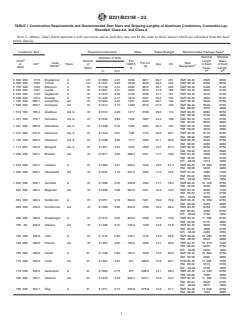
TABLE 1 Construction Requirements and Recommended Reel Sizes and Shipping Lengths of Aluminum Conductors, Concentric-Lay-
Stranded, Class AA, and Class A
NOTE 1—Metric values listed represent a soft conversion and as such they may not be the same as those masses which are calculated from the basic
metric density.
A
Conductor Size Required Construction Mass Rated Strength Recommended Package Sizes
Nominal Nominal
Diameter of Wire
B
Number Per Length Mass
cmils
Code Per km, Reel
or mm Class of 1000 ft, kips kN of Each of Each
C D
Words kg Designation
AWG
Wires lb Piece, Length,
B B
in. mm
ft lb
3 500 000 1773 Bluebonnet A 127 0.1660 4.22 3345 4977 58.7 261 RMT 90.45 2840 9530
3 000 000 1520 Trillium A 127 0.1537 3.90 2840 4226 50.3 223 RMT 90.45 3350 9530
2 750 000 1393 Bitterroot A 91 0.1738 4.42 2602 3872 46.1 205 RMT 90.45 3490 9100
2 500 000 1267 Lupine A 91 0.1657 4.21 2365 3519 41.9 186 RMT 90.45 3840 9100
2 250 000 1140 Sagebrush A 91 0.1572 3.99 2128 3166 37.7 167 RMT 90.45 4270 9100
2 000 000 1013 Cowslip A 91 0.1482 3.77 1873 2787 34.2 153 RMT 90.45 4850 9100
1 750 000 886.7 Jessamine AA 61 0.1694 4.30 1641 2442 29.7 132 RMT 90.45 5940 9760
1 590 000 805.7 Coreopsis AA 61 0.1614 4.10 1489 2216 27.0 120 RMT 90.45 6540 9760
RM 68.38 3270 4880
1 510 500 765.4 Gladiolus AA, A 61 0.1574 4.00 1417 2108 25.6 114 RMT 90.45 6880 9760
RM 68.38 3440 4880
1 431 000 725.1 Carnation AA, A 61 0.1532 3.89 1342 1997 24.3 108 RMT 90.45 7270 9760
RM 68.38 3635 4880
1 351 000 684.6 Columbine AA, A 61 0.1488 3.78 1266 1884 23.4 104 RMT 90.45 7690 9760
RM 68.38 3845 4880
1 272 000 644.5 Narcissus AA, A 61 0.1444 3.67 1192 1774 22.0 98.1 RMT 90.45 8170 9760
RM 68.38 4085 4880
1 192 500 604.2 Hawthorn AA, A 61 0.1398 3.55 1117 1662 21.1 93.5 RMT 90.45 9340 9760
RM 68.38 4360 4880
1 113 000 564.0 Marigold AA, A 61 0.1351 3.43 1044 1553 19.7 87.3 RMT 90.45 9340 9760
RM 68.38 4670 4880
1 033 500 523.7 Bluebell AA 37 0.1671 4.25 968.4 1441 17.7 78.8 RMT 84.45 7630 7400
RM 66.32 3815 3700
NR 48.28 1910 1850
1 033 500 523.7 Larkspur A 61 0.1302 3.31 969.2 1442 18.3 81.3 RMT 90.45 10 060 9760
RM 68.38 5030 4880
1 000 000 506.7 Hawkweed AA 37 0.1644 4.18 937.3 1395 17.2 76.2 RMT 84.45 7880 7400
RM 66.32 3940 3700
NR 48.28 1970 1850
1 000 000 506.7 Camellia A 61 0.1280 3.25 936.8 1394 17.7 78.3 RMT 90.45 10 400 9760
RM 68.38 5200 4880
954 000 483.4 Magnolia AA 37 0.1606 4.08 894.5 1331 16.4 72.6 RMT 84.45 8260 7400
RM 66.32 4130 3700
NR 48.28 2065 1850
954 000 483.4 Goldenrod A 61 0.1251 3.18 894.8 1331 16.9 75.0 RMT 90.45 10 900 9760
RM 68.38 5450 4880
900 000 456.0 Cockscomb AA 37 0.1560 3.96 844.0 1256 16.4 68.4 RMT 84.45 8760 7400
RM 66.32 4390 3700
NR 48.28 2190 1850
900 000 456.0 Snapdragon A 61 0.1215 3.09 844.0 1256 15.9 70.8 RMT 90.45 11 550 9760
RM 68.38 5775 4880
795 00 402.8 Arbutus AA 37 0.1466 3.72 745.3 1109 13.9 61.8 RMT 84.45 9920 7400
RM 66.32 4960 3700
NR 48.28 2480 1850
795 000 402.8 Lilac A 61 0.1142 2.90 745.7 1110 14.3 63.8 RMT 90.45 13 080 9760
RM 68.38 6540 4880
750 000 380.0 Petunia AA 37 0.1424 3.62 703.2 1046 13.1 58.6 RMT 84.45 10 510 7400
RM 66.32 5255 3700
NR 48.28 2630 1850
750 000 380.0 Cattail A 61 0.1109 2.82 703.2 1046 13.5 60.3 RMT 90.45 13 860 9760
RM 68.38 6930 4880
715 500 362.6 Violet AA 37 0.1391 3.53 671 998.5 12.8 56.7 RTM 84.45 11 020 7400
RM 66.32 5510 3700
NR 48.28 2755 1850
715 500 362.6 Nasturtium A 61 0.1083 2.75 671 998.5 13.1 58.4 RMT 90.45 14 530 9760
RM 68.38 7265 4880
700 000 354.7 Verbena AA 37 0.1375 3.49 655.7 975.7 12.5 55.4 RMT 84.45 11 260 7400
RM 66.32 5630 3700
NR 48.28 2815 1850
700 000 354.7 Flag A 61 0.1071 2.72 655.8 975.8 12.9 57.1 RMT 90.45 14 850 9760
RM 68.38 7425 4880
B231/B231M − 23
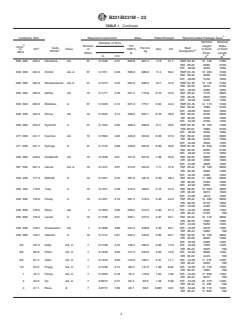
TABLE 1 Continued
A
Conductor Size Required Construction Mass Rated Strength Recommended Package Sizes
Nominal Nominal
Diameter of Wire
B
Number Per Length Mass
cmils
Code Per km, Reel
or mm Class of 1000 ft, kips kN of Each of Each
C D
Words kg Designation
AWG
Wires lb Piece, Length,
B B
in. mm
ft lb
650 000 329.4 Heuchera AA 37 0.1326 3.37 609.8 907.4 11.6 51.7 RMT 84.45 12 130 7400
RM 66.32 6065 3700
NR 48.28 3035 1850
636 000 322.3 Orchid AA, A 37 0.1311 3.33 596.0 886.9 11.4 50.4 RMT 84.45 12 400 7400
RM 66.32 6200 3700
NR 48.28 3100 1850
600 000 304.0 Meadowsweet AA, A 37 0.1273 3.23 562.0 836.3 10.7 47.5 RMT 84.45 13 140 7400
RM 66.32 6570 3700
NR 48.28 3285 1850
556 500 282.0 Dahlia AA 19 0.1711 4.35 521.4 775.8 9.75 43.3 RM 66.32 7270 3800
NR 48.28 3635 1900
NR 42.28 2425 1265
556 500 282.0 Mistletoe A 37 0.1226 3.12 521.3 775.7 9.94 44.3 RMT 84.45 14 170 7400
RM 66.32 7085 3700
NR 48.28 3545 1850
500 000 253.3 Zinnia AA 19 0.1622 4.12 468.5 697.1 8.76 38.9 RM 66.32 8100 3800
NR 48.28 4050 1900
NR 42.28 2700 1265
500 000 253.3 Hyacinth A 37 0.1162 2.95 468.3 696.8 9.11 40.5 RMT 84.45 15 760 7400
RM 66.32 7880 3700
NR 48.28 3940 1850
477 000 241.7 Cosmos AA 19 0.1584 4.02 446.8 664.8 8.36 37.0 RM 66.32 8490 3800
NR 48.28 4245 1900
NR 42.28 2830 1265
477 000 241.7 Syringa A 37 0.1135 2.88 446.8 664.8 8.69 38.6 RMT 84.45 16 530 7400
RM 66.32 8265 3700
NR 48.28 4135 1850
450 000 228.0 Goldentuft AA 19 0.1539 3.91 421.8 627.6 7.89 35.0 RM 66.32 9000 3800
NR 48.28 4500 1900
NR 42.28 3000 1265
397 500 201.4 Canna AA, A 19 0.1447 3.67 372.9 554.9 7.11 31.6 RM 66.32 10 180 3800
NR 48.28 5090 1900
NR 42.28 3395 1265
350 000 177.3 Daffodil A 19 0.1357 3.45 327.9 487.9 6.39 28.4 RM 66.32 11 560 3800
NR 48.28 5780 1900
NR 42.28 3855 1265
336 400 170.5 Tulip A 19 0.1331 3.38 315.5 469.5 6.15 27.3 RM 66.32 12 030 3800
NR 48.28 6015 1900
NR 42.28 4010 1265
300 000 152.0 Peony A 19 0.1257 3.19 281.4 418.3 5.48 24.3 RM 66.32 13 490 3800
NR 48.28 6745 1900
NR 42.28 4495 1265
266 800 135.2 Daisy AA 7 0.1953 4.96 250.2 372.3 4.83 21.4 NR 42.28 5590 1400
NR 36.22 2795 700
266 800 135.2 Laurel A 19 0.1185 3.01 250.1 372.2 4.97 22.1 RM 66.32 15 170 3800
NR 48.28 7585 1900
NR 42.28 5055 1265
250 000 126.7 Sneezewort AA 7 0.1890 4.80 234.4 348.8 4.52 20.1 NR 42.28 5970 1400
NR 36.22 2985 700
250 000 126.7 Valerian A 19 0.1147 2.91 234.3 348.6 4.66 20.7 RM 66.32 16 190 3800
NR 48.28 8095 1900
NR 42.28 5395 1265
4/0 107.2 Oxlip AA, A 7 0.1739 4.42 198.4 295.2 3.83 17.0 NR 42.28 7050 1400
NR 36.22 3525 700
3/0 85.0 Phlox AA, A 7 0.1548 3.93 157.2 233.9 3.04 13.5 NR 42.28 8890 1400
NR 36.22 4445 700
2/0 67.4 Aster AA, A 7 0.1379 3.50 124.8 185.7 2.51 11.1 NR 42.28 11 210 1400
NR 36.22 5605 700
1/0 53.5 Poppy AA, A 7 0.1228 3.12 98.9 147.2 1.99 8.84 NR 42.28 14 130 1400
NR 36.22 7065 700
1 42.4 Pansy AA, A 7 0.1093 2.78 78.4 116.6 1.64 7.30 NR 42.28 17 830 1400
NR 36.22 8915 700
2 33.6 Iris AA, A 7 0.0974 2.47 62.2 92.6 1.35 5.99 NR 42.28 22 470 1400
NR 36.22 11 235 700
4 21.1 Rose A 7 0.0772 1.96 39.1 58.2 0.881 3.91 NR 42.28 35 710 1400
NR 36.22 17 855 700
B231/B231M − 23
TABLE 1 Continued
A
Conductor Size Required Construction Mass Rated Strength Recommended Package Sizes
Nominal Nominal
Diameter of Wire
B
Number Per Length Mass
cmils
Code Per km, Reel
or mm Class of 1000 ft, kips kN of Each of Each
C D
Words kg Designation
AWG
Wires lb Piece, Length,
B B
in. mm
ft lb
6 13.3 Peachbell A 7 0.0612 1.56 24.6 36.6 0.563 2.53 NR 42.28 56 910 1400
NR 36.22 28 455 700
A
For information only.
B 2
Conversion factors: 1 cmil = 5.067 E-04 mm , 1 mil + 2.54 E-02 mm, 1 lb/1000 ft = 1.488 E+00 kg/km, 1 ft = 3.048 E-01 m, l lb = 4.536 E-01 kg, 1 lbf = 4.448 E-03 kN.
C
Code words shown in this column are from, “Publication 50, Code Words for Overhead Aluminum Electrical Conductors,” by the Aluminum Association. They are provided
here for information only.
D
See Table 9 for dimensions of standard reels.
insulate the conductor properly, wires of different diameters component wires multiplied by the rating factor given in Table
may be used provided that the area of cross section after 6. The maximum rated strength of the conductors shall be taken
stranding is in accordance with Section 12. as the sum of the calculated maximum strengths of the
component wires.
8.3 Where compressed stranding is required in order to
insulate the conductor properly, one or more layers of any 9.3 Rated-strength and breaking-strength values shall be
stranded conductor consisting of 7 wires or more may be rounded to three significant figures, in the final value only, in
slightly compressed, thereby reducing the outside diameter of accordance with the rounding method of Practice E29.
the conductor to the nominal values shown in Table 3 or Table
9.4 Rated strengths of conductors are given in Table 1 or
4, provided that the area of cross section after compressing is
Table 2.
in accordance with Section 12.
8.3.1 The average diameter of the conductor in 8.3 shall
10. Density
vary by not more than +1 or −2 % from the diameter specified
10.1 For the purpose of calculating mass, cross sections, and
in Table 3 or Table 4.
so forth, the density of aluminum 1350 shall be taken from the
8.4 The nominal overall diameter of a Class A and AA
applicable ASTM wire specification, Specification B230/
stranded conductor shall be calculated based on the numerical
B230M or Specification B609/B609M.
sum of the diameter thickness of the individual strand wire
component in the conductor. The diameter of the individual
11. Mass and Electrical Resistance
strand wire component shall be as specified in Table 1 and
11.1 The mass and electrical resistance of a unit length of a
Table 2 and this diameter shall be referred to as the “mean
stranded conductor are a function of the length of lay. The
diameter” value. The minimum and maximum overall diameter
approximate mass and electrical resistance may be determined
of a Class A and AA stranded conductor shall be based on
using the standard increments shown in Table 7. When greater
calculations made using the mean diameter tolerances as
accuracy is desired, the increment based on the specific lay of
specified by Specification B230/B230M for the corresponding
the conductor may be calculated (Explanatory Note 5).
strand wire size.
11.2 The maximum electrical resistance of a unit length of
9. Rated Strength of Conductor stranded conductor shall not exceed 2 % over the nominal dc
resistance shown in Tables 3 and 4 (Explanatory Note 8). When
9.1 The rated strength of 1350-H19 conductors shall be
the dc resistance is measured at other than 20 °C, it is to be
taken as the percent, indicated in Table 6, of the sum of the
corrected by using the multiplying factor given in Table 8.
strengths of the component wires, calculated using the nominal
wire diameters and the specified minimum average tensile
11.3 For conductors to be used in covered or insulated wires
strength given in Specification B230/B230M for 1350-H19
or cables dc resistance measurement may be used in lieu of the
wire. In the case of compressed conductors, the nominal wire
method outlined in Section 12, to determine compliance with
diameter should be that of the corresponding non-compressed
this specification.
construction as listed in Tables 1-4.
12. Variation in Area
9.2 Calculations for rated strengths of 1350-H16, -H26,
-H14, -H24, -H142, and -H242 conductors shall be made on 12.1 The area of cross section of the completed conductor
the basis of the strengths of the component wires using the shall not be less than 98 % of the area of cross section of the
nominal wire diameters and the specified maximum and conductor size listed in Column 1 of Tables 1-4. The manu-
minimum tensile strengths for the appropriate temper of the facturer may have the option of determining the cross-sectional
respective component wires given in Specification B609/ area by either of the following methods, except that in case of
B609M. The minimum rated strengths of the conductors shall question regarding area compliance, the method of 12.1.2 shall
be taken as the sum of the calculated minimum strengths of the be used.
B231/B231M − 23
TABLE 2 Construction Requirements and Recommended Reel Sizes and Shipping Lengths of Aluminum Conductors, Concentric Lay-
Stranded, Classes AA and A
NOTE 1—Sizes selected from Specification B682.
A
Stranding Recommended Package Sizes
Rated Strength Nominal Length of Nominal Mass
Conductor Number Diameter, Mass, Reel
Class 1350-H19, Each Piece, of Each Length,
2 B
Size, mm of Wires mm kg/km Designation
kN m kg
2000 A 127 4.48 5632 294 RMT 90.45 770 4325
1600 A 127 4.01 4512 236 RMT 90.45 960 4325
1250 A 91 4.18 3479 183 RMT 90.45 1185 4130
1120 A 91 3.96 3123 165 RMT 90.45 1320 4130
1000 A 91 3.74 2785 151 RMT 90.45 1495 4130
900 AA 61 4.33 2478 133 RMT 90.45 1785 4425
800 AA, A 61 4.09 2211 119 RMT 90.45 2000 4425
RM 68.38 1000 2215
710 AA, A 61 3.85 1959 105 RMT 90.45 2260 4425
RM 68.38 1130 2215
630 AA, A 61 3.63 1742 96.6 RMT 90.45 2540 4425
RM 68.38 1270 2215
560 AA, A 61 3.42 1546 85.7 RMT 90.45 2860 4425
RM 68.38 1430 2215
500 AA 37 4.15 1381 75.1 RMT 84.45 2430 3355
RM 66.32 1215 1680
NR 48.28 610 840
500 A 61 3.23 1379 76.5 RMT 90.45 3210 4425
RM 68.38 1605 2215
450 AA 37 3.94 1245 67.7 RMT 84.45 2695 3355
RM 66.32 1350 1680
NR 48.28 675 840
450 A 61 3.06 1238 68.6 RMT 90.45 3575 4425
RM 68.38 1790 2215
400 AA 37 3.71 1104 61.9 RMT 84.45 3040 3355
RM 66.32 1520 1680
NR 48.28 760 840
400 A 61 2.89 1104 63.0 RMT 90.45 4010 4425
RM 68.38 2005 2215
355 AA 37 3.50 982 55.1 RMT 84.45 3415 3355
RM 66.32 1710 1680
NR 48.28 855 840
355 A 61 2.72 978 57.4 RMT 90.45 4525 4425
RM 68.38 2265 2215
315 AA, A 37 3.29 868 48.7 RMT 84.45 3865 3355
RM 66.32 1935 1680
NR 48.28 970 840
280 AA 19 4.33 772 42.9 RM 66.32 2235 1725
NR 48.28 1115 860
NR 42.28 745 575
280 A 37 3.10 771 43.2 RMT 84.45 4350 3355
RM 66.32 2180 1680
NR 48.28 1090 840
250 AA 19 4.09 689 38.3 RM 66.32 2505 1725
NR 48.28 1250 860
NR 42.28 835 575
250 A 37 2.93 688 39.7 RMT 84.45 875 3355
RM 66.32 2440 1680
NR 48.28 1220 840
224 AA 19 3.87 617 34.3 RM 66.32 2795 1725
NR 48.28 1395 860
NR 42.28 930 575
200 AA, A 19 3.66 552 31.6 RM 66.32 3125 1725
NR 48.28 1560 860
NR 42.28 1040 575
180 A 19 3.47 496 28.4 RM 66.32 3480 1725
NR 48.28 1730 860
NR 42.28 1160 575
160 A 19 3.27 440 25.2 RM
...
This document is not an ASTM standard and is intended only to provide the user of an ASTM standard an indication of what changes have been made to the previous version. Because
it may not be technically possible to adequately depict all changes accurately, ASTM recommends that users consult prior editions as appropriate. In all cases only the current version
of the standard as published by ASTM is to be considered the official document.
Designation: B231/B231M − 16 (Reapproved 2021) B231/B231M − 23
Standard Specification for
Concentric-Lay-Stranded Aluminum 1350 Conductors
This standard is issued under the fixed designation B231/B231M; the number immediately following the designation indicates the year
of original adoption or, in the case of revision, the year of last revision. A number in parentheses indicates the year of last reapproval.
A superscript epsilon (´) indicates an editorial change since the last revision or reapproval.
This standard has been approved for use by agencies of the U.S. Department of Defense.
1. Scope
3 1
1.1 This specification covers aluminum 1350-H19 (extra hard), 1350-H16 or -H26 ( ⁄4 hard), 1350-H14 or -H24 ( ⁄2 hard), and
1350-H142 or -H242 ( ⁄2 hard), bare concentric-lay-stranded conductors constructed with a straight round central wire surrounded
by one or more layers of helically layed wires. The conductors are for general use for electrical purposes (Explanatory Note 1 and
Note 2).
1.2 The values stated in either SI units or inch-pound units are to be regarded separately as standard. The values stated in each
system may not be exact equivalents; therefore, each system shall be used independently of the other. Combining values from the
two systems may result in non-conformance with the standard.
1.2.1 For density, resistivity and temperature, the values stated in SI units are to be regarded as standard.
NOTE 1—Prior to 1975, aluminum 1350 was designated as EC aluminum.
NOTE 2—The aluminum and temper designations conform to ANSI Standard H35.1/H35.1M. Aluminum 1350 corresponds to Unified Numbering System
A91350 in accordance with Practice E527.
NOTE 3—Sealed conductors that are intended to prevent longitudinal water propagation and are further covered/insulated are also permitted within the
guidelines of this specification.
1.3 This international standard was developed in accordance with internationally recognized principles on standardization
established in the Decision on Principles for the Development of International Standards, Guides and Recommendations issued
by the World Trade Organization Technical Barriers to Trade (TBT) Committee.
2. Referenced Documents
2.1 The following documents of the issue in effect on date of material purchase form a part of this specification to the extent
referenced herein:
2.2 ASTM Standards:
B193 Test Method for Resistivity of Electrical Conductor Materials
B230/B230M Specification for Aluminum 1350–H19 Wire for Electrical Purposes
This specification is under the jurisdiction of ASTM Committee B01 on Electrical Conductors and is the direct responsibility of Subcommittee B01.07 on Conductors
of Light Metals.
Current edition approved Oct. 1, 2021Oct. 1, 2023. Published October 2021October 2023. Originally approved in 1948. Last previous edition approved in 20162021 as
B231/B231M – 16.B231/B231M – 16 (2021). DOI: 10.1520/B0231_B0231M-16R21.10.1520/B0231_B0231M-23.
For referenced ASTM standards, visit the ASTM website, www.astm.org, or contact ASTM Customer Service at service@astm.org. For Annual Book of ASTM Standards
volume information, refer to the standard’s Document Summary page on the ASTM website.
Copyright © ASTM International, 100 Barr Harbor Drive, PO Box C700, West Conshohocken, PA 19428-2959. United States
B231/B231M − 23
B263 Test Method for Determination of Cross-Sectional Area of Stranded Conductors
B354 Terminology Relating to Uninsulated Metallic Electrical Conductors
B609/B609M Specification for Aluminum 1350 Round Wire, Annealed and Intermediate Tempers, for Electrical Purposes
B682 Specification for Standard Metric Sizes of Electrical Conductors
E29 Practice for Using Significant Digits in Test Data to Determine Conformance with Specifications
E527 Practice for Numbering Metals and Alloys in the Unified Numbering System (UNS)
2.3 ANSI Documents:
ANSI H35.1 American National Standard Alloy and Temper Designation System for Aluminum
ANSI H35.1M American National Standard Alloy and Temper Designation Systems for Aluminum [Metric]
2.4 NIST Document:
NBS Handbook 100—Copper Wire Tables
2.5 Aluminum Association Document:
Publication 50 Code Words for Overhead Aluminum Electrical Conductors
3. Classification
3.1 For the purpose of this specification, conductors are classified as follows (Explanatory Note 1 and Note 2):
3.1.1 Class AA—For bare conductors usually used in overhead lines.
3.1.2 Class A—For conductors to be covered with weather-resistant materials, and for bare conductors where greater flexibility
than is afforded by Class AA is required. Conductors intended for further fabrication into tree wire or to be insulated and laid
helically with or around aluminum or ACSR messengers, shall be regarded as Class A conductors with respect to direction of lay
only (see 7.47.5).
3.1.3 Class B—For conductors to be insulated with various materials such as rubber, paper, varnished cloth, and so forth, and for
the conductors indicated under Class A where greater flexibility is required.
3.1.4 Classes C and D—For conductors where greater flexibility is required than is provided by Class B conductors.
4. Ordering Information
4.1 Orders for material under this specification shall include the following information:
4.1.1 Quantity,
4.1.2 Conductor size: square millimetres, if cross-sectional area is specified as a requirement (Section 8 and Tables 1-4),
4.1.2.1 Conductor size, number, and diameter of wires for Class B, C, or D conductors, if cross-sectional area is not specified as
a requirement (see 8.2),
4.1.3 Class (see 3.1),
4.1.4 Temper (see 5.1),
4.1.5 Details of special-purpose lays, when required (see 7.2 through 7.57.6),
4.1.6 Special tension tests if required (see 14.1 and 15.1),
4.1.7 Package size and type (see 17.1 and Table 1 or Table 2),
4.1.8 Special package marking, if required (Section 19),
4.1.9 Heavy wood lagging, if required (see 18.2),
Available from American National Standards Institute (ANSI), 25 W. 43rd St., 4th Floor, New York, NY 10036, http://www.ansi.org.
Available from National Institute of Standards and Technology (NIST), 100 Bureau Dr., Stop 1070, Gaithersburg, MD 20899-1070, http://www.nist.gov.
Available from Aluminum Association, 1400 Crystal Dr., Suite 430, Arlington, VA 22202, http://www.aluminum.org.
B231/B231M − 23
TABLE 1 Construction Requirements and Recommended Reel Sizes and Shipping Lengths of Aluminum Conductors, Concentric-Lay-
Stranded, Class AA, and Class A
NOTE 1—Metric values listed represent a soft conversion and as such they may not be the same as those masses which are calculated from the basic
metric density.
A
Conductor Size Required Construction Mass Rated Strength Recommended Package Sizes
Nominal Nominal
Diameter of Wire
B
Number Per Length Mass
cmils
Code Per km, Reel
or mm Class of 1000 ft, kips kN of Each of Each
C D
Words kg Designation
AWG
Wires lb Piece, Length,
B B
in. mm
ft lb
3 500 000 1773 Bluebonnet A 127 0.1660 4.22 3345 4977 58.7 261 RMT 90.45 2840 9530
3 000 000 1520 Trillium A 127 0.1537 3.90 2840 4226 50.3 223 RMT 90.45 3350 9530
2 750 000 1393 Bitterroot A 91 0.1738 4.42 2602 3872 46.1 205 RMT 90.45 3490 9100
2 500 000 1267 Lupine A 91 0.1657 4.21 2365 3519 41.9 186 RMT 90.45 3840 9100
2 250 000 1140 Sagebrush A 91 0.1572 3.99 2128 3166 37.7 167 RMT 90.45 4270 9100
2 000 000 1013 Cowslip A 91 0.1482 3.77 1873 2787 34.2 153 RMT 90.45 4850 9100
1 750 000 886.7 Jessamine AA 61 0.1694 4.30 1641 2442 29.7 132 RMT 90.45 5940 9760
1 590 000 805.7 Coreopsis AA 61 0.1614 4.10 1489 2216 27.0 120 RMT 90.45 6540 9760
RM 68.38 3270 4880
1 510 500 765.4 Gladiolus AA, A 61 0.1574 4.00 1417 2108 25.6 114 RMT 90.45 6880 9760
RM 68.38 3440 4880
1 431 000 725.1 Carnation AA, A 61 0.1532 3.89 1342 1997 24.3 108 RMT 90.45 7270 9760
RM 68.38 3635 4880
1 351 000 684.6 Columbine AA, A 61 0.1488 3.78 1266 1884 23.4 104 RMT 90.45 7690 9760
RM 68.38 3845 4880
1 272 000 644.5 Narcissus AA, A 61 0.1444 3.67 1192 1774 22.0 98.1 RMT 90.45 8170 9760
RM 68.38 4085 4880
1 192 500 604.2 Hawthorn AA, A 61 0.1398 3.55 1117 1662 21.1 93.5 RMT 90.45 9340 9760
RM 68.38 4360 4880
1 113 000 564.0 Marigold AA, A 61 0.1351 3.43 1044 1553 19.7 87.3 RMT 90.45 9340 9760
RM 68.38 4670 4880
1 033 500 523.7 Bluebell AA 37 0.1671 4.25 968.4 1441 17.7 78.8 RMT 84.45 7630 7400
RM 66.32 3815 3700
NR 48.28 1910 1850
1 033 500 523.7 Larkspur A 61 0.1302 3.31 969.2 1442 18.3 81.3 RMT 90.45 10 060 9760
RM 68.38 5030 4880
1 000 000 506.7 Hawkweed AA 37 0.1644 4.18 937.3 1395 17.2 76.2 RMT 84.45 7880 7400
RM 66.32 3940 3700
NR 48.28 1970 1850
1 000 000 506.7 Camellia A 61 0.1280 3.25 936.8 1394 17.7 78.3 RMT 90.45 10 400 9760
RM 68.38 5200 4880
954 000 483.4 Magnolia AA 37 0.1606 4.08 894.5 1331 16.4 72.6 RMT 84.45 8260 7400
RM 66.32 4130 3700
NR 48.28 2065 1850
954 000 483.4 Goldenrod A 61 0.1251 3.18 894.8 1331 16.9 75.0 RMT 90.45 10 900 9760
RM 68.38 5450 4880
900 000 456.0 Cockscomb AA 37 0.1560 3.96 844.0 1256 16.4 68.4 RMT 84.45 8760 7400
RM 66.32 4390 3700
NR 48.28 2190 1850
900 000 456.0 Snapdragon A 61 0.1215 3.09 844.0 1256 15.9 70.8 RMT 90.45 11 550 9760
RM 68.38 5775 4880
795 00 402.8 Arbutus AA 37 0.1466 3.72 745.3 1109 13.9 61.8 RMT 84.45 9920 7400
RM 66.32 4960 3700
NR 48.28 2480 1850
795 000 402.8 Lilac A 61 0.1142 2.90 745.7 1110 14.3 63.8 RMT 90.45 13 080 9760
RM 68.38 6540 4880
750 000 380.0 Petunia AA 37 0.1424 3.62 703.2 1046 13.1 58.6 RMT 84.45 10 510 7400
RM 66.32 5255 3700
NR 48.28 2630 1850
750 000 380.0 Cattail A 61 0.1109 2.82 703.2 1046 13.5 60.3 RMT 90.45 13 860 9760
RM 68.38 6930 4880
715 500 362.6 Violet AA 37 0.1391 3.53 671 998.5 12.8 56.7 RTM 84.45 11 020 7400
RM 66.32 5510 3700
NR 48.28 2755 1850
715 500 362.6 Nasturtium A 61 0.1083 2.75 671 998.5 13.1 58.4 RMT 90.45 14 530 9760
RM 68.38 7265 4880
700 000 354.7 Verbena AA 37 0.1375 3.49 655.7 975.7 12.5 55.4 RMT 84.45 11 260 7400
RM 66.32 5630 3700
NR 48.28 2815 1850
700 000 354.7 Flag A 61 0.1071 2.72 655.8 975.8 12.9 57.1 RMT 90.45 14 850 9760
RM 68.38 7425 4880
B231/B231M − 23
TABLE 1 Continued
A
Conductor Size Required Construction Mass Rated Strength Recommended Package Sizes
Nominal Nominal
Diameter of Wire
B
Number Per Length Mass
cmils
Code Per km, Reel
or mm Class of 1000 ft, kips kN of Each of Each
C D
Words kg Designation
AWG
Wires lb Piece, Length,
B B
in. mm
ft lb
650 000 329.4 Heuchera AA 37 0.1326 3.37 609.8 907.4 11.6 51.7 RMT 84.45 12 130 7400
RM 66.32 6065 3700
NR 48.28 3035 1850
636 000 322.3 Orchid AA, A 37 0.1311 3.33 596.0 886.9 11.4 50.4 RMT 84.45 12 400 7400
RM 66.32 6200 3700
NR 48.28 3100 1850
600 000 304.0 Meadowsweet AA, A 37 0.1273 3.23 562.0 836.3 10.7 47.5 RMT 84.45 13 140 7400
RM 66.32 6570 3700
NR 48.28 3285 1850
556 500 282.0 Dahlia AA 19 0.1711 4.35 521.4 775.8 9.75 43.3 RM 66.32 7270 3800
NR 48.28 3635 1900
NR 42.28 2425 1265
556 500 282.0 Mistletoe A 37 0.1226 3.12 521.3 775.7 9.94 44.3 RMT 84.45 14 170 7400
RM 66.32 7085 3700
NR 48.28 3545 1850
500 000 253.3 Zinnia AA 19 0.1622 4.12 468.5 697.1 8.76 38.9 RM 66.32 8100 3800
NR 48.28 4050 1900
NR 42.28 2700 1265
500 000 253.3 Hyacinth A 37 0.1162 2.95 468.3 696.8 9.11 40.5 RMT 84.45 15 760 7400
RM 66.32 7880 3700
NR 48.28 3940 1850
477 000 241.7 Cosmos AA 19 0.1584 4.02 446.8 664.8 8.36 37.0 RM 66.32 8490 3800
NR 48.28 4245 1900
NR 42.28 2830 1265
477 000 241.7 Syringa A 37 0.1135 2.88 446.8 664.8 8.69 38.6 RMT 84.45 16 530 7400
RM 66.32 8265 3700
NR 48.28 4135 1850
450 000 228.0 Goldentuft AA 19 0.1539 3.91 421.8 627.6 7.89 35.0 RM 66.32 9000 3800
NR 48.28 4500 1900
NR 42.28 3000 1265
397 500 201.4 Canna AA, A 19 0.1447 3.67 372.9 554.9 7.11 31.6 RM 66.32 10 180 3800
NR 48.28 5090 1900
NR 42.28 3395 1265
350 000 177.3 Daffodil A 19 0.1357 3.45 327.9 487.9 6.39 28.4 RM 66.32 11 560 3800
NR 48.28 5780 1900
NR 42.28 3855 1265
336 400 170.5 Tulip A 19 0.1331 3.38 315.5 469.5 6.15 27.3 RM 66.32 12 030 3800
NR 48.28 6015 1900
NR 42.28 4010 1265
300 000 152.0 Peony A 19 0.1257 3.19 281.4 418.3 5.48 24.3 RM 66.32 13 490 3800
NR 48.28 6745 1900
NR 42.28 4495 1265
266 800 135.2 Daisy AA 7 0.1953 4.96 250.2 372.3 4.83 21.4 NR 42.28 5590 1400
NR 36.22 2795 700
266 800 135.2 Laurel A 19 0.1185 3.01 250.1 372.2 4.97 22.1 RM 66.32 15 170 3800
NR 48.28 7585 1900
NR 42.28 5055 1265
250 000 126.7 Sneezewort AA 7 0.1890 4.80 234.4 348.8 4.52 20.1 NR 42.28 5970 1400
NR 36.22 2985 700
250 000 126.7 Valerian A 19 0.1147 2.91 234.3 348.6 4.66 20.7 RM 66.32 16 190 3800
NR 48.28 8095 1900
NR 42.28 5395 1265
4/0 107.2 Oxlip AA, A 7 0.1739 4.42 198.4 295.2 3.83 17.0 NR 42.28 7050 1400
NR 36.22 3525 700
3/0 85.0 Phlox AA, A 7 0.1548 3.93 157.2 233.9 3.04 13.5 NR 42.28 8890 1400
NR 36.22 4445 700
2/0 67.4 Aster AA, A 7 0.1379 3.50 124.8 185.7 2.51 11.1 NR 42.28 11 210 1400
NR 36.22 5605 700
1/0 53.5 Poppy AA, A 7 0.1228 3.12 98.9 147.2 1.99 8.84 NR 42.28 14 130 1400
NR 36.22 7065 700
1 42.4 Pansy AA, A 7 0.1093 2.78 78.4 116.6 1.64 7.30 NR 42.28 17 830 1400
NR 36.22 8915 700
2 33.6 Iris AA, A 7 0.0974 2.47 62.2 92.6 1.35 5.99 NR 42.28 22 470 1400
NR 36.22 11 235 700
4 21.1 Rose A 7 0.0772 1.96 39.1 58.2 0.881 3.91 NR 42.28 35 710 1400
NR 36.22 17 855 700
B231/B231M − 23
TABLE 1 Continued
A
Conductor Size Required Construction Mass Rated Strength Recommended Package Sizes
Nominal Nominal
Diameter of Wire
B
Number Per Length Mass
cmils
Code Per km, Reel
or mm Class of 1000 ft, kips kN of Each of Each
C D
Words kg Designation
AWG
Wires lb Piece, Length,
B B
in. mm
ft lb
6 13.3 Peachbell A 7 0.0612 1.56 24.6 36.6 0.563 2.53 NR 42.28 56 910 1400
NR 36.22 28 455 700
A
For information only.
B 2
Conversion factors: 1 cmil = 5.067 E-04 mm , 1 mil + 2.54 E-02 mm, 1 lb/1000 ft = 1.488 E+00 kg/km, 1 ft = 3.048 E-01 m, l lb = 4.536 E-01 kg, 1 lbf = 4.448 E-03 kN.
C
Code words shown in this column are from, “Publication 50, Code Words for Overhead Aluminum Electrical Conductors,” by the Aluminum Association. They are provided
here for information only.
D
See Table 9Table 9 for for dimensions of standard reels.
4.1.10 Place of inspection (Section 17), and
4.1.11 Method of cross-sectional area determination if not optional (see 12.1).
5. Requirements for Wires
5.1 Aluminum wire employed in Classes AA and A conductors shall be 1350-H19, unless otherwise specified. The purchaser shall
designate the temper of conductors of Classes B, C, and D.
5.1.1 For conductor tempers other than 1350-H19, when temper designations are not more specific in the inquiry and purchase
order, the manufacturer shall have the following options on manufacturing method:
5.1.1.1 Strand the conductor from wires drawn to final temper;
5.1.1.2 Strand the conductor from wires drawn to H19 temper and annealed to final temper prior to stranding;
5.1.1.3 Strand the conductor from 1350-H19 wires and anneal the stranded conductor to final temper.
5.2 Before stranding, the aluminum wire used shall meet the requirements of Specifications B230/B230M or B609/B609M,
whichever is applicable.
5.3 All wires in the conductor shall be of the same temper.
6. Joints
6.1 Only cold-pressure joints or electric-butt, cold-upset joints may be made in the six outer finished wires of (1) Class AA
conductors composed of seven wires or (2) Class A conductors composed of seven wires used in overhead lines. In other
conductors, electric-butt welds, cold-pressure welds, or electric-butt, cold-upset welds may be made in the finished wires
composing conductors, but such welds shall not be closer than prescribed in Table 5 (Explanatory Note 3).
7. Lay
7.1 For Class AA conductors composed of seven wires or more, the preferred length of lay of a layer of wires is 13.5 times the
outside diameter of that layer, but the lay shall be not shall not be less than 10 nor more than 16 times this diameter.the outside
diameter of that layer.
7.2 For all other classes the lay of a layer of wires shall be not less than 8 nor more than 16 times the outside diameter of that
layer, except that for conductors composed of 37 wires or more, this requirement shall apply only to the two outer layers. The lay
of the layers other than the two outer layers shall be at the option of the manufacturer, unless otherwise agreed upon.
B231/B231M − 23
TABLE 2 Construction Requirements and Recommended Reel Sizes and Shipping Lengths of Aluminum Conductors, Concentric Lay-
Stranded, Classes AA and A
NOTE 1—Sizes selected from Specification B682.
A
Stranding Recommended Package Sizes
Rated Strength Nominal Length of Nominal Mass
Conductor Number Diameter, Mass, Reel
Class 1350-H19, Each Piece, of Each Length,
2 B
Size, mm of Wires mm kg/km Designation
kN m kg
2000 A 127 4.48 5632 294 RMT 90.45 770 4325
1600 A 127 4.01 4512 236 RMT 90.45 960 4325
1250 A 91 4.18 3479 183 RMT 90.45 1185 4130
1120 A 91 3.96 3123 165 RMT 90.45 1320 4130
1000 A 91 3.74 2785 151 RMT 90.45 1495 4130
900 AA 61 4.33 2478 133 RMT 90.45 1785 4425
800 AA, A 61 4.09 2211 119 RMT 90.45 2000 4425
RM 68.38 1000 2215
710 AA, A 61 3.85 1959 105 RMT 90.45 2260 4425
RM 68.38 1130 2215
630 AA, A 61 3.63 1742 96.6 RMT 90.45 2540 4425
RM 68.38 1270 2215
560 AA, A 61 3.42 1546 85.7 RMT 90.45 2860 4425
RM 68.38 1430 2215
500 AA 37 4.15 1381 75.1 RMT 84.45 2430 3355
RM 66.32 1215 1680
NR 48.28 610 840
500 A 61 3.23 1379 76.5 RMT 90.45 3210 4425
RM 68.38 1605 2215
450 AA 37 3.94 1245 67.7 RMT 84.45 2695 3355
RM 66.32 1350 1680
NR 48.28 675 840
450 A 61 3.06 1238 68.6 RMT 90.45 3575 4425
RM 68.38 1790 2215
400 AA 37 3.71 1104 61.9 RMT 84.45 3040 3355
RM 66.32 1520 1680
NR 48.28 760 840
400 A 61 2.89 1104 63.0 RMT 90.45 4010 4425
RM 68.38 2005 2215
355 AA 37 3.50 982 55.1 RMT 84.45 3415 3355
RM 66.32 1710 1680
NR 48.28 855 840
355 A 61 2.72 978 57.4 RMT 90.45 4525 4425
RM 68.38 2265 2215
315 AA, A 37 3.29 868 48.7 RMT 84.45 3865 3355
RM 66.32 1935 1680
NR 48.28 970 840
280 AA 19 4.33 772 42.9 RM 66.32 2235 1725
NR 48.28 1115 860
NR 42.28 745 575
280 A 37 3.10 771 43.2 RMT 84.45 4350 3355
RM 66.32 2180 1680
NR 48.28 1090 840
250 AA 19 4.09 689 38.3 RM 66.32 2505 1725
NR 48.28 1250 860
NR 42.28 835 575
250 A 37 2.93 688 39.7 RMT 84.45 875 3355
RM 66.32 2440 1680
NR 48.28 1220 840
224 AA 19 3.87 617 34.3 RM 66.32 2795 1725
NR 48.28 1395 860
NR 42.28 930 575
200 AA, A 19 3.66 552 31.6 RM 66.32 3125 1725
NR 48.28 1560 860
NR 42.28 1040 575
180 A 19 3.47 496 28.4 RM 66.32 3480 1725
NR 48.28 1730 860
NR 42.28 1160 575
160 A 19 3.27 440 25.2 RM 66.32 3920 1725
NR 48.28 1955 860
NR 42.28 1305 575
140 AA 7 5.05 387.0 22.2 NR 42.28 1640 635
NR 36.22 830 320
140 A 19 3.06 386 22.1 RM 66.32 4470 1725
NR 48.28 2230 860
NR 42.28 1490 575
125 AA 7 4.77 345 19.8 NR 42.28 1840 635
NR 36.22 930 320
B231/B231M − 23
TABLE 3 Construction Requirements of Aluminum Conductors, Concentric-Lay-Stranded, Class B, C, and D
Hard-Drawn Copper
Conductor Size Stranding
Equivalent
Class B Class C Class D
Reverse Unilay
Direct Current
Concentric Com-
Resistance
A A Diameter Diameter Diameter
cmils AWG cmils AWG
Number Number Number Compressed pressed
at 20 °C
of Wire, of Wire, of Wire,
of Wires of Wires of Wires Class B Class B
B A A
mils mils mils
Diameter, Diameter,
Ω/1000 ft Ω/km
in. in.
4 000 000 . . . 2 520 000 . . . 217 135.8 271 121.5 271 121.5 . . . . . . 0.00442 0.0145
3 500 000 . . . 2 200 000 . . . 169 143.9 217 127.0 271 113.6 . . . . . . 0.00505 0.0166
3 000 000 . . . 1 890 000 . . . 169 133.2 217 117.6 271 105.2 . . . . . . 0.00584 0.0192
2 500 000 . . . 1 570 000 . . . 127 140.3 169 121.6 217 107.3 . . . . . . 0.00701 0.0229
2 000 000 . . . 1 260 000 . . . 127 125.5 169 108.8 217 96.0 1.583 1.533 0.00867 0.0284
1 900 000 . . . 1 195 000 . . . 127 122.3 169 106.0 217 93.6 1.542 1.494 0.00913 0.0299
1 800 000 . . . 1 132 000 . . . 127 119.1 169 103.2 217 91.1 1.502 1.454 0.00963 0.0316
1 750 000 . . . 1 101 000 . . . 127 117.4 169 101.8 217 89.8 1.480 1.434 0.0099 0.0325
1 700 000 . . . 1 069 000 . . . 127 115.7 169 100.3 217 88.5 1.459 1.413 0.0102 0.0335
C
1 600 000 . . . 1 006 000 . . . 127 112.2 169 97.3 217 85.9 1.415 1.371 0.0109 0.0357
D
1 500 000 . . . 943 000 . . . 91 128.4 127 108.7 169 94.2 1.370 1.327 0.0116 0.0380
D
1 400 000 . . . 880 000 . . . 91 124.0 127 105.0 169 91.0 1.323 1.282 0.0124 0.0407
D
1 300 000 . . . 818 000 . . . 91 119.5 127 101.2 169 87.7 1.275 1.236 0.0133 0.0436
C D
1 250 000 . . . 786 000 . . . 91 117.2 127 99.2 169 86.0 1.250 1.212 0.0138 0.0453
D
1 200 000 . . . 755 000 . . . 91 114.8 127 97.2 169 84.3 1.225 1.187 0.0144 0.0472
D
1 100 000 . . . 692 000 . . . 91 109.9 127 93.1 169 80.7 1.173 1.137 0.0158 0.0518
B
1 000 000 . . . 629 000 . . . 61 128.0 91 104.8 127 88.7 1.117 1.084 0.0173 0.0568
900 000 . . . 566 000 . . . 61 121.5 91 99.4 127 84.2 1.060 1.028 0.0193 0.0633
C
800 000 . . . 503 000 . . . 61 114.5 91 93.8 127 79.4 1.000 0.969 0.0217 0.0712
750 000 . . . 472 000 . . . 61 110.9 91 90.8 127 76.8 0.968 0.939 0.0231 0.0758
700 000 . . . 440 000 . . . 61 107.1 91 87.7 127 74.2 0.935 0.907 0.0248 0.0814
650 000 . . . 409 000 . . . 61 103.2 91 84.5 127 71.5 0.901 0.874 0.0267 0.0876
636 000 . . . 400 000 . . . . . . . . . . . . . . . . . . . . . . . . . . . . . . . . .
600 000 . . . 377 000 . . . 61 99.2 91 81.2 127 68.7 0.866 0.840 0.0289 0.0948
550 000 . . . 346 000 . . . 61 95.0 91 77.7 127 65.8 0.829 0.804 0.0315 0.103
500 000 . . . 314 000 . . . 37 116.2 61 90.5 91 74.1 0.789 0.766 0.0347 0.114
477 000 . . . 300 000 . . . . . . . . . . . . . . . . . . . . . . . . . . . . . . . . .
450 000 . . . 283 000 . . . 37 110.3 61 85.9 91 70.3 0.749 0.727 0.0385 0.126
C
400 000 . . . 252 000 . . . 37 104.0 61 81.0 91 66.3 0.706 0.685 0.0434 0.142
350 000 . . . 220 000 . . . 37 97.3 61 75.7 91 62.0 0.661 0.641 0.0495 0.162
336 400 . . . . . . 0000 . . . . . . . . . . . . . . . . . . . . . . . . . . . . . .
300 000 . . . 188 700 . . . 37 90.0 61 70.1 91 57.4 0.611 0.594 0.0578 0.187
266 800 . . . . . . 000 . . . . . . . . . . . . . . . . . . . . . . . . . . . . . .
250 000 . . . 157 200 . . . 37 82.2 61 64.0 91 52.4 0.558 0.542 0.0694 0.228
211 600 0000 . . . 00 19 105.5 37 75.6 61 58.9 0.512 0.498 0.0820 0.269
167 800 000 . . . 0 19 94.0 37 67.3 61 52.4 0.456 0.443 0.103 0.338
133 100 00 . . . 1 19 83.7 37 60.0 61 46.7 0.405 0.395 0.130 0.427
105 600 0 . . . 2 19 74.5 37 53.4 61 41.6 0.362 0.352 0.164 0.538
83 690 1 . . . 3 19 66.4 37 47.6 61 37.0 0.322 0.313 0.207 0.679
66 360 2 . . . 4 7 97.4 19 59.1 37 42.4 0.283 . . . 0.261 0.856
52 620 3 . . . 5 7 86.7 19 52.6 37 37.7 0.252 . . . 0.330 1.08
41 740 4 . . . 6 7 77.2 19 46.9 37 33.6 0.225 . . . 0.416 1.36
33 090 5 . . . 7 7 68.8 19 41.7 37 29.9 0.200 . . . 0.523 1.72
26 240 6 . . . 8 7 61.2 19 37.2 37 26.6 0.178 . . . 0.661 2.17
20 820 7 . . . 9 7 54.5 19 33.1 37 23.7 0.159 . . . 0.834 2.74
16 510 8 . . . 10 7 48.6 19 29.5 37 21.1 0.142 . . . 1.05 3.44
13 090 9 . . . 11 7 43.2 19 26.2 37 18.8 0.126 . . . 1.32 4.33
10 380 10 . . . 12 7 38.5 19 23.4 37 16.7 0.113 . . . 1.67 5.48
11 . . . . . . . . . . . . . . . . . . . . . . . . 0.100 . . . 2.11 6.92
6530 12 . . . 14 7 30.5 19 18.5 37 13.3 0.089 . . . 2.67 8.76
13 . . . . . . . . . . . . . . . . . . . . . . . . 0.080 . . . 3.34 10.96
4110 14 . . . 16 7 24.2 19 14.7 37 10.5 0.071 . . . 4.22 13.8
2580 16 . . . 18 7 19.2 19 11.7 . . . . . . . . . . . . 6.71 22.0
1620 18 . . . 20 7 15.2 . . . . . . . . . . . . . . . . . . 10.7 35.1
1020 20 . . . 22 7 12.1 . . . . . . . . . . . . . . . . . . 16.9 55.4
A
See Footnote B of Table 1.
B
This size is sensibly equivalent to size 1 033 500 cmils within a difference of 3.24 %.
C
These sizes are sensibly equivalent to sizes 1 590 000; 1 272 000; 795 000; and 397 500 cmil respectively within the cross-sectional area tolerances stipulated by this
specification and associated Specifications B230/B230M and B609/B609M.
D
As agreed upon between the manufacturer and the customer, these sizes may be produced with 61 wire construction of the appropriate wire size and with the
corresponding change in overall diameter.
7.2.1 For conductors to be used in covered or insulated wires or cables, the lay length of the wires shall not be less than 8 nor
B231/B231M − 23
TABLE 4 Construction Requirements of Conductors Classes B, C, and D
NOTE 1—Sizes selected from Specification B682.
Stranding
Class B Class C Class D Nominal Diameter (mm)
Conductor Size, Number of Diameter, mm Number of Diameter, mm Number of Diameter, mm Reverse Con- Direct Current
Unilay Com-
2 A A A
mm Wires Wires Wires c
...