

ASTM B416-98(2023)
(Specification)Standard Specification for Concentric-Lay-Stranded Aluminum-Clad Steel Conductors
General Information
- Abstract
ABSTRACT
This specification covers bare concentric-lay-stranded conductors made from bare, hard-drawn, round, aluminum-clad steel wires for generail use of electrical purposes. This specification does not apply to stranded conductors for reinforcement in ACSR conductors. The conductors shall conform to the required values of breaking strength, nominal diameter and number of individual wires, conductor diameter, mass per unit length and electrical resistance.. Physical and electrical tests shall be performed on the wires before stranding.
SCOPE
1.1 This specification covers bare concentric-lay-stranded conductors made from bare, hard-drawn, round, aluminum-clad steel wires of 20.3 % conductivity for general use of electrical purposes. This specification does not apply to stranded conductors for reinforcement in ACSR conductors.
1.2 The values stated in inch-pound units are to be regarded as standard. The values given in parentheses are mathematical conversions to SI units that are provided for information only and are not considered standard.
1.3 This international standard was developed in accordance with internationally recognized principles on standardization established in the Decision on Principles for the Development of International Standards, Guides and Recommendations issued by the World Trade Organization Technical Barriers to Trade (TBT) Committee.
- Status
- Published
- Publication Date
- 30-Sep-2023
- Technical Committee
- B01 - Electrical Conductors
- Drafting Committee
- B01.06 - Bi-Metallic Conductors

Overview
ASTM B416-98(2023) - Standard Specification for Concentric-Lay-Stranded Aluminum-Clad Steel Conductors provides requirements for bare, concentric-lay-stranded conductors composed of bare, hard-drawn, round, aluminum-clad steel wires. Developed and maintained by ASTM International, this standard is widely recognized in the electrical conductor and utility industries. Its scope is focused on conductors used for general electrical purposes, excluding those intended for reinforcement in ACSR (Aluminum Conductor Steel Reinforced) conductors. The document outlines properties such as breaking strength, wire configuration, nominal diameter, mass per unit length, and electrical resistance, ensuring conductors meet rigorous standards for safety, performance, and durability.
Key Topics
- Conductor Construction: Defines requirements for the number and diameter of wires, arrangement in concentric layers, and preferred lay lengths and directions for different wire counts (3, 7, 19, or 37 wires).
- Material Properties: Specifies that aluminum-clad steel wires used must meet conductivity requirements and be hard-drawn for strength.
- Mechanical Strength: Establishes minimum breaking strength values based on wire count and size, ensuring the finished conductor is robust.
- Physical and Electrical Testing: Requires physical and electrical properties of wires be verified before stranding; includes guidelines for conducting, waiving, or sampling such tests.
- Mass and Electrical Resistance: Details calculations and requirements for mass per unit length and resistance, considering increments due to stranding.
- Joints and Splices: Allows joints or splices in individual wires under strict conditions to maintain strength and conductivity.
- Packaging and Marking: Outlines requirements for packaging, including reel sizes, protective wrapping, weather-resistant tags, and clear identification on each coil or reel.
- Inspection and Rejection Criteria: Provides for systematic inspection, procedures for handling nonconforming products, and retesting protocols.
Applications
Concentric-lay-stranded aluminum-clad steel conductors manufactured to ASTM B416 are essential in various electrical and utility infrastructure applications that require a balance of conductivity, strength, and corrosion resistance. Typical uses include:
- Overhead Power Transmission and Distribution: Utilized for bare overhead electrical lines, these conductors offer superior mechanical strength and durability for long-span applications in utility networks.
- General Electrical Power Applications: Used where the combination of aluminum's conductivity and steel's strength is needed, such as in certain industrial power delivery systems.
- Environments Demanding High Corrosion Resistance: Aluminum-clad steel conductors are preferred for installations where corrosion resistance is critical, supporting extended service life in adverse weather conditions.
The standard ensures that these conductors are qualified for safe and efficient service in power delivery, directly supporting energy infrastructure reliability.
Related Standards
When working with or specifying concentric-lay-stranded aluminum-clad steel conductors according to ASTM B416, additional standards may apply to ensure complete compliance and interoperability, including:
- ASTM B354 – Terminology Relating to Uninsulated Metallic Electrical Conductors: Provides definitions used in B416.
- ASTM B415 – Specification for Hard-Drawn Aluminum-Clad Steel Wire: Specifies the wire material requirements referenced in B416.
- ANSI C8.1 – Definitions and General Standards for Wires and Cables: Industry-wide terminology and baseline requirements.
- NBS Handbook 100 – Copper Wire Tables: Offers reference tables for calculations and conversions relevant to electrical conductors.
Practical Value
Compliance with ASTM B416 ensures electrical conductors provide reliable performance, mechanical durability, and safe operation in a variety of critical infrastructure settings. Utilizing standard-compliant materials and procedures supports utility resilience, project consistency, and regulatory satisfaction. For engineers, manufacturers, and utilities, ASTM B416 offers an essential framework for specifying and qualifying aluminum-clad steel conductors tailored for demanding electrical applications.
Relations
- Effective Date
- 01-Oct-2023
Get Certified
Connect with accredited certification bodies for this standard

IMQ S.p.A. (Certification)
Italian electrical product certification.

SLG Prüf- und Zertifizierungs GmbH
German testing and certification body.

UL Solutions
Global safety science company with testing, inspection and certification.
Sponsored listings
Frequently Asked Questions
ASTM B416-98(2023) is a technical specification published by ASTM International. Its full title is "Standard Specification for Concentric-Lay-Stranded Aluminum-Clad Steel Conductors". This standard covers: ABSTRACT This specification covers bare concentric-lay-stranded conductors made from bare, hard-drawn, round, aluminum-clad steel wires for generail use of electrical purposes. This specification does not apply to stranded conductors for reinforcement in ACSR conductors. The conductors shall conform to the required values of breaking strength, nominal diameter and number of individual wires, conductor diameter, mass per unit length and electrical resistance.. Physical and electrical tests shall be performed on the wires before stranding. SCOPE 1.1 This specification covers bare concentric-lay-stranded conductors made from bare, hard-drawn, round, aluminum-clad steel wires of 20.3 % conductivity for general use of electrical purposes. This specification does not apply to stranded conductors for reinforcement in ACSR conductors. 1.2 The values stated in inch-pound units are to be regarded as standard. The values given in parentheses are mathematical conversions to SI units that are provided for information only and are not considered standard. 1.3 This international standard was developed in accordance with internationally recognized principles on standardization established in the Decision on Principles for the Development of International Standards, Guides and Recommendations issued by the World Trade Organization Technical Barriers to Trade (TBT) Committee.
ABSTRACT This specification covers bare concentric-lay-stranded conductors made from bare, hard-drawn, round, aluminum-clad steel wires for generail use of electrical purposes. This specification does not apply to stranded conductors for reinforcement in ACSR conductors. The conductors shall conform to the required values of breaking strength, nominal diameter and number of individual wires, conductor diameter, mass per unit length and electrical resistance.. Physical and electrical tests shall be performed on the wires before stranding. SCOPE 1.1 This specification covers bare concentric-lay-stranded conductors made from bare, hard-drawn, round, aluminum-clad steel wires of 20.3 % conductivity for general use of electrical purposes. This specification does not apply to stranded conductors for reinforcement in ACSR conductors. 1.2 The values stated in inch-pound units are to be regarded as standard. The values given in parentheses are mathematical conversions to SI units that are provided for information only and are not considered standard. 1.3 This international standard was developed in accordance with internationally recognized principles on standardization established in the Decision on Principles for the Development of International Standards, Guides and Recommendations issued by the World Trade Organization Technical Barriers to Trade (TBT) Committee.
ASTM B416-98(2023) is classified under the following ICS (International Classification for Standards) categories: 29.240.20 - Power transmission and distribution lines. The ICS classification helps identify the subject area and facilitates finding related standards.
ASTM B416-98(2023) has the following relationships with other standards: It is inter standard links to ASTM B416-98(2018). Understanding these relationships helps ensure you are using the most current and applicable version of the standard.
ASTM B416-98(2023) is available in PDF format for immediate download after purchase. The document can be added to your cart and obtained through the secure checkout process. Digital delivery ensures instant access to the complete standard document.
Standards Content (Sample)
This international standard was developed in accordance with internationally recognized principles on standardization established in the Decision on Principles for the
Development of International Standards, Guides and Recommendations issued by the World Trade Organization Technical Barriers to Trade (TBT) Committee.
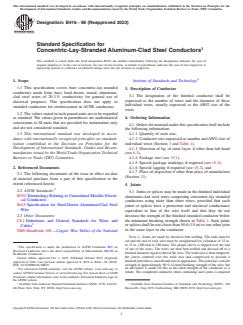
Designation: B416 − 98 (Reapproved 2023)
Standard Specification for
Concentric-Lay-Stranded Aluminum-Clad Steel Conductors
This standard is issued under the fixed designation B416; the number immediately following the designation indicates the year of
original adoption or, in the case of revision, the year of last revision. A number in parentheses indicates the year of last reapproval. A
superscript epsilon (´) indicates an editorial change since the last revision or reapproval.
1. Scope Institute of Standards and Technology
1.1 This specification covers bare concentric-lay-stranded
3. Description of Conductor
conductors made from bare, hard-drawn, round, aluminum-
3.1 The designation of the finished conductor shall be
clad steel wires of 20.3 % conductivity for general use of
expressed as the number of wires and the diameter of these
electrical purposes. This specification does not apply to
individual wires, usually expressed as the AWG size of the
stranded conductors for reinforcement in ACSR conductors.
wires.
1.2 The values stated in inch-pound units are to be regarded
4. Ordering Information
as standard. The values given in parentheses are mathematical
conversions to SI units that are provided for information only
4.1 Orders for material under this specification shall include
and are not considered standard.
the following information:
1.3 This international standard was developed in accor- 4.1.1 Quantity of each size,
dance with internationally recognized principles on standard- 4.1.2 Conductor size expressed as number and AWG size of
ization established in the Decision on Principles for the individual wires (Section 3 and Table 1),
Development of International Standards, Guides and Recom- 4.1.3 Direction of lay of outer layer, if other than left-hand
mendations issued by the World Trade Organization Technical (see 6.3),
Barriers to Trade (TBT) Committee. 4.1.4 Package size (see 15.1),
4.1.5 Special package markings if required (see 15.3),
2. Referenced Documents 4.1.6 Special lagging if required (see 15.2), and
4.1.7 Place of inspection if other than place of manufacture
2.1 The following documents of the issue in effect on date
(Section 13).
of material purchase form a part of this specification to the
extent referenced herein:
5. Joints
2.2 ASTM Standards:
5.1 Joints or splices may be made in the finished individual
B354 Terminology Relating to Uninsulated Metallic Electri-
aluminum-clad steel wires composing concentric-lay stranded
cal Conductors
conductors using more than three wires, provided that such
B415 Specification for Hard-Drawn Aluminum-Clad Steel
joints or splices have a protection and electrical conductance
Wire
equivalent to that of the wire itself and that they do not
decrease the strength of the finished stranded conductor below
2.3 Other Documents:
the minimum breaking strength shown in Table 1. Such joints
C8.1 Definitions and General Standards for Wires and
or splices shall be not closer than 50 ft (15 m) to any other joint
Cables
in the same layer in the conductor.
NBS Handbook 100 —Copper Wire Tables of the National
NOTE 1—Joints are made by electrical butt-welding. The ends must be
cut and the end of each wire must be straightened for a distance of 12 in.
to 15 in. (300 mm to 380 mm). The proper sleeve is slipped over the end
This specification is under the jurisdiction of ASTM Committee B01 on
of one of the wires. The wires are then butt-welded and dressed off to a
Electrical Conductors and is the direct responsibility of Subcommittee B01.06 on
finished diameter equal to that of the wire. The weld area is then tempered,
Bi-Metallic Conductors.
the sleeve centered over the weld area and compressed to provide a
Current edition approved Oct. 1, 2023. Published October 2023. Originally
finished joint that is smooth and neat in appearance. This joint has a tensile
approved in 1964. Last previous edition approved in 2018 as B416 – 98 (2018).
strength of approximately 90 % of rated breaking strength of the wire, but
DOI: 10.1520/B0416-98R23.
an allowance is made for this in the rated strength of the conductor as a
For referenced ASTM standards, visit the ASTM website, www.astm.org, or
whole. The completed conductor when containing such joints is required
contact ASTM Customer Service at service@astm.org. For Annual Book of ASTM
Standards volume information, refer to the standard’s Document Summary page on
the ASTM website.
3 4
Available from American National Standards Institute (ANSI), 25 W. 43rd St., Available from National Institute of Standards and Technology (NIST), 100
4th Floor, New York, NY 10036, http://www.ansi.org. Bureau Dr., Stop 1070, Gaithersburg, MD 20899-1070, http://www.nist.gov.
Copyright © ASTM International, 100 Barr Harbor Drive, PO Box C700, West Conshohocken, PA 19428-2959. United States
B416 − 98 (2023)
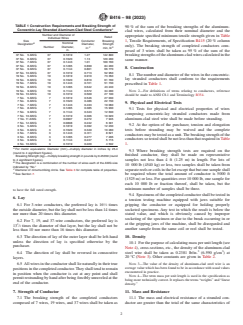
TABLE 1 Construction Requirements and Breaking Strength of
90 % of the sum of the breaking strengths of the aluminum-
A
Concentric-Lay Stranded Aluminum-Clad Steel Conductors
clad wires, calculated from their nominal diameter and the
Number and Diameter of
appropriate specified minimum tensile strength given in Table
Rated
Individual Wires
Size Conductor Breaking
1, Tensile Requirements, of Specification B415 (20 % column
B Nominal
Designation Diameter, Strength
only). The breaking strength of completed conductors com-
Number Diameter, C D
in. min, lb
in.
posed of 3 wires shall be taken as 95 % of the sum of the
37 No. 5 AWG 37 0.1819 1.27 142 800
breaking strengths of the aluminum-clad wires calculated in the
37 No. 6 AWG 37 0.1620 1.13 120 200
same manner.
37 No. 7 AWG 37 0.1443 1.01 100 700
37 No. 8 AWG 37 0.1285 0.899 84 200
8. Construction
37 No. 9 AWG 37 0.1144 0.801 66 770
37 No. 10 AWG 37 0.1019 0.713 52 950
8.1 The number and diameter of the wires in the concentric-
19 No. 5 AWG 19 0.1819 0.910 73 350
lay stranded conductors shall conform to the requirements
19 No. 6 AWG 19 0.1620 0.810 61 700
19 No. 7 AWG 19 0.1443 0.721 51 730
prescribed in Table 1.
19 No. 8 AWG 19 0.1285 0.642 43 240
19 No. 9 AWG 19 0.1144 0.572 34 290
NOTE 2—For definitions of terms relating to conductors, reference
19 No. 10 AWG 19 0.1019 0.509 27 190
should be made to ANSI C8.1 and Terminology B354.
7 No. 5 AWG 7 0.1819 0.546 27 030
7 No. 6 AWG 7 0.1620 0.486 22 730
9. Physical and Electrical Tests
7 No. 7 AWG 7 0.1443 0.433 19 060
7 No. 8 AWG 7 0.1285 0.385 15 930
9.1 Tests for physical and electrical properties of wires
7 No. 9 AWG 7 0.1144 0.343 12 630
composing concentric-lay stranded conductors made from
7 No. 10 AWG 7 0.1019 0.306 10 020
aluminum-clad steel wire shall be made before stranding.
7 No. 11 AWG 7 0.0907 0.272 7 945
7 No. 12 AWG 7 0.0808 0.242 6 301
9.2 At the option of the purchaser, tension and elongation
3 No. 5 AWG 3 0.1819 0.392 12 230
3 No. 6 AWG 3 0.1620 0.349 10 280 tests before stranding may be waived and the complete
3 No. 7 AWG 3 0.1443 0.311 8 621
conductors may be tested as a unit. The breaking strength of the
3 No. 8 AWG 3 0.1285 0.277 7 206
conductors so tested shall be not less than that required in Table
3 No. 9 AWG 3 0.1144 0.247 5 715
3 No. 10 AWG 3 0.1019 0.220 4 532
1.
A
For metric equivalents: Diameter (mm)—multiply diameter in inches by 25.4
9.3 Where breaking strength tests are required on the
(round to 4 significant figures).
finished conductor, they shall be made on representative
Breaking Strength (kg)—multiply breaking strength in pounds by 0.45359 (round
to 4 significant figures). samples not less than 4 ft (1.25 m) in length. For lots of
B
The designation is a combination of the number of wires each of the AWG size
10 000 lb (4540 kg) or less, two samples shall be taken from
indicated by “No.”
C
separate reels or coils in the lot except that but one sample shall
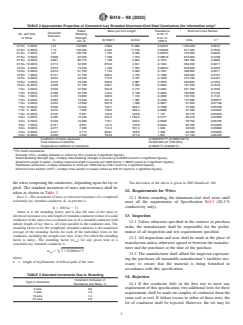
Diameter of circumscribing circle. See Table 3 for complete table of properties.
D
See Section 7.
be required where the total amount of conductor is 5000 ft
(1525 m) or less. For quantities over 10 000 lb, one sample for
each 10 000 lb or fraction thereof, shall be taken, but the
minimum number of samples shall be three.
to have the full rated strength.
9.4 Specimens of the completed conductor shall be tested in
6. Lay
a tension testing machine equipped with jaws suitable for
6.1 For 3-wire conductors, the preferred lay is 16 ⁄2 times gripping the conductor or equipped for holding properly
the outside diameter, but the lay shall not be less than 14 times socketed specimens. Any test in which the result is below the
nor more than 20 times this diameter. stated value, and which is obviously caused by improper
socketing of the specimen or due to the break occurring in or
6.2 For 7, 19, and 37-wire conductors, the preferred lay is
at the gripping jaws of the machine, shall be disregarded and
13 ⁄2 times the diameter of that layer, but the lay shall not be
another sample from the same coil or reel shall be tested.
less than 10 nor more
...