

ASTM B399/B399M-23
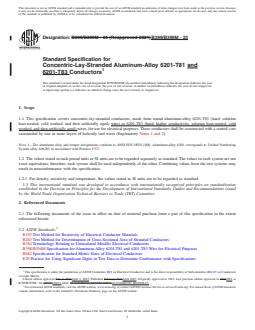
(Specification)Standard Specification for Concentric-Lay-Stranded Aluminum-Alloy 6201-T81 and 6201-T83 Conductors
General Information
- Abstract
ABSTRACT
This specification covers concentric-lay-stranded conductors, made from round aluminum-alloy 6201-T81 (hard: solution heat-treated, cold worked, and then artificially aged) wires, for use for electrical purposes. These conductors shall be constructed with a central core surrounded by one or more layers of helically laid wires. Conductors are classified as follows: Class AA (for bare conductors usually used in overhead lines) and Class A ( for conductors to be covered with weather resistant materials). The concentric-lay-stranded aluminum-alloy 6201 conductors sized to have diameter equal to ACSR, Class AA, and class A shall conform to the described construction requirements. The maximum electrical resistance of a unit length of stranded conductor shall not exceed the required nominal DC resistance. The concentric-lay-stranded aluminum-alloy 6201 conductors sized by standard areas, Class AA, and Class A shall conform to the described construction requirements. Minimum distance between joints in the complex and rating factors shall be described.
SCOPE
1.1 This specification covers concentric-lay-stranded conductors, made from round aluminum-alloy 6201-T81 (hard: solution heat-treated, cold worked, and then artificially aged) wires or 6201-T83 (hard: higher conductivity, solution heat-treated, cold worked, and then artificially aged) wires, for use for electrical purposes. These conductors shall be constructed with a central core surrounded by one or more layers of helically laid wires (Explanatory Notes 1 and 2).
Note 1: The aluminum alloy and temper designations conform to ANSI H35.1/H35.1[M]. Aluminum-alloy 6201 corresponds to Unified Numbering System alloy A96201 in accordance with Practice E527.
1.2 The values stated in inch-pound units or SI units are to be regarded separately as standard. The values in each system are not exact equivalents; therefore, each system shall be used independently of the other. Combining values from the two systems may result in nonconformance with the specification.
1.2.1 For density, resistivity and temperature, the values stated in SI units are to be regarded as standard.
1.3 This international standard was developed in accordance with internationally recognized principles on standardization established in the Decision on Principles for the Development of International Standards, Guides and Recommendations issued by the World Trade Organization Technical Barriers to Trade (TBT) Committee.
- Status
- Published
- Publication Date
- 31-Mar-2023
- Technical Committee
- B01 - Electrical Conductors
- Drafting Committee
- B01.07 - Conductors of Light Metals
Buy Documents
ASTM B399/B399M-23 - Standard Specification for Concentric-Lay-Stranded Aluminum-Alloy 6201-T81 and 6201-T83 Conductors
REDLINE ASTM B399/B399M-23 - Standard Specification for Concentric-Lay-Stranded Aluminum-Alloy 6201-T81 and 6201-T83 Conductors
Overview
ASTM B399/B399M-23 is the international specification for concentric-lay-stranded aluminum-alloy 6201-T81 and 6201-T83 conductors, published by ASTM International. This standard provides requirements for conductors manufactured from round aluminum-alloy 6201, in both T81 (standard strength and conductivity) and T83 (higher conductivity) tempers. These concentric-lay-stranded conductors are widely used for electrical purposes, primarily for power distribution and transmission in overhead lines and other electrical applications.
The document covers conductor construction, material properties, classification, and associated testing protocols to ensure quality and consistency. It applies to both bare and covered conductors, addressing the needs of both utility and industrial users seeking reliable, high-performance electrical conductors.
Key keywords: aluminum-alloy conductor, concentric-lay-stranded, 6201-T81, 6201-T83, ASTM B399/B399M, electrical conductor, overhead line, standard specification.
Key Topics
Material and Construction
- Specifies use of round aluminum-alloy 6201-T81 (solution heat-treated, cold worked, and artificially aged) and 6201-T83 (higher conductivity variant).
- Conductors built with a central core and one or more layers of helically laid wires.
Conductor Classification
- Class AA: For bare conductors, typically utilized in overhead distribution and transmission lines.
- Class A: For conductors intended to be covered with weather-resistant materials.
Dimensional Requirements
- Sizes match standard ACSR conductors for compatibility with existing fittings and accessories.
Electrical Performance
- Maximum electrical resistance per unit length must not exceed specified values.
- Requirements for cross-sectional area and rated strength.
Joints and Lay
- Strict regulations on the type and spacing of joints for mechanical integrity.
- Guidelines for lay length and direction, depending on classification and application.
Testing and Inspection
- Testing before stranding for mechanical and electrical properties.
- Optional tension and breaking strength tests available upon request.
Marking and Packaging
- Detailed requirements for marking, packaging, protection during shipping, and identification for traceability.
Applications
ASTM B399/B399M-23 conductors are essential components in the following areas:
Overhead Power Lines:
Utilized as the main electrical conductors in transmission and distribution networks, both for utilities and large-scale industrial facilities.Utility Infrastructure:
Employed in upgrading or replacing existing conductors due to compatibility with standard ACSR fittings and accessories.Covered and Insulated Conductors:
Class A conductors serve applications where additional protection against environmental exposure is needed via weather-resistant coverings.Renewable Energy:
Suitable for renewable integration points, such as wind and solar farm collection and distribution systems.
The standard’s requirements promote durability, consistent electrical performance, and compatibility with industry practices, providing assurance for utility companies, engineers, and contractors.
Related Standards
When implementing or referencing ASTM B399/B399M-23, several related standards ensure comprehensive compliance and compatibility:
- ASTM B193: Test Method for Resistivity of Electrical Conductor Materials
- ASTM B263: Test Method for Determination of Cross-Sectional Area of Stranded Conductors
- ASTM B354: Terminology Relating to Uninsulated Metallic Electrical Conductors
- ASTM B398/B398M: Specification for Aluminum-Alloy 6201-T81 and 6201-T83 Wire for Electrical Purposes
- ASTM B682: Specification for Standard Metric Sizes of Electrical Conductors
- ANSI H35.1/H35.1[M]: Alloy and Temper Designation for Aluminum
- NBS Handbook 100: Copper Wire Tables (referenced for comparative purposes)
By following ASTM B399/B399M-23 and its related references, users ensure high standards of safety, performance, and interchangeability for aluminum-alloy 6201 conductors in electrical systems.
Relations
- Effective Date
- 01-Jan-1997
- Refers
ASTM B682-01(2016) - Standard Specification for Standard Metric Sizes of Electrical Conductors - Effective Date
- 01-Oct-2016
- Effective Date
- 01-Sep-2016
- Effective Date
- 01-Apr-2016
- Effective Date
- 01-Apr-2014
- Effective Date
- 01-Apr-2014
- Effective Date
- 01-Apr-2013
- Effective Date
- 01-Dec-2012
- Effective Date
- 01-Oct-2010
- Refers
ASTM B682-01(2009)e1 - Standard Specification for Standard Metric Sizes of Electrical Conductors - Effective Date
- 01-Apr-2009
- Refers
ASTM B682-01(2009) - Standard Specification for Standard Metric Sizes of Electrical Conductors - Effective Date
- 01-Apr-2009
- Effective Date
- 01-Oct-2008
- Effective Date
- 01-Sep-2008
- Effective Date
- 01-Oct-2007
- Effective Date
- 15-Nov-2006
Buy Documents
ASTM B399/B399M-23 - Standard Specification for Concentric-Lay-Stranded Aluminum-Alloy 6201-T81 and 6201-T83 Conductors
REDLINE ASTM B399/B399M-23 - Standard Specification for Concentric-Lay-Stranded Aluminum-Alloy 6201-T81 and 6201-T83 Conductors
Get Certified
Connect with accredited certification bodies for this standard

IMQ S.p.A. (Certification)
Italian electrical product certification.

SLG Prüf- und Zertifizierungs GmbH
German testing and certification body.

UL Solutions
Global safety science company with testing, inspection and certification.
Sponsored listings
Frequently Asked Questions
ASTM B399/B399M-23 is a technical specification published by ASTM International. Its full title is "Standard Specification for Concentric-Lay-Stranded Aluminum-Alloy 6201-T81 and 6201-T83 Conductors". This standard covers: ABSTRACT This specification covers concentric-lay-stranded conductors, made from round aluminum-alloy 6201-T81 (hard: solution heat-treated, cold worked, and then artificially aged) wires, for use for electrical purposes. These conductors shall be constructed with a central core surrounded by one or more layers of helically laid wires. Conductors are classified as follows: Class AA (for bare conductors usually used in overhead lines) and Class A ( for conductors to be covered with weather resistant materials). The concentric-lay-stranded aluminum-alloy 6201 conductors sized to have diameter equal to ACSR, Class AA, and class A shall conform to the described construction requirements. The maximum electrical resistance of a unit length of stranded conductor shall not exceed the required nominal DC resistance. The concentric-lay-stranded aluminum-alloy 6201 conductors sized by standard areas, Class AA, and Class A shall conform to the described construction requirements. Minimum distance between joints in the complex and rating factors shall be described. SCOPE 1.1 This specification covers concentric-lay-stranded conductors, made from round aluminum-alloy 6201-T81 (hard: solution heat-treated, cold worked, and then artificially aged) wires or 6201-T83 (hard: higher conductivity, solution heat-treated, cold worked, and then artificially aged) wires, for use for electrical purposes. These conductors shall be constructed with a central core surrounded by one or more layers of helically laid wires (Explanatory Notes 1 and 2). Note 1: The aluminum alloy and temper designations conform to ANSI H35.1/H35.1[M]. Aluminum-alloy 6201 corresponds to Unified Numbering System alloy A96201 in accordance with Practice E527. 1.2 The values stated in inch-pound units or SI units are to be regarded separately as standard. The values in each system are not exact equivalents; therefore, each system shall be used independently of the other. Combining values from the two systems may result in nonconformance with the specification. 1.2.1 For density, resistivity and temperature, the values stated in SI units are to be regarded as standard. 1.3 This international standard was developed in accordance with internationally recognized principles on standardization established in the Decision on Principles for the Development of International Standards, Guides and Recommendations issued by the World Trade Organization Technical Barriers to Trade (TBT) Committee.
ABSTRACT This specification covers concentric-lay-stranded conductors, made from round aluminum-alloy 6201-T81 (hard: solution heat-treated, cold worked, and then artificially aged) wires, for use for electrical purposes. These conductors shall be constructed with a central core surrounded by one or more layers of helically laid wires. Conductors are classified as follows: Class AA (for bare conductors usually used in overhead lines) and Class A ( for conductors to be covered with weather resistant materials). The concentric-lay-stranded aluminum-alloy 6201 conductors sized to have diameter equal to ACSR, Class AA, and class A shall conform to the described construction requirements. The maximum electrical resistance of a unit length of stranded conductor shall not exceed the required nominal DC resistance. The concentric-lay-stranded aluminum-alloy 6201 conductors sized by standard areas, Class AA, and Class A shall conform to the described construction requirements. Minimum distance between joints in the complex and rating factors shall be described. SCOPE 1.1 This specification covers concentric-lay-stranded conductors, made from round aluminum-alloy 6201-T81 (hard: solution heat-treated, cold worked, and then artificially aged) wires or 6201-T83 (hard: higher conductivity, solution heat-treated, cold worked, and then artificially aged) wires, for use for electrical purposes. These conductors shall be constructed with a central core surrounded by one or more layers of helically laid wires (Explanatory Notes 1 and 2). Note 1: The aluminum alloy and temper designations conform to ANSI H35.1/H35.1[M]. Aluminum-alloy 6201 corresponds to Unified Numbering System alloy A96201 in accordance with Practice E527. 1.2 The values stated in inch-pound units or SI units are to be regarded separately as standard. The values in each system are not exact equivalents; therefore, each system shall be used independently of the other. Combining values from the two systems may result in nonconformance with the specification. 1.2.1 For density, resistivity and temperature, the values stated in SI units are to be regarded as standard. 1.3 This international standard was developed in accordance with internationally recognized principles on standardization established in the Decision on Principles for the Development of International Standards, Guides and Recommendations issued by the World Trade Organization Technical Barriers to Trade (TBT) Committee.
ASTM B399/B399M-23 is classified under the following ICS (International Classification for Standards) categories: 29.240.20 - Power transmission and distribution lines. The ICS classification helps identify the subject area and facilitates finding related standards.
ASTM B399/B399M-23 has the following relationships with other standards: It is inter standard links to ASTM B399M-97, ASTM B682-01(2016), ASTM B354-16, ASTM B193-16, ASTM B398/B398M-14, ASTM B193-02(2014), ASTM B398/B398M-02(2013), ASTM B354-12, ASTM B263-04(2010), ASTM B682-01(2009)e1, ASTM B682-01(2009), ASTM E29-08, ASTM B193-02(2008), ASTM B398/B398M-02(2007), ASTM E29-06b. Understanding these relationships helps ensure you are using the most current and applicable version of the standard.
ASTM B399/B399M-23 is available in PDF format for immediate download after purchase. The document can be added to your cart and obtained through the secure checkout process. Digital delivery ensures instant access to the complete standard document.
Standards Content (Sample)
This international standard was developed in accordance with internationally recognized principles on standardization established in the Decision on Principles for the
Development of International Standards, Guides and Recommendations issued by the World Trade Organization Technical Barriers to Trade (TBT) Committee.
Designation: B399/B399M − 23
Standard Specification for
Concentric-Lay-Stranded Aluminum-Alloy 6201-T81 and
6201-T83 Conductors
This standard is issued under the fixed designation B399/B399M; the number immediately following the designation indicates the year
of original adoption or, in the case of revision, the year of last revision. A number in parentheses indicates the year of last reapproval.
A superscript epsilon (´) indicates an editorial change since the last revision or reapproval.
1. Scope B193 Test Method for Resistivity of Electrical Conductor
Materials
1.1 This specification covers concentric-lay-stranded
B263 Test Method for Determination of Cross-Sectional
conductors, made from round aluminum-alloy 6201-T81 (hard:
Area of Stranded Conductors
solution heat-treated, cold worked, and then artificially aged)
B354 Terminology Relating to Uninsulated Metallic Electri-
wires or 6201-T83 (hard: higher conductivity, solution heat-
cal Conductors
treated, cold worked, and then artificially aged) wires, for use
B398/B398M Specification for Aluminum-Alloy 6201-T81
for electrical purposes. These conductors shall be constructed
and 6201-T83 Wire for Electrical Purposes
with a central core surrounded by one or more layers of
B682 Specification for Standard Metric Sizes of Electrical
helically laid wires (Explanatory Notes 1 and 2).
Conductors
NOTE 1—The aluminum alloy and temper designations conform to
E29 Practice for Using Significant Digits in Test Data to
ANSI H35.1/H35.1[M]. Aluminum-alloy 6201 corresponds to Unified
Determine Conformance with Specifications
Numbering System alloy A96201 in accordance with Practice E527.
E527 Practice for Numbering Metals and Alloys in the
1.2 The values stated in inch-pound units or SI units are to
Unified Numbering System (UNS)
be regarded separately as standard. The values in each system
2.3 ANSI Standards:
are not exact equivalents; therefore, each system shall be used
ANSI H35.1 American National Standard for Alloy and
independently of the other. Combining values from the two
Temper Designation Systems for Aluminum
systems may result in nonconformance with the specification.
ANSI H35.1[M] American National Standard Alloy and
1.2.1 For density, resistivity and temperature, the values
Temper Designation Systems for Aluminum [Metric]
stated in SI units are to be regarded as standard.
2.4 NIST Standards:
1.3 This international standard was developed in accor-
NBS Handbook 100 Copper Wire Tables of the National
dance with internationally recognized principles on standard-
Bureau of Standards
ization established in the Decision on Principles for the 2.5 Aluminum Association Publication:
Development of International Standards, Guides and Recom-
Publication 50 Code Words for Overhead Aluminum Elec-
mendations issued by the World Trade Organization Technical trical Conductors
Barriers to Trade (TBT) Committee.
3. Classification
2. Referenced Documents 3.1 For the purpose of this specification, conductors are
classified as follows (Explanatory Notes 1 and 2):
2.1 The following documents of the issue in effect on date
3.1.1 Class AA—For bare conductors usually used in over-
of material purchase form a part of this specification to the
head lines.
extent referenced herein:
3.1.2 Class A—For conductors to be covered with weather-
2.2 ASTM Standards:
resistant materials.
4. Ordering Information
This specification is under the jurisdiction of ASTM Committee B01 on 4.1 Orders for material under this specification shall include
Electrical Conductors and is the direct responsibility of Subcommittee B01.07 on
the following information:
Conductors of Light Metals.
Current edition approved April 1, 2023. Published April 2023. Originally
approved in 1963. Last previous edition approved in 2021 as B399/B399M – 04 Available from American National Standards Institute (ANSI), 25 W. 43rd St.,
(2021). DOI: 10.1520/B0399_B0399M-23. 4th Floor, New York, NY 10036, http://www.ansi.org.
2 4
For referenced ASTM standards, visit the ASTM website, www.astm.org, or Available from National Institute of Standards and Technology (NIST), 100
contact ASTM Customer Service at service@astm.org. For Annual Book of ASTM Bureau Dr., Stop 1070, Gaithersburg, MD 20899-1070, http://www.nist.gov.
Standards volume information, refer to the standard’s Document Summary page on Available from Aluminum Association, Inc., 1525 Wilson Blvd., Suite 600,
the ASTM website. Arlington, VA 22209, http://www.aluminum.org.
Copyright © ASTM International, 100 Barr Harbor Drive, PO Box C700, West Conshohocken, PA 19428-2959. United States
B399/B399M − 23
4.1.1 Quantity of each size, stranding, and class, in the six outer finished wires; no joints are permitted in the
4.1.2 Conductor size, area, and aluminum 1350 equivalent center wire. In other conductors, cold-pressure welds, electric-
size (if required) (Section 8 and Table 1, Table 2, or Table 3),
butt, cold-upset welds, or electric-butt welds may be made in
4.1.3 Number of wires (Table 1, Table 2 or Table 3), the finished wires composing conductors, but such joints shall
4.1.4 Direction of lay of outer layer of aluminum wires if
be not closer than prescribed in Table 4. Following welding,
other than right-hand (see 7.4),
electric-butt welds shall be annealed for a distance of at least
4.1.5 Compressed stranding, if required (see 8.2),
6 in. [150 mm] on each side of the weld.
4.1.6 Special tension test, if required (see 9.2 and 14.2),
4.1.7 Place of inspection (see 15.2),
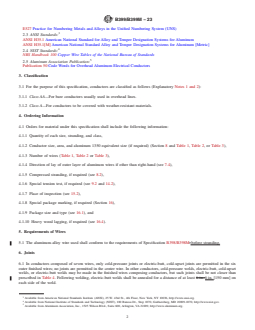
7. Lay
4.1.8 Special package marking, if required (Section 16),
7.1 For Class AA conductors, the length of lay of a layer of
4.1.9 Package size and type (see 16.1), and
wires shall not be less than 10 nor more than 16 times the
4.1.10 Heavy wood lagging, if required (see 16.4).
outside diameter of that layer. The length of lay of any
5. Requirements of Wires aluminum-alloy layer shall not be less than the length of lay of
the aluminum-alloy layer immediately beneath it.
5.1 The aluminum-alloy wire used shall conform to the
requirements of Specification B398/B398M before stranding.
7.2 For Class A conductors, the length of lay of a layer of
wires shall not be less than 8 nor more than 16 times the
6. Joints
outside diameter of that layer, except that for conductors
6.1 In conductors composed of seven wires, only cold- composed of 37 wires or more, this requirement shall apply
pressure joints or electric-butt, cold-upset joints are permitted only to the two outer layers. The length of lay of the layers
TABLE 1 Construction Requirements of Concentric-Lay-Stranded Aluminum-Alloy 6201 Conductors Sized to Have Diameter Equal to
ACSR, Class AA and Class A
NOTE 1—Metric values listed below represent a soft conversion and as such they may not be the same as those metric masses which are calculated
from the basic metric density.
Approximate
Aluminum 1350 Size and Stranding Nominal dc
Conductor Code Rated
Size Having of ACSR with Required Construction Mass Resistance
A
Size Words Strength
Equivalent Equal Diameter at 20 °C
Resistance
Diameter
Number
Size
Strand- lb per kg per ohm per ohm per
2 B 2
of Wires
cmil mm cmil AWG mm of Class kips kN
ing 1000 ft km 1000 ft km
B 2
Wires
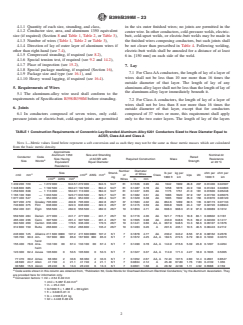
cmil AWG mm in. mm
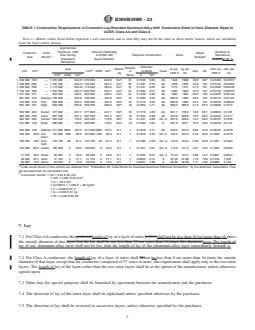
1 439 200 729 — 1 272 000 . . . 644.51 272 000 . . . 644.5 54/7 61 0.1536 3.90 AA 1342 1999 46.8 207 0.01400 0.04597
1 348 800 685 — 1 192 500 . . . 604.21 192 500 . . . 604.2 54/7 61 0.1487 3.78 AA 1258 1878 43.9 194 0.01494 0.04893
1 259 600 638 — 1 113 000 . . . 564.0 1 113 000 . . . 564.0 54/7 61 0.1437 3.65 AA 1175 1751 41.0 181 0.01600 0.05248
1 165 100 590 — 1 033 500 . . . 523.71 033 500 . . . 523.7 54/7 61 0.1382 3.51 AA 1086 1620 37.9 167 0.01730 0.05675
1 077 400 547 — 954 000 . . . 483.4 954 000 . . . 483.4 54/7 61 0.1329 3.38 AA 1005 1502 35.0 156 0.01870 0.06120
927 200 470 Greeley 795 000 . . . 402.8 795 000 . . . 402.8 26/7 37 0.1583 4.02 AA 864.6 1289 30.5 135 0.02173 0.07133
740 800 375 Flint 636 000 . . . 322.3 636 000 . . . 322.3 26/7 37 0.1415 3.59 AA 690.8 1028 24.4 107 0.02720 0.08944
652 400 331 Elgin 556 500 . . . 282.0 556 500 . . . 282.0 26/7 19 0.1853 4.71 AA 608.3 908.3 21.9 97.0 0.03089 0.1012
559 500 284 Darien 477 000 . . . 241.7 477 000 . . . 241.7 26/7 19 0.1716 4.36 AA 521.7 778.3 18.8 83.1 0.03602 0.1181
465 400 236 Cairo 397 500 . . . 201.4 397 500 . . . 201.4 26/7 19 0.1565 3.98 AA 433.9 648.6 15.6 69.2 0.04330 0.1417
394 500 200 Canton 336 400 . . . 170.5 336 400 . . . 170.5 26/7 19 0.1441 3.66 AA, A 367.9 548.5 13.3 58.6 0.05107 0.1676
312 800 159 Butte 266 800 . . . 135.2 266 800 . . . 135.2 26/7 19 0.1283 3.26 A 291.6 435.1 10.5 46.5 0.06443 0.2112
246 900 125 Alliance 211 600 0000 107.2 211 600 0000 107.2 6/1 7 0.1878 4.77 AA 230.2 343.2 8.56 37.8 0.08162 0.2678
195 700 99.3 Am- 167 800 000 85.0 167 800 000 85.0 6/1 7 0.1672 4.25 AA, A 182.5 272.5 6.79 30.0 0.1030 0.3373
herst
155 400 78.6 Ana- 133 100 00 67.4 133 100 00 67.4 6/1 7 0.1490 3.78 AA, A 144.9 215.6 5.39 23.8 0.1297 0.4264
heim
123 300 62.4 Azusa 105 600 0 53.5 105 600 0 53.5 6/1 7 0.1327 3.37 AA, A 114.9 171.3 4.27 18.9 0.1635 0.5365
77 470 39.2 Ames 66 360 2 33.6 66 360 2 33.6 6/1 7 0.1052 2.67 AA, A 72.24 107.5 2.80 12.4 0.2601 0.8547
48 690 24.7 Alton 41 740 4 21.1 41 740 4 21.1 6/1 7 0.0834 2.12 A 45.40 67.80 1.76 7.83 0.4139 1.356
30 580 15.5 Akron 26 240 6 13.3 26 240 6 13.3 6/1 7 0.0661 1.68 A 28.52 42.58 1.11 4.92 0.6588 2.159
A
Code words shown in this column are obtained from, “Publication 50, Code Words for Overhead Aluminum Electrical Conductors,” by the Aluminum Association. They
are provided here for information only.
B
Conversion factors: 1 mil = 2.54 E-02 mm
1 cmil = 5.067 E-04 mm
1 in. = 25.4 mm
1 lb/1000 ft = 1.488 E + 00 kg/km
1 ft = 3.048 E-01 m
1 lb = 4.536 E-01 kg
1 lbf = 4.448 E-03 kN
B399/B399M − 23
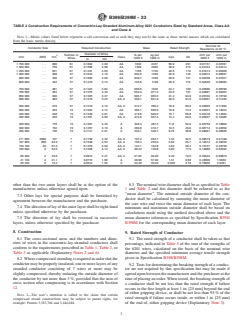
TABLE 2 Construction Requirements of Concentric-Lay-Stranded Aluminum-Alloy 6201 Conductors Sized by Standard Areas, Class AA
and Class A
NOTE 1—Metric values listed below represent a soft conversion and as such they may not be the same as those metric masses which are calculated
from the basic metric density.
Nominal dc
Conductor Size Required Construction Mass Rated Strength
Resistance at 20 °C
Diameter of Wires
Number of lb per kg per ohm per ohm per
cmil AWG mm Class kips kN
Wires 1000 ft 1000 m 1000 ft 1000 m
in. mm
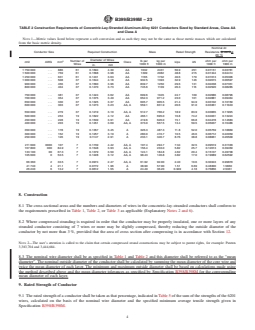
1 750 000 . . . 886 61 0.1694 4.30 AA 1632 2431 56.9 251 0.01151 0.03781
1 500 000 . . . 759 61 0.1568 3.98 AA 1399 2082 48.8 215 0.01344 0.04414
1 250 000 . . . 631 61 0.1431 3.63 AA 1165 1732 40.6 179 0.01613 0.05306
1 000 000 . . . 508 37 0.1644 4.18 AA 932.5 1393 32.9 146 0.02015 0.06597
900 000 . . . 456 37 0.1560 3.96 AA 839.7 1250 29.6 131 0.02238 0.07351
800 000 . . . 404 37 0.1470 3.73 AA 745.6 1109 26.3 116 0.02520 0.08285
750 000 . . . 381 37 0.1424 3.62 AA 699.6 1045 24.7 109 0.02686 0.08796
700 000 . . . 354 37 0.1375 3.49 AA 652.3 971.2 23.0 101 0.02881 0.09464
650 000 . . . 330 37 0.1325 3.37 AA 605.7 905.5 21.4 94.9 0.03102 0.10150
600 000 . . . 303 37 0.1273 3.23 AA, A 559.1 831.9 20.6 91.0 0.03361 0.11049
550 000 . . . 279 37 0.1219 3.10 AA, A 512.7 766.2 18.9 83.9 0.03665 0.11995
500 000 . . . 253 19 0.1622 4.12 AA 466.1 695.0 16.8 74.2 0.04031 0.13224
450 000 . . . 228 19 0.1539 3.91 AA 419.6 626.0 15.1 66.8 0.04478 0.14683
400 000 . . . 203 19 0.1451 3.69 AA, A 373.0 557.5 13.4 59.5 0.05037 0.16486
350 000 . . . 178 19 0.1357 3.45 A 326.3 487.3 11.8 52.0 0.05759 0.18860
300 000 . . . 152 19 0.1257 3.19 A 280.0 416.7 10.5 46.6 0.06712 0.22059
250 000 . . . 126 19 0.1147 2.91 A 233.1 346.7 8.76 38.8 0.08061 0.26509
211 600 0000 107 7 0.1739 4.42 AA, A 197.4 294.7 7.34 32.5 0.09519 0.31188
167 800 000 84.9 7 0.1548 3.93 AA, A 156.4 233.0 5.82 25.7 0.12013 0.39450
133 100 00 67.3 7 0.1379 3.50 AA, A 124.1 184.8 4.62 20.4 0.15137 0.49738
105 600 0 53.5 7 0.1228 3.12 AA, A 98.43 146.8 3.82 17.0 0.19089 0.62592
66 360 2 33.5 7 0.0974 2.47 AA, A 61.92 92.00 2.40 10.6 0.30343 0.99870
41 740 4 21.1 7 0.0772 1.96 A 38.90 57.90 1.51 6.69 0.48300 1.5860
26 240 6 13.2 7 0.0612 1.55 A 24.49 36.20 0.949 4.18 0.76856 2.5361
other than the two outer layers shall be at the option of the 8.3 The nominal wire diameter shall be as specified in Table
manufacturer, unless otherwise agreed upon. 1 and Table 2 and this diameter shall be referred to as the
“mean diameter”. The nominal outside diameter of the con-
7.3 Other lays for special purposes shall be furnished by
ductor shall be calculated by summing the mean diameter of
agreement between the manufacturer and the purchaser.
the core wire and twice the mean diameter of each layer. The
7.4 The direction of lay of the outer layer shall be right-hand
minimum and maximum outside diameter shall be based on
unless specified otherwise by the purchaser.
calculations made using the method described above and the
mean diameter tolerances as specified by Specification B398/
7.5 The direction of lay shall be reversed in successive
layers, unless otherwise specified by the purchaser. B398M for the corresponding mean diameter of each layer.
8. Construction
9. Rated Strength of Conductor
8.1 The cross-sectional areas and the numbers and diam-
9.1 The rated strength of a conductor shall be taken as that
eters of wires in the concentric-lay-stranded conductors shall
percentage, indicated in Table 5 of the sum of the strengths of
conform to the requirements prescribed in Table 1, Ta
...
This document is not an ASTM standard and is intended only to provide the user of an ASTM standard an indication of what changes have been made to the previous version. Because
it may not be technically possible to adequately depict all changes accurately, ASTM recommends that users consult prior editions as appropriate. In all cases only the current version
of the standard as published by ASTM is to be considered the official document.
Designation: B399/B399M − 04 (Reapproved 2021) B399/B399M − 23
Standard Specification for
Concentric-Lay-Stranded Aluminum-Alloy 6201-T81 and
6201-T83 Conductors
This standard is issued under the fixed designation B399/B399M; the number immediately following the designation indicates the year
of original adoption or, in the case of revision, the year of last revision. A number in parentheses indicates the year of last reapproval.
A superscript epsilon (´) indicates an editorial change since the last revision or reapproval.
1. Scope
1.1 This specification covers concentric-lay-stranded conductors, made from round aluminum-alloy 6201-T81 (hard: solution
heat-treated, cold worked, and then artificially aged) wires or 6201-T83 (hard: higher conductivity, solution heat-treated, cold
worked, and then artificially aged) wires, for use for electrical purposes. These conductors shall be constructed with a central core
surrounded by one or more layers of helically laid wires (Explanatory Notes 1 and 2).
NOTE 1—The aluminum alloy and temper designations conform to ANSI H35.1/H35.1[M]. Aluminum-alloy 6201 corresponds to Unified Numbering
System alloy A96201 in accordance with Practice E527.
1.2 The values stated in inch-pound units or SI units are to be regarded separately as standard. The values in each system are not
exact equivalents; therefore, each system shall be used independently of the other. Combining values from the two systems may
result in nonconformance with the specification.
1.2.1 For density, resistivity and temperature, the values stated in SI units are to be regarded as standard.
1.3 This international standard was developed in accordance with internationally recognized principles on standardization
established in the Decision on Principles for the Development of International Standards, Guides and Recommendations issued
by the World Trade Organization Technical Barriers to Trade (TBT) Committee.
2. Referenced Documents
2.1 The following documents of the issue in effect on date of material purchase form a part of this specification to the extent
referenced herein:
2.2 ASTM Standards:
B193 Test Method for Resistivity of Electrical Conductor Materials
B263 Test Method for Determination of Cross-Sectional Area of Stranded Conductors
B354 Terminology Relating to Uninsulated Metallic Electrical Conductors
B398/B398M Specification for Aluminum-Alloy 6201-T81 and 6201-T83 Wire for Electrical Purposes
B682 Specification for Standard Metric Sizes of Electrical Conductors
E29 Practice for Using Significant Digits in Test Data to Determine Conformance with Specifications
This specification is under the jurisdiction of ASTM Committee B01 on Electrical Conductors and is the direct responsibility of Subcommittee B01.07 on Conductors
of Light Metals.
Current edition approved Feb. 1, 2021April 1, 2023. Published February 2021April 2023. Originally approved in 1963. Last previous edition approved in 20152021 as
B399/B399M – 04 (2015).(2021). DOI: 10.1520/B0399_B0399M-04R21.10.1520/B0399_B0399M-23.
For referenced ASTM standards, visit the ASTM website, www.astm.org, or contact ASTM Customer Service at service@astm.org. For Annual Book of ASTM Standards
volume information, refer to the standard’s Document Summary page on the ASTM website.
Copyright © ASTM International, 100 Barr Harbor Drive, PO Box C700, West Conshohocken, PA 19428-2959. United States
B399/B399M − 23
E527 Practice for Numbering Metals and Alloys in the Unified Numbering System (UNS)
2.3 ANSI Standards:
ANSI H35.1 American National Standard for Alloy and Temper Designation Systems for Aluminum
ANSI H35.1[M] American National Standard Alloy and Temper Designation Systems for Aluminum [Metric]
2.4 NIST Standards:
NBS Handbook 100 Copper Wire Tables of the National Bureau of Standards
2.5 Aluminum Association Publication:
Publication 50 Code Words for Overhead Aluminum Electrical Conductors
3. Classification
3.1 For the purpose of this specification, conductors are classified as follows (Explanatory Notes 1 and 2):
3.1.1 Class AA—For bare conductors usually used in overhead lines.
3.1.2 Class A—For conductors to be covered with weather-resistant materials.
4. Ordering Information
4.1 Orders for material under this specification shall include the following information:
4.1.1 Quantity of each size, stranding, and class,
4.1.2 Conductor size, area, and aluminum 1350 equivalent size (if required) (Section 8 and Table 1, Table 2, or Table 3),
4.1.3 Number of wires (Table 1, Table 2 or Table 3),
4.1.4 Direction of lay of outer layer of aluminum wires if other than right-hand (see 7.4),
4.1.5 Compressed stranding, if required (see 8.2),
4.1.6 Special tension test, if required (see 9.2 and 14.2),
4.1.7 Place of inspection (see 15.2),
4.1.8 Special package marking, if required (Section 16),
4.1.9 Package size and type (see 16.1), and
4.1.10 Heavy wood lagging, if required (see 16.4).
5. Requirements of Wires
5.1 The aluminum-alloy wire used shall conform to the requirements of Specification B398/B398M. before stranding.
6. Joints
6.1 In conductors composed of seven wires, only cold-pressure joints or electric-butt, cold-upset joints are permitted in the six
outer finished wires; no joints are permitted in the center wire. In other conductors, cold-pressure welds, electric-butt, cold-upset
welds, or electric-butt welds may be made in the finished wires composing conductors, but such joints shall be not closer than
prescribed in Table 4. Following welding, electric-butt welds shall be annealed for a distance of at least 6 in. 6 in. [150 mm] on
each side of the weld.
Available from American National Standards Institute (ANSI), 25 W. 43rd St., 4th Floor, New York, NY 10036, http://www.ansi.org.
Available from National Institute of Standards and Technology (NIST), 100 Bureau Dr., Stop 1070, Gaithersburg, MD 20899-1070, http://www.nist.gov.
Available from Aluminum Association, Inc., 1525 Wilson Blvd., Suite 600, Arlington, VA 22209, http://www.aluminum.org.
B399/B399M − 23
TABLE 1 Construction Requirements of Concentric-Lay-Stranded Aluminum-Alloy 6201 Conductors Sized to Have Diameter Equal to
ACSR, Class AA and Class A
NOTE 1—Metric values listed below represent a soft conversion and as such they may not be the same as those metric masses which are calculated
from the basic metric density.
Approximate
Aluminum 1350 Size and Stranding Nominal dc
Conductor Code Rated
Size Having of ACSR with Required Construction Mass Resistance
A
Size Words Strength
Equivalent Equal Diameter @ 20°Cat 20 °C
Resistance
Diameter
Number
Size
Strand- lb per kg per ohm per ohm per
2 B 2
of Wires
cmil mm cmil AWG mm of Class kips kN
ing 1000 ft km 1000 ft km
B 2
Wires
cmil AWG mm in. mm
1 439 200 729 — 1 272 000 . . . 644.51 272 000 . . . 644.5 54/7 61 0.1536 3.90 AA 1342 1999 46.8 207 0.01400 0.04597
1 348 800 685 — 1 192 500 . . . 604.21 192 500 . . . 604.2 54/7 61 0.1487 3.78 AA 1258 1878 43.9 194 0.01494 0.04893
1 259 600 638 — 1 113 000 . . . 564.0 1 113 000 . . . 564.0 54/7 61 0.1437 3.65 AA 1175 1751 41.0 181 0.01600 0.05248
1 165 100 590 — 1 033 500 . . . 523.71 033 500 . . . 523.7 54/7 61 0.1382 3.51 AA 1086 1620 37.9 167 0.01730 0.05675
1 077 400 547 — 954 000 . . . 483.4 954 000 . . . 483.4 54/7 61 0.1329 3.38 AA 1005 1502 35.0 156 0.01870 0.06120
927 200 470 Greeley 795 000 . . . 402.8 795 000 . . . 402.8 26/7 37 0.1583 4.02 AA 864.6 1289 30.5 135 0.02173 0.07133
740 800 375 Flint 636 000 . . . 322.3 636 000 . . . 322.3 26/7 37 0.1415 3.59 AA 690.8 1028 24.4 107 0.02720 0.08944
652 400 331 Elgin 556 500 . . . 282.0 556 500 . . . 282.0 26/7 19 0.1853 4.71 AA 608.3 908.3 21.9 97.0 0.03089 0.1012
559 500 284 Darien 477 000 . . . 241.7 477 000 . . . 241.7 26/7 19 0.1716 4.36 AA 521.7 778.3 18.8 83.1 0.03602 0.1181
465 400 236 Cairo 397 500 . . . 201.4 397 500 . . . 201.4 26/7 19 0.1565 3.98 AA 433.9 648.6 15.6 69.2 0.04330 0.1417
394 500 200 Canton 336 400 . . . 170.5 336 400 . . . 170.5 26/7 19 0.1441 3.66 AA, A 367.9 548.5 13.3 58.6 0.05107 0.1676
312 800 159 Butte 266 800 . . . 135.2 266 800 . . . 135.2 26/7 19 0.1283 3.26 A 291.6 435.1 10.5 46.5 0.06443 0.2112
246 900 125 Alliance 211 600 0000 107.2 211 600 0000 107.2 6/1 7 0.1878 4.77 AA 230.2 343.2 8.56 37.8 0.08162 0.2678
195 700 99.3 Am- 167 800 000 85.0 167 800 000 85.0 6/1 7 0.1672 4.25 AA, A 182.5 272.5 6.79 30.0 0.1030 0.3373
herst
155 400 78.6 Ana- 133 100 00 67.4 133 100 00 67.4 6/1 7 0.1490 3.78 AA, A 144.9 215.6 5.39 23.8 0.1297 0.4264
heim
123 300 62.4 Azusa 105 600 0 53.5 105 600 0 53.5 6/1 7 0.1327 3.37 AA, A 114.9 171.3 4.27 18.9 0.1635 0.5365
77 470 39.2 Ames 66 360 2 33.6 66 360 2 33.6 6/1 7 0.1052 2.67 AA, A 72.24 107.5 2.80 12.4 0.2601 0.8547
48 690 24.7 Alton 41 740 4 21.1 41 740 4 21.1 6/1 7 0.0834 2.12 A 45.40 67.80 1.76 7.83 0.4139 1.356
30 580 15.5 Akron 26 240 6 13.3 26 240 6 13.3 6/1 7 0.0661 1.68 A 28.52 42.58 1.11 4.92 0.6588 2.159
A
Code words shown in this column are obtained from, “Publication 50, Code Words for Overhead Aluminum Electrical Conductors,” by the Aluminum Association. They
are provided here for information only.
B
Conversion factors: 1 mil = 2.54 E-02 mm
1 cmil = 5.067 E-04 mm
1 in. = 25.4 mm
1 lb/1000 ft = 1.488 E + 00 kg/km
1 ft = 3.048 E-01 m
1 lb = 4.536 E-01 kg
1 lbf = 4.448 E-03 kN
7. Lay
7.1 For Class AA conductors, the preferred length of lay of a layer of wires is 13.5 shall not be less than 10 nor more than 16 times
the outside diameter of that layer, but the lay shall be not less than 10 nor more than 16 times this diameter.layer. The length of
lay of any aluminum-alloy layer shall not be less than the length of lay of the aluminum-alloy layer immediately beneath it.
7.2 For Class A conductors, the length of lay of a layer of wires shall be not be less than 8 nor more than 16 times the outside
diameter of that layer, except that for conductors composed of 37 wires or more, this requirement shall apply only to the two outer
layers. The length of lay of the layers other than the two outer layers shall be at the option of the manufacturer, unless otherwise
agreed upon.
7.3 Other lays for special purposes shall be furnished by agreement between the manufacturer and the purchaser.
7.4 The direction of lay of the outer layer shall be right-hand unless specified otherwise by the purchaser.
7.5 The direction of lay shall be reversed in successive layers, unless otherwise specified by the purchaser.
B399/B399M − 23
TABLE 2 Construction Requirements of Concentric-Lay-Stranded Aluminum-Alloy 6201 Conductors Sized by Standard Areas, Class AA
and Class A
NOTE 1—Metric values listed below represent a soft conversion and as such they may not be the same as those metric masses which are calculated
from the basic metric density.
Nominal dc
Conductor Size Required Construction Mass Rated Strength Resistance @ 20°Cat
20 °C
Diameter of Wires
Number of lb per kg per ohm per ohm per
cmil AWG mm Class kips kN
Wires 1000 ft 1000 m 1000 ft 1000 m
in. mm
1 750 000 . . . 886 61 0.1694 4.30 AA 1632 2431 56.9 251 0.01151 0.03781
1 500 000 . . . 759 61 0.1568 3.98 AA 1399 2082 48.8 215 0.01344 0.04414
1 250 000 . . . 631 61 0.1431 3.63 AA 1165 1732 40.6 179 0.01613 0.05306
1 000 000 . . . 508 37 0.1644 4.18 AA 932.5 1393 32.9 146 0.02015 0.06597
900 000 . . . 456 37 0.1560 3.96 AA 839.7 1250 29.6 131 0.02238 0.07351
800 000 . . . 404 37 0.1470 3.73 AA 745.6 1109 26.3 116 0.02520 0.08285
750 000 . . . 381 37 0.1424 3.62 AA 699.6 1045 24.7 109 0.02686 0.08796
700 000 . . . 354 37 0.1375 3.49 AA 652.3 971.2 23.0 101 0.02881 0.09464
650 000 . . . 330 37 0.1325 3.37 AA 605.7 905.5 21.4 94.9 0.03102 0.10150
600 000 . . . 303 37 0.1273 3.23 AA, A 559.1 831.9 20.6 91.0 0.03361 0.11049
550 000 . . . 279 37 0.1219 3.10 AA, A 512.7 766.2 18.9 83.9 0.03665 0.11995
500 000 . . . 253 19 0.1622 4.12 AA 466.1 695.0 16.8 74.2 0.04031 0.13224
450 000 . . . 228 19 0.1539 3.91 AA 419.6 626.0 15.1 66.8 0.04478 0.14683
400 000 . . . 203 19 0.1451 3.69 AA, A 373.0 557.5 13.4 59.5 0.05037 0.16486
350 000 . . . 178 19 0.1357 3.45 A 326.3 487.3 11.8 52.0 0.05759 0.18860
300 000 . . . 152 19 0.1257 3.19 A 280.0 416.7 10.5 46.6 0.06712 0.22059
250 000 . . . 126 19 0.1147 2.91 A 233.1 346.7 8.76 38.8 0.08061 0.26509
211 600 0000 107 7 0.1739 4.42 AA, A 197.4 294.7 7.34 32.5 0.09519 0.31188
167 800 000 84.9 7 0.1548 3.93 AA, A 156.4 233.0 5.82 25.7 0.12013 0.39450
133 100 00 67.3 7 0.1379 3.50 AA, A 124.1 184.8 4.62 20.4 0.15137 0.49738
105 600 0 53.5 7 0.1228 3.12 AA, A 98.43 146.8 3.82 17.0 0.19089 0.62592
66 360 2 33.5 7 0.0974 2.47 AA, A 61.92 92.00 2.40 10.6 0.30343 0.99870
41 740 4 21.1 7 0.0772 1.96 A 38.90 57.90 1.51 6.69 0.48300 1.5860
26 240 6 13.2 7 0.0612 1.55 A 24.49 36.20 0.949 4.18 0.76856 2.5361
8. Construction
8.1 The cross-sectional areas and the numbers and diameters of wires in the concentric-lay-stranded conductors shall conform to
the requirements prescribed in Table 1, Table 2, or Table 3 as applicable (Explanatory Notes 2 and 6).
8.2 Where compressed stranding is required in order that the conductor may be properly insulated, one or more layers of any
stranded conductor consisting of 7 wires or more may be slightly compressed, thereby reducing the outside diameter of the
conductor by not more than 3 %, provided that the area of cross section after compressing is in accordance with Section 12.
NOTE 2—The user’s attention is called to the claim that certain compressed strand constructions may be subject to patent rights, for example: Patents
3,
...