

ASTM D6810-22
(Test Method)Standard Test Method for Measurement of Hindered Phenolic Antioxidant Content in Non-Zinc Turbine Oils by Linear Sweep Voltammetry
General Information
- Abstract
SIGNIFICANCE AND USE
5.1 The quantitative determination of hindered phenol antioxidants in a new turbine oil measures the amount of this material that has been added to the oil as protection against oxidation. Beside phenols, turbine oils can be formulated with other antioxidants such as amines which can extend the oil life. In used oil, the determination measures the amount of original (phenolic) antioxidant remaining after oxidation have reduced its initial concentration. This test method is not designed or intended to detect all of the antioxidant intermediates formed during the thermal and oxidative stressing of the oils, which are recognized as having some contribution to the remaining useful life of the used or in-service oil. Nor does it measure the overall stability of an oil, which is determined by the total contribution of all species present. Before making final judgment on the remaining useful life of the used oil, which might result in the replacement of the oil reservoir, it is advised to perform additional analytical techniques (in accordance with Practices D6224 and D4378), having the capability of measuring remaining oxidative life of the used oil.
5.1.1 This test method is applicable to non-zinc turbine oils. These are refined mineral oils containing rust and oxidation inhibitors, but not antiwear additives. This test method has not yet been established with sufficient precision for antiwear oils.
5.2 This test method is also suitable for manufacturing control and specification acceptance.
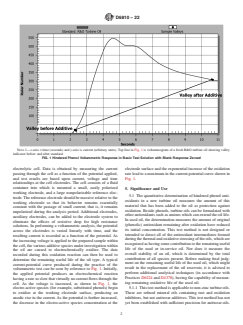
5.3 When a voltammetric analysis is obtained for a turbine oil inhibited with a typical hindered phenol antioxidant, there is an increase in the current of the produced voltammogram between 3 s to 5 s (or 0.3 V to 0.6 V applied voltage) (see Note 1) in the basic test solution (Fig. 1—x-axis 1 second = 0.1 V). Hindered phenol antioxidants detected by voltammetric analysis include, but are not limited to, 2,6-di-tert-butyl-4-methylphenol; 2,6-di-tert-butylphenol and 4,4'-meth...
SCOPE
1.1 This test method covers the voltammetric determination of hindered phenol antioxidants in new or in-service non-zinc turbine oils in concentrations from 0.0075 % by weight up to concentrations found in new oils by measuring the amount of current flow at a specified voltage in the produced voltammogram.
1.2 The values stated in SI units are to be regarded as standard. No other units of measurement are included in this standard.
1.3 This standard does not purport to address all of the safety concerns, if any, associated with its use. It is the responsibility of the user of this standard to establish appropriate safety, health, and environmental practices and determine the applicability of regulatory limitations prior to use.
1.4 This international standard was developed in accordance with internationally recognized principles on standardization established in the Decision on Principles for the Development of International Standards, Guides and Recommendations issued by the World Trade Organization Technical Barriers to Trade (TBT) Committee.
- Status
- Published
- Publication Date
- 30-Jun-2022
- Technical Committee
- D02 - Petroleum Products, Liquid Fuels, and Lubricants
- Drafting Committee
- D02.09.0C - Oxidation of Turbine Oils
Buy Documents
ASTM D6810-22 - Standard Test Method for Measurement of Hindered Phenolic Antioxidant Content in Non-Zinc Turbine Oils by Linear Sweep Voltammetry
REDLINE ASTM D6810-22 - Standard Test Method for Measurement of Hindered Phenolic Antioxidant Content in Non-Zinc Turbine Oils by Linear Sweep Voltammetry
Overview
ASTM D6810-22 is a widely recognized standard that defines the procedure for the determination of hindered phenolic antioxidant content in non-zinc turbine oils using linear sweep voltammetry. This method facilitates the quantitative measurement of phenolic antioxidants to assess both new and in-service oil conditions. Accurate antioxidant content measurement is a critical factor in predicting turbine oil life, optimizing maintenance intervals, and ensuring the reliable performance of turbine equipment.
The standard is specifically applicable to non-zinc turbine oils-refined mineral oils containing rust and oxidation inhibitors but no antiwear additives. It is suitable for both fresh oils (to verify additive levels at manufacture) and used oils (to monitor antioxidant depletion during service).
Key Topics
- Hindered Phenolic Antioxidants in Turbine Oils: Hindered phenols are key oxidation inhibitors that prolong the operational life of turbine oils by protecting against oxidative degradation.
- Linear Sweep Voltammetry: This electrochemical technique involves subjecting the oil sample, dissolved in an alcohol-based electrolyte, to a linearly increasing voltage, and measuring the resulting current. Oxidation of antioxidants produces characteristic signals, allowing for quantitative determination.
- Applications for New and Used Oils: The method determines the initial concentration of antioxidants in new oils as well as the percentage remaining in aged, in-service oils-enabling trend analysis of antioxidant depletion.
- Measurement Range and Sample Requirements: The test covers concentrations from 0.0075% by weight to those found in new oils. It can be used for routine quality control, specification compliance, and ongoing in-service oil monitoring.
- Use Limitations: While it effectively measures original (phenolic) antioxidants, it does not detect all antioxidant intermediates or directly measure overall oil stability. The test is not suitable for oils with antiwear additives and has not been validated for such formulations.
Applications
ASTM D6810-22 plays a valuable role in several key areas:
- Turbine Oil Manufacturing: OEMs and lubricant blenders use this standard to verify additive concentrations during production and for specification acceptance before shipment.
- In-Service Oil Monitoring: Maintenance teams in power plants and industrial facilities routinely apply this method to assess the oxidative health of turbine oils, track antioxidant depletion, and optimize oil replacement schedules.
- Predictive Maintenance: By enabling trend analysis of phenolic antioxidant content, this standard supports condition-based maintenance programs, minimizing unplanned downtime and maintenance costs.
- Quality Assurance: Oil suppliers and end-users use this method to confirm compliance with performance specifications for non-zinc turbine oils, ensuring equipment protection and extended lubricant service life.
To determine complete oil life, users should supplement this test with additional analyses-such as those specified in ASTM D6224 and D4378-for a more comprehensive understanding of oxidative stability.
Related Standards
For broader oil condition monitoring and comprehensive antioxidant determination, consider these related ASTM standards:
- ASTM D6971 - Measurement of hindered phenolic and aromatic amine antioxidant content in non-zinc turbine oils by linear sweep voltammetry.
- ASTM D4378 - In-service monitoring of mineral turbine oils for steam, gas, and combined cycle turbines.
- ASTM D6224 - In-service monitoring of lubricating oil for auxiliary power plant equipment.
- ASTM D1193 - Specification for reagent water.
- ASTM D4057 - Manual sampling of petroleum and petroleum products.
- ASTM D4175 - Terminology relating to petroleum products, liquid fuels, and lubricants.
Keywords
- Hindered phenolic antioxidant
- Non-zinc turbine oil
- Linear sweep voltammetry
- Turbine oil monitoring
- Oxidation inhibitors
- In-service oil analysis
- Oil life prediction
- ASTM D6810-22
By utilizing ASTM D6810-22, oil producers, users, and service providers can ensure robust assessment and management of their turbine lubricants’ oxidative health, contributing to more reliable equipment operation and cost-effective maintenance planning.
Relations
- Effective Date
- 01-Mar-2024
- Refers
ASTM D4175-23a - Standard Terminology Relating to Petroleum Products, Liquid Fuels, and Lubricants - Effective Date
- 15-Dec-2023
- Effective Date
- 01-Nov-2023
- Refers
ASTM D4175-23e1 - Standard Terminology Relating to Petroleum Products, Liquid Fuels, and Lubricants - Effective Date
- 01-Jul-2023
- Effective Date
- 01-Oct-2013
- Effective Date
- 01-Nov-2012
- Refers
ASTM D4057-06(2011) - Standard Practice for Manual Sampling of Petroleum and Petroleum Products - Effective Date
- 01-Jun-2011
- Effective Date
- 01-Jul-2009
- Effective Date
- 01-Jun-2009
- Effective Date
- 15-Apr-2009
- Effective Date
- 01-May-2008
- Effective Date
- 01-Mar-2006
- Effective Date
- 01-Jul-2004
- Effective Date
- 01-Nov-2003
- Effective Date
- 10-May-2003
Buy Documents
ASTM D6810-22 - Standard Test Method for Measurement of Hindered Phenolic Antioxidant Content in Non-Zinc Turbine Oils by Linear Sweep Voltammetry
REDLINE ASTM D6810-22 - Standard Test Method for Measurement of Hindered Phenolic Antioxidant Content in Non-Zinc Turbine Oils by Linear Sweep Voltammetry
Get Certified
Connect with accredited certification bodies for this standard

Element Materials Technology
Materials testing and product certification.

ABS Group Brazil
ABS Group certification services in Brazil.

ABS Quality Evaluations Inc.
American Bureau of Shipping quality certification.
Sponsored listings
Frequently Asked Questions
ASTM D6810-22 is a standard published by ASTM International. Its full title is "Standard Test Method for Measurement of Hindered Phenolic Antioxidant Content in Non-Zinc Turbine Oils by Linear Sweep Voltammetry". This standard covers: SIGNIFICANCE AND USE 5.1 The quantitative determination of hindered phenol antioxidants in a new turbine oil measures the amount of this material that has been added to the oil as protection against oxidation. Beside phenols, turbine oils can be formulated with other antioxidants such as amines which can extend the oil life. In used oil, the determination measures the amount of original (phenolic) antioxidant remaining after oxidation have reduced its initial concentration. This test method is not designed or intended to detect all of the antioxidant intermediates formed during the thermal and oxidative stressing of the oils, which are recognized as having some contribution to the remaining useful life of the used or in-service oil. Nor does it measure the overall stability of an oil, which is determined by the total contribution of all species present. Before making final judgment on the remaining useful life of the used oil, which might result in the replacement of the oil reservoir, it is advised to perform additional analytical techniques (in accordance with Practices D6224 and D4378), having the capability of measuring remaining oxidative life of the used oil. 5.1.1 This test method is applicable to non-zinc turbine oils. These are refined mineral oils containing rust and oxidation inhibitors, but not antiwear additives. This test method has not yet been established with sufficient precision for antiwear oils. 5.2 This test method is also suitable for manufacturing control and specification acceptance. 5.3 When a voltammetric analysis is obtained for a turbine oil inhibited with a typical hindered phenol antioxidant, there is an increase in the current of the produced voltammogram between 3 s to 5 s (or 0.3 V to 0.6 V applied voltage) (see Note 1) in the basic test solution (Fig. 1—x-axis 1 second = 0.1 V). Hindered phenol antioxidants detected by voltammetric analysis include, but are not limited to, 2,6-di-tert-butyl-4-methylphenol; 2,6-di-tert-butylphenol and 4,4'-meth... SCOPE 1.1 This test method covers the voltammetric determination of hindered phenol antioxidants in new or in-service non-zinc turbine oils in concentrations from 0.0075 % by weight up to concentrations found in new oils by measuring the amount of current flow at a specified voltage in the produced voltammogram. 1.2 The values stated in SI units are to be regarded as standard. No other units of measurement are included in this standard. 1.3 This standard does not purport to address all of the safety concerns, if any, associated with its use. It is the responsibility of the user of this standard to establish appropriate safety, health, and environmental practices and determine the applicability of regulatory limitations prior to use. 1.4 This international standard was developed in accordance with internationally recognized principles on standardization established in the Decision on Principles for the Development of International Standards, Guides and Recommendations issued by the World Trade Organization Technical Barriers to Trade (TBT) Committee.
SIGNIFICANCE AND USE 5.1 The quantitative determination of hindered phenol antioxidants in a new turbine oil measures the amount of this material that has been added to the oil as protection against oxidation. Beside phenols, turbine oils can be formulated with other antioxidants such as amines which can extend the oil life. In used oil, the determination measures the amount of original (phenolic) antioxidant remaining after oxidation have reduced its initial concentration. This test method is not designed or intended to detect all of the antioxidant intermediates formed during the thermal and oxidative stressing of the oils, which are recognized as having some contribution to the remaining useful life of the used or in-service oil. Nor does it measure the overall stability of an oil, which is determined by the total contribution of all species present. Before making final judgment on the remaining useful life of the used oil, which might result in the replacement of the oil reservoir, it is advised to perform additional analytical techniques (in accordance with Practices D6224 and D4378), having the capability of measuring remaining oxidative life of the used oil. 5.1.1 This test method is applicable to non-zinc turbine oils. These are refined mineral oils containing rust and oxidation inhibitors, but not antiwear additives. This test method has not yet been established with sufficient precision for antiwear oils. 5.2 This test method is also suitable for manufacturing control and specification acceptance. 5.3 When a voltammetric analysis is obtained for a turbine oil inhibited with a typical hindered phenol antioxidant, there is an increase in the current of the produced voltammogram between 3 s to 5 s (or 0.3 V to 0.6 V applied voltage) (see Note 1) in the basic test solution (Fig. 1—x-axis 1 second = 0.1 V). Hindered phenol antioxidants detected by voltammetric analysis include, but are not limited to, 2,6-di-tert-butyl-4-methylphenol; 2,6-di-tert-butylphenol and 4,4'-meth... SCOPE 1.1 This test method covers the voltammetric determination of hindered phenol antioxidants in new or in-service non-zinc turbine oils in concentrations from 0.0075 % by weight up to concentrations found in new oils by measuring the amount of current flow at a specified voltage in the produced voltammogram. 1.2 The values stated in SI units are to be regarded as standard. No other units of measurement are included in this standard. 1.3 This standard does not purport to address all of the safety concerns, if any, associated with its use. It is the responsibility of the user of this standard to establish appropriate safety, health, and environmental practices and determine the applicability of regulatory limitations prior to use. 1.4 This international standard was developed in accordance with internationally recognized principles on standardization established in the Decision on Principles for the Development of International Standards, Guides and Recommendations issued by the World Trade Organization Technical Barriers to Trade (TBT) Committee.
ASTM D6810-22 is classified under the following ICS (International Classification for Standards) categories: 75.100 - Lubricants, industrial oils and related products. The ICS classification helps identify the subject area and facilitates finding related standards.
ASTM D6810-22 has the following relationships with other standards: It is inter standard links to ASTM D4378-24, ASTM D4175-23a, ASTM D6224-23, ASTM D4175-23e1, ASTM D4378-13, ASTM D4378-12, ASTM D4057-06(2011), ASTM D6224-09, ASTM D6971-09, ASTM D6447-09, ASTM D4378-08, ASTM D1193-06, ASTM D6971-04, ASTM D6447-03, ASTM D4378-03. Understanding these relationships helps ensure you are using the most current and applicable version of the standard.
ASTM D6810-22 is available in PDF format for immediate download after purchase. The document can be added to your cart and obtained through the secure checkout process. Digital delivery ensures instant access to the complete standard document.
Standards Content (Sample)
This international standard was developed in accordance with internationally recognized principles on standardization established in the Decision on Principles for the
Development of International Standards, Guides and Recommendations issued by the World Trade Organization Technical Barriers to Trade (TBT) Committee.
Designation: D6810 − 22
Standard Test Method for
Measurement of Hindered Phenolic Antioxidant Content in
Non-Zinc Turbine Oils by Linear Sweep Voltammetry
This standard is issued under the fixed designation D6810; the number immediately following the designation indicates the year of
original adoption or, in the case of revision, the year of last revision. A number in parentheses indicates the year of last reapproval. A
superscript epsilon (´) indicates an editorial change since the last revision or reapproval.
1. Scope* for Auxiliary Power Plant Equipment
D6447 Test Method for Hydroperoxide Number of Aviation
1.1 This test method covers the voltammetric determination
Turbine Fuels by Voltammetric Analysis
of hindered phenol antioxidants in new or in-service non-zinc
D6971 Test Method for Measurement of Hindered Phenolic
turbine oils in concentrations from 0.0075 % by weight up to
and Aromatic Amine Antioxidant Content in Non-zinc
concentrations found in new oils by measuring the amount of
Turbine Oils by Linear Sweep Voltammetry
current flow at a specified voltage in the produced voltammo-
gram.
3. Terminology
1.2 The values stated in SI units are to be regarded as
3.1 Definitions:
standard. No other units of measurement are included in this
3.1.1 See Terminology D4175 for a more extensive list of
standard.
terms used in this test method.
1.3 This standard does not purport to address all of the
3.1.2 electrolytic cell, n—an electrochemical cell in which
safety concerns, if any, associated with its use. It is the
chemicalreactionsarecausedbyapplyinganexternalpotential
responsibility of the user of this standard to establish appro-
difference greater than, and opposite to, the galvanic electro-
priate safety, health, and environmental practices and deter-
motive force of the cell. IUPAC
mine the applicability of regulatory limitations prior to use.
3.1.3 linear sweep voltammetry, n—a technique applied to
1.4 This international standard was developed in accor-
the monitoring of antioxidant additive content in lubricants,
dance with internationally recognized principles on standard-
where the current is detected as an applied potential is
ization established in the Decision on Principles for the
increased linearly over a period of time.
Development of International Standards, Guides and Recom-
3.1.4 voltammogram, n—the plot of current versus voltage.
mendations issued by the World Trade Organization Technical
Barriers to Trade (TBT) Committee.
4. Summary of Test Method
4.1 A measured quantity of sample is dispensed into a vial
2. Referenced Documents
containing a measured quantity of alcohol-based electrolyte
2.1 ASTM Standards:
solution and containing a layer of sand. When the vial is
D1193 Specification for Reagent Water
shaken, the hindered phenol antioxidants and other solution
D4057 Practice for Manual Sampling of Petroleum and
soluble oil components present in the sample are extracted into
Petroleum Products
the solution and the remaining droplets suspended in the
D4175 Terminology Relating to Petroleum Products, Liquid
solution are agglomerated by the sand. The sand/droplet
Fuels, and Lubricants
suspension is allowed to settle out and the hindered phenol
D4378 Practice for In-Service Monitoring of Mineral Tur-
antioxidants dissolved in the solution are quantified by volta-
bine Oils for Steam, Gas, and Combined Cycle Turbines
mmetric analysis. The results are calculated and reported as
D6224 PracticeforIn-ServiceMonitoringofLubricatingOil
weight percent of antioxidant or as millimoles (mmol) of
antioxidant per litre of sample for prepared and fresh oils and
as a percent remaining antioxidant for used oils.
This test method is under the jurisdiction of ASTM Committee D02 on
Petroleum Products, Liquid Fuels, and Lubricants and is the direct responsibility of
4.2 Voltammetric analysis is a technique that applies
Subcommittee D02.09.0C on Oxidation of Turbine Oils.
electro-analytic methods when a sample to be analyzed is
Current edition approved July 1, 2022. Published August 2022. Originally
approved in 2002. Last previous edition approved in 2021 as D6810 – 21. DOI: mixed with an electrolyte and a solvent and placed within an
10.1520/D6810-22.
For referenced ASTM standards, visit the ASTM website, www.astm.org, or
contact ASTM Customer Service at service@astm.org. For Annual Book of ASTM Inczedy,J.,Lengyel,T.,andUre,A.M., Orange Book: IUPAC Compendium on
Standards volume information, refer to the standard’s Document Summary page on Analytical Nomenclature, Definitive Rules 1997, 3rd Edition, Blackwell Science,
the ASTM website. 1998.
*A Summary of Changes section appears at the end of this standard
Copyright © ASTM International, 100 Barr Harbor Drive, PO Box C700, West Conshohocken, PA 19428-2959. United States
D6810 − 22
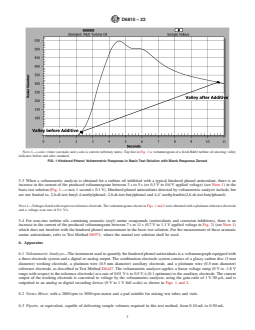
NOTE 1—x-axis = time (seconds) and y-axis is current (arbitrary units). Top line in Fig. 1 is voltammogram of a fresh R&O turbine oil showing valley
indicator before and after standard.
FIG. 1 Hindered Phenol Voltammetric Response in Basic Test Solution with Blank Response Zeroed
electrolytic cell. Data is obtained by measuring the current electrode surface and the exponential increase of the oxidation
passing through the cell as a function of the potential applied, rate lead to a maximum in the current-potential curve shown in
and test results are based upon current, voltage and time Fig. 1.
relationships at the cell electrodes. The cell consists of a fluid
container into which is mounted a small, easily polarized
5. Significance and Use
working electrode, and a large nonpolarizable reference elec-
5.1 The quantitative determination of hindered phenol anti-
trode.Thereferenceelectrodeshouldbemassiverelativetothe
oxidants in a new turbine oil measures the amount of this
working electrode so that its behavior remains essentially
material that has been added to the oil as protection against
constant with the passage of small current; that is, it remains
oxidation. Beside phenols, turbine oils can be formulated with
unpolarized during the analysis period. Additional electrodes,
otherantioxidantssuchasamineswhichcanextendtheoillife.
auxiliary electrodes, can be added to the electrode system to
In used oil, the determination measures the amount of original
eliminate the effects of resistive drop for high resistance
(phenolic) antioxidant remaining after oxidation have reduced
solutions. In performing a voltammetric analysis, the potential
its initial concentration. This test method is not designed or
across the electrodes is varied linearly with time, and the
intended to detect all of the antioxidant intermediates formed
resulting current is recorded as a function of the potential. As
duringthethermalandoxidativestressingoftheoils,whichare
the increasing voltage is applied to the prepared sample within
recognizedashavingsomecontributiontotheremaininguseful
the cell, the various additive species under investigation within
life of the used or in-service oil. Nor does it measure the
the oil are caused to electrochemically oxidize. The data
overall stability of an oil, which is determined by the total
recorded during this oxidation reaction can then be used to
contribution of all species present. Before making final judg-
determine the remaining useful life of the oil type. A typical
ment on the remaining useful life of the used oil, which might
current-potential curve produced during the practice of the
result in the replacement of the oil reservoir, it is advised to
voltammetric test can be seen by reference to Fig. 1. Initially,
perform additional analytical techniques (in accordance with
the applied potential produces an electrochemical reaction
Practices D6224 and D4378), having the capability of measur-
havingaratesoslowthatvirtuallynocurrentflowsthroughthe
ing remaining oxidative life of the used oil.
cell. As the voltage is increased, as shown in Fig. 1, the
5.1.1 This test method is applicable to non-zinc turbine oils.
electro-active species (for example, substituted phenols) begin
to oxidize at the working electrode surface, producing an These are refined mineral oils containing rust and oxidation
anodic rise in the current.As the potential is further increased, inhibitors, but not antiwear additives. This test method has not
the decrease in the electro-active species concentration at the yet been established with sufficient precision for antiwear oils.
D6810 − 22
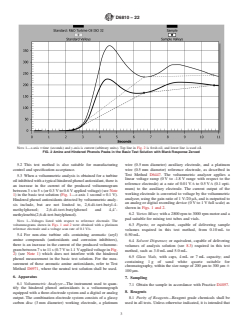
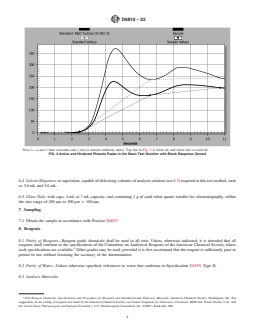
NOTE 1—x-axis = time (seconds) and y-axis is current (arbitrary units). Top line in Fig. 2 is fresh oil, and lower line is used oil.
FIG. 2 Amine and Hindered Phenols Peaks in the Basic Test Solution with Blank Response Zeroed
5.2 This test method is also suitable for manufacturing wire (0.5 mm diameter) auxiliary electrode, and a platinum
control and specification acceptance. wire (0.5 mm diameter) reference electrode, as described in
Test Method D6447. The voltammetric analyzer applies a
5.3 When a voltammetric analysis is obtained for a turbine
linear voltage ramp (0 V to -1.8 V range with respect to the
oilinhibitedwithatypicalhinderedphenolantioxidant,thereis
reference electrode) at a rate of 0.01 V⁄s to 0.5 V⁄s (0.1 opti-
an increase in the current of the produced voltammogram
mum) to the auxiliary electrode. The current output of the
between 3 s to 5 s (or 0.3 Vto 0.6 Vapplied voltage) (see Note
working electrode is converted to voltage by the voltammetric
1) in the basic test solution (Fig. 1—x-axis 1 second = 0.1 V).
analyzer, using the gain ratio of 1 V⁄20 µA, and is outputted to
Hindered phenol antioxidants detected by voltammetric analy-
an analog or digital recording device (0 V to 1 V full scale) as
sis include, but are not limited to, 2,6-di-tert-butyl-4-
shown in Figs. 1 and 2.
methylphenol; 2,6-di-tert-butylphenol and 4,4’-
6.2 Vortex Mixer, with a 2800 rpm to 3000 rpm motor and a
methylenebis(2,6-di-tert-butylphenol).
pad suitable for mixing test tubes and vials.
NOTE 1—Voltages listed with respect to reference electrode. The
voltammograms shown in Figs. 1 and 2 were obtained with a platinum 6.3 Pipette, or equivalent, capable of delivering sample
reference electrode and a voltage scan rate of 0.1 V/s.
volumes required in this test method, from 0.10 mL to
0.50 mL.
5.4 For non-zinc turbine oils containing aromatic (aryl)
amine compounds (antioxidants and corrosion inhibitors),
6.4 Solvent Dispenser, or equivalent, capable of delivering
there is an increase in the current of the produced voltammo-
volumes of analysis solution (see 8.3) required in this test
grambetween7 sto11 s(0.7 Vto1.1 VappliedvoltageinFig.
method, such as 3.0 mL and 5.0 mL.
2) (see Note 1) which does not interfere with the hindered
6.5 Glass Vials, with caps, 4 mL or 7 mL capacity; and
phenol measurement in the basic test solution. For the mea-
containing 1 g of sand white quartz suitable for
surement of these aromatic amine antioxidants, refer to Test
chromatography, within the size range of 200 µm to 300 µm 6
Method D6971, where the neutral test solution shall be used.
100 µm.
6. Apparatus
7. Sampling
6.1 Voltammetric Analyzer—The instrument used to quan-
7.1 Obtain the sample in accordance with Practice D4057.
tify the hindered phenol antioxidants is a voltammograph
8. Reagents
equipped with a three-electrode system and a digital or analog
output. The combination electrode system consists of a glassy 8.1 Purity of Reagents—Reagent grade chemicals shall be
carbon disc (3 mm diameter) working electrode, a platinum used in all tests. Unless otherwise indicated, it is intended that
D6810 − 22
all reagents shall conform to the specifications of the Commit- with an appropriate analysis solvent. This measurement gives
tee onAnalytical Reagents of theAmerican Chemical Society, you a voltammetric reading (standard reading) that indicates
where such specifications are available. Other grades may be the voltammetric response for the concentration hindered
used, provided it is first ascertained that the reagent is phenol antioxidant being analyzed for the oil being tested.
sufficiently pure to permit its use without lessening the accu-
9.2.3 Test Sample (In-Service Oil) Reading:
racy of the determination.
9.2.3.1 Definition—The sample reading is a measurement of
a fresh or in-service oil mixed with the same type of analysis
8.2 Purity of Water—Unless otherwise specified, references
solvent as the standard. This measurement will provide volta-
to water that conforms to Specification D1193, Type II.
mmetric readings that normally range between the blank and
8.3 Analysis Materials:
standard measurements, and refle
...
This document is not an ASTM standard and is intended only to provide the user of an ASTM standard an indication of what changes have been made to the previous version. Because
it may not be technically possible to adequately depict all changes accurately, ASTM recommends that users consult prior editions as appropriate. In all cases only the current version
of the standard as published by ASTM is to be considered the official document.
Designation: D6810 − 21 D6810 − 22
Standard Test Method for
Measurement of Hindered Phenolic Antioxidant Content in
Non-Zinc Turbine Oils by Linear Sweep Voltammetry
This standard is issued under the fixed designation D6810; the number immediately following the designation indicates the year of
original adoption or, in the case of revision, the year of last revision. A number in parentheses indicates the year of last reapproval. A
superscript epsilon (´) indicates an editorial change since the last revision or reapproval.
1. Scope*
1.1 This test method covers the voltammetric determination of hindered phenol antioxidants in new or in-service non-zinc turbine
oils in concentrations from 0.0075 % by weight up to concentrations found in new oils by measuring the amount of current flow
at a specified voltage in the produced voltammogram.
1.2 The values stated in SI units are to be regarded as standard. No other units of measurement are included in this standard.
1.3 This standard does not purport to address all of the safety concerns, if any, associated with its use. It is the responsibility
of the user of this standard to establish appropriate safety, health, and environmental practices and determine the applicability of
regulatory limitations prior to use.
1.4 This international standard was developed in accordance with internationally recognized principles on standardization
established in the Decision on Principles for the Development of International Standards, Guides and Recommendations issued
by the World Trade Organization Technical Barriers to Trade (TBT) Committee.
2. Referenced Documents
2.1 ASTM Standards:
D1193 Specification for Reagent Water
D4057 Practice for Manual Sampling of Petroleum and Petroleum Products
D4175 Terminology Relating to Petroleum Products, Liquid Fuels, and Lubricants
D4378 Practice for In-Service Monitoring of Mineral Turbine Oils for Steam, Gas, and Combined Cycle Turbines
D6224 Practice for In-Service Monitoring of Lubricating Oil for Auxiliary Power Plant Equipment
D6447 Test Method for Hydroperoxide Number of Aviation Turbine Fuels by Voltammetric Analysis
D6971 Test Method for Measurement of Hindered Phenolic and Aromatic Amine Antioxidant Content in Non-zinc Turbine Oils
by Linear Sweep Voltammetry
3. Terminology
3.1 For definitions of terms used in this method, refer to Terminology D4175.
3.1 Definitions:
This test method is under the jurisdiction of ASTM Committee D02 on Petroleum Products, Liquid Fuels, and Lubricants and is the direct responsibility of Subcommittee
D02.09.0C on Oxidation of Turbine Oils.
Current edition approved July 1, 2021July 1, 2022. Published August 2021August 2022. Originally approved in 2002. Last previous edition approved in 20132021 as
D6810 – 13.D6810 – 21. DOI: 10.1520/D6810-21.10.1520/D6810-22.
For referenced ASTM standards, visit the ASTM website, www.astm.org, or contact ASTM Customer Service at service@astm.org. For Annual Book of ASTM Standards
volume information, refer to the standard’s Document Summary page on the ASTM website.
*A Summary of Changes section appears at the end of this standard
Copyright © ASTM International, 100 Barr Harbor Drive, PO Box C700, West Conshohocken, PA 19428-2959. United States
D6810 − 22
3.1.1 See Terminology D4175 for a more extensive list of terms used in this test method.
3.1.2 electrolytic cell, n—an electrochemical cell in which chemical reactions are caused by applying an external potential
difference greater than, and opposite to, the galvanic electromotive force of the cell. IUPAC
3.1.3 linear sweep voltammetry, n—a technique applied to the monitoring of antioxidant additive content in lubricants, where the
current is detected as an applied potential is increased linearly over a period of time.
3.1.4 voltammogram, n—the plot of current versus voltage.
4. Summary of Test Method
4.1 A measured quantity of sample is dispensed into a vial containing a measured quantity of alcohol-based electrolyte solution
and containing a layer of sand. When the vial is shaken, the hindered phenol antioxidants and other solution soluble oil components
present in the sample are extracted into the solution and the remaining droplets suspended in the solution are agglomerated by the
sand. The sand/droplet suspension is allowed to settle out and the hindered phenol antioxidants dissolved in the solution are
quantified by voltammetric analysis. The results are calculated and reported as weight percent of antioxidant or as millimoles
(mmol) of antioxidant per litre of sample for prepared and fresh oils and as a percent remaining antioxidant for used oils.
4.2 Voltammetric analysis is a technique that applies electro-analytic methods when a sample to be analyzed is mixed with an
electrolyte and a solvent and placed within an electrolytic cell. Data is obtained by measuring the current passing through the cell
as a function of the potential applied, and test results are based upon current, voltage and time relationships at the cell electrodes.
The cell consists of a fluid container into which is mounted a small, easily polarized working electrode, and a large nonpolarizable
reference electrode. The reference electrode should be massive relative to the working electrode so that its behavior remains
essentially constant with the passage of small current; that is, it remains unpolarized during the analysis period. Additional
electrodes, auxiliary electrodes, can be added to the electrode system to eliminate the effects of resistive drop for high resistance
solutions. In performing a voltammetric analysis, the potential across the electrodes is varied linearly with time, and the resulting
current is recorded as a function of the potential. As the increasing voltage is applied to the prepared sample within the cell, the
various additive species under investigation within the oil are caused to electrochemically oxidize. The data recorded during this
oxidation reaction can then be used to determine the remaining useful life of the oil type. A typical current-potential curve produced
during the practice of the voltammetric test can be seen by reference to Fig. 1. Initially, the applied potential produces an
electrochemical reaction having a rate so slow that virtually no current flows through the cell. As the voltage is increased, as shown
in Fig. 1, the electro-active species (for example, substituted phenols) begin to oxidize at the working electrode surface, producing
an anodic rise in the current. As the potential is further increased, the decrease in the electro-active species concentration at the
electrode surface and the exponential increase of the oxidation rate lead to a maximum in the current-potential curve shown in Fig.
1.
5. Significance and Use
5.1 The quantitative determination of hindered phenol antioxidants in a new turbine oil measures the amount of this material that
has been added to the oil as protection against oxidation. Beside phenols, turbine oils can be formulated with other antioxidants
such as amines which can extend the oil life. In used oil, the determination measures the amount of original (phenolic) antioxidant
remaining after oxidation have reduced its initial concentration. This test method is not designed or intended to detect all of the
antioxidant intermediates formed during the thermal and oxidative stressing of the oils, which are recognized as having some
contribution to the remaining useful life of the used or in-service oil. Nor does it measure the overall stability of an oil, which is
determined by the total contribution of all species present. Before making final judgment on the remaining useful life of the used
oil, which might result in the replacement of the oil reservoir, it is advised to perform additional analytical techniques (in
accordance with Practices D6224 and D4378), having the capability of measuring remaining oxidative life of the used oil.
5.1.1 This test method is applicable to non-zinc turbine oils. These are refined mineral oils containing rust and oxidation inhibitors,
but not antiwear additives. This test method has not yet been established with sufficient precision for antiwear oils.
5.2 This test method is also suitable for manufacturing control and specification acceptance.
Inczedy, J., Lengyel, T., and Ure, A. M., Orange Book: IUPAC Compendium on Analytical Nomenclature, Definitive Rules 1997, 3rd Edition, Blackwell Science, 1998.
D6810 − 22
NOTE 1—x-axis = time (seconds) and y-axis is current (arbitrary units). Top line in Fig. 1 is voltammogram of a fresh R&O turbine oil showing valley
indicator before and after standard.
FIG. 1 Hindered Phenol Voltammetric Response in Basic Test Solution with Blank Response Zeroed
5.3 When a voltammetric analysis is obtained for a turbine oil inhibited with a typical hindered phenol antioxidant, there is an
increase in the current of the produced voltammogram between 3 s to 5 s (or 0.3 V to 0.6 V applied voltage) (see Note 1) in the
basic test solution (Fig. 1—x-axis 1 second = 0.1 V). Hindered phenol antioxidants detected by voltammetric analysis include, but
are not limited to, 2,6-di-tert-butyl-4-methylphenol; 2,6-di-tert-butylphenol and 4,4’-methylenebis(2,6-di-tert-butylphenol).
NOTE 1—Voltages listed with respect to reference electrode. The voltammograms shown in Figs. 1 and 2 were obtained with a platinum reference electrode
and a voltage scan rate of 0.1 V/s.
5.4 For non-zinc turbine oils containing aromatic (aryl) amine compounds (antioxidants and corrosion inhibitors), there is an
increase in the current of the produced voltammogram between 7 s to 11 s (0.7 V to 1.1 V applied voltage in Fig. 2) (see Note 1)
which does not interfere with the hindered phenol measurement in the basic test solution. For the measurement of these aromatic
amine antioxidants, refer to Test Method D6971, where the neutral test solution shall be used.
6. Apparatus
6.1 Voltammetric Analyzer—The instrument used to quantify the hindered phenol antioxidants is a voltammograph equipped with
a three-electrode system and a digital or analog output. The combination electrode system consists of a glassy carbon disc (3 mm
diameter) working electrode, a platinum wire (0.5 mm diameter) auxiliary electrode, and a platinum wire (0.5 mm diameter)
reference electrode, as described in Test Method D6447. The voltammetric analyzer applies a linear voltage ramp (0 V to -1.8 V
range with respect to the reference electrode) at a rate of 0.01 V ⁄s to 0.5 V ⁄s (0.1 optimum) to the auxiliary electrode. The current
output of the working electrode is converted to voltage by the voltammetric analyzer, using the gain ratio of 1 V ⁄20 μA, and is
outputted to an analog or digital recording device (0 V to 1 V full scale) as shown in Figs. 1 and 2.
6.2 Vortex Mixer, with a 2800 rpm to 3000 rpm motor and a pad suitable for mixing test tubes and vials.
6.3 Pipette, or equivalent, capable of delivering sample volumes required in this test method, from 0.10 mL to 0.50 mL.
D6810 − 22
NOTE 1—x-axis = time (seconds) and y-axis is current (arbitrary units). Top line in Fig. 2 is fresh oil, and lower line is used oil.
FIG. 2 Amine and Hindered Phenols Peaks in the Basic Test Solution with Blank Response Zeroed
6.4 Solvent Dispenser, or equivalent, capable of delivering volumes of analysis solution (see 8.3) required in this test method, such
as 3.0 mL and 5.0 mL.
6.5 Glass Vials, with caps, 4 mL or 7 mL capacity; and containing 1 g of sand white quartz suitable for chromatography, within
the size range of 200 μm to 300 μm 6 100 μm.
7. Sampling
7.1 Obtain the sample in accordance with Practice D4057.
8. Reagents
8.1 Purity of Reagents—Reagent grade chemicals shall be used in all tests. Unless otherwise indicated, it is intended that all
reagents shall conform to the specifications of the Committee on Analytical Reagents of the American Chemical Society, where
such specifications are available. Other grades may be used, provided it is first ascertained that the reagent is sufficiently pure to
permit its use without lessening the accuracy of the determination.
8.2 Purity of Water—Unless otherwise specified, references to water that conforms to Specification D1193, Type II.
8.3 Analysis Materials:
ACS Reagent Chemicals, Specifications and Procedures for Reagents and Standard-Grade Reference Materials, American Chemical Society, Washington, DC. For
suggestions on the testing of reagents not listed by the American Chemical Society, see Analar Standards for Laboratory Chemicals, BDH Ltd., Poole, Dorset, U.K., and
the United States Pharmacopeia and National Formulary, U.S. Pharmacopeial Convention, Inc. (USPC), Rockville, MD.
D6810 − 22
8.3.1 Alcohol Test Solution (Basic
...