

ASTM D6026-21
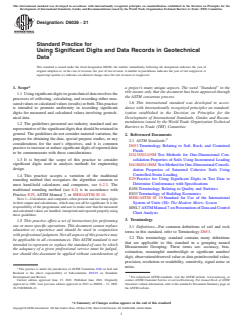
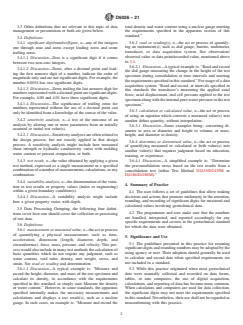
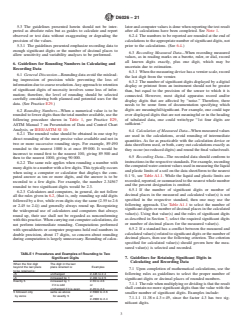
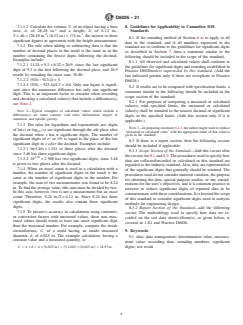
(Practice)Standard Practice for Using Significant Digits and Data Records in Geotechnical Data
General Information
- Abstract
SIGNIFICANCE AND USE
5.1 The guidelines presented in this practice for retaining significant digits and rounding numbers may be adopted by the using agency or user. Their adoption should generally be used to calculate and record data when specified requirements are not included in a standard.
5.2 While this practice originated when most geotechnical data were manually collected and recorded on data forms, tables, or into computers, the use of digital acquisition, calculations, and reporting of data has become more common. When calculators and computers are used for data collection, the significant digits may not meet the requirements specified in this standard. Nevertheless, their use shall not be regarded as nonconforming with this practice.
5.3 The guidelines presented herein should not be interpreted as absolute rules but as guides to calculate and report observed or test data without exaggerating or degrading the precision of the values.
5.3.1 The guidelines presented emphasize recording data to enough significant digits or the number of decimal places to allow sensitivity and variability analyses to be performed.
SCOPE
1.1 Using significant digits in geotechnical data involves the processes of collecting, calculating, and recording either measured values or calculated values (results) or both. This practice is intended to promote uniformity in recording significant digits for measured and calculated values involving geotechnical data.
1.2 The guidelines presented are industry standard and are representative of the significant digits that should be retained in general. The guidelines do not consider material variation, the purpose for obtaining the data, special purpose studies, or any considerations for the user's objectives, and it is common practice to increase or reduce significant digits of reported data to be commensurate with these considerations.
1.3 It is beyond the scope of this practice to consider significant digits used in analysis methods for engineering design.
1.4 This practice accepts a variation of the traditional rounding method that recognizes the algorithm common to most hand-held calculators and computers, see 6.2.3. The traditional rounding method (see 6.2) is in accordance with Practice E29, ASTM Manual 7, or IEEE/ASTM SI 10.
Note 1: Calculators and computers often present and use many digits in their output and calculations, which may not all be significant. It is the responsibility of the programmer and user to make sure that the measured and calculated values are handled, interpreted and reported properly using these guidelines.
1.5 This practice offers a set of instructions for performing one or more specific operations. This document cannot replace education or experience and should be used in conjunction with professional judgment. Not all aspects of this practice may be applicable in all circumstances. This ASTM standard is not intended to represent or replace the standard of care by which the adequacy of a given professional service must be judged, nor should this document be applied without consideration of a project’s many unique aspects. The word “Standard” in the title means only that the document has been approved through the ASTM consensus process.
1.6 This international standard was developed in accordance with internationally recognized principles on standardization established in the Decision on Principles for the Development of International Standards, Guides and Recommendations issued by the World Trade Organization Technical Barriers to Trade (TBT) Committee.
- Status
- Published
- Publication Date
- 14-Jun-2021
- Technical Committee
- D18 - Soil and Rock
- Drafting Committee
- D18.91 - Standards Development and Review
Buy Documents
ASTM D6026-21 - Standard Practice for Using Significant Digits and Data Records in Geotechnical Data
REDLINE ASTM D6026-21 - Standard Practice for Using Significant Digits and Data Records in Geotechnical Data
Overview
ASTM D6026-21: Standard Practice for Using Significant Digits and Data Records in Geotechnical Data provides industry-accepted guidelines for retaining significant digits and handling data records in the field of geotechnical engineering. Published by ASTM International, this standard promotes uniformity and reliability in the collection, calculation, and recording of both measured and calculated geotechnical values. It is intended for agencies, laboratories, and professionals seeking consistency in geotechnical data management when other specific requirements are not outlined.
ASTM D6026-21 accommodates modern data acquisition, calculations, and reporting, including both manual and digital processes. It recognizes that electronic devices such as calculators, computers, and data acquisition systems may display extra digits that extend beyond the actual measurement precision, and offers guidance to avoid misrepresentation of data accuracy.
Key Topics
Retention of Significant Digits
The standard defines clear rules for identifying and retaining the appropriate number of significant digits when recording or calculating geotechnical data. This ensures data is neither overstated nor understated in terms of precision.Rounding Procedures
It outlines industry-standard methods for rounding numerical data, consistent with practices found in ASTM E29 and other referenced standards. Rounding is performed only after all calculations are complete, preventing error accumulation from successive rounding.Interpreting Digital Data
With the increased use of computers and digital sensors in geotechnical testing, the standard addresses how to reconcile automated outputs with required significant digits, ensuring reported values reflect true measurement capabilities.Reporting Requirements
The standard provides best practices for documenting and communicating measured and calculated geotechnical data. It includes references to proper data sheet preparation and use of data forms, as well as guidance on how many digits or decimal places should be used for key properties like density, water content, and shear strength.Data Management for Sensitivity and Variability Analysis
Retaining sufficient digits is emphasized so analyses of sensitivity and variability-such as how soil behaviors change with moisture-can be conducted reliably.
Applications
Geotechnical Laboratory Testing
ASTM D6026-21 is used in soil, rock, and fluid testing environments to ensure that reported values for properties such as density, unit weight, water content, and Atterberg limits conform to best practices for significant digits and rounding.Data Acquisition and Reporting Systems
This standard is particularly relevant for professionals designing or utilizing digital data acquisition systems, ensuring recorded readings align with the actual measurable precision of instruments and sensors.Specification Conformance
When geotechnical data must be compared to specific technical limits or specifications, the careful use of significant digits as outlined in ASTM D6026-21 ensures fair, repeatable, and valid comparisons.Preparation of Technical Reports
Practitioners incorporate the standard’s guidelines in engineering reports, technical submissions, and project data summaries to provide clarity, avoid misinterpretation, and align with industry expectations.
Related Standards
To promote comprehensive geotechnical data management and achieve compatibility across industry practices, ASTM D6026-21 references and aligns with several other standards, including:
- ASTM E29 - Practice for Using Significant Digits in Test Data to Determine Conformance with Specifications
- ASTM Manual 7 - Presentation of Data and Control Chart Analysis
- IEEE/ASTM SI 10 - Standard for the International System of Units (SI)
- ASTM D653 - Terminology Relating to Soil, Rock, and Contained Fluids
- ASTM D2435/D2435M and D4186/D4186M - Test Methods for One-Dimensional Consolidation Properties of Soils
Implementing ASTM D6026-21 ensures data consistency, transparency, and integrity throughout the geotechnical engineering workflow, facilitating accurate analysis, reporting, and compliance with industry standards.
Relations
- Effective Date
- 01-Apr-2022
- Effective Date
- 01-Oct-2017
- Effective Date
- 01-Oct-2017
- Effective Date
- 01-Aug-2014
- Effective Date
- 15-Nov-2013
- Effective Date
- 15-Nov-2013
- Effective Date
- 15-Nov-2013
- Effective Date
- 15-Nov-2013
- Effective Date
- 01-Nov-2013
- Effective Date
- 15-Oct-2013
- Effective Date
- 01-Oct-2013
- Effective Date
- 15-Aug-2013
- Effective Date
- 01-Nov-2012
- Effective Date
- 01-May-2012
- Effective Date
- 01-May-2012
Buy Documents
ASTM D6026-21 - Standard Practice for Using Significant Digits and Data Records in Geotechnical Data
REDLINE ASTM D6026-21 - Standard Practice for Using Significant Digits and Data Records in Geotechnical Data
Frequently Asked Questions
ASTM D6026-21 is a standard published by ASTM International. Its full title is "Standard Practice for Using Significant Digits and Data Records in Geotechnical Data". This standard covers: SIGNIFICANCE AND USE 5.1 The guidelines presented in this practice for retaining significant digits and rounding numbers may be adopted by the using agency or user. Their adoption should generally be used to calculate and record data when specified requirements are not included in a standard. 5.2 While this practice originated when most geotechnical data were manually collected and recorded on data forms, tables, or into computers, the use of digital acquisition, calculations, and reporting of data has become more common. When calculators and computers are used for data collection, the significant digits may not meet the requirements specified in this standard. Nevertheless, their use shall not be regarded as nonconforming with this practice. 5.3 The guidelines presented herein should not be interpreted as absolute rules but as guides to calculate and report observed or test data without exaggerating or degrading the precision of the values. 5.3.1 The guidelines presented emphasize recording data to enough significant digits or the number of decimal places to allow sensitivity and variability analyses to be performed. SCOPE 1.1 Using significant digits in geotechnical data involves the processes of collecting, calculating, and recording either measured values or calculated values (results) or both. This practice is intended to promote uniformity in recording significant digits for measured and calculated values involving geotechnical data. 1.2 The guidelines presented are industry standard and are representative of the significant digits that should be retained in general. The guidelines do not consider material variation, the purpose for obtaining the data, special purpose studies, or any considerations for the user's objectives, and it is common practice to increase or reduce significant digits of reported data to be commensurate with these considerations. 1.3 It is beyond the scope of this practice to consider significant digits used in analysis methods for engineering design. 1.4 This practice accepts a variation of the traditional rounding method that recognizes the algorithm common to most hand-held calculators and computers, see 6.2.3. The traditional rounding method (see 6.2) is in accordance with Practice E29, ASTM Manual 7, or IEEE/ASTM SI 10. Note 1: Calculators and computers often present and use many digits in their output and calculations, which may not all be significant. It is the responsibility of the programmer and user to make sure that the measured and calculated values are handled, interpreted and reported properly using these guidelines. 1.5 This practice offers a set of instructions for performing one or more specific operations. This document cannot replace education or experience and should be used in conjunction with professional judgment. Not all aspects of this practice may be applicable in all circumstances. This ASTM standard is not intended to represent or replace the standard of care by which the adequacy of a given professional service must be judged, nor should this document be applied without consideration of a project’s many unique aspects. The word “Standard” in the title means only that the document has been approved through the ASTM consensus process. 1.6 This international standard was developed in accordance with internationally recognized principles on standardization established in the Decision on Principles for the Development of International Standards, Guides and Recommendations issued by the World Trade Organization Technical Barriers to Trade (TBT) Committee.
SIGNIFICANCE AND USE 5.1 The guidelines presented in this practice for retaining significant digits and rounding numbers may be adopted by the using agency or user. Their adoption should generally be used to calculate and record data when specified requirements are not included in a standard. 5.2 While this practice originated when most geotechnical data were manually collected and recorded on data forms, tables, or into computers, the use of digital acquisition, calculations, and reporting of data has become more common. When calculators and computers are used for data collection, the significant digits may not meet the requirements specified in this standard. Nevertheless, their use shall not be regarded as nonconforming with this practice. 5.3 The guidelines presented herein should not be interpreted as absolute rules but as guides to calculate and report observed or test data without exaggerating or degrading the precision of the values. 5.3.1 The guidelines presented emphasize recording data to enough significant digits or the number of decimal places to allow sensitivity and variability analyses to be performed. SCOPE 1.1 Using significant digits in geotechnical data involves the processes of collecting, calculating, and recording either measured values or calculated values (results) or both. This practice is intended to promote uniformity in recording significant digits for measured and calculated values involving geotechnical data. 1.2 The guidelines presented are industry standard and are representative of the significant digits that should be retained in general. The guidelines do not consider material variation, the purpose for obtaining the data, special purpose studies, or any considerations for the user's objectives, and it is common practice to increase or reduce significant digits of reported data to be commensurate with these considerations. 1.3 It is beyond the scope of this practice to consider significant digits used in analysis methods for engineering design. 1.4 This practice accepts a variation of the traditional rounding method that recognizes the algorithm common to most hand-held calculators and computers, see 6.2.3. The traditional rounding method (see 6.2) is in accordance with Practice E29, ASTM Manual 7, or IEEE/ASTM SI 10. Note 1: Calculators and computers often present and use many digits in their output and calculations, which may not all be significant. It is the responsibility of the programmer and user to make sure that the measured and calculated values are handled, interpreted and reported properly using these guidelines. 1.5 This practice offers a set of instructions for performing one or more specific operations. This document cannot replace education or experience and should be used in conjunction with professional judgment. Not all aspects of this practice may be applicable in all circumstances. This ASTM standard is not intended to represent or replace the standard of care by which the adequacy of a given professional service must be judged, nor should this document be applied without consideration of a project’s many unique aspects. The word “Standard” in the title means only that the document has been approved through the ASTM consensus process. 1.6 This international standard was developed in accordance with internationally recognized principles on standardization established in the Decision on Principles for the Development of International Standards, Guides and Recommendations issued by the World Trade Organization Technical Barriers to Trade (TBT) Committee.
ASTM D6026-21 is classified under the following ICS (International Classification for Standards) categories: 07.020 - Mathematics. The ICS classification helps identify the subject area and facilitates finding related standards.
ASTM D6026-21 has the following relationships with other standards: It is inter standard links to ASTM E456-13a(2022)e1, ASTM E456-13A(2017)e3, ASTM E456-13A(2017)e1, ASTM D653-14, ASTM E456-13ae1, ASTM E456-13a, ASTM E456-13ae2, ASTM E456-13ae3, ASTM E833-13b, ASTM E833-13a, ASTM E833-13, ASTM E456-13, ASTM D4186/D4186M-12, ASTM E456-12, ASTM E833-12. Understanding these relationships helps ensure you are using the most current and applicable version of the standard.
ASTM D6026-21 is available in PDF format for immediate download after purchase. The document can be added to your cart and obtained through the secure checkout process. Digital delivery ensures instant access to the complete standard document.
Standards Content (Sample)
This international standard was developed in accordance with internationally recognized principles on standardization established in the Decision on Principles for the
Development of International Standards, Guides and Recommendations issued by the World Trade Organization Technical Barriers to Trade (TBT) Committee.
Designation:D6026 −21
Standard Practice for
Using Significant Digits and Data Records in Geotechnical
Data
This standard is issued under the fixed designation D6026; the number immediately following the designation indicates the year of
original adoption or, in the case of revision, the year of last revision.Anumber in parentheses indicates the year of last reapproval.A
superscript epsilon (´) indicates an editorial change since the last revision or reapproval.
1. Scope* a project’s many unique aspects. The word “Standard” in the
title means only that the document has been approved through
1.1 Usingsignificantdigitsingeotechnicaldatainvolvesthe
the ASTM consensus process.
processes of collecting, calculating, and recording either mea-
1.6 This international standard was developed in accor-
suredvaluesorcalculatedvalues(results)orboth.Thispractice
dance with internationally recognized principles on standard-
is intended to promote uniformity in recording significant
ization established in the Decision on Principles for the
digits for measured and calculated values involving geotech-
Development of International Standards, Guides and Recom-
nical data.
mendations issued by the World Trade Organization Technical
1.2 The guidelines presented are industry standard and are
Barriers to Trade (TBT) Committee.
representativeofthesignificantdigitsthatshouldberetainedin
general. The guidelines do not consider material variation, the
2. Referenced Documents
purpose for obtaining the data, special purpose studies, or any
2.1 ASTM Standards:
considerations for the user’s objectives, and it is common
D653Terminology Relating to Soil, Rock, and Contained
practicetoincreaseorreducesignificantdigitsofreporteddata
Fluids
to be commensurate with these considerations.
D2435/D2435MTest Methods for One-Dimensional Con-
1.3 It is beyond the scope of this practice to consider
solidation Properties of Soils Using Incremental Loading
significant digits used in analysis methods for engineering
D4186/D4186MTestMethodforOne-DimensionalConsoli-
design.
dation Properties of Saturated Cohesive Soils Using
Controlled-Strain Loading
1.4 This practice accepts a variation of the traditional
E29Practice for Using Significant Digits in Test Data to
rounding method that recognizes the algorithm common to
Determine Conformance with Specifications
most hand-held calculators and computers, see 6.2.3. The
E456Terminology Relating to Quality and Statistics
traditional rounding method (see 6.2) is in accordance with
E833Terminology of Building Economics
Practice E29, ASTM Manual 7, or IEEE/ASTM SI 10.
IEEE/ASTM SI 10Standard for Use of the International
NOTE 1—Calculators and computers often present and use many digits
in their output and calculations, which may not all be significant. It is the
System of Units (SI): The Modern Metric System
responsibility of the programmer and user to make sure that the measured
MNL7ASTMManual7onPresentationofDataandControl
andcalculatedvaluesarehandled,interpretedandreportedproperlyusing
Chart Analysis
these guidelines.
3. Terminology
1.5 This practice offers a set of instructions for performing
one or more specific operations. This document cannot replace
3.1 Definitions—For common definitions of soil and rock
education or experience and should be used in conjunction
terms in this standard, refer to Terminology D653.
withprofessionaljudgment.Notallaspectsofthispracticemay
3.2 This terminology standard contains many definitions
be applicable in all circumstances. This ASTM standard is not
that are applicable to this standard in a grouping named
intended to represent or replace the standard of care by which
Measurement Grouping. These terms are: accuracy, bias,
the adequacy of a given professional service must be judged,
estimation, meaningful number/digit or significant number/
nor should this document be applied without consideration of
digit, observation/observed value or data point/recorded value,
precision, resolution or readability, sensitivity, signal noise or
noise.
This practice is under the jurisdiction of ASTM Committee D18 on Soil and
Rockand is the direct responsibility of Subcommittee D18.91 on Standards
Development and Review. For referenced ASTM standards, visit the ASTM website, www.astm.org, or
Current edition approved June 15, 2021. Published June 2021. Originally contact ASTM Customer Service at service@astm.org. For Annual Book of ASTM
approved in 1996. Last previous edition approved in 2013 as D6026 – 13. DOI: Standards volume information, refer to the standard’s Document Summary page on
10.1520/D6026-21. the ASTM website.
*A Summary of Changes section appears at the end of this standard
Copyright © ASTM International, 100 Barr Harbor Drive, PO Box C700, West Conshohocken, PA 19428-2959. United States
D6026−21
3.3 Other definitions that are relevant to this topic of data total density and water content using a nuclear gauge meeting
management or presentation or both are given below. the requirements specified in the apparatus section of this
standard.”
3.4 Definitions:
3.6.2 read or reading(s), n—the act or process of quantify-
3.4.1 significant digit/number/figure, n—any of the integers
ing an instrument(s); such as dial gauge, burette, multimeter,
one through nine and zeros except leading zeros and some
transducer, or data acquisition system. See observation/
trailing zeros.
observed value or data point/recorded value, mentioned above
3.4.1.1 Discussion—Zero is a significant digit if it comes
in 3.2.
between two non-zero integers.
3.6.2.1 Discussion—Atypicalexampleis:“Readandrecord
3.4.1.2 Discussion—Zeros, after a decimal point and lead-
the dial gauge measuring the change in the height of the test
ing the first nonzero digit of a number, indicate the order of
specimen during consolidation at time intervals and meeting
magnitude only and are not significant digits. For example, the
therequirementsspecifiedinthisstandard.”Forusageofadata
number 0.0034 has two significant digits.
acquisition system: “Read and record, at intervals specified in
3.4.1.3 Discussion—Zeros trailing the last nonzero digit for
this standards the transducer’s measuring the applied axial
numbersrepresentedwithadecimalpointaresignificantdigits.
force, axial displacement, and cell pressure applied to the test
For example, 4.00 and 4.01 have three significant digits.
specimenalongwiththeinternalpore-waterpressureinthetest
3.4.1.4 Discussion—The significance of trailing zeros for
specimen.”
numbers represented without the use of a decimal point can
3.6.3 calculation or calculated value, n—the act or process
onlybeidentifiedfromaknowledgeofthesourceofthevalue.
of using an equation which converts a measured value(s) into
3.4.2 sensitivity analysis, n—a test of the outcome of an
another define quantity, without interpolation.
analysis by altering one or more parameters from an initially
3.6.3.1 Discussion—Some examples being: converting di-
assumed or initial test value(s).
ameter to area or diameter and height to volume, or mass,
3.4.2.1 Discussion—Sensitivityanalysesareoftenrelatedto height, and diameter to density.
the design process, but not exactly applied in that design
3.6.4 determine or determined value, n—the act or process
process. A sensitivity analysis might include how measured
of quantifying measured or calculated or both value(s) into
shear strength or hydraulic conductivity varies with molding
another value(s) that requires judgment based on education,
water content or percent compaction, or both.
training, or experience.
3.4.3 test result, n—the value obtained by applying a given 3.6.4.1 Discussion—A simplified example is: “Determine
test method, expressed as a single measurement or a specified
the preconsolidation stress based on the test results from a
combinationofanumberofmeasurements,calculations,orany consolidation test (either Test Method D2435/D2435M or
combination.
D4186/D4186M).”
3.4.4 variability analysis, n—thedeterminationofthevaria-
4. Summary of Practice
tion in test results or property values (index or engineering)
within a given boundary condition(s).
4.1 The user follows a set of guidelines that allow making
decisions and actions that promote uniformity in the retention,
3.4.4.1 Discussion—A variability analysis might include
rounding, and recording of significant digits for measured and
how a given property varies with depth.
calculated values involving geotechnical data.
3.5 Data Processing Grouping, the following four defini-
4.2 The programmer and user make sure that the numbers
tions cover how one should cover the collection or processing
are handled, interpreted, and reported accordingly for any
of test data.
specific requirements and caveats in the geotechnical standard
3.6 Definitions:
for which the data were obtained.
3.6.1 measurement or measured value, n—theactorprocess
of quantifying a physical measurement; such as time,
5. Significance and Use
acceleration, dimension (length, diameter, depth, and
5.1 The guidelines presented in this practice for retaining
circumference), force, mass, pressure, and velocity. This pro-
significantdigitsandroundingnumbersmaybeadoptedbythe
cesswouldalsoincludeinmanytestmethodsthecalculationof
using agency or user. Their adoption should generally be used
basic quantities which do not require any judgment, such as
to calculate and record data when specified requirements are
water content, void ratio, density, unit weight, stress, and
not included in a standard.
strain. See read or reading and determination.
3.6.1.1 Discussion—A typical example is: “Measure and 5.2 While this practice originated when most geotechnical
record the height, diameter, and mass of the test specimen and data were manually collected and recorded on data forms,
calculate its density, in accordance with the requirements tables, or into computers, the use of digital acquisition,
specified in this standard. or simply state Measure the density calculations, and reporting of data has become more common.
or water content.” However, in some standards, the apparatus When calculators and computers are used for data collection,
specified internally makes the necessary measurements and the significant digits may not meet the requirements specified
calculations and displays a test result(s), such as a nuclear inthisstandard.Nevertheless,theiruseshallnotberegardedas
gauge. In such cases, an example is: “Measure and record the nonconforming with this practice.
D6026−21
5.3 The guidelines presented herein should not be inter- latorandcomputervaluesisdonewhenreportingthetestresult
preted as absolute rules but as guides to calculate and report after all calculations have been completed. See Note 1.
observed or test data without exaggerating or degrading the
6.2.4 The numbers to be reported are rounded at the end of
precision of the values. calculationstotheappropriatenumberofsignificantdigits,not
5.3.1 The guidelines presented emphasize recording data to
prior to the calculations. (See 6.4.)
enough significant digits or the number of decimal places to
6.3 Recording Measured Data—When recording measured
allow sensitivity and variability analyses to be performed.
values, as in reading marks on a burette, ruler, or dial, record
all known digits exactly, plus one digit, which may be
6. Guidelines for Rounding Numbers in Calculating and
uncertain due to estimation.
Recording Data
6.3.1 Whenthemeasuringdevicehasavernierscale,record
6.1 General Discussion—Rounding data avoid the mislead-
the last digit from the vernier.
ing impression of precision while preventing the loss of
6.3.2 Thenumberofsignificantdigitsdisplayedbyadigital
informationduetocoarseresolution.Anyapproachtoretention
display or printout from an instrument should not be greater
of significant digits of necessity involves some loss of infor-
than, but equal to the precision of the sensor to which it is
mation; therefore, the level of rounding should be selected
connected. However, most digital apparatus record and/or
carefully considering both planned and potential uses for the
display digits that are affected by “noise.” Therefore, there
data. (See Practice E29.)
needs to be some form of documentation specifying which
digits are meaningful/significant. For example, one could tape
6.2 Rounding Numbers—When a numerical value is to be
over displayed digits that are not meaningful or in the heading
roundedtofewerdigitsthanthetotalnumberavailable,usethe
of tabulated data, one could write/type “1st four digits are
following procedure shown in Table 1, per Practice E29,
sufficient.”
ASTM Manual 7 on Presentation of Data and Control Chart
Analysis, or IEEE/ASTM SI 10:
6.4 Calculation of Measured Data—When measured values
6.2.1 The rounded value should be obtained in one step by
are used in the calculations, avoid rounding of intermediate
direct rounding of the most precise value available and not in
quantities.As far as practicable with the calculation device or
two or more successive rounding steps. For example, 89490
data sheet/form used, or both, carry out calculations exactly as
rounded to the nearest 1000 is at once 89000. It would be
they occur (no reduced digits) and round the final value/result.
incorrect to round first to the nearest 100, giving 89500 and
6.5 Recording Data—The recorded data should conform to
then to the nearest 1000, giving 90000.
instructionsintherespectivestandards.Forexample,recording
6.2.2 The same rule applies when rounding a number with
thecomputedwatercontentvaluesusedinmeasuringtheliquid
manydigitstoanumberwithafewdigits.Thistypicallyoccurs
andplasticlimitsofasoilonthedatasheet/formtothenearest
when using a computer or calculator that displays the com-
0.1%, see Table A1.1. While the liquid and plastic limits are
puted answer as ten or more digits, and the answer is to be
recorded,reported,orsummarizedtothenearestwholenumber
recorded to a few digits. For example, the number 2.34567
and the percent designation is omitted.
rounded to two significant digits would be 2.3.
6.5.1 If the number of significant digits or number of
6.2.3 Calculators and computers, in general, do not follow
decimal places in the measured and calculated value(s) is not
all the rules given in 6.2, (that is, only rounding up odd digits
specified in the respective standard, then one may use the
followedbyafive,whileevendigitsstaythesame(2.55to2.6
following approach. Use Table A1.1 to select the number of
or 2.45 to 2.4)) and generally always round up. Recognizing
sign
...
This document is not an ASTM standard and is intended only to provide the user of an ASTM standard an indication of what changes have been made to the previous version. Because
it may not be technically possible to adequately depict all changes accurately, ASTM recommends that users consult prior editions as appropriate. In all cases only the current version
of the standard as published by ASTM is to be considered the official document.
Designation: D6026 − 13 D6026 − 21
Standard Practice for
Using Significant Digits and Data Records in Geotechnical
Data
This standard is issued under the fixed designation D6026; the number immediately following the designation indicates the year of
original adoption or, in the case of revision, the year of last revision. A number in parentheses indicates the year of last reapproval. A
superscript epsilon (´) indicates an editorial change since the last revision or reapproval.
1. Scope*
1.1 Using significant digits in geotechnical data involves the processes of collecting, calculating, and recording either measured
values or calculated values (results) or both. This practice is intended to promote uniformity in recording significant digits for
measured and calculated values involving geotechnical data.
1.2 This practice is intended to promote uniformity in recording significant digits for measured and calculated values involving
geotechnical data. The guidelines presented are industry standard,standard and are representative of the significant digits that
should generally be retained. be retained in general. The guidelines do not consider material variation, the purpose for obtaining
the data, special purpose studies, or any considerations for the user’s objectives;objectives, and it is common practice to increase
or reduce significant digits of reported data to be commensurate with these considerations. It is beyond the scope of this practice
to consider significant digits used in analysis methods for engineering design.
1.1.1 Using significant digits in geotechnical data involves the processes of collecting, calculating, and recording either measured
values or calculated values (results), or both.
1.3 It is beyond the scope of this practice to consider significant digits used in analysis methods for engineering design.
1.4 This practice accepts a variation of the traditional rounding method that recognizes the algorithm common to most hand-held
calculators, calculators and computers, see 5.2.36.2.3. The traditional rounding method (see 5.26.2) is in accordance with Practice
E29, ASTM Manual 7, or IEEE/ASTM SI 10.
1.3 This practice offers a set of instructions for performing one or more specific operations. This document cannot replace
education or experience and should be used in conjunction with professional judgment. Not all aspects of this practice may be
applicable in all circumstances. This ASTM standard is not intended to represent or replace the standard of care by which the
adequacy of a given professional service must be judged, nor should this document be applied without consideration of a project’s
many unique aspects. The word “Standard” in the title means only that the document has been approved through the ASTM
consensus process.
NOTE 1—Calculators and computers often present and use many digits in their output and calculations, which may not all be significant. It is the
responsibility of the programmer and user to make sure that the measured and calculated values are handled, interpreted and reported properly using these
guidelines.
1.5 This practice offers a set of instructions for performing one or more specific operations. This document cannot replace
This practice is under the jurisdiction of ASTM Committee D18 on Soil and Rockand is the direct responsibility of Subcommittee D18.91 on Standards Development
and Review.
Current edition approved Nov. 1, 2013June 15, 2021. Published December 2013June 2021. Originally approved in 1996. Last previous edition approved in 20062013 as
D6026 – 06.13. DOI: 10.1520/D6026-13.10.1520/D6026-21.
*A Summary of Changes section appears at the end of this standard
Copyright © ASTM International, 100 Barr Harbor Drive, PO Box C700, West Conshohocken, PA 19428-2959. United States
D6026 − 21
education or experience and should be used in conjunction with professional judgment. Not all aspects of this practice may be
applicable in all circumstances. This ASTM standard is not intended to represent or replace the standard of care by which the
adequacy of a given professional service must be judged, nor should this document be applied without consideration of a project’s
many unique aspects. The word “Standard” in the title means only that the document has been approved through the ASTM
consensus process.
1.6 This international standard was developed in accordance with internationally recognized principles on standardization
established in the Decision on Principles for the Development of International Standards, Guides and Recommendations issued
by the World Trade Organization Technical Barriers to Trade (TBT) Committee.
2. Referenced Documents
2.1 ASTM Standards:
D653 Terminology Relating to Soil, Rock, and Contained Fluids
D2435/D2435M Test Methods for One-Dimensional Consolidation Properties of Soils Using Incremental Loading
D4186/D4186M Test Method for One-Dimensional Consolidation Properties of Saturated Cohesive Soils Using Controlled-
Strain Loading
E29 Practice for Using Significant Digits in Test Data to Determine Conformance with Specifications
E344 Terminology Relating to Thermometry and Hydrometry
E456 Terminology Relating to Quality and Statistics
E833 Terminology of Building Economics
IEEE/ASTM SI 10 Standard for Use of the International System of Units (SI): The Modern Metric System
MNL7 ASTM Manual 7 on Presentation of Data and Control Chart Analysis
3. Terminology
3.1 Definitions:
3.1.1 For common definitions of soil and rock terms in this standard, refer to Terminology D653.
3.1 Definitions—For common definitions of soil and rock terms in this standard, refer to Terminology D653.
3.2 This terminology standard contains many definitions that are applicable to this standard in a grouping named Measurement
Grouping. These terms are: accuracy, bias, estimation, meaningful number/digit or significant number/digit, observation/observed
value or data point/recorded value, precision, resolution or readability, sensitivity, signal noise or noise.
3.3 Other definitions that are relevant to this topic of data management or presentation or both are given below.
3.4 Definitions of Terms Specific to This Standard:Definitions:
3.2.1 accuracy—the closeness of agreement between a test result and an accepted reference value. (See Terminology E456.)
3.2.2 calculated value, n—the resulting value determined by processing measured value(s) using an equation.
3.2.2.1 Discussion—
In many cases the calculated value(s) is considered a determination value(s).
3.2.3 determination value, n—the numerical quantity calculated by means of the test method equation from the measurement
values obtained as directed in a test method.
3.2.4 measurement value, n—the resulting value determined by measuring a dimension, quantity, or property.
3.2.4.1 Discussion—
In many cases the term “measured value(s)” is also referred to as “measurement value(s)”.
3.4.1 precision, significant digit/number/figure, n—the closeness of agreement between independent test results obtained under
stipulated conditions. (See Terminologyany of the integers one through nine and zeros except leading zeros and E456 – 08.)some
trailing zeros.
For referenced ASTM standards, visit the ASTM website, www.astm.org, or contact ASTM Customer Service at service@astm.org. For Annual Book of ASTM Standards
volume information, refer to the standard’s Document Summary page on the ASTM website.
D6026 − 21
3.4.1.1 Discussion—
Precision depends on random errors and does not relate to the true or specified value.Zero is a significant digit if it comes between
two non-zero integers.
3.4.1.2 Discussion—
The measure of precision usually is expressed in terms of imprecision and computed as a standard deviation of the test results. Less
precision is reflected by a larger standard deviation.Zeros, after a decimal point and leading the first nonzero digit of a number,
indicate the order of magnitude only and are not significant digits. For example, the number 0.0034 has two significant digits.
3.4.1.3 Discussion—
Zeros trailing the last nonzero digit for numbers represented with a decimal point are significant digits. For example, 4.00 and 4.01
have three significant digits.
3.4.1.4 Discussion—
“Independent test results” means results obtained in a manner not influenced by any previous result on the same or similar test
object. Quantitative measures of precision depend critically on the stipulated conditions. Repeatability and reproducibility
conditions are particular sets of extreme conditions.The significance of trailing zeros for numbers represented without the use of
a decimal point can only be identified from a knowledge of the source of the value.
3.2.6 rounding, n—the process of reducing the number of digits in a number according to rules relating to the required accuracy
of the value.
3.2.7 significant digit—any of the integers one through nine and zeros except leading zeros and some trailing zeros.
3.2.7.1 Zero is a significant digit if it comes between two non-zero integers.
3.2.7.2 Zeros leading the first nonzero digit of a number indicate the order of magnitude only and are not significant digits. For
example, the number 0.0034 has two significant digits.
3.2.7.3 Zeros trailing the last nonzero digit for numbers represented with a decimal point are significant digits. For example, 4.00
and 4.01 have three significant digits.
3.2.7.4 The significance of trailing zeros for numbers represented without use of a decimal point can only be identified from
knowledge of the source of the value.
3.4.2 sensitivity analysis, n—a test of the outcome of an analysis by altering one or more parameters from an initially assumed
value(s). (See Terminologyor initial test E833 – 09a.)value(s).
3.4.2.1 Discussion—
Sensitivity analyses are often related to the design process, but not exactly applied in that design process. A sensitivity analysis
might include how measured shear strength or hydraulic conductivity varies with molding water content and percent compaction.or
percent compaction, or both.
3.4.3 test result, n—the value obtained by applying a given test method, expressed as a single determinationmeasurement or a
specified combination of a number of determinations.measurements, calculations, or any combination.
3.4.4 variability analysis, n—the determination of the variation in values test results or property values (index or engineering)
within a given boundary condition(s) condition(s).
3.4.4.1 Discussion—
A variability analysis might include how a given property varies with depth.
3.5 Data Processing Grouping, the following four definitions cover how one should cover the collection or processing of test data.
3.6 Definitions:
3.6.1 measurement or measured value, n—the act or process of quantifying a physical measurement; such as time, acceleration,
dimension (length, diameter, depth, and circumference), force, mass, pressure, and velocity. This process would also include in
many test methods the calculation of basic quantities which do not require any judgment, such as water content, void ratio, density,
unit weight, stress, and strain. See read or reading and determination.
3.6.1.1 Discussion—
A typical example is: “Measure and record the height, diameter, and mass of the test specimen and calculate its density, in
accordance with the requirements specified in this standard. or simply state Measure the density or water content.” However, in
D6026 − 21
some standards, the apparatus specified internally makes the necessary measurements and calculations and displays a test result(s),
such as a nuclear gauge. In such cases, an example is: “Measure and record the total density and water content using a nuclear
gauge meeting the requirements specified in the apparatus section of this standard.”
3.6.2 read or reading(s), n—the act or process of quantifying an instrument(s); such as dial gauge, burette, multimeter, transducer,
or data acquisition system. See observation/observed value or data point/recorded value, mentioned above in 3.2.
3.6.2.1 Discussion—
A typical example is: “Read and record the dial gauge measuring the change in the height of the test specimen during consolidation
at time intervals and meeting the requirements specified in this standard.” For usage of a data acquisition system: “Read and record,
at intervals specified in this standards the transducer’s measuring the applied axial force, axial displacement, and cell pressure
applied to the test specimen along with the internal pore-water pressure in the test specimen.”
3.6.3 calculation or calculated value, n—the act or process of using an equation which converts a measured value(s) into another
define quantity, without interpolation.
3.6.3.1 Discussion—
Some examples being: converting diameter to area or diameter and height to volume, or mass, height, and diameter to density.
3.6.4 determine or determined value, n—the act or process of quantifying measured or calculated or both value(s) into another
value(s) that requires judgment based on education, training, or experience.
3.6.4.1 Discussion—
A simplified example is: “Determine the preconsolidation stress based on the test results from a consolidation test (either Test
Method D2435/D2435M or D4186/D4186M).”
4. Summary of Practice
4.1 The user follows a set of guidelines that allow making decisions and actions that promote uniformity in the retention, rounding,
and recording of significant digits for measured and calculated values involving geotechnical data.
4.2 The programmer and user make sure that the numbers are handled, interpreted, and reported accordingly for any specific
requirements and caveats in the geotechnical standard for which the data were obtained.
5. Significance and Use
5.1 The guidelines presented in this practice for retaining significant digits and rounding numbers may be adopted by the using
agency or user. Generally, their Their adoption should generally be used for calculatingto calculate and recordingrecord data when
specified requirements are not included in a standard.
5.2 While this practice originated when most geotechnical data were manually collected and recorded on data forms, tables, or
into computers, the use of digital acquisition, calculations, and reporting of data has become more common. When calculators and
computers are used for data collection, the significant digits may not meet the requirements specified in this standard. Nevertheless,
their use shall not be regarded as nonconforming with this practice.
5.3 The guidelines presented herein should not be interpreted as absolute rules but as guides to calculate and report observed or
test data without exaggerating or degrading the accuracyprecision of the values.
5.3.1 The guidelines presented emphasize recording data to enough significant digits or the number of decimal places to allow
sensitivity and variability analyses to be performed, see performed.3.2.
6. Guidelines for Rounding Numbers in Calculating and Recording Data
6.1 General Discussion—Rounding data avoidsavoid the misleading impression of precision while preventing the loss of
information due to coarse resolution. Any approach to retention of significant digits of necessity involves some loss of information;
therefore, the level of rounding should be selected carefully considering both planned and potential uses for the data. (See Practice
E29.)
6.2 Rounding Numbers—When a numerical value is to be rounded to fewer digits than the total number available, use the
D6026 − 21
following procedure which is shown in Table 1accordance with, per Practice E29, ASTM Manual 7 on Presentation of Data and
Control Chart Analysis, or IEEE/ASTM SI 10:
When the first digit The digit in the last
beyond the last place place retained is: Examples
to be retained is:
<5 unchanged 2.445 to 2.4
>5 increased by 1 2.464 to 2.5
Exactly 5 increased by 1 2.55 to 2.6
if it is odd or
unchanged if it is even 2.45 to 2.4
5 followed only same as above 2.5500 to 2.6
by zeros for exactly 5 or
2.4500 to 2.4
6.2.1 The rounded value should be obtained in one step by direct rounding of the most precise value available and not in two or
more successive rounding steps. For example, 89 490 rounded to the nearest 1000 is at once 89 000. It would be incorrect to round
first to the nearest 100, giving 89 500 and then to the nearest 1000, giving 90 000.
6.2.2 The same rule applies when rounding a number with many digits to a number with a few digits as digits. This typically
occurs when using a computer or calculator that displays the answer to a computation computed answer as ten or more digits, and
the answer is to be recorded to a few digits. For example, the number 2.34567 rounded to two significant digits would be 2.3.
6.2.3 Calculators and computers, in general, do not follow all the rules given in 5.26.2, (that is, only rounding up odd digits
followed by a five, while even digits stay the same (2.55 to 2.6 or 2.45 to 2.4)) and generally always round up. Recognizing the
widespread use of calculators and computers that always round up, their use shall not be regarded as nonconforming with this
practice. When carrying out computer calculations, do not perform intermediate rounding. Computations performed with
spreadsheets or computer programs hold real numbers in double precision, about 17 digits, so concern about rou
...