

ASTM E2126-19
(Test Method)Standard Test Methods for Cyclic (Reversed) Load Test for Shear Resistance of Vertical Elements of the Lateral Force Resisting Systems for Buildings
General Information
- Abstract
SIGNIFICANCE AND USE
5.1 These cyclic test methods are intended to measure the performance of vertical elements of the lateral force resisting system subjected to earthquake loads. Since these loads are cyclic, the loading process simulates the actions and their effects on the specimens.
5.2 The monotonic test is intended to provide data from a continuous displacement ramp loading of a matched test specimen with boundary conditions identical to the specimens that will be cyclically tested. The results from the monotonic test, when employed, are primarily intended for defining the amplitudes of load cycles for the three cyclic protocols.
Note 2: The monotonic test is not intended to serve as an equivalent alternative to the cyclic protocols of this Test Method or the procedures of Test Methods E72 or Practice E564.
SCOPE
1.1 These test methods cover the evaluation of the shear stiffness, shear strength, and ductility of the vertical elements of lateral force resisting systems, including applicable shear connections and hold-down connections, under quasi-static cyclic (reversed) load conditions.
1.2 These test methods are intended for specimens constructed from wood or metal framing braced with solid sheathing or other methods or structural insulated panels.
1.3 The values stated in inch-pound units are to be regarded as standard. The values given in parentheses are mathematical conversions to SI units that are provided for information only and are not considered standard.
1.4 This standard does not purport to address all of the safety concerns, if any, associated with its use. It is the responsibility of the user of this standard to establish appropriate safety, health, and environmental practices and determine the applicability of regulatory limitations prior to use.
1.5 This international standard was developed in accordance with internationally recognized principles on standardization established in the Decision on Principles for the Development of International Standards, Guides and Recommendations issued by the World Trade Organization Technical Barriers to Trade (TBT) Committee.
- Status
- Published
- Publication Date
- 31-Jul-2019
- Technical Committee
- E06 - Performance of Buildings
Buy Documents
ASTM E2126-19 - Standard Test Methods for Cyclic (Reversed) Load Test for Shear Resistance of Vertical Elements of the Lateral Force Resisting Systems for Buildings
REDLINE ASTM E2126-19 - Standard Test Methods for Cyclic (Reversed) Load Test for Shear Resistance of Vertical Elements of the Lateral Force Resisting Systems for Buildings
Overview
ASTM E2126-19: Standard Test Methods for Cyclic (Reversed) Load Test for Shear Resistance of Vertical Elements of the Lateral Force Resisting Systems for Buildings is an international standard published by ASTM International. This standard outlines comprehensive laboratory procedures for evaluating the shear stiffness, shear strength, and ductility of vertical elements-such as framed walls and structural insulated panels-in lateral force resisting systems subjected to simulated earthquake loads. Designed for both wood and metal-framed assemblies, it plays a key role in assessing building performance under seismic conditions and improving structural integrity.
Key Topics
- Cyclic Load Testing: The standard focuses on cyclic (reversed) load test protocols that simulate the dynamic, back-and-forth forces experienced during earthquakes, providing realistic performance data.
- Shear Resistance Performance: ASTM E2126-19 measures key parameters of wall assemblies, including shear strength, shear stiffness, and ductility, under controlled quasi-static cyclic load conditions.
- Applicability to Construction Materials: The test methods are intended for vertical elements constructed with wood framing, metal framing, solid sheathing, structural insulated panels, and relevant shear and hold-down connections.
- Monotonic Test Protocol: An optional monotonic (non-cyclic) test is provided to determine reference displacement values and guide the cyclic loading protocols.
- Test Setup and Reporting: The standard specifies specimen size, framing requirements, attachment details, instrumentation, and reporting requirements to ensure accurate, repeatable results.
Applications
ASTM E2126-19 is an essential resource for professionals engaged in:
- Seismic Design and Testing: Used by engineers, researchers, and manufacturers to verify and improve the seismic performance of wall systems in new and existing buildings.
- Product Certification: Assists manufacturers of wall panels, sheathing systems, and connectors in demonstrating code compliance and performance claims.
- Code Development and Compliance: Supports the development of building codes and standards by providing reliable test data for shear wall performance under earthquake loading.
- Quality Assurance: Employed in laboratory settings and quality control programs to ensure wall assemblies meet required shear resistance characteristics before approval for use in construction.
- Comparative Product Evaluation: Facilitates side-by-side comparisons of different construction materials, connection systems, and wall assembly methods for earthquake-resistant design.
Related Standards
ASTM E2126-19 references and complements several key standards to ensure comprehensive testing and reporting, including:
- ASTM D2395: Density and Specific Gravity of wood and wood-based materials.
- ASTM D4442 & D7438: Moisture content measurement of wood.
- ASTM E72: Strength tests of panels for building construction.
- ASTM E564: Static load test for shear resistance of framed walls.
- ASTM E575: Reporting structural test data.
- ASTM E631: Building constructions terminology.
- ISO 16670: Timber structures joints-quasi-static reversed-cyclic test method.
- ANSI/AWC NDS & CSA O86: Design specifications for wood construction.
Practical Value
By providing standardized cyclic load testing protocols, ASTM E2126-19 helps ensure safer, more resilient buildings in seismically active regions. The results from these tests inform material selection, construction methods, and structural detailing for improved earthquake resistance. With its detailed guidance on specimen preparation, testing, and data reporting, the standard enables consistent evaluation of lateral force resisting systems and supports the advancement of earthquake engineering practices.
Keywords: ASTM E2126-19, cyclic load test, shear resistance, lateral force resisting systems, earthquake loads, framed walls, structural insulated panels, shear strength, shear stiffness, ductility, seismic performance, building construction standards.
Relations
- Effective Date
- 01-Aug-2019
- Effective Date
- 01-Mar-2020
- Effective Date
- 01-Jul-2018
- Effective Date
- 01-Jul-2018
- Effective Date
- 15-Nov-2016
- Effective Date
- 01-Jun-2015
- Effective Date
- 01-Mar-2015
- Effective Date
- 01-Nov-2014
- Effective Date
- 01-Jul-2014
- Refers
ASTM E72-14 - Standard Test Methods of Conducting Strength Tests of Panels for Building Construction - Effective Date
- 01-Jun-2014
- Effective Date
- 01-May-2014
- Effective Date
- 01-May-2014
- Effective Date
- 01-Nov-2013
- Refers
ASTM E72-13 - Standard Test Methods of Conducting Strength Tests of Panels for Building Construction - Effective Date
- 01-Oct-2013
- Effective Date
- 01-Oct-2012
Buy Documents
ASTM E2126-19 - Standard Test Methods for Cyclic (Reversed) Load Test for Shear Resistance of Vertical Elements of the Lateral Force Resisting Systems for Buildings
REDLINE ASTM E2126-19 - Standard Test Methods for Cyclic (Reversed) Load Test for Shear Resistance of Vertical Elements of the Lateral Force Resisting Systems for Buildings
Get Certified
Connect with accredited certification bodies for this standard

DIBt (Deutsches Institut für Bautechnik)
German Institute for Building Technology.
DIN CERTCO
DIN Group product certification.

Aboma Certification B.V.
Specialized in construction, metal, and transport sectors.
Sponsored listings
Frequently Asked Questions
ASTM E2126-19 is a standard published by ASTM International. Its full title is "Standard Test Methods for Cyclic (Reversed) Load Test for Shear Resistance of Vertical Elements of the Lateral Force Resisting Systems for Buildings". This standard covers: SIGNIFICANCE AND USE 5.1 These cyclic test methods are intended to measure the performance of vertical elements of the lateral force resisting system subjected to earthquake loads. Since these loads are cyclic, the loading process simulates the actions and their effects on the specimens. 5.2 The monotonic test is intended to provide data from a continuous displacement ramp loading of a matched test specimen with boundary conditions identical to the specimens that will be cyclically tested. The results from the monotonic test, when employed, are primarily intended for defining the amplitudes of load cycles for the three cyclic protocols. Note 2: The monotonic test is not intended to serve as an equivalent alternative to the cyclic protocols of this Test Method or the procedures of Test Methods E72 or Practice E564. SCOPE 1.1 These test methods cover the evaluation of the shear stiffness, shear strength, and ductility of the vertical elements of lateral force resisting systems, including applicable shear connections and hold-down connections, under quasi-static cyclic (reversed) load conditions. 1.2 These test methods are intended for specimens constructed from wood or metal framing braced with solid sheathing or other methods or structural insulated panels. 1.3 The values stated in inch-pound units are to be regarded as standard. The values given in parentheses are mathematical conversions to SI units that are provided for information only and are not considered standard. 1.4 This standard does not purport to address all of the safety concerns, if any, associated with its use. It is the responsibility of the user of this standard to establish appropriate safety, health, and environmental practices and determine the applicability of regulatory limitations prior to use. 1.5 This international standard was developed in accordance with internationally recognized principles on standardization established in the Decision on Principles for the Development of International Standards, Guides and Recommendations issued by the World Trade Organization Technical Barriers to Trade (TBT) Committee.
SIGNIFICANCE AND USE 5.1 These cyclic test methods are intended to measure the performance of vertical elements of the lateral force resisting system subjected to earthquake loads. Since these loads are cyclic, the loading process simulates the actions and their effects on the specimens. 5.2 The monotonic test is intended to provide data from a continuous displacement ramp loading of a matched test specimen with boundary conditions identical to the specimens that will be cyclically tested. The results from the monotonic test, when employed, are primarily intended for defining the amplitudes of load cycles for the three cyclic protocols. Note 2: The monotonic test is not intended to serve as an equivalent alternative to the cyclic protocols of this Test Method or the procedures of Test Methods E72 or Practice E564. SCOPE 1.1 These test methods cover the evaluation of the shear stiffness, shear strength, and ductility of the vertical elements of lateral force resisting systems, including applicable shear connections and hold-down connections, under quasi-static cyclic (reversed) load conditions. 1.2 These test methods are intended for specimens constructed from wood or metal framing braced with solid sheathing or other methods or structural insulated panels. 1.3 The values stated in inch-pound units are to be regarded as standard. The values given in parentheses are mathematical conversions to SI units that are provided for information only and are not considered standard. 1.4 This standard does not purport to address all of the safety concerns, if any, associated with its use. It is the responsibility of the user of this standard to establish appropriate safety, health, and environmental practices and determine the applicability of regulatory limitations prior to use. 1.5 This international standard was developed in accordance with internationally recognized principles on standardization established in the Decision on Principles for the Development of International Standards, Guides and Recommendations issued by the World Trade Organization Technical Barriers to Trade (TBT) Committee.
ASTM E2126-19 is classified under the following ICS (International Classification for Standards) categories: 91.060.10 - Walls. Partitions. Facades. The ICS classification helps identify the subject area and facilitates finding related standards.
ASTM E2126-19 has the following relationships with other standards: It is inter standard links to ASTM E2126-11(2018), ASTM D4442-20, ASTM E564-06(2018), ASTM E575-05(2018), ASTM D4442-16, ASTM D4442-15, ASTM E631-15, ASTM E631-14, ASTM E72-14a, ASTM E72-14, ASTM D2395-14, ASTM D2395-14e1, ASTM E72-13a, ASTM E72-13, ASTM E564-06(2012). Understanding these relationships helps ensure you are using the most current and applicable version of the standard.
ASTM E2126-19 is available in PDF format for immediate download after purchase. The document can be added to your cart and obtained through the secure checkout process. Digital delivery ensures instant access to the complete standard document.
Standards Content (Sample)
This international standard was developed in accordance with internationally recognized principles on standardization established in the Decision on Principles for the
Development of International Standards, Guides and Recommendations issued by the World Trade Organization Technical Barriers to Trade (TBT) Committee.
Designation: E2126 − 19
Standard Test Methods for
Cyclic (Reversed) Load Test for Shear Resistance of Vertical
Elements of the Lateral Force Resisting Systems for
Buildings
This standard is issued under the fixed designation E2126; the number immediately following the designation indicates the year of
original adoption or, in the case of revision, the year of last revision. A number in parentheses indicates the year of last reapproval. A
superscript epsilon (´) indicates an editorial change since the last revision or reapproval.
1. Scope D4442 Test Methods for Direct Moisture Content Measure-
ment of Wood and Wood-Based Materials
1.1 These test methods cover the evaluation of the shear
D7438 Practice for Field Calibration and Application of
stiffness, shear strength, and ductility of the vertical elements
Hand-Held Moisture Meters
of lateral force resisting systems, including applicable shear
E72 Test Methods of Conducting Strength Tests of Panels
connections and hold-down connections, under quasi-static
for Building Construction
cyclic (reversed) load conditions.
E564 Practice for Static Load Test for Shear Resistance of
1.2 These test methods are intended for specimens con-
Framed Walls for Buildings
structed from wood or metal framing braced with solid
E575 Practice for Reporting Data from Structural Tests of
sheathing or other methods or structural insulated panels.
Building Constructions, Elements, Connections, and As-
1.3 The values stated in inch-pound units are to be regarded semblies
E631 Terminology of Building Constructions
as standard. The values given in parentheses are mathematical
conversions to SI units that are provided for information only
2.2 ISO Standard:
and are not considered standard.
ISO 16670 Timber Structures—Joints Made with Mechani-
1.4 This standard does not purport to address all of the cal Fasteners—Quasi-static Reversed-cyclic Test Method
safety concerns, if any, associated with its use. It is the
2.3 Other Standards:
4 4
responsibility of the user of this standard to establish appro-
ANSI/AWC NDS National Design Specification for Wood
priate safety, health, and environmental practices and deter-
Construction
mine the applicability of regulatory limitations prior to use.
CSA O86 Engineering Design in Wood
1.5 This international standard was developed in accor-
dance with internationally recognized principles on standard-
3. Terminology
ization established in the Decision on Principles for the
3.1 For definitions of terms used in this standard, see
Development of International Standards, Guides and Recom-
Terminology E631.
mendations issued by the World Trade Organization Technical
Barriers to Trade (TBT) Committee. 3.2 Definitions of Terms Specific to This Standard:
3.2.1 ductility ratio, cyclic (D), n—the ratio of the ultimate
2. Referenced Documents
displacement (∆ ) and the yield displacement (∆ )ofa
u yield
specimen observed in cyclic test.
2.1 ASTM Standards:
D2395 TestMethodsforDensityandSpecificGravity(Rela- 3.2.2 elastic shear stiffness (K ) (see 9.1.4, Fig. 1),n—the
e
resistance to deformation of a specimen in the elastic range
tive Density) of Wood and Wood-Based Materials
before the first major event (FME) is achieved, which can be
expressed as a slope measured by the ratio of the resisted shear
load to the corresponding displacement.
These test methods are under the jurisdiction of ASTM Committee E06 on
Performance of Buildings and are the direct responsibility of Subcommittee E06.11
on Horizontal and Vertical Structures/Structural Performance of Completed Struc-
tures.
Current edition approved Aug. 1, 2019. Published August 2019. Originally Available from International Organization for Standardization (ISO), ISO
approved in 2001. Last previous edition approved in 2018 as E2126–11 (2018). Central Secretariat, BIBC II, Chemin de Blandonnet 8, CP 401, 1214 Vernier,
DOI: 10.1520/E2126–19. Geneva, Switzerland, http://www.iso.org.
2 4
For referenced ASTM standards, visit the ASTM website, www.astm.org, or A registered trademark of and available from American Wood Council, 222
contact ASTM Customer Service at service@astm.org. For Annual Book of ASTM Catoctin Circle SE, Suite 201, Leesburg, VA 20175, https://www.awc.org.
Standards volume information, refer to the standard’s Document Summary page on Available from CSA Group, 178 Rexdale Blvd. Toronto, ON Canada M9W
theASTM website. 1R3, Canada, http://www.csagroup.org.
Copyright © ASTM International, 100 Barr Harbor Drive, PO Box C700, West Conshohocken, PA 19428-2959. United States
E2126 − 19
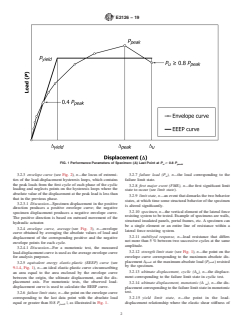
FIG. 1 Performance Parameters of Specimen: (A) Last Point at P $ 0.8 P
u peak
3.2.3 envelope curve (see Fig. 2),n—the locus of extremi- 3.2.7 failure load (P ), n—the load corresponding to the
u
ties of the load-displacement hysteresis loops, which contains failure limit state.
the peak loads from the first cycle of each phase of the cyclic
3.2.8 first major event (FME), n—the first significant limit
loading and neglects points on the hysteresis loops where the
state to occur (see limit state).
absolute value of the displacement at the peak load is less than
3.2.9 limit state, n—an event that demarks the two behavior
that in the previous phase.
states, at which time some structural behavior of the specimen
3.2.3.1 Discussion—Specimen displacement in the positive
is altered significantly.
direction produces a positive envelope curve; the negative
3.2.10 specimen, n—the vertical element of the lateral force
specimen displacement produces a negative envelope curve.
resisting system to be tested. Example of specimens are walls,
The positive direction is based on outward movement of the
structural insulated panels, portal frames, etc. A specimen can
hydraulic actuator.
be a single element or an entire line of resistance within a
3.2.4 envelope curve, average (see Fig. 3),n—envelope
lateral force resisting system.
curve obtained by averaging the absolute values of load and
3.2.11 stabilized response, n—load resistance that differs
displacement of the corresponding positive and the negative
not more than 5 % between two successive cycles at the same
envelope points for each cycle.
amplitude.
3.2.4.1 Discussion—For a monotonic test, the measured
3.2.12 strength limit state (see Fig. 1),n—the point on the
load-displacement curve is used as the average envelope curve
envelope curve corresponding to the maximum absolute dis-
for analysis purposes.
placement ∆ at the maximum absolute load (P ) resisted
peak peak
3.2.5 equivalent energy elastic-plastic (EEEP) curve (see
by the specimen.
9.1.4, Fig. 1),n—an ideal elastic-plastic curve circumscribing
3.2.13 ultimate displacement, cyclic (∆ ), n—the displace-
an area equal to the area enclosed by the envelope curve
u
ment corresponding to the failure limit state in cyclic test.
between the origin, the ultimate displacement, and the dis-
placement axis. For monotonic tests, the observed load-
3.2.14 ultimate displacement, monotonic (∆ ), n—the dis-
m
displacement curve is used to calculate the EEEP curve. placement corresponding to the failure limit state in monotonic
test.
3.2.6 failure limit state, n—the point on the envelope curve
corresponding to the last data point with the absolute load 3.2.15 yield limit state, n—the point in the load-
equal or greater than |0.8 P |, as illustrated in Fig. 1. displacement relationship where the elastic shear stiffness of
peak
E2126 − 19
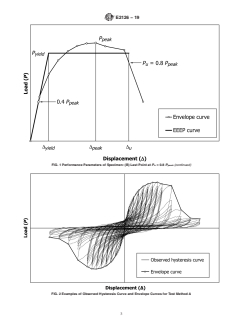
FIG. 1 Performance Parameters of Specimen: (B) Last Point at P =0.8 P (continued)
u peak
FIG. 2 Examples of Observed Hysteresis Curve and Envelope Curves for Test Method A
E2126 − 19
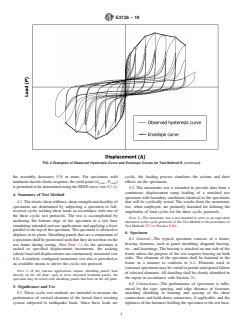
FIG. 2 Examples of Observed Hysteresis Curve and Envelope Curves for Test Method B (continued)
the assembly decreases 5 % or more. For specimens with cyclic, the loading process simulates the actions and their
nonlinearductileelasticresponse,theyieldpoint(∆ ,P ) effects on the specimens.
yield yield
ispermittedtobedeterminedusingtheEEEPcurve(see9.1.4).
5.2 The monotonic test is intended to provide data from a
continuous displacement ramp loading of a matched test
4. Summary of Test Method
specimen with boundary conditions identical to the specimens
4.1 Theelasticshearstiffness,shearstrengthandductilityof
that will be cyclically tested. The results from the monotonic
specimens are determined by subjecting a specimen to full-
test, when employed, are primarily intended for defining the
reversal cyclic racking shear loads in accordance with one of
amplitudes of load cycles for the three cyclic protocols.
the three cyclic test protocols. The test is accomplished by
NOTE 2—The monotonic test is not intended to serve as an equivalent
anchoring the bottom edge of the specimen to a test base
alternative to the cyclic protocols of thisTest Method or the procedures of
simulating intended end-use applications and applying a force
Test Methods E72 or Practice E564.
parallel to the top of the specimen. The specimen is allowed to
6. Specimen
displace in its plane. Sheathing panels that are a component of
6.1 General—The typical specimen consists of a frame,
aspecimenshallbepositionedsuchthattheydonotbearonthe
bracing elements, such as panel sheathing, diagonal bracing,
test frame during testing. (See Note 1.) As the specimen is
etc., and fastenings. The bracing is attached on one side of the
racked to specified displacement increments, the racking
frame unless the purpose of the test requires bracing on both
(shear) load and displacements are continuously measured (see
sides. The elements of the specimen shall be fastened to the
8.8).Asimilarly configured monotonic test also is provided as
frame in a manner to conform to 6.2. Elements used to
an available means to derive the cyclic test protocol.
constructspecimensmaybevariedtopermitanticipatedfailure
NOTE 1—If the end-use applications require sheathing panels bear
of selected elements.All detailing shall be clearly identified in
directly on the sill plate, such as most structural insulated panels, the
the report in accordance with Section 10.
specimen may be tested with sheathing panels that bear on the sill plate.
6.2 Connections—The performance of specimens is influ-
5. Significance and Use
enced by the type, spacing, and edge distance of fasteners
5.1 These cyclic test methods are intended to measure the attaching sheathing to framing and spacing of the shear
performance of vertical elements of the lateral force resisting connections and hold-down connectors, if applicable, and the
system subjected to earthquake loads. Since these loads are tightness of the fasteners holding the specimen to the test base.
E2126 − 19
FIG. 2 Examples of Observed Hysteresis Curve and Envelope Curves for Test Method C (continued)
FIG. 3 Example of Average Envelope Curve (see Fig. 2, Test Method C)
E2126 − 19
6.2.1 Sheathing Panel Attachments—All panel attachments 6.3.1.2 All Other Systems with Wood Framing—The critical
shall be consistent with the types used in actual building wood framing members to be measured shall be those that
construction. Structural details, such as fastener schedules, directly contribute to the in-plane shear strength and stiffness
fastener edge distance, and the gap between panels, shall be of the specimen. No individual framing member shall exceed
reported in accordance with Section 10. the published reference specific gravity by more than 10 %.
6.2.2 Attachment to the Test Base—Specimen shall be at-
NOTE 4—Test Methods D2395, Method G, is sometimes useful for an
tached to the test base with fasteners in a manner representing
approximate specific gravity determination that can be used to pre-sort
field conditions. For intended use requirements over a non-
materials prior to constructing a specimen. While it does not provide a
direct correlation to Test Methods D2395, MethodsAor B, for any given
rigid foundation, a mock-up flexible base shall be constructed
piece, it can help to predict the average oven-dry specific gravity of the
to simulate field conditions. Consideration shall be given to the
framing prior to building the specimen. Published reference values for
orientation and type of floor joists relative to the orientation of
specific gravity can be found in documents such as the ANSI/AWC NDS
the wall assembly. When strap connections are used, they shall
and CSA O86.
be installed (that is, inside/outside the sheathing, etc.) without
6.3.2 For steel or other metal framing members, record the
pre-tension in a configuration that simulates the field applica-
material specifications and thickness.
tion. The test report shall include details regarding this attach-
ment. 6.4 Structural Insulated Panel—The panel is prefabricated
assembly consisting of an insulating core of 1.5 in. (38 mm)
6.2.3 Anchor and Hold-Down Bolts—When the specimen
minimum sandwiched between two facings. The assembly is
frame is made of solid wood or wood-based composites, the
constructed by attaching panels together and to top and bottom
anchorboltsshallbetightenedtonomorethanfingertightplus
plates or tracks.
a ⁄8 turn, provided that the design value of stress perpendicular
to the grain is not exceeded. The hold-down bolts shall be
6.5 Specimen Size—The specimen shall have a height and
tightened consistently between replicates in accordance with
length or aspect (height/length) ratio that is consistent with
hold-down manufacturer’s recommendation.The assembly test
intended use requirements in actual building construction (see
shall not start within 10 min of the anchor bolt tightening to
Fig. 4).
allow for stress relaxation of the anchor.
7. Test Setup
NOTE 3—Since solid wood and wood-based composites relax over time
as well as potentially shrink due to changing moisture content, the intent
7.1 The specimen shall be tested such that all elements and
of the finger tight plus a ⁄8 turn is to avoid any significant pre-tension on
sheathing surfaces are observable. For specimens such as
the anchor bolts, which may affect the test results. It is the committee
judgment that the maximum bolt tension should not be more than 300 lbf
framed walls with sheathing on both faces of framing or
(1.33 kN) for the purpose of ensuring the bolt is not caught on a thread or
frameless structural insulated panels, the specimens are dis-
not seated fully. It should be noted that, however, the bolt tension depends
mantled after tests to permit observation of all elements.
onwoodspeciesanddensity,boltthreadpitch(orboltdiameter),andplate
washer size.Ageneral rule of thumb is to finger-tight plus ⁄8 turn, which
7.2 The bottom of the specimen shall be attached to a test
will result in a nut displacement of approximately 0.01 in. (0.254 mm) for
base as specified in 6.2. The test apparatus shall support the
1 5
⁄2 and ⁄8 in. diameter (12.7 and 15.9 mm diameter) UNC bolts.Atorque
specimen as necessary to prevent displacement from the plane
of about 50 lbf-in. (5.65 kN-mm) without bolt lubrication would normally
of the specimen, but in-plane displacement shall not be
produce 300 lbf (1.33 kN) of bolt tension.
restricted.
6.3 Frame Requirements—The frame of the specimen shall
7.3 Racking load shall be applied horizontally along the
consist of materials representative of those to be used in the
plane of the specimen using a double-acting hydraulic actuator
actual building construction. The connections of these mem-
with a load cell. The load shall be distributed along the top of
bers shall be consistent with those intended in actual building
the specimen by means of a loading beam or other adequate
construction.
devices.Thebeamusedtotransferloadsbetweenthehydraulic
6.3.1 For wood framing members, record the species and
cylinder and the test specimen shall be selected so that it does
grade of lumber used or the relevant product identification
not contribute to the measured racking strength and stiffness.
information for structural composite lumber framing; moisture
content of the framing members at the time of the specimen 7.3.1 If applied to the top of the specimen directly, for
example, as is shown in Fig. 5, the maximum stiffness of load
fabrication and testing, if more than 24 h passes between these
2 2
operations (use Test Methods D4442, Methods A or B; or beam permitted is 330 000 kips-in. (947 kN-m ).
Practice D7438); and specific gravity of the critical framing
NOTE 5—The selected stiffness corresponds with an HSS 5 by 3 by ⁄4
members (use Test Methods D2395, Methods A or B). The
in. (127 by 76 by 6.4 mm) steel section. Other sections with equal or less
measured average oven-dry specific gravity of the critical
stiffness have been successfully employed.
framing members shall be representative of the reference
7.3.2 The load beam selected shall not be continuous over
published specific gravity as outlined below:
discontinuities in the test specimen.
6.3.1.1 Light-frame Wood Stud Shearwalls with Structural
NOTE 6—Examples of discontinuities include portal frame openings,
Panel Sheathing—The critical members to be measured shall
wall perforations, transitions between differential bracing types, etc.
be those that receive perimeter sheathing fasteners at the
Continuation of a rigid load beam over these discontinuities can add to the
sheathing panel boundaries. The measured average oven-dry
measured in-plane rigidity of the system. However, the use of continuous
specific gravity of these members shall not exceed the pub-
load beam over discontinuities may be considered provided that the added
lished reference specific gravity by more than 0.03. in-plane rigidity can be justified by the end-use applications.
E2126 − 19
FIG. 4 An Example of Shear Wall Specimen
7.3.3 The combined gravity load applied to the specimen by cyclic test displacement cycle amplitudes, at least one mono-
the load beam and actuator shall be less than 350 lbf (1.56 kN), tonic test shall be conducted.
unless the purpose of the test includes the influence of vertical
8.2 The cyclic displacement of the actuator shall be con-
loads on the system performance (see Appendix X3).
trolled to follow a cyclic displacement schedule described in
7.4 Testsetupshallbedesignedandinstalledsothatvertical
either 8.3 (Test Method A), 8.4 (Test Method B), or 8.5 (Test
(gravity)loadsfromtestequipmentappliedtothespecimenare
Method C). Monotonic displacement of the actuator shall be
negligible. Other vertical loads shall not be added to the
controlled to follow the continuous ramp described in 8.6 (Test
specimen unless justified by analysis of actual building con-
Method D).
structionortheobjectiveofthetesting.Whenverticalloadsare
8.3 Test Method A (Sequential-Phased Displacement Proce-
applied, the magnitude and test setup for the vertical load shall
dure):
be reported along with the justification.
8.3.1 Sequential Phased Displacement (SPD) Loading
NOTE 7—The neglect of vertical loads in this standard may result in
Protocol—Displacement-controlled loading procedure that in-
inaccurate estimates of the capacity of the specimen as an element of the
volves displacement cycles grouped in phases at incrementally
lateral force resisting system in actual building construction. For example,
increasing displacement levels. The cycles shall form either a
the neglect of uplift forces in testing may overestimate the racking
sinusoidal wave or a triangular wave. The SPD loading
capacity of the element, while the neglect of dead weight of the story
above may underestimate the racking capacity of the element unless consists of two displacement patterns and is illustrated in Fig.
buckling is the predominant failure mode.
6. The first displacement pattern consists of three phases, each
containing three fully-reversing cycles of equal amplitude, at
8. Procedure
displacements representing 25 %, 50 %, and 75 % of antici-
8.1 Number of Tests—A minimum of two specimens of a pated FME. The second displacement pattern is illustrated in
given construction shall be tested cyclically if the shear Fig. 7. Each phase is associated with a respective displacement
strength (v ) values of each specimen calculated according level and contains one initial cycle, three decay cycles, and a
peak
to9.1.1arewithin10 %ofeachother.Thelowerofthetwotest number of stabilization cycles. For nailed wood-frame walls,
values shall be used to calculate the 10 % allowance. three stabilization cycles are sufficient to obtain a stabilized
Otherwise, at least three specimens of a given construction response. The amplitude of each consecutive decay cycle
shall be cyclically tested. When required to initially define the decreases by 25 % of the initial displacement.
E2126 − 19
FIG. 5 An Example of Test Setup for Shear Wall Specimen
FIG. 6 Cyclic Displacement Schedule (Test Method A)
E2126 − 19
FIG. 7 Single Phase of Pattern 2 (Test Method A)
FIG. 8 Cyclic Displacement Schedule (Test Method B)
8.3.2 The schedule of amplitude increments between the 8.4.1 ISO Displacement Schedule—Displacement-
sequential phases is given in Table 1. The amplitude incre-
controlled loading procedure that involves displacement cycles
ments selected for the SPD procedure are based on the FME
grouped in phases at incrementally increasing displacement
determined from the monotonic test on an identical specimen
levels. The ISO loading schedule consists of two displacement
in accordance with Test Method D. To determine ∆ ,itis
yield patterns and is illustrated in Fig. 8. The first displacement
permitted to compute EEEP curves, as shown in Fig. 1 based
pattern consists of five single fully reversed cycles at displace-
on monotonic test data, in accordance with 9.1.4.
ments of 1.25 %, 2.5 %, 5 %, 7.5 %, and 10 % of the ultimate
8.4 Test Method B (ISO 16670 Protocol): displacement ∆ . The second displacement pattern consists of
m
E2126 − 19
FIG. 9 Cyclic Displacement Pattern (Test Method C)
TABLE 1 Test Method A—Amplitudes of Initial Cycles
Minimum
Amplitude of Initial Cycle
Pattern Step Number
% FME
A
of Cycles
11 3 25
23 50
33 75
2 4 7 100
5 7 125
6 7 150
7 7 175
8 7 200
9 7 250
10 7 300
11 7 350
12 Additional increments of
50 (until specimen failure)
A
See 8.3.1 for details.
phases, each containing three fully reversed cycles of equal amplitude expressed as a fraction (percent) of the reference
amplitude, at displacements of 20 %, 40 %, 60 %, 80 %, deformation, ∆, and subsequent trailing cycles with amplitude
100 %, and 120 % of the ultimate displacement ∆ . of 75 % of the primary one.
m
8.4.2 Thesequenceofamplitudes,whichisgiveninTable2,
NOTE 8—The initiation cycles serve to check loading equipment,
are a function of the mean value (where applicable) of the
measurement devices, and the force-deformation response at small am-
ultimate displacement (∆ ) obtained from the monotonic tests
plitudes.
m
on a matched specimen in accordance with Test Method D.
8.5.2 The schedule of amplitude increments is given in
8.5 Test Method C (CUREE Basic Loading Protocol): Table 3 and is illustrated in Fig. 9. The reference deformation
8.5.1 CUREE Basic Loading Protocol—Displacement- ∆ shall be an estimate of the maximum displacement at which
controlled loading procedure that involves displacement cycles theloadinaprimarycyclehasnotyetdroppedbelow0.8P .
peak
grouped in phases at incrementally increasing displacement The value of∆ shall not exceed 0.025 times the wall height. In
levels.The loading history starts with a series of (six) initiation the absence of previous data or a consensus value, an initial
cycles at small amplitudes (of equal amplitude). Further, each esti
...
This document is not an ASTM standard and is intended only to provide the user of an ASTM standard an indication of what changes have been made to the previous version. Because
it may not be technically possible to adequately depict all changes accurately, ASTM recommends that users consult prior editions as appropriate. In all cases only the current version
of the standard as published by ASTM is to be considered the official document.
Designation: E2126 − 11 (Reapproved 2018) E2126 − 19
Standard Test Methods for
Cyclic (Reversed) Load Test for Shear Resistance of Vertical
Elements of the Lateral Force Resisting Systems for
Buildings
This standard is issued under the fixed designation E2126; the number immediately following the designation indicates the year of
original adoption or, in the case of revision, the year of last revision. A number in parentheses indicates the year of last reapproval. A
superscript epsilon (´) indicates an editorial change since the last revision or reapproval.
1. Scope
1.1 These test methods cover the evaluation of the shear stiffness, shear strength, and ductility of the vertical elements of lateral
force resisting systems, including applicable shear connections and hold-down connections, under quasi-static cyclic (reversed)
load conditions.
1.2 These test methods are intended for specimens constructed from wood or metal framing braced with solid sheathing or other
methods or structural insulated panels.
1.3 The values stated in inch-pound units are to be regarded as standard. The values given in parentheses are mathematical
conversions to SI units that are provided for information only and are not considered standard.
1.4 This standard does not purport to address all of the safety concerns, if any, associated with its use. It is the responsibility
of the user of this standard to establish appropriate safety, health, and environmental practices and determine the applicability of
regulatory limitations prior to use.
1.5 This international standard was developed in accordance with internationally recognized principles on standardization
established in the Decision on Principles for the Development of International Standards, Guides and Recommendations issued
by the World Trade Organization Technical Barriers to Trade (TBT) Committee.
2. Referenced Documents
2.1 ASTM Standards:
D2395 Test Methods for Density and Specific Gravity (Relative Density) of Wood and Wood-Based Materials
D4442 Test Methods for Direct Moisture Content Measurement of Wood and Wood-Based Materials
D4444D7438 Test Method for Laboratory Standardization and CalibrationPractice for Field Calibration and Application of
Hand-Held Moisture Meters
E72 Test Methods of Conducting Strength Tests of Panels for Building Construction
E564 Practice for Static Load Test for Shear Resistance of Framed Walls for Buildings
E575 Practice for Reporting Data from Structural Tests of Building Constructions, Elements, Connections, and Assemblies
E631 Terminology of Building Constructions
2.2 ISO Standard:
ISO 16670 Timber Structures—Joints Made with Mechanical Fasteners—Quasi-static Reversed-cyclic Test Method
2.3 Other Standards:
4 4
ANSI/AF&PA NDSANSI/AWC NDS National Design Specification for Wood Construction
CSA O86 Engineering Design in Wood
These test methods are under the jurisdiction of ASTM Committee E06 on Performance of Buildings and are the direct responsibility of Subcommittee E06.11 on
Horizontal and Vertical Structures/Structural Performance of Completed Structures.
Current edition approved July 1, 2018Aug. 1, 2019. Published July 2018August 2019. Originally approved in 2001. Last previous edition approved in 20112018 as
E2126 – 11.E2126–11 (2018). DOI: 10.1520/E2126-11R18.10.1520/E2126–19.
For referenced ASTM standards, visit the ASTM website, www.astm.org, or contact ASTM Customer Service at service@astm.org. For Annual Book of ASTM Standards
volume information, refer to the standard’s Document Summary page on the ASTM website.
Available from International Organization for Standardization (ISO), ISO Central Secretariat, BIBC II, Chemin de Blandonnet 8, CP 401, 1214 Vernier, Geneva,
Switzerland, http://www.iso.org.
Available from American Forest & Paper Association (AF&PA), 1101 K St., NW, Suite 700, Washington, DC 20005, http://www.afandpa.org.A registered trademark of
and available from American Wood Council, 222 Catoctin Circle SE, Suite 201, Leesburg, VA 20175, https://www.awc.org.
Available from CSA Group, 178 Rexdale Blvd. Toronto, ON Canada M9W 1R3, Canada, http://www.csagroup.org.
Copyright © ASTM International, 100 Barr Harbor Drive, PO Box C700, West Conshohocken, PA 19428-2959. United States
E2126 − 19
3. Terminology
3.1 For definitions of terms used in this standard, see Terminology E631.
3.2 Definitions of Terms Specific to This Standard:
3.2.1 ductility ratio, cyclic (D), n—the ratio of the ultimate displacement (Δ ) and the yield displacement (Δ ) of a specimen
u yield
observed in cyclic test.
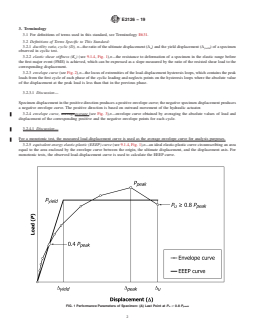
3.2.2 elastic shear stiffness (K ) (see 9.1.4, Fig. 1),n—the resistance to deformation of a specimen in the elastic range before
e
the first major event (FME) is achieved, which can be expressed as a slope measured by the ratio of the resisted shear load to the
corresponding displacement.
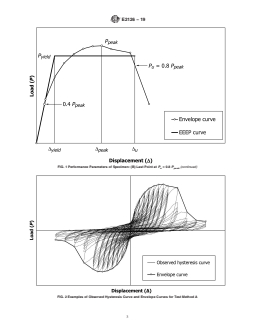
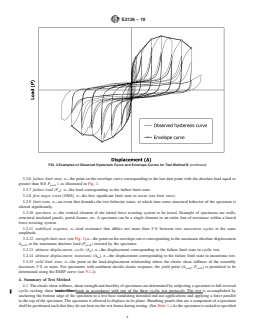
3.2.3 envelope curve (see Fig. 2),n—the locus of extremities of the load-displacement hysteresis loops, which contains the peak
loads from the first cycle of each phase of the cyclic loading and neglects points on the hysteresis loops where the absolute value
of the displacement at the peak load is less than that in the previous phase.
3.2.3.1 Discussion—
Specimen displacement in the positive direction produces a positive envelope curve; the negative specimen displacement produces
a negative envelope curve. The positive direction is based on outward movement of the hydraulic actuator.
3.2.4 envelope curve, averageaverage (see Fig. 3),n—envelope curve obtained by averaging the absolute values of load and
displacement of the corresponding positive and the negative envelope points for each cycle.
3.2.4.1 Discussion—
For a monotonic test, the measured load-displacement curve is used as the average envelope curve for analysis purposes.
3.2.5 equivalent energy elastic-plastic (EEEP) curve (see 9.1.4, Fig. 1),n—an ideal elastic-plastic curve circumscribing an area
equal to the area enclosed by the envelope curve between the origin, the ultimate displacement, and the displacement axis. For
monotonic tests, the observed load-displacement curve is used to calculate the EEEP curve.
FIG. 1 Performance Parameters of Specimen: (A) Last Point at P $ 0.8 P
u peak
E2126 − 19
FIG. 1 Performance Parameters of Specimen: (B) Last Point at P = 0.8 P (continued)
u peak
FIG. 2 Examples of Observed Hysteresis Curve and Envelope Curves for Test Method A
E2126 − 19
FIG. 2 Examples of Observed Hysteresis Curve and Envelope Curves for Test Method B (continued)
3.2.6 failure limit state, n—the point on the envelope curve corresponding to the last data point with the absolute load equal or
greater than |0.8 P |, as illustrated in Fig. 1.
peak
3.2.7 failure load (P ), n—the load corresponding to the failure limit state.
u
3.2.8 first major event (FME), n—the first significant limit state to occur (see limit state).
3.2.9 limit state, n—an event that demarks the two behavior states, at which time some structural behavior of the specimen is
altered significantly.
3.2.10 specimen, n—the vertical element of the lateral force resisting system to be tested. Example of specimens are walls,
structural insulated panels, portal frames, etc. A specimen can be a single element or an entire line of resistance within a lateral
force resisting system.
3.2.11 stabilized response, n—load resistance that differs not more than 5 % between two successive cycles at the same
amplitude.
3.2.12 strength limit state (see Fig. 1),n—the point on the envelope curve corresponding to the maximum absolute displacement
Δ at the maximum absolute load (P ) resisted by the specimen.
peak peak
3.2.13 ultimate displacement, cyclic (Δ ), n—the displacement corresponding to the failure limit state in cyclic test.
u
3.2.14 ultimate displacement, monotonic (Δ ), n—the displacement corresponding to the failure limit state in monotonic test.
m
3.2.15 yield limit state, n—the point in the load-displacement relationship where the elastic shear stiffness of the assembly
decreases 5 % or more. For specimens with nonlinear ductile elastic response, the yield point (Δ , P ) is permitted to be
yield yield
determined using the EEEP curve (see 9.1.4).
4. Summary of Test Method
4.1 The elastic shear stiffness, shear strength and ductility of specimens are determined by subjecting a specimen to full-reversal
cyclic racking shear loads. This loads in accordance with one of the three cyclic test protocols. The test is accomplished by
anchoring the bottom edge of the specimen to a test base simulating intended end-use applications and applying a force parallel
to the top of the specimen. The specimen is allowed to displace in its plane. Sheathing panels that are a component of a specimen
shall be positioned such that they do not bear on the test frame during testing. (See Note 1.) As the specimen is racked to specified
E2126 − 19
FIG. 2 Examples of Observed Hysteresis Curve and Envelope Curves for Test Method C (continued)
FIG. 3 Example of Average Envelope Curve (see Fig. 2, Test Method C)
E2126 − 19
displacement increments, the racking (shear) load and displacements are continuously measured (see 8.78.8). A similarly
configured monotonic test also is provided as an available means to derive the cyclic test protocol.
NOTE 1—If the end-use applications require sheathing panels bear directly on the sill plate, such as most structural insulated panels, the specimen may
be tested with sheathing panels that bear on the sill plate.
5. Significance and Use
5.1 These cyclic test methods are intended to measure the performance of vertical elements of the lateral force resisting system
subjected to earthquake loads. Since these loads are cyclic, the loading process simulates the actions and their effects on the
specimens.
5.2 The monotonic test is intended to provide data from a continuous displacement ramp loading of a matched test specimen
with boundary conditions identical to the specimens that will be cyclically tested. The results from the monotonic test, when
employed, are primarily intended for defining the amplitudes of load cycles for the three cyclic protocols.
NOTE 2—The monotonic test is not intended to serve as an equivalent alternative to the cyclic protocols of this Test Method or the procedures of Test
Methods E72 or Practice E564.
6. Specimen
6.1 General—The typical specimen consists of a frame, bracing elements, such as panel sheathing, diagonal bracing, etc., and
fastenings. The bracing is attached on one side of the frame unless the purpose of the test requires bracing on both sides. The
elements of the specimen shall be fastened to the frame in a manner to conform to 6.2. Elements used to construct specimens may
be varied to permit anticipated failure of selected elements. All detailing shall be clearly identified in the report in accordance with
Section 10.
6.2 Connections—The performance of specimens is influenced by the type, spacing, and edge distance of fasteners attaching
sheathing to framing and spacing of the shear connections and hold-down connectors, if applicable, and the tightness of the
fasteners holding the specimen to the test base.
6.2.1 Sheathing Panel Attachments—All panel attachments shall be consistent with the types used in actual building
construction. Structural details, such as fastener schedules, fastener edge distance, and the gap between panels, shall be reported
in accordance with Section 10.
6.2.2 Attachment to the Test Base—Specimen shall be attached to the test base with fasteners in a manner representing field
conditions. For intended use requirements over a non-rigid foundation, a mock-up flexible base shall be constructed to simulate
field conditions. Consideration shall be given to the orientation and type of floor joists relative to the orientation of the wall
assembly. When strap connections are used, they shall be installed (that is, inside/outside the sheathing, etc.) without pre-tension
in a configuration that simulates the field application. The test report shall include details regarding this attachment.
6.2.3 Anchor and Hold-Down Bolts—When the specimen frame is made of solid wood or wood-based composites, the anchor
bolts shall be tightened to no more than finger tight plus a ⁄8 turn, provided that the design value of stress perpendicular to the
grain is not exceeded (see exceeded. Note 2). The hold-down bolts shall be tightened consistently between replicates in accordance
with hold-down manufacturer’s recommendation. The assembly test shall not start within 10 min of the anchor bolt tightening to
allow for stress relaxation of the anchor.
NOTE 3—Since solid wood and wood-based composites relax over time as well as potentially shrink due to changing moisture content, the intent of
the finger tight plus a ⁄8 turn is to avoid any significant pre-tension on the anchor bolts, which may affect the test results. It is the committee judgment
that the maximum bolt tension should not be more than 300 lbf (1.33 kN) for the purpose of ensuring the bolt is not caught on a thread or not seated
fully. It should be noted that, however, the bolt tension depends on wood species and density, bolt thread pitch (or bolt diameter), and plate washer size.
1 1
A general rule of thumb is to finger-tight plus ⁄8 turn, which will result in a nut displacement of approximately 0.01 in. (0.254 mm) for ⁄2 and
⁄8-in.-diameter in. diameter (12.7 and 15.9-mm-diameter) 15.9 mm diameter) UNC bolts. A torque of about 50 lbf-in. (5.65 kN-mm) without bolt
lubrication would normally produce 300 lbf (1.33 kN) of bolt tension.
6.3 Frame Requirements—The frame of the specimen shall consist of materials representative of those to be used in the actual
building construction. The connections of these members shall be consistent with those intended in actual building construction.
6.3.1 For wood framing members, record the species and grade of lumber used (oror the relevant product identification
information for structural composite lumber framing);framing; moisture content of the framing members at the time of the
specimen fabrication and testing, if more than 24 h passes between these operations (see(use Test Methods D4442, Test Methods
A or B; or D4444,Practice D7438Test Methods A or B); ); and specific gravity of the critical framing members (see(use Test
Methods D2395, Test Method A). The Methods A or B). The measured average oven-dry specific gravity of the critical framing
members shall be representative of the reference published specific gravity for the product with no individual member exceeding
the published value by more that 10 % (see ANSI/AF&PA NDS for example).as outlined below:
6.3.1.1 Light-frame Wood Stud Shearwalls with Structural Panel Sheathing—The critical members to be measured shall be
those that receive perimeter sheathing fasteners at the sheathing panel boundaries. The measured average oven-dry specific gravity
of these members shall not exceed the published reference specific gravity by more than 0.03.
E2126 − 19
6.3.1.2 All Other Systems with Wood Framing—The critical wood framing members to be measured shall be those that directly
contribute to the in-plane shear strength and stiffness of the specimen. No individual framing member shall exceed the published
reference specific gravity by more than 10 %.
NOTE 4—Test Methods D2395, Method G, is sometimes useful for an approximate specific gravity determination that can be used to pre-sort materials
prior to constructing a specimen. While it does not provide a direct correlation to Test Methods D2395, Methods A or B, for any given piece, it can help
to predict the average oven-dry specific gravity of the framing prior to building the specimen. Published reference values for specific gravity can be found
in documents such as the ANSI/AWC NDS and CSA O86.
6.3.2 For steel or other metal framing members, record the material specifications and thickness.
6.4 Structural Insulated Panel—The panel is prefabricated assembly consisting of an insulating core of 1.5 in. (38 mm)
minimum sandwiched between two facings. The assembly is constructed by attaching panels together and to top and bottom plates
or tracks.
6.5 Specimen Size—The specimen shall have a height and length or aspect (height/length) ratio that is consistent with intended
use requirements in actual building construction (see Fig. 4).
7. Test Setup
7.1 The specimen shall be tested such that all elements and sheathing surfaces are observable. For specimens such as framed
walls with sheathing on both faces of framing or frameless structural insulated panels, the specimens are dismantled after tests to
permit observation of all elements.
7.2 The bottom of the specimen shall be attached to a test base as specified in 6.2. The test apparatus shall support the specimen
as necessary to prevent displacement from the plane of the specimen, but in-plane displacement shall not be restricted.
7.3 Racking load shall be applied horizontally along the plane of the specimen using a double-acting hydraulic actuator with
a load cell. The load shall be distributed along the top of the specimen by means of a loading beam or other adequate devices. The
beam used to transfer loads between the hydraulic cylinder and the test specimen shall be selected so that it does not contribute
to the measured racking strength and stiffness.
7.3.1 If applied to the top of the specimen directly, for example, as is shown in Fig. 5, the maximum stiffness of load beam
2 2
permitted is 330 000 kips-in. (947 kN-m ) (see Note 3).
FIG. 4 An Example of Shear Wall Specimen
E2126 − 19
FIG. 5 An Example of Test Setup for Shear Wall Specimen
NOTE 5—The selected stiffness corresponds with an HSS 5 ×by 3 ×by ⁄4-in. in. (127 × 76 × 6.4-mm) by 76 by 6.4 mm) steel section. Other sections
with equal or less stiffness have been successfully employed.
7.3.2 The load beam selected shall not be continuous over discontinuities in the test specimen (see specimen.Note 4).
NOTE 6—Examples of discontinuities include portal frame openings, wall perforations, transitions between differential bracing types, etc. Continuation
of a rigid load beam over these discontinuities can add to the measured in-plane rigidity of the system. However, the use of continuous load beam over
discontinuities may be considered provided that the added in-plane rigidity can be justified by the end-use applications.
7.3.3 The combined gravity load applied to the specimen by the load beam and actuator shall be less than 350 lbf (1.56 kN),
unless the purpose of the test includes the influence of vertical loads on the system performance (see Appendix X3).
7.4 Test setup shall be designed and installed so that vertical (gravity) loads from test equipment applied to the specimen are
negligible. Other vertical loads shall not be added to the specimen unless justified by analysis of actual building construction or
the objective of the testing. When vertical loads are applied, the magnitude and test setup for the vertical load shall be reported
along with the justification.
NOTE 7—The neglect of vertical loads in this standard may result in inaccurate estimates of the capacity of the specimen as an element of the lateral
force resisting system in actual building construction. For example, the neglect of uplift forces in testing may overestimate the racking capacity of the
element, while the neglect of dead weight of the story above may underestimate the racking capacity of the element unless buckling is the predominant
failure mode.
8. Procedure
8.1 Number of Tests—A minimum of two specimens of a given construction shall be tested cyclically if the shear strength (v )
peak
values of each specimen calculated according to 9.1.1 are within 10 % of each other. The lower of the two test values shall be used
to calculate the 10 % allowance. Otherwise, at least three specimens of a given construction shall be tested.cyclically tested. When
required to initially define the cyclic test displacement cycle amplitudes, at least one monotonic test shall be conducted.
E2126 − 19
8.2 The cyclic displacement of the actuator shall be controlled to follow a cyclic displacement procedureschedule described in
either 8.3 (Test Method A), 8.4 (Test Method B), or 8.5 (Test Method C). Monotonic displacement of the actuator shall be
controlled to follow the continuous ramp described in 8.6 (Test Method D).
8.3 Test Method A (Sequential-Phased Displacement Procedure):
8.3.1 Sequential Phased Displacement (SPD) Loading Protocol—Displacement-controlled loading procedure that involves
displacement cycles grouped in phases at incrementally increasing displacement levels. The cycles shall form either a sinusoidal
wave or a triangular wave. The SPD loading consists of two displacement patterns and is illustrated in Fig. 6. The first displacement
pattern consists of three phases, each containing three fully-reversing cycles of equal amplitude, at displacements representing
25 %, 50 %, and 75 % of anticipated FME. The second displacement pattern is illustrated in Fig. 7. Each phase is associated with
a respective displacement level and contains one initial cycle, three decay cycles, and a number of stabilization cycles. For nailed
wood-frame walls, three stabilization cycles are sufficient to obtain a stabilized response. The amplitude of each consecutive decay
cycle decreases by 25 % of the initial displacement.
8.3.2 The schedule of amplitude increments between the sequential phases is given in Table 1. The amplitude increments
selected for the SPD procedure are based on the FME determined from the static monotonic load test on an identical specimen in
accordance with PracticeTest E564. Method D. To determine Δ , it is permitted to compute EEEP curves, as shown in Fig. 1
yield
based on monotonic test data, in accordance with 9.1.4.
8.4 Test Method B (ISO 16670 Protocol):
8.4.1 ISO Displacement Schedule—Displacement-controlled loading procedure that involves displacement cycles grouped in
phases at incrementally increasing displacement levels. The ISO loading schedule consists of two displacement patterns and is
illustrated in Fig. 8. The first displacement pattern consists of five single fully reversed cycles at displacements of 1.25 %, 2.5 %,
5 %, 7.5 %, and 10 % of the ultimate displacement Δ . The second displacement pattern consists of phases, each containing three
m
fully reversed cycles of equal amplitude, at displacements of 20 %, 40 %, 60 %, 80 %, 100 %, and 120 % of the ultimate
displacement Δ .
m
8.4.2 The sequence of amplitudes, which is given in Table 2, are a function of the mean value (where applicable) of the ultimate
displacement (Δ ) obtained from matched specimens in the monotonic tests on a matched specimen in accordance with
m
PracticeTest E564.Method D.
8.5 Test Method C (CUREE Basic Loading Protocol):
8.5.1 CUREE Basic Loading Protocol—Displacement-controlled loading procedure that involves displacement cycles grouped
in phases at incrementally increasing displacement levels. The loading history starts with a series of (six) initiation cycles at small
amplitudes (of equal amplitude). Further, each phase of the loading history consists of a primary cycle with amplitude expressed
as a fraction (percent) of the reference deformation, Δ, and subsequent trailing cycles with amplitude of 75 % of the primary one.
NOTE 8—The initiation cycles serve to check loading equipment, measurement devices, and the force-deformation response at small amplitudes.
FIG. 6 Cyclic Displacement Schedule (Test Method A)
E2126 − 19
FIG. 7 Single Phase of Pattern 2 (Test Method A)
FIG. 8 Cyclic Displacement Schedule (Test Method B)
8.5.2 The schedule of amplitude increments is given in Table 3 and is illustrated in Fig. 9. The reference deformation Δ shall
be an estimate of the maximum displacement at which the load in a primary cycle has not yet dropped below 0.8 P . The value
peak
of Δ shall not exceed 0.025 times the wall height. In the absence of previous data or a consensus value, an initial estimate of the
maximum displacement shall be permitted to be obtained from a monotonic test on
...