

ASTM D6461/D6461M-22
(Specification)Standard Specifications for Silt Fence Materials
General Information
- Abstract
ABSTRACT
This specification covers requirements and test methods for geotextile fabrics and associated components used in temporary silt fence applications. It is applicable to the use of a geotextile as a vertical permeable interceptor designed to remove suspended soil from overland, nonconcentrated water flow. The function of a temporary silt fence is to trap and allow settlement of soil particles from sediment laden water. The purpose is to greatly limit the transport of eroded soil from the construction site by water runoff. Fibers used in the manufacture of geotextiles for silt fence, and the threads used in joining geotextiles by sewing, shall consist of long-chain synthetic polymers composed of at least 95 % by weight of polyolefins or polyester. They shall be formed into a stable network such that the filaments or yarns retain their dimensional stability relative to each other, including selvages. Geotextiles and related materials used for temporary silt fence shall conform with required grab strength, permittivity, apparent opening size, and ultraviolet stability. The prescribed support posts are described in the specification.
SCOPE
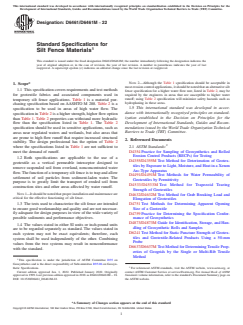
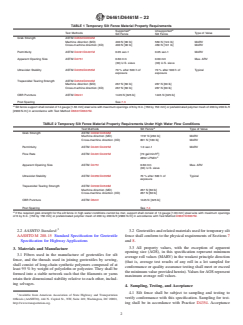
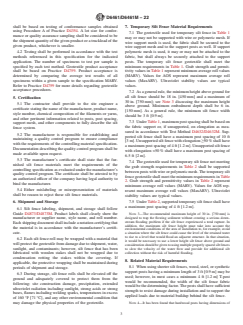
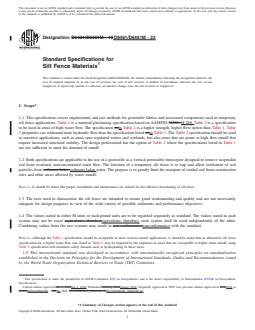
1.1 This specification covers requirements and test methods for geotextile fabrics and associated components used in temporary silt fence applications. Table 1 is a material purchasing specification based on AASHTO M 288. Table 2 is a specification to be used in areas of high water flow. The specification in Table 2 is a higher strength, higher flow option than Table 1. Table 2 properties can withstand more hydraulic flow than the specification listed in Table 1. The Table 2 specification should be used in sensitive applications, such as areas near regulated waters and wetlands, but also areas that are prone to high flow runoff that require increased structural stability. The design professional has the option of Table 2 where the specifications listed in Table 1 are not sufficient to meet the demand of runoff.
1.2 Both specifications are applicable to the use of a geotextile as a vertical permeable interceptor designed to remove suspended soil from overland, nonconcentrated water flow. The function of a temporary silt fence is to trap and allow settlement of soil particles from sediment-laden water. The purpose is to greatly limit the transport of eroded soil from construction sites and other areas affected by water runoff.
Note 1: It should be noted that proper installation and maintenance are critical for the effective functioning of silt fence.
1.3 The tests used to characterize the silt fence are intended to ensure good workmanship and quality and are not necessarily adequate for design purposes in view of the wide variety of possible sediments and performance objectives.
1.4 The values stated in either SI units or inch-pound units are to be regarded separately as standard. The values stated in each system may not be exact equivalents; therefore, each system shall be used independently of the other. Combining values from the two systems may result in nonconformance with the standard.
Note 2: Although the Table 1 specification should be acceptable in most erosion control applications, it should be noted that an alternative silt fence specification for a higher water flow rate, listed in Table 2, may be required by the engineers in areas that are susceptible to higher water runoff; using Table 2 specification will minimize safety hazards such as hydroplaning in these areas.
1.5 This international standard was developed in accordance with internationally recognized principles on standardization established in the Decision on Principles for the Development of International Standards, Guides and Recommendations issued by the World Trade Organization Technical Barriers to Trade (TBT) Committee.
- Status
- Published
- Publication Date
- 31-Dec-2021
- Technical Committee
- D35 - Geosynthetics
- Drafting Committee
- D35.06 - Geosynthetic Specifications

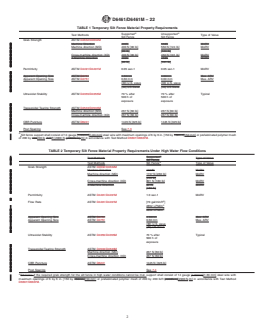
Overview
ASTM D6461/D6461M-22, Standard Specifications for Silt Fence Materials, establishes the requirements and test methods for geotextile fabrics and associated components designed for use in temporary silt fence applications. Silt fences function as vertical, permeable barriers that intercept overland, non-concentrated water flow to remove suspended soil, effectively controlling sediment transfer from areas undergoing construction or land disturbance. This standard covers both material properties and quality protocols to ensure consistent performance and environmental compliance.
Key Topics
- Geotextile Material Requirements: Specifies that geotextiles and sewing threads must consist of long-chain synthetic polymers (minimum 95% by weight polyolefins or polyester) arranged as a stable network for dimensional stability.
- Physical Property Standards: Silt fence fabrics must meet criteria for grab strength, permittivity, apparent opening size (AOS), ultraviolet (UV) stability, trapezoidal tearing strength, and puncture resistance.
- Support Structures: Details on the requirement for support posts (wood, steel, or synthetic), wire mesh, or polymeric mesh support backing, including specifications for post spacing based on supported or unsupported fabric installations.
- Testing and Conformance: Outlines sampling and testing methods for ensuring materials meet minimum average roll values (MARV), along with procedures for acceptance and quality control certifications.
- Dual Specification Tables:
- Table 1: Standard silt fence material property requirements based on AASHTO M288 for typical applications.
- Table 2: Enhanced properties for high-flow or sensitive environments, providing greater strength and higher hydraulic capacity.
Applications
- Construction Site Erosion Control: Temporary silt fences are essential components of sediment control plans for construction and infrastructure development projects, effectively minimizing the migration of eroded soils into waterways.
- Environmental Protection: Used near regulated waters and wetlands to avoid sediment pollution, particularly where high runoff or sensitive landscapes require additional structural integrity.
- Stormwater Management: Helps in controlling sediment during heavy rain or high-flow events, thereby reducing flood risks and safety hazards such as hydroplaning.
- Land Disturbance Projects: Applied wherever there is potential for soil displacement due to grading, excavation, or landscaping activities.
Proper installation and ongoing maintenance are critical to the effectiveness of silt fencing. Poorly installed or maintained silt fences may fail to trap sediment, leading to environmental compliance issues.
Related Standards
When implementing ASTM D6461/D6461M-22, the following documents provide complementary guidance and terminology for silt fence and geotextile selection:
- AASHTO M 288 - Geotextile Specification for Highway Applications
- ASTM D4355/D4355M - Test Method for Deterioration by Light, Moisture, and Heat
- ASTM D4491/D4491M - Water Permeability Testing by Permittivity
- ASTM D4632/D4632M - Grab Breaking Load and Elongation Testing
- ASTM D4751 - Determining Apparent Opening Size
- ASTM D6241 - Static Puncture Strength by 50-mm Probe
- ASTM D6637/D6637M - Tensile Properties of Geogrids
Practical Value
Adhering to ASTM D6461/D6461M-22 helps designers, engineers, and contractors reliably select and implement temporary silt fences that meet regulatory, environmental, and safety requirements.
- Assured Performance: Material specifications and certification requirements help guarantee silt fences will perform effectively in the intended application.
- Quality Control: Emphasis on manufacturer quality programs and standardized testing ensures product consistency and project compliance.
- Risk Mitigation: Use of the appropriate specification (standard or high-flow) minimises the likelihood of sediment runoff and related hazards.
Keywords: geotextile, silt fence, sediment control, erosion control, ASTM D6461, construction runoff, AASHTO M288, temporary barrier, environmental compliance, high-flow sediment control.
Relations
- Effective Date
- 15-Nov-2023
- Effective Date
- 01-May-2020
- Effective Date
- 01-Jan-2020
- Refers
ASTM D4491/D4491M-17 - Standard Test Methods for Water Permeability of Geotextiles by Permittivity - Effective Date
- 01-Jan-2017
- Refers
ASTM D4491/D4491M-16 - Standard Test Methods for Water Permeability of Geotextiles by Permittivity - Effective Date
- 01-Jul-2016
- Effective Date
- 01-Jul-2016
- Effective Date
- 01-Jan-2016
- Effective Date
- 15-Jul-2015
- Refers
ASTM D4491/D4491M-15 - Standard Test Methods for Water Permeability of Geotextiles by Permittivity - Effective Date
- 01-Jul-2015
- Refers
ASTM D4632/D4632M-15 - Standard Test Method for Grab Breaking Load and Elongation of Geotextiles - Effective Date
- 01-Jan-2015
- Effective Date
- 15-Jul-2014
- Effective Date
- 01-May-2013
- Effective Date
- 01-May-2013
- Effective Date
- 01-Jul-2012
- Effective Date
- 01-Jul-2012
Get Certified
Connect with accredited certification bodies for this standard

Control Union Certifications
Global certification for agriculture and sustainability.

Hohenstein Institut
Textile testing and certification.

Bureau Veritas Bangladesh
Bureau Veritas certification services in Bangladesh.
Sponsored listings
Frequently Asked Questions
ASTM D6461/D6461M-22 is a technical specification published by ASTM International. Its full title is "Standard Specifications for Silt Fence Materials". This standard covers: ABSTRACT This specification covers requirements and test methods for geotextile fabrics and associated components used in temporary silt fence applications. It is applicable to the use of a geotextile as a vertical permeable interceptor designed to remove suspended soil from overland, nonconcentrated water flow. The function of a temporary silt fence is to trap and allow settlement of soil particles from sediment laden water. The purpose is to greatly limit the transport of eroded soil from the construction site by water runoff. Fibers used in the manufacture of geotextiles for silt fence, and the threads used in joining geotextiles by sewing, shall consist of long-chain synthetic polymers composed of at least 95 % by weight of polyolefins or polyester. They shall be formed into a stable network such that the filaments or yarns retain their dimensional stability relative to each other, including selvages. Geotextiles and related materials used for temporary silt fence shall conform with required grab strength, permittivity, apparent opening size, and ultraviolet stability. The prescribed support posts are described in the specification. SCOPE 1.1 This specification covers requirements and test methods for geotextile fabrics and associated components used in temporary silt fence applications. Table 1 is a material purchasing specification based on AASHTO M 288. Table 2 is a specification to be used in areas of high water flow. The specification in Table 2 is a higher strength, higher flow option than Table 1. Table 2 properties can withstand more hydraulic flow than the specification listed in Table 1. The Table 2 specification should be used in sensitive applications, such as areas near regulated waters and wetlands, but also areas that are prone to high flow runoff that require increased structural stability. The design professional has the option of Table 2 where the specifications listed in Table 1 are not sufficient to meet the demand of runoff. 1.2 Both specifications are applicable to the use of a geotextile as a vertical permeable interceptor designed to remove suspended soil from overland, nonconcentrated water flow. The function of a temporary silt fence is to trap and allow settlement of soil particles from sediment-laden water. The purpose is to greatly limit the transport of eroded soil from construction sites and other areas affected by water runoff. Note 1: It should be noted that proper installation and maintenance are critical for the effective functioning of silt fence. 1.3 The tests used to characterize the silt fence are intended to ensure good workmanship and quality and are not necessarily adequate for design purposes in view of the wide variety of possible sediments and performance objectives. 1.4 The values stated in either SI units or inch-pound units are to be regarded separately as standard. The values stated in each system may not be exact equivalents; therefore, each system shall be used independently of the other. Combining values from the two systems may result in nonconformance with the standard. Note 2: Although the Table 1 specification should be acceptable in most erosion control applications, it should be noted that an alternative silt fence specification for a higher water flow rate, listed in Table 2, may be required by the engineers in areas that are susceptible to higher water runoff; using Table 2 specification will minimize safety hazards such as hydroplaning in these areas. 1.5 This international standard was developed in accordance with internationally recognized principles on standardization established in the Decision on Principles for the Development of International Standards, Guides and Recommendations issued by the World Trade Organization Technical Barriers to Trade (TBT) Committee.
ABSTRACT This specification covers requirements and test methods for geotextile fabrics and associated components used in temporary silt fence applications. It is applicable to the use of a geotextile as a vertical permeable interceptor designed to remove suspended soil from overland, nonconcentrated water flow. The function of a temporary silt fence is to trap and allow settlement of soil particles from sediment laden water. The purpose is to greatly limit the transport of eroded soil from the construction site by water runoff. Fibers used in the manufacture of geotextiles for silt fence, and the threads used in joining geotextiles by sewing, shall consist of long-chain synthetic polymers composed of at least 95 % by weight of polyolefins or polyester. They shall be formed into a stable network such that the filaments or yarns retain their dimensional stability relative to each other, including selvages. Geotextiles and related materials used for temporary silt fence shall conform with required grab strength, permittivity, apparent opening size, and ultraviolet stability. The prescribed support posts are described in the specification. SCOPE 1.1 This specification covers requirements and test methods for geotextile fabrics and associated components used in temporary silt fence applications. Table 1 is a material purchasing specification based on AASHTO M 288. Table 2 is a specification to be used in areas of high water flow. The specification in Table 2 is a higher strength, higher flow option than Table 1. Table 2 properties can withstand more hydraulic flow than the specification listed in Table 1. The Table 2 specification should be used in sensitive applications, such as areas near regulated waters and wetlands, but also areas that are prone to high flow runoff that require increased structural stability. The design professional has the option of Table 2 where the specifications listed in Table 1 are not sufficient to meet the demand of runoff. 1.2 Both specifications are applicable to the use of a geotextile as a vertical permeable interceptor designed to remove suspended soil from overland, nonconcentrated water flow. The function of a temporary silt fence is to trap and allow settlement of soil particles from sediment-laden water. The purpose is to greatly limit the transport of eroded soil from construction sites and other areas affected by water runoff. Note 1: It should be noted that proper installation and maintenance are critical for the effective functioning of silt fence. 1.3 The tests used to characterize the silt fence are intended to ensure good workmanship and quality and are not necessarily adequate for design purposes in view of the wide variety of possible sediments and performance objectives. 1.4 The values stated in either SI units or inch-pound units are to be regarded separately as standard. The values stated in each system may not be exact equivalents; therefore, each system shall be used independently of the other. Combining values from the two systems may result in nonconformance with the standard. Note 2: Although the Table 1 specification should be acceptable in most erosion control applications, it should be noted that an alternative silt fence specification for a higher water flow rate, listed in Table 2, may be required by the engineers in areas that are susceptible to higher water runoff; using Table 2 specification will minimize safety hazards such as hydroplaning in these areas. 1.5 This international standard was developed in accordance with internationally recognized principles on standardization established in the Decision on Principles for the Development of International Standards, Guides and Recommendations issued by the World Trade Organization Technical Barriers to Trade (TBT) Committee.
ASTM D6461/D6461M-22 is classified under the following ICS (International Classification for Standards) categories: 59.080.70 - Geotextiles. The ICS classification helps identify the subject area and facilitates finding related standards.
ASTM D6461/D6461M-22 has the following relationships with other standards: It is inter standard links to ASTM D6637/D6637M-15(2023), ASTM D4354-12(2020), ASTM D4751-20, ASTM D4491/D4491M-17, ASTM D4491/D4491M-16, ASTM D4751-16, ASTM D4873/D4873M-16, ASTM D6637/D6637M-15, ASTM D4491/D4491M-15, ASTM D4632/D4632M-15, ASTM D4355/D4355M-14, ASTM D4632/D4632M-08(2013)e2, ASTM D4632/D4632M-08(2013)e1, ASTM D4354-12, ASTM D4751-12. Understanding these relationships helps ensure you are using the most current and applicable version of the standard.
ASTM D6461/D6461M-22 is available in PDF format for immediate download after purchase. The document can be added to your cart and obtained through the secure checkout process. Digital delivery ensures instant access to the complete standard document.
Standards Content (Sample)
This international standard was developed in accordance with internationally recognized principles on standardization established in the Decision on Principles for the
Development of International Standards, Guides and Recommendations issued by the World Trade Organization Technical Barriers to Trade (TBT) Committee.
Designation:D6461/D6461M −22
Standard Specifications for
Silt Fence Materials
This standard is issued under the fixed designation D6461/D6461M; the number immediately following the designation indicates the
year of original adoption or, in the case of revision, the year of last revision. A number in parentheses indicates the year of last
reapproval. A superscript epsilon (´) indicates an editorial change since the last revision or reapproval.
NOTE 2—Although the Table 1 specification should be acceptable in
1. Scope*
mosterosioncontrolapplications,itshouldbenotedthatanalternativesilt
1.1 This specification covers requirements and test methods
fence specification for a higher water flow rate, listed in Table 2, may be
for geotextile fabrics and associated components used in required by the engineers in areas that are susceptible to higher water
runoff; using Table 2 specification will minimize safety hazards such as
temporary silt fence applications. Table 1 is a material pur-
hydroplaning in these areas.
chasing specification based on AASHTO M 288. Table 2 is a
1.5 This international standard was developed in accor-
specification to be used in areas of high water flow. The
dance with internationally recognized principles on standard-
specification in Table 2 is a higher strength, higher flow option
ization established in the Decision on Principles for the
than Table 1. Table 2 properties can withstand more hydraulic
Development of International Standards, Guides and Recom-
flow than the specification listed in Table 1. The Table 2
mendations issued by the World Trade Organization Technical
specification should be used in sensitive applications, such as
Barriers to Trade (TBT) Committee.
areas near regulated waters and wetlands, but also areas that
are prone to high flow runoff that require increased structural
2. Referenced Documents
stability. The design professional has the option of Table 2
2.1 ASTM Standards:
where the specifications listed in Table 1 are not sufficient to
D4354 Practice for Sampling of Geosynthetics and Rolled
meet the demand of runoff.
Erosion Control Products (RECPs) for Testing
1.2 Both specifications are applicable to the use of a
D4355/D4355M Test Method for Deterioration of Geotex-
geotextile as a vertical permeable interceptor designed to
tiles by Exposure to Light, Moisture, and Heat in a Xenon
remove suspended soil from overland, nonconcentrated water
Arc-Type Apparatus
flow.The function of a temporary silt fence is to trap and allow
D4491/D4491M Test Methods for Water Permeability of
settlement of soil particles from sediment-laden water. The
Geotextiles by Permittivity
purpose is to greatly limit the transport of eroded soil from
D4533/D4533M Test Method for Trapezoid Tearing
construction sites and other areas affected by water runoff.
Strength of Geotextiles
NOTE1—Itshouldbenotedthatproperinstallationandmaintenanceare
D4632/D4632M Test Method for Grab Breaking Load and
critical for the effective functioning of silt fence.
Elongation of Geotextiles
1.3 The tests used to characterize the silt fence are intended
D4751 Test Methods for Determining Apparent Opening
to ensure good workmanship and quality and are not necessar- Size of a Geotextile
ily adequate for design purposes in view of the wide variety of
D4759 Practice for Determining the Specification Confor-
possible sediments and performance objectives. mance of Geosynthetics
D4873/D4873M Guide for Identification, Storage, and Han-
1.4 The values stated in either SI units or inch-pound units
dling of Geosynthetic Rolls and Samples
are to be regarded separately as standard. The values stated in
D6241 Test Method for Static Puncture Strength of Geotex-
each system may not be exact equivalents; therefore, each
tiles and Geotextile-Related Products Using a 50-mm
system shall be used independently of the other. Combining
Probe
values from the two systems may result in nonconformance
D6637/D6637M Test Method for Determining Tensile Prop-
with the standard.
erties of Geogrids by the Single or Multi-Rib Tensile
Method
This specification is under the jurisdiction of ASTM Committee D35 on
Geosynthetics and is the direct responsibility of Subcommittee D35.06 on Geosyn-
thetic Specifications. For referenced ASTM standards, visit the ASTM website, www.astm.org, or
Current edition approved Jan. 1, 2022. Published January 2022. Originally contact ASTM Customer Service at service@astm.org. For Annual Book of ASTM
approved in 1999. Last previous edition approved in 2018 as D6461/D6461M – 18. Standards volume information, refer to the standard’s Document Summary page on
DOI: 10.1520/D6461_D6461M-22. the ASTM website.
*A Summary of Changes section appears at the end of this standard
Copyright © ASTM International, 100 Barr Harbor Drive, PO Box C700, West Conshohocken, PA 19428-2959. United States
D6461/D6461M−22
TABLE 1 Temporary Silt Fence Material Property Requirements
A A
Supported Unsupported
Test Methods Type of Value
Silt Fence Silt Fence
Grab Strength ASTM D4632/D4632M
Machine direction (MD) 400 N [90 lb] 550 N [124 lb] MARV
Cross-machine direction (XD) 400 N [90 lb] 450 N [101 lb] MARV
Permittivity ASTM D4491/D4491M 0.05 sec-1 0.05 sec-1 MARV
Apparent Opening Size ASTM D4751 0.60 mm 0.60 mm Max. ARV
(30) U.S. sieve (30) U.S. sieve
Ultraviolet Stability ASTM D4355/D4355M 70%after500hof 70%after500hof Typical
exposure exposure
Trapezoidal Tearing Strength ASTM D4533/D4533M
Machine direction (MD) 267 N [60 lb] 267 N [60 lb]
Cross-machine direction (XD) 267 N [60 lb] 267 N [60 lb]
CBR Puncture ASTM D6241 1445 N [325 lb] 1445 N [325 lb]
Post Spacing See 7.3
A
Silt fence support shall consist of 14 gauge [1.63 mm] steel wire with maximum openings of 6 by 6 in. [150 by 150 mm] or prefabricated polymer mesh of 200 by 200 lb ⁄ft
[2900 N ⁄m] in accordance with Test Method D6637/D6637M.
TABLE 2 Temporary Silt Fence Material Property Requirements Under High Water Flow Conditions
A
Test Methods Silt Fence Type of Value
Grab Strength ASTM D4632/D4632M
Machine direction (MD) 1157 N [260 lb] MARV
Cross-machine direction (XD) 801 N [180 lb] MARV
Permittivity ASTM D4491/D4491M 1.0 sec-1 MARV
Flow Rate ASTM D4491/D4491M [70 gal/min/ft ]
2852 LPM/m
Apparent Opening Size ASTM D4751 0.60 mm Max. ARV
(30) U.S. sieve
Ultraviolet Stability ASTM D4355/D4355M 70%after500hof Typical
exposure
Trapezoidal Tearing Strength ASTM D4533/D4533M
Machine direction (MD) 267 N [60 lb]
Cross-machine direction (XD) 267 N [60 lb]
CBR Puncture ASTM D6241 1445 N [325 lb]
Post Spacing See 7.4
A
If the required grab strength for the silt fence in high water conditions cannot be met, support shall consist of 14 gauge [1.63 mm] steel wire with maximum openings
of 6 by 6 in. [150 by 150 mm] or prefabricated polymer mesh of 200 by 200 lb/ft [2900 N ⁄m] in accordance with Test Method D6637/D6637M.
2.2 AASHTO Standard: 3.2 Geotextiles and related materials used for temporary silt
AASHTO M 288-15 Standard Specification for Geotextile fence shall conform to the physical requirements of Sections 7
Specification for Highway Applications and 8.
3.3 All property values, with the exception of apparent
3. Materials and Manufacture
opening size (AOS), in this specification represent minimum
3.1 Fibers used in the manufacture of geotextiles for silt
average roll values (MARV) in the weakest principle direction
fence, and the threads used in joining geotextiles by sewing,
(that is, average test results of any roll in a lot sampled for
shall consist of long-chain synthetic polymers composed of at
conformance or quality assurance testing shall meet or exceed
least 95 % by weight of polyolefin or polyester. They shall be
theminimumvalueprovidedherein).ValuesforAOSrepresent
formed into a stable network such that the filaments or yarns
maximum average roll values.
retain their dimensional stability relative to each other, includ-
ing selvages.
4. Sampling, Testing, and Acceptance
4.1 Silt fence shall be subject to sampling and testing to
Available from American Association of State Highway and Transportation
verify conformance with this specification. Sampling for test-
Officials (AASHTO), 444 N. Capitol St., NW, Suite 249, Washington, DC 20001,
http://www.transportation.org. ing shall be in accordance with Practice D4354. Acceptance
D6461/D6461M−22
shall be based on testing of conformance samples obtained 7. Temporary Silt Fence Material Requirements
using Procedure A of Practice D4354. A lot size for confor-
7.1 The geotextile used f
...
This document is not an ASTM standard and is intended only to provide the user of an ASTM standard an indication of what changes have been made to the previous version. Because
it may not be technically possible to adequately depict all changes accurately, ASTM recommends that users consult prior editions as appropriate. In all cases only the current version
of the standard as published by ASTM is to be considered the official document.
Designation: D6461/D6461M − 18 D6461/D6461M − 22
Standard Specifications for
Silt Fence Materials
This standard is issued under the fixed designation D6461/D6461M; the number immediately following the designation indicates the
year of original adoption or, in the case of revision, the year of last revision. A number in parentheses indicates the year of last
reapproval. A superscript epsilon (´) indicates an editorial change since the last revision or reapproval.
1. Scope*
1.1 This specification covers requirements and test methods for geotextile fabrics and associated components used in temporary
silt fence applications. Table 1 is a material purchasing specification based on AASHTO M288. M 288. Table 2 is a specification
to be used in areas of high water flow. The specification onin Table 2 is a higher strength, higher flow option than Table 1. Table
2 properties can withstand more hydraulic flow than the specification listed onin Table 1. The Table 2 specification should be used
in sensitive applications, such as areas near regulated waters and wetlands, but also areas that are prone to high flow runoff that
require increased structural stability. The design professional has the option of Table 2 where the specifications listed in Table 1
are not sufficient to meet the demand of runoff.
1.2 Both specifications are applicable to the use of a geotextile as a vertical permeable interceptor designed to remove suspended
soil from overland, nonconcentrated water flow. The function of a temporary silt fence is to trap and allow settlement of soil
particles from sediment laden sediment-laden water. The purpose is to greatly limit the transport of eroded soil from construction
sites and other areas affected by water runoff.
NOTE 1—It should be noted that proper installation and maintenance are critical for the effective functioning of silt fence.
1.3 The tests used to characterize the silt fence are intended to ensure good workmanship and quality and are not necessarily
adequate for design purposes in view of the wide variety of possible sediments and performance objectives.
1.4 The values stated in either SI units or inch-pound units are to be regarded separately as standard. The values stated in each
system may not be exact equivalents, thereforeequivalents; therefore, each system shall be used independently of the other.
Combining values from the two systems may result in non-conformancenonconformance with the standard.
NOTE 2—Although the Table 1 specification should be acceptable in most erosion control applications, it should be noted that an alternative silt fence
specification for a higher water flow rate, listed in Table 2, may be required by the engineers in areas that are susceptible to higher water runoff; using
Table 2 specification will minimize safety hazards such as hydroplaning in these areas.
1.5 This international standard was developed in accordance with internationally recognized principles on standardization
established in the Decision on Principles for the Development of International Standards, Guides and Recommendations issued
by the World Trade Organization Technical Barriers to Trade (TBT) Committee.
This specification is under the jurisdiction of ASTM Committee D35 on Geosynthetics and is the direct responsibility of Subcommittee D35.06 on Geosynthetic
Specifications.
Current edition approved Jan. 1, 2018Jan. 1, 2022. Published February 2018January 2022. Originally approved in 1999. Last previous edition approved in 20162018 as
D6461D6461/D6461M – 16a.18. DOI: 10.1520/D6461_D6461M-18.10.1520/D6461_D6461M-22.
*A Summary of Changes section appears at the end of this standard
Copyright © ASTM International, 100 Barr Harbor Drive, PO Box C700, West Conshohocken, PA 19428-2959. United States
D6461/D6461M − 22
TABLE 1 Temporary Silt Fence Material Property Requirements
A A
Supported Unsupported
Test Methods Type of Value
Silt Fence Silt Fence
Grab Strength ASTM D4632/D4632M
Machine Direction 400N 550N MARV
Machine direction (MD) 400 N [90 lb] 550 N [124 lb] MARV
[90 lb] [124 lb]
Cross-machine direction (XD) 400 N [90 lb] 450 N [101 lb] MARV
X-Machine Direction 400N 450N MARV
[90 lb] [101 lb]
Permittivity ASTM D4491/D4491M 0.05 sec-1 0.05 sec-1 MARV
Apparent Opening Size ASTM D4751 0.60mm 0.60mm Max. ARV
Apparent Opening Size ASTM D4751 0.60 mm 0.60 mm Max. ARV
(30) U.S. sieve (30) U.S. sieve
(30) US Sieve (30) US Sieve
Ultraviolet Stability ASTM D4355/D4355M 70 % after 70 % after Typical
500 h of 500 h of
exposure exposure
Trapezoidal Tearing Strength ASTM D4533/D4533M
Machine direction (MD) 267 N [60 lb] 267 N [60 lb]
Cross-machine direction (XD) 267 N [60 lb] 267 N [60 lb]
CBR Puncture ASTM D6241 1445 N [325 lb] 1445 N [325 lb]
Post Spacing See 7.3
A
Silt fence support shall consist of 14 gauge [1.63mm][1.63 mm] steel wire with maximum openings of 6 by 6 in. [150 by 150mm]150 mm] or prefabricated polymer mesh
of 200 by 200200 lb lb/ft⁄ft [2900 N [2900N/m] ⁄m] in accordance with Test Method D6637/D6637M.
TABLE 2 Temporary Silt Fence Material Property Requirements Under High Water Flow Conditions
A
Supported
Test Methods Type of Value
Silt Fence
A
Test Methods Silt Fence Type of Value
Grab Strength ASTM D4632/D4632M
Machine Direction 1157N MARV
Machine direction (MD) 1157 N [260 lb] MARV
[260 lb]
Cross-machine direction (XD) 801 N [180 lb] MARV
X-Machine Direction 801N MARV
[180 lb]
Permittivity ASTM D4491/D4491M 1.0 sec-1 MARV
Flow Rate ASTM D4491/D4491M [70 gal/min/ft ]
2852 LPM/m
2852 LPM/m
Apparent Opening Size ASTM D4751 0.60mm Max. ARV
Apparent Opening Size ASTM D4751 0.60 mm Max. ARV
(30) U.S. sieve
(30) US Sieve
Ultraviolet Stability ASTM D4355/D4355M 70 % after Typical
500 h of
exposure
Trapezoidal Tearing Strength ASTM D4533/D4533M
Machine direction (MD) 267 N [60 lb]
Cross-machine direction (XD) 267 N [60 lb]
CBR Puncture ASTM D6241 1445 N [325 lb]
Post Spacing See 7.4
A
Silt fence If the required grab strength for the silt fence in high water conditions cannot be met, support shall consist of 14 gauge [1.63mm][1.63 mm] steel wire with
maximum openings of 6 by 6 in. [150 by 150mm]150 mm] or prefabricated polymer mesh of 200 by 200 lb/ft [2900N/m][2900 N ⁄m] in accordance with Test Method
D6637/D6637M.
D6461/D6461M − 22
2. Referenced Documents
2.1 ASTM Standards:
D123 Terminology Relating to Textiles
D276 Test Methods for Identification of Fibers in Textiles (Withdrawn 2021)
D653 Terminology Relating to Soil, Rock, and Contained Fluids
D4354 Practice for Sampling of Geosynthetics and Rolled Erosion Control Products (RECPs) for Testing
D4355/D4355M Test Method for Deterioration of Geotextiles by Exposure to Light, Moisture, and Heat in a Xenon Arc-Type
Apparatus
D4439 Terminology for Geosynthetics
D4491/D4491M Test Methods for Water Permeability of Geotextiles by Permittivity
D4533/D4533M Test Method for Trapezoid Tearing Strength of Geotextiles
D4632/D4632M Test Method for Grab Breaking Load and Elongation of Geotextiles
D4751 Test Methods for Determining Apparent Opening Size of a Geotextile
D4759 Practice for Determining the Specification Conformance of Geosynthetics
D4873/D4873M Guide for Identification, Storage, and Handling of Geosynthetic Rolls and Samples
D6241 Test Method for Static Puncture Strength of Geotextiles and Geotextile-Related Products Using a 50-mm Probe
D6637/D6637M Test Method for Determining Tensile Properties of Geogrids by the Single or Multi-Rib Tensile Method
2.2 AASHTO Standard:
AASHTO M288-15 AASHTO M 288-15 Standard Specification for Geotextile Specification for Highway Applications
3. Materials and Manufacture
3.1 Fibers used in the manufacture of geotextiles for silt fence, and the threads used in joining geotextiles by sewing, shall consist
of long-chain synthetic polymers composed of at least 95 % by weight of polyolefin or polyester. They shall be formed into a stable
network such that the filaments or yarns retain their dimensional stability relative to each other, including selvages.
3.2 Geotextiles and related materials used for temporary silt fence shall conform to the physical requirements of Sections 7 and
8.
3.3 All property values, with the exception of apparent opening size (AOS), in this specification represent minimum average roll
values (MARV) in the weakest principle direction (that is, average test results of any roll in a lot sampled for conformance or
quality assurance testing shall meet or exceed the minimum value provided herein). Values for AOS represent maximum average
roll values.
4. Sampling, Testing, and Acceptance
4.1 Silt fence shall be subject to sampling and testing to verify conformance with this specification. Sampling for testing shall be
in accordance with Practice D4354. Acceptance shall be based on testing of conformance samples obtained using Procedure A of
Practice D4354. A lot size for conformance or quality assurance sampling shall be considered to be the shipment quantity of the
given product or a truckload of the given product, whichever is smaller.
4.2 Testing shall be performed in accordance with the test methods referenced in this specification for the indicated application.
The number of specimens to test per sample (see Terminology D653) is specified by each test method. Geotextile product
acceptance shall be based on Practice D4759. Product acceptance is determined by comparing the average test results of all
specimens within a given sample to the sp
...