

ASTM B988-18(2022)
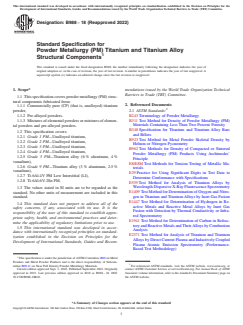
(Specification)Standard Specification for Powder Metallurgy (PM) Titanium and Titanium Alloy Structural Components
General Information
- Abstract
ABSTRACT
This specification covers powder metallurgy (PM) structural components fabricated from commercially pure (CP) (that is, unalloyed) titanium powder, pre-alloyed powders, and mixtures of elemental powders or mixtures of elemental powders and pre-alloyed powders. It addresses ordering information, materials and manufacture, chemical composition requirements, tensile requirements, physical properties, mechanical properties, dimensions, mass, permissible variations, sampling, inspection, and certification.
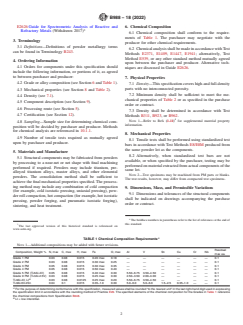
SCOPE
1.1 This specification covers powder metallurgy (PM) structural components fabricated from:
1.1.1 Commercially pure (CP) (that is, unalloyed) titanium powder,
1.1.2 Pre-alloyed powders.
1.1.3 Mixtures of elemental powders or mixtures of elemental powders and pre-alloyed powders.
1.2 This specification covers:
1.2.1 Grade 1 PM—Unalloyed titanium,
1.2.2 Grade 2 PM—Unalloyed titanium,
1.2.3 Grade 3 PM—Unalloyed titanium,
1.2.4 Grade 4 PM—Unalloyed titanium,
1.2.5 Grade 5 PM—Titanium alloy (6 % aluminum, 4 % vanadium),
1.2.6 Grade 9 PM—Titanium alloy (3 % aluminum, 2.5 % vanadium),
1.2.7 Ti-6Al-4V PM Low Interstitial (LI),
1.2.8 Ti-6Al-6V-2Sn PM.
1.3 The values stated in SI units are to be regarded as the standard. No other units of measurement are included in this standard.
1.4 This standard does not purport to address all of the safety concerns, if any, associated with its use. It is the responsibility of the user of this standard to establish appropriate safety, health, and environmental practices and determine the applicability of regulatory limitations prior to use.
1.5 This international standard was developed in accordance with internationally recognized principles on standardization established in the Decision on Principles for the Development of International Standards, Guides and Recommendations issued by the World Trade Organization Technical Barriers to Trade (TBT) Committee.
- Status
- Published
- Publication Date
- 31-Aug-2022
- Technical Committee
- B09 - Metal Powders and Metal Powder Products
- Drafting Committee
- B09.11 - Near Full Density Powder Metallurgy Materials

Overview
ASTM B988-18(2022), Standard Specification for Powder Metallurgy (PM) Titanium and Titanium Alloy Structural Components, sets forth the requirements for the fabrication and performance of titanium and titanium alloy structural components produced by powder metallurgy (PM) methods. Developed by ASTM International, this standard covers a broad range of titanium grades, including commercially pure (CP) grades and extensively used titanium alloys. B988-18(2022) details criteria for materials, processing, chemical composition, mechanical properties, ordering information, and quality assurance. Adhering to this specification ensures that PM titanium parts meet stringent performance benchmarks for engineering applications.
Key Topics
Material Grades Covered:
- CP (Unalloyed) Titanium: Grades 1, 2, 3, and 4
- Titanium Alloys: Grade 5 (Ti-6Al-4V), Grade 9 (Ti-3Al-2.5V), Ti-6Al-4V Low Interstitial (LI), Ti-6Al-6V-2Sn
Fabrication Methods:
- Powder metallurgy (PM) techniques including cold isostatic pressing, hot isostatic pressing, powder forging, and sintering
- Use of commercially pure powders, pre-alloyed powders, or blends
Property Requirements:
- Chemical composition in compliance with specific elemental limits
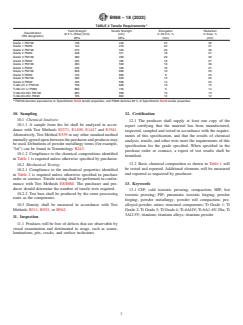
- Mechanical properties such as tensile strength, yield strength, and elongation
- Minimum density requirements for structural integrity
Quality Assurance:
- Detailed sampling protocols
- Certifications and documentation attesting to compliance
- Inspection for surface and internal defects
Buying & Ordering Criteria:
- Clear specification of grade, required mechanical properties, density, and component description
Applications
Adherence to ASTM B988-18(2022) guarantees high-quality PM titanium components that deliver reliable performance in demanding sectors. Typical applications include:
- Aerospace: Lightweight, high-strength structural parts for airframes, engine mounts, and landing gear
- Medical Devices: Biocompatible implants, surgical instruments, and orthopedic hardware
- Automotive: Lightweight components for high-performance and electric vehicles
- Industrial Equipment: Corrosion-resistant and high-strength parts for chemical processing, oil & gas, and power generation
- Defense and Military: Armor components, vehicle parts, and advanced weaponry assemblies
Powder metallurgy titanium offers advantages such as near-net-shape production, material efficiency, improved microstructure control, and potential for cost savings over wrought products.
Related Standards
For comprehensive powder metallurgy and titanium fabrication, users may consult the following related ASTM standards:
- ASTM B243: Terminology of Powder Metallurgy
- ASTM B311: Test Method for Density of Powder Metallurgy (PM) Materials
- ASTM B348: Specification for Titanium and Titanium Alloy Bars and Billets
- ASTM B923: Test Method for Metal Powder Skeletal Density
- ASTM B962: Test Methods for Density of Compacted or Sintered PM Products
- ASTM E8/E8M: Test Methods for Tension Testing of Metallic Materials
- ASTM E29: Practice for Using Significant Digits in Test Data
- ASTM E539, E1409, E1447, E1941, E2371: Various test methods for chemical analysis of titanium and titanium alloys
Compliance with ASTM B988-18(2022), in conjunction with these related standards, allows manufacturers and end-users to specify, produce, and certify powder metallurgy titanium and titanium alloy components with confidence. This ensures reliability, performance, and traceability across vital industries requiring premium metallic components.
Keywords: powder metallurgy titanium, PM titanium alloys, ASTM B988, titanium structural components, Ti-6Al-4V, titanium powder components, titanium alloy standards, aerospace titanium, medical grade titanium, high-strength titanium parts
Relations
- Effective Date
- 01-Jan-2024
- Effective Date
- 15-Nov-2023
- Effective Date
- 01-Mar-2019
- Effective Date
- 01-Oct-2018
- Effective Date
- 01-Oct-2016
- Effective Date
- 15-Jul-2016
- Effective Date
- 01-Jul-2016
- Effective Date
- 01-Apr-2015
- Effective Date
- 01-Feb-2015
- Effective Date
- 01-Sep-2014
- Effective Date
- 01-Nov-2013
- Effective Date
- 01-Jul-2013
- Effective Date
- 01-Jun-2013
- Effective Date
- 01-Apr-2013
- Effective Date
- 01-Apr-2013
Get Certified
Connect with accredited certification bodies for this standard

Element Materials Technology
Materials testing and product certification.

Inštitut za kovinske materiale in tehnologije
Institute of Metals and Technology. Materials testing, metallurgical analysis, NDT.
Sponsored listings
Frequently Asked Questions
ASTM B988-18(2022) is a technical specification published by ASTM International. Its full title is "Standard Specification for Powder Metallurgy (PM) Titanium and Titanium Alloy Structural Components". This standard covers: ABSTRACT This specification covers powder metallurgy (PM) structural components fabricated from commercially pure (CP) (that is, unalloyed) titanium powder, pre-alloyed powders, and mixtures of elemental powders or mixtures of elemental powders and pre-alloyed powders. It addresses ordering information, materials and manufacture, chemical composition requirements, tensile requirements, physical properties, mechanical properties, dimensions, mass, permissible variations, sampling, inspection, and certification. SCOPE 1.1 This specification covers powder metallurgy (PM) structural components fabricated from: 1.1.1 Commercially pure (CP) (that is, unalloyed) titanium powder, 1.1.2 Pre-alloyed powders. 1.1.3 Mixtures of elemental powders or mixtures of elemental powders and pre-alloyed powders. 1.2 This specification covers: 1.2.1 Grade 1 PM—Unalloyed titanium, 1.2.2 Grade 2 PM—Unalloyed titanium, 1.2.3 Grade 3 PM—Unalloyed titanium, 1.2.4 Grade 4 PM—Unalloyed titanium, 1.2.5 Grade 5 PM—Titanium alloy (6 % aluminum, 4 % vanadium), 1.2.6 Grade 9 PM—Titanium alloy (3 % aluminum, 2.5 % vanadium), 1.2.7 Ti-6Al-4V PM Low Interstitial (LI), 1.2.8 Ti-6Al-6V-2Sn PM. 1.3 The values stated in SI units are to be regarded as the standard. No other units of measurement are included in this standard. 1.4 This standard does not purport to address all of the safety concerns, if any, associated with its use. It is the responsibility of the user of this standard to establish appropriate safety, health, and environmental practices and determine the applicability of regulatory limitations prior to use. 1.5 This international standard was developed in accordance with internationally recognized principles on standardization established in the Decision on Principles for the Development of International Standards, Guides and Recommendations issued by the World Trade Organization Technical Barriers to Trade (TBT) Committee.
ABSTRACT This specification covers powder metallurgy (PM) structural components fabricated from commercially pure (CP) (that is, unalloyed) titanium powder, pre-alloyed powders, and mixtures of elemental powders or mixtures of elemental powders and pre-alloyed powders. It addresses ordering information, materials and manufacture, chemical composition requirements, tensile requirements, physical properties, mechanical properties, dimensions, mass, permissible variations, sampling, inspection, and certification. SCOPE 1.1 This specification covers powder metallurgy (PM) structural components fabricated from: 1.1.1 Commercially pure (CP) (that is, unalloyed) titanium powder, 1.1.2 Pre-alloyed powders. 1.1.3 Mixtures of elemental powders or mixtures of elemental powders and pre-alloyed powders. 1.2 This specification covers: 1.2.1 Grade 1 PM—Unalloyed titanium, 1.2.2 Grade 2 PM—Unalloyed titanium, 1.2.3 Grade 3 PM—Unalloyed titanium, 1.2.4 Grade 4 PM—Unalloyed titanium, 1.2.5 Grade 5 PM—Titanium alloy (6 % aluminum, 4 % vanadium), 1.2.6 Grade 9 PM—Titanium alloy (3 % aluminum, 2.5 % vanadium), 1.2.7 Ti-6Al-4V PM Low Interstitial (LI), 1.2.8 Ti-6Al-6V-2Sn PM. 1.3 The values stated in SI units are to be regarded as the standard. No other units of measurement are included in this standard. 1.4 This standard does not purport to address all of the safety concerns, if any, associated with its use. It is the responsibility of the user of this standard to establish appropriate safety, health, and environmental practices and determine the applicability of regulatory limitations prior to use. 1.5 This international standard was developed in accordance with internationally recognized principles on standardization established in the Decision on Principles for the Development of International Standards, Guides and Recommendations issued by the World Trade Organization Technical Barriers to Trade (TBT) Committee.
ASTM B988-18(2022) is classified under the following ICS (International Classification for Standards) categories: 77.160 - Powder metallurgy. The ICS classification helps identify the subject area and facilitates finding related standards.
ASTM B988-18(2022) has the following relationships with other standards: It is inter standard links to ASTM E8/E8M-24, ASTM B923-23, ASTM E539-19, ASTM B243-18, ASTM B923-16, ASTM E8/E8M-16, ASTM B243-16, ASTM B962-15, ASTM E8/E8M-15, ASTM B962-14, ASTM B243-13, ASTM B348-13, ASTM E8/E8M-13, ASTM B311-13, ASTM B962-13. Understanding these relationships helps ensure you are using the most current and applicable version of the standard.
ASTM B988-18(2022) is available in PDF format for immediate download after purchase. The document can be added to your cart and obtained through the secure checkout process. Digital delivery ensures instant access to the complete standard document.
Standards Content (Sample)
This international standard was developed in accordance with internationally recognized principles on standardization established in the Decision on Principles for the
Development of International Standards, Guides and Recommendations issued by the World Trade Organization Technical Barriers to Trade (TBT) Committee.
Designation:B988 −18 (Reapproved 2022)
Standard Specification for
Powder Metallurgy (PM) Titanium and Titanium Alloy
Structural Components
This standard is issued under the fixed designation B988; the number immediately following the designation indicates the year of
original adoption or, in the case of revision, the year of last revision. A number in parentheses indicates the year of last reapproval. A
superscript epsilon (´) indicates an editorial change since the last revision or reapproval.
1. Scope* mendations issued by the World Trade Organization Technical
Barriers to Trade (TBT) Committee.
1.1 Thisspecificationcoverspowdermetallurgy(PM)struc-
tural components fabricated from:
2. Referenced Documents
1.1.1 Commercially pure (CP) (that is, unalloyed) titanium
powder, 2.1 ASTM Standards:
1.1.2 Pre-alloyed powders. B243 Terminology of Powder Metallurgy
B311 Test Method for Density of Powder Metallurgy (PM)
1.1.3 Mixturesofelementalpowdersormixturesofelemen-
tal powders and pre-alloyed powders. Materials Containing Less Than Two Percent Porosity
B348 Specification for Titanium and Titanium Alloy Bars
1.2 This specification covers:
and Billets
1.2.1 Grade 1 PM—Unalloyed titanium,
B923 Test Method for Metal Powder Skeletal Density by
1.2.2 Grade 2 PM—Unalloyed titanium,
Helium or Nitrogen Pycnometry
1.2.3 Grade 3 PM—Unalloyed titanium,
B962 Test Methods for Density of Compacted or Sintered
1.2.4 Grade 4 PM—Unalloyed titanium,
Powder Metallurgy (PM) Products Using Archimedes’
1.2.5 Grade 5 PM—Titanium alloy (6 % aluminum, 4 %
Principle
vanadium),
E8/E8M Test Methods for Tension Testing of Metallic Ma-
1.2.6 Grade 9 PM—Titanium alloy (3 % aluminum, 2.5 %
terials
vanadium),
E29 Practice for Using Significant Digits in Test Data to
1.2.7 Ti-6Al-4V PM Low Interstitial (LI),
Determine Conformance with Specifications
1.2.8 Ti-6Al-6V-2Sn PM.
E539 Test Method for Analysis of Titanium Alloys by
WavelengthDispersiveX-RayFluorescenceSpectrometry
1.3 The values stated in SI units are to be regarded as the
E1409 Test Method for Determination of Oxygen and Nitro-
standard. No other units of measurement are included in this
gen in Titanium and TitaniumAlloys by Inert Gas Fusion
standard.
E1447 Test Method for Determination of Hydrogen in Re-
1.4 This standard does not purport to address all of the
active Metals and Reactive Metal Alloys by Inert Gas
safety concerns, if any, associated with its use. It is the
Fusion with Detection by Thermal Conductivity or Infra-
responsibility of the user of this standard to establish appro-
red Spectrometry
priate safety, health, and environmental practices and deter-
E1941 Test Method for Determination of Carbon in Refrac-
mine the applicability of regulatory limitations prior to use.
tory andReactive Metals andTheirAlloys byCombustion
1.5 This international standard was developed in accor-
Analysis
dance with internationally recognized principles on standard-
E2371 Test Method for Analysis of Titanium and Titanium
ization established in the Decision on Principles for the
Alloys by Direct Current Plasma and Inductively Coupled
Development of International Standards, Guides and Recom-
Plasma Atomic Emission Spectrometry (Performance-
Based Test Methodology)
This specification is under the jurisdiction ofASTM Committee B09 on Metal
Powders and Metal Powder Products and is the direct responsibility of Subcom-
mittee B09.11 on Near Full Density Powder Metallurgy Materials. For referenced ASTM standards, visit the ASTM website, www.astm.org, or
Current edition approved Sept. 1, 2022. Published September 2022. Originally contact ASTM Customer Service at service@astm.org. For Annual Book of ASTM
approved in 2013. Last previous edition approved in 2018 as B988 – 18. DOI: Standards volume information, refer to the standard’s Document Summary page on
10.1520/B988-18R22. the ASTM website.
*A Summary of Changes section appears at the end of this standard
Copyright © ASTM International, 100 Barr Harbor Drive, PO Box C700, West Conshohocken, PA 19428-2959. United States
B988−18 (2022)
E2626 Guide for Spectrometric Analysis of Reactive and 6. Chemical Composition
Refractory Metals (Withdrawn 2017)
6.1 Chemical composition shall conform to the require-
ments of Table 1. The purchaser may negotiate with the
3. Terminology
producer for other chemical requirements.
3.1 Definitions—Definitions of powder metallurgy terms
6.2 ChemicalanalysisshallbemadeinaccordancewithTest
can be found in Terminology B243.
Methods E2371, E1409, E1447, E1941; alternatively, Test
Method E539, or any other standard method mutually agreed
4. Ordering Information
upon between the purchaser and producer. Alternative tech-
4.1 Orders for components under this specification should
niques are discussed in Guide E2626.
include the following information, or portions of it, as agreed
to between purchaser and producer:
7. Physical Properties
4.2 Grade or alloy composition (see Section 6 and Table 1).
7.1 Density—Thisspecificationcovershigh-andfull-density
parts with no interconnected porosity.
4.3 Mechanical properties (see Section 8 and Table 2).
7.2 Minimum density shall be sufficient to meet the me-
4.4 Density (see 7.1).
chanical properties of Table 2 or as specified in the purchase
4.5 Component description (see Section 9).
order or contract.
4.6 Processing route (see Section 5).
7.3 Density shall be determined in accordance with Test
4.7 Certification (see Section 12).
Methods B311, B923,or B962.
NOTE 1—Refer to Refs (1-11) for supplemental material property
4.8 Sampling—Sample size for determining chemical com-
information.
position will be decided by purchaser and producer. Methods
for chemical analysis are referenced in 10.1.1.
8. Mechanical Properties
4.9 Number of tensile tests required as mutually agreed
8.1 Tensile tests shall be performed using standardized test
upon by purchaser and producer.
bars in accordance with Test Methods E8/E8M produced from
the same powder lot as the components.
5. Materials and Manufacture
8.2 Alternatively, when standardized test bars are not
5.1 Structural components may be fabricated from powders
available, or when specified by the purchaser, testing may be
by processing to a near-net or net shape with final machining
performedonmaterialextractedfromactualcomponentsofthe
performed if required. Powders may include titanium, pre-
same lot.
alloyed titanium alloys, master alloys, and other elemental
NOTE 2—Test specimens may be machined from PM parts or blanks.
powders. The consolidation method shall be sufficient to
The test results, however, may differ from compacted test specimens.
achieve the final mechanical properties specified. The process-
ing method may include any combination of cold compaction
9. Dimensions, Mass, and Permissible Variations
(for example, cold isostatic pressing, uniaxial pressing), pow-
9.1 Dimensions and tolerances of the structural components
der roll compaction, hot compaction (for example, hot isostatic
shall be indicated on drawings accompanying the purchase
pressing, powder forging, and pneumatic isostatic forging),
order or contract.
sintering, and heat treatment.
The boldface numbers in parentheses refer to the list of references at the end of
this standard.
The last approved version of this historical standard is referenced on
www.astm.org.
A
TABLE 1 Chemical Composition Requirements
NOTE 1—Additional compositions may be added with future revisions.
Residual
Composition, Weight % N, max C, max H, max Fe O, max Al V Sn Cu Cr Nb
max ea.
Grade 1 PM 0.03 0.08 0.0
...