

ASTM F2785-21
(Specification)Standard Specification for Polyamide 12 Gas Pressure Pipe, Tubing, and Fittings
General Information
- Abstract
ABSTRACT
This specification details the material and performance requirements, as well as the corresponding test methods, for the evaluation of polyamide 12 gas pressure pipes, tubing, and fittings that are intended for use in the distribution of natural gas in fuel gas mains and services for direct burial and reliner applications. It does not apply to threaded pipes. The pipes and fittings shall be made from virgin or reworked polyamide material that satisfies the short- and long-term hydrostatic design stress and hydrostatic design basis ratings, and rapid crack propagation (RCP) resistance properties. Properly sampled pipe and fitting specimens shall undergo test procedures and conform to the following requirements: workmanship; dimension (diameter, toe-in, wall thickness, wall thickness eccentricity range, ovality, and length); conditioning; slow crack growth resistance; resistance to RCP; minimum hydrostatic burst pressure/apparent tensile strength (quick burst); sustained pressure; outdoor storage stability; chemical resistance; elevated temperature service; butt fusion joints; butt heat fusion fittings; electrofusion fittings; mechanical fittings; transition fittings and anodeless risers; valves; and excess flow valves.
SCOPE
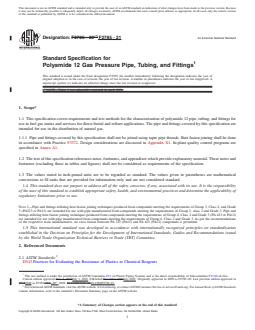
1.1 This specification covers requirements and test methods for the characterization of polyamide 12 pipe, tubing, and fittings for use in fuel gas mains and services for direct burial and reliner applications. The pipe and fittings covered by this specification are intended for use in the distribution of natural gas.
1.1.1 Pipe and fittings covered by this specification shall not be joined using taper pipe threads. Butt fusion joining shall be done in accordance with Practice F3372. Design considerations are discussed in Appendix X1. In-plant quality control programs are specified in Annex A1.
1.2 The text of this specification references notes, footnotes, and appendixes which provide explanatory material. These notes and footnotes (excluding those in tables and figures) shall not be considered as requirements of the specification.
1.3 The values stated in inch-pound units are to be regarded as standard. The values given in parentheses are mathematical conversions to SI units that are provided for information only and are not considered standard.
1.4 This standard does not purport to address all of the safety concerns, if any, associated with its use. It is the responsibility of the user of this standard to establish appropriate safety, health, and environmental practices and determine the applicability of regulatory limitations prior to use.
Note 1: Pipe and fittings utilizing heat fusion joining techniques produced from compounds meeting the requirements of Group 3, Class 2, and Grade 3 (PA323 or PA11) are intended for use with pipe manufactured from compounds meeting the requirements of Group 3, class 2 and Grade 3. Pipe and fittings utilizing heat fusion joining techniques produced from compounds meeting the requirements of Group 4, Class 2 and Grade 3 (PA 423 or PA12) are intended for use with pipe manufactured from compounds meeting the requirements of Group 4, Class 2 and Grade 3. As per the recommendations of the respective resin manufacturers, no cross fusion between PA 323 (PA11) and PA 423 (PA12) compounds is permitted.
1.5 This international standard was developed in accordance with internationally recognized principles on standardization established in the Decision on Principles for the Development of International Standards, Guides and Recommendations issued by the World Trade Organization Technical Barriers to Trade (TBT) Committee.
- Status
- Published
- Publication Date
- 30-Jun-2021
- Technical Committee
- F17 - Plastic Piping Systems
- Drafting Committee
- F17.60 - Gas
Buy Documents
ASTM F2785-21 - Standard Specification for Polyamide 12 Gas Pressure Pipe, Tubing, and Fittings
REDLINE ASTM F2785-21 - Standard Specification for Polyamide 12 Gas Pressure Pipe, Tubing, and Fittings
Overview
ASTM F2785-21 is the recognized international standard specification for polyamide 12 (PA12) gas pressure pipe, tubing, and fittings, established by ASTM International. The document defines material and performance requirements, as well as testing methods, to ensure the quality and reliability of PA12 piping systems used in distributing natural gas. This standard addresses essential aspects such as workmanship, dimensional tolerances, hydrostatic design stress, rapid crack propagation resistance, chemical stability, and traceability, making it critical for manufacturers, utilities, and installers in the gas distribution sector.
Key Topics
- Scope: The standard applies to PA12 pipes, tubing, and fittings for direct burial and reliner applications intended for natural gas distribution. It specifically excludes pipes joined using taper pipe threads.
- Material Requirements: Only virgin or suitable reworked polyamide 12 materials with specified hydrostatic design basis (HDB) and demonstrated resistance to both short- and long-term stresses are permitted.
- Performance Testing:
- Hydrostatic Strength: Pipe and fitting materials must meet both short-term burst and long-term sustained pressure resistance.
- Crack Propagation: Products are tested for resistance to both slow crack growth and rapid crack propagation (RCP).
- Dimensional Tolerance: Strict guidelines are provided for diameter, wall thickness, eccentricity, ovality, and length.
- Chemical Resistance: Resistance testing against various chemicals commonly encountered in gas applications is required.
- Joining Methods: Only approved butt fusion and heat fusion joining techniques are allowed, following established ASTM practices. Mechanical, electrofusion, and transition fittings must meet referenced ASTM criteria.
- Traceability: Mandatory traceability coding and detailed marking ensure product identification throughout its service life.
- Quality Assurance: The specification outlines in-plant quality control and documentation practices for consistent product performance.
Applications
- Natural Gas Distribution: PA12 pipes, tubing, and fittings produced under ASTM F2785-21 are designed for the safe, efficient underground distribution of natural gas in fuel gas mains and services.
- Direct Burial and Relining: The robust physical and chemical resistance properties of PA12 make these components suitable for both direct burial and lining of existing pipelines.
- Long-Term Infrastructure: Utilities benefit from high durability, UV and outdoor storage stability, and resistance to chemical exposure, making PA12 piping solutions reliable for long-term gas infrastructure needs.
- Safety and Regulatory Compliance: The standard supports compliance with relevant national codes, enhancing public safety and meeting environmental requirements.
Related Standards
ASTM F2785-21 references several related ASTM, ANSI, ISO, and industry-specific standards essential for product specification and testing, including:
- ASTM D543: Evaluating the chemical resistance of plastics
- ASTM D638 / ISO 527: Testing tensile properties of plastics
- ASTM D1598 & D1599: Hydrostatic pressure tests for plastic pipes
- ASTM D2837: Hydrostatic design basis determination
- ASTM F1733, F2145, F2767, F1973: Specifications for various polyamide fusion and mechanical fittings
- ASTM F3372: Butt fusion joining guidelines for PA12
- ANSI B31.8: Gas transmission and distribution piping systems
- ISO 16486-1: PA-U piping systems for gaseous fuels
- ASTM F2897: Tracking and traceability encoding for gas distribution components
Practical Value
Adherence to ASTM F2785-21 ensures the safety, longevity, and regulatory compliance of PA12 gas pressure piping systems. By providing standardized requirements for material quality, mechanical and chemical performance, joining methods, and full component traceability, this standard delivers critical value to utilities, manufacturers, and installers seeking reliable and efficient solutions for modern gas distribution networks.
Relations
- Effective Date
- 01-Apr-2024
- Effective Date
- 01-Feb-2024
- Effective Date
- 01-Nov-2023
- Effective Date
- 01-Nov-2023
- Effective Date
- 29-Sep-2023
- Effective Date
- 01-Apr-2020
- Effective Date
- 01-Aug-2019
- Effective Date
- 01-Aug-2019
- Effective Date
- 01-Aug-2019
- Effective Date
- 01-Jan-2019
- Effective Date
- 01-Jan-2019
- Effective Date
- 01-Sep-2018
- Effective Date
- 15-Jun-2018
- Effective Date
- 01-Apr-2018
- Effective Date
- 01-Apr-2018
Buy Documents
ASTM F2785-21 - Standard Specification for Polyamide 12 Gas Pressure Pipe, Tubing, and Fittings
REDLINE ASTM F2785-21 - Standard Specification for Polyamide 12 Gas Pressure Pipe, Tubing, and Fittings
Get Certified
Connect with accredited certification bodies for this standard

Institut za varilstvo d.o.o. (Welding Institute)
Slovenia's leading welding institute since 1952. ISO 3834, EN 1090, pressure equipment certification, NDT personnel, welder qualification. Only IIW Au
Sponsored listings
Frequently Asked Questions
ASTM F2785-21 is a technical specification published by ASTM International. Its full title is "Standard Specification for Polyamide 12 Gas Pressure Pipe, Tubing, and Fittings". This standard covers: ABSTRACT This specification details the material and performance requirements, as well as the corresponding test methods, for the evaluation of polyamide 12 gas pressure pipes, tubing, and fittings that are intended for use in the distribution of natural gas in fuel gas mains and services for direct burial and reliner applications. It does not apply to threaded pipes. The pipes and fittings shall be made from virgin or reworked polyamide material that satisfies the short- and long-term hydrostatic design stress and hydrostatic design basis ratings, and rapid crack propagation (RCP) resistance properties. Properly sampled pipe and fitting specimens shall undergo test procedures and conform to the following requirements: workmanship; dimension (diameter, toe-in, wall thickness, wall thickness eccentricity range, ovality, and length); conditioning; slow crack growth resistance; resistance to RCP; minimum hydrostatic burst pressure/apparent tensile strength (quick burst); sustained pressure; outdoor storage stability; chemical resistance; elevated temperature service; butt fusion joints; butt heat fusion fittings; electrofusion fittings; mechanical fittings; transition fittings and anodeless risers; valves; and excess flow valves. SCOPE 1.1 This specification covers requirements and test methods for the characterization of polyamide 12 pipe, tubing, and fittings for use in fuel gas mains and services for direct burial and reliner applications. The pipe and fittings covered by this specification are intended for use in the distribution of natural gas. 1.1.1 Pipe and fittings covered by this specification shall not be joined using taper pipe threads. Butt fusion joining shall be done in accordance with Practice F3372. Design considerations are discussed in Appendix X1. In-plant quality control programs are specified in Annex A1. 1.2 The text of this specification references notes, footnotes, and appendixes which provide explanatory material. These notes and footnotes (excluding those in tables and figures) shall not be considered as requirements of the specification. 1.3 The values stated in inch-pound units are to be regarded as standard. The values given in parentheses are mathematical conversions to SI units that are provided for information only and are not considered standard. 1.4 This standard does not purport to address all of the safety concerns, if any, associated with its use. It is the responsibility of the user of this standard to establish appropriate safety, health, and environmental practices and determine the applicability of regulatory limitations prior to use. Note 1: Pipe and fittings utilizing heat fusion joining techniques produced from compounds meeting the requirements of Group 3, Class 2, and Grade 3 (PA323 or PA11) are intended for use with pipe manufactured from compounds meeting the requirements of Group 3, class 2 and Grade 3. Pipe and fittings utilizing heat fusion joining techniques produced from compounds meeting the requirements of Group 4, Class 2 and Grade 3 (PA 423 or PA12) are intended for use with pipe manufactured from compounds meeting the requirements of Group 4, Class 2 and Grade 3. As per the recommendations of the respective resin manufacturers, no cross fusion between PA 323 (PA11) and PA 423 (PA12) compounds is permitted. 1.5 This international standard was developed in accordance with internationally recognized principles on standardization established in the Decision on Principles for the Development of International Standards, Guides and Recommendations issued by the World Trade Organization Technical Barriers to Trade (TBT) Committee.
ABSTRACT This specification details the material and performance requirements, as well as the corresponding test methods, for the evaluation of polyamide 12 gas pressure pipes, tubing, and fittings that are intended for use in the distribution of natural gas in fuel gas mains and services for direct burial and reliner applications. It does not apply to threaded pipes. The pipes and fittings shall be made from virgin or reworked polyamide material that satisfies the short- and long-term hydrostatic design stress and hydrostatic design basis ratings, and rapid crack propagation (RCP) resistance properties. Properly sampled pipe and fitting specimens shall undergo test procedures and conform to the following requirements: workmanship; dimension (diameter, toe-in, wall thickness, wall thickness eccentricity range, ovality, and length); conditioning; slow crack growth resistance; resistance to RCP; minimum hydrostatic burst pressure/apparent tensile strength (quick burst); sustained pressure; outdoor storage stability; chemical resistance; elevated temperature service; butt fusion joints; butt heat fusion fittings; electrofusion fittings; mechanical fittings; transition fittings and anodeless risers; valves; and excess flow valves. SCOPE 1.1 This specification covers requirements and test methods for the characterization of polyamide 12 pipe, tubing, and fittings for use in fuel gas mains and services for direct burial and reliner applications. The pipe and fittings covered by this specification are intended for use in the distribution of natural gas. 1.1.1 Pipe and fittings covered by this specification shall not be joined using taper pipe threads. Butt fusion joining shall be done in accordance with Practice F3372. Design considerations are discussed in Appendix X1. In-plant quality control programs are specified in Annex A1. 1.2 The text of this specification references notes, footnotes, and appendixes which provide explanatory material. These notes and footnotes (excluding those in tables and figures) shall not be considered as requirements of the specification. 1.3 The values stated in inch-pound units are to be regarded as standard. The values given in parentheses are mathematical conversions to SI units that are provided for information only and are not considered standard. 1.4 This standard does not purport to address all of the safety concerns, if any, associated with its use. It is the responsibility of the user of this standard to establish appropriate safety, health, and environmental practices and determine the applicability of regulatory limitations prior to use. Note 1: Pipe and fittings utilizing heat fusion joining techniques produced from compounds meeting the requirements of Group 3, Class 2, and Grade 3 (PA323 or PA11) are intended for use with pipe manufactured from compounds meeting the requirements of Group 3, class 2 and Grade 3. Pipe and fittings utilizing heat fusion joining techniques produced from compounds meeting the requirements of Group 4, Class 2 and Grade 3 (PA 423 or PA12) are intended for use with pipe manufactured from compounds meeting the requirements of Group 4, Class 2 and Grade 3. As per the recommendations of the respective resin manufacturers, no cross fusion between PA 323 (PA11) and PA 423 (PA12) compounds is permitted. 1.5 This international standard was developed in accordance with internationally recognized principles on standardization established in the Decision on Principles for the Development of International Standards, Guides and Recommendations issued by the World Trade Organization Technical Barriers to Trade (TBT) Committee.
ASTM F2785-21 is classified under the following ICS (International Classification for Standards) categories: 23.040.20 - Plastics pipes; 23.040.45 - Plastics fittings. The ICS classification helps identify the subject area and facilitates finding related standards.
ASTM F2785-21 has the following relationships with other standards: It is inter standard links to ASTM F1473-24, ASTM F1733-24, ASTM F2897-23a, ASTM F2767-18(2023), ASTM D1898-68(1989), ASTM F412-20, ASTM F1025-19, ASTM D2290-19a, ASTM D789-19, ASTM D2290-19, ASTM F412-19, ASTM D1599-18, ASTM D789-18, ASTM D648-18, ASTM F2767-18. Understanding these relationships helps ensure you are using the most current and applicable version of the standard.
ASTM F2785-21 is available in PDF format for immediate download after purchase. The document can be added to your cart and obtained through the secure checkout process. Digital delivery ensures instant access to the complete standard document.
Standards Content (Sample)
This international standard was developed in accordance with internationally recognized principles on standardization established in the Decision on Principles for the
Development of International Standards, Guides and Recommendations issued by the World Trade Organization Technical Barriers to Trade (TBT) Committee.
Designation:F2785 −21 An American National Standard
Standard Specification for
Polyamide 12 Gas Pressure Pipe, Tubing, and Fittings
This standard is issued under the fixed designation F2785; the number immediately following the designation indicates the year of
original adoption or, in the case of revision, the year of last revision.Anumber in parentheses indicates the year of last reapproval.A
superscript epsilon (´) indicates an editorial change since the last revision or reapproval.
1. Scope* ization established in the Decision on Principles for the
Development of International Standards, Guides and Recom-
1.1 This specification covers requirements and test methods
mendations issued by the World Trade Organization Technical
for the characterization of polyamide 12 pipe, tubing, and
Barriers to Trade (TBT) Committee.
fittings for use in fuel gas mains and services for direct burial
and reliner applications. The pipe and fittings covered by this
2. Referenced Documents
specification are intended for use in the distribution of natural
gas.
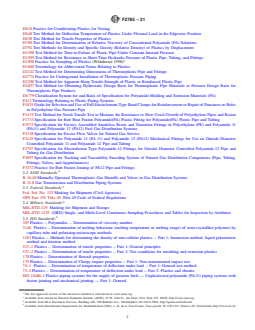
2.1 ASTM Standards:
1.1.1 Pipeandfittingscoveredbythisspecificationshallnot
D543Practices for Evaluating the Resistance of Plastics to
be joined using taper pipe threads. Butt fusion joining shall be
Chemical Reagents
doneinaccordancewithPracticeF3372.Designconsiderations
D618Practice for Conditioning Plastics for Testing
are discussed in Appendix X1. In-plant quality control pro-
D648Test Method for Deflection Temperature of Plastics
grams are specified in Annex A1.
Under Flexural Load in the Edgewise Position
1.2 Thetextofthisspecificationreferencesnotes,footnotes, D638Test Method for Tensile Properties of Plastics
and appendixes which provide explanatory material. These
D789Test Method for Determination of Relative Viscosity
notesandfootnotes(excludingthoseintablesandfigures)shall
of Concentrated Polyamide (PA) Solutions
not be considered as requirements of the specification.
D792Test Methods for Density and Specific Gravity (Rela-
tive Density) of Plastics by Displacement
1.3 Thevaluesstatedininch-poundunitsaretoberegarded
D1598Test Method for Time-to-Failure of Plastic Pipe
as standard. The values given in parentheses are mathematical
Under Constant Internal Pressure
conversions to SI units that are provided for information only
D1599Test Method for Resistance to Short-Time Hydraulic
and are not considered standard.
Pressure of Plastic Pipe, Tubing, and Fittings
1.4 This standard does not purport to address all of the
D1898Practice for Sampling of Plastics (Withdrawn 1998)
safety concerns, if any, associated with its use. It is the
D1600TerminologyforAbbreviatedTermsRelatingtoPlas-
responsibility of the user of this standard to establish appro-
tics
priate safety, health, and environmental practices and deter-
D2122Test Method for Determining Dimensions of Ther-
mine the applicability of regulatory limitations prior to use.
moplastic Pipe and Fittings
NOTE 1—Pipe and fittings utilizing heat fusion joining techniques
D2774PracticeforUndergroundInstallationofThermoplas-
produced from compounds meeting the requirements of Group 3, Class 2,
tic Pressure Piping
andGrade3(PA323orPA11)areintendedforusewithpipemanufactured
D2290Test Method for Apparent Hoop Tensile Strength of
from compounds meeting the requirements of Group 3, class 2 and Grade
3.Pipeandfittingsutilizing heat fusion joining techniques producedfrom Plastic or Reinforced Plastic Pipe
compoundsmeetingtherequirementsofGroup4,Class2andGrade3(PA
D2837Test Method for Obtaining Hydrostatic Design Basis
423 or PA12) are intended for use with pipe manufactured from com-
forThermoplasticPipeMaterialsorPressureDesignBasis
poundsmeetingtherequirementsofGroup4,Class2andGrade3.Asper
for Thermoplastic Pipe Products
the recommendations of the respective resin manufacturers, no cross
D6779Classification System for and Basis of Specification
fusion between PA 323 (PA11) and PA 423 (PA12) compounds is
permitted.
for Polyamide Molding and Extrusion Materials (PA)
F412Terminology Relating to Plastic Piping Systems
1.5 This international standard was developed in accor-
dance with internationally recognized principles on standard-
For referenced ASTM standards, visit the ASTM website, www.astm.org, or
This test method is under the jurisdiction ofASTM Committee F17 on Plastic contact ASTM Customer Service at service@astm.org. For Annual Book of ASTM
Piping Systems and is the direct responsibility of Subcommittee F17.60 on Gas. Standards volume information, refer to the standard’s Document Summary page on
CurrenteditionapprovedJuly1,2021.PublishedJuly2021.Originallyapproved the ASTM website.
ɛ1 3
in 2009 as F2785–09. Last previous edition approved in 2020 as F2785–20 . DOI: The last approved version of this historical standard is referenced on
10.1520/F2785-21. www.astm.org.
*A Summary of Changes section appears at the end of this standard
Copyright © ASTM International, 100 Barr Harbor Drive, PO Box C700, West Conshohocken, PA 19428-2959. United States
F2785−21
F1025Guide for Selection and Use of Full-Encirclement- 527–2Plastics -- Determination of tensile properties -- Part
Type Band Clamps for Reinforcement or Repair of Punc- 2: Test conditions for moulding and extrusion plastics
tures or Holes in Polyethylene Gas Pressure Pipe 178Plastics -- Determination of flexural properties
F1473Test Method for Notch Tensile Test to Measure the 179Plastics -- Determination of Charpy impact properties --
Resistance to Slow Crack Growth of Polyethylene Pipes Part 1: Non-instrumented impact test
and Resins 75–1 Plastics -- Determination of temperature of deflection
F1733Specification for Butt Heat Fusion Polyamide(PA) under load -- Part 1: General test method
Plastic Fitting for Polyamide(PA) Plastic Pipe andTubing 75–2Plastics -- Determination of temperature of deflection
F1973Specification for Factory Assembled Anodeless Ris- under load -- Part 2: Plastics and ebonite
ers and Transition Fittings in Polyethylene (PE) and ISO 16486-1Plastics piping systems for the supply of
Polyamide 11 (PA11) and Polyamide 12 (PA12) Fuel Gas gaseous fuels — Unplasticized polyamide (PA-U) piping
Distribution Systems systems with fusion jointing and mechanical jointing —
F2138Specification for Excess FlowValves for Natural Gas Part 1: General
Service
2.6 Plastic Pipe Institute:
F2145Specification for Polyamide 11 (PA 11) and Poly-
PPI TR3Policies and Procedures for Developing Hydro-
amide 12 (PA12) Mechanical Fittings for Use on Outside
static Design Basis (HDB), Pressure Design Basis (PDB),
DiameterControlledPolyamide11andPolyamide12Pipe
Strength Design Basis (SDB), and Minimum Required
and Tubing
Strength (MRS) Ratings for Thermoplastic Piping Mate-
F2767Specification for Electrofusion Type Polyamide-12
rials or Pipe
Fittings for Outside Diameter Controlled Polyamide-12
PPI TR4Hydrostatic Design Bases and Maximum Recom-
Pipe and Tubing for Gas Distribution
mended Hydrostatic Design Stresses for Thermoplastic
F2897Specification for Tracking and Traceability Encoding
Piping Materials
System of Natural Gas Distribution Components (Pipe,
PPI TN7Nature of Hydrostatic Stress Rupture Curves
Tubing, Fittings, Valves, and Appurtenances)
2.7 Other Standards:
F3372Practice for Butt Fusion Joining of PA12 Pipe and
NationalFireProtectionAssociation:NFPA58,Storageand
Fittings
Handling Liquefied Petroleum Gases
2.2 ANSI Standards:
3. Terminology
B16.40ManuallyOperatedThermoplasticGasShutoffsand
Valves in Gas Distribution Systems 3.1 Definitions—Definitions are in accordance with Termi-
B 31.8Gas Transmission and Distribution Piping Systems
nology F412, and abbreviations are in accordance with Termi-
nology D1600, unless otherwise specified.
2.3 Federal Standards:
Fed. Std. No. 123Marking for Shipment (Civil Agencies)
3.2 The gas industry terminology used in this specification
OPS Part 192Title 49,Title 49 Code of Federal Regulations
is in accordance withANSI B31.8 or CFR OPS Part 192 Title
49, unless otherwise indicated.
2.4 Military Standards:
MIL-STD-129 Marking for Shipment and Storage
3.3 Theterm pipeusedhereinreferstobothpipeandtubing
MIL-STD-1235 (ORD) Single- and Multi-Level Continu-
unless specifically stated otherwise.
ous Sampling Procedures and Tables for Inspection by
3.4 Definitions of Terms Specific to This Standard:
Attributes
3.4.1 re-rounding equipment, n—equipment used to reform
2.5 ISO Standards:
the pipe and permanently reduce ovality to 5% or less.
307Plastics -- Polyamides -- Determination of viscosity
3.4.2 rounding equipment, n—equipment, devices, clamps,
number
and so forth, used to temporarily hold the pipe round while
3146 Plastics -- Determination of melting behaviour (melt-
out-of-roundness measurements are made, or a joining proce-
ing temperature or melting range) of semi-crystalline
dure (heat fusion, electrofusion, or mechanical) is performed.
polymers by capillary tube and polarizing-microscope
3.4.3 standard thermoplastic material designated code,
methods
n—the pipe material designation code shall consist of the
1183Plastics -- Methods for determining the density of
abbreviation for the polyamide (PA) followed by Arabic
non-cellular plastics -- Part 1: Immersion method, liquid
numerals which describe the short term properties in accor-
pyknometer method and titration method
dance with Classification D6779, the hydrostatic design stress
527–1Plastics -- Determination of tensile properties -- Part
for water at 73.4°F (23°C) in units of 100 psi with any
1: General principles
decimal figures dropped. Where the hydrostatic design stress
code contains less than two figures, a zero is used before the
4 number. Thus, a complete material designation code shall
Available fromAmerican National Standards Institute (ANSI), 25 W. 43rd St.,
4th Floor, New York, NY 10036, http://www.ansi.org.
Available from DLA Document Services, Building 4/D, 700 Robbins Ave.,
Philadelphia, PA 19111-5094, http://quicksearch.dla.mil. Available from Plastics Pipe Institute (PPI), 105 Decker Court, Suite 825,
Available from International Organization for Standardization (ISO), 1, ch. de Irving, TX 75062, http://www.plasticpipe.org.
la Voie-Creuse, Case postale 56, CH-1211, Geneva 20, Switzerland, http:// Available from National Fire Protection Association (NFPA), 1 Batterymarch
www.iso.ch. Park, Quincy, MA 02169-7471, http://www.nfpa.org.
F2785−21
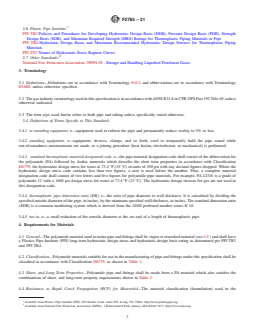
TABLE 2 Short and Long Term Property Requirements
consist of two letters and five figures for polyamide pipe
materials. For example, PA 42316 is a grade of polyamide 12 PA Material Short-Term in Long-Term in
Designation Code Accordance with Accordance with
with a 1600 psi design stress for water at 73.4°F (23°C). The
D6779 D2837
hydrostatic design stresses for gas are not used in this desig-
PA42316 PA423 HDB of 3150 psi
nation code. for 73 °F (23 °C)
3.4.4 thermoplastic pipe dimension ratio (DR), n—the ratio
of pipe diameter to wall thickness. It is calculated by dividing
the specified outside diameter of the pipe, in inches, by the
4.5 Rework Material—Clean rework material of the same
minimum specified wall thickness, in inches. The standard
commercial designation, generated from the manufacturer’s
dimension ratio (SDR) is a common numbering system which
own pipe and fitting production shall not be used unless the
is derived from the ANSI preferred number series R 10.
pipe and fittings produced meet all the requirements of this
3.4.5 toe-in, n—a small reduction of the outside diameter at specification.
the cut end of a length of thermoplastic pipe.
4.6 Documentation—A documentation system to allow for
traceability of raw materials including percentage and material
4. Requirements for Materials
classification(ordesignation,ifapplicable)ofreworkmaterials
4.1 General—The polyamide material used to make pipe
used in the manufacture of the pipe product meeting the
and fittings shall be virgin or reworked material (see 4.5 ) and
requirementsofthisspecificationshallexistandbesuppliedto
shall have a Plastics Pipe Institute (PPI) long-term hydrostatic
the purchaser, if requested.
design stress and hydrostatic design basis rating as determined
per PPI TR3 and PPI TR4. 5. Requirements for Pipe and Fittings
4.2 Classification—Polyamide materials suitable for use in 5.1 General—Pipe shall be supplied in either coils or
the manufacturing of pipe and fittings under this specification straightlengths.Anypipesuppliedincoilsmustmeetthesame
shall be classified in accordance with Classification D6779,as requirements before and after coiling.
shown in Table 1.
5.2 Workmanship—The pipe and fittings shall be homoge-
4.3 Short- and Long-Term Properties—Polyamide pipe and neous throughout and free of visible cracks, holes, foreign
fittings shall be made from a PA material which also satisfies inclusion, blisters, and dents, or other injurious defects. The
pipe and fittings shall be as uniform as commercially practi-
the combinations of short- and long-term property require-
ments shown in Table 2. cable in color, opacity, density, and other physical properties.
4.4 Resistance to Rapid Crack Propagation (RCP) for 5.3 Pipe and Tubing Dimensions and Tolerances:
Materialsl—The material classification (formulation) used in 5.3.1 Dimension—The dimensions shall be specified by
the manufacture of pipe and fittings under this specification wall thickness and outside diameter.
shall be tested for resistance to failure by RCP in accordance 5.3.1.1 Diameters—The outside diameter shall meet the
with 6.7. The data obtained shall be made available upon requirements given in Table 3 or Table 4 when measured in
request without limitations on disclosure, and shall not subse- accordance with 6.5.
quently be subject to disclosure limitations when used by 5.3.1.2 Toe-In—Whenmeasuredinaccordancewith6.5.1.1,
others.The values obtained are applicable to all pipes with the theoutsidediameteratthecutendofthepipeshallnotbemore
wall thickness of the pipe tested and all thinner wall pipes. than 1.5 % smaller than the undistorted outside diameter.
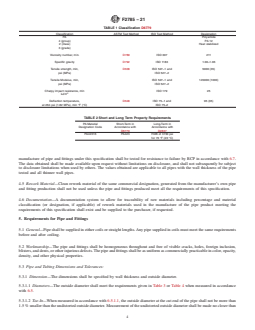
TABLE 1 Classification D6779
Classification ASTM Test Method ISO Test Method Designation
PA Polyamide
4 (group) PA 12
2 (class) Heat stabilized
3 (grade)
Viscosity number, min. D789 ISO 307 211
Specific gravity D792 ISO 1183 1.00–1.06
Tensile strength, min, D638 ISO 527–1 and 5000 (35)
psi (MPa) ISO 527–2
Tensile Modulus, min, ISO 527–1 and 145000 (1000)
psi (MPa) ISO 527–2
Charpy impact resistance, min ISO 179 25
kJ/m
Deflection temperature, D648 ISO 75–1 and 95 (35)
at 264 psi (1.82 MPa), min °F (°C) ISO 75–2
F2785−21
TABLE 3 Outside Diameters and Tolerances for PA12 Pipe, in. (mm)
Nominal Pipe Size Outside Diameter Tolerance Maximum out-of-roundness
⁄2 0.840 (21.3) ±0.004 (±0.102) 0.016 (0.41)
⁄4 1.050 (26.7) ±0.004 (±0.102) 0.02 (0.51)
1 1.315 (33.4) ±0.005 (±0.127) 0.02 (0.51)
1 ⁄4 1.660 (42.1) ±0.005 (±0.127) 0.024 (0.61)
1 ⁄2 1.900 (48.3) ±0.006 (±0.152) 0.024 (0.61)
2 2.375 (60.3) ±0.006 (±0.152) 0.024 (0.61)
3 3.500 (88.9) ±0.008 (±0.203) 0.03 (0.76)
4 4.500 (114.3) ±0.009 (±0.229) 0.03 (0.76)
5 5.563 (141.3) ±0.010 (±0.254) 0.06 (1.52)
6 6.625 (168.3) ±0.011 (±0.279) 0.07 (1.78)
8 8.625 (219) ±0.013 (±0.38) 0.08 (2.0)
10 10.750 (273) ±0.015 (±0.38) 0.1 (2.5)
12 12.750 (324) ±0.017 (±0.43) 0.1 (2.5)
TABLE 4 Tubing Diameters, Wall Thicknesses, and Tolerances, in. (mm)
†
Nominal Tubing Size (CTS) Outside Diameter Tolerance Minimum Wall Wall Thickness Tolerance
Thickness
⁄2 0.625 (15.9) ±0.004 (±0.10) 0.090 (2.27) +0.009 (+0.23)
⁄2 0.625 (15.9) ±0.004 (±0.10) 0.104 (2.64) +0.010 (+0.25)
⁄4 0.875 (22.2) ±0.004 (±0.10) 0.090 (2.27) +0.009 (+0.23)
1 1.125 (28.6) ±0.005 (±0.13) 0.090 (2.27) +0.012 (+0.31)
1 1.125 (28.6) ±0.005 (±0.13) 0.099 (2.51) +0.011 (+0.28)
1 1.125 (28.6) ±0.005 (±0.13) 0.101 (2.56) +0.012 (+0.31)
1 1.125 (28.6) ±0.005 (±0.13) 0.121 (3.07) +0.015 (+0.38)
1 ⁄4 1.375 (34.9) ±0.005 (±0.13) 0.090 (2.27) +0.011 (+0.28)
1 ⁄4 1.375 (34.9) ±0.005 (±0.13) 0.121 (3.07) +0.015 (+0.38)
†
Editorially corrected in April 2021.
Measurementoftheundistortedoutsidediametershallbemade 5.3.1.7 When sizes other than those listed in Table 3, Table
no closer than 1.5 pipe diameters or 11.8 in. (300 mm), 4or Table 5 are used, tolerances shall be: for outside diameter,
whichever distance is less, from the cut end of the pipe. use same tolerance of next smaller size; for wall thickness, use
Undistorted outside diameter shall meet the requirements of same tolerance percentage as shown in the tables.
Table 3 or Table 4.
5.4 Slow Crack Growth Resistance—PA 12 materials shall
5.3.1.3 Wall Thickness—The wall thickness shall be as
meet a slow crack growth resistance requirement of 500 hours
specified in Table 4 or Table 5 when measured in accordance
when tested in accordance with 6.6.
with 6.5.1.2. The minimum wall thickness at any point of
5.5 Resistance to Rapid Crack Propagation (RCP)—
measurementshallbenotlessthantheminimumwallthickness
Additional testing for resistance to RCP is required when the
specified in Table 4 or Table 5.
wall thickness of the pipe being produced in accordance with
5.3.1.4 Wall Thickness Eccentricity Range—Thewallthick-
this standard exceeds that of the pipe used to establish the
nesseccentricityrangeshallbewithin12%whenmeasuredin
resistancetoRCP.Inthesecircumstances,additionaltestingfor
accordance with 6.5.1.3.
resistance to failure by RCP in accordance with 6.7 shall be
5.3.1.5 Ovality—The ovality (cross section) of 3 in. IPS
conducted. The data obtained shall be made available upon
(88.9 mm) and smaller pipe shall not exceed 5 % when
request without limitations on disclosure, and shall not subse-
measured in accordance with 6.5.3. Measurements of coiled
quently be subject to disclosure limitations when used by
pipe shall be made on a sample cut from the coil, and in case
others.
of disagreement, conditioned per 6.3.
NOTE 4—The requirements and testing for resistance to RCP do not
NOTE 2—Other factors, that is, installation compaction, static soil
provide information for all possible conditions of use. The user should
loading, and dynamic vehicular loads may increase the ovality; therefore,
consult with the manufacturer and other appropriate sources such as resin
5%waschosenasthelimitfortheamountcontributedbymanufacturing,
suppliers, research, academia, etc., to determine that the RCP resistance
packing, in-plant storage, and shipping.
provided by the pipe producer is sufficient for the intended use.
(1) Before or during installation, coiled pipe larger than 3 in. IPS (88.9
mm) shall be processed by the installer through re-rounding equipment
5.6 Minimum Hydrostatic Burst Pressure/Apparent Tensile
that corrects ovality to 5% or less.
Strength (Quick Burst)—The pipe or system shall fail in a
NOTE 3—Ovality is a packaging condition that occurs when roundable
ductile manner when tested in accordance with Test Method
pipe is wound into a coil—the pipe flattens out as it is coiled. Ovality is
D1599 at a hoop stress greater than 3900 psi (27 MPa). For
correctedwhenjoiningequipmentisappliedtoroundablepipe,orbyfield
processing roundable pipe through re-rounding and straightening equip-
pipe sizes above 4-in. nominal diameter, the testing laboratory
ment during installation.
shall be allowed to replace the quick burst test (Test Method
5.3.1.6 Length—The pipe shall be supplied in straight D1599) by the apparent ring tensile strength test (Test Method
lengths or coils as agreed upon between the manufacturer and D2290). The minimum apparent tensile strength at yield when
the purchaser. The length shall not be less than the minimum determined in accordance with 6.10 shall be 3900 psi (27
length agreed upon when corrected to 73°F (23°C). MPa).
F2785−21
A,B
TABLE 5 Wall Thickness and Tolerances for PA12 Pipe, in. (mm)
C
Nominal Pipe Size (IPS) DR Minimum Tolerance
⁄2 9.33 0.090 (2.29) +0.011 (+0.28)
D
⁄4 0.090 (2.29) +0.011 (+0.28)
11.0 0.095 (2.41) +0.011 (+0.28)
D
1 0.090 (2.29) +0.011 (+0.28)
1 ⁄4 11 0.120 (3.05) +0.014 (+0.36)
D
0.090 (2.29) +0.011 (+0.28)
1 ⁄2 11 0.151 (3.84) +0.018 (+0.46)
D
0.090 (2.29) +0.011 (+0.28)
11 0.173 (4.39) +0.021 (+0.53)
2 11 0.216 (5.49) +0.026 (+0.66)
9.33 0.255 (6.48) +0.031 (+0.79)
3 13.5 0.259 (6.58) +0.031 (+0.79)
11.5 0.304 (7.72) +0.036 (+0.91)
11 0.318 (8.08) +0.038 (+0.96)
9.33 0.375 (9.53) +0.045 (+1.14)
4 17 0.265 (6.73) +0.032 (+0.81)
13.5 0.333 (8.46) +0.040 (+1.02)
11.5 0.391 (9.93) +0.047 (+1.19)
11.0 0.409 (10.39) +0.049 (+1.25)
9.33 0.482 (12.24) +0.058 (+1.47)
6 17 0.390 (9.91) +0.047 (+1.19)
13.5 0.491 (12.47) +0.059 (+1.50)
11.5 0.576 (14.63) +0.069 (+1.75)
11.0 0.602 (15.29) +0.072 (+1.83)
8 17 0.507 (12.90) +0.061 (+1.549)
13.5 0.639 (16.23) +0.077 (+1.956)
11.5 0.750 (19.05) +0.090 (+2.286)
11 0.784 (19.91) +0.094 (+2.388)
10 17 0.632 (16.05) +0.076 (+1.930)
13.5 0.796 (20.22) +0.096 (+2.438)
11.5 0.935 (23.75) +0.112 (+2.845)
11.0 0.977 (24.82) +0.177 (+2.972)
12 17 0.750 (19.05) +0.090 (+2.286)
13.5 0.944 (23.98) +0.113 (+2.870)
11.5 1.109 (28.17) +0.133 (+3.378)
11.0 1.159 (29.44) +0.139 (+3.531)
A
The sizes listed in Table 5 are those commercially available sizes used by the gas industry.
B
The minimum is the lowest wall thickness of the pipe at any cross section. The maximum permitted wall thickness, at any cross section, is the minimum wall thickness
plus the stated tolerance. All tolerances are on the plus side of the minimum requirement.
C
The DR shown are designations commonly accepted by the gas industry and do not calculate exactly.
D
The wall thicknesses are minimum and are not a function of the dimension ratios.
toartificialweathering.Theserequirementsandtestmethodsarebasedon
5.7 Sustained Pressure at 73 °F (23 °C)—The pipe or sys-
expected UV exposure levels in North America. Alternate requirements
temshallnotfailinlessthan1000hwhentestedinaccordance
and alternate determination methods may be appropriate in other regions
withTestMethodD1598.Thehoopstressshallbe2800psi(19
of the world. As an example, ISO 4437 standard requires a minimum
MPa).
resistance to an accumulation of 3.6GJ for non-black polyethylene
materials.
5.8 Outdoor Storage Stability—Black PA12 materials shall
contain 2 to 3 percent well dispersed carbon black. Due to the 5.9 Chemical Resistance—The weight, yield strength, and
relative viscosity requirements for PA12 pipe when measured
absorptive properties of the carbon black, is considered to be
stabilized against deterioration from unprotected exposure to in accordance with 6.11 are in Table 6.
UV for not less than 10 years. Yellow PA12 material shall be
5.10 Elevated Temperature Service—Polyamide 12 piping
stabilized and protected against deterioration from unprotected
materials intended for use at temperatures above 100°F
UV exposure for not less than 3 years.
(38°C) shall have the PPI hydrostatic design basis (HDB)
determined at the specific temperature in accordance with Test
NOTE 5—The determination for outdoor storage resistance is often
based on measuring the ductility properties of the pipe material exposed Method D2837. The 100 000-h intercept (long-term strength)
TABLE 6 Chemical Resistance
Chemical Weight Change, Yield Strength Change, Relative Viscosity,
Max% max% %
Mineral Oil +0.5 –12 ±3
Tertiary-butyl +0.5 –12 ±3
mercaptan (5 %)
Methanol +5 –35 ±3
Ethylene glycol +0.5 –12 ±3
Toluene (15 %) +7 –40 ±3
F2785−21
shallbecategorizedinaccordancewithTable7andbelistedas methods that are applicable from other specifications will be
the “hydrostatic design basis of XXX psi at XXX °F (C°) for referenced in the paragraph pertaining to that particular test.
(compound name).”
6.2 Sampling—Takearepresentativesampleofthepipeand
NOTE 6—Many design factors for elevated temperature service cannot
fittings sufficient to determine conformance with this specifi-
be covered in this specification. Users should consult applicable codes for
cation.About40ft(12m)ofpipeisrequiredtoperformallthe
limitations on pertinent maximum temperatures.
tests prescribed. The number of fittings required varies, de-
NOTE 7—In the absence of an HDB established at the specified
temperature,theHDBofahighertemperaturemaybeusedindetermining pendinguponthesizeandtypeoffitting.Asamplingplanshall
a design pressure rating at the specified temperature by arithmetic
be agreed upon by the purchaser and the manufacturer (see
interpolation.
Practice D1898).
5.11 Joints:
6.2.1 Pipe Test Specimens—Not less than 50 % of the test
5.11.1 Butt Fusion:
specimens required for any pressure test shall have at least a
5.11.1.1 Buttfusionjointsofpolyamide12pipeandfittings
partofthemarkingintheircentralsections.Thecentralsection
shall be made in accordance with Practice F3372.
is that portion of pipe which is at least one pipe diameter away
5.11.1.2 PA12 butt fusion joining shall be between compo-
from an end closure.
nents (pipes, fittings, or valves) having the same SDR or DR.
Butt fusion between unlike SDR or DR components shall be 6.3 Conditioning—Unlessotherwisespecified,conditionthe
allowed only if it has been demonstrated that long term specimenspriortotestat73.4°F 63.6°F(23°C 62°C)and
performance is not adversely affected. The minimum require- 50 % 6 5 % relative humidity for not less than 40 h, in
ment to demonstrate long term performance shall be the
accordance with Procedure A of Practice D618 for those tests
requirements of 5.6 of this specification. The Hydrostatic
where conditioning is required and in all cases of disagree-
Design Basis (HDB) of the PA12 material shall be confirmed
ment.
using specimens containing butt fusion joints resulting from
6.4 Test Conditions—Conduct the test in the standard labo-
different SDRs or DRs. Pipe/pipe joints of the material that
ratory atmosphere of 73.4°F 6 3.6°F (23°C 6 2°C) and 50
passshallvalidatepipe/pipe,pipe/fitting,orfitting/fittingjoints
% 6 5 % relative humidity, unless otherwise specified.
of the same SDR ratio for the material.
6.5 Dimensions and Tolerances:
5.12 Fittings—Fittings shall meet the requirements of the
applicable ASTM standards.
6.5.1 Pipe—Any length of pipe is used to determine the
5.12.1 Butt Heat Fusion Fittings—Butt heat fusion fittings
dimensions. Coiled pipe shall be measured in the natural
intendedforusewithPA12pipingsystemsshallconformtothe
springback condition, unless specified otherwise.
requirements of Specification F1733.
6.5.1.1 Diameter—Measure the diameter of the pipe in
5.12.2 Electrofusion Fittings—Electrofusion fittings in-
accordance with Test Method D2122. The average outside
tended for use with PA12 piping systems shall conform to the
diameterfornonroundablepipeisthearithmeticaverageofthe
requirements contained within Specifcation F2767.
maximum and minimum diameters at any cross section on the
5.12.3 Mechanical Fittings—Mechanical fittings intended
length of the pipe. For roundable pipe, out-of-roundness
for use with PA12 piping systems shall conform to the
tolerance applies to measurements made while the pipe is
requirements contained within Specification F2145.
rounded with the manufacturer’s recommended equipment.
5.12.4 Transition Fittings and Anodeless Risers— Transi-
Measure out-of-roundness within one-half pipe diameter or 2
tion fittings and anodeless risers intended for use with PA12
in. (50 mm), whichever is closer, of the rounding equipment.
pipings systems shall conform to the requirements contained
See Test Method D2122 for definitions of nonroundable and
within Specification F1973.
roundable pipe.
5.13 Valves—Gas valves shall meet the requirements of
(
...
This document is not an ASTM standard and is intended only to provide the user of an ASTM standard an indication of what changes have been made to the previous version. Because
it may not be technically possible to adequately depict all changes accurately, ASTM recommends that users consult prior editions as appropriate. In all cases only the current version
of the standard as published by ASTM is to be considered the official document.
´1
Designation: F2785 − 20 F2785 − 21 An American National Standard
Standard Specification for
Polyamide 12 Gas Pressure Pipe, Tubing, and Fittings
This standard is issued under the fixed designation F2785; the number immediately following the designation indicates the year of
original adoption or, in the case of revision, the year of last revision. A number in parentheses indicates the year of last reapproval. A
superscript epsilon (´) indicates an editorial change since the last revision or reapproval.
ε NOTE—Table 4 was editorially corrected in April 2021.
1. Scope*
1.1 This specification covers requirements and test methods for the characterization of polyamide 12 pipe, tubing, and fittings for
use in fuel gas mains and services for direct burial and reliner applications. The pipe and fittings covered by this specification are
intended for use in the distribution of natural gas.
1.1.1 Pipe and fittings covered by this specification shall not be joined using taper pipe threads. Butt fusion joining shall be done
in accordance with Practice F3372. Design considerations are discussed in Appendix X1. In-plant quality control programs are
specified in Annex A1.
1.2 The text of this specification references notes, footnotes, and appendixes which provide explanatory material. These notes and
footnotes (excluding those in tables and figures) shall not be considered as requirements of the specification.
1.3 The values stated in inch-pound units are to be regarded as standard. The values given in parentheses are mathematical
conversions to SI units that are provided for information only and are not considered standard.
1.4 This standard does not purport to address all of the safety concerns, if any, associated with its use. It is the responsibility
of the user of this standard to establish appropriate safety, health, and environmental practices and determine the applicability of
regulatory limitations prior to use.
NOTE 1—Pipe and fittings utilizing heat fusion joining techniques produced from compounds meeting the requirements of Group 3, Class 2, and Grade
3 (PA323 or PA11) are intended for use with pipe manufactured from compounds meeting the requirements of Group 3, class 2 and Grade 3. Pipe and
fittings utilizing heat fusion joining techniques produced from compounds meeting the requirements of Group 4, Class 2 and Grade 3 (PA 423 or PA12)
are intended for use with pipe manufactured from compounds meeting the requirements of Group 4, Class 2 and Grade 3. As per the recommendations
of the respective resin manufacturers, no cross fusion between PA 323 (PA11) and PA 423 (PA12) compounds is permitted.
1.5 This international standard was developed in accordance with internationally recognized principles on standardization
established in the Decision on Principles for the Development of International Standards, Guides and Recommendations issued
by the World Trade Organization Technical Barriers to Trade (TBT) Committee.
2. Referenced Documents
2.1 ASTM Standards:
D543 Practices for Evaluating the Resistance of Plastics to Chemical Reagents
This test method is under the jurisdiction of ASTM Committee F17 on Plastic Piping Systems and is the direct responsibility of Subcommittee F17.60 on Gas.
Current edition approved Dec. 1, 2020July 1, 2021. Published December 2020July 2021. Originally approved in 2009 as F2785–09. Last previous edition approved in
ɛ1
20182020 as F2785–18a.–20 . DOI: 10.1520/F2785-20.10.1520/F2785-21.
For referenced ASTM standards, visit the ASTM website, www.astm.org, or contact ASTM Customer Service at service@astm.org. For Annual Book of ASTM Standards
volume information, refer to the standard’s Document Summary page on the ASTM website.
*A Summary of Changes section appears at the end of this standard
Copyright © ASTM International, 100 Barr Harbor Drive, PO Box C700, West Conshohocken, PA 19428-2959. United States
F2785 − 21
D618 Practice for Conditioning Plastics for Testing
D648 Test Method for Deflection Temperature of Plastics Under Flexural Load in the Edgewise Position
D638 Test Method for Tensile Properties of Plastics
D789 Test Method for Determination of Relative Viscosity of Concentrated Polyamide (PA) Solutions
D792 Test Methods for Density and Specific Gravity (Relative Density) of Plastics by Displacement
D1598 Test Method for Time-to-Failure of Plastic Pipe Under Constant Internal Pressure
D1599 Test Method for Resistance to Short-Time Hydraulic Pressure of Plastic Pipe, Tubing, and Fittings
D1898 Practice for Sampling of Plastics (Withdrawn 1998)
D1600 Terminology for Abbreviated Terms Relating to Plastics
D2122 Test Method for Determining Dimensions of Thermoplastic Pipe and Fittings
D2774 Practice for Underground Installation of Thermoplastic Pressure Piping
D2290 Test Method for Apparent Hoop Tensile Strength of Plastic or Reinforced Plastic Pipe
D2837 Test Method for Obtaining Hydrostatic Design Basis for Thermoplastic Pipe Materials or Pressure Design Basis for
Thermoplastic Pipe Products
D6779 Classification System for and Basis of Specification for Polyamide Molding and Extrusion Materials (PA)
F412 Terminology Relating to Plastic Piping Systems
F1025 Guide for Selection and Use of Full-Encirclement-Type Band Clamps for Reinforcement or Repair of Punctures or Holes
in Polyethylene Gas Pressure Pipe
F1473 Test Method for Notch Tensile Test to Measure the Resistance to Slow Crack Growth of Polyethylene Pipes and Resins
F1733 Specification for Butt Heat Fusion Polyamide(PA) Plastic Fitting for Polyamide(PA) Plastic Pipe and Tubing
F1973 Specification for Factory Assembled Anodeless Risers and Transition Fittings in Polyethylene (PE) and Polyamide 11
(PA11) and Polyamide 12 (PA12) Fuel Gas Distribution Systems
F2138 Specification for Excess Flow Valves for Natural Gas Service
F2145 Specification for Polyamide 11 (PA 11) and Polyamide 12 (PA12) Mechanical Fittings for Use on Outside Diameter
Controlled Polyamide 11 and Polyamide 12 Pipe and Tubing
F2767 Specification for Electrofusion Type Polyamide-12 Fittings for Outside Diameter Controlled Polyamide-12 Pipe and
Tubing for Gas Distribution
F2897 Specification for Tracking and Traceability Encoding System of Natural Gas Distribution Components (Pipe, Tubing,
Fittings, Valves, and Appurtenances)
F3372 Practice for Butt Fusion Joining of PA12 Pipe and Fittings
2.2 ANSI Standards:
B 16.40 Manually Operated Thermoplastic Gas Shutoffs and Valves in Gas Distribution Systems
B 31.8 Gas Transmission and Distribution Piping Systems
2.3 Federal Standards:
Fed. Std. No. 123 Marking for Shipment (Civil Agencies)
OPS Part 192 Title 49 ,Title 49 Code of Federal Regulations
2.4 Military Standards:
MIL-STD-129 Marking for Shipment and Storage
MIL-STD-1235 (ORD) Single- and Multi-Level Continuous Sampling Procedures and Tables for Inspection by Attributes
2.5 ISO Standards:
307 Plastics -- Polyamides -- Determination of viscosity number
3146 Plastics -- Determination of melting behaviour (melting temperature or melting range) of semi-crystalline polymers by
capillary tube and polarizing-microscope methods
1183 Plastics -- Methods for determining the density of non-cellular plastics -- Part 1: Immersion method, liquid pyknometer
method and titration method
527–1 Plastics -- Determination of tensile properties -- Part 1: General principles
527–2 Plastics -- Determination of tensile properties -- Part 2: Test conditions for moulding and extrusion plastics
178 Plastics -- Determination of flexural properties
179 Plastics -- Determination of Charpy impact properties -- Part 1: Non-instrumented impact test
75–1 Plastics -- Determination of temperature of deflection under load -- Part 1: General test method
75–2 Plastics -- Determination of temperature of deflection under load -- Part 2: Plastics and ebonite
ISO 16486-1 Plastics piping systems for the supply of gaseous fuels — Unplasticized polyamide (PA-U) piping systems with
fusion jointing and mechanical jointing — Part 1: General
The last approved version of this historical standard is referenced on www.astm.org.
Available from American National Standards Institute (ANSI), 25 W. 43rd St., 4th Floor, New York, NY 10036, http://www.ansi.org.
Available from DLA Document Services, Building 4/D, 700 Robbins Ave., Philadelphia, PA 19111-5094, http://quicksearch.dla.mil.
Available from International Organization for Standardization (ISO), 1, ch. de la Voie-Creuse, Case postale 56, CH-1211, Geneva 20, Switzerland, http://www.iso.ch.
F2785 − 21
2.6 Plastic Pipe Institute:
PPI TR3 Policies and Procedures for Developing Hydrostatic Design Basis (HDB), Pressure Design Basis (PDB), Strength
Design Basis (SDB), and Minimum Required Strength (MRS) Ratings for Thermoplastic Piping Materials or Pipe
PPI TR4 Hydrostatic Design Bases and Maximum Recommended Hydrostatic Design Stresses for Thermoplastic Piping
Materials
PPI TN7 Nature of Hydrostatic Stress Rupture Curves
2.7 Other Standards:
National Fire Protection Association: NFPA 58 , Storage and Handling Liquefied Petroleum Gases
3. Terminology
3.1 Definitions—Definitions are in accordance with Terminology F412, and abbreviations are in accordance with Terminology
D1600, unless otherwise specified.
3.2 The gas industry terminology used in this specification is in accordance with ANSI B31.8 or CFR OPS Part 192 Title 49, unless
otherwise indicated.
3.3 The term pipe used herein refers to both pipe and tubing unless specifically stated otherwise.
3.4 Definitions of Terms Specific to This Standard:
3.4.1 re-rounding equipment, n—equipment used to reform the pipe and permanently reduce ovality to 5% or less.
3.4.2 rounding equipment, n—equipment, devices, clamps, and so forth, used to temporarily hold the pipe round while
out-of-roundness measurements are made, or a joining procedure (heat fusion, electrofusion, or mechanical) is performed.
3.4.3 standard thermoplastic material designated code, n—the pipe material designation code shall consist of the abbreviation for
the polyamide (PA) followed by Arabic numerals which describe the short term properties in accordance with Classification
D6779, the hydrostatic design stress for water at 73.4 °F (23 °C) in units of 100 psi with any decimal figures dropped. Where the
hydrostatic design stress code contains less than two figures, a zero is used before the number. Thus, a complete material
designation code shall consist of two letters and five figures for polyamide pipe materials. For example, PA 42316 is a grade of
polyamide 12 with a 1600 psi design stress for water at 73.4 °F (23 °C). The hydrostatic design stresses for gas are not used in
this designation code.
3.4.4 thermoplastic pipe dimension ratio (DR), n—the ratio of pipe diameter to wall thickness. It is calculated by dividing the
specified outside diameter of the pipe, in inches, by the minimum specified wall thickness, in inches. The standard dimension ratio
(SDR) is a common numbering system which is derived from the ANSI preferred number series R 10.
3.4.5 toe-in, n—a small reduction of the outside diameter at the cut end of a length of thermoplastic pipe.
4. Requirements for Materials
4.1 General—The polyamide material used to make pipe and fittings shall be virgin or reworked material (see 4.5 ) and shall have
a Plastics Pipe Institute (PPI) long-term hydrostatic design stress and hydrostatic design basis rating as determined per PPI TR3
and PPI TR4.
4.2 Classification—Polyamide materials suitable for use in the manufacturing of pipe and fittings under this specification shall be
classified in accordance with Classification D6779, as shown in Table 1.
4.3 Short- and Long-Term Properties—Polyamide pipe and fittings shall be made from a PA material which also satisfies the
combinations of short- and long-term property requirements shown in Table 2.
4.4 Resistance to Rapid Crack Propagation (RCP) for Materialsl—The material classification (formulation) used in the
Available from Plastics Pipe Institute (PPI), 105 Decker Court, Suite 825, Irving, TX 75062, http://www.plasticpipe.org.
Available from National Fire Protection Association (NFPA), 1 Batterymarch Park, Quincy, MA 02169-7471, http://www.nfpa.org.
F2785 − 21
TABLE 1 Classification D6779
Classification ASTM Test Method ISO Test Method Designation
PA Polyamide
4 (group) PA 12
2 (class) Heat stabilized
3 (grade)
Viscosity number, min. D789 ISO 307 211
Specific gravity D792 ISO 1183 1.00–1.06
Tensile strength, min, D638 ISO 527–1 and 5000 (35)
psi (MPa) ISO 527–2
Tensile Modulus, min, ISO 527–1 and 145000 (1000)
psi (MPa) ISO 527–2
Charpy impact resistance, min ISO 179 25
kJ/m
Deflection temperature, D648 ISO 75–1 and 95 (35)
at 264 psi (1.82 MPa), min °F (°C) ISO 75–2
TABLE 2 Short and Long Term Property Requirements
PA Material Short-Term in Long-Term in
Designation Code Accordance with Accordance with
D6779 D2837
PA42316 PA423 HDB of 3150 psi
for 73 °F (23 °C)
manufacture of pipe and fittings under this specification shall be tested for resistance to failure by RCP in accordance with 6.7.
The data obtained shall be made available upon request without limitations on disclosure, and shall not subsequently be subject
to disclosure limitations when used by others. The values obtained are applicable to all pipes with the wall thickness of the pipe
tested and all thinner wall pipes.
4.5 Rework Material—Clean rework material of the same commercial designation, generated from the manufacturer’s own pipe
and fitting production shall not be used unless the pipe and fittings produced meet all the requirements of this specification.
4.6 Documentation—A documentation system to allow for traceability of raw materials including percentage and material
classification (or designation, if applicable) of rework materials used in the manufacture of the pipe product meeting the
requirements of this specification shall exist and be supplied to the purchaser, if requested.
5. Requirements for Pipe and Fittings
5.1 General—Pipe shall be supplied in either coils or straight lengths. Any pipe supplied in coils must meet the same requirements
before and after coiling.
5.2 Workmanship—The pipe and fittings shall be homogeneous throughout and free of visible cracks, holes, foreign inclusion,
blisters, and dents, or other injurious defects. The pipe and fittings shall be as uniform as commercially practicable in color, opacity,
density, and other physical properties.
5.3 Pipe and Tubing Dimensions and Tolerances:
5.3.1 Dimension—The dimensions shall be specified by wall thickness and outside diameter.
5.3.1.1 Diameters—The outside diameter shall meet the requirements given in Table 3 or Table 4 when measured in accordance
with 6.5.
5.3.1.2 Toe-In—When measured in accordance with 6.5.1.1, the outside diameter at the cut end of the pipe shall not be more than
1.5 % smaller than the undistorted outside diameter. Measurement of the undistorted outside diameter shall be made no closer than
F2785 − 21
TABLE 3 Outside Diameters and Tolerances for PA12 Pipe, in. (mm)
Nominal Pipe Size Outside Diameter Tolerance Maximum out-of-roundness
⁄2 0.840 (21.3) ±0.004 (±0.102) 0.016 (0.41)
⁄4 1.050 (26.7) ±0.004 (±0.102) 0.02 (0.51)
1 1.315 (33.4) ±0.005 (±0.127) 0.02 (0.51)
1 ⁄4 1.660 (42.1) ±0.005 (±0.127) 0.024 (0.61)
1 ⁄2 1.900 (48.3) ±0.006 (±0.152) 0.024 (0.61)
2 2.375 (60.3) ±0.006 (±0.152) 0.024 (0.61)
3 3.500 (88.9) ±0.008 (±0.203) 0.03 (0.76)
4 4.500 (114.3) ±0.009 (±0.229) 0.03 (0.76)
5 5.563 (141.3) ±0.010 (±0.254) 0.06 (1.52)
6 6.625 (168.3) ±0.011 (±0.279) 0.07 (1.78)
8 8.625 (219) ±0.013 (±0.38) 0.08 (2.0)
10 10.750 (273) ±0.015 (±0.38) 0.1 (2.5)
12 12.750 (324) ±0.017 (±0.43) 0.1 (2.5)
TABLE 4 Tubing Diameters, Wall Thicknesses, and Tolerances, in. (mm)
†
Nominal Tubing Size (CTS) Outside Diameter Tolerance Minimum Wall Wall Thickness Tolerance
Thickness
⁄2 0.625 (15.9) ±0.004 (±0.10) 0.090 (2.27) +0.009 (+0.23)
⁄2 0.625 (15.9) ±0.004 (±0.10) 0.104 (2.64) +0.010 (+0.25)
⁄4 0.875 (22.2) ±0.004 (±0.10) 0.090 (2.27) +0.009 (+0.23)
1 1.125 (28.6) ±0.005 (±0.13) 0.090 (2.27) +0.012 (+0.31)
1 1.125 (28.6) ±0.005 (±0.13) 0.099 (2.51) +0.011 (+0.28)
1 1.125 (28.6) ±0.005 (±0.13) 0.101 (2.56) +0.012 (+0.31)
1 1.125 (28.6) ±0.005 (±0.13) 0.121 (3.07) +0.015 (+0.38)
1 ⁄4 1.375 (34.9) ±0.005 (±0.13) 0.090 (2.27) +0.011 (+0.28)
1 ⁄4 1.375 (34.9) ±0.005 (±0.13) 0.121 (3.07) +0.015 (+0.38)
†
Editorially corrected in April 2021.
1.5 pipe diameters or 11.8 in. (300 mm), whichever distance is less, from the cut end of the pipe. Undistorted outside diameter
shall meet the requirements of Table 3 or Table 4.
5.3.1.3 Wall Thickness—The wall thickness shall be as specified in Table 4 or Table 5 when measured in accordance with 6.5.1.2.
The minimum wall thickness at any point of measurement shall be not less than the minimum wall thickness specified in Table
4 or Table 5.
5.3.1.4 Wall Thickness Eccentricity Range— The wall thickness eccentricity range shall be within 12 % when measured in
accordance with 6.5.1.3.
5.3.1.5 Ovality—The ovality (cross section) of 3 in. IPS (88.9 mm) and smaller pipe shall not exceed 5 % when measured in
accordance with 6.5.3. Measurements of coiled pipe shall be made on a sample cut from the coil, and in case of disagreement,
conditioned per 6.3.
NOTE 2—Other factors, that is, installation compaction, static soil loading, and dynamic vehicular loads may increase the ovality; therefore, 5 % was
chosen as the limit for the amount contributed by manufacturing, packing, in-plant storage, and shipping.
(1) Before or during installation, coiled pipe larger than 3 in. IPS (88.9 mm) shall be processed by the installer through re-rounding equipment that corrects
ovality to 5% or less.
NOTE 3—Ovality is a packaging condition that occurs when roundable pipe is wound into a coil—the pipe flattens out as it is coiled. Ovality is corrected
when joining equipment is applied to roundable pipe, or by field processing roundable pipe through re-rounding and straightening equipment during
installation.
5.3.1.6 Length—The pipe shall be supplied in straight lengths or coils as agreed upon between the manufacturer and the purchaser.
The length shall not be less than the minimum length agreed upon when corrected to 73 °F (23 °C).
5.3.1.7 When sizes other than those listed in Table 3, Table 4or Table 5 are used, tolerances shall be: for outside diameter, use same
tolerance of next smaller size; for wall thickness, use same tolerance percentage as shown in the tables.
5.4 Slow Crack Growth Resistance—PA 12 materials shall meet a slow crack growth resistance requirement of 500 hours when
tested in accordance with 6.6.
5.5 Resistance to Rapid Crack Propagation (RCP)—Additional testing for resistance to RCP is required when the wall thickness
F2785 − 21
A,B
TABLE 5 Wall Thickness and Tolerances for PA12 Pipe, in. (mm)
C
Nominal Pipe Size (IPS) DR Minimum Tolerance
⁄2 9.33 0.090 (2.29) +0.011 (+0.28)
D
⁄4 0.090 (2.29) +0.011 (+0.28)
11.0 0.095 (2.41) +0.011 (+0.28)
D
1 0.090 (2.29) +0.011 (+0.28)
1 ⁄4 11 0.120 (3.05) +0.014 (+0.36)
D
0.090 (2.29) +0.011 (+0.28)
1 ⁄2 11 0.151 (3.84) +0.018 (+0.46)
D
0.090 (2.29) +0.011 (+0.28)
11 0.173 (4.39) +0.021 (+0.53)
2 11 0.216 (5.49) +0.026 (+0.66)
9.33 0.255 (6.48) +0.031 (+0.79)
3 13.5 0.259 (6.58) +0.031 (+0.79)
11.5 0.304 (7.72) +0.036 (+0.91)
11 0.318 (8.08) +0.038 (+0.96)
9.33 0.375 (9.53) +0.045 (+1.14)
4 17 0.265 (6.73) +0.032 (+0.81)
13.5 0.333 (8.46) +0.040 (+1.02)
11.5 0.391 (9.93) +0.047 (+1.19)
11.0 0.409 (10.39) +0.049 (+1.25)
9.33 0.482 (12.24) +0.058 (+1.47)
6 17 0.390 (9.91) +0.047 (+1.19)
13.5 0.491 (12.47) +0.059 (+1.50)
11.5 0.576 (14.63) +0.069 (+1.75)
11.0 0.602 (15.29) +0.072 (+1.83)
8 17 0.507 (12.90) +0.061 (+1.549)
13.5 0.639 (16.23) +0.077 (+1.956)
11.5 0.750 (19.05) +0.090 (+2.286)
11 0.784 (19.91) +0.094 (+2.388)
10 17 0.632 (16.05) +0.076 (+1.930)
13.5 0.796 (20.22) +0.096 (+2.438)
11.5 0.935 (23.75) +0.112 (+2.845)
11.0 0.977 (24.82) +0.177 (+2.972)
12 17 0.750 (19.05) +0.090 (+2.286)
13.5 0.944 (23.98) +0.113 (+2.870)
11.5 1.109 (28.17) +0.133 (+3.378)
11.0 1.159 (29.44) +0.139 (+3.531)
A
The sizes listed in Table 5 are those commercially available sizes used by the gas industry.
B
The minimum is the lowest wall thickness of the pipe at any cross section. The maximum permitted wall thickness, at any cross section, is the minimum wall thickness
plus the stated tolerance. All tolerances are on the plus side of the minimum requirement.
C
The DR shown are designations commonly accepted by the gas industry and do not calculate exactly.
D
The wall thicknesses are minimum and are not a function of the dimension ratios.
of the pipe being produced in accordance with this standard exceeds that of the pipe used to establish the resistance to RCP. In
these circumstances, additional testing for resistance to failure by RCP in accordance with 6.7 shall be conducted. The data
obtained shall be made available upon request without limitations on disclosure, and shall not subsequently be subject to disclosure
limitations when used by others.
NOTE 4—The requirements and testing for resistance to RCP do not provide information for all possible conditions of use. The user should consult with
the manufacturer and other appropriate sources such as resin suppliers, research, academia, etc., to determine that the RCP resistance provided by the pipe
producer is sufficient for the intended use.
5.6 Minimum Hydrostatic Burst Pressure/Apparent Tensile Strength (Quick Burst)—The pipe or system shall fail in a ductile
manner when tested in accordance with Test Method D1599 at a hoop stress greater than 3900 psi (27 MPa). For pipe sizes above
4-in. nominal diameter, the testing laboratory shall be allowed to replace the quick burst test (Test Method D1599) by the apparent
ring tensile strength test (Test Method D2290). The minimum apparent tensile strength at yield when determined in accordance
with 6.10 shall be 3900 psi (27 MPa).
5.7 Sustained Pressure at 73 °F (23 °C)—The pipe or system shall not fail in less than 1000 h when tested in accordance with Test
Method D1598. The hoop stress shall be 2800 psi (19 MPa).
5.8 Outdoor Storage Stability—PA 12 pipe stored outdoors and unprotected for at least two years from date of manufacture shall
meet all the requirements of this specification. PA 12 pipe stored outdoors for over two years from date of manufacture is suitable
for use if it meets the requirements of this specification.Black PA 12 materials shall contain 2 to 3 percent well dispersed carbon
black. Due to the absorptive properties of the carbon black, is considered to be stabilized against deterioration from unprotected
F2785 − 21
exposure to UV for not less than 10 years. Yellow PA 12 material shall be stabilized and protected against deterioration from
unprotected UV exposure for not less than 3 years.
NOTE 5—The determination for outdoor storage resistance is often based on measuring the ductility properties of the pipe material exposed to artificial
weathering. These requirements and test methods are based on expected UV exposure levels in North America. Alternate requirements and alternate
determination methods may be appropriate in other regions of the world. As an example, ISO 4437 standard requires a minimum resistance to an
accumulation of 3.6GJ for non-black polyethylene materials.
5.9 Chemical Resistance—The weight, yield strength, and relative viscosity requirements for PA 12 pipe when measured in
accordance with 6.11 are in Table 6.
5.10 Elevated Temperature Service—Polyamide 12 piping materials intended for use at temperatures above 100 °F (38 °C) shall
have the PPI hydrostatic design basis (HDB) determined at the specific temperature in accordance with Test Method D2837. The
100 000-h intercept (long-term strength) shall be categorized in accordance with Table 7 and be listed as the “hydrostatic design
basis of XXX psi at XXX °F (C°) for (compound name).”
NOTE 6—Many design factors for elevated temperature service cannot be covered in this specification. Users should consult applicable codes for
limitations on pertinent maximum temperatures.
NOTE 7—In the absence of an HDB established at the specified temperature, the HDB of a higher temperature may be used in determining a design
pressure rating at the specified temperature by arithmetic interpolation.
5.11 Joints:
5.11.1 Butt Fusion:
5.11.1.1 Butt fusion joints of polyamide 12 pipe and fittings shall be made in accordance with Practice F3372.
5.11.1.2 PA 12 butt fusion joining shall be between components (pipes, fittings, or valves) having the same SDR or DR. Butt fusion
between unlike SDR or DR components shall be allowed only if it has been demonstrated that long term performance is not
adversely affected. The minimum requirement to demonstrate long term performance shall be the requirements of 5.6 of this
specification. The Hydrostatic Design Basis (HDB) of the PA 12 material shall be confirmed using specimens containing butt fusion
joints resulting from different SDRs or DRs. Pipe/pipe joints of the material that pass shall validate pipe/pipe, pipe/fitting, or
fitting/fitting joints of the same SDR ratio for the material.
5.12 Fittings—Fittings shall meet the requirements of the applicable ASTM standards.
5.12.1 Butt Heat Fusion Fittings—Butt heat fusion fittings intended for use with PA12 piping systems shall conform to the
requirements of Specification F1733.
5.12.2 Electrofusion Fittings—Electrofusion fittings intended for use with PA12 piping systems shall conform to the requirements
contained within Specifcation F2767.
5.12.3 Mechanical Fittings—Mechanical fittings intended for use with PA12 piping systems shall conform to the requirements
contained within Specification F2145.
5.12.4 Transition Fittings and Anodeless Risers— Transition fittings and anodeless risers intended for use with PA12 pipings
systems shall conform to the requirements contained within Specification F1973.
TABLE 6 Chemical Resistance
Chemical Weight Change, Yield Strength Change, Relative Viscosity,
Max% max% %
Mineral Oil +0.5 –12 ±3
Tertiary-butyl +0.5 –12 ±3
mercaptan (5 %)
Methanol +5 –35 ±3
Ethylene glycol +0.5 –12 ±3
Toluene (15 %) +7 –40 ±3
F2785 − 21
TABLE 7 Pipe Category
Property Test Method Category
A B C D E F G H
Temperature . . . 100 (38) 120 (49) 140 (60) 160 (71) 180 (82) . . .
°F (°C)
Hydrostatic Design Basis, psi (MPa) D2837 400 (2.8) 500 630 800 1000 (6.9) 1250 (8.6) 1600 (11.0) 2000 (13.8)
(3.4) (4.3) (5.5)
Examples: EH – At 140 °F (60 °C) the HDB is 2000 psi (13.8 MPa)
5.13 Valves—Gas valves shall meet the requirements of ANSI Standard B 16.40.
5.14 Excess Flow Valves—Excess flow valves shall meet the requirements of Specification F2138.
6. Test Methods
6.1 General—The test methods in this specification cover plastic pipe and fittings to be used for gas distribution. Test methods
that are applicable from other specifications will be referenced in the paragraph pertaining to that particular test.
6.2 Sampling—Take a representative sample of the pipe and fittings sufficient to determine conformance with this specification.
About 40 ft (12 m) of pipe is required to perform all the tests prescribed. The number of fittings required varies, depending upon
the size and type of fitting. A sampling plan shall be agreed upon by the purchaser and the manufacturer (see Practice D1898).
6.2.1 Pipe Test Specimens—Not less than 50 % of the test specimens required for any pressure test shall have at least a part of
the marking in their central sections. The central section is that portion of pipe which is at least one pipe diameter away from an
end closure.
6.3 Conditioning—Unless otherwise specified, condition the specimens prior to test at 73.473.4 °F 6 3.6 °F (23(23 °C 6 2 °C)
and 50 % 6 5 % relative humidity for not less than 40 h, in accordance with Procedure A of Practice D618 for those tests where
conditioning is required and in all cases of disagreement.
6.4 Test Conditions—Conduct the test in the standard laboratory atmosphere of 73.473.4 °F 6 3.6 °F (23(23 °C 6 2 °C) and 50
% 6 5 % relative humidity, unless otherwise specified.
6.5 Dimensions and Tolerances:
6.5.1 Pipe—Any length of pipe is used to determine the dimensions. Coiled pipe shall be measured in the natural springback
condition, unless specified otherwise.
6.5.1.1 Diameter—Measure the diameter of the pipe in accordance with Test Method D2122. The average outside diameter for
nonroundable pipe is the arithmetic average of the maximum and minimum diameters at any cross section on
...