

ASTM F2986-23
(Specification)Standard Specification for Corrugated Polyethylene Pipe and Fittings for Mine Leachate, Heap Leach Aeration and Other Mining Applications
General Information
- Abstract
SCOPE
1.1 This specification covers requirements and test methods for materials, workmanship, dimensions, perforations, pipe stiffness, elongation, joint separation resistance, quality of extruded polyethylene, brittleness, testing, and marking of corrugated polyethylene (PE) pipe and fittings for mine drainage, leachate collection, heap leach aeration, and transmission pipe. It covers nominal sizes 50 mm (2 in.) to 250 mm (10 in.) in single-wall profile, and 75 mm (3 in.) to 1500 mm (60 in.) in double-wall profile.
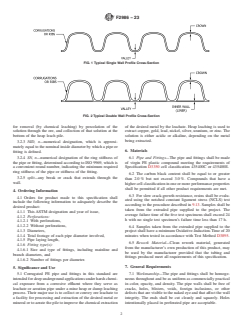
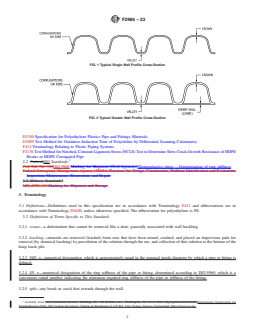
1.2 This specification covers single profile wall, annular extruded corrugated polyethylene pipe as depicted in Fig. 1, and double wall, annular extruded corrugated polyethylene pipe as depicted in Fig. 2.
FIG. 1 Typical Single Wall Profile Cross-Section
FIG. 2 Typical Double Wall Profile Cross-Section
1.3 The values stated in SI units are to be regarded as standard. The values given in parentheses are mathematical conversions to inch-pound units that are provided for information only and are not considered standard.
1.4 The following precautionary caveat pertains only to the test method portion, Section 9, of this specification: This standard does not purport to address all of the safety concerns, if any, associated with its use. It is the responsibility of the user of this standard to establish appropriate safety, health, and environmental practices and determine the applicability of regulatory limitations prior to use.
1.5 This international standard was developed in accordance with internationally recognized principles on standardization established in the Decision on Principles for the Development of International Standards, Guides and Recommendations issued by the World Trade Organization Technical Barriers to Trade (TBT) Committee.
- Status
- Published
- Publication Date
- 31-Oct-2023
- Technical Committee
- F17 - Plastic Piping Systems
- Drafting Committee
- F17.65 - Land Drainage
Buy Documents
ASTM F2986-23 - Standard Specification for Corrugated Polyethylene Pipe and Fittings for Mine Leachate, Heap Leach Aeration and Other Mining Applications
REDLINE ASTM F2986-23 - Standard Specification for Corrugated Polyethylene Pipe and Fittings for Mine Leachate, Heap Leach Aeration and Other Mining Applications
Overview
ASTM F2986-23 is the international standard specification for corrugated polyethylene (PE) pipe and fittings designed specifically for mine leachate, heap leach aeration, and a variety of mining drainage and collection applications. Published and maintained by ASTM International, this standard establishes manufacturing, material, dimensional, performance, and marking requirements for both single-wall and double-wall corrugated PE pipe systems. It ensures product reliability in harsh mining environments with aggressive chemical exposure, making it essential for projects requiring durable drainage, leachate management, and aeration solutions.
Key Topics
- Material Requirements: Pipes and fittings must be produced using high-quality virgin PE compounds, compliant with ASTM D3350 cell classifications. Requirements for carbon black content and slow crack growth resistance ensure long-term performance.
- Product Construction: Covers single-wall (50 mm–250 mm) and double-wall (75 mm–1500 mm) annular extruded corrugated profiles, catering to a broad range of system sizes.
- Performance Testing: Includes stringent criteria for pipe stiffness, joint separation resistance, elongation, brittleness, and oxidative induction time. Testing protocols help guarantee mechanical integrity under load and exposure to aggressive solutions.
- Perforation and Aeration Features: Prescribes location, size, and protective measures for perforations, particularly in aeration systems to prevent clogging and ensure uniform airflow in heap leach piles.
- Marking and Certification: Mandates clear product markings for traceability, including the ASTM F2986 designation, size, PE legend, and manufacturer ID, as well as options for SN class and date coding.
Applications
ASTM F2986-23 supports critical mining operations by standardizing components for:
- Mine Leachate Collection: Corrugated PE pipes are central to draining and transporting aggressive leachate solutions from heap leach pads or stockpiles, ensuring safe and efficient metal extraction processes.
- Heap Leach Aeration: Aeration pipes facilitate even air distribution through heap leach piles, improving chemical reactions and optimizing mineral recovery.
- Mine Water Drainage and Underdrain Systems: Pipes and fittings designed under this standard provide robust solutions for managing groundwater and surface water in mining sites, helping reduce environmental risk.
- Transmission Pipework: Durable for conveying chemically aggressive fluids, these PE piping systems are relied upon in severe-field mining environments.
Related Standards
ASTM F2986-23 references and aligns with several key standards to ensure interoperability and comprehensive quality assurance:
- ASTM D3350: Specification for Polyethylene Plastics Pipe and Fittings Materials
- ASTM D2122: Methods for Determining Dimensions of Thermoplastic Pipe and Fittings
- ASTM D2412: Methods for Determination of External Loading Characteristics of Plastic Pipe
- ASTM D2444: Impact Resistance of Thermoplastic Pipe and Fittings by Tup (Falling Weight)
- ASTM F2136: Test Method for Notched, Constant Ligament-Stress (NCLS) for HDPE Crack Resistance
- ISO 9969: Thermoplastics Pipes - Determination of Ring Stiffness
Additionally, it acknowledges specialized federal and military packaging and marking standards where applicable, enhancing its utility for government and large-scale mining contracts.
Practical Value
Implementing ASTM F2986-23 ensures long-term reliability, structural performance, and regulatory compliance for corrugated polyethylene piping systems in demanding mining environments. By following this standard, engineers, specifiers, and procurement professionals can maximize operational uptime, simplify maintenance, and support sustainable mining practices, all while safeguarding personnel and the environment from chemical exposures related to mine drainage and leachate collection.
Relations
- Effective Date
- 01-Nov-2023
- Effective Date
- 01-Feb-2024
- Effective Date
- 15-Feb-2018
- Refers
ASTM D1600-18 - Standard Terminology for Abbreviated Terms Relating to Plastics (Withdrawn 2024) - Effective Date
- 01-Jan-2018
Buy Documents
ASTM F2986-23 - Standard Specification for Corrugated Polyethylene Pipe and Fittings for Mine Leachate, Heap Leach Aeration and Other Mining Applications
REDLINE ASTM F2986-23 - Standard Specification for Corrugated Polyethylene Pipe and Fittings for Mine Leachate, Heap Leach Aeration and Other Mining Applications
Get Certified
Connect with accredited certification bodies for this standard

Institut za varilstvo d.o.o. (Welding Institute)
Slovenia's leading welding institute since 1952. ISO 3834, EN 1090, pressure equipment certification, NDT personnel, welder qualification. Only IIW Au
Sponsored listings
Frequently Asked Questions
ASTM F2986-23 is a technical specification published by ASTM International. Its full title is "Standard Specification for Corrugated Polyethylene Pipe and Fittings for Mine Leachate, Heap Leach Aeration and Other Mining Applications". This standard covers: SCOPE 1.1 This specification covers requirements and test methods for materials, workmanship, dimensions, perforations, pipe stiffness, elongation, joint separation resistance, quality of extruded polyethylene, brittleness, testing, and marking of corrugated polyethylene (PE) pipe and fittings for mine drainage, leachate collection, heap leach aeration, and transmission pipe. It covers nominal sizes 50 mm (2 in.) to 250 mm (10 in.) in single-wall profile, and 75 mm (3 in.) to 1500 mm (60 in.) in double-wall profile. 1.2 This specification covers single profile wall, annular extruded corrugated polyethylene pipe as depicted in Fig. 1, and double wall, annular extruded corrugated polyethylene pipe as depicted in Fig. 2. FIG. 1 Typical Single Wall Profile Cross-Section FIG. 2 Typical Double Wall Profile Cross-Section 1.3 The values stated in SI units are to be regarded as standard. The values given in parentheses are mathematical conversions to inch-pound units that are provided for information only and are not considered standard. 1.4 The following precautionary caveat pertains only to the test method portion, Section 9, of this specification: This standard does not purport to address all of the safety concerns, if any, associated with its use. It is the responsibility of the user of this standard to establish appropriate safety, health, and environmental practices and determine the applicability of regulatory limitations prior to use. 1.5 This international standard was developed in accordance with internationally recognized principles on standardization established in the Decision on Principles for the Development of International Standards, Guides and Recommendations issued by the World Trade Organization Technical Barriers to Trade (TBT) Committee.
SCOPE 1.1 This specification covers requirements and test methods for materials, workmanship, dimensions, perforations, pipe stiffness, elongation, joint separation resistance, quality of extruded polyethylene, brittleness, testing, and marking of corrugated polyethylene (PE) pipe and fittings for mine drainage, leachate collection, heap leach aeration, and transmission pipe. It covers nominal sizes 50 mm (2 in.) to 250 mm (10 in.) in single-wall profile, and 75 mm (3 in.) to 1500 mm (60 in.) in double-wall profile. 1.2 This specification covers single profile wall, annular extruded corrugated polyethylene pipe as depicted in Fig. 1, and double wall, annular extruded corrugated polyethylene pipe as depicted in Fig. 2. FIG. 1 Typical Single Wall Profile Cross-Section FIG. 2 Typical Double Wall Profile Cross-Section 1.3 The values stated in SI units are to be regarded as standard. The values given in parentheses are mathematical conversions to inch-pound units that are provided for information only and are not considered standard. 1.4 The following precautionary caveat pertains only to the test method portion, Section 9, of this specification: This standard does not purport to address all of the safety concerns, if any, associated with its use. It is the responsibility of the user of this standard to establish appropriate safety, health, and environmental practices and determine the applicability of regulatory limitations prior to use. 1.5 This international standard was developed in accordance with internationally recognized principles on standardization established in the Decision on Principles for the Development of International Standards, Guides and Recommendations issued by the World Trade Organization Technical Barriers to Trade (TBT) Committee.
ASTM F2986-23 is classified under the following ICS (International Classification for Standards) categories: 23.040.20 - Plastics pipes; 23.040.45 - Plastics fittings. The ICS classification helps identify the subject area and facilitates finding related standards.
ASTM F2986-23 has the following relationships with other standards: It is inter standard links to ASTM F2986-12(2023), ASTM F2136-18(2024), ASTM F2136-18, ASTM D1600-18. Understanding these relationships helps ensure you are using the most current and applicable version of the standard.
ASTM F2986-23 is available in PDF format for immediate download after purchase. The document can be added to your cart and obtained through the secure checkout process. Digital delivery ensures instant access to the complete standard document.
Standards Content (Sample)
This international standard was developed in accordance with internationally recognized principles on standardization established in the Decision on Principles for the
Development of International Standards, Guides and Recommendations issued by the World Trade Organization Technical Barriers to Trade (TBT) Committee.
Designation: F2986 − 23
Standard Specification for
Corrugated Polyethylene Pipe and Fittings for Mine
Leachate, Heap Leach Aeration and Other Mining
Applications
This standard is issued under the fixed designation F2986; the number immediately following the designation indicates the year of
original adoption or, in the case of revision, the year of last revision. A number in parentheses indicates the year of last reapproval. A
superscript epsilon (´) indicates an editorial change since the last revision or reapproval.
1. Scope* 2. Referenced Documents
2.1 ASTM Standards:
1.1 This specification covers requirements and test methods
D618 Practice for Conditioning Plastics for Testing
for materials, workmanship, dimensions, perforations, pipe
D1600 Terminology for Abbreviated Terms Relating to Plas-
stiffness, elongation, joint separation resistance, quality of
tics
extruded polyethylene, brittleness, testing, and marking of
D2122 Test Method for Determining Dimensions of Ther-
corrugated polyethylene (PE) pipe and fittings for mine
moplastic Pipe and Fittings
drainage, leachate collection, heap leach aeration, and trans-
D2412 Test Method for Determination of External Loading
mission pipe. It covers nominal sizes 50 mm (2 in.) to 250 mm
Characteristics of Plastic Pipe by Parallel-Plate Loading
(10 in.) in single-wall profile, and 75 mm (3 in.) to 1500 mm
D2444 Practice for Determination of the Impact Resistance
(60 in.) in double-wall profile.
of Thermoplastic Pipe and Fittings by Means of a Tup
(Falling Weight)
1.2 This specification covers single profile wall, annular
D3350 Specification for Polyethylene Plastics Pipe and Fit-
extruded corrugated polyethylene pipe as depicted in Fig. 1,
tings Materials
and double wall, annular extruded corrugated polyethylene
D3895 Test Method for Oxidative-Induction Time of Poly-
pipe as depicted in Fig. 2.
olefins by Differential Scanning Calorimetry
1.3 The values stated in SI units are to be regarded as
F412 Terminology Relating to Plastic Piping Systems
standard. The values given in parentheses are mathematical
F2136 Test Method for Notched, Constant Ligament-Stress
conversions to inch-pound units that are provided for informa-
(NCLS) Test to Determine Slow-Crack-Growth Resis-
tion only and are not considered standard.
tance of HDPE Resins or HDPE Corrugated Pipe
2.2 ISO Standards:
1.4 The following precautionary caveat pertains only to the
ISO 9969 Thermoplastics pipes —Determination of ring
test method portion, Section 9, of this specification: This
stiffness
standard does not purport to address all of the safety concerns,
if any, associated with its use. It is the responsibility of the user
3. Terminology
of this standard to establish appropriate safety, health, and
3.1 Definitions—Definitions used in this specification are in
environmental practices and determine the applicability of
accordance with Terminology F412 and abbreviations are in
regulatory limitations prior to use.
accordance with Terminology D1600, unless otherwise speci-
1.5 This international standard was developed in accor-
fied. The abbreviation for polyethylene is PE.
dance with internationally recognized principles on standard-
3.2 Definitions of Terms Specific to This Standard:
ization established in the Decision on Principles for the
3.2.1 crease—a deformation that cannot be removed like a
Development of International Standards, Guides and Recom-
dent: generally associated with wall buckling.
mendations issued by the World Trade Organization Technical
3.2.2 leaching—minerals are removed (leached) from ores
Barriers to Trade (TBT) Committee.
that have been mined, crushed, and placed on impervious pads
For referenced ASTM standards, visit the ASTM website, www.astm.org, or
This test method is under the jurisdiction of ASTM Committee F17 on Plastic contact ASTM Customer Service at service@astm.org. For Annual Book of ASTM
Piping Systems and is the direct responsibility of Subcommittee F17.65 on Land Standards volume information, refer to the standard’s Document Summary page on
Drainage. the ASTM website.
Current edition approved Nov. 1, 2023. Published December 2023. Originally Available from International Organization for Standardization (ISO), ISO
approved in 2012. Last previous edition approved in 2023 as F2986–12(2023). DOI: Central Secretariat, Chemin de Blandonnet 8, CP 401, 1214 Vernier, Geneva,
10.1520/F2986-23. Switzerland, https://www.iso.org.
*A Summary of Changes section appears at the end of this standard
Copyright © ASTM International, 100 Barr Harbor Drive, PO Box C700, West Conshohocken, PA 19428-2959. United States
F2986 − 23
FIG. 1 Typical Single Wall Profile Cross-Section
FIG. 2 Typical Double Wall Profile Cross-Section
for removal (by chemical leaching) by percolation of the of the desired metal by the leachate. Heap leaching is used to
solution through the ore, and collection of that solution at the extract copper, gold, lead, nickel, silver, uranium, or zinc. The
bottom of the heap leach pile. solution is either acidic or alkaline, depending on the metal
being extracted.
3.2.3 NID, n—numerical designation, which is approxi-
mately equal to the nominal inside diameter by which a pipe or
6. Materials
fitting is defined.
3.2.4 SN, n—numerical designation of the ring stiffness of 6.1 Pipe and Fittings—The pipe and fittings shall be made
the pipe or fitting, determined according to ISO 9969, which is of virgin PE plastic compound meeting the requirements of
a convenient round number, indicating the minimum required Specification D3350 cell classification 435400C or 435400E.
ring stiffness of the pipe or stiffness of the fitting.
6.2 The carbon black content shall be equal to or greater
3.2.5 split—any break or crack that extends through the
than 2.0 % but not exceed 3.0 %. Compounds that have a
wall.
higher cell classification in one or more performance properties
shall be permitted if all other product requirements are met.
4. Ordering Information
6.3 For slow crack-growth resistance, resins shall be evalu-
4.1 Orders for product made to this specification shall
ated using the notched constant ligament stress (NCLS) test
include the following information to adequately describe the
according to the procedure described in 9.13. Samples shall be
desired product:
taken from the extruded pipe supplied to the project. The
4.1.1 This ASTM designation and year of issue,
average failure time of the five test specimens shall exceed 24
4.1.2 Perforations:
h with no single test specimen’s failure time less than 17 h.
4.1.2.1 With perforations,
4.1.2.2 Without perforations,
6.4 Samples taken from the extruded pipe supplied to the
4.1.3 Diameters,
project shall have a minimum Oxidative-Induction-Time of 20
4.1.4 Total footage of each pipe diameter involved,
minutes when tested in accordance with Test Method D3895.
4.1.5 Pipe laying length,
6.5 Rework Material—Clean rework material, generated
4.1.6 Fitting type(s):
from the manufacturer’s own production of this product, may
4.1.6.1 Size and type of fittings, including mainline and
be used by the manufacturer provided that the tubing and
branch diameters, and
fittings produced meet all requirements of this specification.
4.1.6.2 Number of fittings per diameter.
7. General Requirements
5. Significance and Use
5.1 Corrugated PE pipe and fittings in this standard are 7.1 Workmanship—The pipe and fittings shall be homoge-
intended for deep underground applications under harsh chemi- neous throughout and be as uniform as commercially practical
cal exposure from a corrosive effluent where they serve as in color, opacity, and density. The pipe walls shall be free of
leachate or aeration pipe under a mine heap or dump leaching cracks, holes, blisters, voids, foreign inclusions, or other
process. Their major use is to collect or convey ore leachate to defects that are visible to the naked eye and that affect the wall
a facility for processing and extraction of the desired metal or integrity. The ends shall be cut cleanly and squarely. Holes
mineral or to aerate the pile to improve the chemical extraction intentionally placed in perforated pipe are acceptable.
F2986 − 23
7.1.1 Visible defects, cracks, creases, splits, obstruction to through the openings between the corrugation valleys and the
flow in perforations or in pipe, are not permissible. cover (or “hat”). The covers are equal in thickness to the pipe
couplings, are produced with resins compatible to the pipe, and
7.2 Dimensions:
welded at both longitudinal ends to the corrugation crests by
7.2.1 NID—The nominal size for the pipe and fittings shall
extrusion welding. Perforation covers shall be clearly marked
be the NID value listed in Table 1 and Table 2, respectively,
(color, large lettering, numbers) identifying the perforation
rounded to the closest whole number.
pattern under it. Spacing of the perforations and covers are
7.2.2 Minimum Inside Diameter—The manufacturer’s stated
determined by the design engineer (typically 2 meters apart).
minimum inside diameter for single profile wall and double
7.2.7 Crown Marking—The perforated pipe shall have clear
profile wall shall be as shown in Table 1 and Table 2,
marking, such as a stripe, colored spots, etc., identifying the
respectively, when measured in accordance with 9.3.
pipe crown centered over the perforations.
NOTE 1—The minimum inside diameter is the smallest diameter the
NOTE 4—For perforated pipe applications, the size of the embedment
pipe can be and is used for the hydraulic design of the pipe.
zone and permeability of the embedment material provide the desired
NOTE 2—The outside diameters and the corrugation pitch of products
level of infiltration or inflow. The gradation and compaction of the
manufactured to this specification are not specified; therefore, compatibil-
embedment material shall be compatible with the perforation size to avoid
ity between pipe and fittings from different manufacturers or the same
embedment backfill migration into the pipe.
manufacturer shall be verified.
7.3 Pipe Stiffness:
7.2.3 Minimum Crown, Valley and Liner, Wall
Thicknesses—The minimum wall thickness of the pipe crown 7.3.1 The pipe shall have a minimum pipe stiffness at 5 %
deflection for single wall and double wall as shown in Table 1
shall meet the requirements given in Table 1 when measured in
accordance with 9.4. The minimum wall thickness of the valley and Table 2, respectively, when tested in accordance with 7.3.2.
Two pipe stiffness classes, standard and XS, are produced for
and liner shall meet the requirements given in Table 2 when
50 mm through 600 mm (2 in. through 24 in.) diameters in
measured in accordance with 9.4.
Table 2.
7.2.4 Length—The pipe shall be supplied in any length
agreeable to both the owner and the manufacturer. Length shall 7.3.2 Optionally, and in addition to the minimum pipe
stiffness at 5 % deflection, where required, the minimum SN
not be less than 99 % of stated quantity when measured in
accordance with 9.5. (Nominal Ring Stiffness) class shall meet the requirements
given in Table 1 when tested in accordance with 9.8.
7.2.5 Perforations—Circular perforations or slots shall be
cleanly cut, placed in the valley of the corrugation rib, and
7.4 Elongation—For single wall pipe only; continuously
uniformly spaced along the length and circumference of the
extruded pipe that elongates more than 5 %, but less than 10 %,
pipe. Dimensions of the perforations and the minimum perfo-
when tested in accordance with 9.9, shall meet the require-
ration inlet area shall be as listed in Table 3. Other perforation
ments of 7.3 when tested in accordance with 9.10. Pipe that
dimensions and configurations shall be permitted, where re-
elongates more than 10 % shall be rejected.
quired to meet the needs of the specifier. All measurements
7.5 Brittleness—Pipe and fitting specimens shall be tested in
shall be made in accordance with 9.6. Pipe connected by bell
accordance with 9.12.
and spigot joints shall not be perforated in the area of the bells
and spigots. Perforations for aeration pipes shall be placed in
7.6 Bond—The bond between layers of spirally laminated
the top 120° portion of the pipe.
pipe shall be strong and uniform. There shall be no separation
of layers when the pipe is deflected 20 %, in accordance with
NOTE 3—For heap leach aeration pipe systems, the perforation open
Test Method D2412, nor shall it be possible to separate the
area will vary throughout the pipe run to achieve even distribution of the
air through the heap leach pile. Some non-perforated pipe is required as layers with the point of a knife when the pipe is in the deflected
part of the air distribution manifold system.
condition.
NOTE 5—This test may be conducted as a continuation of pipe stiffness
7.2.6 Perforation covers—Perforations for aeration pipes
testing as specified in 9.7.
must be protected from plugging with ore by a cover or hat as
shown in Fig. 3. This cover must permit air the be discharged 7.7 Fitting Requirements:
TABLE 1 Single Wall Pipe Dimension and Stiffness
Minimum Minimum Pipe SN Class
Minimum Crown
NID Inside Stiffness at 5 %
Thickness
Diameter Deflection
U.S.
Metric
Customary mm in. mm in. kPa psi
series
serie
50 2 49 1.92 0.50 0.0197 240 35 4
75 3 76 3.00 0.64 0.025 240 35 4
100 4 99 3.88 0.64 0.025 240 35 4
125 5 123 4.85 0.69 0.027 240 35 4
150 6 148 5.82 0.71 0.029 240 35 4
200 8 197 7.76 0.91 0.036 240 35 4
225 9 223 8.78 1.07 0.042 240 35 4
250 10 250 9.85 1.22 0.048 240 35 4
F2986 − 23
TABLE 2 Double Wall Pipe Dimensions and Stiffness
Minimum Inside Minimum Standard Minimum XS Pipe SN Class
Minimum Valley Minimum Liner
NID Diameter Pipe Stiffness at 5 % Stiffness at 5 %
Thickness Thickness
Deflection deflection
U.S.
Metric
Customary mm in. mm in. mm in. kPa lbs/in./in. kPa lbs/in./in. Standard XS
series
series
50 2 48 1.90 0.64 0.025 0.05 0.020 345 50 485 70 6 9
75 3 75 3 0.64 0.025 0.05 0.020 345 50 485 70 6 10
100 4 95 3.74 0.64 0.025 0.05 0.020 345 50 485 70 6 10
125 5 125 5 0.69 0.027 0.05 0.020 345 50 450 65 6 8
150 6 145 5.71 0.71 0.028 0.05 0.020 345 50 450 65 6 8
200 8 195 7.68 0.91 0.036 0.6 0.024 345 50 415 60 6 8
225 9 229 5.82 1.07 0.042 0.6 0.024 345 50 415 60 6 8
250 10 245 9.65 1.22 0.048 0.6 0.024 345 50 415 60 6 8
300 12 295 11.61 1.80 0.071 0.9 0.035 345 50 380 55 6 7
375 15 369 14.54 2.21 0.087 1.0 0.040 290 42 310 45 5 6
400 16 392 15.43 2.49 0.098 1.1 0.045 283 41 303 44 5 6
450 18 443 17.45 3.05 0.120 1.3 0.051 275 40 297 43 5 6
500 20 490 19.92 3.05 0.120 1.4 0.055 265 39 280 41 5 6
525 21 517 20.36 3.05 0.216 1.5 0.060 260 38 276 40 5 6
600 24 588 23.15 3.05 0.120 1.5 0.060 235 34 262 38 5 6
675 27 665 26.18 3.3 0.130 1.5 0.060 195 28 . . . .
750 30 739 29.08 3.4 0.132 1.5 0.060 195 28 . . . .
800 32 785 30.91 3.8 0.150 1.6 0.063 180 26 . . . .
900 36 886 34.90 4.6 0.182 1.7 0.067 150 22 . . . .
1000 40 985 38.79 4.6 0.182 1.8 0.070 141 21 . . . .
1050 42 1034 40.72 4.6 0.182 1.8 0.071 140 20 . . . .
1200 48 1182 46.54 4.8 0.187 1.8 0.071 125 18 . . . .
1350 54 1330 52.36 4.8 0.187 2.0 0.079 110 16 . . . .
1500 60 1478 58.17 5.9 0.231 2.0 0.079 95 14 . . . .
TABLE 3 Perforation Dimensions
Type of Perforation Minimum Inlet Area
NID Circular Slo
...
This document is not an ASTM standard and is intended only to provide the user of an ASTM standard an indication of what changes have been made to the previous version. Because
it may not be technically possible to adequately depict all changes accurately, ASTM recommends that users consult prior editions as appropriate. In all cases only the current version
of the standard as published by ASTM is to be considered the official document.
Designation: F2986 − 12 (Reapproved 2023) F2986 − 23
Standard Specification for
Corrugated Polyethylene Pipe and Fittings for Mine
Leachate Leachate, Heap Leach Aeration and Other Mining
Applications
This standard is issued under the fixed designation F2986; the number immediately following the designation indicates the year of
original adoption or, in the case of revision, the year of last revision. A number in parentheses indicates the year of last reapproval. A
superscript epsilon (´) indicates an editorial change since the last revision or reapproval.
1. Scope Scope*
1.1 This specification covers requirements and test methods for materials, workmanship, dimensions, perforations, pipe stiffness,
elongation, joint separation resistance, quality of extruded polyethylene, brittleness, testing, and marking of corrugated
polyethylene (PE) pipe and fittings for mine drainage and leachate collection drainage, leachate collection, heap leach aeration, and
transmission pipe. It covers nominal sizes 3 in. (75 mm), 4 in. (100 mm), 6 in. (150 mm), 8 in. (200 mm), 10 in. (250 mm), 12
in. (300 mm), 15 in. (375 mm), 18 in. (450 mm) and 24 in. (600 mm) diameter.50 mm (2 in.) to 250 mm (10 in.) in single-wall
profile, and 75 mm (3 in.) to 1500 mm (60 in.) in double-wall profile.
1.2 This specification covers single profile wall, annular extruded corrugated polyethylene pipe as depicted in Fig. 1, and double
wall, annular extruded corrugated polyethylene pipe as depicted in Fig. 2.
1.3 The values stated in inch-poundSI units are to be regarded as standard. The values given in parentheses are mathematical
conversions to SIinch-pound units that are provided for information only and are not considered standard.
1.4 The following precautionary caveat pertains only to the test method portion, Section 9, of this specification: This standard
does not purport to address all of the safety concerns, if any, associated with its use. It is the responsibility of the user of this
standard to establish appropriate safety, health, and environmental practices and determine the applicability of regulatory
limitations prior to use.
1.5 This international standard was developed in accordance with internationally recognized principles on standardization
established in the Decision on Principles for the Development of International Standards, Guides and Recommendations issued
by the World Trade Organization Technical Barriers to Trade (TBT) Committee.
2. Referenced Documents
2.1 ASTM Standards:
D618 Practice for Conditioning Plastics for Testing
D1600 Terminology for Abbreviated Terms Relating to Plastics
D2122 Test Method for Determining Dimensions of Thermoplastic Pipe and Fittings
D2412 Test Method for Determination of External Loading Characteristics of Plastic Pipe by Parallel-Plate Loading
D2444 Practice for Determination of the Impact Resistance of Thermoplastic Pipe and Fittings by Means of a Tup (Falling
Weight)
This test method is under the jurisdiction of ASTM Committee F17 on Plastic Piping Systems and is the direct responsibility of Subcommittee F17.65 on Land Drainage.
Current edition approved July 1, 2023Nov. 1, 2023. Published July 2023December 2023. Originally approved in 2012. Last previous edition approved in 20172023 as
F2986–12(2017).F2986–12(2023). DOI: 10.1520/F2986-12R23.10.1520/F2986-23.
For referenced ASTM standards, visit the ASTM website, www.astm.org, or contact ASTM Customer Service at service@astm.org. For Annual Book of ASTM Standards
volume information, refer to the standard’s Document Summary page on the ASTM website.
*A Summary of Changes section appears at the end of this standard
Copyright © ASTM International, 100 Barr Harbor Drive, PO Box C700, West Conshohocken, PA 19428-2959. United States
F2986 − 23
FIG. 1 Typical Single Wall Profile Cross-Section
FIG. 2 Typical Double Wall Profile Cross-Section
D3350 Specification for Polyethylene Plastics Pipe and Fittings Materials
D3895 Test Method for Oxidative-Induction Time of Polyolefins by Differential Scanning Calorimetry
F412 Terminology Relating to Plastic Piping Systems
F2136 Test Method for Notched, Constant Ligament-Stress (NCLS) Test to Determine Slow-Crack-Growth Resistance of HDPE
Resins or HDPE Corrugated Pipe
2.2 FederalISO Standards:
Fed. Std. No. 123ISO 9969 Marking for Shipment (Civil Agencies)Thermoplastics pipes —Determination of ring stiffness
Federal Emergency Management Agency (FEMA) Practices for Design, Construction, Problem Identification and Evaluation,
Inspection, Maintenance, Renovation, and Repair
2.3 Military Standard:
MIL-STD-129 Marking for Shipment and Storage
3. Terminology
3.1 Definitions—Definitions used in this specification are in accordance with Terminology F412 and abbreviations are in
accordance with Terminology D1600, unless otherwise specified. The abbreviation for polyethylene is PE.
3.2 Definitions of Terms Specific to This Standard:
3.2.1 crease—a deformation that cannot be removed like a dent: generally associated with wall buckling.
3.2.2 leaching—minerals are removed (leached) from ores that have been mined, crushed, and placed on impervious pads for
removal (by chemical leaching) by percolation of the solution through the ore, and collection of that solution at the bottom of the
heap leach pile.
3.2.3 NID, n—numerical designation, which is approximately equal to the nominal inside diameter by which a pipe or fitting is
defined.
3.2.4 SN, n—numerical designation of the ring stiffness of the pipe or fitting, determined according to ISO 9969, which is a
convenient round number, indicating the minimum required ring stiffness of the pipe or stiffness of the fitting.
3.2.5 split—any break or crack that extends through the wall.
Available from DLA Document Services, Building 4/D, 700 Robbins Ave., Philadelphia, PA 19111-5094, http://quicksearch.dla.mil.International Organization for
Standardization (ISO), ISO Central Secretariat, Chemin de Blandonnet 8, CP 401, 1214 Vernier, Geneva, Switzerland, https://www.iso.org.
F2986 − 23
4. Ordering Information
4.1 Orders for product made to this specification shall include the following information to adequately describe the desired
product:
4.1.1 This ASTM designation and year of issue,
4.1.2 Perforations:
4.1.2.1 With perforations,
4.1.2.2 Without perforations,
4.1.3 Diameters,
4.1.4 Total footage of each pipe diameter involved,
4.1.5 Pipe laying length,
4.1.6 Fitting type(s):
4.1.6.1 Size and type of fittings, including mainline and branch diameters, and
4.1.6.2 Number of fittings per diameter.
5. Significance and Use
5.1 Corrugated PE pipe and fittings in this standard are intended for deep underground applications under harsh chemical exposure
from a corrosive effluent where they serve as leachate or aeration pipe under a mine heap or dump leaching process. Their major
use is to collect or convey ore leachate to a facility for processing and extraction of the desired metal or mineral. mineral or to
aerate the pile to improve the chemical extraction of the desired metal by the leachate. Heap leaching is used to extract copper,
gold, lead, nickel, silver, uranium, or zinc. The solution may be is either acidic or alkaline, depending on the metal being extracted.
6. Materials
6.1 Pipe and Fittings—The pipe and fittings shall be made of virgin PE plastic compound meeting the requirements of
Specification D3350 cell classification 435400C or 435400E.
6.2 The carbon black content shall be equal to or greater than 2.0 % but not exceed 3.0 %. Compounds that have a higher cell
classification in one or more performance properties shall be permitted if all other product requirements are met.
6.3 Pipe and Fittings—The pipe and fittings shall be made of virgin PE plastic compound meeting the requirements of
Specification D3350 cell classification 435400C or 435400E, except that carbon black content shall be equal to or greater than
2.0 % but not exceed 3.0 %. Compounds that have a higher cell classification in one or more performance properties shall be
permitted if all other product requirements are met. For slow crack-growth resistance, resins shall be evaluated using the notched
constant ligament stress (NCLS) test according to the procedure described in 9.129.13. Samples shall be taken from the extruded
pipe supplied to the project. The average failure time of the five test specimens shall exceed 24 h with no single test specimen’s
failure time less than 17 h. Samples taken from the extruded pipe supplied to the project shall have a minimum
Oxidative-Induction-Time of 20 minutes when tested in accordance with Test Method D3895.
6.4 Samples taken from the extruded pipe supplied to the project shall have a minimum Oxidative-Induction-Time of 20 minutes
when tested in accordance with Test Method D3895.
6.5 Rework Material—Clean rework material, generated from the manufacturer’s own production of this product, may be used by
the manufacturer provided that the tubing and fittings produced meet all requirements of this specification.
F2986 − 23
7. General Requirements
7.1 Workmanship—The pipe and fittings shall be homogeneous throughout and be as uniform as commercially practical in color,
opacity, and density. The pipe walls shall be free of cracks, holes, blisters, voids, foreign inclusions, or other defects that are visible
to the naked eye and that may affect the wall integrity. The ends shall be cut cleanly and squarely. Holes intentionally placed in
perforated pipe are acceptable.
7.1.1 Visible defects, cracks, creases, splits, obstruction to flow in perforations or in pipe, are not permissible.
7.2 Dimensions and Tolerance: Dimensions:
7.2.1 Nominal Size—NID—The nominal size for the pipe and fittings for single profile wall and double profile wall shall be the
minimum inside diameter as shown NID value listed in Table 1 and Table 2, respectively, rounded to the closest whole number.
7.2.2 Minimum Inside Diameter—The actual manufacturer’s stated minimum inside diameter for single profile wall and double
profile wall shall be the minimum inside diameter with a +4.5 % or – 0 % tolerance when measured in accordance with 9.3 and
as shown in Table 1 and Table 2, respectively.respectively, when measured in accordance with 9.3.
NOTE 1—The minimum inside diameter is the smallest diameter the pipe can be and is used for the hydraulic design of the pipe.
NOTE 2—The outside diameters and the corrugation pitch of products manufactured to this specification are not specified; therefore, compatibility between
pipe and fittings from different manufacturers or the same manufacturer shall be verified.
7.2.3 Minimum Crest, Crown, Valley and Liner, Wall Thickness—Thicknesses—The minimum wall thickness of the pipe
crestcrown shall meet the requirements given in Table 1 when measured in accordance with 9.4. The minimum wall thickness of
the valley and liner shall meet the requirements given in Table 2 when measured in accordance with 9.4.
7.2.4 Length—The pipe shall be supplied in any length agreeable to both the owner and the manufacturer. Length shall not be less
than 99 % of stated quantity when measured in accordance with 9.5.
7.2.5 Perforations—Perforations Circular perforations or slots shall be cleanly cut, placed in the valley of the corrugation rib, and
TABLE 1 Single Wall Pipe Stiffness and Pipe Dimensions
Minimum Minimum Pipe Minimum XS Pipe Minimum
Inside Stiffness at 5 % Stiffness at 5 % Crest
Diameter Deflection Deflection Thickness
in. mm lbs/in/in kPa lbs/in/in kPa in. mm
3 75 50 345 70 480 0.025 0.64
4 100 50 345 70 480 0.025 0.64
5 125 50 345 65 450 0.027 0.69
6 150 50 345 60 415 0.028 0.71
8 200 50 345 0.036 0.91
10 250 50 345 0.048 1.22
12 300 50 345 0.071 1.80
15 375 42 290 0.087 2.21
18 450 40 275 0.120 3.05
24 600 34 235 0.120 3.05
TABLE 1 Single Wall Pipe Dimension and Stiffness
Minimum Minimum Pipe SN
Minimum Crown
NID Inside Stiffness at 5 % Class
Thickness
Diameter Deflection
U.S.
Metric
Customary mm in. mm in. kPa psi
series
serie
50 2 49 1.92 0.50 0.0197 240 35 4
75 3 76 3.00 0.64 0.025 240 35 4
100 4 99 3.88 0.64 0.025 240 35 4
125 5 123 4.85 0.69 0.027 240 35 4
150 6 148 5.82 0.71 0.029 240 35 4
200 8 197 7.76 0.91 0.036 240 35 4
225 9 223 8.78 1.07 0.042 240 35 4
250 10 250 9.85 1.22 0.048 240 35 4
F2986 − 23
TABLE 2 Double Wall Pipe Stiffness and Pipe Dimensions
Minimum Minimum Pipe Minimum Minimum
Inside Stiffness at 5 % Valley Liner
Diameter Deflection Thickness Thickness
in. mm lbs/in/in kPa in. mm in. mm
3 75 50 345 0.025 0.64 0.020 0.5
4 100 50 345 0.025 0.64 0.020 0.5
5 125 50 345 0.027 0.69 0.020 0.5
6 150 50 345 0.028 0.71 0.020 0.5
8 200 50 345 0.036 0.91 0.024 0.6
10 250 50 345 0.048 1.22 0.024 0.6
12 300 50 345 0.071 1.80 0.035 0.9
15 375 42 290 0.087 2.21 0.040 1.0
18 450 40 275 0.120 3.05 0.051 1.3
24 600 34 235 0.120 3.05 0.060 1.5
TABLE 2 Double Wall Pipe Dimensions and Stiffness
Minimum Minimum Standard Minimum SN
Inside Minimum Valley Minimum Liner Pipe XS Class
NID
Diameter Thickness Thickness Stiffness at 5 % Pipe Stiffness at 5 %
Deflection deflection
U.S.
Metric
Customary mm in. mm in. mm in. kPa lbs/in./in. kPa lbs/in./in. Standard XS
series
series
50 2 48 1.90 0.64 0.025 0.05 0.020 345 50 485 70 6 9
75 3 75 3 0.64 0.025 0.05 0.020 345 50 485 70 6 10
100 4 95 3.74 0.64 0.025 0.05 0.020 345 50 485 70 6 10
125 5 125 5 0.69 0.027 0.05 0.020 345 50 450 65 6 8
150 6 145 5.71 0.71 0.028 0.05 0.020 345 50 450 65 6 8
200 8 195 7.68 0.91 0.036 0.6 0.024 345 50 415 60 6 8
225 9 229 5.82 1.07 0.042 0.6 0.024 345 50 415 60 6 8
250 10 245 9.65 1.22 0.048 0.6 0.024 345 50 415 60 6 8
300 12 295 11.61 1.80 0.071 0.9 0.035 345 50 380 55 6 7
375 15 369 14.54 2.21 0.087 1.0 0.040 290 42 310 45 5 6
400 16 392 15.43 2.49 0.098 1.1 0.045 283 41 303 44 5 6
450 18 443 17.45 3.05 0.120 1.3 0.051 275 40 297 43 5 6
500 20 490 19.92 3.05 0.120 1.4 0.055 265 39 280 41 5 6
525 21 517 20.36 3.05 0.216 1.5 0.060 260 38 276 40 5 6
600 24 588 23.15 3.05 0.120 1.5 0.060 235 34 262 38 5 6
675 27 665 26.18 3.3 0.130 1.5 0.060 195 28 . . . .
750 30 739 29.08 3.4 0.132 1.5 0.060 195 28 . . . .
800 32 785 30.91 3.8 0.150 1.6 0.063 180 26 . . . .
900 36 886 34.90 4.6 0.182 1.7 0.067 150 22 . . . .
1000 40 985 38.79 4.6 0.182 1.8 0.070 141 21 . . . .
1050 42 1034 40.72 4.6 0.182 1.8 0.071 140 20 . . . .
1200 48 1182 46.54 4.8 0.187 1.8 0.071 125 18 . . . .
1350 54 1330 52.36 4.8 0.187 2.0 0.079 110 16 . . . .
1500 60 1478 58.17 5.9 0.231 2.0 0.079 95 14 . . . .
uniformly spaced along the length and circumference of the pipe. Dimensions of the perforations and the minimum perforation
inlet area shall be as listed in Table 3. Other perforation dimensions and configurations shall be permitted, where required to meet
the needs of the specifier. All measurements shall be made in accordance with 9.6. Pipe connected by bell and spigot joints shall
not be perforated in the area of the bells and spigots. Perforations for aeration pipes shall be placed in the top 120° portion of the
pipe.
NOTE 3—For heap leach aeration pipe systems, the perforation open area will vary throughout the pipe run to achieve even distribution of the air through
the heap leach pile. Some non-perforated pipe is required as part of the air distribution manifold system.
7.2.6 Perforation covers—Perforations for aeration pipes must be protected from plugging with ore by a cover or hat as shown
in Fig. 3. This cover must permit air the be discharged through the openings between the corrugation valleys and the cover (or
“hat”). The covers are equal in thickness to the pipe couplings, are produced with resins compatible to the pipe, and welded at both
longitudinal ends to the corrugation crests by extrusion welding. Perforation covers shall be clearly marked (color, large lettering,
numbers) identifying the perforation pattern under it. Spacing of the perforations and covers are determined by the design engineer
(typically 2 meters apart).
7.2.7 Crown Marking—The perforated pipe shall have clear marking, such as a stripe, colored spots, etc., identifying the pipe
crown centered over the perforations.
F2986 − 23
TABLE 3 Perforation Dimensions
Type of Perforation
Minimum Inside Diameter Circular
Maximum Diameter Minimum Inlet Area
2 2
in. mm in. mm in /ft cm /m
3 75 0.187 4.75 1.0 20
4 100 0.187 4.75 1.0 20
5 125 0.187 4.75 1.0 20
6 150 0.187 4.75 1.0 20
8 200 0.256 6.25 1.0 20
10 250 0.315 8.00 1.0 20
12 300 0.375 10.0 1.5 30
15 375 0.375 10.0 1.5 30
18 450 0.375 10.0 1.5 30
24 600 0.375 10.0 2.0 40
TABLE 3 Perforation Dimensions
Type of Perforation Minimum Inlet Area
NID Circular Slots
Maximum Diameter Maximum Width Maximum Length
2 2
Metric Series U.S. mm in. mm in. mm in. cm /m in. /ft
Customary
Series
150 6 4.75 0.19 3 0.12 25 1.00 20 1.0
200 8 6.25 0.26 3 0.12 30 1.20 20 1.0
225 9 6.25 0.26 3 0.12 30 1.20 20 1.0
250 10 8.00 0.32 3 0.12 30 1.20 20 1.0
300 12 10.00 0.38 3 0.12 70 2.75 30 1.5
375 15 10.00 0.38 3 0.12 70 2.75 30 1.5
400 16 10.00 0.38 3 0.12 70 2.75 30 1.5
450 18 10.00 0.38 3 0.12 70 2.75 30 1.5
500 20 10.00 0.38 3 0.12 70 2.75 40 2.0
525 21 10.00 0.38 3 0.12 70 2.75 40 2.0
600 24 10.00 0.38 3 0.12 70 2.75 40 2.0
675 27 10.00 0.38 3 0.12 70 2.75 40 2.0
750 30 10.00 0.38 3 0.12 70 2.75 40 2.0
800 32 10.00 0.38 3 0.12 70 2.75 40 2.0
900 36 10.00 0.38 3 0.12 70 2.75 40 2.0
1000 40 10.00 0.38 3 0.12 70 2.75 40 2.0
1050 42 10.00 0.38 3 0.12 70 2.75 40 2.0
1350 54 10.00 0.38 3 0.12 70 2.75 40 2.0
1500 60 10.00 0.38 3 0.12 70 2.75 40 2.0
NOTE 4—For perforated pipe applications, the size of the embedment zone and permeability of the embedment material provide the desired level of
infiltration or inflow. The gradation and compaction of the embedment material shall be compatible with the perforation size to avoid embedment backfill
migration into the pipe.
7.3 Pipe Stiffness—Stiffness: The pipe shall have a minimum pipe stiffness at 5 % deflection for single wall and double wall as
shown in Table 1 and Table 2, respectively, when tested in accordance with 9.7. Two pipe stiffness classes, standard and XS, are
produced for 3 in.– 6 in. (75 mm through 150 mm) diameters in
...