

ASTM F1574-03a(2017)
(Test Method)Standard Test Method for Compressive Strength of Gaskets at Elevated Temperatures
General Information
- Abstract
SIGNIFICANCE AND USE
4.1 The compressive strength or crush-extrusion resistance of a gasket material is a major factor with regard to the selection of a given material for use in a particular sealing application. The significance of the test method is based, in part, on the assumption that a material, once it has been crushed or extruded, will no longer function as effectively as a seal. This assumption can only be used as a guide, however, since exact yield or failure points are difficult to define for gasket materials (which are usually viscoelastic in nature). Two or more materials can be compared to determine differences in their resistance to compressive stress. A sample of material can be compared to an established standard or previously determined characteristics on original lots of the same material, for quality assurance purposes. See 6.2 for discussion of specimen area and geometry effects.
SCOPE
1.1 This test method covers the determination of compressive strength characteristics (crush-extrusion resistance) of gasket materials at elevated temperature.
1.2 The values stated in SI units are to be regarded as the standard. The values in parentheses are for information only.
1.3 This standard does not purport to address all of the safety concerns, if any, associated with its use. It is the responsibility of the user of this standard to establish appropriate safety and health practices and determine the applicability of regulatory limitations prior to use.
1.4 This international standard was developed in accordance with internationally recognized principles on standardization established in the Decision on Principles for the Development of International Standards, Guides and Recommendations issued by the World Trade Organization Technical Barriers to Trade (TBT) Committee.
- Status
- Published
- Publication Date
- 30-Apr-2017
- Technical Committee
- F03 - Gaskets
- Drafting Committee
- F03.20 - Mechanical Test Methods

Overview
ASTM F1574-03a(2017): Standard Test Method for Compressive Strength of Gaskets at Elevated Temperatures is an internationally recognized ASTM standard designed to determine the compressive strength, also known as crush-extrusion resistance, of gasket materials when exposed to elevated temperatures. This standardized test method offers critical insights for the material selection process for sealing applications, ensuring that gaskets perform reliably under thermal and compressive stress. The procedure helps compare different gasket materials or benchmark variations from a single production source, supporting quality assurance processes in various industries.
Key Topics
- Compressive Strength/Crush-Extrusion Resistance: Central to gasket material selection, the compressive strength test evaluates a material’s ability to resist yielding or extrusion under high pressure and temperature. Once a gasket material exceeds its compressive yield stress, its effectiveness as a seal is diminished.
- Test Conditions and Parameters: The standard details specimen preparation, specifically annular samples, and recommends tests at 150°C (302°F), with options for other temperatures as agreed between producer and user.
- Measurement and Reporting: Dimensional changes, both in thickness and planar dimensions, are meticulously measured under applied stress and after stress removal. Results such as percent deformation and compressive yield stress point are documented for comparative analysis.
- Quality Assurance: The method allows for direct material comparison or quality checks by comparing samples to previously established standards.
Applications
ASTM F1574-03a(2017) is highly relevant for industries and sectors where gasket performance under thermal and compressive stress is critical, such as:
- Automotive and Aerospace: Ensures that gasket materials used in engines or exhaust systems withstand temperature fluctuations and pressure without extrusion or failure.
- Industrial Equipment: Supports the design and manufacturing of piping, pumps, or compressors where high-temperature sealing is essential for safety and performance.
- Energy and Power Generation: Validates gasket suitability for boiler, turbine, or heat exchanger applications operating at elevated temperatures.
- Quality Control Laboratories: Provides a standard method for benchmarking new or existing materials, facilitating ongoing quality assurance and product certification.
By using this ASTM standard, manufacturers and engineers can minimize the risk of in-service gasket failure, improve product reliability, and meet regulatory or safety requirements in demanding operational environments.
Related Standards
The following related ASTM standards provide complementary methods and classification systems for gasket material testing:
- ASTM F104: Classification System for Nonmetallic Gasket Materials - Offers comprehensive categorization of gasket materials, facilitating material selection and specification.
- ASTM F1315: Test Method for Density of a Sheet Gasket Material - Used for density determination, often in conjunction with compressive strength testing for complete material assessment.
These standards, along with ASTM F1574-03a(2017), reinforce a consistent, reliable approach to gasket material evaluation, meeting both industry and regulatory expectations for safety and performance.
Keywords: ASTM F1574-03a(2017), gasket compressive strength, elevated temperature, crush-extrusion resistance, standard test method, gasket quality assurance, thermal stress, sealing applications, ASTM standards for gaskets.
Relations
- Effective Date
- 01-May-2017
- Effective Date
- 01-Jan-2020
- Effective Date
- 01-Feb-2017
- Effective Date
- 01-Mar-2014
- Effective Date
- 01-Apr-2011
- Effective Date
- 01-Oct-2009
- Effective Date
- 01-Oct-2006
- Effective Date
- 10-Apr-2003
- Effective Date
- 10-Oct-2002
- Effective Date
- 10-Nov-2000
- Effective Date
- 10-Oct-2000
Get Certified
Connect with accredited certification bodies for this standard

Institut za varilstvo d.o.o. (Welding Institute)
Slovenia's leading welding institute since 1952. ISO 3834, EN 1090, pressure equipment certification, NDT personnel, welder qualification. Only IIW Au
Sponsored listings
Frequently Asked Questions
ASTM F1574-03a(2017) is a standard published by ASTM International. Its full title is "Standard Test Method for Compressive Strength of Gaskets at Elevated Temperatures". This standard covers: SIGNIFICANCE AND USE 4.1 The compressive strength or crush-extrusion resistance of a gasket material is a major factor with regard to the selection of a given material for use in a particular sealing application. The significance of the test method is based, in part, on the assumption that a material, once it has been crushed or extruded, will no longer function as effectively as a seal. This assumption can only be used as a guide, however, since exact yield or failure points are difficult to define for gasket materials (which are usually viscoelastic in nature). Two or more materials can be compared to determine differences in their resistance to compressive stress. A sample of material can be compared to an established standard or previously determined characteristics on original lots of the same material, for quality assurance purposes. See 6.2 for discussion of specimen area and geometry effects. SCOPE 1.1 This test method covers the determination of compressive strength characteristics (crush-extrusion resistance) of gasket materials at elevated temperature. 1.2 The values stated in SI units are to be regarded as the standard. The values in parentheses are for information only. 1.3 This standard does not purport to address all of the safety concerns, if any, associated with its use. It is the responsibility of the user of this standard to establish appropriate safety and health practices and determine the applicability of regulatory limitations prior to use. 1.4 This international standard was developed in accordance with internationally recognized principles on standardization established in the Decision on Principles for the Development of International Standards, Guides and Recommendations issued by the World Trade Organization Technical Barriers to Trade (TBT) Committee.
SIGNIFICANCE AND USE 4.1 The compressive strength or crush-extrusion resistance of a gasket material is a major factor with regard to the selection of a given material for use in a particular sealing application. The significance of the test method is based, in part, on the assumption that a material, once it has been crushed or extruded, will no longer function as effectively as a seal. This assumption can only be used as a guide, however, since exact yield or failure points are difficult to define for gasket materials (which are usually viscoelastic in nature). Two or more materials can be compared to determine differences in their resistance to compressive stress. A sample of material can be compared to an established standard or previously determined characteristics on original lots of the same material, for quality assurance purposes. See 6.2 for discussion of specimen area and geometry effects. SCOPE 1.1 This test method covers the determination of compressive strength characteristics (crush-extrusion resistance) of gasket materials at elevated temperature. 1.2 The values stated in SI units are to be regarded as the standard. The values in parentheses are for information only. 1.3 This standard does not purport to address all of the safety concerns, if any, associated with its use. It is the responsibility of the user of this standard to establish appropriate safety and health practices and determine the applicability of regulatory limitations prior to use. 1.4 This international standard was developed in accordance with internationally recognized principles on standardization established in the Decision on Principles for the Development of International Standards, Guides and Recommendations issued by the World Trade Organization Technical Barriers to Trade (TBT) Committee.
ASTM F1574-03a(2017) is classified under the following ICS (International Classification for Standards) categories: 23.100.60 - Filters, seals and contamination of fluids. The ICS classification helps identify the subject area and facilitates finding related standards.
ASTM F1574-03a(2017) has the following relationships with other standards: It is inter standard links to ASTM F1574-03a(2009), ASTM F104-11(2020), ASTM F1315-17, ASTM F1315-00(2014), ASTM F104-11, ASTM F104-03(2009), ASTM F1315-00(2006), ASTM F104-03, ASTM F104-02e1, ASTM F1315-00, ASTM F104-00. Understanding these relationships helps ensure you are using the most current and applicable version of the standard.
ASTM F1574-03a(2017) is available in PDF format for immediate download after purchase. The document can be added to your cart and obtained through the secure checkout process. Digital delivery ensures instant access to the complete standard document.
Standards Content (Sample)
This international standard was developed in accordance with internationally recognized principles on standardization established in the Decision on Principles for the
Development of International Standards, Guides and Recommendations issued by the World Trade Organization Technical Barriers to Trade (TBT) Committee.
Designation: F1574 − 03a (Reapproved 2017)
Standard Test Method for
Compressive Strength of Gaskets at Elevated
Temperatures
This standard is issued under the fixed designation F1574; the number immediately following the designation indicates the year of
original adoption or, in the case of revision, the year of last revision. A number in parentheses indicates the year of last reapproval. A
superscript epsilon (´) indicates an editorial change since the last revision or reapproval.
1. Scope compressive yield stress point beyond which the material will
no longer decrease in thickness without also extruding in the
1.1 This test method covers the determination of compres-
planar dimensions. This condition is also revealed by physical
sive strength characteristics (crush-extrusion resistance) of
measurements of the change in size of the specimens in the
gasket materials at elevated temperature.
planar dimensions. Tests may be performed at various
1.2 The values stated in SI units are to be regarded as the
temperatures, as agreed upon between the producer and the
standard. The values in parentheses are for information only.
user, to determine the relationship between temperature and
1.3 This standard does not purport to address all of the compressive behavior.
safety concerns, if any, associated with its use. It is the
4. Significance and Use
responsibility of the user of this standard to establish appro-
priate safety and health practices and determine the applica-
4.1 The compressive strength or crush-extrusion resistance
bility of regulatory limitations prior to use.
of a gasket material is a major factor with regard to the
1.4 This international standard was developed in accor-
selection of a given material for use in a particular sealing
dance with internationally recognized principles on standard-
application. The significance of the test method is based, in
ization established in the Decision on Principles for the
part, on the assumption that a material, once it has been
Development of International Standards, Guides and Recom-
crushed or extruded, will no longer function as effectively as a
mendations issued by the World Trade Organization Technical
seal. This assumption can only be used as a guide, however,
Barriers to Trade (TBT) Committee.
since exact yield or failure points are difficult to define for
gasketmaterials(whichareusuallyviscoelasticinnature).Two
2. Referenced Documents
or more materials can be compared to determine differences in
2.1 ASTM Standards: their resistance to compressive stress.Asample of material can
F104 Classification System for Nonmetallic Gasket Materi-
be compared to an established standard or previously deter-
als mined characteristics on original lots of the same material, for
F1315 Test Method for Density of a Sheet Gasket Material
quality assurance purposes. See 6.2 for discussion of specimen
area and geometry effects.
3. Summary of the Test Method
5. Apparatus
3.1 Specimens cut from gasket material are subjected to
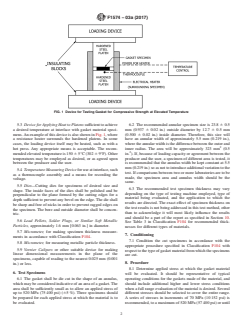
various stresses perpendicular to the flat surface of the speci- 5.1 Testing Machine , for applying a known value of com-
mens for a specified time at 150°C (302°F). Dimensional
pressive stresses to specimens. The machine should be capable
changes to the thickness and in the plane of the specimen are
of applying a stress of up to 520 MPa (75 400 psi) (tolerance
determined while it is under stress and after the stress has been
of 65 %), depending on the indent resistance of the steel
removed. A graphical display of percent deformation plotted
platens and the means of reading the applied load.
against the applied stress will enable determination of a
5.2 Hardened Steel Platens, Two (Rockwell of C35 to 40 or
equivalent), circular shape, larger than the specimen diameter.
1 A suitable size is a diameter of approximately 100 mm (3.94
This test method is under the jurisdiction ofASTM Committee F03 on Gaskets
and is the direct responsibility of Subcommittee F03.20 on Mechanical Test in.). The surface finish shall be RMS 0.25 to 0.50 µm (10 to 20
Methods.
µm). Fig. 1 shows a suitable arrangement of steel platens and
CurrenteditionapprovedMay1,2017.PublishedJuly2017.Originallyapproved
test specimen.
in 1995. Last previous edition approved in 2009 as F1574 – 03a (2009). DOI:
10.1520/F1574-03AR17.
For referenced ASTM standards, visit the ASTM website, www.astm.org, or
contact ASTM Customer Service at service@astm.org. For Annual Book of ASTM Examples of such equipment include Baldwin-Southwark, Instron, Tinius-
Standards volume information, refer to the standard’s Document Summary page on Olsen, MTS, or any type of pressing device which has been properly calibrated to
the ASTM website. apply a known force.
Copyright © ASTM International, 100 Barr Harbor Drive, PO Box C700, West Conshohocken, PA 19428-2959. United States
F1574 − 03a (2017)
FIG. 1 Device for Testing Gasket for Compressive Strength at Elevated Temperature
5.3 DeviceforApplyingHeattoPlatenssufficienttoachieve 6.2 The recommended annular specimen size is 23.8 6 0.5
a desired temperature at interface with gasket material speci- mm (0.937 6 0.02 in.) outside diameter by 12.7 6 0.5 mm
mens.An example of this device is also shown in Fig. 1, where (0.500 6 0.02 in.) inside diameter. Therefore, this size will
a resistance heater surrounds the hardened platens. In some have an annular width of approximately 5.5 mm (0.219 in.),
cases, the loading device itself may be heated, such as with a where the annular width is the difference between the outer and
hot press. Any appropriate means is acceptable. The recom- inner radius. The area will be approximately 323 mm (0.5
mended elevated temperature is 150 6 5°C (302 6 9°F). Other in. ). If, because of loading capacity or agreement between the
temperatures may be employed as desired, or as agreed upon producer and the user, a specimen of different area is tested, it
between the producer and the user. is recommended that the annulus width be kept constant at 5.5
mm (0.219 in.) so as not to introduce additional variation to the
5.4 TemperatureMeasuringDeviceforuseatinterface,such
test. If comparisons between two or more laboratories are to be
as a thermocouple assembly and a means for recording the
made, the specimen area and annulus width should be the
voltage.
same.
5.5 Dies—Cutting dies for specimens of desired size and
6.3 The recommended test specimen thickness may vary
shape. The inside faces of the dies shall be polished and be
depending on the type of testing machine employed, type of
perpendicular to the plane formed by the cutting edges for a
material being evaluated, and the application to which the
depth sufficient to prevent any bevel on the edge. The die shall
results are directed. The exact effect of specimen thickness on
be sharp and free of nicks in order to prevent ragged edges on
the test results is not being addressed in this test method, other
the specimen. The bore and outside diameter shall be concen-
than to acknowledge it will most likely influence the results
tric.
and should be a part of the report as specified in Section 10.
5.6 Lead Pellets, Solder Plugs, or Similar Soft Metallic
See Table 3 in Classification F104 for recommended thick-
Particles, approximately 1.6 mm [0.063 in.] in diameter.
nesses for different types of materials.
5.7 Micrometer, for making specimen thickness measure-
7. Conditioning
ments in accordance with Classification F104.
7.1 Condition the cut specimens in accordance with the
5.8 Micrometer, for measuring metallic particle thickness.
appropriate procedure specified in Classification F104 with
5.9 Vernier Calipers or other suitable device for making
respecttothetypeofgasketmaterialfromwhichthespecimens
linear dimensional measurements in the plane of the
are cut.
specimens, capable of reading to the nearest 0.025 mm (0.001
8. Procedure
in.) or less.
8.1 Determine applied stress at which the gasket material
6. Test Specimens
will be evaluated. It should be representative of typical
6.1 The gasket shall be die cut in the s
...