

ASTM F3270/F3270M-17
(Practice)Standard Practice for Compression versus Load Properties of Gasket Materials
General Information
- Abstract
SIGNIFICANCE AND USE
5.1 The load versus thickness properties of a gasket material are an important factor with regard to the selection of a given material for use in a particular sealing application. Additionally, compression/load behavior data are a common request from users. The test allows comparison of materials at room temperature or elevated temperatures or both. Additionally, properties can be evaluated while loading and unloading the material at room temperature or elevated temperatures or both. The significance of the test method is based, in part, on the assumption that, if a material exhibits too much compression at either room temperatures or elevated temperatures, it will no longer function as effectively as a seal. The results may be used in certain flange design methods to characterize properties for design such as finite element analysis (FEA). The results may be used to confirm adequate assembly loading based on measured gasket compression in the field. Two or more materials can be compared to determine differences in their compression properties. A sample of material can be compared to an established standard or previously determined characteristics on original lots of the same material for quality assurance purposes.
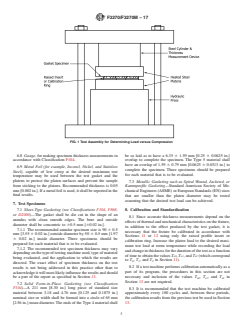
5.2 If desired, samples may be tested with a raised profile flange, insert, or calibration ring described in 6.3 and Fig. 1 so that the area (2042 mm2 [3.18 in.2]) remains constant during the test.
FIG. 1 Test Assembly for Determining Load versus Compression
SCOPE
1.1 This practice measures the compression properties of a gasket material by measuring gasket deflection while it is subjected to an increasing compressive load until a target load is reached. The load and change in thickness are recorded at a defined loading rate as a function of time for the duration of the test.
1.2 Suggested loading rates are 0.5 MPa/s [72.52 psi/s] for all types of gaskets except for expanded polytetrafluoroethylene (PTFE), elastomer, and cork/elastomer gaskets when 0.1 MPa/s [14.5 psi/s] is used.
1.3 The Part A test is performed that measures the compression properties of a gasket material by measuring gasket thickness while it is subjected to an increasing compressive load until a target load is reached. This test is performed at room temperature but may be performed at an elevated temperature if desired or when agreed upon by producer and user.
1.4 The Part B test may be performed that measures the compression properties of a gasket material by measuring gasket thickness while it is subjected to increasing compressive loads that includes a sequence or sequences in which the gasket is unloaded followed by a resumption of the compressive load until a target load is reached. The unloading rate is the same as the loading rate unless different loading and unloading rates are desired or when agreed upon by producer and user. This test is performed at room temperature but may be performed at an elevated temperature if desired or when agreed upon by producer and user.
1.5 The testing parameters for both Parts A and B including the gasket material type, gasket dimensions, platen type (RF or FF), target load, loading time, recording interval used during the test, loading and unloading rates, and temperature are to be reported with the results.
1.6 Units—The values stated in either SI units or inch-pound units are to be regarded separately as standard. The values stated in each system may not be exact equivalents; therefore, each system shall be used independently of the other. Combining values from the two systems may result in non-conformance with the standard.
1.7 This standard does not purport to address all of the safety concerns, if any, associated with its use. It is the responsibility of the user of this standard to establish appropriate safety, health, and environmental practices and determine the applicability of regulatory limitations prior to use.
1.8 This internation...
- Status
- Published
- Publication Date
- 31-Aug-2017
- Technical Committee
- F03 - Gaskets
- Drafting Committee
- F03.20 - Mechanical Test Methods
Overview
ASTM F3270/F3270M-17, Standard Practice for Compression versus Load Properties of Gasket Materials, is a key international standard developed by ASTM for evaluating the compression characteristics of gasket materials under increasing compressive loads. The practice provides a systematic approach for measuring gasket deflection and thickness changes as a function of applied load, both at room and elevated temperatures. Understanding these properties is crucial for the selection and quality assurance of gaskets used in a variety of sealing applications, ensuring reliability and effectiveness in critical environments.
Key Topics
- Compression vs. Load Relationship: The standard focuses on the correlation between load and gasket thickness, measuring how materials compress under applied force.
- Test Methods: It prescribes both loading-only (Part A) and loading/unloading (Part B) sequences, allowing assessment under different operational scenarios.
- Sample Preparation: Provides details for preparing and conditioning specimen samples, including sheet-type, form-in-place, and metallic gaskets.
- Test Conditions: Specifies parameters such as loading/unloading rates, temperatures, and the importance of documenting specimen dimensions and test apparatus types (e.g., RF or FF platens).
- Reporting Requirements: Outlines comprehensive data recording, including load vs. thickness plots, material identification, and all pertinent test conditions.
- Significance and Use: Highlights the practical importance of compression properties for sealing performance, flange design calculations (such as finite element analysis), and field validation through assembly loading checks.
Applications
Implementing ASTM F3270/F3270M-17 provides several practical benefits across industries where sealing integrity is critical:
- Material Selection: Enables comparison of different gasket materials to ensure optimal sealing performance in application-specific environments, including both room temperature and elevated temperature conditions.
- Flange Design: Supports accurate modeling and simulation (e.g., finite element analysis), helping engineers specify appropriate gaskets based on real-world load-compression data.
- Quality Assurance: Facilitates verification that new gasket lots meet established performance criteria by comparing test results to previous data or standard specifications.
- Field Assembly Validation: Confirms that actual gasket compression during installation aligns with target specifications, reducing the risk of seal failure.
- Research and Development: Provides standardized testing data essential for the development of new or improved gasket materials.
This standard is widely used in industries such as automotive, aerospace, chemical processing, power generation, and anywhere reliable static or dynamic seals are required.
Related Standards
ASTM F3270/F3270M-17 is often used alongside other important ASTM standards, including:
- ASTM D2000: Classification System for Rubber Products in Automotive Applications
- ASTM F104: Classification System for Nonmetallic Gasket Materials
- ASTM F868: Classification for Laminated Composite Gasket Materials
These related standards help ensure comprehensive material characterization and quality across diverse gasket applications.
By applying the methodologies outlined in ASTM F3270/F3270M-17, organizations can optimize gasket selection and sealing system performance, supporting reliable operations across a multitude of demanding industrial applications. For more detailed information and official documentation, visit the ASTM website.
Keywords: gasket compression, load vs. thickness, gasket materials, sealing applications, ASTM F3270, compression testing, flange design, quality assurance, industrial standards.
Relations
- Effective Date
- 01-Jan-2020
- Effective Date
- 01-May-2017
- Effective Date
- 01-Apr-2011
- Effective Date
- 01-Oct-2009
- Effective Date
- 01-May-2009
- Effective Date
- 10-Apr-2003
- Effective Date
- 10-Oct-2002
- Effective Date
- 10-Oct-2002
- Effective Date
- 10-Oct-2000
- Effective Date
- 01-Jan-1997
Get Certified
Connect with accredited certification bodies for this standard

Institut za varilstvo d.o.o. (Welding Institute)
Slovenia's leading welding institute since 1952. ISO 3834, EN 1090, pressure equipment certification, NDT personnel, welder qualification. Only IIW Au
Sponsored listings
Frequently Asked Questions
ASTM F3270/F3270M-17 is a standard published by ASTM International. Its full title is "Standard Practice for Compression versus Load Properties of Gasket Materials". This standard covers: SIGNIFICANCE AND USE 5.1 The load versus thickness properties of a gasket material are an important factor with regard to the selection of a given material for use in a particular sealing application. Additionally, compression/load behavior data are a common request from users. The test allows comparison of materials at room temperature or elevated temperatures or both. Additionally, properties can be evaluated while loading and unloading the material at room temperature or elevated temperatures or both. The significance of the test method is based, in part, on the assumption that, if a material exhibits too much compression at either room temperatures or elevated temperatures, it will no longer function as effectively as a seal. The results may be used in certain flange design methods to characterize properties for design such as finite element analysis (FEA). The results may be used to confirm adequate assembly loading based on measured gasket compression in the field. Two or more materials can be compared to determine differences in their compression properties. A sample of material can be compared to an established standard or previously determined characteristics on original lots of the same material for quality assurance purposes. 5.2 If desired, samples may be tested with a raised profile flange, insert, or calibration ring described in 6.3 and Fig. 1 so that the area (2042 mm2 [3.18 in.2]) remains constant during the test. FIG. 1 Test Assembly for Determining Load versus Compression SCOPE 1.1 This practice measures the compression properties of a gasket material by measuring gasket deflection while it is subjected to an increasing compressive load until a target load is reached. The load and change in thickness are recorded at a defined loading rate as a function of time for the duration of the test. 1.2 Suggested loading rates are 0.5 MPa/s [72.52 psi/s] for all types of gaskets except for expanded polytetrafluoroethylene (PTFE), elastomer, and cork/elastomer gaskets when 0.1 MPa/s [14.5 psi/s] is used. 1.3 The Part A test is performed that measures the compression properties of a gasket material by measuring gasket thickness while it is subjected to an increasing compressive load until a target load is reached. This test is performed at room temperature but may be performed at an elevated temperature if desired or when agreed upon by producer and user. 1.4 The Part B test may be performed that measures the compression properties of a gasket material by measuring gasket thickness while it is subjected to increasing compressive loads that includes a sequence or sequences in which the gasket is unloaded followed by a resumption of the compressive load until a target load is reached. The unloading rate is the same as the loading rate unless different loading and unloading rates are desired or when agreed upon by producer and user. This test is performed at room temperature but may be performed at an elevated temperature if desired or when agreed upon by producer and user. 1.5 The testing parameters for both Parts A and B including the gasket material type, gasket dimensions, platen type (RF or FF), target load, loading time, recording interval used during the test, loading and unloading rates, and temperature are to be reported with the results. 1.6 Units—The values stated in either SI units or inch-pound units are to be regarded separately as standard. The values stated in each system may not be exact equivalents; therefore, each system shall be used independently of the other. Combining values from the two systems may result in non-conformance with the standard. 1.7 This standard does not purport to address all of the safety concerns, if any, associated with its use. It is the responsibility of the user of this standard to establish appropriate safety, health, and environmental practices and determine the applicability of regulatory limitations prior to use. 1.8 This internation...
SIGNIFICANCE AND USE 5.1 The load versus thickness properties of a gasket material are an important factor with regard to the selection of a given material for use in a particular sealing application. Additionally, compression/load behavior data are a common request from users. The test allows comparison of materials at room temperature or elevated temperatures or both. Additionally, properties can be evaluated while loading and unloading the material at room temperature or elevated temperatures or both. The significance of the test method is based, in part, on the assumption that, if a material exhibits too much compression at either room temperatures or elevated temperatures, it will no longer function as effectively as a seal. The results may be used in certain flange design methods to characterize properties for design such as finite element analysis (FEA). The results may be used to confirm adequate assembly loading based on measured gasket compression in the field. Two or more materials can be compared to determine differences in their compression properties. A sample of material can be compared to an established standard or previously determined characteristics on original lots of the same material for quality assurance purposes. 5.2 If desired, samples may be tested with a raised profile flange, insert, or calibration ring described in 6.3 and Fig. 1 so that the area (2042 mm2 [3.18 in.2]) remains constant during the test. FIG. 1 Test Assembly for Determining Load versus Compression SCOPE 1.1 This practice measures the compression properties of a gasket material by measuring gasket deflection while it is subjected to an increasing compressive load until a target load is reached. The load and change in thickness are recorded at a defined loading rate as a function of time for the duration of the test. 1.2 Suggested loading rates are 0.5 MPa/s [72.52 psi/s] for all types of gaskets except for expanded polytetrafluoroethylene (PTFE), elastomer, and cork/elastomer gaskets when 0.1 MPa/s [14.5 psi/s] is used. 1.3 The Part A test is performed that measures the compression properties of a gasket material by measuring gasket thickness while it is subjected to an increasing compressive load until a target load is reached. This test is performed at room temperature but may be performed at an elevated temperature if desired or when agreed upon by producer and user. 1.4 The Part B test may be performed that measures the compression properties of a gasket material by measuring gasket thickness while it is subjected to increasing compressive loads that includes a sequence or sequences in which the gasket is unloaded followed by a resumption of the compressive load until a target load is reached. The unloading rate is the same as the loading rate unless different loading and unloading rates are desired or when agreed upon by producer and user. This test is performed at room temperature but may be performed at an elevated temperature if desired or when agreed upon by producer and user. 1.5 The testing parameters for both Parts A and B including the gasket material type, gasket dimensions, platen type (RF or FF), target load, loading time, recording interval used during the test, loading and unloading rates, and temperature are to be reported with the results. 1.6 Units—The values stated in either SI units or inch-pound units are to be regarded separately as standard. The values stated in each system may not be exact equivalents; therefore, each system shall be used independently of the other. Combining values from the two systems may result in non-conformance with the standard. 1.7 This standard does not purport to address all of the safety concerns, if any, associated with its use. It is the responsibility of the user of this standard to establish appropriate safety, health, and environmental practices and determine the applicability of regulatory limitations prior to use. 1.8 This internation...
ASTM F3270/F3270M-17 is classified under the following ICS (International Classification for Standards) categories: 23.100.60 - Filters, seals and contamination of fluids. The ICS classification helps identify the subject area and facilitates finding related standards.
ASTM F3270/F3270M-17 has the following relationships with other standards: It is inter standard links to ASTM F104-11(2020), ASTM F868-17, ASTM F104-11, ASTM F104-03(2009), ASTM F868-02(2009), ASTM F104-03, ASTM F104-02e1, ASTM F868-02, ASTM F104-00, ASTM F868-91(1997)e1. Understanding these relationships helps ensure you are using the most current and applicable version of the standard.
ASTM F3270/F3270M-17 is available in PDF format for immediate download after purchase. The document can be added to your cart and obtained through the secure checkout process. Digital delivery ensures instant access to the complete standard document.
Standards Content (Sample)
This international standard was developed in accordance with internationally recognized principles on standardization established in the Decision on Principles for the
Development of International Standards, Guides and Recommendations issued by the World Trade Organization Technical Barriers to Trade (TBT) Committee.
Designation: F3270/F3270M − 17
Standard Practice for
Compression versus Load Properties of Gasket Materials
Thisstandard is issued under the fixed designation F3270/F3270M;the numberimmediatelyfollowingthedesignationindicatestheyear
of original adoption or, in the case of revision, the year of last revision. A number in parentheses indicates the year of last reapproval.
A superscript epsilon (´) indicates an editorial change since the last revision or reapproval.
1. Scope therefore, each system shall be used independently of the other.
Combining values from the two systems may result in non-
1.1 This practice measures the compression properties of a
conformance with the standard.
gasket material by measuring gasket deflection while it is
1.7 This standard does not purport to address all of the
subjected to an increasing compressive load until a target load
safety concerns, if any, associated with its use. It is the
is reached. The load and change in thickness are recorded at a
responsibility of the user of this standard to establish appro-
defined loading rate as a function of time for the duration of the
priate safety, health, and environmental practices and deter-
test.
mine the applicability of regulatory limitations prior to use.
1.2 Suggested loading rates are 0.5 MPa/s [72.52 psi/s] for
1.8 This international standard was developed in accor-
all types of gaskets except for expanded polytetrafluoroethyl-
dance with internationally recognized principles on standard-
ene (PTFE), elastomer, and cork/elastomer gaskets when 0.1
ization established in the Decision on Principles for the
MPa/s [14.5 psi/s] is used.
Development of International Standards, Guides and Recom-
1.3 The PartAtest is performed that measures the compres-
mendations issued by the World Trade Organization Technical
sion properties of a gasket material by measuring gasket
Barriers to Trade (TBT) Committee.
thickness while it is subjected to an increasing compressive
load until a target load is reached. This test is performed at
2. Referenced Documents
room temperature but may be performed at an elevated
2.1 ASTM Standards:
temperature if desired or when agreed upon by producer and
D2000 Classification System for Rubber Products in Auto-
user.
motive Applications
1.4 The Part B test may be performed that measures the
F104 Classification System for Nonmetallic Gasket Materi-
compression properties of a gasket material by measuring
als
gasketthicknesswhileitissubjectedtoincreasingcompressive
F868 Classification for Laminated Composite Gasket Mate-
loadsthatincludesasequenceorsequencesinwhichthegasket
rials
is unloaded followed by a resumption of the compressive load
until a target load is reached. The unloading rate is the same as
3. Terminology
theloadingrateunlessdifferentloadingandunloadingratesare
3.1 Definitions:
desired or when agreed upon by producer and user. This test is
3.1.1 final specimen thickness, T ,n—specimen thickness
performed at room temperature but may be performed at an
recorded at the target stress for the material type.
elevated temperature if desired or when agreed upon by
3.1.2 initial specimen thickness, T,n—initial specimen
producer and user.
thickness recorded on testing device.
1.5 The testing parameters for both PartsAand B including
3.1.3 original specimen thickness, T ,n—average of speci-
the gasket material type, gasket dimensions, platen type (RF or
men thickness measured in three places 120° apart before
FF), target load, loading time, recording interval used during
placing specimen on the testing device.
the test, loading and unloading rates, and temperature are to be
3.2 Symbols:
reported with the results.
3.2.1 T —original calibration ring thickness.
s0
1.6 Units—The values stated in either SI units or inch-
3.2.2 T —calibration ring thickness recorded on testing
pound units are to be regarded separately as standard. The s1
device after bringing platens together.
values stated in each system may not be exact equivalents;
1 2
This practice is under the jurisdiction ofASTM Committee F03 on Gaskets and For referenced ASTM standards, visit the ASTM website, www.astm.org, or
is the direct responsibility of Subcommittee F03.20 on Mechanical Test Methods. contact ASTM Customer Service at service@astm.org. For Annual Book of ASTM
Current edition approved Sept. 1, 2017. Published October 2017. DOI: 10.1520/ Standards volume information, refer to the standard’s Document Summary page on
F3270_F3270M-17. the ASTM website.
Copyright © ASTM International, 100 Barr Harbor Drive, PO Box C700, West Conshohocken, PA 19428-2959. United States
F3270/F3270M − 17
3.2.3 T —final calibration ring thickness recorded at test assemblyloadingbasedonmeasuredgasketcompressioninthe
s2
maximum load. field. Two or more materials can be compared to determine
differences in their compression properties. A sample of
4. Summary of Practice
material can be compared to an established standard or
4.1 Compression Curve—The relationship of the thickness
previously determined characteristics on original lots of the
of a gasket material at a given surface pressure is an important
same material for quality assurance purposes.
property for both the evaluation of a gasket material or the
5.2 If desired, samples may be tested with a raised profile
development of new materials. Specimens cut from gasket
flange, insert, or calibration ring described in 6.3 and Fig. 1 so
materials are subjected at room temperature or an elevated
2 2
that the area (2042 mm [3.18 in. ]) remains constant during
temperature or both to an increasing load at a defined loading
the test.
rate (see 1.2) perpendicular to the flat surface of the specimen
until a specified load is attained. Material thickness and load
6. Apparatus
should be recorded as a function of time for the duration of the
test to evaluate the load versus thickness relationship for the
6.1 Testing Machine, for applying a known value of com-
material.When an elevated temperature test is performed it can
pressive stresses to specimens. The machine should be capable
be done at the specified load before the specified temperature
of applying a stress of up to the expected maximum loads for
is applied, or with the material at the specified temperature
materials being tested to a specimen size described in 7.1 at
before the load is applied, as agreed upon by the user or
room temperature, depending on the indent resistance of the
producer or both. The specified temperature should be deter-
steel platens and the means of reading the applied load.
mined by the material being tested or as agreed upon by the
6.2 Hardened Steel Platens, Two (Rockwell of C35 to 40 or
user or producer or both. Reporting for an elevated temperature
Equivalent), circular shape, larger than the specimen diameter.
test should include the load at which the specified temperature
The faces of the platens shall be plane parallel with a surface
is applied.
finish between 3.2 and 6.4 µm [125 and 250 µin.], serrated or
4.2 Part A – Loading Sequence—Specimenscutfromgasket
machined. Fig. 1 shows a suitable arrangement of steel platens
material are subjected at room temperature to an increasing
and test specimen. Other finishes as desired or agreed upon
load perpendicular to the flat surface of the specimen until a
between the producer and the user may also be used.
specified load is attained. Material thickness and load should
6.3 Hardened Steel Platens, Two (Rockwell of C35 to 40 or
be recorded as a function of time for the duration of the test to
Equivalent), circular shape, larger than the specimen diameter.
evaluate the load versus thickness relationship for the material.
If the platens will only be used with a raised face flange, insert,
4.3 Part B – Loading/Unloading Sequence—In addition to a
or calibration ring, the faces of the platens shall be plane
loading sequence, the test may include an unloading sequence
parallel with a smooth finish. Otherwise, the faces of the
or sequences to measure the thickness as load is decreased. If
platens shall be plane parallel with a surface finish between 3.2
unloading is included, the gasket thickness is measured both
and 6.4 µm [125 and 250 µin.], serrated or machined. Fig. 1
while it is subjected to increasing compressive loads and
shows a suitable arrangement of steel platens and test speci-
duringasequenceorsequencesinwhichthegasketisunloaded
men. Other finishes as desired or agreed upon between the
followed by a resumption of the compressive load until a target
producer and the user may also be used.
load is reached.
6.4 Device for Applying Heat to Platens, sufficient to
4.4 The testing parameters, including the gasket material
achieve a desired temperature at interface with gasket material
type, gasket dimensions, platen type (RF or FF), the target
specimens. In some cases, the loading device itself may be
load, loading and unloading rates, and temperature, are to be
heated, such as with a hot press. Any appropriate means is
reported with the results.
acceptable. The device shall be capable of increasing the
temperature at a rate between 2 and 5°C [3 and 9°F] per
5. Significance and Use
minute. The temperature difference between the two platens
5.1 The load versus thickness properties of a gasket material
shall not exceed 5°C [9°F] at any time. The maximum
are an important factor with regard to the selection of a given
temperature limit can be determined by the user and their
material for use in a particular sealing application.
requirements for their equipment. Other heating rates may be
Additionally, compression/load behavior data are a common
used as desired or agreed upon between the producer and the
request from users. The test allows comparison of materials at
user.
room temperature or elevated temperatures or both.
Additionally, properties can be evaluated while loading and
6.5 Temperature Measuring Device, for use at interface,
unloading the material at room temperature or elevated tem- suchasathermocoupleassemblyandameansforrecordingthe
peratures or both. The significance of the test method is based,
voltage.
in part, on the assumption that, if a material exhibits too much
6.6 Dial or Thickness Measuring Device, an indicating dial,
compression at either room temperatures or elevated
or dials, graduated in 0.025 mm [0.001 in.] or a digital device
temperatures, it will no longer function as effectively as a seal.
to show or record the thickness of the specimen during the test.
The results may be used in certain flange design methods to
characterize properties for design such as finite element analy- 6.7 Shield—A safety shield for protection from severe
sis (FEA). The results may be used to confirm adequate outgassing that may occur during the test.
F3270/F3270M − 17
FIG. 1 Test Assembly for Determining Load versus Compression
6.8 Gauge, for making specimen thickness measurements in be so laid as to have a 6.35 6 1.59 mm [0.25 6 0.0625 in.]
accordanc
...