

ASTM E2821-20
(Specification)Standard Specification for Compacted Mineral-Insulated, Metal-Sheathed Cable Used in Industrial Resistance Thermometers
General Information
- Abstract
ABSTRACT
This specification establishes the requirements for compacted, mineral-insulated, metal-sheathed (MIMS) cables used to manufacture metal-sheathed, industrial resistance thermometers known as Resistance Temperature Detectors (RTDs). It covers the material requirements, significance and use, ordering information and basis for purchase, processing requirements, quality verification and test requirements, certification and reports, packaging, marking, and shipping.
SCOPE
1.1 This specification covers the requirements for compacted, mineral-insulated, metal-sheathed (MIMS) cables used to manufacture metal-sheathed, industrial resistance thermometers referred to in this document as Resistance Temperature Detectors or RTDs.
1.2 The materials of construction include copper, nickel-clad copper, copper-45 % nickel (constantan), or nickel conductors, an austenitic stainless steel or nickel-chromium alloy sheath, and either magnesia (MgO) or alumina (Al2O3) insulation.
1.3 The cable diameter is between 0.093 and 0.500 in. (2.33 and 12.70 mm) and contains between two and eight conductors, set in various design configurations and wire spacings.
1.4 The values of temperature in this specification are based on the International Temperature Scale of 1990 (ITS-90).
1.5 The values stated in inch-pound units are to be regarded as standard. The values given in parentheses are mathematical conversions to SI units that are provided for information only and are not considered standard.
1.6 This standard does not purport to address all of the safety concerns, if any, associated with its use. It is the responsibility of the user of this standard to establish appropriate safety, health, and environmental practices and determine the applicability of regulatory limitations prior to use.
1.7 This international standard was developed in accordance with internationally recognized principles on standardization established in the Decision on Principles for the Development of International Standards, Guides and Recommendations issued by the World Trade Organization Technical Barriers to Trade (TBT) Committee.
- Status
- Published
- Publication Date
- 30-Apr-2020
- Technical Committee
- E20 - Temperature Measurement
- Drafting Committee
- E20.03 - Resistance Thermometers
Buy Documents
ASTM E2821-20 - Standard Specification for Compacted Mineral-Insulated, Metal-Sheathed Cable Used in Industrial Resistance Thermometers
REDLINE ASTM E2821-20 - Standard Specification for Compacted Mineral-Insulated, Metal-Sheathed Cable Used in Industrial Resistance Thermometers
Overview
ASTM E2821-20 is the international standard specification for compacted, mineral-insulated, metal-sheathed (MIMS) cables used in the manufacture of industrial resistance thermometers, commonly known as Resistance Temperature Detectors (RTDs). The standard, developed by ASTM International’s Committee E20 on Temperature Measurement, ensures MIMS cables meet essential requirements for material properties, construction, performance, testing, certification, packaging, and labeling. This specification is widely referenced in industrial temperature measurement applications, setting benchmarks for cable durability, insulation integrity, conductor compatibility, and overall sensor reliability.
Key Topics
- Materials of Construction: Specifications for conductors (copper, nickel-clad copper, copper-45% nickel [constantan], or nickel), sheath materials (austenitic stainless steel or nickel-chromium alloys), and insulators (magnesia - MgO or alumina - Al₂O₃).
- Cable Dimensions and Configuration: Applicable for cable diameters between 0.093 and 0.500 inches (2.33 to 12.70 mm), with two to eight conductors, in varying configurations and spacings.
- Testing and Verification: Includes dimensional inspections, insulation resistance tests, conductor resistance matching (within 10% tolerance), dielectric breakdown testing, and other supplementary assessments (elevated temperature insulation, sheath integrity, etc.).
- Quality Assurance and Certification: Documentation requirements to prove compliance with ordering requirements and test results, including retention of records for quality traceability.
- Packaging and Marking: Guidelines for sealing cable ends, marking finished cables and containers, and requirements for shipping and packaging to maintain cable integrity and traceability.
Applications
Compacted MIMS RTD cables manufactured according to ASTM E2821-20 are primarily utilized in harsh and demanding industrial environments where accurate and stable temperature measurement is critical. Typical application scenarios include:
- Industrial Process Control: In refineries, power plants, chemical processing, and manufacturing, where resistance thermometers monitor and regulate process temperatures.
- Sensor Manufacturing: Cable serves as the key component connecting the RTD sensing element to terminal heads or extension leads, ensuring stable and protected signal transmission.
- High-Temperature Environments: The robust construction and specified materials withstand exposure to extremes of temperature, vibration, and corrosive substances.
- Extension Cables: Used to extend the connection between industrial thermometers and monitoring devices or control panels, maintaining signal quality over longer distances.
Related Standards
Several other ASTM and ANSI standards are referenced within ASTM E2821-20, ensuring a harmonized framework for quality and compatibility in temperature measurement technology:
- ASTM E1137/E1137M: Specification for Industrial Platinum Resistance Thermometers.
- ASTM E780, E839: Test methods for insulation resistance and performance verification of sheathed MIMS cables.
- ASTM E1652: Specification for magnesium oxide and aluminum oxide powder insulators used in RTDs.
- ASTM A213/A213M, A249/A249M, A269, A632: Specifications for stainless steel tubing relevant to sheath construction.
- ASTM B163, B167, B516: Specifications for nickel and nickel alloy tubing for condenser and sheathed applications.
- ANSI B46.1: Guidelines on surface texture and roughness, referenced for surface finish quality.
Keywords: ASTM E2821-20, mineral-insulated cable, metal-sheathed, RTD cable, industrial resistance thermometers, MIMS, temperature sensors, insulation resistance, sheath integrity, ASTM temperature standards.
Relations
- Effective Date
- 01-Mar-2024
- Effective Date
- 01-Dec-2023
- Refers
ASTM E839-23 - Standard Test Methods for Sheathed Thermocouples and Sheathed Thermocouple Cable - Effective Date
- 01-Nov-2023
- Effective Date
- 01-Nov-2019
- Effective Date
- 01-Sep-2019
- Effective Date
- 01-Sep-2019
- Effective Date
- 01-Sep-2018
- Effective Date
- 01-Jul-2018
- Effective Date
- 01-Apr-2018
- Effective Date
- 01-Mar-2018
- Effective Date
- 01-Nov-2016
- Effective Date
- 01-Nov-2016
- Effective Date
- 01-Sep-2016
- Effective Date
- 01-May-2016
- Effective Date
- 01-Dec-2015
Buy Documents
ASTM E2821-20 - Standard Specification for Compacted Mineral-Insulated, Metal-Sheathed Cable Used in Industrial Resistance Thermometers
REDLINE ASTM E2821-20 - Standard Specification for Compacted Mineral-Insulated, Metal-Sheathed Cable Used in Industrial Resistance Thermometers
Get Certified
Connect with accredited certification bodies for this standard

BSMI (Bureau of Standards, Metrology and Inspection)
Taiwan's standards and inspection authority.
Sponsored listings
Frequently Asked Questions
ASTM E2821-20 is a technical specification published by ASTM International. Its full title is "Standard Specification for Compacted Mineral-Insulated, Metal-Sheathed Cable Used in Industrial Resistance Thermometers". This standard covers: ABSTRACT This specification establishes the requirements for compacted, mineral-insulated, metal-sheathed (MIMS) cables used to manufacture metal-sheathed, industrial resistance thermometers known as Resistance Temperature Detectors (RTDs). It covers the material requirements, significance and use, ordering information and basis for purchase, processing requirements, quality verification and test requirements, certification and reports, packaging, marking, and shipping. SCOPE 1.1 This specification covers the requirements for compacted, mineral-insulated, metal-sheathed (MIMS) cables used to manufacture metal-sheathed, industrial resistance thermometers referred to in this document as Resistance Temperature Detectors or RTDs. 1.2 The materials of construction include copper, nickel-clad copper, copper-45 % nickel (constantan), or nickel conductors, an austenitic stainless steel or nickel-chromium alloy sheath, and either magnesia (MgO) or alumina (Al2O3) insulation. 1.3 The cable diameter is between 0.093 and 0.500 in. (2.33 and 12.70 mm) and contains between two and eight conductors, set in various design configurations and wire spacings. 1.4 The values of temperature in this specification are based on the International Temperature Scale of 1990 (ITS-90). 1.5 The values stated in inch-pound units are to be regarded as standard. The values given in parentheses are mathematical conversions to SI units that are provided for information only and are not considered standard. 1.6 This standard does not purport to address all of the safety concerns, if any, associated with its use. It is the responsibility of the user of this standard to establish appropriate safety, health, and environmental practices and determine the applicability of regulatory limitations prior to use. 1.7 This international standard was developed in accordance with internationally recognized principles on standardization established in the Decision on Principles for the Development of International Standards, Guides and Recommendations issued by the World Trade Organization Technical Barriers to Trade (TBT) Committee.
ABSTRACT This specification establishes the requirements for compacted, mineral-insulated, metal-sheathed (MIMS) cables used to manufacture metal-sheathed, industrial resistance thermometers known as Resistance Temperature Detectors (RTDs). It covers the material requirements, significance and use, ordering information and basis for purchase, processing requirements, quality verification and test requirements, certification and reports, packaging, marking, and shipping. SCOPE 1.1 This specification covers the requirements for compacted, mineral-insulated, metal-sheathed (MIMS) cables used to manufacture metal-sheathed, industrial resistance thermometers referred to in this document as Resistance Temperature Detectors or RTDs. 1.2 The materials of construction include copper, nickel-clad copper, copper-45 % nickel (constantan), or nickel conductors, an austenitic stainless steel or nickel-chromium alloy sheath, and either magnesia (MgO) or alumina (Al2O3) insulation. 1.3 The cable diameter is between 0.093 and 0.500 in. (2.33 and 12.70 mm) and contains between two and eight conductors, set in various design configurations and wire spacings. 1.4 The values of temperature in this specification are based on the International Temperature Scale of 1990 (ITS-90). 1.5 The values stated in inch-pound units are to be regarded as standard. The values given in parentheses are mathematical conversions to SI units that are provided for information only and are not considered standard. 1.6 This standard does not purport to address all of the safety concerns, if any, associated with its use. It is the responsibility of the user of this standard to establish appropriate safety, health, and environmental practices and determine the applicability of regulatory limitations prior to use. 1.7 This international standard was developed in accordance with internationally recognized principles on standardization established in the Decision on Principles for the Development of International Standards, Guides and Recommendations issued by the World Trade Organization Technical Barriers to Trade (TBT) Committee.
ASTM E2821-20 is classified under the following ICS (International Classification for Standards) categories: 17.200.20 - Temperature-measuring instruments. The ICS classification helps identify the subject area and facilitates finding related standards.
ASTM E2821-20 has the following relationships with other standards: It is inter standard links to ASTM A249/A249M-24, ASTM E344-23, ASTM E839-23, ASTM A213/A213M-19, ASTM E344-19, ASTM A632-19, ASTM A213/A213M-18a, ASTM A249/A249M-18, ASTM E344-18, ASTM A213/A213M-18, ASTM E839-11(2016), ASTM E344-16, ASTM A249/A249M-16a, ASTM A249/A249M-16, ASTM A249/A249M-15a. Understanding these relationships helps ensure you are using the most current and applicable version of the standard.
ASTM E2821-20 is available in PDF format for immediate download after purchase. The document can be added to your cart and obtained through the secure checkout process. Digital delivery ensures instant access to the complete standard document.
Standards Content (Sample)
This international standard was developed in accordance with internationally recognized principles on standardization established in the Decision on Principles for the
Development of International Standards, Guides and Recommendations issued by the World Trade Organization Technical Barriers to Trade (TBT) Committee.
Designation:E2821 −20
Standard Specification for
Compacted Mineral-Insulated, Metal-Sheathed Cable Used
in Industrial Resistance Thermometers
This standard is issued under the fixed designation E2821; the number immediately following the designation indicates the year of
original adoption or, in the case of revision, the year of last revision.Anumber in parentheses indicates the year of last reapproval.A
superscript epsilon (´) indicates an editorial change since the last revision or reapproval.
1. Scope 2. Referenced Documents
1.1 This specification covers the requirements for 2.1 Thelatestissuesofthefollowingdocumentsformapart
compacted, mineral-insulated, metal-sheathed (MIMS) cables
of this specification to the extent specified herein. In the event
used to manufacture metal-sheathed, industrial resistance ther- of a conflict between this specification and other specifications
mometers referred to in this document as Resistance Tempera- referenced herein, this specification shall take precedence.
ture Detectors or RTDs.
2.2 Due to the similarity between Compacted MIMS Ther-
1.2 The materials of construction include copper, nickel- mocouple Cable and Compacted MIMS Cable used in Indus-
clad copper, copper-45 % nickel (constantan), or nickel trial Resistance Thermometers, some Thermocouple ASTM
conductors, an austenitic stainless steel or nickel-chromium
Standards may apply.
alloy sheath, and either magnesia (MgO) or alumina (Al O )
2 3 2
2.3 ASTM Standards:
insulation.
A213/A213MSpecification for Seamless Ferritic and Aus-
1.3 Thecablediameterisbetween0.093and0.500in.(2.33
tenitic Alloy-Steel Boiler, Superheater, and Heat-
and 12.70 mm) and contains between two and eight
Exchanger Tubes
conductors, set in various design configurations and wire A249/A249MSpecification for Welded Austenitic Steel
spacings.
Boiler, Superheater, Heat-Exchanger, and Condenser
Tubes
1.4 Thevaluesoftemperatureinthisspecificationarebased
A632Specification for Seamless and Welded Austenitic
on the International Temperature Scale of 1990 (ITS-90).
Stainless Steel Tubing (Small-Diameter) for General Ser-
1.5 The values stated in inch-pound units are to be regarded
vice
as standard. The values given in parentheses are mathematical E112Test Methods for Determining Average Grain Size
conversions to SI units that are provided for information only E344Terminology Relating to Thermometry and Hydrom-
and are not considered standard.
etry
E780Test Method for Measuring the Insulation Resistance
1.6 This standard does not purport to address all of the
of Mineral-Insulated, Metal-SheathedThermocouples and
safety concerns, if any, associated with its use. It is the
Mineral-Insulated, Metal-Sheathed Cable at Room Tem-
responsibility of the user of this standard to establish appro-
perature
priate safety, health, and environmental practices and deter-
E839 Test Methods for Sheathed Thermocouples and
mine the applicability of regulatory limitations prior to use.
Sheathed Thermocouple Cable
1.7 This international standard was developed in accor-
E1137/E1137MSpecification for Industrial Platinum Resis-
dance with internationally recognized principles on standard-
tance Thermometers
ization established in the Decision on Principles for the
E1652Specification for Magnesium Oxide and Aluminum
Development of International Standards, Guides and Recom-
Oxide Powder and Crushable Insulators Used in the
mendations issued by the World Trade Organization Technical
Manufacture of Base Metal Thermocouples, Metal-
Barriers to Trade (TBT) Committee.
Sheathed Platinum Resistance Thermometers, and Noble
Metal Thermocouples
This specification is under the jurisdiction of ASTM Committee E20 on
Temperature Measurement and is the direct responsibility of Subcommittee E20.03
on Resistance Thermometers. For referenced ASTM standards, visit the ASTM website, www.astm.org, or
Current edition approved May 1, 2020. Published June 2020. Originally contact ASTM Customer Service at service@astm.org. For Annual Book of ASTM
approved in 2013. Last previous edition approved in 2013 as E2821– 13. DOI: Standards volume information, refer to the standard’s Document Summary page on
10.1520/E2821-20 the ASTM website.
Copyright © ASTM International, 100 Barr Harbor Drive, PO Box C700, West Conshohocken, PA 19428-2959. United States
E2821−20
2.4 ANSI Standard: 5.1.8 Any deviations from this specification or the refer-
ANSI B46.1Surface Texture, Surface Roughness, Waviness enced documents.
and Lay 5.1.9 The Optional Clearance if applicable (see Fig. 1).
6. General Requirements
3. Terminology
6.1 MIMS RTD Cable—Cable shall be in accordance with
3.1 Definitions—ThedefinitionsgiveninTerminologyE344
this specification (see Fig. 2). Fig. 2 shows a cable with two
shall apply to this specification.
conductors, but more than two conductors may be specified.
3.2 Definitions:
6.2 Conductor Resistance Match—The resistance of each
3.2.1 lot, n—a quantity of finished MIMS RTD cable
conductor shall be measured. The difference between the
manufactured from tubing from the same heat, wire from the
maximum conductor resistance and minimum conductor resis-
same spool and heat, and insulation from the same batch, then
tance shall not exceed 10% of the minimum conductor
assembled and processed together under controlled production
resistance.
conditions to the required final outside diameter.
6.3 Dimensions—The dimensional and tolerance require-
3.2.2 raw material, n—tubing, insulation, and wires used in
fabrication of MIMS RTD cable. ments for sheath diameter and wall thickness, conductor
diameter, and insulation thickness depicted in Fig. 2 and
4. Significance and Use
summarized in Table 1 shall be based on the nominal sheath
outside diameters.The purchaser need only specify the cable’s
4.1 MIMS RTD cable may be used as follows:
outside diameter and number of conductors required in the
4.1.1 As a cable for attaching the sensing element to a
ordering documents. The preferred cable sizes are listed in
sensor termination within a thermometer (see Specification
Table 2. For any nominal sheath size:
E1137/E1137M).
6.3.1 The outside diameter tolerance, A, shall be 60.001 in.
4.1.2 As an extension cable connecting a thermometer to
(0.025 mm) or 61% of the outside diameter, whichever is
another device.
greater.
5. Ordering Information and Basis for Purchase 6.3.2 The wall thickness, B, shall be at least 8% of the
nominal sheath outside diameter and shall be uniform within
5.1 The purchasing documents shall specify the following
1.6% of the minimum sheath outside diameter.
options:
6.3.3 Theconductordiameter, D,shallbeatleast8%ofthe
5.1.1 The total length of finished MIMS RTD cable or the
nominal sheath outside diameter.
length of each piece of finished MIMS RTD cable.
6.3.4 Theinsulationthickness, C,eitherbetweenconductors
5.1.2 The material and number of conductors (see Fig. 1)
or between any conductor and the inside surface of the sheath,
and the allowable variation in conductor resistances if other
shall be at least 4% of the nominal sheath outside diameter.
than that specified in 6.2. Consult individual manufacturers for
6.3.5 An optional clearance “F” (see Figs. 1 and 2) may be
the number of conductors which are limited by cable size.
specified when the material between the conductors will be
5.1.3 The sheath material (see 7.3) and whether it shall be
removedtoallowfortheinstallationofasensingelement.This
seamless or welded and drawn. Note that other sheath material
construction is used when manufacturing Platinum Resistance
may be used with purchaser and producer agreement
Thermometers (PRTs) using this cable. Unless otherwise
5.1.4 The nominal outside diameter of the sheath (see 6.3).
specified, the other dimensional requirements shall be main-
5.1.5 The insulating material (either MgO orAl O ) and its
2 3
tained. Consult the cable manufacturer regarding this optional
respective type (see 7.2). Note that other insulation composi-
feature.
tion and impurity levels may be used with purchaser and
6.3.6 DimensionsshallbemeasuredinaccordancewithTest
producer agreement.
Methods E839.
5.1.6 The seal to be applied to the exposed insulation at the
6.4 Materials—The RTD cable shall be fabricated from
cable end(s) prior to shipment (see 11.1).
5.1.7 Supplementary testing or material requirements (see component parts specified in Section 7.
Supplementary Requirements).
6.5 Insulation Resistance at Room Temperature—The mini-
mum insulation resistance between conductors and between
eachconductorandthesheath(atroomtemperature)shallbeas
Available fromAmerican National Standards Institute (ANSI), 25 W. 43rd St.,
4th Floor, New York, NY 10036, http://www.ansi.org.Available from American
National Standards Institute (ANSI), 25 W. 43rd St., 4th Floor, New York, NY
10036, http://www.ansi.org.
FIG. 1Examples of Conductor Wire Configurations FIG. 2Sheathed RTD Material Construction
E2821−20
TABLE 1 Summary of RTD Cable Dimensional Requirements TABLE 4 Recommended Maximum Conductor Operating
(Percentage of Outside Diameter) Temperatures
2, 3, 4, 6, or 8 Wires Conductor Type °C °F
Minimum Sheath Thickness “B” 8 % Copper 250 482
Minimum Conductor Diameter “D” 8 % Nickel Clad 400 752
Minimum Insulation Thickness “C” 4 % Copper
Nickel 201 650 1200
Optional Clearance “F” 25 %
Copper-45 % 650 1200
Nickel (Constantan)
TABLE 2 Dimensions of Metal Sheathed RTD Cable in SI and
Inch-Pound Units
Preferred Sizes—Nominal Outside Diameter “A”
mm in.
7.1.2 All conductors used in a specific cable shall be from
3.00 0.125
the same lot of material in order to minimize the generation of
4.50 0.188
6.00 0.250
spurious Electromotive Forces (EMFs) when placed in a
8.00 0.313
temperature gradient.
9.50 0.375
7.1.3 Prior to assembly, the producer shall verify that all
conductors used are free of visible surface oxides, scale and
contaminates such as drawing compounds, carbon, dirt and
specified in Table 3 when tested in accordance with Test dust.Theabsenceofscaleandcontaminantscanbeverifiedby
Method E780 for the voltages noted. The values of insulation
wiping the wire with a solvent-saturated lint-free cloth.
resistance, shall apply to the supplied lengths. Acetone, isopropyl alcohol, methanol, and ethanol are all
acceptable solvents. A light discoloration of the cloth is
6.6 Minimum Insulation Density—The minimum density of
acceptable unless particles of grit or metal flakes are visually
the compacted mineral oxide insulation shall exceed the value
detectablewithoutuseofmagnification.Ifacetoneoranyother
which represents 70% of the maximum theoretical density of
3 3
solvent that may leave a residual film is used for initial
the material. This 70% value is 0.090 lb/in. (2506 kg/m ) for
3 3 4
cleaning, a final cleaning with an acceptable cleaning solvent,
MgO, and 0.101 lb/in. (2780 kg/m ) for Al O . See also
2 3
such as isopropyl alcohol, shall be performed.
Supplementary Requirement S5.
7.2 Insulation:
6.7 Sheath Condition—The sheath shall be free of visible
7.2.1 The insulation shall be magnesia (MgO) or alumina
surface contaminants and oxidation and shall be annealed to
(Al O ) conforming to Specification E1652.
2 3
the extent that the conductors will permit. Tests for proving
conformance are in Supplementary Requirement S2 or S8.
NOTE1—Otherinsulationcompositionandimpuritylevelsmaybeused
with purchaser and producer agreement.
6.8 Sheath Integrity—The sheath of the finished RTD cable
7.3 Sheath Material:
shallexcludegasesandliquids.Thereshallbenoholes,cracks,
7.3.1 The sheath material shall be austenitic stainless steel,
or other void defects that penetrate through the sheath wall.
or heat-resistant nickel-chrome alloy. If tubing is used, either
Tests for proving conformance to this requirement are in
seamless or welded is acceptable.
Supplementary Requirement S3.
7.3.2 Alternateheat-resistanttubingmaterialsmaybespeci-
6.9 Additional optional requirements are listed in the
fied for the sheath by the producer provided the annealing
Supplementary Requirements section and may be included in
requirements imposed by 6.7 are satisfied.
the purchasing documents, if desired by the purchaser.
7.3.3 Prior to assembly, the producer shall verify that each
pieceofsheathmaterialusedinthefabricationofRTDcableis
7. Material Requirements
free of visible surface oxides, scale and contaminants such as
7.1 Conductors:
drawing compounds, carbon, dirt, and dust. The absence of
7.1.1 The conductors shall be solid, round wire of copper,
scale and contaminants can be verified by passing a solvent-
nickel, nickel clad copper, or copper-45% nickel (constantan)
saturated swatch of lint-free yarn or cloth against the inner
with maximum operating temperatures as specified in Table 4.
surface of the sheath material. Acetone, isopropyl alcohol,
methanol and ethanol are all acceptable solvents. A light
discoloration of the swatch or plug
...
This document is not an ASTM standard and is intended only to provide the user of an ASTM standard an indication of what changes have been made to the previous version. Because
it may not be technically possible to adequately depict all changes accurately, ASTM recommends that users consult prior editions as appropriate. In all cases only the current version
of the standard as published by ASTM is to be considered the official document.
Designation: E2821 − 13 E2821 − 20
Standard Specification for
Compacted Mineral-Insulated, Metal-Sheathed Cable Used
in Industrial Resistance Thermometers
This standard is issued under the fixed designation E2821; the number immediately following the designation indicates the year of
original adoption or, in the case of revision, the year of last revision. A number in parentheses indicates the year of last reapproval. A
superscript epsilon (´) indicates an editorial change since the last revision or reapproval.
1. Scope
1.1 This specification covers the requirements for compacted, mineral-insulated, metal-sheathed (MIMS) cables used to
manufacture metal-sheathed, industrial resistance thermometers referred to in this document as Resistance Temperature Detectors
or RTDs.
1.2 The materials of construction include copper, nickel-clad copper, copper-45 % nickel (constantan), or nickel conductors, an
austenitic stainless steel or nickel-chromium alloy sheath, and either magnesia (MgO) or alumina (Al O ) insulation.
2 3
1.3 The cable diameter is between 0.093 and 0.500 in. (2.33 and 12.70 mm) and contains between two and eight conductors,
set in various design configurations and wire spacings.
1.4 The values of temperature in this specification are based on the International Temperature Scale of 1990 (ITS-90).
1.5 The values stated in inch-pound units are to be regarded as standard. The values given in parentheses are mathematical
conversions to SI units that are provided for information only and are not considered standard.
1.6 This standard does not purport to address all of the safety concerns, if any, associated with its use. It is the responsibility
of the user of this standard to establish appropriate safety safety, health, and healthenvironmental practices and determine the
applicability of regulatory limitations prior to use.
1.7 This international standard was developed in accordance with internationally recognized principles on standardization
established in the Decision on Principles for the Development of International Standards, Guides and Recommendations issued
by the World Trade Organization Technical Barriers to Trade (TBT) Committee.
2. Referenced Documents
2.1 The latest issues of the following documents form a part of this specification to the extent specified herein. In the event of
a conflict between this specification and other specifications referenced herein, this specification shall take precedence.
2.2 Due to the similarity between Compacted MIMS Thermocouple Cable and Compacted MIMS Cable, Cable used in
Industrial Resistance Thermometers, some Thermocouple ASTM Standards may apply.
2.3 ASTM Standards:
A213/A213M Specification for Seamless Ferritic and Austenitic Alloy-Steel Boiler, Superheater, and Heat-Exchanger Tubes
A249/A249M Specification for Welded Austenitic Steel Boiler, Superheater, Heat-Exchanger, and Condenser Tubes
A269 Specification for Seamless and Welded Austenitic Stainless Steel Tubing for General Service
A632 Specification for Seamless and Welded Austenitic Stainless Steel Tubing (Small-Diameter) for General Service
B163E112 Specification for Seamless Nickel and Nickel Alloy Condenser and Heat-Exchanger TubesTest Methods for
Determining Average Grain Size
B167 Specification for Nickel-Chromium-Aluminum Alloys (UNS N06699), Nickel-Chromium-Iron Alloys (UNS N06600,
N06601, N06603, N06690, N06693, N06025, N06045, and N06696), Nickel-Chromium-Cobalt-Molybdenum Alloy (UNS
N06617), Nickel-Iron-Chromium-Tungsten Alloy (UNS N06674), and
B516 Specification for Welded Nickel-Chromium-Aluminum Alloy (UNS N06699) and Nickel-Chromium-Iron Alloy (UNS
This specification is under the jurisdiction of ASTM Committee E20 on Temperature Measurement and is the direct responsibility of Subcommittee E20.03 on Resistance
Thermometers.
Current edition approved May 1, 2013May 1, 2020. Published July 2013June 2020. Originally approved in 2013. Last previous edition approved in 2013 as E2821 – 13.
DOI: 10.1520/E2821-1310.1520/E2821-20
For referenced ASTM standards, visit the ASTM website, www.astm.org, or contact ASTM Customer Service at service@astm.org. For Annual Book of ASTM Standards
volume information, refer to the standard’s Document Summary page on the ASTM website.
Copyright © ASTM International, 100 Barr Harbor Drive, PO Box C700, West Conshohocken, PA 19428-2959. United States
E2821 − 20
N06600, UNS N06601, UNS N06603, UNS N06025, UNS N06045, UNS N06690, and UNS N06693) Tubes
E344 Terminology Relating to Thermometry and Hydrometry
E780 Test Method for Measuring the Insulation Resistance of Mineral-Insulated, Metal-Sheathed Thermocouples and
Mineral-Insulated, Metal-Sheathed Cable at Room Temperature
E839 Test Methods for Sheathed Thermocouples and Sheathed Thermocouple Cable
E1137/E1137M Specification for Industrial Platinum Resistance Thermometers
E1652 Specification for Magnesium Oxide and Aluminum Oxide Powder and Crushable Insulators Used in the Manufacture of
Base Metal Thermocouples, Metal-Sheathed Platinum Resistance Thermometers, and Noble Metal Thermocouples
2.4 ANSI Standard:
ANSI B46.1 Surface Texture, Surface Roughness, Waviness and Lay
3. Terminology
3.1 Definitions—The definitions given in Terminology E344 shall apply to this specification.
3.2 Definitions:
3.2.1 lot, n—a quantity of finished MIMS RTD cable manufactured from tubing from the same heat, wire from the same spool
and heat, and insulation from the same batch, then assembled and processed together under controlled production conditions to
the required final outside diameter.
3.2.2 raw material, n—tubing, insulation, and wires used in fabrication of MIMS RTD cable.
4. Significance and Use
4.1 MIMS RTD cable may be used as follows:
4.1.1 As a cable for attaching the sensing element to a sensor termination within a thermometer (see Specification
E1137/E1137M).
4.1.2 As an extension cable connecting a thermometer to another device.
5. Ordering Information and Basis for Purchase
5.1 The purchasing documents shall specify the following options:
5.1.1 The total length of finished MIMS RTD cable or the length of each piece of finished MIMS RTD cable.
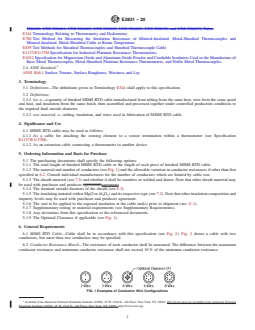
5.1.2 The material and number of conductors (see Fig. 1) and the allowable variation in conductor resistances if other than that
specified in 6.2. Consult individual manufacturers for the number of conductors which are limited by cable size.
5.1.3 The sheath material (see 7.3) and whether it shall be seamless or welded and drawn. Note that other sheath material may
be used with purchaser and producer agreement.agreement
5.1.4 The nominal outside diameter of the sheath (see 6.3).
5.1.5 The insulating material (either MgO or Al O ) and its respective type (see 7.2). Note that other insulation composition and
2 3
impurity levels may be used with purchaser and producer agreement.
5.1.6 The seal to be applied to the exposed insulation at the cable end(s) prior to shipment (see 11.1).
5.1.7 Supplementary testing or material requirements (see Supplementary Requirements).
5.1.8 Any deviations from this specification or the referenced documents.
5.1.9 The Optional Clearance if applicable (see Fig. 1).
6. General Requirements
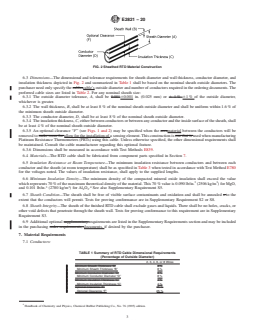
6.1 MIMS RTD Cable—Cable shall be in accordance with this specification (see Fig. 2). Fig. 2 shows a cable with two
conductors, but more than two conductors may be specified.
6.2 Conductor Resistance Match—The resistance of each conductor shall be measured. The difference between the maximum
conductor resistance and minimum conductor resistance shall not exceed 10 % of the minimum conductor resistance.
FIG. 1 Examples of Conductor Wire Configurations
Available from American National Standards Institute (ANSI), 25 W. 43rd St., 4th Floor, New York, NY 10036, http://www.ansi.org.Available from American National
Standards Institute (ANSI), 25 W. 43rd St., 4th Floor, New York, NY 10036, http://www.ansi.org.
E2821 − 20
FIG. 2 Sheathed RTD Material Construction
6.3 Dimensions—The dimensional and tolerance requirements for sheath diameter and wall thickness, conductor diameter, and
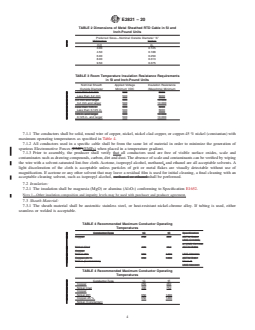
insulation thickness depicted in Fig. 2 and summarized in Table 1 shall be based on the nominal sheath outside diameters. The
purchaser need only specify the cablescable’s outside diameter and number of conductors required in the ordering documents. The
preferred cable sizes are listed in Table 2. For any nominal sheath size:
6.3.1 The outside diameter tolerance, A, shall be 0.00160.001 in. (0.025 mm) or 6 1 % 61 % of the outside diameter,
whichever is greater.
6.3.2 The wall thickness, B, shall be at least 8 % of the nominal sheath outside diameter and shall be uniform within 1.6 % of
the minimum sheath outside diameter.
6.3.3 The conductor diameter, D, shall be at least 8 % of the nominal sheath outside diameter.
6.3.4 The insulation thickness, C, either between conductors or between any conductor and the inside surface of the sheath, shall
be at least 4 % of the nominal sheath outside diameter.
6.3.5 An optional clearance “F” (see Figs. 1 and 2) may be specified when the areamaterial between the conductors will be
removed to make room for allow for the installation of a sensing element. This construction is one that is used when manufacturing
Platinum Resistance Thermometers (PRTs) using this cable. Unless otherwise specified, the other dimensional requirements shall
be maintained. Consult the cable manufacturer regarding this optional feature.
6.3.6 Dimensions shall be measured in accordance with Test Methods E839.
6.4 Materials—The RTD cable shall be fabricated from component parts specified in Section 7.
6.5 Insulation Resistance at Room Temperature—The minimum insulation resistance between conductors and between each
conductor and the sheath (at room temperature) shall be as specified in Table 3 when tested in accordance with Test Method E780
for the voltages noted. The values of insulation resistance, shall apply to the supplied lengths.
6.6 Minimum Insulation Density—The minimum density of the compacted mineral oxide insulation shall exceed the value
3 3
which represents 70 % of the maximum theoretical density of the material. This 70 % value is 0.090 lb/in. (2506 kg/m ) for MgO,
3 3 4
and 0.101 lb/in. (2780 kg/m ) for Al O . See also Supplementary Requirement S5.
2 3
6.7 Sheath Condition—The sheath shall be free of visible surface contaminants and oxidation and shall be annealed s to the
extent that the conductors will permit. Tests for proving conformance are in Supplementary Requirement S2 or S8.
6.8 Sheath Integrity—The sheath of the finished RTD cable shall exclude gases and liquids. There shall be no holes, cracks, or
other void defects that penetrate through the sheath wall. Tests for proving conformance to this requirement are in Supplementary
Requirement S3.
6.9 Additional optional supplementary requirements are listed in the Supplementary Requirements section and may be included
in the purchasing order requirements, documents, if desired by the purchaser.
7. Material Requirements
7.1 Conductors:
TABLE 1 Summary of RTD Cable Dimensional Requirements
(Percentage of Outside Diameter)
2, 3, 4, 6, or 8 Wires
Minimum Sheath Thickness “B” 8 %
Minimum Sheath Thickness “B” 8 %
Minimum Conductor Diameter “D” 8 %
Minimum Conductor Diameter “D” 8 %
Minimum Insulation Thickness “C” 4 %
Minimum Insulation Thickness “C” 4 %
Optional Clearance “F” 25 %
Optional Clearance “F” 25 %
Handbook of Chemistry and Physics, Chemical Rubber Publishing Co., No. 76 (1995) edition.
E2821 − 20
TABLE 2 Dimensions of Metal Sheathed RTD Cable in SI and
Inch-Pound Units
Preferred Sizes—Nominal Outside Diameter “A”
Millimetres Inches
mm in.
3.00 0.125
4.50 0.188
6.00 0.250
8.00 0.313
9.50 0.375
TABLE 3 Room Temperature Insulation Resistance Requirements
in SI and Inch-Pound Units
Nominal Sheath Applied Voltage Insulation Resistance
Outside Diameter Minimum VDC (Megohms) Minimum
Less than 3.2 mm 500 5000
Less than 3.2 mm 500 5000
3.2 mm and larger 500 10 000
3.2 mm and larger 500 10 000
Less than 125 in. 500 5000
Less than 0.125 in. 500 5000
125 in. and larger 500 10 000
0.125 in. and larger 500 10 000
7.1.1 The conductors shall be solid, round wire of copper, nickel, nickel clad copper, or copper-45 % nickel (constantan) with
maximum operating temperatures as specified in Table 4.
7.1.2 All conductors used in a specific cable shall be from the same lot of material in order to minimize the generation of
spurious Electromotive Forces (EMF)(EMFs) when placed in a temperature gradient.
7.1.3 Prior to assembly, the producer shall verify that all conductors used are free of visible surface oxides, scale and
contaminates such as drawing compounds, carbon, dirt and dust. The absence of scale and contaminants can be verified by wiping
the wire with a solvent-saturated lint-free cloth. Acetone, isopropyl alcohol, methanol, and ethanol are all acceptable solvents. A
light discoloration of the cloth is acceptable unless particles of grit or metal flakes are visually detectable without use of
magnification. If acetone or any other solvent that may leave a residual film is used for initial cleaning, a final cleaning with an
acceptable cleaning solvent, such as isopropyl alcohol, methanol or ethanol shall be performed.
7.2 Insulation:
7.2.1 The insulation shall be magnesia (MgO) or alumina (Al O ) conforming to Specification E1652.
2 3
NOTE 1—Other insulation composition and impurity levels may be used with purchaser and producer agreement.
7.3 Sheath Material:
7.3.1 The sheath material shall be austenitic stainless steel, or heat-resistant nickel-chrome alloy. If tubing is used, either
seamless or welded is acceptable.
TABLE 4 Recommended Maximum Conductor Operating
Temperatures
Conductor Type °C °F Specification
Copper 250 482 ASTM B286,
UNS C11000,
or UNS C01200
Nickel Clad 400 752 ASTM B366
Copper
Nickel 201 650 1200 UNS N02201
Copper-45 % 650 1200 ASTM B367
Nickel (Constantan) Class 5
UNS N04401
TABLE 4 Recommended Maximum Conductor Operating
Temperatures
Conductor Type °C °F
Copper 250 482
Nickel Clad 400 752
Copper
Nickel 201 650 1200
Copper-45 % 650 1200
Nickel (Constantan)
E2821 − 20
7.3.2 A nickel-chrome-iron sheath, as in Specifications B163, B167, or B516, is recommended for fresh water s
...