

ASTM B514-05(2019)
(Specification)Standard Specification for Welded Nickel-Iron-Chromium Alloy Pipe
General Information
- Abstract
ABSTRACT
This specification covers nickel-iron-chromium alloys in the form of welded, cold-worked, and annealed pipe for general corrosive service and heat resisting applications. These products are furnished three alloys: UNS N08120, UNS N0880, and UNS N08810. The materials shall conform to the required chemical composition for nickel, chromium, iorn, manganese, carbon, copper, silicon, sulfur, aluminum, titanium, columbium, molybdenum, phosphorus, tungsten, cobalt, and nitrogen. The materials shall conform to the requred mechaniical properties such as tensile strength, yield strength, and elongation. A transverse sample representing the full wall thickness of annealed alloys UNS N08120 and N08810 shall conform to the average grain size. Pipe shall be capable of withstanding, without cracking, flattening under a load applied gradually. Each piece of each lot shall be subjected to hydrostatic test, pneumatic test, eddy current test, ultrasonic test, leak test, electric test, and transverse guided bend test.
SCOPE
1.1 This specification2 covers nickel-iron-chromium alloys in the form of welded, cold-worked, and annealed pipe for general corrosive service and heat-resisting applications. These products are furnished in three alloys: UNS N08120, UNS N08800, and UNS N08810.3 Alloy UNS N08800 is employed normally in service temperatures up to and including 1100 °F (593 °C). Alloys UNS N08120 and UNS N08810 are employed normally in service temperatures above 1100 °F where resistance to creep and rupture is required, and are annealed to develop controlled grain size for optimum properties in this temperature range.
1.2 This specification covers outside diameter and nominal wall pipe shown in ANSI B36.19. Pipe having other dimensions may be furnished provided such pipe complies with all other requirements of the specification.
1.3 The values stated in inch-pound units are to be regarded as standard. The values given in parentheses are mathematical conversions to SI units that are provided for information only and are not considered standard.
1.4 This standard does not purport to address all of the safety concerns, if any, associated with its use. It is the responsibility of the user of this standard to establish appropriate safety, health, and environmental practices and determine the applicability of regulatory limitations prior to use.
1.5 This international standard was developed in accordance with internationally recognized principles on standardization established in the Decision on Principles for the Development of International Standards, Guides and Recommendations issued by the World Trade Organization Technical Barriers to Trade (TBT) Committee.
- Status
- Published
- Publication Date
- 31-Mar-2019
- Technical Committee
- B02 - Nonferrous Metals and Alloys
- Drafting Committee
- B02.07 - Refined Nickel and Cobalt and Their Alloys


Overview
ASTM B514-05(2019) is the authoritative standard specification developed by ASTM International for welded nickel-iron-chromium alloy pipe. This specification governs the production and quality requirements for welded, cold-worked, and annealed pipe primarily used in general corrosive service and heat-resistant applications. Covering alloys UNS N08120, UNS N08800, and UNS N08810, it establishes guidelines for chemical composition, mechanical properties, manufacturing processes, and testing practices to ensure product reliability and integrity in demanding environments.
Key Topics
- Alloy Types: The specification applies to three main alloys:
- UNS N08120: Used in high-temperature environments requiring resistance to creep and rupture above 1100 °F (593 °C)
- UNS N08800: Suitable for service temperatures up to and including 1100 °F (593 °C)
- UNS N08810: Also designed for high-temperature resistance above 1100 °F
- Chemical Composition: Defines limits for nickel, chromium, iron, manganese, carbon, copper, silicon, sulfur, aluminum, titanium, columbium (niobium), molybdenum, phosphorus, tungsten, cobalt, nitrogen, and boron.
- Mechanical Properties: Ensures minimum tensile strength, yield strength, and elongation for each alloy and specifies average grain size for high-performance in hot environments.
- Manufacturing Process:
- Pipes must be made by automated welding without filler metal.
- Cold working required prior to annealing for strength and performance.
- Supplied with scale-free finish for corrosion resistance.
- Testing Requirements: Each pipe undergoes a range of quality and non-destructive tests, including:
- Hydrostatic
- Pneumatic (air underwater)
- Eddy current
- Ultrasonic
- Leak test
- Electric test
- Flattening and/or transverse guided bend test
Applications
Welded nickel-iron-chromium alloy pipes produced to ASTM B514 are critical in applications that demand high corrosion resistance and heat resilience, such as:
- Chemical and Petrochemical Industries: Transport of aggressive media and process fluids at both moderate and elevated temperatures.
- Power Generation: Piping in boilers, heat exchangers, and superheater systems exposed to extreme temperatures and thermal cycling.
- Refining and Oil & Gas: Suitable for handling hot gases and liquids, protecting against oxidation and carburization.
- Pharmaceutical and Food Processing: Where purity and resistance to chemical attack are paramount, especially at high temperatures.
- Industrial Furnaces and Kilns: Structural and transport piping that endures continuous high-heat operation.
Related Standards
For organizations involved with the procurement, manufacture, or application of nickel alloy welded pipes, referencing other relevant standards adds value and ensures full compliance:
- ASTM B775: General requirements for nickel and nickel alloy welded pipe
- ASTM B899: Terminology relating to non-ferrous metals and alloys
- ANSI B36.19: Stainless steel pipe dimensions
- ASME SB-514: Equivalent specification in the ASME Boiler and Pressure Vessel Code
When selecting nickel-iron-chromium alloy pipe for corrosive or heat-resistant applications, compliance with ASTM B514-05(2019) is essential for safety, performance, and regulatory alignment. This standard provides a comprehensive framework that underpins quality and consistency in demanding industrial environments.
Relations
- Effective Date
- 01-Apr-2019
- Effective Date
- 01-Oct-2016
- Effective Date
- 01-Oct-2015
- Effective Date
- 01-Oct-2015
- Effective Date
- 01-Oct-2014
- Effective Date
- 01-Feb-2013
- Effective Date
- 01-Feb-2013
- Effective Date
- 01-Oct-2009
- Effective Date
- 01-Oct-2009
- Effective Date
- 01-Apr-2008
- Effective Date
- 01-Dec-2006
- Effective Date
- 01-Nov-2005
- Effective Date
- 01-May-2004
- Effective Date
- 01-Nov-2003
- Effective Date
- 10-Jun-2003
Get Certified
Connect with accredited certification bodies for this standard

Element Materials Technology
Materials testing and product certification.

Inštitut za kovinske materiale in tehnologije
Institute of Metals and Technology. Materials testing, metallurgical analysis, NDT.
Sponsored listings
Frequently Asked Questions
ASTM B514-05(2019) is a technical specification published by ASTM International. Its full title is "Standard Specification for Welded Nickel-Iron-Chromium Alloy Pipe". This standard covers: ABSTRACT This specification covers nickel-iron-chromium alloys in the form of welded, cold-worked, and annealed pipe for general corrosive service and heat resisting applications. These products are furnished three alloys: UNS N08120, UNS N0880, and UNS N08810. The materials shall conform to the required chemical composition for nickel, chromium, iorn, manganese, carbon, copper, silicon, sulfur, aluminum, titanium, columbium, molybdenum, phosphorus, tungsten, cobalt, and nitrogen. The materials shall conform to the requred mechaniical properties such as tensile strength, yield strength, and elongation. A transverse sample representing the full wall thickness of annealed alloys UNS N08120 and N08810 shall conform to the average grain size. Pipe shall be capable of withstanding, without cracking, flattening under a load applied gradually. Each piece of each lot shall be subjected to hydrostatic test, pneumatic test, eddy current test, ultrasonic test, leak test, electric test, and transverse guided bend test. SCOPE 1.1 This specification2 covers nickel-iron-chromium alloys in the form of welded, cold-worked, and annealed pipe for general corrosive service and heat-resisting applications. These products are furnished in three alloys: UNS N08120, UNS N08800, and UNS N08810.3 Alloy UNS N08800 is employed normally in service temperatures up to and including 1100 °F (593 °C). Alloys UNS N08120 and UNS N08810 are employed normally in service temperatures above 1100 °F where resistance to creep and rupture is required, and are annealed to develop controlled grain size for optimum properties in this temperature range. 1.2 This specification covers outside diameter and nominal wall pipe shown in ANSI B36.19. Pipe having other dimensions may be furnished provided such pipe complies with all other requirements of the specification. 1.3 The values stated in inch-pound units are to be regarded as standard. The values given in parentheses are mathematical conversions to SI units that are provided for information only and are not considered standard. 1.4 This standard does not purport to address all of the safety concerns, if any, associated with its use. It is the responsibility of the user of this standard to establish appropriate safety, health, and environmental practices and determine the applicability of regulatory limitations prior to use. 1.5 This international standard was developed in accordance with internationally recognized principles on standardization established in the Decision on Principles for the Development of International Standards, Guides and Recommendations issued by the World Trade Organization Technical Barriers to Trade (TBT) Committee.
ABSTRACT This specification covers nickel-iron-chromium alloys in the form of welded, cold-worked, and annealed pipe for general corrosive service and heat resisting applications. These products are furnished three alloys: UNS N08120, UNS N0880, and UNS N08810. The materials shall conform to the required chemical composition for nickel, chromium, iorn, manganese, carbon, copper, silicon, sulfur, aluminum, titanium, columbium, molybdenum, phosphorus, tungsten, cobalt, and nitrogen. The materials shall conform to the requred mechaniical properties such as tensile strength, yield strength, and elongation. A transverse sample representing the full wall thickness of annealed alloys UNS N08120 and N08810 shall conform to the average grain size. Pipe shall be capable of withstanding, without cracking, flattening under a load applied gradually. Each piece of each lot shall be subjected to hydrostatic test, pneumatic test, eddy current test, ultrasonic test, leak test, electric test, and transverse guided bend test. SCOPE 1.1 This specification2 covers nickel-iron-chromium alloys in the form of welded, cold-worked, and annealed pipe for general corrosive service and heat-resisting applications. These products are furnished in three alloys: UNS N08120, UNS N08800, and UNS N08810.3 Alloy UNS N08800 is employed normally in service temperatures up to and including 1100 °F (593 °C). Alloys UNS N08120 and UNS N08810 are employed normally in service temperatures above 1100 °F where resistance to creep and rupture is required, and are annealed to develop controlled grain size for optimum properties in this temperature range. 1.2 This specification covers outside diameter and nominal wall pipe shown in ANSI B36.19. Pipe having other dimensions may be furnished provided such pipe complies with all other requirements of the specification. 1.3 The values stated in inch-pound units are to be regarded as standard. The values given in parentheses are mathematical conversions to SI units that are provided for information only and are not considered standard. 1.4 This standard does not purport to address all of the safety concerns, if any, associated with its use. It is the responsibility of the user of this standard to establish appropriate safety, health, and environmental practices and determine the applicability of regulatory limitations prior to use. 1.5 This international standard was developed in accordance with internationally recognized principles on standardization established in the Decision on Principles for the Development of International Standards, Guides and Recommendations issued by the World Trade Organization Technical Barriers to Trade (TBT) Committee.
ASTM B514-05(2019) is classified under the following ICS (International Classification for Standards) categories: 77.150.40 - Nickel and chromium products. The ICS classification helps identify the subject area and facilitates finding related standards.
ASTM B514-05(2019) has the following relationships with other standards: It is inter standard links to ASTM B514-05(2014), ASTM B899-16, ASTM B775-15, ASTM B899-15, ASTM B899-14, ASTM B899-13, ASTM B775-13, ASTM B899-09, ASTM B899-09e1, ASTM B775-08, ASTM B899-06, ASTM B899-05, ASTM B899-04, ASTM B899-03a, ASTM B899-03. Understanding these relationships helps ensure you are using the most current and applicable version of the standard.
ASTM B514-05(2019) is available in PDF format for immediate download after purchase. The document can be added to your cart and obtained through the secure checkout process. Digital delivery ensures instant access to the complete standard document.
Standards Content (Sample)
This international standard was developed in accordance with internationally recognized principles on standardization established in the Decision on Principles for the
Development of International Standards, Guides and Recommendations issued by the World Trade Organization Technical Barriers to Trade (TBT) Committee.
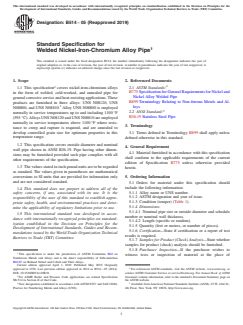
Designation:B514 −05 (Reapproved 2019)
Standard Specification for
Welded Nickel-Iron-Chromium Alloy Pipe
This standard is issued under the fixed designation B514; the number immediately following the designation indicates the year of
original adoption or, in the case of revision, the year of last revision. A number in parentheses indicates the year of last reapproval. A
superscript epsilon (´) indicates an editorial change since the last revision or reapproval.
1. Scope 2. Referenced Documents
2.1 ASTM Standards:
1.1 This specification covers nickel-iron-chromium alloys
B775 Specification for General Requirements for Nickel and
in the form of welded, cold-worked, and annealed pipe for
Nickel Alloy Welded Pipe
general corrosive service and heat-resisting applications.These
B899 Terminology Relating to Non-ferrous Metals and Al-
products are furnished in three alloys: UNS N08120, UNS
3 loys
N08800, and UNS N08810. Alloy UNS N08800 is employed
2.2 ANSI Standard:
normally in service temperatures up to and including 1100 °F
B36.19 Stainless Steel Pipe
(593 °C).AlloysUNSN08120andUNSN08810areemployed
normally in service temperatures above 1100 °F where resis-
3. Terminology
tance to creep and rupture is required, and are annealed to
develop controlled grain size for optimum properties in this 3.1 Terms defined in Terminology B899 shall apply unless
temperature range. defined otherwise in this standard.
1.2 This specification covers outside diameter and nominal
4. General Requirement
wall pipe shown in ANSI B36.19. Pipe having other dimen-
4.1 Material furnished in accordance with this specification
sions may be furnished provided such pipe complies with all
shall conform to the applicable requirements of the current
other requirements of the specification.
edition of Specification B775 unless otherwise provided
1.3 The values stated in inch-pound units are to be regarded
herein.
as standard. The values given in parentheses are mathematical
conversions to SI units that are provided for information only 5. Ordering Information
and are not considered standard.
5.1 Orders for material under this specification should
include the following information:
1.4 This standard does not purport to address all of the
5.1.1 Alloy name or UNS number.
safety concerns, if any, associated with its use. It is the
5.1.2 ASTM designation and year of issue.
responsibility of the user of this standard to establish appro-
5.1.3 Condition (temper) (Table 1).
priate safety, health, and environmental practices and deter-
5.1.4 Dimensions:
mine the applicability of regulatory limitations prior to use.
5.1.4.1 Nominal pipe size or outside diameter and schedule
1.5 This international standard was developed in accor-
number or nominal wall thickness.
dance with internationally recognized principles on standard-
5.1.4.2 Length (specific or random).
ization established in the Decision on Principles for the
5.1.5 Quantity (feet or metres, or number of pieces).
Development of International Standards, Guides and Recom-
5.1.6 Certification—State if certification or a report of test
mendations issued by the World Trade Organization Technical
results is required.
Barriers to Trade (TBT) Committee.
5.1.7 Samples for Product (Check) Analysis—State whether
samples for product (check) analysis should be furnished.
5.1.8 Purchaser Inspection—If the purchaser wishes to
This specification is under the jurisdiction of ASTM Committee B02 on
witness tests or inspection of material at the place of
Nonferrous Metals and Alloys and is the direct responsibility of Subcommittee
B02.07 on Refined Nickel and Cobalt and Their Alloys.
Current edition approved April 1, 2019. Published May 2019. Originally
approved in 1970. Last previous edition approved in 2014 as B514 – 05 (2014). For referenced ASTM standards, visit the ASTM website, www.astm.org, or
DOI: 10.1520/B0514-05R19. contact ASTM Customer Service at service@astm.org. For Annual Book of ASTM
For ASME Boiler and Pressure Code applications see related Specification Standards volume information, refer to the standard’s Document Summary page on
SB-514 in Section II of that Code. the ASTM website.
3 5
New designation established in accordance with ASTM E527 and SAE J1086, Available from American National Standards Institute (ANSI), 25 W. 43rd St.,
Practice for Numbering Metals and Alloys (UNS). 4th Floor, New York, NY 10036, http://www.ansi.org.
Copyright © ASTM International, 100 Barr Harbor Drive, PO Box C700, West Conshohocken, PA 19428-2959. United States
B514−05 (2019)
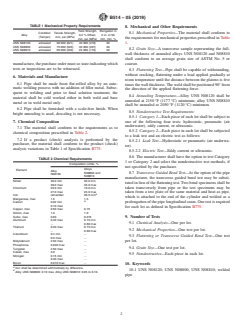
TABLE 1 Mechanical Property Requirements
8. Mechanical and Other Requirements
Yield Strength, Elongation in
Condition Tensile Strength, 8.1 Mechanical Properties—The material shall conform to
Alloy 0.2 % Offset, 2 in. or 50
(Temper) min, psi (MPa)
the requirements for mechanical properties prescribed in Table
min, psi (MPa) mm, min, %
1.
U
...