

ASTM D3642-13(2021)
(Test Method)Standard Test Method for Softening Point of Certain Alkali-Soluble Resins
General Information
- Abstract
SIGNIFICANCE AND USE
4.1 In general, with materials of this type, softening does not take place at a definite temperature. As the temperature rises, these materials gradually and imperceptibly change from brittle solids to soft, viscous liquids. For this reason, the determination of the softening point must be made by a fixed, arbitrary, and closely defined methods if the results are to be comparable.
SCOPE
1.1 This test method covers the determination of the softening point of certain alkali-soluble resins having uniform plastic flow characteristics as the melting point is approached.
1.2 The resin manufacturer should specify whether or not this test method may be used for his product(s).
1.3 This test method is not suitable for styrene-maleic anhydride resins.
Note 1: For testing rosin and other resins, see Test Method E28. For testing asphalts, tars, and pitches, see Test Method D2398.
1.4 This standard does not purport to address all of the safety concerns, if any, associated with its use. It is the responsibility of the user of this standard to establish appropriate safety, health, and environmental practices and determine the applicability of regulatory limitations prior to use.
1.5 This international standard was developed in accordance with internationally recognized principles on standardization established in the Decision on Principles for the Development of International Standards, Guides and Recommendations issued by the World Trade Organization Technical Barriers to Trade (TBT) Committee.
- Status
- Published
- Publication Date
- 28-Feb-2021
- Technical Committee
- D21 - Polishes
- Drafting Committee
- D21.02 - Raw Materials


Overview
ASTM D3642-13(2021) is an internationally recognized standard test method developed by ASTM International. The standard specifies a procedure for determining the softening point of certain alkali-soluble resins using a clearly defined, reproducible method. This test is valuable for resins exhibiting uniform plastic flow characteristics near their melting points, where a precise melting temperature cannot be defined due to the gradual transition from brittle solid to viscous liquid.
Proper determination of the softening point is essential for manufacturers and end-users seeking consistent quality in resin materials, especially for raw material assessment, quality control, and research and development in coatings, adhesives, and plastics industries. The method uses a specified apparatus and controlled heating to ensure results are accurate and comparable across different laboratories.
Key Topics
- Softening Point Measurement: The method determines the temperature at which a disk of resin held in a ring is forced downward by a steel ball as the resin softens within a heated glycerin bath.
- Controlled Heating Process: The test specifies a strict heating rate, monitored carefully to avoid exceeding prescribed limits, ensuring reproducible results.
- Sample Preparation: Detailed steps are provided for preparing and processing resin samples to avoid errors from overheating or air entrapment, which could affect test accuracy.
- Applicability: This test is applicable primarily to certain alkali-soluble resins, excluding styrene-maleic anhydride resins. Manufacturers should specify if this test method is appropriate for their products.
- Safety Considerations: Users must establish appropriate safety, health, and environmental practices as the standard does not address all potential hazards.
- Equipment Requirements: The apparatus includes a brass-shouldered ring, steel ball, ball-centering guide, heat-resistant glass vessel, adjustable support, precise thermometer, and a mechanical stirrer.
Applications
The ASTM D3642 test method for softening point determination is extensively used in the following areas:
- Quality Assurance in Resin Manufacturing: Ensuring that batches of alkali-soluble resins conform to specified softening characteristics critical to processing and end-use performance.
- Research & Development: Supporting the development of new formulations or improvements in resin chemistry, particularly for use in coatings, adhesives, polishes, and specialty plastics.
- Material Selection: Assisting engineers and formulators in choosing appropriate resins for applications requiring precise thermal behavior, such as hot-melt adhesives or heat-activated coatings.
- Comparative Testing: Providing a widely accepted basis for comparing the softening points of various resins, facilitating supplier qualification and product specification.
- Process Control: Monitoring consistency in production processes where softening point directly impacts downstream processing efficiency and product quality.
Related Standards
For comprehensive resin testing and to address specific material categories, consider the following related ASTM standards:
- ASTM E28 - Test Methods for Softening Point of Resins Derived from Pine Chemicals and Hydrocarbons, by Ring-and-Ball Apparatus
- ASTM D2398 - Test Method for Softening Point of Bitumen in Ethylene Glycol (Ring-and-Ball) (withdrawn)
- ASTM E2251 - Specification for Liquid-in-Glass ASTM Thermometers with Low-Hazard Precision Liquids
Each of these standards outlines specific test procedures tailored to the material type, ensuring accurate and relevant results for product performance and compliance.
By adhering to ASTM D3642-13(2021), laboratories and manufacturers can ensure reliable characterization of alkali-soluble resin softening points, supporting quality, consistency, and informed material selection in industrial applications.
Relations
- Effective Date
- 01-May-2011
- Effective Date
- 01-Nov-2010
- Effective Date
- 01-Jun-2009
- Effective Date
- 01-Nov-2007
- Effective Date
- 01-Jun-2004
- Effective Date
- 01-Nov-2003
- Effective Date
- 10-Jan-2003
- Effective Date
- 10-Dec-1999
Get Certified
Connect with accredited certification bodies for this standard

DIN CERTCO
DIN Group product certification.

Smithers Quality Assessments
US management systems and product certification.
Sponsored listings
Frequently Asked Questions
ASTM D3642-13(2021) is a standard published by ASTM International. Its full title is "Standard Test Method for Softening Point of Certain Alkali-Soluble Resins". This standard covers: SIGNIFICANCE AND USE 4.1 In general, with materials of this type, softening does not take place at a definite temperature. As the temperature rises, these materials gradually and imperceptibly change from brittle solids to soft, viscous liquids. For this reason, the determination of the softening point must be made by a fixed, arbitrary, and closely defined methods if the results are to be comparable. SCOPE 1.1 This test method covers the determination of the softening point of certain alkali-soluble resins having uniform plastic flow characteristics as the melting point is approached. 1.2 The resin manufacturer should specify whether or not this test method may be used for his product(s). 1.3 This test method is not suitable for styrene-maleic anhydride resins. Note 1: For testing rosin and other resins, see Test Method E28. For testing asphalts, tars, and pitches, see Test Method D2398. 1.4 This standard does not purport to address all of the safety concerns, if any, associated with its use. It is the responsibility of the user of this standard to establish appropriate safety, health, and environmental practices and determine the applicability of regulatory limitations prior to use. 1.5 This international standard was developed in accordance with internationally recognized principles on standardization established in the Decision on Principles for the Development of International Standards, Guides and Recommendations issued by the World Trade Organization Technical Barriers to Trade (TBT) Committee.
SIGNIFICANCE AND USE 4.1 In general, with materials of this type, softening does not take place at a definite temperature. As the temperature rises, these materials gradually and imperceptibly change from brittle solids to soft, viscous liquids. For this reason, the determination of the softening point must be made by a fixed, arbitrary, and closely defined methods if the results are to be comparable. SCOPE 1.1 This test method covers the determination of the softening point of certain alkali-soluble resins having uniform plastic flow characteristics as the melting point is approached. 1.2 The resin manufacturer should specify whether or not this test method may be used for his product(s). 1.3 This test method is not suitable for styrene-maleic anhydride resins. Note 1: For testing rosin and other resins, see Test Method E28. For testing asphalts, tars, and pitches, see Test Method D2398. 1.4 This standard does not purport to address all of the safety concerns, if any, associated with its use. It is the responsibility of the user of this standard to establish appropriate safety, health, and environmental practices and determine the applicability of regulatory limitations prior to use. 1.5 This international standard was developed in accordance with internationally recognized principles on standardization established in the Decision on Principles for the Development of International Standards, Guides and Recommendations issued by the World Trade Organization Technical Barriers to Trade (TBT) Committee.
ASTM D3642-13(2021) is classified under the following ICS (International Classification for Standards) categories: 83.080.10 - Thermosetting materials. The ICS classification helps identify the subject area and facilitates finding related standards.
ASTM D3642-13(2021) has the following relationships with other standards: It is inter standard links to ASTM E2251-11, ASTM E2251-10, ASTM E28-99(2009), ASTM E2251-07, ASTM E28-99(2004), ASTM E2251-03a, ASTM E2251-03, ASTM E28-99. Understanding these relationships helps ensure you are using the most current and applicable version of the standard.
ASTM D3642-13(2021) is available in PDF format for immediate download after purchase. The document can be added to your cart and obtained through the secure checkout process. Digital delivery ensures instant access to the complete standard document.
Standards Content (Sample)
This international standard was developed in accordance with internationally recognized principles on standardization established in the Decision on Principles for the
Development of International Standards, Guides and Recommendations issued by the World Trade Organization Technical Barriers to Trade (TBT) Committee.
Designation: D3642 − 13 (Reapproved 2021)
Standard Test Method for
Softening Point of Certain Alkali-Soluble Resins
This standard is issued under the fixed designation D3642; the number immediately following the designation indicates the year of
original adoption or, in the case of revision, the year of last revision. A number in parentheses indicates the year of last reapproval. A
superscript epsilon (´) indicates an editorial change since the last revision or reapproval.
1. Scope 3. Terminology
1.1 This test method covers the determination of the soft- 3.1 Definitions:
ening point of certain alkali-soluble resins having uniform 3.1.1 softening point—thetemperatureatwhichadiskofthe
sample held within a horizontal ring is forced downward a
plastic flow characteristics as the melting point is approached.
distance of 1 in. (25.4 mm) under the weight of a steel ball as
1.2 The resin manufacturer should specify whether or not
the sample is heated at a prescribed rate in a glycerin bath.
this test method may be used for his product(s).
1.3 This test method is not suitable for styrene-maleic
4. Significance and Use
anhydride resins.
4.1 In general, with materials of this type, softening does
NOTE 1—For testing rosin and other resins, see Test Method E28. For
not take place at a definite temperature. As the temperature
testing asphalts, tars, and pitches, see Test Method D2398.
rises, these materials gradually and imperceptibly change from
1.4 This standard does not purport to address all of the brittle solids to soft, viscous liquids. For this reason, the
safety concerns, if any, associated with its use. It is the determination of the softening point must be made by a fixed,
arbitrary, and closely defined methods if the results are to be
responsibility of the user of this standard to establish appro-
priate safety, health, and environmental practices and deter- comparable.
mine the applicability of regulatory limitations prior to use.
5. Apparatus
1.5 This international standard was developed in accor-
dance with internationally recognized principles on standard-
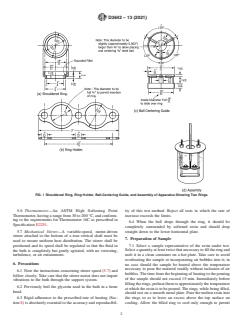
5.1 Ring—A brass-shouldered ring conforming to the di-
ization established in the Decision on Principles for the
mensions shown in Fig. 1(a).
Development of International Standards, Guides and Recom-
5.2 Ball—Asteel ball, 9.53 mm ( ⁄8 in.) in diameter, weigh-
mendations issued by the World Trade Organization Technical
ing between 3.45 and 3.55 g.
Barriers to Trade (TBT) Committee.
5.3 Ball-Centering Guide—A guide for centering the ball,
constructed of brass and having the general shape and dimen-
2. Referenced Documents
sions illustrated in Fig. 1(c).
2.1 ASTM Standards:
5.4 Container—Aglass vessel, capable of being heated, not
D2398 Test Method for Softening Point of Bitumen in
less than 85 mm (3.34 in.) in diameter and not less than 127
Ethylene Glycol (Ring-and-Ball) (Withdrawn 1984)
mm (5 in.) in depth from the bottom of the flare. (An 800-mL,
E28 Test Methods for Softening Point of Resins Derived
low-form Griffin beaker of heat-resistant glass meets this
from Pine Chemicals and Hydrocarbons, by Ring-and-
requirement.)
Ball Apparatus
E2251 Specification for Liquid-in-Glass ASTM Thermom-
5.5 Support for Ring and Thermometer, as shown in Fig.
eters with Low-Hazard Precision Liquids
1(d). Note the following requirements:
5.5.1 The ring shall be supported in a horizontal position.
5.5.2 The bottom of the ring shall be 25.4 mm (1 in.) above
1 the horizontal plate below it.
This test method is under the jurisdiction ofASTM Committee D21 on Polishes
and is the direct responsibility of Subcommittee D21.02 on Raw Materials.
5.5.3 The bottom surface of the horizontal plate shall be at
Current edition approved March 1, 2021. Published March 2021. Originally
least 12.5 mm (0.5 in.) and not more than 19 mm (0.75 in.)
approved in 1978. Last previous edition approved in 2013 as D3642 – 13. DOI:
above the bottom of the beaker.
10.1520/D3642-13R21
5.5.4 The depth of liquid in the beaker shall be not less than
For referenced ASTM standards, visit the ASTM website, www.astm.org, or
contact ASTM Customer Service at service@astm.org. For Annual Book of ASTM
102 mm (4 in.).
Standards volume information, refer to the standard’s Document Summary page on
5.5.5 The thermometer shall be suspended so that the
the ASTM website.
bottom of the bulb is level with the bottom of the ring and
The last approved version of this historical standard is referenced on
www.astm.org. within 12.7 mm (0.5 in.) but not touching the ring.
Copyright © ASTM International, 100 Barr Harbor Drive, PO Box C700, West Conshohocken, PA 19428-2959. United States
D3642 − 13 (2021)
FIG. 1 Shouldered Ring, Ring Holder, Ball-Centering Guide, and Assembly of Apparatus Showing Two Rings
5.6 Thermometer—An ASTM High Softening Point ity of this test metho
...