

ASTM D4502-92(2019)
(Test Method)Standard Test Method for Heat and Moisture Resistance of Wood-Adhesive Joints
General Information
- Abstract
SIGNIFICANCE AND USE
5.1 This test method can serve as a useful tool for durability assessment and service life forecasting.
5.1.1 This test method can be used to measure the effects of heat and moisture and the effect of their interaction on adhesives and bonded joints. Knowledge of these effects is useful to an adhesive formulator or manufacturer. Moist heat aging is particularly useful for determining the effects of acidic adhesive systems on the hydrolysis of wood adherends.
5.1.2 This test method provides a means of comparing the rate of degradation of an unknown adhesive-adherend combination to the rate of degradation of a known combination in thermal or hydrolytic aging environments. Such a comparison can be useful to adhesive manufacturers for introducing a new product to the market and for helping designers selecting adhesives.
5.1.3 This test method does not duplicate any natural service environment, but it does provide a means of estimating the service life of joints in similar environments. Service-life estimates are useful to designers of bonded structures or structures using bonded products.
5.2 Service-life estimates rely on the assumption that the chemical degradation mechanism is the same at the elevated aging temperatures as at the service temperature. However, this may not be true in every case. This possibility, together with the variability in specimen preparation, in the aging exposures, and in the strength measurements, require that caution be used in accepting the estimate of service life.
SCOPE
1.1 The purpose of this test method is to estimate the resistance of adhesive-bonded joints to thermal and hydrolytic degradation.
1.2 This test method is primarily for wood-to-wood joints but may be applied to joints of wood to other materials.
1.3 The effects of chemicals such as fire retardants, preservatives, and extractives in the wood upon joint degradation resistance can be estimated.
1.4 This test method does not account for the effects of stress, the other principal degrading factor, nor does it account for cyclic or variable temperature or moisture levels.
1.5 The values stated in SI units are to be regarded as standard. The values given in parentheses after SI units are provided for information only and are not considered standard.
1.6 This standard does not purport to address all of the safety concerns, if any, associated with its use. It is the responsibility of the user of this standard to establish appropriate safety, health, and environmental practices and determine the applicability of regulatory limitations prior to use.
1.7 This international standard was developed in accordance with internationally recognized principles on standardization established in the Decision on Principles for the Development of International Standards, Guides and Recommendations issued by the World Trade Organization Technical Barriers to Trade (TBT) Committee.
- Status
- Published
- Publication Date
- 28-Feb-2019
- Technical Committee
- D14 - Adhesives
- Drafting Committee
- D14.70 - Construction Adhesives
Overview
ASTM D4502-92(2019), titled Standard Test Method for Heat and Moisture Resistance of Wood-Adhesive Joints, is an important standard developed by ASTM International. It provides a systematic method for assessing how wood-adhesive joints respond to heat and moisture exposure, making it essential for evaluating the durability and service life of adhesive bonds in wood construction and related industries. Although this test does not perfectly replicate natural service conditions, it offers reliable estimations that support both product development and quality assurance for adhesives used in bonding wood and other materials.
Key Topics
- Durability Assessment: The standard focuses on predicting the longevity of adhesive-bonded joints exposed to thermal and hydrolytic (moisture-driven) degradation, which is crucial for understanding product performance in demanding environments.
- Accelerated Aging: By subjecting specimens to elevated temperatures and controlled humidity, the method simulates long-term exposure in a compressed timeframe, allowing for speedy evaluation of different adhesive formulations and wood combinations.
- Comparative Analysis: The protocol facilitates direct comparison between new adhesive systems and established products under identical conditions, providing valuable information for adhesive manufacturers and end users.
- Chemical Effects: The influence of wood treatment chemicals such as fire retardants, preservatives, and natural extractives on adhesive joint degradation can be assessed using this method.
- Limitations: The standard primarily considers thermal and moisture effects, and does not address other degrading factors such as physical stress, or variable/cyclic exposure conditions.
Applications
Practical Value
- Adhesive Formulation and Selection: Manufacturers use this test to validate new adhesive products, ensuring they meet expected service life requirements before market launch. Designers and engineers rely on these results for selecting adhesives with proven heat and moisture resistance, particularly in applications where environmental durability is critical.
- Structural Bonding Verification: The test is particularly relevant for bonded wood products used in construction, furniture, and engineered wood applications to verify that joints will remain intact over time, even under challenging environmental conditions.
- Quality Control: Routine use as a quality control tool ensures consistency in adhesive performance during manufacturing, identifying any production issues or formulation changes that may affect joint integrity.
- Service Life Forecasting: Estimates from this procedure help stakeholders make informed decisions regarding maintenance schedules, warranty periods, and expected product lifespan, which contributes to risk mitigation and sustainability planning.
- Assessment of Wood Treatments: Evaluating the interaction of treated woods (with preservatives or fire retardants) with specific adhesives supports the development of safer and more durable wood-based systems.
Related Standards
The ASTM D4502-92(2019) method references and complements several other key standards relevant to adhesive and wood joint testing, including:
- ASTM D907: Standard Terminology of Adhesives - Provides definitions and terminology to ensure consistency in adhesive research and application.
- ASTM D897: Test Method for Tensile Properties of Adhesive Bonds - Evaluates tensile strength characteristics of adhesive joints.
- ASTM D905: Test Method for Strength Properties of Adhesive Bonds in Shear by Compression Loading - Measures shear strength, often serving as a baseline reference for D4502.
- ASTM D2339: Test Method for Strength Properties of Adhesives in Two-Ply Wood Construction in Shear by Tension Loading - Offers alternative specimen and testing configuration options, further enhancing comparative analysis.
- ASTM D2304 and D2307: Methods for Thermal Endurance of Electrical Insulation - Relevant for cross-comparison of degradation processes under elevated temperatures.
- IEEE Temperature Limits Standards: For assessing temperature exposures in the context of electrical and electronic components.
Conclusion
Adopting ASTM D4502-92(2019) in research, production, and product certification processes ensures a high level of confidence in the heat and moisture resistance of wood-adhesive joints. The standard’s rigorous, comparative, and accelerated approach enables adhesive manufacturers, wood product engineers, and quality control laboratories to optimize joint performance and predict service life accurately, supporting safer, longer-lasting bonded wood systems across the industry.
Keywords: ASTM D4502-92, wood-adhesive joints, heat resistance, moisture resistance, adhesive durability, accelerated aging, service life prediction, bonded wood structures, adhesive comparison, wood treatments, structural adhesives, quality control.
Relations
- Replaces
ASTM D4502-92(2011) - Standard Test Method for Heat and Moisture Resistance of Wood-Adhesive Joints - Effective Date
- 01-Mar-2019
- Effective Date
- 01-Apr-2020
- Effective Date
- 01-Aug-2017
- Effective Date
- 01-May-2016
- Effective Date
- 01-Jul-2012
- Effective Date
- 01-May-2012
- Effective Date
- 01-Dec-2011
- Effective Date
- 01-Apr-2011
- Effective Date
- 01-Jan-2011
- Refers
ASTM D2304-10 - Standard Test Method for Thermal Endurance of Rigid Electrical Insulating Materials - Effective Date
- 01-Oct-2010
- Effective Date
- 01-Oct-2008
- Effective Date
- 01-Oct-2008
- Effective Date
- 01-Oct-2008
- Effective Date
- 01-Oct-2008
- Effective Date
- 15-Aug-2008
Get Certified
Connect with accredited certification bodies for this standard

DIN CERTCO
DIN Group product certification.

Smithers Quality Assessments
US management systems and product certification.
Sponsored listings
Frequently Asked Questions
ASTM D4502-92(2019) is a standard published by ASTM International. Its full title is "Standard Test Method for Heat and Moisture Resistance of Wood-Adhesive Joints". This standard covers: SIGNIFICANCE AND USE 5.1 This test method can serve as a useful tool for durability assessment and service life forecasting. 5.1.1 This test method can be used to measure the effects of heat and moisture and the effect of their interaction on adhesives and bonded joints. Knowledge of these effects is useful to an adhesive formulator or manufacturer. Moist heat aging is particularly useful for determining the effects of acidic adhesive systems on the hydrolysis of wood adherends. 5.1.2 This test method provides a means of comparing the rate of degradation of an unknown adhesive-adherend combination to the rate of degradation of a known combination in thermal or hydrolytic aging environments. Such a comparison can be useful to adhesive manufacturers for introducing a new product to the market and for helping designers selecting adhesives. 5.1.3 This test method does not duplicate any natural service environment, but it does provide a means of estimating the service life of joints in similar environments. Service-life estimates are useful to designers of bonded structures or structures using bonded products. 5.2 Service-life estimates rely on the assumption that the chemical degradation mechanism is the same at the elevated aging temperatures as at the service temperature. However, this may not be true in every case. This possibility, together with the variability in specimen preparation, in the aging exposures, and in the strength measurements, require that caution be used in accepting the estimate of service life. SCOPE 1.1 The purpose of this test method is to estimate the resistance of adhesive-bonded joints to thermal and hydrolytic degradation. 1.2 This test method is primarily for wood-to-wood joints but may be applied to joints of wood to other materials. 1.3 The effects of chemicals such as fire retardants, preservatives, and extractives in the wood upon joint degradation resistance can be estimated. 1.4 This test method does not account for the effects of stress, the other principal degrading factor, nor does it account for cyclic or variable temperature or moisture levels. 1.5 The values stated in SI units are to be regarded as standard. The values given in parentheses after SI units are provided for information only and are not considered standard. 1.6 This standard does not purport to address all of the safety concerns, if any, associated with its use. It is the responsibility of the user of this standard to establish appropriate safety, health, and environmental practices and determine the applicability of regulatory limitations prior to use. 1.7 This international standard was developed in accordance with internationally recognized principles on standardization established in the Decision on Principles for the Development of International Standards, Guides and Recommendations issued by the World Trade Organization Technical Barriers to Trade (TBT) Committee.
SIGNIFICANCE AND USE 5.1 This test method can serve as a useful tool for durability assessment and service life forecasting. 5.1.1 This test method can be used to measure the effects of heat and moisture and the effect of their interaction on adhesives and bonded joints. Knowledge of these effects is useful to an adhesive formulator or manufacturer. Moist heat aging is particularly useful for determining the effects of acidic adhesive systems on the hydrolysis of wood adherends. 5.1.2 This test method provides a means of comparing the rate of degradation of an unknown adhesive-adherend combination to the rate of degradation of a known combination in thermal or hydrolytic aging environments. Such a comparison can be useful to adhesive manufacturers for introducing a new product to the market and for helping designers selecting adhesives. 5.1.3 This test method does not duplicate any natural service environment, but it does provide a means of estimating the service life of joints in similar environments. Service-life estimates are useful to designers of bonded structures or structures using bonded products. 5.2 Service-life estimates rely on the assumption that the chemical degradation mechanism is the same at the elevated aging temperatures as at the service temperature. However, this may not be true in every case. This possibility, together with the variability in specimen preparation, in the aging exposures, and in the strength measurements, require that caution be used in accepting the estimate of service life. SCOPE 1.1 The purpose of this test method is to estimate the resistance of adhesive-bonded joints to thermal and hydrolytic degradation. 1.2 This test method is primarily for wood-to-wood joints but may be applied to joints of wood to other materials. 1.3 The effects of chemicals such as fire retardants, preservatives, and extractives in the wood upon joint degradation resistance can be estimated. 1.4 This test method does not account for the effects of stress, the other principal degrading factor, nor does it account for cyclic or variable temperature or moisture levels. 1.5 The values stated in SI units are to be regarded as standard. The values given in parentheses after SI units are provided for information only and are not considered standard. 1.6 This standard does not purport to address all of the safety concerns, if any, associated with its use. It is the responsibility of the user of this standard to establish appropriate safety, health, and environmental practices and determine the applicability of regulatory limitations prior to use. 1.7 This international standard was developed in accordance with internationally recognized principles on standardization established in the Decision on Principles for the Development of International Standards, Guides and Recommendations issued by the World Trade Organization Technical Barriers to Trade (TBT) Committee.
ASTM D4502-92(2019) is classified under the following ICS (International Classification for Standards) categories: 83.180 - Adhesives. The ICS classification helps identify the subject area and facilitates finding related standards.
ASTM D4502-92(2019) has the following relationships with other standards: It is inter standard links to ASTM D4502-92(2011), ASTM D2339-20, ASTM D2339-98(2017), ASTM D897-08(2016), ASTM D907-12a, ASTM D907-12, ASTM D907-11a, ASTM D2339-98(2011), ASTM D907-11, ASTM D2304-10, ASTM D905-08e1, ASTM D897-08, ASTM D907-08b, ASTM D905-08, ASTM D907-08a. Understanding these relationships helps ensure you are using the most current and applicable version of the standard.
ASTM D4502-92(2019) is available in PDF format for immediate download after purchase. The document can be added to your cart and obtained through the secure checkout process. Digital delivery ensures instant access to the complete standard document.
Standards Content (Sample)
This international standard was developed in accordance with internationally recognized principles on standardization established in the Decision on Principles for the
Development of International Standards, Guides and Recommendations issued by the World Trade Organization Technical Barriers to Trade (TBT) Committee.
Designation: D4502 − 92 (Reapproved 2019)
Standard Test Method for
Heat and Moisture Resistance of Wood-Adhesive Joints
This standard is issued under the fixed designation D4502; the number immediately following the designation indicates the year of
original adoption or, in the case of revision, the year of last revision.Anumber in parentheses indicates the year of last reapproval.A
superscript epsilon (´) indicates an editorial change since the last revision or reapproval.
1. Scope D907Terminology of Adhesives
D2304Test Method for Thermal Endurance of Rigid Elec-
1.1 The purpose of this test method is to estimate the
trical Insulating Materials
resistance of adhesive-bonded joints to thermal and hydrolytic
D2307 Test Method for Thermal Endurance of Film-
degradation.
Insulated Round Magnet Wire
1.2 This test method is primarily for wood-to-wood joints
D2339Test Method for Strength Properties ofAdhesives in
but may be applied to joints of wood to other materials.
Two-PlyWood Construction in Shear byTension Loading
1.3 The effects of chemicals such as fire retardants, 2.2 IEEE Standard:
preservatives, and extractives in the wood upon joint degrada-
IEEENo.1GeneralPrinciplesforTemperatureLimitsinthe
tion resistance can be estimated. Rating of Electrical Equipment
1.4 This test method does not account for the effects of
3. Terminology
stress, the other principal degrading factor, nor does it account
3.1 Definitions
for cyclic or variable temperature or moisture levels.
3.1.1 For definitions of terms used in this test method, refer
1.5 The values stated in SI units are to be regarded as
to Terminology D907.
standard. The values given in parentheses after SI units are
3.2 shear strength, n—in an adhesive joint, the maximum
providedforinformationonlyandarenotconsideredstandard.
average stress when a force is applied parallel to the joint.
1.6 This standard does not purport to address all of the
3.2.1 Discussion—In most adhesive test methods, the shear
safety concerns, if any, associated with its use. It is the
strength is actually the maximum average stress at failure of
responsibility of the user of this standard to establish appro-
the specimen, not necessarily the true maximum stress in the
priate safety, health, and environmental practices and deter-
material.
mine the applicability of regulatory limitations prior to use.
1.7 This international standard was developed in accor-
4. Summary of Test Method
dance with internationally recognized principles on standard-
4.1 The degradation of adhesive joints is a physicochemical
ization established in the Decision on Principles for the
process. The speed of degradation is related to the levels of
Development of International Standards, Guides and Recom-
temperature, moisture (and other chemicals), and physical
mendations issued by the World Trade Organization Technical
stress to which the joint is exposed. This test method is based
Barriers to Trade (TBT) Committee.
on the principles of chemical kinetics and uses theArrehenius
temperature dependence relationship to estimate the long-term
2. Referenced Documents
effects of heat and moisture at the service temperature.
2.1 ASTM Standards:
4.2 Specimens whose unaged properties have been esti-
D897Test Method forTensile Properties ofAdhesive Bonds
mated by control tests are subjected to an accelerated thermal
D905Test Method for Strength Properties of Adhesive
or hydrolytic aging environment in groups. Aging is acceler-
Bonds in Shear by Compression Loading
ated by using elevated temperature. Periodically, a group of
specimens is removed from the aging environment and tested.
The estimated property after aging and the time of aging are
This test method is under the jurisdiction of ASTM Committee D14 on
recorded.Afterseveralgroupshavebeentestedinthismanner,
Adhesives and is the direct responsibility of Subcommittee D14.70 on Construction
Adhesives.
the rate of property loss in the aging environment can be
Current edition approved March 1, 2019. Published March 2019. Originally
estimated. This basic experiment is repeated at several other
approved in 1985. Last previous edition approved in 2011 as D4502–92(2011).
elevated temperatures, and the rates of property loss at those
DOI: 10.1520/D4502-92R19.
For referenced ASTM standards, visit the ASTM website, www.astm.org, or
contact ASTM Customer Service at service@astm.org. For Annual Book of ASTM
Standards volume information, refer to the standard’s Document Summary page on Available from Institute of Electrical and Electronics Engineers, Inc. (IEEE),
the ASTM website. 445 Hoes Ln., P.O. Box 1331, Piscataway, NJ 08854-1331, http://www.ieee.org.
Copyright © ASTM International, 100 Barr Harbor Drive, PO Box C700, West Conshohocken, PA 19428-2959. United States
D4502 − 92 (2019)
temperatures estimated. The rate of property loss relationship perature over saturated salt solutions. Wide-neck canning jars
to temperature is estimated. This relationship can be extrapo- with volumes of 3 ⁄2 L (1 gal), rubber gaskets, and clamp lids
lated to lower service temperatures for estimating service life. haveprovensatisfactoryattemperaturesof100°C(212°F)and
below. The jars must have a platform inside (without legs) to
4.3 This test method employs a smaller version of the Test
support specimens above the saturated salt solution. A 6mm
MethodD905blockshearspecimen,butothershearstrengthor
( ⁄4in.) diameter bead of silicone sealant around the inside
tensile strength specimens may also be used.
surface of the jar and about 5 cm (2 in.) above the bottom
providesaledgetosupporttheplatform.Theplatformmustbe
5. Significance and Use
perforated to permit free-flow of water vapor. It may be cut
5.1 Thistestmethodcanserveasausefultoolfordurability
from any material that is resistant to corrosion, heat, and
assessment and service life forecasting.
moisture. Perforated high-density hardboard has proven satis-
5.1.1 This test method can be used to measure the effects of
factory. The platform must be cut in half to pass through the
heat and moisture and the effect of their interaction on
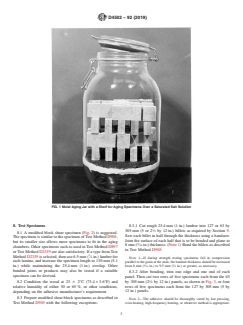
neck of the jar.An aging jar with platform is shown in Fig. 1.
adhesives and bonded joints. Knowledge of these effects is
The jars must be placed in an aging oven, such as described in
useful to an adhesive formulator or manufacturer. Moist heat
5.1, to achieve the required temperature.
agingisparticularlyusefulfordeterminingtheeffectsofacidic
6.4 Water Baths—Constant-level water baths capable of
adhesive systems on the hydrolysis of wood adherends.
controltowithin0.5°Cofthedesiredtemperaturearerequired.
5.1.2 This test method provides a means of comparing the
The baths must be able to contain 100 specimens.
rate of degradation of an unknown adhesive-adherend combi-
nation to the rate of degradation of a known combination in
6.5 Testing Machine—The testing machine shall have a
thermal or hydrolytic aging environments. Such a comparison
capacity of not less than 3000 kg (6210 lbf) in compression.
can be useful to adhesive manufacturers for introducing a new
The machine shall be capable of maintaining a uniform rate of
product to the market and for helping designers selecting
loading such that the load may be applied with a continuous
adhesives.
motion of the movable head to the maximum load at a rate of
5.1.3 This test method does not duplicate any natural
10.0 6 5 mm/min (0.40 in./min) with a permissible variation
serviceenvironment,butitdoesprovideameansofestimating
of+0.5%.
the service life of joints in similar environments. Service-life
6.6 Shearing Tool—A shearing tool similar to the tool
estimates are useful to designers of bonded structures or
pictured in Test Method D905 is satisfactory. The tool must
structures using bonded products.
have a self-aligning seat to ensure uniform lateral distribution
5.2 Service-life estimates rely on the assumption that the
of the load.
chemical degradation mechanism is the same at the elevated
agingtemperaturesasattheservicetemperature.However,this
7. Materials
may not be true in every case. This possibility, together with
7.1 Adhesive to Be Tested:
thevariabilityinspecimenpreparation,intheagingexposures,
7.2 Joints—Wood for wood-to-wood joints or joints of
and in the strength measurements, require that caution be used
wood to metal or plastic shall be free of defects such as knots,
in accepting the estimate of service life.
cracks, short-grain and sharp-grain deviations, or any discol-
6. Apparatus
orations or soft spots indicative of decay. Generally, a high-
density uniform-textured wood is desirable so that the maxi-
6.1 Aging Ovens—Ovens are required that are capable of
mum stress will be placed on the adhesive joint during testing.
control within 62 % of specified exposure temperature
The standard shall be hard maple (Acer saccharum or Acer
throughout the chamber for extended periods of time (60.5°C
nigrum) having a minimum specific gravity of 0.65 (based on
control is desirable). The ovens must be capable of operating
oven-dry weight and volume). Other species may be used
at temperatures from 60 to 175°C. The oven must have an
whereevaluationoftheadhesive’sperformanceincontactwith
internal capacity for up to 100 specimens well-spaced and
that species is a specific requirement.
supported on racks to allow free air flow.
7.3 Saturated Salt Solutions—A constant relative humidity
6.2 Environmental Chambers—Chambers for moist-heat
at a given temperature can be maintained in sealed aging jars
aging must be capable of 60.5°C temperature and 0.5%
byasaturatedaqueoussolutionincontactwithanexcessofthe
relative humidity control uniformly throughout the chamber.
solid phase of a specific salt. Tables are available that show
The chamber must be capable of operating at temperatures
relative humidities at given temperatures for many salts.
from 60 to 90°C and relative humidity from 60 to 80%. The
Sodium chloride is recommended. A saturated solution of
chamber must have the capacity for up to 100 specimens
sodiumchloridewillproducearelativehumidityof73to76%
well-spaced and supported on racks to allow free air flow.
overthetemperaturerangefrom40to100°C.Thistranslatesto
6.3 Moist Aging Jars—Heat-resistant glass jars are required
wood moisture content in the approximate range from 9 to
to expose specimens to constant relative humidity and tem-
13%.
Millett,M.A.,Western,L.J.,andBooth,J.J.,“AcceleratedAgingofCellulosic
Materials: Design andApplication of a Heating Chamber,” TAPPI, Vol 50, No. 11, Dean, J.A., ed., Lange’s Handbook of Chemistry, 12th ed., McGraw-Hill Book
1967, pp. 74A–80A. Co., Inc., 1978.
D4502 − 92 (2019)
FIG. 1 Moist Aging Jar with a Shelf for Aging Specimens Over a Saturated Salt Solution
8. Test Specimens 8.3.1 Cut rough 25.4mm (1in.) lumber into 127 or 63 by
305mm (5 or 2 ⁄2 by 12in.) billets as required by Section 9.
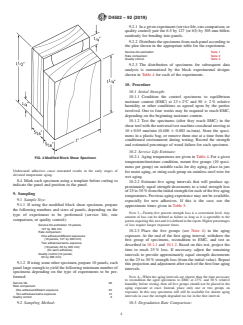
8.1 A modified block shear specimen (Fig. 2) is suggested.
Saw each billet in half through the thickness using a bandsaw.
ThespecimenissimilartothespecimenofTestMethodD905,
Joint the surface of each half that is to be bonded and plane to
but its smaller size allows more specimens to fit in the aging
8mm( ⁄16in.)thickness.(Note1)Bondthebilletsasdescribed
chambers. Other specimens such as used inTest Method D897
in Test Method D905.
orTestMethodD2339arealsosatisfactory.IfatypefromTest
MethodD2339isselected,thenuse6.5mm( ⁄4in.)lumberfor
NOTE 1—If during strength testing specimens fail in compression
each lamina, and increase the specimen length to 130 mm (5.1
paralleltothegrainattheends,thelaminaethicknessshouldbeincreased
5 3
from8mm( ⁄16 in.) to 9.5 mm ( ⁄8 in.) or greater, as necessary.
in.) while maintaining the 25.4mm (1in.) overlap. Other
bonded joints or products may also be tested if a suitable
8.3.2 After bonding, trim one edge and one end of each
specimen can be devised.
panel. Then cut two rows of five specimens each from the 63
by 305mm (2 ⁄2 by 12in.) panels, as shown in Fig. 3, or four
8.2 Condition the wood at 23 6 2°C (73.4+3.6°F) and
rows of five specimens each from the 127 by 305mm (5 by
relative humidity of either 30 or 65%, or other conditions,
12in.) panels.
depending on the adhesive manufacturer’s requirement.
8.3 Prepare modified shear block specimens as described in
NOTE 2—The adhesive should be thoroughly cured by hot pressing,
Test Method D905 with the following exceptions: oven heating, high-frequency heating, or whatever method is appropriate.
D4502 − 92 (2019)
9.2.1 Inagivenexperiment(servicelife,ratecomparison,or
quality control) pair the 6.5 by 127 (or 63) by 305-mm billets
randomly for bonding into panels.
9.2.2 Distributethespecimensfromeachpanelaccordingto
the plan shown in the appropriate table for the experiment.
Service-life estimation Table 1
Rate comparison Table 2
Quality control Table 3
9.2.3 The distribution of specimens for subsequent data
analysis is summarized by the block experimental designs
shown in Table 4 for each of the experiments.
10. Procedure
10.1 Initial Strength:
10.1.1 Condition the control specimens to equilibrium
moisture content (EMC) at 23+2°C and 50 6 2% relative
humidity or other conditions as agreed upon by the parties
involved. One to four weeks may be required to reach EMC,
depending on the beginning moisture content.
10.1.2 Test the specimens (after they reach EMC) in the
shear tool with the universal test machine crosshead moving at
10+0.05 mm/min (0.400 6 0.002 in./min). Store the speci-
mens in a plastic bag, or remove them one at a time from the
conditioned environment during testing. Record the strength
and estimated percentage of wood failure for each specimen.
10.2 Service Life Estimate:
10.2.1 Aging temperatures are given inTable 4. For a given
FIG. 2 Modified Block Shear Specimen
temperature/moisture condition, mount five groups (10 speci-
mens per group) on suitable racks for dry aging, place in jars
Undercured adhesives cause unwanted results in the early stages of
for moist aging, or string each group on stainless steel wire for
elevated temperature aging.
wet aging.
8.4 Mark each specimen using a template before cutting to
10.2.2 Estimate five aging intervals that will produce ap-
indicate the panel and position in the panel.
proximately equal strength decrements to a total strength loss
of25to30%fromtheinitialstrengthforeachofthefiveaging
9. Sampling
temperatures. Previous aging experience may not be available,
9.1 Sample Size:
especially for new adhesives. If this is the case, use the
9.1.1 If using the modified block shear specimen, prepare
approximate times given in Table 5.
the following numbers and sizes of panels, depending on the
NOTE 3—Twenty-five percent strength loss is a convenient level. Any
type of experiment to be performed (service life, rate
amount of loss can be defined as failure as long as it is agreeable to the
comparison, or quality control):
partiesrequiringthistestanditisdefinedinthereport.Higherpercentages
Service life estimation 10 panels, of loss require longer exposure times.
127 by 305 mm
10.2.3 Place the five groups (see Note 4) in the aging
Rate comparison:
One adhesive/different exposures exposure. At the end of the first aging interval, withdraw the
(10 panels, 127 by 305 mm)
first group of specimens, recondition to EMC, and test as
Two adhesives/same exposure
described in 10.1.1 and 10.1.2. Based on this test, project the
(10 panels, 63 by 305 mm)
(for each adhesive) time to reach 25% loss. If necessary, adjust the remaining
Quality control (10 panels,
intervals to provide approximately equal strength decrements
63 by 305 mm)
to the 25 to 30% strength loss (from the initial value). Repeat
9.1.2 If using some other specimen, prepare 10 panels, each
this projection and adjustment after each of the first four aging
panel large enough to yield the following minimum number of
intervals.
specimens depending on the type of experiments to be per-
NOTE 4—When the aging intervals are shorter than the time necessary
formed:
to recondition the aged specimens to EMC at 23°C and 50% relative
Service life 26
humidity before testing, then all five groups should not be placed in the
Rate comparison:
aging exposure at once. Instead, place only one or two groups on
One adhesive/different exposure 22
exposure. In this way specimens will still be available for shorter aging
Two adhesives/same exposure 12
intervals in case the strength degraded too far in the first interval.
Quality control 3
9.2 Sampling Method: 10.3 Degradation Rate Comparison:
D4502 − 92 (2019)
FIG. 3 (A) Top View of One End of a Panel Showing Trim and Individual Blocks for Specimens, and (B) Side View Showing Two Cuts
on Each End of a Block to Form the Offset
10.3.1 Aging may be dry, moist, or wet depending on the 10.4.2 Age the group of specimens for a time that is the
aging conditions of the adhesive to which the test adhesive is same as one of the times used in the previous evaluation and
to be compared. Select three temperatures from Table 1 for the that should cause about 25 to 30% strength loss. After aging,
chosen moisture level. If the adhesive is thought to be very recondition to EMC and test in accordance with 10.1.1 and
durable, use the three highest temperatures. If the adhesive is 10.1.2.
thought to be less durable, use the three lower temperatures.
For a given temperature, use five groups (20 specimens per
11. Calculations
group). Prepare for aging as described in 9.2.1.
11.1 Service Life Estimate:
10.3.2 Estimate five aging intervals to 25 to 30% strength
11.1.1 Makeavisualestimateoftheexpectedservicelifeas
loss as described in 10.2.2, 10.2.3, and Note 4.
follows:
10.3.3 After aging, recondition the specimens to EMC and
test as described in 10.1.1 and 10.1.2. 11.1.1.1 Calculate the average values of the residual shear
strengthfromthe10specimensateachaginginterval,foreach
10.4 Quality Control:
temperature.
10.4.1 Normally the quality control test will be applied to
11.1.1.2 Prepare rate curves for each temperature by plot-
adhesives previously evaluated by the service life or degrada-
ting the log of the average residual strength at a given aging
tion rate procedures. Select one temperature for dry and one
interval as a function of the aging time.
temperature for wet aging from Table 4 that should cause a 25
to 30% strength loss in less than 48 h, based on the previous 11.1.1.3 Determinetheestimateoftheinitialstrength(yaxis
agingexperience.Ifpreviousexperienceisnotavailable,select intercept)andtheagingtimeatwhicheachratecurveintersects
a temperature/time from Table 5 as a starting point. the 75% residual strength line (Fig. 4).
D4502 − 92 (2019)
TABLE 1 Specimen Distribution for Service Life Estimation Experiment at a Single Moisture Level Using Ten 127 by 305 mm (5 by
12 in.) Bonded Panels Yielding 2 Specimens Each
Test group Panel
Total
Aging
Temperature 12 34 5 6 7 8 9 10
interval
Control 1 1 1 1 1 1 1 1 1 1 10
1 1 11 11 1 1 1 1 1 1 10
1 3 11 11 1 1 1 1 1 1 10
1 4 11 11 1 1 1 1 1 1 10
1 5 11 11 1 1 1 1 1 1 10
2 1 11 11 1 1 1 1 1 1 10
2 2 11 11 1 1 1 1 1 1 10
2 3 11 11 1 1 1 1 1 1 10
2 4 11 11 1 1 1 1 1 1 10
2 5 11 11 1 1 1 1 1 1 10
3 1 11 11 1 1 1 1 1 1 10
3 2 11 11 1 1 1 1 1 1 10
3 3 11 11 1 1 1 1 1 1 10
3 4 11 11 1 1 1 1 1 1 10
3 5 11 11 1 1 1 1 1 1 10
4 1 11 11 1 1 1 1 1 1 10
4 2 11 11 1 1 1 1 1 1 10
4 3 11 11 1 1 1 1 1 1 10
4 4 11 11 1 1 1 1 1 1 10
4 5 11 11 1 1 1 1 1 1 10
5 1 11 11 1 1 1 1 1 1 10
5 2 11 11 1 1 1 1 1 1 10
5 3 11 11 1 1 1 1 1 1 10
5 4 11 11 1 1 1 1 1 1 10
5 5 11 11 1 1 1 1 1 1 10
Total 2626 2626 26 26 26 26 26 26 260
Leftover 2 2 2 2 2 2 2 2 2 2 20
A
TABLE 2 Specimen Distribution for the Experiment to Compare Degradation Rates of a Single Adhesive in Two Exposures Using 127
by 305 mm (5 by 12 in.) Bonded Panels Yielding 28 Specimens Each
Panel
Test Aging
Total
Group Interval
1 2 34 5 6 78 9 10
Exposure I
Control 2 2 2 2 2 2 2 2 2 2 20
12 2 2 2 2 2 2 2 2 2 20
22 2 2 2 2 2 2 2 2 2 20
32 2 2 2 2 2 2 2 2 2 20
42 2 2 2 2 2 2 2 2 2 20
52 2 2 2 2 2 2 2 2 2 20
Exposure II
Control 2 2 2 2 2 2 2 2 2 2 20
12 2 2 2 2 2 2 2 2 2 20
22 2 2 2 2 2 2 2 2 2 20
32 2 2 2 2 2 2 2 2 2 20
42 2 2 2 2 2 2 2 2 2 20
52 2 2 2 2 2 2 2 2 2 20
Total 24 24 2424 24 24 2424 24 24 240
Leftover 4 4 4 4 4 4 4 4 4 4 40
A
Tocomparetwodifferentadhesivesinasingleexposureprepareten63by305 mm(2 ⁄2by12 in.)panels(yielding14specimenseach)witheachadhesive.Ifcomparing
two adhesives, a group of control specimens is also required for the second adhesive.
TABLE 3 Specimen Distribution for Wet and Dry Quality Control
11.1.1.4 Forthewetanddryagingconditions,plottheaging Tests Using Ten 63 by 305 mm (2 ⁄2 by 12 in.) Bonded Panels
Yielding 14 Specimens Each
times to 75% residual strength as a function of temperature in
Panel
the Arrhenius convention of log time versus reciprocal tem-
Test group Total
perature (Fig. 5). Visually fit a straight line through the five 1 2 3 456 7 8 9 10
Dry control 2 2 2 2 2 2 2 2 2 2 20
temperature data points for the wet or dry condition.
Dry exposure 2 2 2 2 2 2 2 2 2 2 20
11.1.1.5 Project this line to the temperature at which the
Wet control 2 2 2 2 2 2 2 2 2 2 20
expectedservicelifeistobeestimatedbutnotmorethan50°C
Wet exposure 2 2 2 2 2 2 2 2 2 2 20
lower than the lowest accelerated aging temperature. Total 8 8 8 888 8 8 8 8 80
Leftover 6 6 6 6 6 6 6 6 6 6 60
11.1.2 Make a statistical estimate of the service life in a
given moisture condition. Detailed procedures are given in
Annex A2 or Annex A3 (Version I or II).
D4502 − 92 (2019)
TABLE 4 Block Experimental Designs for Service Life Estimation,
(specimen) to degrade to 75% residual strength (75% of the
Rate Comparison, and Quality Control Experiments
estimated initial strength) (t ) at each aging temperature.
0.75
Aging Interval
Aging
Test Group Control
NOTE 5—The choice of 25% strength loss as the criteria for failure is
Temperature
12 3 4 5
convenient but arbitrary. Any percentage may be chosen based on the
A
Service Life Estimation
consent of those parties involved.
Control 1 10 10 10 10 10 10
Dry 2 10 10 10 10 10
11.1.2.3 Finally, fit the estimated failure time versus tem-
perature data to the following equation:
log y 5 A1B/T (2)
Wet 1 10 10 10 10 10
where:
41010101010 y = estimated failure time (t ),
0.75
T = absolute aging temperature in degrees Kelvin
B
Rate Comparison
(°C+273),
Control 20
A = fitted regression constant, and
Exposure I 20 20 20 20 20
C
Control 20
B = fitted regression coefficient (temperature dependence).
Exposure II or 20 20 20 20 20
different adhe-
11.1.2.4 Finally,calculatetheestimatedmeanfailuretimeat
sive in the same
service temperature (SL ) and the lower confidence limit for
0.75
exposure
D
individual estimates of service life.
Quality Control
Dry control 20
11.2 Rate Comparison:
Dry exposure 20
Wet control 20
11.2.1 This procedure may be used to compare two adhe-
Wet exposure 20
sives aged at the same temperature/moisture condition or one
A
Each block in the table includes 1 specimen from each of 10 panels (see
adhesive at two different temperature levels (one moisture
Table 1).
B
level) or two moisture levels (one temperature level).
Each block in the table includes 2 specimens from each of 10 panels (see
Table 2).
11.2.2 Fit the strength versus time data for each adhesive or
C
Thissetofcontrolspecimensisrequiredonlyifcomparing2differentadhesives.
...