

ASTM D3154-14(2023)
(Test Method)Standard Test Method for Average Velocity in a Duct (Pitot Tube Method)
General Information
- Abstract
SIGNIFICANCE AND USE
5.1 The procedures presented in this test method are available, in part, in Test Methods D3685/D3685M, as well as the ASME Methods (PTC 19.10-1968, PTC 19.10-1981, and PTC 38-1980) given in 2.3 and Footnote 5,5 the 40 CFR Part 60 given in 2.4, and the publication given in Footnote 6.6
SCOPE
1.1 This test method describes measurement of the average velocity of a gas stream for the purpose of determining gas flow in a stack, duct, or flue. Although technically complex, it is generally considered the most accurate and often the only practical test method for taking velocity measurements.
1.2 This test method is suitable for measuring gas velocities above 3 m/s (10 ft/s).
1.3 This test method provides procedures for determining stack gas composition and moisture content.
1.4 The values stated in SI units are to be regarded as standard. The inch-pound units given in parentheses are for information only.
1.5 This test method is applicable to conditions where steady-state flow occurs, and for constant fluid conditions, where the direction of flow is normal to the face tube opening of the pitot tube employed in the method. The method cannot be used for direct measurement when cyclonic or swirling flow conditions are present.
1.6 This standard does not purport to address all of the safety concerns, if any, associated with its use. It is the responsibility of the user of this standard to establish appropriate safety, health, and environmental practices and determine the applicability of regulatory limitations prior to use.
1.7 This international standard was developed in accordance with internationally recognized principles on standardization established in the Decision on Principles for the Development of International Standards, Guides and Recommendations issued by the World Trade Organization Technical Barriers to Trade (TBT) Committee.
- Status
- Published
- Publication Date
- 31-Dec-2022
- Technical Committee
- D22 - Air Quality
- Drafting Committee
- D22.03 - Ambient Atmospheres and Source Emissions
Overview
ASTM D3154-14(2023): Standard Test Method for Average Velocity in a Duct (Pitot Tube Method) provides a comprehensive procedure for measuring the average velocity of gas streams in stacks, ducts, or flues using the pitot tube method. Published by ASTM International, this standard is recognized internationally and aligned with global standardization principles. The document details the recommended practices, equipment, and calibration steps necessary for the precise determination of gas flow, making it a cornerstone reference for emissions testing and air quality measurement.
This test method is regarded as the most accurate-and sometimes the only practical-approach for obtaining velocity measurements in industrial applications where gas velocities exceed 3 m/s (10 ft/s) and steady-state conditions are present. The standard further includes procedures for determining stack gas composition and moisture content, supporting compliance with regulatory and environmental requirements.
Key Topics
- Gas Velocity Measurement: How to use either a standard or S-type pitot tube, along with manometers or draft gauges, for measuring the velocity head in ducts and stacks.
- Applicability: Intended for gas streams with velocities above 3 m/s (10 ft/s), where the flow is steady and perpendicular to the pitot tube. Not recommended for cyclonic or swirling flows.
- Sampling and Traverse Techniques: Guidelines for the selection of sampling points and traverse locations to ensure accuracy across various duct and stack geometries.
- Equipment and Calibration: Requirements for pitot tubes, differential pressure gauges, thermocouples, dry gas meters, gas analyzers, and moisture measurement devices. Emphasizes regular calibration according to related ASTM practices.
- Safety and Compliance: Users must establish suitable safety, health, and environmental protocols and verify the suitability of this test method for regulatory compliance.
Applications
The ASTM D3154-14(2023) Pitot Tube Method is vital for:
- Industrial Emissions Monitoring: Determining exhaust velocities for pollutant quantification and reporting at stationary sources such as power plants, refineries, manufacturing facilities, and chemical plants.
- Regulatory Compliance: Supporting measurements for meeting environmental standards and reporting obligations, including those set by the US EPA (such as 40 CFR Part 60).
- Process Optimization: Verifying and optimizing airflow in industrial ventilation, air pollution control systems, and combustion processes.
- Environmental Consulting: Used by consultants for air quality assessments, permitting, and environmental auditing.
- Research and Development: Essential for R&D tasks requiring accurate airflow and gas sampling in laboratory and field studies.
Related Standards
The test method references and is complemented by several other standards and regulations:
- ASTM D3685/D3685M: Methods for sampling and determination of particulate matter in stack gases.
- ASME PTC 19.10 & PTC 38: Protocols for flue and exhaust gas analysis and particulate matter measurement.
- EPA 40 CFR Part 60: US federal standards for stationary source emissions.
- ASTM D1071: Volumetric measurement of gaseous fuel samples.
- ASTM D3195: Rotameter calibration.
- ASTM D6522: Measurement of nitrogen oxides, carbon monoxide, and oxygen concentrations.
- ASTM D1356, D1193, D3631, E2251, E337: Cover terminology, reagent water specifications, pressure and temperature measurement techniques.
In summary, ASTM D3154-14(2023) is a foundational standard for accurate measurement of gas velocities in ducts and stacks, serving regulatory, operational, and research needs across industries with significant air emissions. The method's emphasis on precise instrumentation, systematic sampling, and traceable calibration assures dependable results for compliance and process improvement.
Relations
- Effective Date
- 01-Sep-2020
- Effective Date
- 01-Jun-2020
- Effective Date
- 15-Mar-2020
- Effective Date
- 01-Apr-2017
- Effective Date
- 01-Mar-2017
- Effective Date
- 01-Sep-2016
- Effective Date
- 15-Oct-2015
- Effective Date
- 01-Jul-2015
- Effective Date
- 01-Dec-2014
- Effective Date
- 01-May-2014
- Effective Date
- 15-Jan-2014
- Effective Date
- 01-Dec-2011
- Effective Date
- 01-Oct-2011
- Effective Date
- 01-May-2011
- Effective Date
- 01-Nov-2010
Get Certified
Connect with accredited certification bodies for this standard

BSMI (Bureau of Standards, Metrology and Inspection)
Taiwan's standards and inspection authority.
Sponsored listings
Frequently Asked Questions
ASTM D3154-14(2023) is a standard published by ASTM International. Its full title is "Standard Test Method for Average Velocity in a Duct (Pitot Tube Method)". This standard covers: SIGNIFICANCE AND USE 5.1 The procedures presented in this test method are available, in part, in Test Methods D3685/D3685M, as well as the ASME Methods (PTC 19.10-1968, PTC 19.10-1981, and PTC 38-1980) given in 2.3 and Footnote 5,5 the 40 CFR Part 60 given in 2.4, and the publication given in Footnote 6.6 SCOPE 1.1 This test method describes measurement of the average velocity of a gas stream for the purpose of determining gas flow in a stack, duct, or flue. Although technically complex, it is generally considered the most accurate and often the only practical test method for taking velocity measurements. 1.2 This test method is suitable for measuring gas velocities above 3 m/s (10 ft/s). 1.3 This test method provides procedures for determining stack gas composition and moisture content. 1.4 The values stated in SI units are to be regarded as standard. The inch-pound units given in parentheses are for information only. 1.5 This test method is applicable to conditions where steady-state flow occurs, and for constant fluid conditions, where the direction of flow is normal to the face tube opening of the pitot tube employed in the method. The method cannot be used for direct measurement when cyclonic or swirling flow conditions are present. 1.6 This standard does not purport to address all of the safety concerns, if any, associated with its use. It is the responsibility of the user of this standard to establish appropriate safety, health, and environmental practices and determine the applicability of regulatory limitations prior to use. 1.7 This international standard was developed in accordance with internationally recognized principles on standardization established in the Decision on Principles for the Development of International Standards, Guides and Recommendations issued by the World Trade Organization Technical Barriers to Trade (TBT) Committee.
SIGNIFICANCE AND USE 5.1 The procedures presented in this test method are available, in part, in Test Methods D3685/D3685M, as well as the ASME Methods (PTC 19.10-1968, PTC 19.10-1981, and PTC 38-1980) given in 2.3 and Footnote 5,5 the 40 CFR Part 60 given in 2.4, and the publication given in Footnote 6.6 SCOPE 1.1 This test method describes measurement of the average velocity of a gas stream for the purpose of determining gas flow in a stack, duct, or flue. Although technically complex, it is generally considered the most accurate and often the only practical test method for taking velocity measurements. 1.2 This test method is suitable for measuring gas velocities above 3 m/s (10 ft/s). 1.3 This test method provides procedures for determining stack gas composition and moisture content. 1.4 The values stated in SI units are to be regarded as standard. The inch-pound units given in parentheses are for information only. 1.5 This test method is applicable to conditions where steady-state flow occurs, and for constant fluid conditions, where the direction of flow is normal to the face tube opening of the pitot tube employed in the method. The method cannot be used for direct measurement when cyclonic or swirling flow conditions are present. 1.6 This standard does not purport to address all of the safety concerns, if any, associated with its use. It is the responsibility of the user of this standard to establish appropriate safety, health, and environmental practices and determine the applicability of regulatory limitations prior to use. 1.7 This international standard was developed in accordance with internationally recognized principles on standardization established in the Decision on Principles for the Development of International Standards, Guides and Recommendations issued by the World Trade Organization Technical Barriers to Trade (TBT) Committee.
ASTM D3154-14(2023) is classified under the following ICS (International Classification for Standards) categories: 17.120.20 - Flow in open channels. The ICS classification helps identify the subject area and facilitates finding related standards.
ASTM D3154-14(2023) has the following relationships with other standards: It is inter standard links to ASTM D1356-20a, ASTM D6522-20, ASTM D1356-20, ASTM D1071-17, ASTM D3631-99(2017), ASTM D3796-09(2016), ASTM D1356-15a, ASTM D1356-15, ASTM D1356-14b, ASTM D1356-14a, ASTM D1356-14, ASTM D6522-11, ASTM D3631-99(2011), ASTM E2251-11, ASTM E2251-10. Understanding these relationships helps ensure you are using the most current and applicable version of the standard.
ASTM D3154-14(2023) is available in PDF format for immediate download after purchase. The document can be added to your cart and obtained through the secure checkout process. Digital delivery ensures instant access to the complete standard document.
Standards Content (Sample)
This international standard was developed in accordance with internationally recognized principles on standardization established in the Decision on Principles for the
Development of International Standards, Guides and Recommendations issued by the World Trade Organization Technical Barriers to Trade (TBT) Committee.
Designation: D3154 − 14 (Reapproved 2023)
Standard Test Method for
Average Velocity in a Duct (Pitot Tube Method)
This standard is issued under the fixed designation D3154; the number immediately following the designation indicates the year of
original adoption or, in the case of revision, the year of last revision. A number in parentheses indicates the year of last reapproval. A
superscript epsilon (´) indicates an editorial change since the last revision or reapproval.
1. Scope 2. Referenced Documents
2.1 ASTM Standards:
1.1 This test method describes measurement of the average
D1071 Test Methods for Volumetric Measurement of Gas-
velocity of a gas stream for the purpose of determining gas
eous Fuel Samples
flow in a stack, duct, or flue. Although technically complex, it
D1193 Specification for Reagent Water
is generally considered the most accurate and often the only
D1356 Terminology Relating to Sampling and Analysis of
practical test method for taking velocity measurements.
Atmospheres
1.2 This test method is suitable for measuring gas velocities
D3195 Practice for Rotameter Calibration
above 3 m/s (10 ft/s).
D3631 Test Methods for Measuring Surface Atmospheric
Pressure
1.3 This test method provides procedures for determining
D3685/D3685M Test Methods for Sampling and Determina-
stack gas composition and moisture content.
tion of Particulate Matter in Stack Gases
1.4 The values stated in SI units are to be regarded as D3796 Practice for Calibration of Type S Pitot Tubes
standard. The inch-pound units given in parentheses are for D6522 Test Method for Determination of Nitrogen Oxides,
information only. Carbon Monoxide, and Oxygen Concentrations in Emis-
sions from Natural Gas-Fired Reciprocating Engines,
1.5 This test method is applicable to conditions where
Combustion Turbines, Boilers, and Process Heaters Using
steady-state flow occurs, and for constant fluid conditions,
Portable Analyzers
where the direction of flow is normal to the face tube opening
E337 Test Method for Measuring Humidity with a Psy-
of the pitot tube employed in the method. The method cannot
chrometer (the Measurement of Wet- and Dry-Bulb Tem-
be used for direct measurement when cyclonic or swirling flow
peratures)
conditions are present.
E2251 Specification for Liquid-in-Glass ASTM Thermom-
eters with Low-Hazard Precision Liquids
1.6 This standard does not purport to address all of the
safety concerns, if any, associated with its use. It is the
2.2 EPA Standards:
responsibility of the user of this standard to establish appro-
EPA-600/9-76-005 Quality Assurance Handbook for Air
priate safety, health, and environmental practices and deter- Pollution Measurement Systems. Vol I. Principles
mine the applicability of regulatory limitations prior to use.
EPA-600/4-77-027b Quality Assurance Handbook for Air
Pollution Measurement Systems. Vol III. Stationary
1.7 This international standard was developed in accor-
Source Specific Methods
dance with internationally recognized principles on standard-
ization established in the Decision on Principles for the
2.3 ASME Performance Test Code Standards:
Development of International Standards, Guides and Recom-
PTC 19.10-1968 Flue and Exhaust Gas Analysis
mendations issued by the World Trade Organization Technical
PTC 19.10-1981 Part 10, Flue and Exhaust Measurements:
Barriers to Trade (TBT) Committee.
Instruments and Apparatus
For referenced ASTM standards, visit the ASTM website, www.astm.org, or
contact ASTM Customer Service at service@astm.org. For Annual Book of ASTM
Standards volume information, refer to the standard’s Document Summary page on
the ASTM website.
1 3
This test method is under the jurisdiction of ASTM Committee D22 on Air Available from U.S. Government Printing Office, Superintendent of
Quality and is the direct responsibility of Subcommittee D22.03 on Ambient Documents, 732 N. Capitol St., NW, Washington, DC 20401-0001, http://
Atmospheres and Source Emissions. www.access.gpo.gov.
Current edition approved Jan. 1, 2023. Published February 2023. Originally Available from American Society of Mechanical Engineers (ASME), ASME
approved in 1972. Last previous edition approved in 2014 as D3154 – 14. DOI: International Headquarters, Two Park Ave., New York, NY 10016-5990, http://
10.1520/D3154-14R23. www.asme.org.
Copyright © ASTM International, 100 Barr Harbor Drive, PO Box C700, West Conshohocken, PA 19428-2959. United States
D3154 − 14 (2023)
PTC 38-1980 Determining the Concentration of Particulate
T = stack gas temperature, K (°R).
s
Matter in a Gas Stream
T = standard absolute temperature, 298 K
std
(528°R).
2.4 Code of Federal Regulation:
V = initial volume of condenser water, mL.
i
40 CFR Part 60 Standards of Performance for Stationary
V = final volume of condenser water, mL.
f
Sources, Appendix A1, Test Methods 1 through 4
V = volume of gas sample measured by the dry
m
3 3
gas meter, dm (dft ).
3. Terminology
v = stack gas velocity, m/s (ft/s).
s
3.1 Definitions:
V = volume of gas sample measured by the dry
m(std)
3.1.1 For definitions of terms used in this test method, refer
gas meter, corrected to standard conditions,
3 3
to Terminology D1356.
dm (dft ).
3.2 Descriptions of Symbols Specific to This Standard: V = volume of water vapor condensed, corrected
wc(std)
3 3
to standard conditions, sm (sft ).
2 2
A = cross-sectional area of stack, m (ft ).
V = volume of water vapor collected in silica gel,
wsg(std)
3 3
B = water vapor in the gas stream, proportion by
ws
corrected to standard conditions, sm (sft ).
volume.
W = final mass of silica gel or silica gel plus
f
C = pitot tube coefficient, dimensionless.
p
impinger, g.
D = internal diameter of stack, cm, (in.).
s
W = initial mass of silica gel or silica gel plus
i
K = pitot tube constant:
p
impinger, g.
1/2
g/g2mol
~ !
=
Y = dry gas meter calibration factor.
128.9 m/s (SI),
F G
~K!
0.28 = molecular weight of nitrogen or carbon
=
1/2
lb/lb 2 mol
~ !
monoxide, divided by 100.
85.49 ft/s
F G
~R!
0.32 = molecular weight of oxygen, divided by 100.
(inch-pound).
0.44 = molecular weight of carbon dioxide, divided
m = mean velocity, m/s (ft/s).
by 100.
M = molecular weight of stack gas, dry basis,
d
3600 = conversion factor, s/h.
g/g − mol (lb/lb − mol).
M = molecular weight of stack gas, wet basis,
s
4. Summary of Test Method
g/g − mol (lb/lb − mol).
4.1 This test method describes the use of instrumentation,
M = molecular weight of water, 18.0 g/g − mol
w
equipment, and operational procedures necessary for the mea-
(18.0 lb/lb − mol).
surement and calculation of the average velocity of air or gas
N = number of sampling points across a diam-
flows in flues, ducts, or stacks utilizing the pitot tube principle,
eter.
with a manometer or draft gauge for pressure measurement.
n = nth sampling point from center of stack.
The stack gas composition is determined, using either an Orsat
Δp = velocity head of stack gas, kPa (in. water).
analyzer, a Fyrite analyzer, or automated O and CO analyzers
P = static pressure of stack gas, kPa (in. water).
static 2 2
P = barometric pressure, kPa (in. Hg).
for determining diluent gas (O and CO ) concentrations, and
bar 2 2
P = absolute pressure at the dry gas meter (for
condensation techniques for determining the moisture content.
m
this test method it equals P ), kPa (in. Hg).
bar
5. Significance and Use
P = absolute stack gas pressure, kPa (mm Hg).
s
P = standard ambient atmospheric pressure,
std
5.1 The procedures presented in this test method are
101.3 kPa (760 mm Hg).
available, in part, in Test Methods D3685/D3685M, as well as
% CO = percent CO in the stack gas, by volume, dry
2 2
the ASME Methods (PTC 19.10-1968, PTC 19.10-1981, and
basis. 5
PTC 38-1980) given in 2.3 and Footnote 5, the 40 CFR Part
%(N + CO) = sum of the percents of N and CO in the
2 2
60 given in 2.4, and the publication given in Footnote 6.
stack gas, by volume, dry basis.
%O = percent O in the stack gas, by volume, dry
2 2 6. Apparatus
basis.
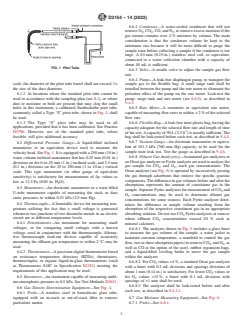
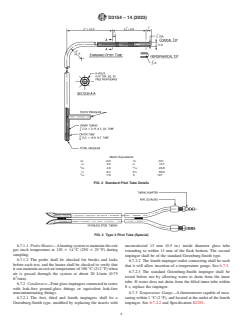
6.1 Pitot Tube, used in conjunction with a suitable
Q = dry volumetric stack gas flow rate corrected
std
3 3 manometer, provides the method for determining the velocity
to standard conditions, dsm /h (dsft /h).
in a duct. The construction of a standard pitot tube and the
R = ideal gas constant, 0.08312 (kPa) (m )/g −
method of connecting it to a draft gauge are shown in Fig. 1.
mol) (K) − (SI system) or 21.85 (in. Hg)
Details are shown in Fig. 2.
(ft )/(lb − mole) (°R) − (inch-pound).
6.1.1 To minimize the stem effect when the physical dimen-
r = radial distance from center of stack to nth
n
sions of the pitot tube are too large with respect to the flow
sampling point, cm (in.).
ρ = density of water, 0.9971 g/mL (0.002194
w
lb/mL) at 25 °C (77 °F).
Colen, P., Corey, R. C., and Meyers, J. W., “Methods and Instrumentation for
S = between laboratory bias, m/s (ft/s).
T Furnace Heat Absorption Studies; Temperature and Composition of Gases at
S = among single laboratory bias, m/s (ft/s). Furnace Outlets,” Transaction of the American Society of Mechanical Engineers,
s
Vol 71, pp. 965–78, 1949.
T = absolute average dry gas meter temperature,
m
Bulletin WP-50, Western Precipitation Division, Joy Manufacturing Co.,
K (°R).
“Methods for Determination of Velocity, Dust, and Mist Content of Gases.”
D3154 − 14 (2023)
6.6.2 Condenser—A water-cooled condenser that will not
remove O , CO , CO, and N , to remove excess moisture if the
2 2 2
gas stream contains over 2 % moisture by volume. The main
consideration is that the condenser volume be kept to the
minimum size because it will be more difficult to purge the
sample train before collecting a sample if the condenser is too
large. A 63-mm (0.25-in.) stainless steel coil, or equivalent,
connected to a water collection chamber with a capacity of
about 40 mL is sufficient.
FIG. 1 Pitot Tube
6.6.3 Valve—A needle valve to adjust the sample gas flow
rate.
6.6.4 Pump—A leak-free diaphragm pump, to transport the
scale, the diameter of the pitot tube barrel shall not exceed ⁄30 sample gas to the flexible bag. A small surge tank shall be
the size of the duct diameter. installed between the pump and the rate meter to eliminate the
6.1.2 At locations where the standard pitot tube cannot be pulsation effect of the pump on the rate meter. Leak-test the
pump, surge tank and rate meter (see 6.6.5), as described in
used in accordance with the sampling plan (see 8.1), or where
dust or moisture or both are present that may clog the small 9.4.3.
holes in this instrument, a calibrated Staubscheibe pitot tube, 6.6.5 Rate Meter—A rotameter or equivalent rate meter,
commonly called a Type “S” pitot tube, shown in Fig. 3, shall capable of measuring flow rates to within 62 % of the selected
be used. flow rate.
6.1.3 The Type “S” pitot tube may be used in all
6.6.6 Flexible Bag—A leak-free inert plastic bag, having the
applications, provided that it has been calibrated. See Practice
capacity adequate for the selected flow rate and length of time
D3796. However, use of the standard pitot tube, where
of the test. A capacity of 90 L (3.2 ft ) is usually sufficient. The
feasible, will give additional accuracy.
bag shall be leak-tested before each test, as described in 9.4.4.
6.6.7 Vacuum Gauge—An electronic manometer, or equiva-
6.2 Differential Pressure Gauge—A liquid-filled inclined
lent of 101.3 kPa (760 mm Hg) capacity, to be used for the
manometer or an equivalent device used to measure the
sample train leak test. Test the gauge as described in 9.4.6.
velocity head. See Fig. 1. It is equipped with a 250 mm (10 in.)
6.6.8 Diluent Gas Analyzer(s)—Automated gas analyzers or
water column inclined manometer that has 0.25 mm (0.01 in.)
an Orsat gas analyzer or Fyrite analyzer are used to analyze the
divisions on the 0-to-25 mm (1 in.) inclined scale, and 2.5 mm
gas sample for CO , and O , stack gas concentrations. The
(0.1 in.) divisions on the 25 to 250-mm (1 to 10-in.) vertical 2 2
Orsat analyzer (see Fig. 5) is operated by successively passing
scale. This type manometer (or other gauge of equivalent
the gas through adsorbents that remove the specific gaseous
sensitivity) is satisfactory for measurements of Δp values as
components. The difference in gas volumes before and after the
low as 12.5 Pa (0.05 in. H O).
absorptions represents the amount of constituent gas in the
6.3 Manometer—An electronic manometer or a water filled
sample. Separate Fyrite analyzers for measurement of CO and
U-tube manometer capable of measuring the stack or duct
O concentrations may be used to determine diluent gas
static pressures to within 0.33 kPa (2.5 mm Hg).
concentrations for some sources. Each Fyrite analyzer deter-
6.4 Thermocouple—A bimetallic device for measuring tem-
mines the difference in sample volume resulting from the
perature utilizing the fact that a small voltage is generated
absorption of the respective constituent gas in an appropriate
whenever two junctions of two dissimilar metals in an electric
absorbing solution. Do not use CO Fyrite analyzers at sources
circuit are at different temperature levels.
where effluent CO concentrations exceed 20 % such as
6.4.1 Potentiometer—An instrument for measuring small
mineral calciners.
voltages, or for comparing small voltages with a known
6.6.8.1 The analyzer shown in Fig. 5 includes a glass buret
voltage, used in conjuncture with the thermocouple. Alterna-
to measure the gas volume of the sample, a water jacket to
tive thermocouple read-out devices capable of accurately
maintain constant temperature, a manifold to control the gas
measuring the effluent gas temperature to within 2 °C may be
flow, two or three absorption pipets (to remove CO , and O , as
2 2
used.
well as CO at the option of the user), rubber expansion bags,
6.4.2 Thermometer—A precision digital thermometer based
and a liquid-filled leveling bottle to move the gas sample
on resistance temperature detectors (RTDs), thermistors,
within the analyzer.
thermocouples, or organic liquid-in-glass thermometers (such
6.6.8.2 For CO values >4 %, a standard Orsat gas analyzer
as Thermometer S18C in Specification E2251) meeting the
with a buret with 0.2 mL divisions and spacings divisions of
requirements of this application may be used.
about 1 mm (0.14 in.) is satisfactory. For lower CO values or
for O values >15 %, a buret with 0.1 mL divisions with
6.5 Barometer—An instrument capable of measuring ambi- 2
spacings of >1 mm shall be used.
ent atmospheric pressure to 0.5 kPa. See Test Methods D3631.
6.6.8.3 The analyzer shall be leak-tested before and after
6.6 Gas Density Determination Equipment—See Fig. 4.
each test, as described in 9.4.2.1.
6.6.1 Probe—A stainless steel or borosilicate glass tube,
6.7 Gas Moisture Measuring Equipment—See Fig. 6.
equipped with an in-stack or out-of-stack filter to remove
particulate matter. 6.7.1 Probe—See 6.6.1.
D3154 − 14 (2023)
Metric Equivalents
in. mm in. mm
1 1
⁄8 3.2 ⁄2 12.7
5 15
⁄32 4.0 ⁄16 23.8
1 1
⁄4 6.4 2 ⁄2 63.5
⁄16 7.9 5 127
FIG. 2 Standard Pitot Tube Details
FIG. 3 Type 3 Pitot Tube (Special)
6.7.1.1 Probe Heater—A heating system to maintain the exit unconstricted 13 mm (0.5 in.) inside diameter glass tube
gas stack temperature at 120 6 14 °C (250 6 25 °F) during extending to within 13 mm of the flask bottom. The second
sampling.
impinger shall be of the standard Greenburg-Smith type.
6.7.1.2 The probe shall be checked for breaks and leaks
6.7.2.2 The fourth impinger outlet connecting shall be such
before each test, and the heater shall be checked to verify that
that it will allow insertion of a temperature gauge. See 6.7.3.
it can maintain an exit air temperature of 100 °C (212 °F) when
6.7.2.3 The standard Greenburg-Smith impinger shall be
air is passed through the system at about 20 L/min (0.75
tested before use by allowing water to drain from the inner
ft /min).
tube. If water does not drain from the filled inner tube within
6.7.2 Condensers—Four glass impingers connected in series
8 s, replace the impinger.
with leak-free ground-glass fittings or equivalent leak-free
6.7.3 Temperature Gauge—A thermometer capable of mea-
noncontaminating fittings.
suring within 1 °C (2 °F), and located at the outlet of the fourth
6.7.2.1 The first, third and fourth impingers shall be a
Greenburg-Smith type, modified by replacing the inserts with impinger. See 6.7.2.2 and Specification E2251.
D3154 − 14 (2023)
6.7.5 Metering System—A metering system, consisting of a
vacuum gauge, leak-free vacuum pump, thermometers, a dry
gas meter, differential pressure gauge and related equipment.
See Test Methods D3685/D3685M for details of this system.
6.7.5.1 The system shall be leak-tested before and after each
test, at both positive and negative pressures, following the
directions in 9.5.4.
6.7.6 Barometer—See 6.5.
6.7.7 Graduated Cylinder or Triple Beam Balance or Both,
to measure the water condensed in the impingers. Accuracy
shall be 61 mL or 61 g. Cylinder shall be Class A, 250 mL,
with ≤2 mL subdivisions.
6.7.8 Stack Gas Temperature Sensor—A thermocouple or
equivalent, to measure stack gas temperature to within 61 °C
(2 °F) when the stack gas is suspected of being saturated or
FIG. 4 Integrated Gas Sampling Train containing water droplets.
7. Reagents and Materials
7.1 Purity of Reagents—Reagent grade chemicals shall be
used in all tests. All reagents shall conform to the specifications
of the Committee on Analytical Reagents of the American
Chemical Society where such specifications are available.
7.2 Purity of Water—Water shall be Type 2 reagent water,
conforming to Specification D1193.
7.3 Alkaline Pyrogallic Acid Reagent, used as O absorp-
tion solution. Mix 40 mL of pyrogallic acid solution (see 7.9)
with 69 mL of KOH solution (see 7.8). Mix just before use. In
cold weather, some KOH may precipitate. If so, add enough
water to redissolve the KOH.
7.4 Confining Solution —Add 200 g of sodium sulfate
(Na SO ) (see 7.11) to 50 mL of concentrated sulfuric acid
2 4
(H SO ) (see 7.12), and add a few drops of methyl orange
2 4
indicator solution (see 7.7). Dilute to 1 L.
7.5 Cuprous Chloride Solution (135 g/L)—Dissolve 180 g
of cuprous chloride (Cu Cl ) in 1 L of concentrated HCl (see
2 2
7.6). Add 330 mL of water, and boil gently in a loosely covered
FIG. 5 Orsat Apparatus flask containing coils of sheet copper until the color disappears.
Cool and transfer to a stock bottle, containing a few pieces of
copper coil or wire. This solution is used for absorbing CO if
elected by the user. Alternatively, the balance of dry gas other
than CO and O may be assumed to have a molecular weight
2 2
of 28.
7.6 Hydrochloric Acid (Concentrated), HCl, sp. gr. 1.19.
7.7 Methyl Orange Indicator Solution—Dissolve 0.1 g of
the sodium salt of para-dimethylaminoazobenzene-sulfonic
acid (methyl orange) in water, and dilute to 100 mL.
7.8 Potassium Hydroxide Solution (355 g/L)—Dissolve 355
g potassium hydroxide (KOH) (cp electrolytic, not purified
ACS Reagent Chemicals, Specifications and Procedures for Reagents and
Standard-Grade Reference Materials, American Chemical Society, Washington,
DC. For suggestions on the testing of reagents not listed by the American Chemical
FIG. 6 Moisture Sampling Train Society, see Analar Standards for Laboratory Chemicals, BDH Ltd., Poole, Dorset,
U.K., and the United States Pharmacopeia and National Formulary, U.S. Pharma-
copeial Convention, Inc. (USPC), Rockville, MD.
6.7.4 Cooling System—An ice bath condenser with crushed
See PTC 19.10-1968. This edition is referenced because the 1981 edition (PTC
ice to contain the impingers and to condense the moisture in the
19.10-1981) does not describe preparation of the Orsat reagents. The PTC also
sample gas stream. describes other solutions that may be used.
D3154 − 14 (2023)
TABLE 1 Minimum Number of Measurements for Rectangular
Ducts
Cross Sectional Area of
Number of Measurements
2 2
Sampling Sites, m (ft )
Less than 0.2 (2) 4
0.2 to 2.3 (2 to 25) 12
Greater than 2.3 (25) 20
FIG. 7 Traverse Positions and Rectangular Flue
with alcohol) in water and dilute to 1 L. If a precipitate forms,
pour off the clear liquid after settling. Keep the solution in a
rubber-stoppered stock bottle. It is used as the CO absorbing
reagent.
7.9 Pyrogallic Acid Solution (740 g/L)—Dissolve 200 g of
white resublimated pyrogallic acid (pyrogallol or 1,2,3-
trihydroxybenzene) in 270 mL of water warm enough to
dissolve the pyrogallic acid. Cool to room temperature, and
FIG. 8 Traverse Positions and Round Flue
transfer to a rubber-stoppered stock bottle.
7.10 Silica Gel—Water-absorbing crystals, indicating.
7.11 Sodium Sulfate (Na SO ).
2 4
stream and two diameters upstream from a flow disturbance is
7.12 Sulfuric Acid (Concentrated), H SO , sp. gr. 1.84. used, increase the number of sampling points as noted in 8.8.
2 4
8.4 When sampling must be done in an irregular-shaped
8. Sampling
duct, divide the duct into equal areas of any shape, and measure
8.1 Selection of Sampling Site—Select a sampling site that is
the parameters at the centroid of each area.
at least eight stack or duct diameters downstream and two
8.5 Increase the number of sampling points when sampling
diameters upstream from any bend, expansion, contraction, or
less than eight diameters downstream and two diameters
visible flame.
upstream from any flow disturbance. When only four to six
8.1.1 If the above is impractical, select a site that comes as
diameters of straight duct are available, double the number of
close as possible to meeting the above conditions.
points used. Sampling sites less than four diameters down-
8.1.2 If there is a possibility of cyclonic or non-linear flow,
stream from any flow disturbance are special cases and each
perform a cyclonic flow test as described in EPA-600/4-77-
case shall be determined on its own merits in the field. Where
027b, Section 3.0.1.
sampling sites are less than two diameters downstream from
8.2 In rectangular ducts, divide the cross-sectional area into
any flow disturbances, reasonable accuracy with pitot tube
equal rectangular subareas as shown in Fig. 7. The number of
measurements cannot be expected and another method for
areas to be used depends on the flow pattern and duct size. Use
stack gas quantitation should be sought.
Table 1 to find the minimum number of areas when sampling
8.6 The velocity distribution shall be uniform throughout
at least eight equivalent diameters downstream and two equiva-
the traverse plane, such that 80 to 90 % of the measurements
lent diameters upstream from the nearest flow disturbance. The
(11.1) are greater than 10 % of the maximum velocity. If less
equivalent diameter is as follows:
than 75 % of the measurements are greater than 10 % of the
2 ~length × width!/~length1width! (1)
maximum velocity, choose an alternate sampling location.
If a site less than eight diameters downstream and two
8.7 The flow stream shall be at a right angle, 610°, to the
diameters upstream from a flow disturbance is used increase
traverse plane.
the number of sampling points in accordance with 8.5.
8.7.1 Determine the angle of the flow stream using a
standard pitot by measuring the orientation of the pitot tube
8.3 In circular stacks or ducts divide the area concentrically
that produces the maximum velocity pressure value. Determine
as shown in Fig. 8. The minimum number of areas to use and
the angle of the flow stream using a S-Type pitot by measuring
the distance to the test point is shown in Table 2 or may be
the orientation of the pitot tube at 90 degrees to the flow
calculated as follows:
direction that produces that produces a null condition (no
2n 2 1
~ !
differential pressure).
r 5 D Π(2)
n s
4N
8.8 If the traverse plane is in the vicinity of a fan, locate it
Conduct traverses across two diameter axes at right angles to to minimize the effects of leakage in the portion of the system
each other. Again, if a site less than eight diameters down- located between the fan and the traverse point.
D3154 − 14 (2023)
TABLE 2 Location of Traverse Points in Circular Stacks
(Percent of Stack Diameter From Inside Wall to Traverse Point)
Traverse Point Number
Number of Traverse Points on a Diameter
on a Diameter
2 4 6 8 10 12 14 16 18 20 22 24
1 14.6 6.7 4.4 3.2 2.6 2.1 1.8 1.6 1.4 1.3 1.1 1.1
2 85.4 25.0 14.6 10.5 8.2 6.7 5.7 4.9 4.4 3.9 3.5 3.2
3 . 75.0 29.6 19.4 14.6 11.8 9.9 8.5 7.5 6.7 6.0 5.5
4 . 73.3 70.4 32.3 22.6 17.7 14.6 12.5 10.9 9.7 8.7 7.9
5 . . 85.4 67.7 34.2 25.0 20.1 16.9 14.6 12.9 11.6 10.5
6 . . 95.6 80.6 65.8 35.6 26.9 22.0 18.8 16.5 14.6 13.2
7 . . . 89.5 77.4 64.4 36.6 28.3 23.6 20.4 18.0 16.1
8 . . . 96.8 85.4 75.0 63.4 37.5 29.6 25.0 21.6 19.4
9 . . . . 91.8 82.3 73.1 62.5 38.6 30.6 26.2 23.0
10 . . . . 97.4 88.2 79.9 71.7 61.8 38.9 31.5 27.2
11 . . . . . 93.3 85.3 78.0 70.4 61.2 39.3 32.3
12 . . . . . 97.9 90.1 83.1 76.4 69.4 60.7 39.8
13 . . . . . . 94.3 87.5 81.2 75.0 68.5 60.2
14 . . . . . . 98.2 91.5 85.4 79.6 73.8 67.7
15 . . . . . . . 95.1 89.1 83.5 78.2 72.8
16 . . . . . . . 98.4 92.5 87.1 82.0 77.0
17 . . . . . . . . 95.6 90.3 85.4 80.6
18 . . . . . . . . 98.6 93.3 88.4 83.9
19 . . . . . . . . . 96.1 91.3 86.8
20 . . . . . . . . . 98.7 94.0 89.5
21 . . . . . . . . . . 96.5 92.1
22 . . . . . . . . . . 98
...