

ASTM D6560-22
(Test Method)Standard Test Method for Determination of Asphaltenes (Heptane Insolubles) in Crude Petroleum and Petroleum Products
General Information
- Abstract
SIGNIFICANCE AND USE
5.1 Asphaltenes are the organic molecules of highest molecular mass and carbon-hydrogen ratio normally occurring in crude petroleum and petroleum products containing residual material. They may give problems during storage and handling if the suspension of asphaltene molecules is disturbed through excess stress or incompatibility. They are also the last molecules in a product to combust completely, and thus may be one indicator of black smoke propensity. Their composition normally includes a disproportionately high quantity of the sulfur, nitrogen, and metals present in the crude petroleum or petroleum product.
SCOPE
1.1 This test method covers a procedure for the determination of the heptane insoluble asphaltene content of gas oil, diesel fuel, residual fuel oils, lubricating oil, bitumen, and crude petroleum that has been topped to an oil temperature of 260 °C (see A1.2.1.1).
1.2 The precision is applicable to values between 0.50 % m/m and 30.0 % m/m. Values outside this range may still be valid but may not give the same precision values.
1.3 Oils containing additives may give erroneous results.
1.4 The values stated in SI units are to be regarded as standard. No other units of measurement are included in this standard.
1.5 This standard does not purport to address all of the safety concerns, if any, associated with its use. It is the responsibility of the user of this standard to establish appropriate safety, health, and environmental practices and determine the applicability of regulatory limitations prior to use.
1.6 This international standard was developed in accordance with internationally recognized principles on standardization established in the Decision on Principles for the Development of International Standards, Guides and Recommendations issued by the World Trade Organization Technical Barriers to Trade (TBT) Committee.
- Status
- Published
- Publication Date
- 31-May-2022
- Technical Committee
- D02 - Petroleum Products, Liquid Fuels, and Lubricants
- Drafting Committee
- D02.14 - Stability, Cleanliness and Compatibility of Liquid Fuels
Buy Documents
ASTM D6560-22 - Standard Test Method for Determination of Asphaltenes (Heptane Insolubles) in Crude Petroleum and Petroleum Products
REDLINE ASTM D6560-22 - Standard Test Method for Determination of Asphaltenes (Heptane Insolubles) in Crude Petroleum and Petroleum Products
Overview
ASTM D6560-22: Standard Test Method for Determination of Asphaltenes (Heptane Insolubles) in Crude Petroleum and Petroleum Products provides a widely recognized laboratory procedure for quantifying the asphaltene content of petroleum samples. Asphaltenes are high-molecular-weight organic molecules found in crude oil and residual petroleum products. Their tendency to precipitate under certain conditions can cause significant operational challenges in processing, storage, and handling. This standardized test method enables reliable evaluation of asphaltenes, supporting quality control, process optimization, and compliance in petroleum refining, blending, and product certification.
Key Topics
Asphaltene Determination: Measures the concentration of heptane-insoluble asphaltenes in products such as gas oil, diesel fuel, residual fuel oils, lubricating oil, bitumen, and crude petroleum (topped to 260 °C). The method is applicable to asphaltene contents ranging from 0.50% to 30.0% by mass.
Test Method Summary: The procedure involves mixing a test portion with heptane, collecting the precipitated asphaltenes and removing waxy and inorganic materials through extraction and filtration. The purified asphaltenes are then dissolved in hot toluene and weighed after solvent removal.
Operational Considerations:
- Testing should be performed on samples without additive content, as additives may interfere with results.
- Results are reported in SI units exclusively.
- Precision data apply primarily within the stated concentration range.
- Comprehensive safety and environmental precautions must be considered during testing and handling of solvents.
Significance:
- Asphaltenes contain high levels of sulfur, nitrogen, and metals, impacting combustion characteristics and operational reliability.
- Accurate measurement helps assess stability, compatibility, and fouling risks for crude oils and fuels.
- The parameter is a key indicator for black smoke propensity during combustion.
Applications
ASTM D6560-22 is essential for:
Crude Oil Characterization: Determining asphaltene content in crude aids in predicting refining behavior, fouling tendency, and downstream processing decisions.
Petroleum Product Quality Control: Ensures that products like diesel fuel, lubricating oil, and residua comply with specifications regarding asphaltene content, thus reducing risks of deposit formation and combustion problems.
Process Troubleshooting: Identifies the root cause of storage, transport, and fouling issues linked to asphaltene instability.
Bitumen Analysis: Supports pavement and waterproofing industries by allowing consistent assessment of the asphaltene fraction in bitumen.
Regulatory Compliance: Assists in meeting national and international standards for fuel performance and environmental impact.
Related Standards
Several ASTM standards are referenced or commonly used alongside ASTM D6560-22:
- ASTM D86: Test Method for Distillation of Petroleum Products and Liquid Fuels at Atmospheric Pressure
- ASTM D1298: Test Method for Density, Relative Density, or API Gravity of Crude Petroleum and Liquid Petroleum Products by Hydrometer Method
- ASTM D4052: Test Method for Density, Relative Density, and API Gravity of Liquids by Digital Density Meter
- ASTM D4057: Practice for Manual Sampling of Petroleum and Petroleum Products
- ASTM D4175: Terminology Relating to Petroleum Products, Liquid Fuels, and Lubricants
- ASTM D4177: Practice for Automatic Sampling of Petroleum and Petroleum Products
ASTM D6560-22 aligns with internationally recognized principles for standardization, supporting harmonized quality assurance and process control within the global petroleum industry.
Keywords: ASTM D6560-22, asphaltene determination, heptane insolubles, crude petroleum, petroleum products, fuel oil, diesel, bitumen, lubricating oil, standard test method, quality control, petroleum refining, sample preparation, international standards.
Relations
- Refers
ASTM D4175-23a - Standard Terminology Relating to Petroleum Products, Liquid Fuels, and Lubricants - Effective Date
- 15-Dec-2023
- Effective Date
- 01-Dec-2023
- Effective Date
- 01-Dec-2023
- Refers
ASTM D4175-23e1 - Standard Terminology Relating to Petroleum Products, Liquid Fuels, and Lubricants - Effective Date
- 01-Jul-2023
- Effective Date
- 01-Jul-2016
- Effective Date
- 15-May-2012
- Effective Date
- 01-Apr-2012
- Refers
ASTM D86-11b - Standard Test Method for Distillation of Petroleum Products at Atmospheric Pressure - Effective Date
- 01-Dec-2011
- Refers
ASTM D4057-06(2011) - Standard Practice for Manual Sampling of Petroleum and Petroleum Products - Effective Date
- 01-Jun-2011
- Refers
ASTM D86-09 - Standard Test Method for Distillation of Petroleum Products at Atmospheric Pressure - Effective Date
- 15-Apr-2009
- Refers
ASTM D86-08a - Standard Test Method for Distillation of Petroleum Products at Atmospheric Pressure - Effective Date
- 15-Dec-2008
- Refers
ASTM D86-08 - Standard Test Method for Distillation of Petroleum Products at Atmospheric Pressure - Effective Date
- 15-Nov-2008
- Refers
ASTM D86-07b - Standard Test Method for Distillation of Petroleum Products at Atmospheric Pressure - Effective Date
- 15-Nov-2007
- Refers
ASTM D86-07a - Standard Test Method for Distillation of Petroleum Products at Atmospheric Pressure - Effective Date
- 01-Apr-2007
- Refers
ASTM D86-07 - Standard Test Method for Distillation of Petroleum Products at Atmospheric Pressure - Effective Date
- 15-Jan-2007
Buy Documents
ASTM D6560-22 - Standard Test Method for Determination of Asphaltenes (Heptane Insolubles) in Crude Petroleum and Petroleum Products
REDLINE ASTM D6560-22 - Standard Test Method for Determination of Asphaltenes (Heptane Insolubles) in Crude Petroleum and Petroleum Products
Get Certified
Connect with accredited certification bodies for this standard

Element Materials Technology
Materials testing and product certification.

ABS Group Brazil
ABS Group certification services in Brazil.

ABS Quality Evaluations Inc.
American Bureau of Shipping quality certification.
Sponsored listings
Frequently Asked Questions
ASTM D6560-22 is a standard published by ASTM International. Its full title is "Standard Test Method for Determination of Asphaltenes (Heptane Insolubles) in Crude Petroleum and Petroleum Products". This standard covers: SIGNIFICANCE AND USE 5.1 Asphaltenes are the organic molecules of highest molecular mass and carbon-hydrogen ratio normally occurring in crude petroleum and petroleum products containing residual material. They may give problems during storage and handling if the suspension of asphaltene molecules is disturbed through excess stress or incompatibility. They are also the last molecules in a product to combust completely, and thus may be one indicator of black smoke propensity. Their composition normally includes a disproportionately high quantity of the sulfur, nitrogen, and metals present in the crude petroleum or petroleum product. SCOPE 1.1 This test method covers a procedure for the determination of the heptane insoluble asphaltene content of gas oil, diesel fuel, residual fuel oils, lubricating oil, bitumen, and crude petroleum that has been topped to an oil temperature of 260 °C (see A1.2.1.1). 1.2 The precision is applicable to values between 0.50 % m/m and 30.0 % m/m. Values outside this range may still be valid but may not give the same precision values. 1.3 Oils containing additives may give erroneous results. 1.4 The values stated in SI units are to be regarded as standard. No other units of measurement are included in this standard. 1.5 This standard does not purport to address all of the safety concerns, if any, associated with its use. It is the responsibility of the user of this standard to establish appropriate safety, health, and environmental practices and determine the applicability of regulatory limitations prior to use. 1.6 This international standard was developed in accordance with internationally recognized principles on standardization established in the Decision on Principles for the Development of International Standards, Guides and Recommendations issued by the World Trade Organization Technical Barriers to Trade (TBT) Committee.
SIGNIFICANCE AND USE 5.1 Asphaltenes are the organic molecules of highest molecular mass and carbon-hydrogen ratio normally occurring in crude petroleum and petroleum products containing residual material. They may give problems during storage and handling if the suspension of asphaltene molecules is disturbed through excess stress or incompatibility. They are also the last molecules in a product to combust completely, and thus may be one indicator of black smoke propensity. Their composition normally includes a disproportionately high quantity of the sulfur, nitrogen, and metals present in the crude petroleum or petroleum product. SCOPE 1.1 This test method covers a procedure for the determination of the heptane insoluble asphaltene content of gas oil, diesel fuel, residual fuel oils, lubricating oil, bitumen, and crude petroleum that has been topped to an oil temperature of 260 °C (see A1.2.1.1). 1.2 The precision is applicable to values between 0.50 % m/m and 30.0 % m/m. Values outside this range may still be valid but may not give the same precision values. 1.3 Oils containing additives may give erroneous results. 1.4 The values stated in SI units are to be regarded as standard. No other units of measurement are included in this standard. 1.5 This standard does not purport to address all of the safety concerns, if any, associated with its use. It is the responsibility of the user of this standard to establish appropriate safety, health, and environmental practices and determine the applicability of regulatory limitations prior to use. 1.6 This international standard was developed in accordance with internationally recognized principles on standardization established in the Decision on Principles for the Development of International Standards, Guides and Recommendations issued by the World Trade Organization Technical Barriers to Trade (TBT) Committee.
ASTM D6560-22 is classified under the following ICS (International Classification for Standards) categories: 75.040 - Crude petroleum; 75.080 - Petroleum products in general. The ICS classification helps identify the subject area and facilitates finding related standards.
ASTM D6560-22 has the following relationships with other standards: It is inter standard links to ASTM D4175-23a, ASTM D86-23ae1, ASTM D86-23a, ASTM D4175-23e1, ASTM D86-16, ASTM D1298-12a, ASTM D1298-12, ASTM D86-11b, ASTM D4057-06(2011), ASTM D86-09, ASTM D86-08a, ASTM D86-08, ASTM D86-07b, ASTM D86-07a, ASTM D86-07. Understanding these relationships helps ensure you are using the most current and applicable version of the standard.
ASTM D6560-22 is available in PDF format for immediate download after purchase. The document can be added to your cart and obtained through the secure checkout process. Digital delivery ensures instant access to the complete standard document.
Standards Content (Sample)
This international standard was developed in accordance with internationally recognized principles on standardization established in the Decision on Principles for the
Development of International Standards, Guides and Recommendations issued by the World Trade Organization Technical Barriers to Trade (TBT) Committee.
Designation: D6560 −22
Designation: IP 143⁄21
Standard Test Method for
Determination of Asphaltenes (Heptane Insolubles) in Crude
1,2
Petroleum and Petroleum Products
This standard is issued under the fixed designation D6560; the number immediately following the designation indicates the year of
original adoption or, in the case of revision, the year of last revision.Anumber in parentheses indicates the year of last reapproval.A
superscript epsilon (´) indicates an editorial change since the last revision or reapproval.
1. Scope* 2. Referenced Documents
1.1 This test method covers a procedure for the determina-
2.1 ASTM Standards:
tion of the heptane insoluble asphaltene content of gas oil,
D86Test Method for Distillation of Petroleum Products and
diesel fuel, residual fuel oils, lubricating oil, bitumen, and
Liquid Fuels at Atmospheric Pressure
crude petroleum that has been topped to an oil temperature of
D1298Test Method for Density, Relative Density, or API
260°C (see A1.2.1.1).
Gravity of Crude Petroleum and Liquid Petroleum Prod-
ucts by Hydrometer Method
1.2 The precision is applicable to values between
D4052Test Method for Density, Relative Density, and API
0.50%m⁄m and 30.0%m⁄m. Values outside this range may
Gravity of Liquids by Digital Density Meter
still be valid but may not give the same precision values.
D4057Practice for Manual Sampling of Petroleum and
1.3 Oils containing additives may give erroneous results.
Petroleum Products
D4175Terminology Relating to Petroleum Products, Liquid
1.4 The values stated in SI units are to be regarded as
Fuels, and Lubricants
standard. No other units of measurement are included in this
D4177Practice for Automatic Sampling of Petroleum and
standard.
Petroleum Products
1.5 This standard does not purport to address all of the
2.2 Energy Institute Standard:
safety concerns, if any, associated with its use. It is the
Specifications for IP Standard Thermometers
responsibility of the user of this standard to establish appro-
priate safety, health, and environmental practices and deter-
3. Terminology
mine the applicability of regulatory limitations prior to use.
1.6 This international standard was developed in accor-
3.1 Definitions:
dance with internationally recognized principles on standard-
3.1.1 For definitions of terms used in this test method, refer
ization established in the Decision on Principles for the
to Terminology D4175.
Development of International Standards, Guides and Recom-
3.1.2 asphaltenes, n—(rarely used in the singular) — in
mendations issued by the World Trade Organization Technical
petroleum technology, represent an oil fraction that is soluble
Barriers to Trade (TBT) Committee.
in a specified aromatic solvent but separates upon addition of
an excess of a specified paraffinic solvent.
3.1.2.1 Discussion—In this test method, the aromatic sol-
This test method is under the jurisdiction of ASTM International Committee
vent is hot toluene and the paraffinic solvent is heptane.
D02 on Petroleum Products, Liquid Fuels, and Lubricants and is the direct
3.1.2.2 Discussion—Historically, benzene was the aromatic
responsibility of ASTM Subcommittee D02.14 on Stability, Cleanliness and
Compatibility of Liquid Fuels. The technically equivalent standard as referenced is
solvent, but benzene is not typically used now for health
under the jurisdiction of the Energy Institute Subcommittee SC-B-5.
reasons. The precision of this test method when using toluene
CurrenteditionapprovedJune1,2022.PublishedJuly2022.Originallyapproved
has been found to be the same as when using benzene.
in 2000. Last previous edition approved in 2017 as D6560–17. DOI: 10.1520/
D6560-22.
This standard is based on material published in the IP Standard methods for
Analysis and Testing of Petroleum and Related Products and British Standard 2000
Parts, copyright Energy Institute, 61 New Cavendish Street, London, W1M 8AR. For referenced ASTM standards, visit the ASTM website, www.astm.org, or
Adapted with permission of Energy Institute. contact ASTM Customer Service at service@astm.org. For Annual Book of ASTM
This test method has been developed through the cooperative effort between Standards volume information, refer to the standard’s Document Summary page on
ASTMandtheEnergyInstitute,London.ASTMandIPstandardswereapprovedby the ASTM website.
ASTMandEItechnicalcommitteesasbeingtechnicallyequivalentbutthatdoesnot Available from Energy Institute, 61 New Cavendish St., London, WIM 8AR,
imply both standards are identical. UK.
*A Summary of Changes section appears at the end of this standard
Copyright © ASTM International, 100 Barr Harbor Drive, PO Box C700, West Conshohocken, PA 19428-2959. United States
D6560 − 22
4. Summary of Test Method
4.1 A test portion of the sample is mixed with heptane and
the mixture heated under reflux, and the precipitated
asphaltenes, waxy substances, and inorganic material are
collected on a filter paper. The waxy substances are removed
by washing with hot heptane in an extractor.
4.2 After removal of the waxy substances, the asphaltenes
are separated from the inorganic material by dissolution in hot
toluene, the extraction solvent is evaporated, and the as-
phaltenes weighed.
5. Significance and Use
5.1 Asphaltenes are the organic molecules of highest mo-
lecular mass and carbon-hydrogen ratio normally occurring in
crude petroleum and petroleum products containing residual
material.Theymaygiveproblemsduringstorageandhandling
if the suspension of asphaltene molecules is disturbed through
excess stress or incompatibility. They are also the last mol-
ecules in a product to combust completely, and thus may be
one indicator of black smoke propensity. Their composition
normally includes a disproportionately high quantity of the
sulfur, nitrogen, and metals present in the crude petroleum or
petroleum product.
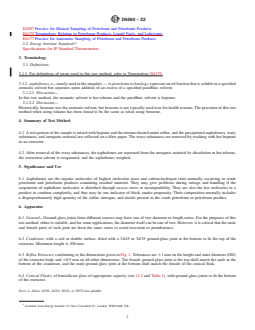
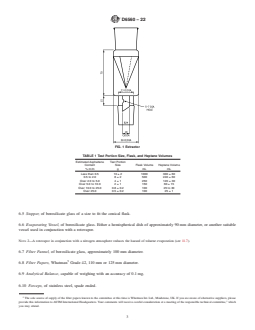
FIG. 1 Extractor
6. Apparatus
TABLE 1 Test Portion Size, Flask, and Heptane Volumes
6.1 General—Ground-glass joints from different sources
Estimated Asphaltene Test Portion
may have one of two diameter to length ratios. For the
Content Size Flask Volume Heptane Volume
purposes of this test method, either is suitable, and for some
%m/m g mL mL
applications, the diameter itself can be one of two. However, it
Less than 0.5 10 ± 2 1000 300 ± 60
0.5to2.0 8±2 500 240±60
is critical that the male and female parts of each joint are from
Over 2.0 to 5.0 4 ± 1 250 120 ± 30
the same series to avoid recession or protuberance.
Over 5.0 to 10.0 2 ± 1 150 60 ± 15
Over 10.0 to 25.0 0.8 ± 0.2 100 25 to 30
6.2 Condenser, with a coil or double surface, fitted with a
Over 25.0 0.5 ± 0.2 100 25 ± 1
34/45or34/35ground-glassjointatthebottomtofitthetopof
the extractor. Minimum length is 300mm.
6.3 Reflux Extractor,conformingtothedimensionsgivenin
6.8 Filter Papers,Whatman Grade42,110mmor125mm
Fig.1.Tolerancesare 61mmontheheightandouterdiameter
diameter.
(OD) of the extractor body and 60.5mm on all other dimen-
6.9 Analytical Balance, capable of weighing with an accu-
sions. The female ground-glass joint at the top shall match the
racy of 0.1mg.
maleatthebottomofthecondenser,andthemaleground-glass
joint at the bottom shall match the female of the conical flask.
6.10 Forceps, of stainless steel, spade ended.
6.4 Conical Flasks, of borosilicate glass of appropriate
6.11 Timing Device, electronic or manual, accurate to 1.0s.
capacity (see 11.2 and Table 1), with ground-glass joints to fit
6.12 Oven, capable of maintaining a temperature from
the bottom of the extractor.
100°C to 110°C.
NOTE 1—Sizes 24/39, 24/29, 29/43, or 29/32 are suitable.
6.13 Graduated Cylinders, of 50mL and 100mL capacity.
6.5 Stopper, of borosilicate glass of a size to fit the conical
6.14 Stirring Rods, of glass or polytetrafluoroethylene
flask.
(PTFE), 150mm by 3mm diameter.
6.6 Evaporating Vessel, of borosilicate glass. Either a hemi- 6.15 Cooling Vessel, consisting of either a dessicator with-
spherical dish of approximately 90mm diameter, or another out desiccant, or another suitable tightly-stoppered vessel.
suitable vessel used in conjunction with a rotovapor.
NOTE 2—A rotovapor in conjunction with a nitrogen atmosphere
The sole source of supply of the filter papers known to the committee at this
reduces the hazard of toluene evaporation (see 11.7).
timeisWhatmanInt.Ltd.,Maidstone,UK.Ifyouareawareofalternativesuppliers,
please provide this information to ASTM International Headquarters. Your com-
6.7 Filter Funnel, of borosilicate glass, approximately
ments will receive careful consideration at a meeting of the responsible technical
100mm diameter. committee, which you may attend.
D6560 − 22
6.16 Mixer, high-speed, nonaerating. expected asphaltene content of above 25%m⁄m, a minimum
heptane volume of 25mL shall be used (see Table 1).
7. Reagents
11.3 Boil the mixture under reflux for 60min 6 5min.
7.1 Toluene (methylbenzene) [C H CH ], analytical reagent
Remove the flask and contents at the end of this period, cool,
6 5 3
or nitration grade.
close with a stopper (see 6.5), and store in a dark cupboard for
90min to 150min, calculated from the time of removal from
7.2 Heptane [C H ], analytical reagent grade.
7 16
reflux.
8. Sampling
11.4 Place the filter paper, folded as shown in Fig. 2 (so as
to prevent loss of asphaltenes by creeping), in the filter funnel,
8.1 Unless otherwise specified, take samples by the proce-
using forceps. Thereafter, handle the filter paper only with
dures described in Practice D4057 or D4177.
forceps. Without agitation, decant the liquid into the filter
paper, and then transfer the residue in the flask as completely
9. Test Portion Preparation
as possible with successive quantities of hot heptane, using the
9.1 Test portions from the laboratory samples shall be
stirring rod (see 6.14) as necessary. Give the flask a final rinse
drawn after thorough mixing and subdivision. Heat viscous
with hot heptane, and pour the rinsings through the filter. Set
samples of residual fuels to a temperature that renders the
the flask aside, without washing, for use as specified in 11.6.
sampleliquid,butnotabove80°C,andhomogenize,usingthe
11.5 Remove the filter paper and contents from the funnel,
mixer (see 6.16) as necessary.
and place in the reflux extractor (see 6.3). Using a flask
9.2 Heat samples of penetration grade bitumens to a tem-
different from that used initially, reflux with heptane (see 7.2)
perature not exceeding 120°C, and stir well before taking an
atarateof2drops⁄sto4drops⁄sfromtheendofthecondenser
aliquot.
for an extraction period of not less than 60min, or until a few
9.3 Samples of hard bitumens shall be ground to a powder
drops of heptane from the bottom of the extractor leave no
before an aliquot is taken.
residue on evaporation on a glass slide.
9.4 Samples of crude petroleum shall be prepared in accor-
11.6 Replacetheflaskbytheoneusedinitially,andtowhich
dance with the procedure described in the AnnexA1, unless it
has been added 30mL to 60mL of toluene (see 7.1), and
is known that the crude petroleum contains negligible quanti-
continuerefluxinguntilalltheasphalteneshavebeendissolved
ties of material boiling below 80°C.
from the paper.
11.7 Transferthecontentsoftheflasktoacleananddry(see
10. Apparatus Preparation
Section10)evaporatingvessel(see6.6),weighedtothenearest
10.1 Clean all glass flasks (see 6.4) and dishes (see 6.6)by
0.2mg by tare against a similar dish. Wash out the flask with
a means that matches the cleanliness obtained by the use of a
successive small quantities of toluene to a total not exceeding
strongly oxidizing agent, such as ammonium peroxydisulfate
30mL. Remove the toluene by evaporation on a boiling water
in concentrated sulfuric acid at approximately 8g⁄L, or sulfu-
bath, or by evaporation in a rotovapor under an atmosphere of
ric acid itself, soaking for at least 12h, followed by rinses in
nitrogen. (Warning—Perform the evaporation in a fume
tap water, distilled water, and the acetone, using forceps only
hood.)
for handling. Strong oxidizing acid cleaning solutions are
11.8 Dry the dish and
...
This document is not an ASTM standard and is intended only to provide the user of an ASTM standard an indication of what changes have been made to the previous version. Because
it may not be technically possible to adequately depict all changes accurately, ASTM recommends that users consult prior editions as appropriate. In all cases only the current version
of the standard as published by ASTM is to be considered the official document.
Designation: D6560 − 17 D6560 − 22
Designation: IP 143 ⁄01⁄21
Standard Test Method for
Determination of Asphaltenes (Heptane Insolubles) in Crude
1,2
Petroleum and Petroleum Products
This standard is issued under the fixed designation D6560; the number immediately following the designation indicates the year of
original adoption or, in the case of revision, the year of last revision. A number in parentheses indicates the year of last reapproval. A
superscript epsilon (´) indicates an editorial change since the last revision or reapproval.
1. Scope*
1.1 This test method covers a procedure for the determination of the heptane insoluble asphaltene content of gas oil, diesel fuel,
residual fuel oils, lubricating oil, bitumen, and crude petroleum that has been topped to an oil temperature of 260 °C (see A1.2.1.1).
1.2 The precision is applicable to values between 0.50 % m ⁄m and 30.0 % m ⁄m. Values outside this range may still be valid but
may not give the same precision values.
1.3 Oils containing additives may give erroneous results.
1.4 The values stated in SI units are to be regarded as standard. No other units of measurement are included in this standard.
1.5 This standard does not purport to address all of the safety concerns, if any, associated with its use. It is the responsibility
of the user of this standard to establish appropriate safety, health, and environmental practices and determine the applicability of
regulatory limitations prior to use.
1.6 This international standard was developed in accordance with internationally recognized principles on standardization
established in the Decision on Principles for the Development of International Standards, Guides and Recommendations issued
by the World Trade Organization Technical Barriers to Trade (TBT) Committee.
2. Referenced Documents
2.1 ASTM Standards:
D86 Test Method for Distillation of Petroleum Products and Liquid Fuels at Atmospheric Pressure
D1298 Test Method for Density, Relative Density, or API Gravity of Crude Petroleum and Liquid Petroleum Products by
Hydrometer Method
D4052 Test Method for Density, Relative Density, and API Gravity of Liquids by Digital Density Meter
This test method is under the jurisdiction of ASTM International Committee D02 on Petroleum Products, Liquid Fuels, and Lubricants and is the direct responsibility
of ASTM Subcommittee D02.14 on Stability, Cleanliness and Compatibility of Liquid Fuels. The technically equivalent standard as referenced is under the jurisdiction of
the Energy Institute Subcommittee SC-B-5.
Current edition approved Dec. 1, 2017June 1, 2022. Published March 2018July 2022. Originally approved in 2000. Last previous edition approved in 20122017 as
D6560 – 12.D6560 – 17. DOI: 10.1520/D6560-17.10.1520/D6560-22.
This standard is based on material published in the IP Standard methods for Analysis and Testing of Petroleum and Related Products and British Standard 2000 Parts,
copyright Energy Institute, 61 New Cavendish Street, London, W1M 8AR. Adapted with permission of Energy Institute.
This test method has been developed through the cooperative effort between ASTM and the Energy Institute, London. ASTM and IP standards were approved by ASTM
and EI technical committees as being technically equivalent but that does not imply both standards are identical.
For referenced ASTM standards, visit the ASTM website, www.astm.org, or contact ASTM Customer Service at service@astm.org. For Annual Book of ASTM Standards
volume information, refer to the standard’s Document Summary page on the ASTM website.
*A Summary of Changes section appears at the end of this standard
Copyright © ASTM International, 100 Barr Harbor Drive, PO Box C700, West Conshohocken, PA 19428-2959. United States
D6560 − 22
D4057 Practice for Manual Sampling of Petroleum and Petroleum Products
D4175 Terminology Relating to Petroleum Products, Liquid Fuels, and Lubricants
D4177 Practice for Automatic Sampling of Petroleum and Petroleum Products
2.2 Energy Institute Standard:
Specifications for IP Standard Thermometers
3. Terminology
3.1 Definitions:
3.1.1 For definitions of terms used in this test method, refer to Terminology D4175.
3.1.2 asphaltenes, n—(rarely used in the singular) — in petroleum technology, represent an oil fraction that is soluble in a specified
aromatic solvent but separates upon addition of an excess of a specified paraffinic solvent.
3.1.2.1 Discussion—
In this test method, the aromatic solvent is hot toluene and the paraffinic solvent is heptane.
3.1.2.2 Discussion—
Historically, benzene was the aromatic solvent, but benzene is not typically used now for health reasons. The precision of this test
method when using toluene has been found to be the same as when using benzene.
4. Summary of Test Method
4.1 A test portion of the sample is mixed with heptane and the mixture heated under reflux, and the precipitated asphaltenes, waxy
substances, and inorganic material are collected on a filter paper. The waxy substances are removed by washing with hot heptane
in an extractor.
4.2 After removal of the waxy substances, the asphaltenes are separated from the inorganic material by dissolution in hot toluene,
the extraction solvent is evaporated, and the asphaltenes weighed.
5. Significance and Use
5.1 Asphaltenes are the organic molecules of highest molecular mass and carbon-hydrogen ratio normally occurring in crude
petroleum and petroleum products containing residual material. They may give problems during storage and handling if the
suspension of asphaltene molecules is disturbed through excess stress or incompatibility. They are also the last molecules in a
product to combust completely, and thus may be one indicator of black smoke propensity. Their composition normally includes
a disproportionately high quantity of the sulfur, nitrogen, and metals present in the crude petroleum or petroleum product.
6. Apparatus
6.1 General—Ground-glass joints from different sources may have one of two diameter to length ratios. For the purposes of this
test method, either is suitable, and for some applications, the diameter itself can be one of two. However, it is critical that the male
and female parts of each joint are from the same series to avoid recession or protuberance.
6.2 Condenser, with a coil or double surface, fitted with a 34/45 or 34/35 ground-glass joint at the bottom to fit the top of the
extractor. Minimum length is 300 mm.
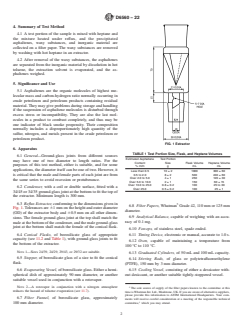
6.3 Reflux Extractor, conforming to the dimensions given in Fig. 1. Tolerances are 61 mm on the height and outer diameter (OD)
of the extractor body and 60.5 mm on all other dimensions. The female ground-glass joint at the top shall match the male at the
bottom of the condenser, and the male ground-glass joint at the bottom shall match the female of the conical flask.
6.4 Conical Flasks, of borosilicate glass of appropriate capacity (see 11.2 and Table 1), with ground-glass joints to fit the bottom
of the extractor.
NOTE 1—Sizes 24/39, 24/29, 29/43, or 29/32 are suitable.
Available from Energy Institute, 61 New Cavendish St., London, WIM 8AR, UK.
D6560 − 22
FIG. 1 Extractor
TABLE 1 Test Portion Size, Flask, and Heptane Volumes
Estimated Asphaltene Test Portion
Content Size Flask Volume Heptane Volume
% m/m g mL mL
Less than 0.5 10 ± 2 1000 300 ± 60
0.5 to 2.0 8 ± 2 500 240 ± 60
Over 2.0 to 5.0 4 ± 1 250 120 ± 30
Over 5.0 to 10.0 2 ± 1 150 60 ± 15
Over 10.0 to 25.0 0.8 ± 0.2 100 25 to 30
Over 25.0 0.5 ± 0.2 100 25 ± 1
6.5 Stopper, of borosilicate glass of a size to fit the conical flask.
6.6 Evaporating Vessel, of borosilicate glass. Either a hemispherical dish of approximately 90 mm diameter, or another suitable
vessel used in conjunction with a rotovapor.
NOTE 2—A rotovapor in conjunction with a nitrogen atmosphere reduces the hazard of toluene evaporation (see 11.7).
6.7 Filter Funnel, of borosilicate glass, approximately 100 mm diameter.
6.8 Filter Papers, Whatman Grade 42, 110 mm or 125 mm diameter.
6.9 Analytical Balance, capable of weighing with an accuracy of 0.1 mg.
6.10 Forceps, of stainless steel, spade ended.
The sole source of supply of the filter papers known to the committee at this time is Whatman Int. Ltd., Maidstone, UK. If you are aware of alternative suppliers, please
provide this information to ASTM International Headquarters. Your comments will receive careful consideration at a meeting of the responsible technical committee, which
you may attend.
D6560 − 22
6.11 Timing Device, electronic or manual, accurate to 1.0 s.
6.12 Oven, capable of maintaining a temperature from 100 °C to 110 °C.
6.13 Graduated Cylinders, of 50 mL and 100 mL capacity.
6.14 Stirring Rods, of glass or polytetrafluoroethylene (PTFE), 150 mm by 3 mm diameter.
6.15 Cooling Vessel, consisting of either a dessicator without desiccant, or another suitable tightly-stoppered vessel.
6.16 Mixer, high-speed, nonaerating.
7. Reagents
7.1 Toluene (methylbenzene) [C H CH ], analytical reagent or nitration grade.
6 5 3
7.2 Heptane [C H ], analytical reagent grade.
7 16
8. Sampling
8.1 Unless otherwise specified, take samples by the procedures described in Practice D4057 or D4177.
9. Test Portion Preparation
9.1 Test portions from the laboratory samples shall be drawn after thorough mixing and subdivision. Heat viscous samples of
residual fuels to a temperature that renders the sample liquid, but not above 80 °C, and homogenize, using the mixer (see 6.16)
as necessary.
9.2 Heat samples of penetration grade bitumens to a temperature not exceeding 120 °C, and stir well before taking an aliquot.
9.3 Samples of hard bitumens shall be ground to a powder before an aliquot is taken.
9.4 Samples of crude petroleum shall be prepared in accordance with the procedure described in the Annex A1, unless it is known
that the crude petroleum contains negligible quantities of material boiling below 80 °C.
10. Apparatus Preparation
10.1 Clean all glass flasks (see 6.4) and dishes (see 6.6) by a means that matches the cleanliness obtained by the use of a strongly
oxidizing agent, such as ammonium peroxydisulfate in concentrated sulfuric acid at approximately 8 g ⁄L, or sulfuric acid itself,
soaking for at least 12 h, followed by rinses in tap water, distilled water, and the acetone, using forceps only for handling. Strong
oxidizing acid cleaning solutions are highly corrosive and potentially hazardous in contact with organic materials.
10.2 For routine analysis, use a proprietary laboratory detergent to clean the glassware, followed by the rinses described in 10.1.
When the detergent cleaning no longer matches the cleanliness required based on visual appearance, use a strong oxidizing agent.
10.3 After rinsing, place the glassware in the oven (see 6.12) for 30 min, and cool in the cooling vessel (see 6.15) for 30 min before
weighing.
11. Procedure
11.1 Estimate the asphaltene content of the sample, or residue obtained from the procedure in Annex A1, and weigh the quantity,
to the nearest 1 mg for masses above 1 g and to the nearest 0.1 mg for masses of 1 g and below (see Table 1), into a flask (see
6.4) of appropriate capacity (see Table 1).
D6560 − 22
11.2 Add heptane (see 7.2) to the test portion in the flask at a ratio of 30 mL to each 1 g of sample if the expected asphaltene
content is below 25 % m ⁄m. For samples with an expected asphaltene content of above 25 % m ⁄m, a minimum heptane volume
of 25 mL shall be used (see Table 1).
11.3 Boil the mixture under reflux for 60 min 6 5 min. Remove the flask and contents at the end of this period, cool, close with
a stopper (see 6.5), and store in a dark cupboard for 90 min to 150 min, calculated from the time of removal from reflux.
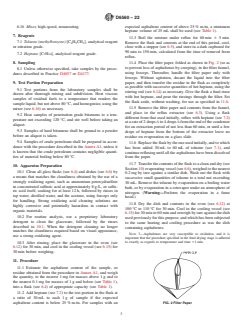
11.4 Place the filter paper, folded as shown in Fig. 2 (so as to prevent loss of asphaltenes by creeping), in the filter funnel, using
forceps. Thereafter, handle the filter paper only with forceps. Without agitation, decant the liquid into the filter paper, and then
transfer the residue in the flask as completely as possible with successive quantities of hot heptane, using the stirring rod (see 6.14)
as necessary. Give the flask a final rinse with hot heptane, and pour the rinsings through the filter. Set the flask aside, without
washing, for use as specified in 11.6.
11.5 Remove the filter paper and contents from the funnel, and place in the reflux extractor (see 6.3). Using a flask different from
that used initially, reflux with heptane (see 7.2) at a rate of 2 drops ⁄s to 4 drops ⁄s from the end of the condenser for an ex
...