

ASTM E748-19
(Guide)Standard Guide for Thermal Neutron Radiography of Materials
General Information
- Abstract
SIGNIFICANCE AND USE
4.1 This guide covers types of materials to be examined, neutron radiographic examination techniques, neutron production and collimation methods, radiographic film, and converter screen selection. Within the present state of the neutron radiologic art, these practices are generally applicable to specific material combinations, processes, and techniques.
SCOPE
1.1 Purpose—Practices to be employed for the radiographic examination of materials and components with thermal neutrons are outlined herein. They are intended as a guide for the production of neutron radiographs that possess consistent quality characteristics, as well as aiding the user to consider the applicability of thermal neutron radiology. Statements concerning preferred practice are provided without a discussion of the technical background for the preference. The necessary technical background can be found in Refs (1-16).2
1.2 Limitations—Acceptance standards have not been established for any material or production process (see Section 5 on Basis of Application). Adherence to the guide will, however, produce reproducible results. Neutron radiography, whether performed by means of a reactor, an accelerator, subcritical assembly, or radioactive source, will be consistent in sensitivity and resolution only if the consistency of all details of the technique, such as neutron source, collimation, geometry, film, etc., are maintained. This guide is limited to the use of photographic or radiographic film in combination with conversion screens for image recording; other imaging systems are available. Emphasis is placed on the use of nuclear reactor neutron sources.
1.3 Interpretation and Acceptance Standards—Interpretation and acceptance standards are not covered by this guide. Designation of accept-reject standards is recognized to be within the cognizance of product specifications.
1.4 Safety Practices—General practices for personnel protection against neutron and associated radiation peculiar to the neutron radiologic process are discussed in Section 18. Jurisdictional nuclear regulations will also apply.
1.5 Other Aspects of the Neutron Radiographic Process—For many important aspects of neutron radiography such as technique, files, viewing of radiographs, storage of radiographs, film processing, and record keeping, refer to Guide E94, which covers these aspects for X-ray radiography. (See Section 2.)
1.6 The values stated in either SI or inch-pound units are to be regarded as the standard.
1.7 This standard does not purport to address all of the safety concerns, if any, associated with its use. It is the responsibility of the user of this standard to establish appropriate safety, health, and environmental practices and determine the applicability of regulatory limitations prior to use.
1.8 This international standard was developed in accordance with internationally recognized principles on standardization established in the Decision on Principles for the Development of International Standards, Guides and Recommendations issued by the World Trade Organization Technical Barriers to Trade (TBT) Committee.
- Status
- Published
- Publication Date
- 30-Apr-2019
- Technical Committee
- E07 - Nondestructive Testing
- Drafting Committee
- E07.05 - Radiology (Neutron) Method
Overview
ASTM E748-19, issued by ASTM International, is a standard guide specifying recommended practices for the thermal neutron radiography of materials. This guide details methods and techniques for performing radiographic examinations of materials and components using thermal neutrons, focusing on the use of photographic or radiographic film in combination with converter screens. It covers key elements such as neutron generation, moderation, collimation methods, imaging techniques, film, and screen selection, ensuring reproducible and consistent image quality in neutron radiographs.
The standard serves as a practical reference for applying thermal neutron radiography in nondestructive testing (NDT), supporting users in achieving high-quality and reliable imaging results across various industrial applications. While preferred practices are outlined, the standard does not set acceptance or interpretation criteria, leaving such determinations to individual product specifications and contractual agreements.
Key Topics
Neutron Radiography Techniques
- Direct and indirect imaging methods using conversion screens and radiographic film.
- Selection of optimal imaging systems for various applications.
Neutron Sources and Moderation
- Use of nuclear reactors, subcritical assemblies, accelerators, and isotopic sources.
- Guidance on moderator choices based on application needs.
Collimation and Beam Control
- Design and selection of divergent, multichannel, pinhole, and straight collimators.
- Methods to ensure beam uniformity and minimize unwanted scatter.
Film and Converter Screen Selection
- Criteria for choosing converter screens (materials include gadolinium, indium, dysprosium, etc.).
- Recommendations for film and screen combinations for best image resolution and sensitivity.
Safety and Regulatory Compliance
- General radiation safety practices for personnel working with neutron sources.
- Consideration of jurisdictional nuclear regulations and requirements for monitoring activated objects and materials.
Practical Aspects and Limitations
- Advice on cassette material selection (aluminum or magnesium preferred).
- Techniques for managing backscatter, masking, and use of contrast agents.
Applications
Thermal neutron radiography is a powerful nondestructive testing (NDT) method with applications across diverse industries:
Material Science and Metallurgy
- Detection of hydrogenous and low-density materials within high-density assemblies where X-ray radiography may fail.
- Location and measurement of moisture, corrosion, or adhesives within metal structures.
Aerospace and Automotive
- Inspection of turbine blades for ceramic residues and voids, assessment of adhesive bonds, and examination of complex composite structures.
Nuclear Industry
- Examination of nuclear reactor fuel rods, control plates, and detection of poison distribution.
- Non-destructive analysis of highly radioactive objects using indirect neutron imaging methods.
Research and Quality Control
- Analyses of isotope distributions within samples or assemblies.
- Monitoring of material migration in electronic components and batteries.
Civil Engineering
- Investigation of moisture movement in concrete and identification of voids or inclusions in large assemblies.
Related Standards
Several supporting standards define best practices and terminology relevant to thermal neutron radiography:
- ASTM E94: Guide for Radiographic Examination Using Industrial Radiographic Film
- ASTM E543: Specification for Agencies Performing Nondestructive Testing
- ASTM E545: Test Method for Determining Image Quality in Direct Thermal Neutron Radiographic Examination
- ASTM E803: Test Method for Determining L/D Ratio of Neutron Radiography Beams
- ASTM E1316: Terminology for Nondestructive Examinations
- ASNT SNT-TC-1A: Recommended Practice for Personnel Qualification and Certification
- ANSI/ASNT-CP-189: Standard for Qualification and Certification of Nondestructive Testing Personnel
- NAS-410: Aerospace NDT Personnel Qualification and Certification
- ISO 9712: Non-Destructive Testing - Qualification and Certification of NDT Personnel
These standards, used in conjunction with ASTM E748-19, form a comprehensive framework for the thermal neutron radiography of materials, ensuring high technical consistency, safety, and quality across industries.
Keywords: thermal neutron radiography, neutron sources, neutron collimator, radiographic film, converter screens, nondestructive testing, ASTM E748-19, image quality, safety practices.
Relations
- Effective Date
- 01-May-2019
- Effective Date
- 01-Feb-2024
- Effective Date
- 01-Dec-2019
- Effective Date
- 01-Mar-2019
- Effective Date
- 01-Jan-2018
- Effective Date
- 01-Nov-2017
- Effective Date
- 15-Jun-2017
- Effective Date
- 01-Feb-2017
- Effective Date
- 01-Aug-2016
- Effective Date
- 01-Feb-2016
- Effective Date
- 01-Dec-2015
- Effective Date
- 01-Sep-2015
- Effective Date
- 01-Jun-2014
- Effective Date
- 01-Jun-2014
- Effective Date
- 01-Jun-2014
Get Certified
Connect with accredited certification bodies for this standard

IMP NDT d.o.o.
Non-destructive testing services. Radiography, ultrasonic, magnetic particle, penetrant, visual inspection.
Inštitut za kovinske materiale in tehnologije
Institute of Metals and Technology. Materials testing, metallurgical analysis, NDT.
Q Techna d.o.o.
NDT and quality assurance specialist. 30+ years experience. NDT personnel certification per ISO 9712, nuclear and thermal power plant inspections, QA/
Sponsored listings
Frequently Asked Questions
ASTM E748-19 is a guide published by ASTM International. Its full title is "Standard Guide for Thermal Neutron Radiography of Materials". This standard covers: SIGNIFICANCE AND USE 4.1 This guide covers types of materials to be examined, neutron radiographic examination techniques, neutron production and collimation methods, radiographic film, and converter screen selection. Within the present state of the neutron radiologic art, these practices are generally applicable to specific material combinations, processes, and techniques. SCOPE 1.1 Purpose—Practices to be employed for the radiographic examination of materials and components with thermal neutrons are outlined herein. They are intended as a guide for the production of neutron radiographs that possess consistent quality characteristics, as well as aiding the user to consider the applicability of thermal neutron radiology. Statements concerning preferred practice are provided without a discussion of the technical background for the preference. The necessary technical background can be found in Refs (1-16).2 1.2 Limitations—Acceptance standards have not been established for any material or production process (see Section 5 on Basis of Application). Adherence to the guide will, however, produce reproducible results. Neutron radiography, whether performed by means of a reactor, an accelerator, subcritical assembly, or radioactive source, will be consistent in sensitivity and resolution only if the consistency of all details of the technique, such as neutron source, collimation, geometry, film, etc., are maintained. This guide is limited to the use of photographic or radiographic film in combination with conversion screens for image recording; other imaging systems are available. Emphasis is placed on the use of nuclear reactor neutron sources. 1.3 Interpretation and Acceptance Standards—Interpretation and acceptance standards are not covered by this guide. Designation of accept-reject standards is recognized to be within the cognizance of product specifications. 1.4 Safety Practices—General practices for personnel protection against neutron and associated radiation peculiar to the neutron radiologic process are discussed in Section 18. Jurisdictional nuclear regulations will also apply. 1.5 Other Aspects of the Neutron Radiographic Process—For many important aspects of neutron radiography such as technique, files, viewing of radiographs, storage of radiographs, film processing, and record keeping, refer to Guide E94, which covers these aspects for X-ray radiography. (See Section 2.) 1.6 The values stated in either SI or inch-pound units are to be regarded as the standard. 1.7 This standard does not purport to address all of the safety concerns, if any, associated with its use. It is the responsibility of the user of this standard to establish appropriate safety, health, and environmental practices and determine the applicability of regulatory limitations prior to use. 1.8 This international standard was developed in accordance with internationally recognized principles on standardization established in the Decision on Principles for the Development of International Standards, Guides and Recommendations issued by the World Trade Organization Technical Barriers to Trade (TBT) Committee.
SIGNIFICANCE AND USE 4.1 This guide covers types of materials to be examined, neutron radiographic examination techniques, neutron production and collimation methods, radiographic film, and converter screen selection. Within the present state of the neutron radiologic art, these practices are generally applicable to specific material combinations, processes, and techniques. SCOPE 1.1 Purpose—Practices to be employed for the radiographic examination of materials and components with thermal neutrons are outlined herein. They are intended as a guide for the production of neutron radiographs that possess consistent quality characteristics, as well as aiding the user to consider the applicability of thermal neutron radiology. Statements concerning preferred practice are provided without a discussion of the technical background for the preference. The necessary technical background can be found in Refs (1-16).2 1.2 Limitations—Acceptance standards have not been established for any material or production process (see Section 5 on Basis of Application). Adherence to the guide will, however, produce reproducible results. Neutron radiography, whether performed by means of a reactor, an accelerator, subcritical assembly, or radioactive source, will be consistent in sensitivity and resolution only if the consistency of all details of the technique, such as neutron source, collimation, geometry, film, etc., are maintained. This guide is limited to the use of photographic or radiographic film in combination with conversion screens for image recording; other imaging systems are available. Emphasis is placed on the use of nuclear reactor neutron sources. 1.3 Interpretation and Acceptance Standards—Interpretation and acceptance standards are not covered by this guide. Designation of accept-reject standards is recognized to be within the cognizance of product specifications. 1.4 Safety Practices—General practices for personnel protection against neutron and associated radiation peculiar to the neutron radiologic process are discussed in Section 18. Jurisdictional nuclear regulations will also apply. 1.5 Other Aspects of the Neutron Radiographic Process—For many important aspects of neutron radiography such as technique, files, viewing of radiographs, storage of radiographs, film processing, and record keeping, refer to Guide E94, which covers these aspects for X-ray radiography. (See Section 2.) 1.6 The values stated in either SI or inch-pound units are to be regarded as the standard. 1.7 This standard does not purport to address all of the safety concerns, if any, associated with its use. It is the responsibility of the user of this standard to establish appropriate safety, health, and environmental practices and determine the applicability of regulatory limitations prior to use. 1.8 This international standard was developed in accordance with internationally recognized principles on standardization established in the Decision on Principles for the Development of International Standards, Guides and Recommendations issued by the World Trade Organization Technical Barriers to Trade (TBT) Committee.
ASTM E748-19 is classified under the following ICS (International Classification for Standards) categories: 19.100 - Non-destructive testing. The ICS classification helps identify the subject area and facilitates finding related standards.
ASTM E748-19 has the following relationships with other standards: It is inter standard links to ASTM E748-16, ASTM E1316-24, ASTM E1316-19b, ASTM E1316-19, ASTM E1316-18, ASTM E803-17, ASTM E1316-17a, ASTM E1316-17, ASTM E1316-16a, ASTM E1316-16, ASTM E1316-15a, ASTM E1316-15, ASTM E1316-14, ASTM E1316-14e1, ASTM E545-14. Understanding these relationships helps ensure you are using the most current and applicable version of the standard.
ASTM E748-19 is available in PDF format for immediate download after purchase. The document can be added to your cart and obtained through the secure checkout process. Digital delivery ensures instant access to the complete standard document.
Standards Content (Sample)
This international standard was developed in accordance with internationally recognized principles on standardization established in the Decision on Principles for the
Development of International Standards, Guides and Recommendations issued by the World Trade Organization Technical Barriers to Trade (TBT) Committee.
Designation: E748 − 19
Standard Guide for
Thermal Neutron Radiography of Materials
This standard is issued under the fixed designation E748; the number immediately following the designation indicates the year of
original adoption or, in the case of revision, the year of last revision.Anumber in parentheses indicates the year of last reapproval.A
superscript epsilon (´) indicates an editorial change since the last revision or reapproval.
1. Scope* radiographs, film processing, and record keeping, refer to
Guide E94, which covers these aspects for X-ray radiography.
1.1 Purpose—Practicestobeemployedfortheradiographic
(See Section 2.)
examination of materials and components with thermal neu-
trons are outlined herein. They are intended as a guide for the 1.6 The values stated in either SI or inch-pound units are to
production of neutron radiographs that possess consistent be regarded as the standard.
qualitycharacteristics,aswellasaidingtheusertoconsiderthe
1.7 This standard does not purport to address all of the
applicabilityofthermalneutronradiology.Statementsconcern-
safety concerns, if any, associated with its use. It is the
ing preferred practice are provided without a discussion of the
responsibility of the user of this standard to establish appro-
technical background for the preference. The necessary tech-
priate safety, health, and environmental practices and deter-
nical background can be found in Refs (1-16).
mine the applicability of regulatory limitations prior to use.
1.8 This international standard was developed in accor-
1.2 Limitations—Acceptancestandardshavenotbeenestab-
dance with internationally recognized principles on standard-
lished for any material or production process (see Section 5 on
ization established in the Decision on Principles for the
Basis of Application). Adherence to the guide will, however,
Development of International Standards, Guides and Recom-
produce reproducible results. Neutron radiography, whether
mendations issued by the World Trade Organization Technical
performed by means of a reactor, an accelerator, subcritical
Barriers to Trade (TBT) Committee.
assembly,orradioactivesource,willbeconsistentinsensitivity
and resolution only if the consistency of all details of the
2. Referenced Documents
technique, such as neutron source, collimation, geometry, film,
etc., are maintained. This guide is limited to the use of
2.1 ASTM Standards:
photographicorradiographicfilmincombinationwithconver-
E94Guide for Radiographic Examination Using Industrial
sion screens for image recording; other imaging systems are
Radiographic Film
available. Emphasis is placed on the use of nuclear reactor
E543Specification forAgencies Performing Nondestructive
neutron sources.
Testing
E545Test Method for Determining Image Quality in Direct
1.3 Interpretation and Acceptance Standards—
Thermal Neutron Radiographic Examination
Interpretationandacceptancestandardsarenotcoveredbythis
E803TestMethodforDeterminingthe L/DRatioofNeutron
guide. Designation of accept-reject standards is recognized to
Radiography Beams
be within the cognizance of product specifications.
E1316Terminology for Nondestructive Examinations
1.4 Safety Practices—General practices for personnel pro-
2.2 ASNT Standard:
tection against neutron and associated radiation peculiar to the
Recommended Practice SNT-TC-1Afor Personnel Qualifi-
neutron radiologic process are discussed in Section 18. Juris-
cation and Certification
dictional nuclear regulations will also apply.
2.3 ANSI Standard:
1.5 Other Aspects of the Neutron Radiographic Process—
ANSI/ASNT-CP-189Standard for Qualification and Certifi-
For many important aspects of neutron radiography such as
cation of Nondestructive Testing Personnel
technique, files, viewing of radiographs, storage of
1 3
This guide is under the jurisdiction ofASTM Committee E07 on Nondestruc- For referenced ASTM standards, visit the ASTM website, www.astm.org, or
tive Testing and is the direct responsibility of Subcommittee E07.05 on Radiology contact ASTM Customer Service at service@astm.org. For Annual Book of ASTM
(Neutron) Method. Standards volume information, refer to the standard’s Document Summary page on
Current edition approved May 1, 2019. Published June 2019. Originally the ASTM website.
approved in 1980. Last previous edition approved in 2016 as E748–16. DOI: AvailablefromAmericanSocietyforNondestructiveTesting(ASNT),P.O.Box
10.1520/E0748-19. 28518, 1711 Arlingate Ln., Columbus, OH 43228-0518, http://www.asnt.org.
2 5
Theboldfacenumbersinparenthesesrefertothelistofreferencesattheendof Available fromAmerican National Standards Institute (ANSI), 25 W. 43rd St.,
this standard. 4th Floor, New York, NY 10036, http://www.ansi.org.
*A Summary of Changes section appears at the end of this standard
Copyright © ASTM International, 100 Barr Harbor Drive, PO Box C700, West Conshohocken, PA 19428-2959. United States
E748 − 19
2.4 AIA Document: and neutrons differ drastically, the two techniques in general
NAS-410Nondestructive Testing Personnel Qualification serve to complement one another.
and Certification
6.2 Facilities—The basic neutron radiography facility con-
2.5 ISO Standard:
sists of a source of fast neutrons, a moderator, a gamma filter,
ISO9712Non-Destructive Testing—Qualification and Cer-
a collimator, a conversion screen, a film image recorder or
tification of NDT Personnel
other imaging system, a cassette, and adequate biological
shielding and interlock systems. A schematic diagram of a
3. Terminology
representative neutron radiography facility is illustrated inFig.
1.
3.1 Definitions—For definitions of terms used in these
practices, see Terminology E1316, Section H.
7. Neutron Sources
4. Significance and Use
7.1 General—The thermal neutron beam may be obtained
from a nuclear reactor, a subcritical assembly, a radioactive
4.1 This guide covers types of materials to be examined,
neutron source, or an accelerator. Neutron radiography has
neutron radiographic examination techniques, neutron produc-
been achieved successfully with all four sources. In all cases
tion and collimation methods, radiographic film, and converter
the initial neutrons generated possess high energies and must
screen selection. Within the present state of the neutron
be reduced in energy (moderated) to be useful for thermal
radiologic art, these practices are generally applicable to
neutronradiography.Thismaybeachievedbysurroundingthe
specific material combinations, processes, and techniques.
source with light materials such as water, oil, plastic, paraffin,
beryllium, or graphite.The preferred moderator will be depen-
5. Basis of Application
dent on the constraints dictated by the energy of the primary
5.1 Personnel Qualification—If specified in the contractual
neutrons, which will in turn be dictated by neutron beam
agreement,personnelperformingexaminationstothisstandard
parameters such as thermal neutron yield requirements, cad-
shall be qualified in accordance with a nationally or interna-
mium ratio, and beam gamma ray contamination. The charac-
tionally recognized NDT personnel qualification practice or
teristics of a particular system for a given application are left
standardsuchasANSI/ASNT-CP-189,SNT-TC-1A,NAS-410,
for the seller and the buyer of the service to decide. Charac-
ISO9712, or a similar document and certified by the employer
teristics and capabilities of each type of source are referenced
or certifying agency, as applicable. The practice or standard
in the References section. A general comparison of sources is
used and its applicable revision shall be identified in the
shown in Table 1.
contractual agreement between the using parties.
7.2 Nuclear Reactors—Nuclear reactors are the preferred
5.2 Qualification of Nondestructive Agencies—If specified
thermalneutronsourceingeneral,sincehighneutronfluxesare
in the contractual agreement, NDT agencies shall be qualified
available and exposures can be made in a relatively short time
and evaluated as described in Specification E543. The appli-
span.The high neutron intensity makes it possible to provide a
cable edition of Specification E543 shall be specified in the
tightlycollimatedbeam;therefore,high-resolutionradiographs
contractual agreement.
can be produced.
5.3 Procedures and Techniques—The procedures and tech-
7.3 Subcritical Assembly—A subcritical assembly is
niquestobeusedshallbeasdescribedinthesepracticesunless
achieved by the addition of sufficient fissionable material
otherwisespecified.Specifictechniquesmaybespecifiedinthe
surrounding a moderated source of neutrons, usually a radio-
contractual agreement.
isotope source. Although the total thermal neutron yield is
5.4 Reporting Criteria/Acceptance Criteria—Reporting cri-
smaller than that of a nuclear reactor, such a system offers the
teriafortheexaminationresultsshallbeinaccordancewith1.3
attractions of adequate image quality in a reasonable exposure
unless otherwise specified. Acceptance criteria (for example,
for reference radiographs) shall be specified in the contractual
agreement.
6. Neutron Radiography
6.1 The Method—Neutron radiography is basically similar
to X-ray radiography in that both techniques employ radiation
beam intensity modulation by an object to image macroscopic
object details. X-rays or gamma rays are replaced by neutrons
as the penetrating radiation in a through-transmission exami-
nation.SincetheabsorptioncharacteristicsofmatterforX-rays
Available from Aerospace Industries Association (AIA), 1000 Wilson Blvd.,
Suite 1700, Arlington, VA 22209, http://www.aia-aerospace.org.
Available fromAmerican National Standards Institute (ANSI), 25 W. 43rd St., FIG. 1 Typical Neutron Radiography Facility with Divergent Colli-
4th Floor, New York, NY 10036, http://www.ansi.org. mator
E748 − 19
TABLE 1 Comparison of Thermal Neutron Sources
Type of Source Typical Radiographic Flux, n/cm ·s Radiographic Resolution Characteristics
5 8
Nuclear reactor 10 to 10 excellent stable operation, not portable
4 6
Subcritical assembly 10 to 10 good stable operation, portability difficult
3 6
Accelerator 10 to 10 medium on-off operation, transportable
1 4
Radioisotope 10 to 10 poor to medium stable operation, portability possible
time,relativeeaseoflicensing,adequateneutronyieldformost the following types: (1) a free-standing gadolinium metal
industrial applications, and the possibility of transportable screen accessible to film on both sides; (2) a sapphire-coated,
operation.
vapor-deposited gadolinium screen on a substrate such as
aluminum; or (3) a light-emitting fluorescent screen such as
7.4 Accelerator Sources—Accelerators used for thermal
gadolinium oxysulfide or LiF/ZnS. Exposure of an additional
neutron radiography have generally been of the low-voltage
3 4
film (without object) is often useful to resolve artifacts that
type which utilize the H(d,n) He reaction, high-energy X-ray
may appear in radiographs. Such artifacts could result from
machines in which the (x,n) reaction is applied and Van de
screen marks, excess pressure, light leaks, development, or
Graaff and other high-energy accelerators which employ reac-
9 10
non-uniform film. In the case of light-emitting conversion
tions such as Be(d,n) B. In all cases, the targets are
screens, it is recommended that the spectral response of the
surrounded by a moderator to reduce the neutrons to thermal
light emission be matched as closely as possible to that of the
energies. The total neutron yields of such machines can be on
12 −1
film used for optimum results. The direct method should be
theorderof10 ·n·s ;thethermalneutronfluxofsuchsources
9 −2 −1
employed whenever high-resolution radiographs are required,
before collimation can be on the order of 10 n·cm ·s , for
and high beam contamination of low-energy gamma rays or
example, the yield from a Van de Graaff accelerator.
highly radioactive objects do not preclude its use.
7.5 Isotopic Sources—Many isotopic sources have been
employed for neutron radiologic applications. Those that have
8.3 Indirect Method—Thismethodmakesuseofconversion
been most widely utilized are outlined in Table 2. Radioactive
screens that can be made temporarily radioactive by neutron
sources offer the best possibility for portable operation.
capture.Theconversionscreenisexposedalonetotheneutron-
However, because of the relatively low neutron yield, the
imaging beam; the film is not present. Candidate conversion
exposure times are usually long for a given image quality.The
materials include rhodium, gold, indium, and dysprosium.
isotopic source Cf offers a number of advantages for
Indium and dysprosium are recommended with dysprosium
thermal neutron radiology, namely, low neutron energy and
yielding the greater speed and emitting less energetic gamma
small physical size, both of which lead to efficient neutron
radiation. It is recommended that the conversion screens be
moderation, and the possibility for high total neutron yields.
activated in the neutron beam for a maximum of three
half-lives.Furtherneutronirradiationwillresultinanegligible
8. Imaging Methods and Conversion Screens
amount of additional induced activity. After irradiation, the
8.1 General—Neutrons are indirectly ionizing particulate
conversion screens should be placed in intimate contact with a
radiation that have little direct effect on radiographic film. To
radiographic film in a vacuum cassette, or other light-tight
obtain a neutron radiographic image on film, a conversion
assemblyinwhichgoodcontactcanbemaintainedbetweenthe
screen is normally employed; upon neutron capture, screens
radiographic film and radioactive screen. X-ray intensification
emitpromptanddelayeddecayproductsintheformofnuclear
screens may be used to increase the speed of the auto-
radiation or light. In all cases the screen should be placed in
radiographic process if desired. For the indirect type of
intimate contact with the radiographic film in order to obtain
exposure, the material from which the cassette is fabricated is
sharp images.
immaterial as there are no neutrons to be scattered in the
exposure process. In this case, as in the activation process,
8.2 Direct Method—Inthedirectmethod,afilmisplacedon
the source side of the conversion screen (front film) and thereislittletobegainedforconversionscreen-filmexposures
extending beyond three half-lives. It is recommended that this
exposed to the neutron beam together with the conversion
screen. Electron emission upon neutron capture is the mecha- method be employed whenever the neutron beam is highly
nism by which the film is primarily exposed in the case of contaminated with gamma rays, which in turn cause film
gadolinium conversion screens. The screen is generally one of fogging and reduced contrast sensitivity, or when highly
TABLE 2 Radioactive Sources Employed for Thermal Neutron Radiography
A
Source Type Half-Life Comments
Sb-Be (γ,n) 60 days short half-life and high γ-background, low neutron energy is advantage for
moderation, high yield source
Po-Be (α,n) 138 days short half-life, low γ-background
Am-Be (α,n) 458 years long half-life, easily shielded γ-background
241 242
Am- Cm-Be (α,n) 163 days short half-life, high neutron yield
Cf spontaneous fission 2.65 years long half-life, high neutron yield, small size and low energy offer advantages in
moderation
A
These comments compare sources in the table.
E748 − 19
radioactive objects are to be radiographed. In short, this ing a high degree of collimation within a short collimation
method is beam gamma-insensitive. length. When this type of collimator is employed, a suitable
collimator to detector distance should be maintained to avoid
8.4 Other Imaging Systems—The scope of this guide is
registry of the collimator pattern on the radiologic image.
limited to film detectors (see 1.2). However, other neutron
9.4 Straight Collimator—A straight-tube reentrant port can
detectorsystemssuchastrack-etchanddigitaldetectorsystems
also be used instead of the tapered assembly described in 9.2.
are available.
Although such collimators were widely used in early neutron
radiologic work, the need to examine larger objects and to
9. Neutron Collimators
achieve higher resolution has fostered the use of divergent
9.1 General—Neutron sources for thermal neutron radiol-
collimators.
ogygenerallyinvolveasizeablemoderatorregioninwhichthe
9.5 Pinhole Collimator—Higher resolution can be obtained
neutron motion is highly multidirectional. Collimators are
with a straight collimator when it is employed in conjunction
required to produce a beam and thereby produce adequate
with a pinhole iris. The pinhole is generally fabricated from a
image resolution capability in a neutron radiology facility. It
neutron-opaquematerialsuchasCd,Gd,or B.Theresolution
shouldbenotedthatinthedefinitionsofcollimatorparameters,
attainable will be dependent on the pinhole diameter D.A
it is assumed that the object under examination is placed as
schematic diagram of this system is illustrated in Fig. 2.
close to the detector system as possible to decrease both
magnification and image unsharpness due to the finite neutron
10. Beam Filters
source size. Several types of collimators are available. These
10.1 Thermal Neutron Radiography—Ingeneral,filtersmay
include the widely used divergent type, multichannel, pinhole,
notbenecessary.However,itmaybedesirabletoemployPbor
and straight collimators. The image spatial resolution proper-
Bi filters in the neutron beam to minimize beam gamma-ray
ties of the beams are generally set in part by the diameter or
contamination. Whenever Bi gamma-ray filters are employed
longest dimension of the collimator entrance port (D) and the
inahighneutronfluxenvironment,thefiltershouldbeencased
distance between that aperture and the imaging system (L).An
in a sealed aluminum can to contain alpha particle contamina-
exception is the multichannel collimator in which D is the
tion due to the Po produced by the neutron capture reaction
diameter of a channel and L is the length of the collimator. It
in Bi. Gamma rays can cause film fogging and reduced
should be noted that the detection system used in conjunction
contrast sensitivity. In particular, some scintillator converter
with a multichannel collimator will register the collimator
screens exhibit sensitivity to beam gamma-ray contamination.
pattern.Registrycanbeeliminatedbyempiricallyadjustingthe
This effect can be minimized by careful selection of the
distance between the collimator and the imaging system until
screen/film combination.
the pattern disappears. Ratios of L/D as low as 10 are not
unusual for low neutron yield sources, while higher resolution
11. Beam Uniformity
capability systems often will display L/D values of several
hundred or more. Test Method E803 details the method of
11.1 The only true measurement of the beam uniformity is
measuring the L/D ratio for neutron radiography systems. The
witharadiographmadewithoutobjects.Ideallytheintensityof
actual spatial resolution or image unsharpness in a particular
neutrons should be uniform across the entire radiograph.
radiologic examination will depend, of course, on factors
11.2 A common approach for measuring the beam unifor-
additionaltothebeamcharacteristics.Theseincludetheobject
mity is to expose a film without any objects present on it to an
size,thegeometryofthesystem,andscatterconditions.Forthe
optical density of 2.0 to 3.0. Optical density measurements are
typical calculation of geometric unsharpness, the size of the
then taken at the center of the film and 25 to 30 mm towards
X-radiologic source, F, would be replaced by the size of the
thecenterfromeachcornerofthefilm,andthenumericalmean
effective thermal neutron radiologic source (D) as discussed in
of these measurements calculated. If the beam diameter is
Guide E94.
smaller than the film, the four outside measurements are taken
9.2 Divergent Collimator—The divergent collimator is a 25 to 30 mm from the edge of the beam at 90 degree intervals.
tapered reentrant port into the point of highest thermal neutron
fluxinthemoderator.Thewallsofthecollimatorarelinedwith
a thermal neutron absorbing material to permit only unscat-
tered neutrons from the source to reach the object and the
image plane. This type of collimator is preferred when larger
objects will be radiographed in a single exposure. It is
recommended that the divergent collimator be lined with a
neutron absorber which produces neutron capture decay prod-
uctsthatwillnotresultinbackgroundfo
...
This document is not an ASTM standard and is intended only to provide the user of an ASTM standard an indication of what changes have been made to the previous version. Because
it may not be technically possible to adequately depict all changes accurately, ASTM recommends that users consult prior editions as appropriate. In all cases only the current version
of the standard as published by ASTM is to be considered the official document.
Designation: E748 − 16 E748 − 19
Standard Guide for
Thermal Neutron Radiography of Materials
This standard is issued under the fixed designation E748; the number immediately following the designation indicates the year of
original adoption or, in the case of revision, the year of last revision. A number in parentheses indicates the year of last reapproval. A
superscript epsilon (´) indicates an editorial change since the last revision or reapproval.
1. Scope*
1.1 Purpose—Practices to be employed for the radiographic examination of materials and components with thermal neutrons
are outlined herein. They are intended as a guide for the production of neutron radiographs that possess consistent quality
characteristics, as well as aiding the user to consider the applicability of thermal neutron radiology. Statements concerning
preferred practice are provided without a discussion of the technical background for the preference. The necessary technical
background can be found in Refs (1-16).
1.2 Limitations—Acceptance standards have not been established for any material or production process (see Section 5 on Basis
of Application). Adherence to the guide will, however, produce reproducible results. Neutron radiography, whether performed by
means of a reactor, an accelerator, subcritical assembly, or radioactive source, will be consistent in sensitivity and resolution only
if the consistency of all details of the technique, such as neutron source, collimation, geometry, film, etc., are maintained. This
guide is limited to the use of photographic or radiographic film in combination with conversion screens for image recording; other
imaging systems are available. Emphasis is placed on the use of nuclear reactor neutron sources.
1.3 Interpretation and Acceptance Standards—Interpretation and acceptance standards are not covered by this guide.
Designation of accept-reject standards is recognized to be within the cognizance of product specifications.
1.4 Safety Practices—General practices for personnel protection against neutron and associated radiation peculiar to the neutron
radiologic process are discussed in Section 1718. Jurisdictional nuclear regulations will also apply.
1.5 Other Aspects of the Neutron Radiographic Process—For many important aspects of neutron radiography such as technique,
files, viewing of radiographs, storage of radiographs, film processing, and record keeping, refer to Guide E94, which covers these
aspects for x-rayX-ray radiography. (See Section 2.)
1.6 The values stated in either SI or inch-pound units are to be regarded as the standard.
1.7 This standard does not purport to address all of the safety concerns, if any, associated with its use. It is the responsibility
of the user of this standard to establish appropriate safety safety, health, and healthenvironmental practices and determine the
applicability of regulatory limitations prior to use.
1.8 This international standard was developed in accordance with internationally recognized principles on standardization
established in the Decision on Principles for the Development of International Standards, Guides and Recommendations issued
by the World Trade Organization Technical Barriers to Trade (TBT) Committee.
2. Referenced Documents
2.1 ASTM Standards:
E94 Guide for Radiographic Examination Using Industrial Radiographic Film
E543 Specification for Agencies Performing Nondestructive Testing
E545 Test Method for Determining Image Quality in Direct Thermal Neutron Radiographic Examination
E803 Test Method for Determining the L/D Ratio of Neutron Radiography Beams
E1316 Terminology for Nondestructive Examinations
These practices areThis guide is under the jurisdiction of ASTM Committee E07 on Nondestructive Testing and areis the direct responsibility of Subcommittee E07.05
on Radiology (Neutron) Method.
Current edition approved Feb. 15, 2016May 1, 2019. Published February 2016June 2019. Originally approved in 1980. Last previous edition approved in 20082016 as
E748 – 02E748 – 16.(2008). DOI: 10.1520/E0748-16.10.1520/E0748-19.
The boldface numbers in parentheses refer to the list of references at the end of these practices.this standard.
For referenced ASTM standards, visit the ASTM website, www.astm.org, or contact ASTM Customer Service at service@astm.org. For Annual Book of ASTM Standards
volume information, refer to the standard’s Document Summary page on the ASTM website.
*A Summary of Changes section appears at the end of this standard
Copyright © ASTM International, 100 Barr Harbor Drive, PO Box C700, West Conshohocken, PA 19428-2959. United States
E748 − 19
2.2 ASNT Standard:
Recommended Practice SNT-TC-1A for Personnel Qualification and Certification
2.3 ANSI Standard:
ANSI/ASNT-CP-189 Standard for Qualification and Certification of Nondestructive Testing Personnel
2.4 AIA Document:
NAS-410 Nondestructive Testing Personnel Qualification and Certification
2.5 ISO Standard:
ISO 9712 Non-Destructive Testing—Qualification and Certification of NDT Personnel
3. Terminology
3.1 Definitions—For definitions of terms used in these practices, see Terminology E1316, Section H.
4. Significance and Use
4.1 This guide covers types of materials to be examined, neutron radiographic examination techniques, neutron production and
collimation methods, radiographic film, and converter screen selection. Within the present state of the neutron radiologic art, these
practices are generally applicable to specific material combinations, processes, and techniques.
5. Basis of Application
5.1 Personnel Qualification—If specified in the contractual agreement, personnel performing examinations to this standard shall
be qualified in accordance with a nationally or internationally recognized NDT personnel qualification practice or standard such
as ANSI/ASNT-CP-189, SNT-TC-1A, NAS-410, ISO 9712, or a similar document and certified by the employer or certifying
agency, as applicable. The practice or standard used and its applicable revision shall be identified in the contractual agreement
between the using parties.
5.2 Qualification of Nondestructive Agencies—If specified in the contractual agreement, NDT agencies shall be qualified and
evaluated as described in PracticeSpecification E543. The applicable edition of PracticeSpecification E543 shall be specified in the
contractual agreement.
5.3 Procedures and Techniques—The procedures and techniques to be used shall be as described in these practices unless
otherwise specified. Specific techniques may be specified in the contractual agreement.
5.4 Reporting Criteria/Acceptance Criteria—Reporting criteria for the examination results shall be in accordance with 1.3
unless otherwise specified. Acceptance criteria (for example, for reference radiographs) shall be specified in the contractual
agreement.
6. Neutron Radiography
6.1 The Method—Neutron radiography is basically similar to X-ray radiography in that both techniques employ radiation beam
intensity modulation by an object to image macroscopic object details. X-rays or gamma rays are replaced by neutrons as the
penetrating radiation in a through-transmission examination. Since the absorption characteristics of matter for X-rays and neutrons
differ drastically, the two techniques in general serve to complement one another.
6.2 Facilities—The basic neutron radiography facility consists of a source of fast neutrons, a moderator, a gamma filter, a
collimator, a conversion screen, a film image recorder or other imaging system, a cassette, and adequate biological shielding and
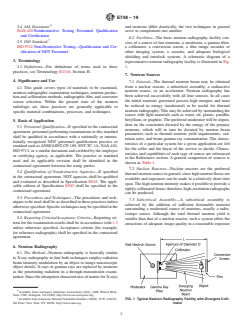
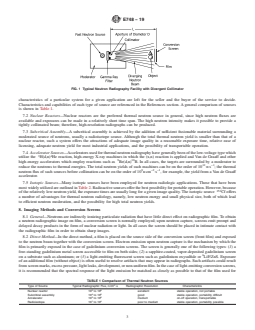
interlock systems. A schematic diagram of a representative neutron radiography facility is illustrated in Fig. 1.
7. Neutron Sources
7.1 General—The thermal neutron beam may be obtained from a nuclear reactor, a subcritical assembly, a radioactive neutron
source, or an accelerator. Neutron radiography has been achieved successfully with all four sources. In all cases the initial neutrons
generated possess high energies and must be reduced in energy (moderated) to be useful for thermal neutron radiography. This may
be achieved by surrounding the source with light materials such as water, oil, plastic, paraffin, beryllium, or graphite. The preferred
moderator will be dependent on the constraints dictated by the energy of the primary neutrons, which will in turn be dictated by
neutron beam parameters such as thermal neutron yield requirements, cadmium ratio, and beam gamma ray contamination. The
Available from the American Society for Nondestructive Testing, 1711 Arlingate Lane, Testing (ASNT), P.O. Box 28518, 1711 Arlingate Ln., Columbus, OH
43228-0518.43228-0518, http://www.asnt.org.
Available from American National Standards Institute (ANSI), 25 W. 43rd St., 4th Floor, New York, NY 10036.10036, http://www.ansi.org.
Available from Aerospace Industries Association of America, Inc., 1250 Eye St., NW, Washington, DC 20005.(AIA), 1000 Wilson Blvd., Suite 1700, Arlington, VA
22209, http://www.aia-aerospace.org.
Available from American National Standards Institute (ANSI), 25 W. 43rd St., 4th Floor, New York, NY 10036, http://www.ansi.org.
E748 − 19
FIG. 1 Typical Neutron Radiography Facility with Divergent Collimator
characteristics of a particular system for a given application are left for the seller and the buyer of the service to decide.
Characteristics and capabilities of each type of source are referenced in the References section. A general comparison of sources
is shown in Table 1.
7.2 Nuclear Reactors—Nuclear reactors are the preferred thermal neutron source in general, since high neutron fluxes are
available and exposures can be made in a relatively short time span. The high neutron intensity makes it possible to provide a
tightly collimated beam; therefore, high-resolution radiographs can be produced.
7.3 Subcritical Assembly—A subcritical assembly is achieved by the addition of sufficient fissionable material surrounding a
moderated source of neutrons, usually a radioisotope source. Although the total thermal neutron yield is smaller than that of a
nuclear reactor, such a system offers the attractions of adequate image quality in a reasonable exposure time, relative ease of
licensing, adequate neutron yield for most industrial applications, and the possibility of transportable operation.
7.4 Accelerator Sources—Accelerators used for thermal neutron radiography have generally been of the low-voltage type which
3 4
utilize the H(d,n) He reaction, high-energy X-ray machines in which the (x,n) reaction is applied and Van de Graaff and other
9 10
high-energy accelerators which employ reactions such as Be(d,n) B. In all cases, the targets are surrounded by a moderator to
12 −1
reduce the neutrons to thermal energies. The total neutron yields of such machines can be on the order of 10 ·n·s ; the thermal
9 −2 −1
neutron flux of such sources before collimation can be on the order of 10 n·cm ·s , for example, the yield from a Van de Graaff
accelerator.
7.5 Isotopic Sources—Many isotopic sources have been employed for neutron radiologic applications. Those that have been
most widely utilized are outlined in Table 2. Radioactive sources offer the best possibility for portable operation. However, because
of the relatively low neutron yield, the exposure times are usually long for a given image quality. The isotopic source Cf offers
a number of advantages for thermal neutron radiology, namely, low neutron energy and small physical size, both of which lead
to efficient neutron moderation, and the possibility for high total neutron yields.
8. Imaging Methods and Conversion Screens
8.1 General—Neutrons are indirectly ionizing particulate radiation that have little direct effect on radiographic film. To obtain
a neutron radiographic image on film, a conversion screen is normally employed; upon neutron capture, screens emit prompt and
delayed decay products in the form of nuclear radiation or light. In all cases the screen should be placed in intimate contact with
the radiographic film in order to obtain sharp images.
8.2 Direct Method—In the direct method, a film is placed on the source side of the conversion screen (front film) and exposed
to the neutron beam together with the conversion screen. Electron emission upon neutron capture is the mechanism by which the
film is primarily exposed in the case of gadolinium conversion screens. The screen is generally one of the following types: (1) a
free-standing gadolinium metal screen accessible to film on both sides; (2) a sapphire-coated, vapor-deposited gadolinium screen
on a substrate such as aluminum; or (3) a light-emitting fluorescent screen such as gadolinium oxysulfide or LiF/ZnS. Exposure
of an additional film (without object) is often useful to resolve artifacts that may appear in radiographs. Such artifacts could result
from screen marks, excess pressure, light leaks, development, or non-uniform film. In the case of light-emitting conversion screens,
it is recommended that the spectral response of the light emission be matched as closely as possible to that of the film used for
TABLE 1 Comparison of Thermal Neutron Sources
Type of Source Typical Radiographic Flux, n/cm ·s Radiographic Resolution Characteristics
5 8
Nuclear reactor 10 to 10 excellent stable operation, not portable
4 6
Subcritical assembly 10 to 10 good stable operation, portability difficult
3 6
Accelerator 10 to 10 medium on-off operation, transportable
1 4
Radioisotope 10 to 10 poor to medium stable operation, portability possible
E748 − 19
TABLE 2 Radioactive Sources Employed for Thermal Neutron Radiography
A
Source Type Half-Life Comments
Sb-Be (γ,n) 60 days short half-life and high γ-background, low neutron energy is advantage for
moderation, high yield source
Po-Be (α,n) 138 days short half-life, low γ-background
Am-Be (α,n) 458 years long half-life, easily shielded γ-background
241 242
Am- Cm-Be (α,n) 163 days short half-life, high neutron yield
Cf spontaneous fission 2.65 years long half-life, high neutron yield, small size and low energy offer advantages in
moderation
A
These comments compare sources in the table.
optimum results. The direct method should be employed whenever high-resolution radiographs are required, and high beam
contamination of low-energy gamma rays or highly radioactive objects do not preclude its use.
8.3 Indirect Method—This method makes use of conversion screens that can be made temporarily radioactive by neutron
capture. The conversion screen is exposed alone to the neutron-imaging beam; the film is not present. Candidate conversion
materials include rhodium, gold, indium, and dysprosium. Indium and dysprosium are recommended with dysprosium yielding the
greater speed and emitting less energetic gamma radiation. It is recommended that the conversion screens be activated in the
neutron beam for a maximum of three half-lives. Further neutron irradiation will result in a negligible amount of additional induced
activity. After irradiation, the conversion screens should be placed in intimate contact with a radiographic film in a vacuum cassette,
or other light-tight assembly in which good contact can be maintained between the radiographic film and radioactive screen. X-ray
intensification screens may be used to increase the speed of the auto-radiographic process if desired. For the indirect type of
exposure, the material from which the cassette is fabricated is immaterial as there are no neutrons to be scattered in the exposure
process. In this case, as in the activation process, there is little to be gained for conversion screen-film exposures extending beyond
three half-lives. It is recommended that this method be employed whenever the neutron beam is highly contaminated with gamma
rays, which in turn cause film fogging and reduced contrast sensitivity, or when highly radioactive objects are to be radiographed.
In short, this method is beam gamma-insensitive.
8.4 Other Imaging Systems—The scope of this guide is limited to film detectors (see 1.2). However, other neutron detector
systems such as track-etch and digital detector systems are available.
9. Neutron Collimators
9.1 General—Neutron sources for thermal neutron radiology generally involve a sizeable moderator region in which the neutron
motion is highly multidirectional. Collimators are required to produce a beam and thereby produce adequate image resolution
capability in a neutron radiology facility. It should be noted that in the definitions of collimator parameters, it is assumed that the
object under examination is placed as close to the detector system as possible to decrease both magnification and image
unsharpness due to the finite neutron source size. Several types of collimators are available. These include the widely used
divergent type, multichannel, pinhole, and straight collimators. The image spatial resolution properties of the beams are generally
set in part by the diameter or longest dimension of the collimator entrance port (D) and the distance between that aperture and the
imaging system (L). An exception is the multichannel collimator in which D is the diameter of a channel and L is the length of
the collimator. It should be noted that the detection system used in conjunction with a multichannel collimator will register the
collimator pattern. Registry can be eliminated by empirically adjusting the distance between the collimator and the imaging system
until the pattern disappears. Ratios of L/D as low as 10 are not unusual for low neutron yield sources, while higher resolution
capability systems often will display L/D values of several hundred or more. Test Method E803 details the method of measuring
the L/D ratio for neutron radiography systems. The actual spatial resolution or image unsharpness in a particular radiologic
examination will depend, of course, on factors additional to the beam characteristics. These include the object size, the geometry
of the system, and scatter conditions. For the typical calculation of geometric unsharpness, the size of the X-radiologic source, F,
would be replaced by the size of the effective thermal neutron radiologic source (D) as discussed in Guide E94.
9.2 Divergent Collimator—The divergent collimator is a tapered reentrant port into the point of highest thermal neutron flux in
the moderator. The walls of the collimator are lined with a thermal neutron absorbing material to permit only unscattered neutrons
from the source to reach the object and the image plane. This type of collimator is preferred when larger objects will be
radiographed in a single exposure. It is recommended that the divergent collimator be lined with a neutron absorber which produces
neutron capture decay products that will not result in background fogging of the film, such as Li carbonate. A typical divergent
collimating system is illustrated in the schematic diagram of Fig. 1.
9.3 Multichannel Collimator—The multichannel collimator is an array of tubular collimators stacked within a larger collimator
envelope. It is recommended as a means of achieving a high degree of collimation within a short collimation length. When this
type of collimator is employed, a suitable collimator to detector distance should be maintained to avoid registry of the collimator
pattern on the radiologic image.
E748 − 19
9.4 Straight Collimator—A straight-tube reentrant port can also be used instead of the tapered assembly described in 9.2.
Although such collimators were widely used in early neutron radiologic work, the need to examine larger objects and to achieve
higher resolution has fostered the use of divergent collimators.
9.5 Pinhole Collimator—Higher resolution can be obtained with a straight collimator when it is employed in conjunction with
a pinhole iris. The pinhole is generally fabricated from a neutron-opaque material such as Cd, Gd, or B. The resolution attainable
will be dependent on the pinhole diameter D. A schematic diagram of this system is illustrated in Fig. 2.
10. Beam Filters
10.1 Thermal Neutron Radiography—In general, filters may not be necessary. However, it may be desirable to employ Pb or
Bi filters in the neutron beam to minimize beam gamma-ray contamination. Whenever Bi gamma-ray filters are employed in a high
neutron flux environment, the filter should be encased in a sealed aluminum can to contain alpha particle contamination due to
210 209
the Po produced by the neutron capture reaction in Bi. Gamma rays can cause film fogging and reduced contrast sensitivity.
In particular, some scintillator converter screens exhibit sensitivity to beam gamma-ray contamination. This effect can be
minimized by careful selection of the screen/film combination.
11. Beam Uniformity
11.1 The only true measurement of the beam uniformity is with a radiograph made without objects. Ideally the intensity of
neutrons should be uniform across the entire radiograph.
11.2 A common approach for measuring the beam uniformity is to expose a film without any objects present on it to an optical
density of 2.0 to 3.0. Optical density measurements are then taken at the center of the film and 25 to 30 mm towards the center
from each corner of the film, and the numerical mean of these measurements calculated. If the beam diameter is smaller than the
film, the four outside measurements are taken 25 to 30 mm from the edge of the beam at 90 degree intervals. A beam is considered
to be uniform if the optical density does not vary by more than 65 % from this numerical mean.
12. Masking
12.1 General—In general, masking is not often used in thermal neutron radiology. Where it is desirable to reduce scatter or to
reduce unusual contrasts, the choice of masking materials should be made carefully. Materials that scatter readily, such as those
containing hydrogen or materials that emit radiation that
...