

ASTM D8370-22
(Test Method)Standard Test Method for Field Measurement of Electrochemical Impedance on Coatings and Linings
General Information
- Abstract
SIGNIFICANCE AND USE
4.1 This test method is suitable for in-service condition assessment and quality control (QC) testing.
4.2 This technique is used to investigate a polymer barrier coating over a conductive substrate and is limited to exposed and accessible coating surfaces.
4.3 This test method is applicable to polymer barrier coatings of all thicknesses provided the impedance is within equipment capabilities. Special considerations are required for evaluation of coatings exceeding 2 mm thickness or containing conductive media, such as metal pigments and conducting polymers.
4.4 This test method provides the experimental method needed to ensure proper application of field EIS testing and reporting of its results. This test method uses two test cells per measurement with no electrical connection to the substrate (1-4) (a deviation from the traditional three-electrode measurement) to prevent the need for electrical connection to the underlying structure.
Note 1: The two-test-cell method measures the impedances beneath the two cells plus the impedance of the path between them. This arrangement has additional risks of false negatives/positives that are not encountered using the traditional three-electrode measurement in which an electrical connection to the substrate is made. For this test method, a false positive is defined as a higher impedance value than is typical for the coating, and a false negative is defined as a lower impedance value than is typical for the coating. A traditional three-electrode measurement in the field is possible, but a reliable electrical connection to the substrate can be challenging and may require damage to an otherwise good coating.
4.5 This test method may be used at any time during the life of a coating system. If used for QC, allow for any manufacturer’s recommended cure or drying time unless otherwise agreed upon between the participating parties.
Note 2: The results obtained by using this test method could be used for informed coatin...
SCOPE
1.1 This test method covers the procedure for field measurement of electrochemical impedance spectroscopy (EIS) for polymeric coatings over conductive substrates.
1.2 This test method covers the parameters for determining an adequate sample size.
1.3 Units—The values stated in SI units are to be regarded as standard. No other units of measurement are included in this standard.
1.4 This standard does not purport to address all of the safety concerns, if any, associated with its use. It is the responsibility of the user of this standard to establish appropriate safety, health, and environmental practices and determine the applicability of regulatory limitations prior to use.
1.5 This international standard was developed in accordance with internationally recognized principles on standardization established in the Decision on Principles for the Development of International Standards, Guides and Recommendations issued by the World Trade Organization Technical Barriers to Trade (TBT) Committee.
- Status
- Published
- Publication Date
- 28-Feb-2022
- Technical Committee
- D01 - Paint and Related Coatings, Materials, and Applications
- Drafting Committee
- D01.48 - Durability of Pipeline Coating and Linings
Overview
ASTM D8370-22 is the standard test method for field measurement of electrochemical impedance on coatings and linings. Developed by ASTM International, this standard provides a reliable technique for assessing the condition of polymeric barrier coatings applied over conductive substrates, such as steel structures and pipelines, under real-world conditions. Electrochemical Impedance Spectroscopy (EIS) is a non-destructive testing method essential for in-service condition assessment and quality control (QC) of protective coatings. Utilizing field EIS techniques helps professionals determine coating integrity, predict maintenance needs, and ensure long-term corrosion protection.
Key Topics
Scope of Application:
- Suitable for all thicknesses of polymer barrier coatings, provided the impedance is within equipment capabilities.
- Limited to exposed and accessible coating surfaces.
- Requires special considerations for coatings over 2 mm thick or those with conductive media (e.g., metal pigments or conducting polymers).
Test Methodology:
- Field EIS uses a two-test-cell method, with no direct electrical connection to the substrate, to avoid damaging the coating during testing.
- Measurements are performed using specific test cells, electrodes, and electrolytes, following precise procedures for placement, hydration, and data collection.
- Results must be interpreted by specialists with experience in EIS, protective coatings, and corrosion testing.
Sampling and Reporting:
- Provides guidance on sample size and the organization of test locations.
- Requires documentation, including sampling plans, test conditions, environmental data, coating characteristics, and visual inspection findings.
- Data presentation should include Bode and Nyquist plots to illustrate impedance measurements.
Applications
In-Service Condition Assessment:
- Enables inspection of operational infrastructure such as pipelines, storage tanks, and other metallic structures coated with polymeric barriers.
- Detects coating degradation, uniformity, and potential areas vulnerable to corrosion without compromising the underlying substrate.
Quality Control and Assurance:
- Supports evaluation of coating performance after application, confirming proper curing and adherence to specifications.
- Provides objective, repeatable criteria for acceptance in coating contracts.
Maintenance Planning:
- Helps asset managers and engineers make informed decisions regarding the repair or replacement of protective coatings based on reliable field data.
- Identifies sections where maintenance is urgent, potentially reducing downtime and costs associated with premature coating failure.
Long-Term Performance Monitoring:
- Facilitates the tracking of coating condition throughout its service life, allowing for proactive maintenance and extending the lifespan of infrastructure assets.
Related Standards
ASTM D8370-22 references and aligns with other key international and ASTM standards in protective coatings and electrochemical testing, including:
- ASTM D16: Terminology for Paint, Related Coatings, Materials, and Applications
- ASTM D610, D660, D661, D714: Test methods for visual inspection and evaluation of paint degradation
- ASTM G3: Practice for conventions applicable to electrochemical measurements in corrosion testing
- ASTM G106: Practice for verification of algorithms and equipment for electrochemical impedance measurements
- ASTM G193: Terminology and acronyms relating to corrosion
Relevant ISO standards include:
- ISO 16773 Series: Electrochemical impedance spectroscopy (EIS) on coated and uncoated metallic specimens, covering terminology, data collection, analysis, and interpretation.
Practical Value
Implementing ASTM D8370-22 in field coating assessments ensures:
- Standardized, non-destructive evaluation methods for polymer barrier coatings.
- Reduced risk of premature coating failures and unplanned maintenance.
- Compliance with international best practices in coating quality control and corrosion prevention.
This standard is an essential reference for engineers, inspectors, and asset managers responsible for the maintenance and protection of coated infrastructure across industries such as oil and gas, water, transportation, and utilities.
Relations
- Effective Date
- 01-Jan-2024
- Refers
ASTM D660-93(2019) - Standard Test Method for Evaluating Degree of Checking of Exterior Paints - Effective Date
- 01-Oct-2019
- Refers
ASTM D661-93(2019) - Standard Test Method for Evaluating Degree of Cracking of Exterior Paints - Effective Date
- 01-Oct-2019
- Effective Date
- 01-May-2019
- Refers
ASTM D610-08(2019) - Standard Practice for Evaluating Degree of Rusting on Painted Steel Surfaces - Effective Date
- 01-Jan-2019
- Effective Date
- 01-Jan-2017
- Effective Date
- 01-Jul-2016
- Effective Date
- 01-May-2016
- Effective Date
- 15-Dec-2014
- Effective Date
- 01-Dec-2014
- Effective Date
- 01-Dec-2013
- Refers
ASTM D610-08(2012) - Standard Practice for Evaluating Degree of Rusting on Painted Steel Surfaces - Effective Date
- 01-Nov-2012
- Effective Date
- 01-Aug-2012
- Refers
ASTM D661-93(2011) - Standard Test Method for Evaluating Degree of Cracking of Exterior Paints - Effective Date
- 01-Nov-2011
- Refers
ASTM D660-93(2011) - Standard Test Method for Evaluating Degree of Checking of Exterior Paints - Effective Date
- 01-Nov-2011
Get Certified
Connect with accredited certification bodies for this standard

DVS-ZERT GmbH
German welding certification society.
CARES (UK Certification Authority for Reinforcing Steels)
UK certification for reinforcing steels and construction.
EWF/IIW (European/International Welding Federation)
International welding personnel certification.
Sponsored listings
Frequently Asked Questions
ASTM D8370-22 is a standard published by ASTM International. Its full title is "Standard Test Method for Field Measurement of Electrochemical Impedance on Coatings and Linings". This standard covers: SIGNIFICANCE AND USE 4.1 This test method is suitable for in-service condition assessment and quality control (QC) testing. 4.2 This technique is used to investigate a polymer barrier coating over a conductive substrate and is limited to exposed and accessible coating surfaces. 4.3 This test method is applicable to polymer barrier coatings of all thicknesses provided the impedance is within equipment capabilities. Special considerations are required for evaluation of coatings exceeding 2 mm thickness or containing conductive media, such as metal pigments and conducting polymers. 4.4 This test method provides the experimental method needed to ensure proper application of field EIS testing and reporting of its results. This test method uses two test cells per measurement with no electrical connection to the substrate (1-4) (a deviation from the traditional three-electrode measurement) to prevent the need for electrical connection to the underlying structure. Note 1: The two-test-cell method measures the impedances beneath the two cells plus the impedance of the path between them. This arrangement has additional risks of false negatives/positives that are not encountered using the traditional three-electrode measurement in which an electrical connection to the substrate is made. For this test method, a false positive is defined as a higher impedance value than is typical for the coating, and a false negative is defined as a lower impedance value than is typical for the coating. A traditional three-electrode measurement in the field is possible, but a reliable electrical connection to the substrate can be challenging and may require damage to an otherwise good coating. 4.5 This test method may be used at any time during the life of a coating system. If used for QC, allow for any manufacturer’s recommended cure or drying time unless otherwise agreed upon between the participating parties. Note 2: The results obtained by using this test method could be used for informed coatin... SCOPE 1.1 This test method covers the procedure for field measurement of electrochemical impedance spectroscopy (EIS) for polymeric coatings over conductive substrates. 1.2 This test method covers the parameters for determining an adequate sample size. 1.3 Units—The values stated in SI units are to be regarded as standard. No other units of measurement are included in this standard. 1.4 This standard does not purport to address all of the safety concerns, if any, associated with its use. It is the responsibility of the user of this standard to establish appropriate safety, health, and environmental practices and determine the applicability of regulatory limitations prior to use. 1.5 This international standard was developed in accordance with internationally recognized principles on standardization established in the Decision on Principles for the Development of International Standards, Guides and Recommendations issued by the World Trade Organization Technical Barriers to Trade (TBT) Committee.
SIGNIFICANCE AND USE 4.1 This test method is suitable for in-service condition assessment and quality control (QC) testing. 4.2 This technique is used to investigate a polymer barrier coating over a conductive substrate and is limited to exposed and accessible coating surfaces. 4.3 This test method is applicable to polymer barrier coatings of all thicknesses provided the impedance is within equipment capabilities. Special considerations are required for evaluation of coatings exceeding 2 mm thickness or containing conductive media, such as metal pigments and conducting polymers. 4.4 This test method provides the experimental method needed to ensure proper application of field EIS testing and reporting of its results. This test method uses two test cells per measurement with no electrical connection to the substrate (1-4) (a deviation from the traditional three-electrode measurement) to prevent the need for electrical connection to the underlying structure. Note 1: The two-test-cell method measures the impedances beneath the two cells plus the impedance of the path between them. This arrangement has additional risks of false negatives/positives that are not encountered using the traditional three-electrode measurement in which an electrical connection to the substrate is made. For this test method, a false positive is defined as a higher impedance value than is typical for the coating, and a false negative is defined as a lower impedance value than is typical for the coating. A traditional three-electrode measurement in the field is possible, but a reliable electrical connection to the substrate can be challenging and may require damage to an otherwise good coating. 4.5 This test method may be used at any time during the life of a coating system. If used for QC, allow for any manufacturer’s recommended cure or drying time unless otherwise agreed upon between the participating parties. Note 2: The results obtained by using this test method could be used for informed coatin... SCOPE 1.1 This test method covers the procedure for field measurement of electrochemical impedance spectroscopy (EIS) for polymeric coatings over conductive substrates. 1.2 This test method covers the parameters for determining an adequate sample size. 1.3 Units—The values stated in SI units are to be regarded as standard. No other units of measurement are included in this standard. 1.4 This standard does not purport to address all of the safety concerns, if any, associated with its use. It is the responsibility of the user of this standard to establish appropriate safety, health, and environmental practices and determine the applicability of regulatory limitations prior to use. 1.5 This international standard was developed in accordance with internationally recognized principles on standardization established in the Decision on Principles for the Development of International Standards, Guides and Recommendations issued by the World Trade Organization Technical Barriers to Trade (TBT) Committee.
ASTM D8370-22 is classified under the following ICS (International Classification for Standards) categories: 25.220.99 - Other treatments and coatings. The ICS classification helps identify the subject area and facilitates finding related standards.
ASTM D8370-22 has the following relationships with other standards: It is inter standard links to ASTM D16-24, ASTM D660-93(2019), ASTM D661-93(2019), ASTM G3-14(2019), ASTM D610-08(2019), ASTM G215-17, ASTM D16-16, ASTM G215-16, ASTM G3-14, ASTM D16-14, ASTM G3-13, ASTM D610-08(2012), ASTM D16-12, ASTM D661-93(2011), ASTM D660-93(2011). Understanding these relationships helps ensure you are using the most current and applicable version of the standard.
ASTM D8370-22 is available in PDF format for immediate download after purchase. The document can be added to your cart and obtained through the secure checkout process. Digital delivery ensures instant access to the complete standard document.
Standards Content (Sample)
This international standard was developed in accordance with internationally recognized principles on standardization established in the Decision on Principles for the
Development of International Standards, Guides and Recommendations issued by the World Trade Organization Technical Barriers to Trade (TBT) Committee.
Designation: D8370 − 22
Standard Test Method for
Field Measurement of Electrochemical Impedance on
Coatings and Linings
This standard is issued under the fixed designation D8370; the number immediately following the designation indicates the year of
original adoption or, in the case of revision, the year of last revision. A number in parentheses indicates the year of last reapproval. A
superscript epsilon (´) indicates an editorial change since the last revision or reapproval.
1. Scope G3 Practice for Conventions Applicable to Electrochemical
Measurements in Corrosion Testing
1.1 Thistestmethodcoverstheprocedureforfieldmeasure-
G106 Practice for Verification of Algorithm and Equipment
ment of electrochemical impedance spectroscopy (EIS) for
for Electrochemical Impedance Measurements
polymeric coatings over conductive substrates.
G193 Terminology and Acronyms Relating to Corrosion
1.2 This test method covers the parameters for determining
G215 Guide for Electrode Potential Measurement
an adequate sample size.
2.2 ISO Standards:
1.3 Units—The values stated in SI units are to be regarded
ISO 16773-1 Electrochemical impedance spectroscopy
as standard. No other units of measurement are included in this
(EIS) on coated and uncoated metallic specimens—Part 1:
standard.
Terms and definitions
ISO 16773-2 Electrochemical impedance spectroscopy
1.4 This standard does not purport to address all of the
(EIS) on coated and uncoated metallic specimens—Part 2:
safety concerns, if any, associated with its use. It is the
Collection of data
responsibility of the user of this standard to establish appro-
ISO 16773-3 Electrochemical impedance spectroscopy
priate safety, health, and environmental practices and deter-
(EIS) on coated and uncoated metallic specimens—Part 3:
mine the applicability of regulatory limitations prior to use.
Processing and analysis of data from dummy cells
1.5 This international standard was developed in accor-
ISO 16773-4 Electrochemical impedance spectroscopy
dance with internationally recognized principles on standard-
(EIS) on coated and uncoated metallic specimens—Part 4:
ization established in the Decision on Principles for the
Examples of spectra of polymer-coated and uncoated
Development of International Standards, Guides and Recom-
specimens
mendations issued by the World Trade Organization Technical
Barriers to Trade (TBT) Committee.
3. Terminology
2. Referenced Documents
3.1 Definitions—For definitions of terms used in this test
2.1 ASTM Standards: method, refer to Terminologies G193 and D16.
D16 TerminologyforPaint,RelatedCoatings,Materials,and
3.2 Definitions of Terms Specific to This Standard:
Applications
3.2.1 test area, n—total area of the coating surface within a
D610 Practice for Evaluating Degree of Rusting on Painted
pair of test cells.
Steel Surfaces
3.2.2 test location, n—discrete physical location(s) selected
D660 Test Method for Evaluating Degree of Checking of
on each structure for performing the electrochemical imped-
Exterior Paints
ance spectroscopy (EIS) measurements.
D661 Test Method for Evaluating Degree of Cracking of
Exterior Paints
4. Significance and Use
D714 Test Method for Evaluating Degree of Blistering of
4.1 This test method is suitable for in-service condition
Paints
assessment and quality control (QC) testing.
4.2 This technique is used to investigate a polymer barrier
This test method is under the jurisdiction of ASTM Committee D01 on Paint
and Related Coatings, Materials, andApplications and is the direct responsibility of
coating over a conductive substrate and is limited to exposed
Subcommittee D01.48 on Durability of Pipeline Coating and Linings.
and accessible coating surfaces.
Current edition approved March 1, 2022. Published March 2022. DOI: 10.1520/
D8370-22.
For referenced ASTM standards, visit the ASTM website, www.astm.org, or
contact ASTM Customer Service at service@astm.org. For Annual Book of ASTM Available from International Organization for Standardization (ISO), ISO
Standards volume information, refer to the standard’s Document Summary page on Central Secretariat, Chemin de Blandonnet 8, CP 401, 1214 Vernier, Geneva,
the ASTM website. Switzerland, https://www.iso.org.
Copyright © ASTM International, 100 Barr Harbor Drive, PO Box C700, West Conshohocken, PA 19428-2959. United States
D8370 − 22
approaching the limit of the instrument’s input impedance, larger surface
4.3 This test method is applicable to polymer barrier coat-
areas may be needed. Typical test cell materials include a 100 mL plastic
ings of all thicknesses provided the impedance is within
beaker with the bottom removed or a short length of plastic pipe such as
equipment capabilities. Special considerations are required for
acrylic, polycarbonate, or PVC.Afast-setting marine or silicone adhesive
evaluation of coatings exceeding 2 mm thickness or containing
to secure the test cell to the coating surface is preferred when needed.
conductive media, such as metal pigments and conducting
Application of adhesives, especially those using solvents, may be destruc-
tive to the field coating being tested; proper repair procedures need to be
polymers.
developed in advance of testing. Commercial gasket-sealed magnetic test
4.4 This test method provides the experimental method
cells (in the case of ferritic steel substrates) and similar approaches that
needed to ensure proper application of field EIS testing and combine the test cell and the electrodes into a single unit are also suitable,
provided the conditions of 5.3 are met.
reporting of its results. This test method uses two test cells per
measurement with no electrical connection to the substrate
5.2 Electrolyte Solution—An electrolyte solution shall be
(1-4) (a deviation from the traditional three-electrode measure-
added to the test cell to reduce the resistance between the
ment) to prevent the need for electrical connection to the
electrodes and the coating surface. The electrolyte solution
underlying structure.
resistance shall be sufficiently less than the coating being
measured.
NOTE 1—The two-test-cell method measures the impedances beneath
the two cells plus the impedance of the path between them. This
NOTE4—Taporbottledwatergenerallymeetsthisrequirementbutmay
arrangement has additional risks of false negatives/positives that are not
be treated with table salt to decrease the electrolyte resistance further.
encounteredusingthetraditionalthree-electrodemeasurementinwhichan
Other electrolytes such as conductive gels may be suitable.
electrical connection to the substrate is made. For this test method, a false
positive is defined as a higher impedance value than is typical for the 5.3 Measurement Electrodes—Measurement electrodes are
coating, and a false negative is defined as a lower impedance value than
required to perform the test method. At a minimum, two
is typical for the coating.Atraditional three-electrode measurement in the
electrodes are required: one electrode to apply the potentiostat
field is possible, but a reliable electrical connection to the substrate can be
voltage and current to one test cell (working electrode (WE))
challenging and may require damage to an otherwise good coating.
and one electrode to sense the voltage and current response in
4.5 This test method may be used at any time during the life
theothertestcell(counterelectrode(CE)).SeeGuideG106for
of a coating system. If used for QC, allow for any manufac-
more information.
turer’s recommended cure or drying time unless otherwise
NOTE 5—Consult with the potentiostat manufacturer for guidance on
agreed upon between the participating parties.
their specific electrode configurations and how to perform a two-electrode
NOTE 2—The results obtained by using this test method could be used
impedance measurement using their equipment.
for informed coating maintenance decisions, for example, whether to
5.3.1 Working and Counter Electrodes—The WE and CE
replace a coating system, and may also be applicable as QC measurement
shall be the same material, inert, and conductive with a surface
for coating contracts.
area that is sufficiently high to not limit uniform current
4.6 The results obtained by using this test method shall not
density.
be considered as a means for estimating the structural proper-
ties of the underlying structure.
NOTE6—EnsurethattheWEandCEsurfacesarecleananduncorroded
before each test for consistent results. Acceptable materials should have
4.7 The results obtained by using this test method do not
low reactivity such as platinum, stainless steel, or graphite.
measurethecorrosionsusceptibilityoftheunderlyingstructure
5.3.2 Reference Electrode (RE) (if Used)—The RE can be
because it uses two test cells with no electrical connection to
usedtosensethecircuitvoltageseparatelyratherthancoupling
the substrate. The open circuit potential and voltage perturba-
both parameters under a CE. Suitable REs include a silver/
tion are applied to the test cell electrode, per 5.3, and not the
silver chloride/potassium chloride reference electrode or satu-
underlying structure.
rated calomel electrode (SCE). See Guide G215 for more
4.8 The electrochemical impedance measurements shall be
information.
interpreted by engineers or technical specialists experienced in
5.4 Electrical Lead Wires—Use potentiostat manufacturer
the fields of protective coatings and corrosion testing. It is
supplied cable, which should be electrically shielded, for the
often necessary to use other data such as visual inspection, dry
potentiostat used.
film thickness, and adhesion testing, in addition to electro-
chemical impedance, to formulate conclusions concerning
NOTE 7—External sources of electrical interference should be avoided
corrosion activity of the underlying structure or the remaining
or diminished. Sources of interferences can include fluorescent lights,
motors, and cellular phones in transmitting mode in close proximity. The
service life of the coating system. See Test Methods D660,
leads should all be as far away from one another as possible (the counter
D661,D714,orPracticeD610formoreinformationoncoating
lead far from the working lead far from the reference lead). Care should
visual inspection.
be taken in arranging leads by not coiling or crossing over one another so
that stray current or inductance is not introduced in the experiment.
5. Apparatus
5.5 Potentiostat—A potentiostat should have a floating
5.1 Test Cell—The measurement shall be performed using a
design, that is, the WE is not grounded within the instrument.
surface area of 25 cm or otherwise agreed upon within each
The minimum parameters are a frequency range of 0.01 Hz to
test cell. The test cell should be a nonconductive material. Use 11
10 000 Hz, an input impedance of 10 Ω, a compliance
adhesives or other means to ensure the surface area is un-
voltage of 5 V, and a current range of 6100 pA to 610 mA
changed during testing.
with a current resolution no greater than 0.015 % of the current
NOTE 3—To achieve measurement of high-impedance coatings that are range (see Appendix X1). The potentiostat may use any power
D8370 − 22
NOTE 11—Six measurements may not be sufficient to evaluate large
source, although AC power may produce a source of electro-
surfaceareas.Asaguideline,measure10to20testlocationsforstructures
magnetic interference.
with less than 100 m of coating surface area. For structures with greater
NOTE 8—Maintain the potentiostat in accordance with the manufactur- than1000 m ofcoatingsurfacearea,increasethenumberoftestlocations
to 30 to 50, as practical.
er’s instructions. Perform dummy cell testing in accordance with Practice
G106toverifythatthemeasurementoutputsarewithinthemanufacturer’s
7.2 Impedance Measurement—Place the measurement elec-
reported tolerances. For additional information, see ISO 16773-3.
trodes within the test cells for the respective test area. Sub-
merge the electrode surface area in the electrolyte solution for
6. Test Location and Test Area
each measurement and position so they are not in contact with
6.1 The test area for each measurement is a polymer coating
the coating surface during measurement. A two- or three-
on a conductive substrate, such as coated infrastructure. The
electrode measurement may be used with minimal to no
conductive substrate beneath the coating shall have electrical
difference in the resulting data.
continuity between each pair of measured test cells.
NOTE 12—The RE, if used, should be allowed to stabilize before use.
6.2 Select an area containing undamaged coating at each
See 7.2.5.
test location. Remove mud, dirt, and other contaminants from
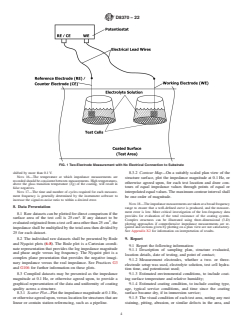
7.2.1 Two-Electrode Measurement—One test cell contains
thecoatingsurfaceusingcleanwaterandscrubbing,asneeded,
theWE and the other test cell contains the CE/RE combined as
and wipe dry with a clean rag. Inspect the surface for cracks,
a single electrode (Fig. 1).
rust-through, and other defects to ensure the selected test area
7.2.2 Three-Electrode Measurement—An alternative is for
contains no visible coating flaws.
the CE/RE to be a separate CE and RE (Fig. 2).
NOTE 9—This test method is most easily applied to horizontal or 7.2.3 Connect the electrical lead wires to the measurement
near-horizontal surfaces. The coating surface area in contact with the
electrodes and the potentiostat to complete an electrical circuit
electrolyte will impact results; maintain electrolyte contact with the
that includes the potentiostat, electrical lead wires, electrodes,
coating surface area during the measurement. Poor electrolyte contact
electrolyte, coating beneath each test cell, and conductive
with the coating surface will result in false positives. Additionally, a thin
substrate.
filmofcondensedmoistureonthecoatingsurfacebetweencellscancreate
a low-impedance pathway that could result in a false negative; for this 7.2.4 Program the potentiostat software to perform imped-
reason, it is important to ensure the coating surface is dry.
ance measurements beginning at 10 000 Hz and ending at
0.1 Hz, or lower, applying at least four measured points per
6.3 Each test location requires two test cells to perform the
impedance measurement using no electrical connection to the decade. The applied voltage shall be a sine wave at the open
circuit potential with root mean squared (rms) amplitude of
substrate. Secure two test cells to the coating surface and
achieve a watertight seal. The two cells shall be separated by a 0.01 V or higher.
distance not less than 5 cm and not more than the
NOTE 13—Use an end frequency of 0.1 Hz to balance test time and
manufacturer-supplied cables will allow.
usefulness of the data, but use lower frequencies, for example, 0.01 Hz,
for diagnostics and spot checks.The applied voltage amplitude required is
6.4 Add electrolyte solution to the test cells, allowing for
dependentonthecoatingmaterialpropertiesandthickness.Inaddition,all
recommended cure time if an adhesive is used. Allow the
potentiostats have a minimum current that they can measure. If the
electrolyte solution to hydrate into coating to achieve equilib-
measurement does not receive the signal, increase the voltage amplitude.
rium. Hydration time may range from 1 h to more than 24 h High-impedance coatings may require the rms amplitude to be 0.20 V or
higher.An open lead measurement, that is, all leads are disconnected and
and is dependent on the coating type, age, quality, and recent
open to air, may be required to evaluate the minimum current that the
exposures to water immersion or humidity (5). The shortest
potentiostat can measure. See ISO 16773-2, Annex A, or the potentiostat
hydration times apply to aged coatings and those in immersion
manufacturer’s instructions for guidelines on conducting an open lead
service. If testing is being specified for QC of a newly applied
measurement.
coating, that is, no previous hydration, the time should be at
7.2.5 If possible, review the open circuit potential to con-
least48 horotherwiseagreedupon.Iftestingisbeingspecified
firm system circuit continuity before beginning the impedance
for initial service life readings of a new coating, the hydration
measurement. An acceptable allowance for potential drift is
time required may be much longer.
60.005 V per 20 s. If a stable open circuit potential cannot be
achieved, check the measurement electrodes, electrical lead
NOT
...