

ASTM D6191-97(2021)
(Test Method)Standard Test Method for Measurement of Evolved Formaldehyde from Water Reducible Air-Dry Coatings
General Information
- Abstract
SIGNIFICANCE AND USE
4.1 This test method measures the amount of formaldehyde that is released from a coating under laboratory conditions. The amount of formaldehyde available for release from a coating may vary depending on composition, and may decrease as the sample ages.
4.2 This test method may be used for typical air dried paints where water is the major volatile material. The useful range is estimated to be from 10 ppm to 1000 ppm formaldehyde in the sample.
4.3 Significant amounts of other volatile aldehydes, such as acetaldehyde, are reported to cause an interference with the determination of formaldehyde. This limitation is not expected to cause a problem for most common water reducible coatings.
4.4 Samples containing organic solvents as the major volatile component have not been evaluated and are not expected to be compatible with this test method.
SCOPE
1.1 This test method may be used to measure the amount of formaldehyde evolved from air-dry water reducible coatings utilizing latices, resin emulsions, or water reducible alkyds. The results may be used to define the “free” formaldehyde evolved from a sample under controlled laboratory conditions.
1.2 This standard does not purport to address all of the safety concerns, if any, associated with its use. It is the responsibility of the user of this standard to establish appropriate safety, health, and environmental practices and determine the applicability of regulatory limitations prior to use.
1.3 This international standard was developed in accordance with internationally recognized principles on standardization established in the Decision on Principles for the Development of International Standards, Guides and Recommendations issued by the World Trade Organization Technical Barriers to Trade (TBT) Committee.
- Status
- Published
- Publication Date
- 31-Jan-2021
- Technical Committee
- D01 - Paint and Related Coatings, Materials, and Applications
- Drafting Committee
- D01.21 - Chemical Analysis of Paints and Paint Materials


Overview
ASTM D6191-97(2021), published by ASTM International, provides a standardized test method for measuring the amount of formaldehyde evolved from water reducible air-dry coatings. This method is specifically designed for use with coatings where water is the major volatile component, such as those formulated with latices, resin emulsions, and water reducible alkyds. The standard supports manufacturers, laboratories, and regulatory agencies in the controlled and quantitative determination of "free" formaldehyde released from air-dried coatings under laboratory conditions. The results are relevant for health, safety, quality control, and regulatory compliance in the coatings industry.
Key Topics
- Scope of Application: Applicable to air-dry, water reducible coatings using latices, resin emulsions, or water reducible alkyds.
- Measurement Range: The method is effective for formaldehyde concentrations between approximately 10 ppm and 1000 ppm in samples.
- Interferences: High levels of other volatile aldehydes (e.g., acetaldehyde) may interfere with formaldehyde determination, though this is generally not an issue for common water reducible coatings.
- Limitations: The method is not suitable for coatings where organic solvents are the major volatile components, as these have not been evaluated for this process.
- Safety Considerations: Users must ensure appropriate safety, health, and environmental practices-formaldehyde and related chemicals are hazardous.
- International Compatibility: Developed following internationally recognized standardization principles to ensure broad acceptance and regulatory alignment.
Applications
The ASTM D6191-97(2021) standard is essential for:
- Paint and Coatings Manufacturers: Assessing formaldehyde emissions during product development and quality assurance to ensure formulations meet safety standards.
- Testing Laboratories: Conducting formaldehyde emission testing for compliance, certification, or research.
- Regulatory Compliance: Providing reliable data for regulatory submissions where formaldehyde release is controlled or limited by law.
- Indoor Air Quality Assessment: Supporting the evaluation of materials that impact indoor air quality in residential, commercial, or institutional environments.
- Health and Safety Evaluations: Identifying potential occupational exposures for workers involved in the application or handling of air-dry water reducible coatings.
- Product Labeling: Supplying evidence for claims related to low-formaldehyde or low-emission coatings.
Related Standards
To supplement formaldehyde emission testing and further ensure compliance, consider these related ASTM standards:
- ASTM D2194: Formerly provided a test method for concentration of formaldehyde solutions (now withdrawn). Referenced as a calibration method in this standard.
- ASTM D01 Standards: Covers paints, related coatings, materials, and chemical analyses.
- Other VOC Measurement Standards: Explore additional ASTM guidelines for measuring volatile organic compound (VOC) content and emissions in paints and coatings.
- WTO TBT Principles: The development of ASTM D6191-97(2021) aligns with the World Trade Organization’s Technical Barriers to Trade requirements for international standardization.
Practical Value
Implementing ASTM D6191-97(2021) ensures precise and reproducible measurement of evolved formaldehyde from water reducible coatings, thus helping stakeholders:
- Comply with international product safety regulations
- Maintain high indoor air quality standards
- Foster consumer confidence in low-emission coatings
- Enable accurate product comparisons and quality control
For manufacturers and testing authorities, this standard offers a consistent approach to formaldehyde emission measurement, supporting safer and more sustainable coatings solutions.
Keywords: ASTM D6191, evolved formaldehyde, water reducible coatings, air-dry coatings, formaldehyde emission test, coatings industry standard, VOC testing, indoor air quality, regulatory compliance.
Relations
- Effective Date
- 01-Jun-2007
Get Certified
Connect with accredited certification bodies for this standard

DVS-ZERT GmbH
German welding certification society.
CARES (UK Certification Authority for Reinforcing Steels)
UK certification for reinforcing steels and construction.
EWF/IIW (European/International Welding Federation)
International welding personnel certification.
Sponsored listings
Frequently Asked Questions
ASTM D6191-97(2021) is a standard published by ASTM International. Its full title is "Standard Test Method for Measurement of Evolved Formaldehyde from Water Reducible Air-Dry Coatings". This standard covers: SIGNIFICANCE AND USE 4.1 This test method measures the amount of formaldehyde that is released from a coating under laboratory conditions. The amount of formaldehyde available for release from a coating may vary depending on composition, and may decrease as the sample ages. 4.2 This test method may be used for typical air dried paints where water is the major volatile material. The useful range is estimated to be from 10 ppm to 1000 ppm formaldehyde in the sample. 4.3 Significant amounts of other volatile aldehydes, such as acetaldehyde, are reported to cause an interference with the determination of formaldehyde. This limitation is not expected to cause a problem for most common water reducible coatings. 4.4 Samples containing organic solvents as the major volatile component have not been evaluated and are not expected to be compatible with this test method. SCOPE 1.1 This test method may be used to measure the amount of formaldehyde evolved from air-dry water reducible coatings utilizing latices, resin emulsions, or water reducible alkyds. The results may be used to define the “free” formaldehyde evolved from a sample under controlled laboratory conditions. 1.2 This standard does not purport to address all of the safety concerns, if any, associated with its use. It is the responsibility of the user of this standard to establish appropriate safety, health, and environmental practices and determine the applicability of regulatory limitations prior to use. 1.3 This international standard was developed in accordance with internationally recognized principles on standardization established in the Decision on Principles for the Development of International Standards, Guides and Recommendations issued by the World Trade Organization Technical Barriers to Trade (TBT) Committee.
SIGNIFICANCE AND USE 4.1 This test method measures the amount of formaldehyde that is released from a coating under laboratory conditions. The amount of formaldehyde available for release from a coating may vary depending on composition, and may decrease as the sample ages. 4.2 This test method may be used for typical air dried paints where water is the major volatile material. The useful range is estimated to be from 10 ppm to 1000 ppm formaldehyde in the sample. 4.3 Significant amounts of other volatile aldehydes, such as acetaldehyde, are reported to cause an interference with the determination of formaldehyde. This limitation is not expected to cause a problem for most common water reducible coatings. 4.4 Samples containing organic solvents as the major volatile component have not been evaluated and are not expected to be compatible with this test method. SCOPE 1.1 This test method may be used to measure the amount of formaldehyde evolved from air-dry water reducible coatings utilizing latices, resin emulsions, or water reducible alkyds. The results may be used to define the “free” formaldehyde evolved from a sample under controlled laboratory conditions. 1.2 This standard does not purport to address all of the safety concerns, if any, associated with its use. It is the responsibility of the user of this standard to establish appropriate safety, health, and environmental practices and determine the applicability of regulatory limitations prior to use. 1.3 This international standard was developed in accordance with internationally recognized principles on standardization established in the Decision on Principles for the Development of International Standards, Guides and Recommendations issued by the World Trade Organization Technical Barriers to Trade (TBT) Committee.
ASTM D6191-97(2021) is classified under the following ICS (International Classification for Standards) categories: 25.220.99 - Other treatments and coatings. The ICS classification helps identify the subject area and facilitates finding related standards.
ASTM D6191-97(2021) has the following relationships with other standards: It is inter standard links to ASTM D2194-02(2007). Understanding these relationships helps ensure you are using the most current and applicable version of the standard.
ASTM D6191-97(2021) is available in PDF format for immediate download after purchase. The document can be added to your cart and obtained through the secure checkout process. Digital delivery ensures instant access to the complete standard document.
Standards Content (Sample)
This international standard was developed in accordance with internationally recognized principles on standardization established in the Decision on Principles for the
Development of International Standards, Guides and Recommendations issued by the World Trade Organization Technical Barriers to Trade (TBT) Committee.
Designation: D6191 − 97 (Reapproved 2021)
Standard Test Method for
Measurement of Evolved Formaldehyde from Water
Reducible Air-Dry Coatings
This standard is issued under the fixed designation D6191; the number immediately following the designation indicates the year of
original adoption or, in the case of revision, the year of last revision. A number in parentheses indicates the year of last reapproval. A
superscript epsilon (´) indicates an editorial change since the last revision or reapproval.
1. Scope 4. Significance and Use
1.1 This test method may be used to measure the amount of
4.1 This test method measures the amount of formaldehyde
formaldehyde evolved from air-dry water reducible coatings
that is released from a coating under laboratory conditions.The
utilizing latices, resin emulsions, or water reducible alkyds.
amount of formaldehyde available for release from a coating
The results may be used to define the “free” formaldehyde
may vary depending on composition, and may decrease as the
evolved from a sample under controlled laboratory conditions.
sample ages.
1.2 This standard does not purport to address all of the
4.2 This test method may be used for typical air dried paints
safety concerns, if any, associated with its use. It is the
where water is the major volatile material. The useful range is
responsibility of the user of this standard to establish appro-
estimated to be from 10 ppm to 1000 ppm formaldehyde in the
priate safety, health, and environmental practices and deter-
sample.
mine the applicability of regulatory limitations prior to use.
4.3 Significant amounts of other volatile aldehydes, such as
1.3 This international standard was developed in accor-
acetaldehyde, are reported to cause an interference with the
dance with internationally recognized principles on standard-
determination of formaldehyde. This limitation is not expected
ization established in the Decision on Principles for the
to cause a problem for most common water reducible coatings.
Development of International Standards, Guides and Recom-
mendations issued by the World Trade Organization Technical
4.4 Samples containing organic solvents as the major vola-
Barriers to Trade (TBT) Committee.
tile component have not been evaluated and are not expected to
be compatible with this test method.
2. Referenced Documents
5. Apparatus
2.1 ASTM Standards:
D2194 Test Method for Concentration of Formaldehyde
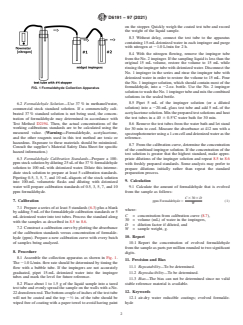
5.1 Formaldehyde CollectionApparatus, assembled using a
Solutions (Withdrawn 2021)
flowmeter to control the nitrogen flow at ; 1.0 L/min, a 25 by
200 mm outside diameter long glass test tube, and two 30-mL
3. Summary of Test Method
midget impingers. Connections are made with glass tubes
through a No. 4 two-hole rubber stopper and clear flexible
3.1 A sample of water reducible coating is placed on the
tubing (see Fig. 1).
walls of a test tube with a drawdown rod and purged with
nitrogen. The evolved formaldehyde is collected in deionized
5.2 Drawdown Bar, stainless steel No. 22 wire-wound
water with tandem impingers and measured colorimetrically
6.4-mm rod.
using acetylacetone at 412 nm.
5.3 Glass Sample Bottles, (;2 oz), capable of holding
30-mL solution.
This test method is under the jurisdiction of ASTM Committee D01 on Paint
5.4 Spectrophotometer, capable of measuring the absor-
and Related Coatings, Materials, andApplications and is the direct responsibility of
banceofsolutionsat412nmwithaminimumsamplelightpath
Subcommittee D01.21 on Chemical Analysis of Paints and Paint Materials.
of 10 mm.
Current edition approved Feb. 1, 2021. Published March 2021. Originally
approved in 1997. Last previous edition approved in 2014 as D6191 – 97 (2014).
DOI: 10.1520/D6191-97R21.
6. Reagents
For referenced ASTM standards, visit the ASTM website, www.astm.org, or
contact ASTM Customer Service at service@astm.org. For Annual Book of ASTM
6.1 Acetylacetone Solution—Dissolve 150 6 0.1 g ammo-
Standards volume information, refer to the standard’s Document Summary page on
nium acetate in ;600 mL deionized water in a 1-L volumetric
the ASTM website.
flask.Add 3.0-mLglacial acetic acid and 2.0-mLacetylacetone
The last approved version of this historical standard is referenced on
www.astm.org. (2,4 pentanedione) and dilute to volume.
Copyright © ASTM International, 100 Barr Harbor Drive, PO Box C700, West Conshohocken, PA 19428-2959. United States
D6191 − 97 (2021)
on the stopper. Quickly weigh the coated test tube and record
the weight of the liquid sample.
8.3 Without delay, connect the test tube to the apparatus
containing 15-mL deionized water in each impinger and purge
with nitrogen at ;1.0 L/min for 2 h.
8.4 With the nitrogen flowing, remove the impinger tube
from the No. 2 impinger. If the sampling liquid is less than the
original 15 mL volume, restore the volume to 15 mL while
rinsing the impinger tube with deionized water. Disconnect the
No. 1 impinger in the series and rinse the impinger tube with
deionized water in order to restore the volume to 15 mL. Pour
the No. 1 impinger solution, which should
...