

ASTM C1710-24
(Guide)Standard Guide for Installation of Flexible Closed Cell Preformed Insulation in Tube and Sheet Form
General Information
- Abstract
SIGNIFICANCE AND USE
5.1 This guide applies to flexible closed cell insulation tubing and sheet materials manufactured according to Specifications C534 and C1427. This standard is intended to provide a basic guide for installing these types of materials.
5.2 Confirm application use temperature is consistent with specified use temperature for material as defined in ASTM Specifications unless otherwise agreed upon with the manufacturer. There are different grades for each of the insulation types referred to in this guide, material and grade installed should be that specified.
5.3 This guide is not intended to cover all aspects associated with installation for all applications, consult the National, Commercial Industrial Insulation Standards (MICA Manual) or the specific product manufacturer for recommendations, or both. See ASHRAE Handbook (Fundamentals – Chapter 23) and ASHRAE Handbook (Refrigeration – Chapter 10).
SCOPE
1.1 This guide covers recommended installation techniques for flexible closed cell pre-formed insulation in tube or sheet form. This guide is applicable to materials manufactured in accordance with Specification C534 (Elastomeric based insulation) or Specification C1427 (polyolefin based insulation). The materials covered in this guide encompass a service temperature of –297 to 300°F (–183 to 150°C) as indicated in the material specifications referenced above. Many of the recommendations made are specific to below ambient applications only.
1.2 The purpose of this guide is to optimize the thermal performance and longevity of installed closed cell flexible insulation systems. By following this guide, the owner, and designer can expect to achieve the energy savings expected and prevention of condensation under the specified design conditions. This document is limited to installation procedures and does not encompass system design.
1.3 The values stated in inch-pound units are to be regarded as standard. The values given in parentheses are mathematical conversions to SI units that are provided for information only and are not considered standard.
1.4 This standard does not purport to address all of the safety concerns, if any, associated with its use. It is the responsibility of the user of this standard to establish appropriate safety, health, and environmental practices and determine the applicability of regulatory limitations prior to use.
1.5 This international standard was developed in accordance with internationally recognized principles on standardization established in the Decision on Principles for the Development of International Standards, Guides and Recommendations issued by the World Trade Organization Technical Barriers to Trade (TBT) Committee.
- Status
- Published
- Publication Date
- 29-Feb-2024
- Technical Committee
- C16 - Thermal Insulation
- Drafting Committee
- C16.40 - Insulation Systems
Buy Documents
ASTM C1710-24 - Standard Guide for Installation of Flexible Closed Cell Preformed Insulation in Tube and Sheet Form
REDLINE ASTM C1710-24 - Standard Guide for Installation of Flexible Closed Cell Preformed Insulation in Tube and Sheet Form
Overview
ASTM C1710-24: Standard Guide for Installation of Flexible Closed Cell Preformed Insulation in Tube and Sheet Form provides comprehensive guidelines for the proper installation of flexible closed cell tubular and sheet insulation materials. These materials are widely used for thermal insulation in HVAC systems, piping, vessels, and ducts. The guide applies to products manufactured in accordance with ASTM C534 (elastomeric-based insulation) and ASTM C1427 (polyolefin-based insulation), with a focus on preserving thermal performance, energy efficiency, and moisture control.
Designed for professionals in mechanical insulation, this standard supports energy savings, condensation prevention, and system longevity through the use of best installation practices.
Key Topics
Material Scope and Temperature Range
- Coverage includes elastomeric and polyolefin flexible closed cell insulation in tube and sheet form.
- Applicable to systems functioning within –297°F to 300°F (–183°C to 150°C), as specified by manufacturer standards.
Installation Best Practices
- Do not pull or stretch insulation; always push or slightly oversize to maintain thickness.
- Surfaces must be clean and dry before application. Special care is needed for systems in operation to prevent moisture entrapment.
- All seams, butt joints, cutouts, and termination points must be sealed with an approved adhesive system to prevent air and moisture ingress.
- For below-ambient applications and high humidity environments, use vapor stops and barriers to control moisture migration.
Special Situations
- Guidance for fitting insulation, including elbows, tees, valves, and large diameter pipes.
- Recommendations for pipes, ducts, tanks, vessels, and when layering insulation.
- Mechanical protection-such as jacketing or cladding-is recommended for areas subject to mechanical abuse or outdoor installation.
Inspection and Safety
- Final inspection should ensure correct material, size, and absence of damage or unsealed seams, which are the most common cause of insulation failure.
- Users must establish appropriate health, safety, and environmental procedures, including ventilation and personal protective equipment when using adhesives.
Applications
Flexible closed cell preformed insulation is essential for:
- Mechanical Piping Systems: Used extensively on chilled water, refrigeration lines, and hot water piping to prevent condensation, maintain energy efficiency, and provide long-term thermal protection.
- HVAC Ductwork: Wrapped on rectangular, round, or oval ducts for temperature control and condensation prevention, especially in commercial and industrial settings.
- Process Equipment: Insulating tanks, vessels, and large diameter process pipes in commercial and industrial facilities.
- Special Environments: Suitable for applications requiring resistance to below-ambient temperatures, direct burial (with appropriate recommendations), or systems exposed to outdoor conditions.
By adhering to this guide, facility owners, engineers, and insulation contractors can expect optimal system performance, reduced energy loss, and longer service life for insulated systems.
Related Standards
- ASTM C534: Specification for Preformed Flexible Elastomeric Cellular Thermal Insulation in Sheet and Tubular Form
- ASTM C1427: Specification for Extruded Preformed Flexible Cellular Polyolefin Thermal Insulation in Sheet and Tubular Form
- ASTM C585: Practice for Inner and Outer Diameters of Thermal Insulation for Nominal Sizes of Pipe and Tubing
- MICA Manual: National Commercial and Industrial Insulation Standards
- ASHRAE Handbook: Fundamentals (Chapter 23) and Refrigeration (Chapter 10)
These documents collectively provide a framework for selecting, installing, and maintaining flexible closed cell insulation systems in a wide variety of commercial, industrial, and institutional applications.
ASTM C1710-24 ensures that flexible closed cell insulation systems are properly installed for maximum performance, addressing energy efficiency, condensation control, and installation quality across various mechanical and building services applications.
Relations
- Effective Date
- 01-Mar-2024
- Effective Date
- 15-Apr-2024
- Effective Date
- 01-May-2022
- Effective Date
- 01-Mar-2024
Buy Documents
ASTM C1710-24 - Standard Guide for Installation of Flexible Closed Cell Preformed Insulation in Tube and Sheet Form
REDLINE ASTM C1710-24 - Standard Guide for Installation of Flexible Closed Cell Preformed Insulation in Tube and Sheet Form
Get Certified
Connect with accredited certification bodies for this standard

IMQ S.p.A. (Certification)
Italian electrical product certification.

SLG Prüf- und Zertifizierungs GmbH
German testing and certification body.

UL Solutions
Global safety science company with testing, inspection and certification.
Sponsored listings
Frequently Asked Questions
ASTM C1710-24 is a guide published by ASTM International. Its full title is "Standard Guide for Installation of Flexible Closed Cell Preformed Insulation in Tube and Sheet Form". This standard covers: SIGNIFICANCE AND USE 5.1 This guide applies to flexible closed cell insulation tubing and sheet materials manufactured according to Specifications C534 and C1427. This standard is intended to provide a basic guide for installing these types of materials. 5.2 Confirm application use temperature is consistent with specified use temperature for material as defined in ASTM Specifications unless otherwise agreed upon with the manufacturer. There are different grades for each of the insulation types referred to in this guide, material and grade installed should be that specified. 5.3 This guide is not intended to cover all aspects associated with installation for all applications, consult the National, Commercial Industrial Insulation Standards (MICA Manual) or the specific product manufacturer for recommendations, or both. See ASHRAE Handbook (Fundamentals – Chapter 23) and ASHRAE Handbook (Refrigeration – Chapter 10). SCOPE 1.1 This guide covers recommended installation techniques for flexible closed cell pre-formed insulation in tube or sheet form. This guide is applicable to materials manufactured in accordance with Specification C534 (Elastomeric based insulation) or Specification C1427 (polyolefin based insulation). The materials covered in this guide encompass a service temperature of –297 to 300°F (–183 to 150°C) as indicated in the material specifications referenced above. Many of the recommendations made are specific to below ambient applications only. 1.2 The purpose of this guide is to optimize the thermal performance and longevity of installed closed cell flexible insulation systems. By following this guide, the owner, and designer can expect to achieve the energy savings expected and prevention of condensation under the specified design conditions. This document is limited to installation procedures and does not encompass system design. 1.3 The values stated in inch-pound units are to be regarded as standard. The values given in parentheses are mathematical conversions to SI units that are provided for information only and are not considered standard. 1.4 This standard does not purport to address all of the safety concerns, if any, associated with its use. It is the responsibility of the user of this standard to establish appropriate safety, health, and environmental practices and determine the applicability of regulatory limitations prior to use. 1.5 This international standard was developed in accordance with internationally recognized principles on standardization established in the Decision on Principles for the Development of International Standards, Guides and Recommendations issued by the World Trade Organization Technical Barriers to Trade (TBT) Committee.
SIGNIFICANCE AND USE 5.1 This guide applies to flexible closed cell insulation tubing and sheet materials manufactured according to Specifications C534 and C1427. This standard is intended to provide a basic guide for installing these types of materials. 5.2 Confirm application use temperature is consistent with specified use temperature for material as defined in ASTM Specifications unless otherwise agreed upon with the manufacturer. There are different grades for each of the insulation types referred to in this guide, material and grade installed should be that specified. 5.3 This guide is not intended to cover all aspects associated with installation for all applications, consult the National, Commercial Industrial Insulation Standards (MICA Manual) or the specific product manufacturer for recommendations, or both. See ASHRAE Handbook (Fundamentals – Chapter 23) and ASHRAE Handbook (Refrigeration – Chapter 10). SCOPE 1.1 This guide covers recommended installation techniques for flexible closed cell pre-formed insulation in tube or sheet form. This guide is applicable to materials manufactured in accordance with Specification C534 (Elastomeric based insulation) or Specification C1427 (polyolefin based insulation). The materials covered in this guide encompass a service temperature of –297 to 300°F (–183 to 150°C) as indicated in the material specifications referenced above. Many of the recommendations made are specific to below ambient applications only. 1.2 The purpose of this guide is to optimize the thermal performance and longevity of installed closed cell flexible insulation systems. By following this guide, the owner, and designer can expect to achieve the energy savings expected and prevention of condensation under the specified design conditions. This document is limited to installation procedures and does not encompass system design. 1.3 The values stated in inch-pound units are to be regarded as standard. The values given in parentheses are mathematical conversions to SI units that are provided for information only and are not considered standard. 1.4 This standard does not purport to address all of the safety concerns, if any, associated with its use. It is the responsibility of the user of this standard to establish appropriate safety, health, and environmental practices and determine the applicability of regulatory limitations prior to use. 1.5 This international standard was developed in accordance with internationally recognized principles on standardization established in the Decision on Principles for the Development of International Standards, Guides and Recommendations issued by the World Trade Organization Technical Barriers to Trade (TBT) Committee.
ASTM C1710-24 is classified under the following ICS (International Classification for Standards) categories: 29.035.20 - Plastics and rubber insulating materials. The ICS classification helps identify the subject area and facilitates finding related standards.
ASTM C1710-24 has the following relationships with other standards: It is inter standard links to ASTM C1710-22, ASTM C168-24, ASTM C168-22, ASTM C450-18. Understanding these relationships helps ensure you are using the most current and applicable version of the standard.
ASTM C1710-24 is available in PDF format for immediate download after purchase. The document can be added to your cart and obtained through the secure checkout process. Digital delivery ensures instant access to the complete standard document.
Standards Content (Sample)
This international standard was developed in accordance with internationally recognized principles on standardization established in the Decision on Principles for the
Development of International Standards, Guides and Recommendations issued by the World Trade Organization Technical Barriers to Trade (TBT) Committee.
Designation: C1710 − 24
Standard Guide for
Installation of Flexible Closed Cell Preformed Insulation in
Tube and Sheet Form
This standard is issued under the fixed designation C1710; the number immediately following the designation indicates the year of
original adoption or, in the case of revision, the year of last revision. A number in parentheses indicates the year of last reapproval. A
superscript epsilon (´) indicates an editorial change since the last revision or reapproval.
1. Scope 2. Referenced Documents
2.1 ASTM Standards:
1.1 This guide covers recommended installation techniques
C168 Terminology Relating to Thermal Insulation
for flexible closed cell pre-formed insulation in tube or sheet
C534 Specification for Preformed Flexible Elastomeric Cel-
form. This guide is applicable to materials manufactured in
lular Thermal Insulation in Sheet and Tubular Form
accordance with Specification C534 (Elastomeric based insu-
C585 Practice for Inner and Outer Diameters of Thermal
lation) or Specification C1427 (polyolefin based insulation).
Insulation for Nominal Sizes of Pipe and Tubing
The materials covered in this guide encompass a service
C1427 Specification for Extruded Preformed Flexible Cel-
temperature of –297 to 300°F (–183 to 150°C) as indicated in
lular Polyolefin Thermal Insulation in Sheet and Tubular
the material specifications referenced above. Many of the
Form
recommendations made are specific to below ambient applica-
2.2 Other Standards:
tions only.
National Commerical, Industrial Insulation Standards
1.2 The purpose of this guide is to optimize the thermal
(MICA Manual)
performance and longevity of installed closed cell flexible
ASHRAE Handbook (Fundamentals – Chapter 23)
insulation systems. By following this guide, the owner, and
ASHRAE Handbook (Refrigeration – Chapter 10)
designer can expect to achieve the energy savings expected and
3. Terminology
prevention of condensation under the specified design condi-
tions. This document is limited to installation procedures and 3.1 Definitions—Terminology C168 shall be considered as
does not encompass system design. applying to the terms in this specification.
3.2 Definitions of Terms Specific to This Standard:
1.3 The values stated in inch-pound units are to be regarded
3.2.1 seams—Longitudinal or horizontal cross-sections
as standard. The values given in parentheses are mathematical
where insulation meets and must be adhered to itself or other
conversions to SI units that are provided for information only
system components.
and are not considered standard.
3.2.2 butt joints—Cross-sections where two pieces of tubu-
1.4 This standard does not purport to address all of the
lar or sheet insulation must be adhered to itself or other system
safety concerns, if any, associated with its use. It is the
components.
responsibility of the user of this standard to establish appro-
3.2.3 vapor (water) stops—Locations / methods to prevent
priate safety, health, and environmental practices and deter-
water or water vapor from traveling from one pipe insulation
mine the applicability of regulatory limitations prior to use.
section to an adjacent insulation and prevent water traveling
1.5 This international standard was developed in accor-
down the annular space between the pipe insulation and the
dance with internationally recognized principles on standard-
tubular pipe.
ization established in the Decision on Principles for the
3.2.4 sleeving/multi layering—Applying another layer of
Development of International Standards, Guides and Recom-
insulation over the first layer. This process is used when the
mendations issued by the World Trade Organization Technical
Barriers to Trade (TBT) Committee.
For referenced ASTM standards, visit the ASTM website, www.astm.org, or
contact ASTM Customer Service at service@astm.org. For Annual Book of ASTM
Standards volume information, refer to the standard’s Document Summary page on
This guide is under the jurisdiction of ASTM Committee C16 on Thermal the ASTM website.
Insulation and is the direct responsibility of Subcommittee C16.40 on Insulation Available from MICA (Midwest Insulation Contractors Association) 16712 Elm
Systems. Circle, Omaha, NE 68130. http://www.micainsulation.org.
Current edition approved March 1, 2024. Published April 2024. Originally Available from American Society of Heating, Refrigerating, and Air-
approved in 2009. Last previous edition approved in 2022 as C1710 – 22. DOI: Conditioning Engineers, Inc. (ASHRAE), 1791 Tullie Circle, NE, Atlanta, GA
10.1520/C1710-24. 30329, http://www.ashrae.org.
Copyright © ASTM International, 100 Barr Harbor Drive, PO Box C700, West Conshohocken, PA 19428-2959. United States
C1710 − 24
insulation thickness required is greater than that which is 6. Workmanship, Finish and Appearance
commercially available. This technique is also employed when
6.1 The insulation shall have no visible defects that will
proper installation practice requires multiple layers and or
adversely affect its performance or appearance. Materials shall
staggered joint application, even if a single layer thickness is
be kept clean and dry until used. Use good quality tools at all
available.
times. Ensure cleanliness of insulation products, pipe work,
vessels, fittings and tools. Avoid dust, dirt, oil or water on
4. Summary of Guide
surfaces and equipment. It is recommended to apply insulation
4.1 Proper insulation thickness shall be installed as specified
to a system which is not in operation. If insulation must be
and not compromised. The integrity of the insulation system
applied to a system that is operating, special precautions must
shall be maintained throughout the application. Never pull or
be taken to prevent condensation from being trapped in the
stretch insulation, always push or over-size insulation.
insulation envelope. Never stretch insulation to fit. Specified
dimensions for the inner diameter (ID) and wall thickness shall
4.2 All seams, butt joints, cutouts and termination points
be adhered to.
shall be sealed with a manufacturer’s approved adhesive to
prevent air/moisture intrusion. For below ambient applications,
7. Dimensional Tolerances
install vapor stops at all insulation terminations or
interruptions, such as at supports, valves and flanges This can
7.1 Dimensions for the ID, wall and length shall conform to
be accomplished by several methods; by adhering the insula-
tolerances published by the manufacturer and or applicable
tion directly to the pipe using a 2 in. (50 mm) strip of contact
ASTM standards, for example Specifications C534 and C1427
adhesive or sealant to maintain closure, insulation tape can also
and Practice C585 can be used to determine the outer diameter
be used for this purpose by wrapping it around the pipe. A
of the insulation for sizing jacketing and fitting dimensions.
vapor barrier mastic or tape can also be used for this purpose.
On straight runs, install vapor stops every 18 ft (5.4 m) to
8. General Installation Recommendations
minimize moisture problems if they occur.
8.1 All seams, butt joints, cut outs and termination points
4.3 Specific product Manufacturer’s recommended instal-
should be sealed with a manufacturer’s approved system.
lation practices shall be used in all cases.
External taping of seams is not recommended as an exclusive
4.4 Product should be applied to clean, dry surfaces. If the method of sealing joints or seams for below ambient systems.
system is operating, additional steps may be needed to insure a
Approved adhesives can be: contact adhesives, spray adhesives
proper installation. or pressure sensitive adhesives. Water based adhesives are not
recommended because of their slow drying time which causes
4.5 A coating, jacket, cladding or appropriate protection
them to pull apart. Adhesives should be applied according to
shall be used where mechanical abuse or damage is expected.
manufacturer’s recommendations. A thinner layer of adhesive
Outdoor applications may require special consideration – refer
is best, with 100 % coverage on both surfaces. Always keep
to the manufacturer’s recommendations.
adhesives stirred thoroughly. Allow solvents to dissipate before
4.6 For satisfactory performance, properly installed protec-
combining two surfaces. This will be determined by time,
tive vapor retarders/barriers and vapor stops must be used on
temperature and adhesive type. Ensure all seams are aligned,
high relative humidity and below ambient temperature appli-
tight, and are completely sealed.
cations to reduce movement of moisture through or around the
8.2 The specified insulation thickness should be maintained
insulation to the colder interior surface.
throughout the installation. When using unslit tubular insula-
tion on pipe work being installed, the insulation should be
5. Significance and Use
slid/pushed on the pipe, never pulled as this will stretch and
5.1 This guide applies to flexible closed cell insulation
thin the insulation. The insulation is not to be stretched to fit.
tubing and sheet materials manufactured according to Specifi-
All insulation should be installed under slight compression to
cations C534 and C1427. This standard is intended to provide
ensure a snug fit. Accommodations need to be made to prevent
a basic guide for installing these types of materials.
the insulation from being compressed by weight; that is, pipe
hangers. For applications where the pipe work is already
5.2 Confirm application use temperature is consistent with
installed, the insulation must be slit and adhesive applied or
specified use temperature for material as defined in ASTM
pre-slit/pre-glued insulation used.
Specifications unless otherwise agreed upon with the manufac-
turer. There are different grades for each of the insulation types
8.3 Install insulation on systems that are dry, at room
referred to in this guide, material and grade installed should be
temperature and already pressure tested.
that specified.
8.4 Use miter boxes or templates for making accurate cuts.
5.3 This guide is not intended to cover all aspects associated
See Fig. 1. Keep to correct dimensions. Do not cut the
with installation for all applications, consult the National,
insulation short and stretch it to fit the space.
Commercial Industrial Insulation Standards (MICA Manual) or
the specific product manufacturer for recommendations, or 8.5 Slide insulation on straight piping runs whenever pos-
both. See ASHRAE Handbook (Fundamentals – Chapter 23) sible to reduce seams. If insulation must be slit to apply to
and ASHRAE Handbook (Refrigeration – Chapter 10). piping, slit in a straight line. On large ID insulation where the
C1710 − 24
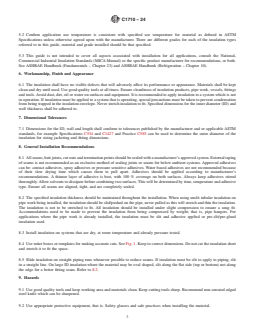
FIG. 1 USE Miter Box For Making Cuts
material may be oval shaped, slit along the flat side (top or 9.3 Provide suitable ventilation when working with solvent
bottom) not along the edge for a better fitting seam. Refer to based adhesives.
8.2.
10. Recommendations for Specific Installation Situations
9. Hazards
10.1 Straight Pipe Section – unjoined—Slide insulation
9.1 Use good quality tools and keep working area and
along the pipe work for straight runs. Seal all butt joints, cut
materials clean. Keep cutting tools sharp. Recommend non-
outs and termination points. See Fig. 2.
serrated edged steel knife which can be sharpened.
10.1.1 Slit tube in a straight line (Fig. 3). Apply a thin brush
9.2 Use appropriate protective equipment, that is. Safety coat of contact adhesive to each seam. Slip the insulation over
glasses and safe practices when installing the material. the pipe. Allow adhesive to properly set and press seams
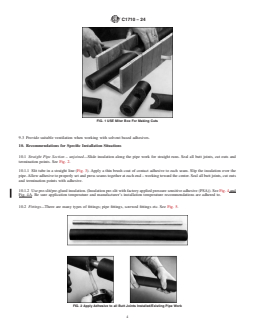
FIG. 2 Apply Adhesive to all Butt Joints Installed/Existing Pipe Work
C1710 − 24
other. See Fig. 6. Apply contact adhesive to both faces and
press firmly together when properly set. Slit open the formed
bend by cutting through the throat or heel of fitting. Apply
brush coat of contact adhesive to both longitudinal seams of the
fabricated fitting. Place over bend and press seams firmly
together. See Fig. 7. Fabricate 45s in a similar manner.
10.2.2 Optional (but not optimal) Method—Slide insulation
aroun
...
This document is not an ASTM standard and is intended only to provide the user of an ASTM standard an indication of what changes have been made to the previous version. Because
it may not be technically possible to adequately depict all changes accurately, ASTM recommends that users consult prior editions as appropriate. In all cases only the current version
of the standard as published by ASTM is to be considered the official document.
Designation: C1710 − 22 C1710 − 24
Standard Guide for
Installation of Flexible Closed Cell Preformed Insulation in
Tube and Sheet Form
This standard is issued under the fixed designation C1710; the number immediately following the designation indicates the year of
original adoption or, in the case of revision, the year of last revision. A number in parentheses indicates the year of last reapproval. A
superscript epsilon (´) indicates an editorial change since the last revision or reapproval.
1. Scope
1.1 This guide covers recommended installation techniques for flexible closed cell pre-formed insulation in tube or sheet form.
This guide is applicable to materials manufactured in accordance with Specification C534 (Elastomeric based insulation) or
Specification C1427 (polyolefin based insulation). The materials covered in this guide encompass a service temperature of –297
to 300°F (–183 to 150°C) as indicated in the material specifications referenced above. Many of the recommendations made are
specific to below ambient applications only.
1.2 The purpose of this guide is to optimize the thermal performance and longevity of installed closed cell flexible insulation
systems. By following this guide, the owner, and designer can expect to achieve the energy savings expected and prevention of
condensation under the specified design conditions. This document is limited to installation procedures and does not encompass
system design.
1.3 The values stated in inch-pound units are to be regarded as standard. The values given in parentheses are mathematical
conversions to SI units that are provided for information only and are not considered standard.
1.4 This standard does not purport to address all of the safety concerns, if any, associated with its use. It is the responsibility
of the user of this standard to establish appropriate safety, health, and environmental practices and determine the applicability of
regulatory limitations prior to use.
1.5 This international standard was developed in accordance with internationally recognized principles on standardization
established in the Decision on Principles for the Development of International Standards, Guides and Recommendations issued
by the World Trade Organization Technical Barriers to Trade (TBT) Committee.
2. Referenced Documents
2.1 ASTM Standards:
C168 Terminology Relating to Thermal Insulation
C534 Specification for Preformed Flexible Elastomeric Cellular Thermal Insulation in Sheet and Tubular Form
C585 Practice for Inner and Outer Diameters of Thermal Insulation for Nominal Sizes of Pipe and Tubing
C1427 Specification for Extruded Preformed Flexible Cellular Polyolefin Thermal Insulation in Sheet and Tubular Form
This guide is under the jurisdiction of ASTM Committee C16 on Thermal Insulation and is the direct responsibility of Subcommittee C16.40 on Insulation Systems.
Current edition approved March 1, 2022March 1, 2024. Published April 2022April 2024. Originally approved in 2009. Last previous edition approved in 20212022 as
C1710 – 21a.C1710 – 22. DOI: 10.1520/C1710-22.10.1520/C1710-24.
For referenced ASTM standards, visit the ASTM website, www.astm.org, or contact ASTM Customer Service at service@astm.org. For Annual Book of ASTM Standards
volume information, refer to the standard’s Document Summary page on the ASTM website.
Copyright © ASTM International, 100 Barr Harbor Drive, PO Box C700, West Conshohocken, PA 19428-2959. United States
C1710 − 24
2.2 Other Standards:
National Commerical, Industrial Insulation Standards (MICA Manual)
ASHRAE Handbook (Fundamentals – Chapter 23)
ASHRAE Handbook (Refrigeration – Chapter 10)
3. Terminology
3.1 Definitions—Terminology C168 shall be considered as applying to the terms in this specification.
3.2 Definitions of Terms Specific to This Standard:
3.2.1 seams—Longitudinal or horizontal cross-sections where insulation meets and must be adhered to itself or other system
components.
3.2.2 butt joints—Cross-sections where two pieces of tubular or sheet insulation must be adhered to itself or other system
components.
3.2.3 vapor (water) stops—Locations / methods to prevent water or water vapor from traveling from one pipe insulation section
to an adjacent insulation and prevent water traveling down the annular space between the pipe insulation and the tubular pipe.
3.2.4 sleeving/multi layering—Applying another layer of insulation over the first layer. This process is used when the insulation
thickness required is greater than that which is commercially available. This technique is also employed when proper installation
practice requires multiple layers and or staggered joint application, even if a single layer thickness is available.
4. Summary of Guide
4.1 Proper insulation thickness shall be installed as specified and not compromised. The integrity of the insulation system shall
be maintained throughout the application. Never pull or stretch insulation, always push or over-size insulation.
4.2 All seams, butt joints, cutouts and termination points shall be sealed with a manufacturer’s approved adhesive to prevent
air/moisture intrusion. For below ambient applications, install vapor stops at all insulation terminations or interruptions, such as
at supports, valves and flanges This can be accomplished by several methods; by adhering the insulation directly to the pipe using
a 2 in. (50 mm) strip of contact adhesive or sealant to maintain closure, insulation tape can also be used for this purpose by
wrapping it around the pipe. A vapor barrier mastic or tape can also be used for this purpose. On straight runs, install vapor stops
every 18 ft (5.4 m) to minimize moisture problems if they occur.
4.3 Specific product Manufacturer’s recommended installation practices shall be used in all cases.
4.4 Product should be applied to clean, dry surfaces. If the system is operating, additional steps may be needed to insure a proper
installation.
4.5 A coating, jacket, cladding or appropriate protection shall be used where mechanical abuse or damage is expected. Outdoor
applications may require special consideration – refer to the manufacturer’s recommendations.
4.6 For satisfactory performance, properly installed protective vapor retarders/barriers and vapor stops must be used on high
relative humidity and below ambient temperature applications to reduce movement of moisture through or around the insulation
to the colder interior surface.
5. Significance and Use
5.1 This guide applies to flexible closed cell insulation tubing and sheet materials manufactured according to Specifications C534
and C1427. This standard is intended to provide a basic guide for installing these types of materials.
Available from MICA (Midwest Insulation Contractors Association) 16712 Elm Circle, Omaha, NE 68130. http://www.micainsulation.org.
Available from American Society of Heating, Refrigerating, and Air-Conditioning Engineers, Inc. (ASHRAE), 1791 Tullie Circle, NE, Atlanta, GA 30329,
http://www.ashrae.org.
C1710 − 24
5.2 Confirm application use temperature is consistent with specified use temperature for material as defined in ASTM
Specifications unless otherwise agreed upon with the manufacturer. There are different grades for each of the insulation types
referred to in this guide, material and grade installed should be that specified.
5.3 This guide is not intended to cover all aspects associated with installation for all applications, consult the National,
Commercial Industrial Insulation Standards (MICA Manual) or the specific product manufacturer for recommendations, or both.
See ASHRAE Handbook (Fundamentals – Chapter 23) and ASHRAE Handbook (Refrigeration – Chapter 10).
6. Workmanship, Finish and Appearance
6.1 The insulation shall have no visible defects that will adversely affect its performance or appearance. Materials shall be kept
clean and dry until used. Use good quality tools at all times. Ensure cleanliness of insulation products, pipe work, vessels, fittings
and tools. Avoid dust, dirt, oil or water on surfaces and equipment. It is recommended to apply insulation to a system which is not
in operation. If insulation must be applied to a system that is operating, special precautions must be taken to prevent condensation
from being trapped in the insulation envelope. Never stretch insulation to fit. Specified dimensions for the inner diameter (ID) and
wall thickness shall be adhered to.
7. Dimensional Tolerances
7.1 Dimensions for the ID, wall and length shall conform to tolerances published by the manufacturer and or applicable ASTM
standards, for example Specifications C534 and C1427 and Practice C585 can be used to determine the outer diameter of the
insulation for sizing jacketing and fitting dimensions.
8. General Installation Recommendations
8.1 All seams, butt joints, cut outs and termination points should be sealed with a manufacturer’s approved system. External taping
of seams is not recommended as an exclusive method of sealing joints or seams for below ambient systems. Approved adhesives
can be: contact adhesives, spray adhesives or pressure sensitive adhesives. Water based adhesives are not recommended because
of their slow drying time which causes them to pull apart. Adhesives should be applied according to manufacturer’s
recommendations. A thinner layer of adhesive is best, with 100 % coverage on both surfaces. Always keep adhesives stirred
thoroughly. Allow solvents to dissipate before combining two surfaces. This will be determined by time, temperature and adhesive
type. Ensure all seams are aligned, tight, and are completely sealed.
8.2 The specified insulation thickness should be maintained throughout the installation. When using unslit tubular insulation on
pipe work being installed, the insulation should be slid/pushed on the pipe, never pulled as this will stretch and thin the insulation.
The insulation is not to be stretched to fit. All insulation should be installed under slight compression to ensure a snug fit.
Accommodations need to be made to prevent the insulation from being compressed by weight; that is, pipe hangers. For
applications where the pipe work is already installed, the insulation must be slit and adhesive applied or pre-slit/pre-glued
insulation used.
8.3 Install insulation on systems that are dry, at room temperature and already pressure tested.
8.4 Use miter boxes or templates for making accurate cuts. See Fig. 1. Keep to correct dimensions. Do not cut the insulation short
and stretch it to fit the space.
8.5 Slide insulation on straight piping runs whenever possible to reduce seams. If insulation must be slit to apply to piping, slit
in a straight line. On large ID insulation where the material may be oval shaped, slit along the flat side (top or bottom) not along
the edge for a better fitting seam. Refer to 8.2.
9. Hazards
9.1 Use good quality tools and keep working area and materials clean. Keep cutting tools sharp. Recommend non-serrated edged
steel knife which can be sharpened.
9.2 Use appropriate protective equipment, that is. Safety glasses and safe practices when installing the material.
C1710 − 24
FIG. 1 USE Miter Box For Making Cuts
9.3 Provide suitable ventilation when working with solvent based adhesives.
10. Recommendations for Specific Installation Situations
10.1 Straight Pipe Section – unjoined—Slide insulation along the pipe work for straight runs. Seal all butt joints, cut outs and
termination points. See Fig. 2.
10.1.1 Slit tube in a straight line (Fig. 3). Apply a thin brush coat of contact adhesive to each seam. Slip the insulation over the
pipe. Allow adhesive to properly set and press seams together at each end – working toward the center. Seal all butt joints, cut outs
and termination points with adhesive.
10.1.2 Use pre-slit/pre-glued insulation. (Insulation pre-slit with factory applied pressure sensitive adhesive (PSA)). See Fig. 4 and
Fig. 4A. Be sure application temperature and manufacturer’s installation temperature recommendations are adhered to.
10.2 Fittings—There are many types of fittings; pipe fittings, screwed fittings etc. See Fig. 5.
FIG. 2 Appl
...