

ASTM C542-05(2017)
(Specification)Standard Specification for Lock-Strip Gaskets
General Information
- Abstract
ABSTRACT
This specification defines the required properties of lock-strip gaskets where resistance to sunlight, weathering, flame, oxidation, permanent deformation under load, and diminution of gripping pressure are prime essentials. Gaskets shall be manufactured from an ozone-resistant compound and shall not be dependent for ozone resistance on surface protection which can be removed by abrasion, detergents, or other means. The tensile strength test and elongation test shall be performed to meet the requirements prescribed. Tear resistance test, hardness test, compression test, brittleness temperature test, ozone resistance test, heat aging effect test, flame propagation test, and lip pressure test shall be performed to meet the requirements prescribed.
SCOPE
1.1 This specification defines the required properties of lock-strip gaskets where resistance to sunlight, weathering, flame, oxidation, permanent deformation under load, and diminution of gripping pressure are prime essentials.
Note 1: The requirement of flame propagation may be waived by the architect or professional engineer when doing so does not conflict with local codes or ordinances.
1.2 This specification applies only to the “locking” compression type of gasket, sometimes referred to as the “zipper” type.
Note 2: Structural integrity and weather-tightness of the wall requires the sound design and installation of the entire system of which the gasket is only one component.
1.3 The values stated in SI units are to be regarded as the standard.
1.4 Test Method C1166, as referenced in this specification, should be used to measure and describe the properties of materials, products, or assemblies in response to heat and flame under controlled laboratory conditions and should not be used to describe or appraise the fire hazard or fire risk of materials, products, or assemblies under actual fire conditions. However, results of this test may be used as elements of a fire risk assessment which takes into account all of the factors which are pertinent to an assessment of the fire hazard of a particular end use.
1.5 The following precautionary caveat pertains only to the test method portion, Section 7, of this specification: This standard does not purport to address the safety concerns, if any, associated with its use. It is the responsibility of the user of this standard to establish appropriate safety and health practices and determine the applicability of regulatory limitations prior to use.
1.6 The committee with jurisdiction over this standard is not aware of any comparable standards published by other organizations.
1.7 This international standard was developed in accordance with internationally recognized principles on standardization established in the Decision on Principles for the Development of International Standards, Guides and Recommendations issued by the World Trade Organization Technical Barriers to Trade (TBT) Committee.
- Status
- Published
- Publication Date
- 31-May-2017
- Technical Committee
- C24 - Building Seals and Sealants
- Drafting Committee
- C24.73 - Compression Seal and Lock Strip Gaskets
Overview
ASTM C542-05(2017) - Standard Specification for Lock-Strip Gaskets, published by ASTM International, defines the essential requirements for lock-strip gaskets used primarily in building and glazing applications. This specification ensures that lock-strip gaskets deliver performance and durability, especially where resistance to sunlight, weathering, flame, oxidation, permanent deformation under load, and the retention of gripping pressure are critical.
Lock-strip gaskets, also known as "locking" or "zipper" gaskets, are compression-type sealing products. They are important components for achieving weather-tightness and structural integrity in panel and glazing systems. The standard addresses physical properties, manufacturing methods, and key test procedures to guarantee a high-performance product fit for demanding environments.
Key Topics
- Material Requirements: Gaskets must be made from ozone-resistant compounds; surface treatments alone are not sufficient.
- Physical and Mechanical Properties:
- Tensile strength
- Elongation
- Tear resistance
- Hardness
- Compression set
- Brittleness temperature
- Ozone resistance
- Heat aging effects
- Flame Propagation: Contains provisions for gaskets that may require flame resistance, and notes when this requirement can be waived per local codes.
- Dimensional Tolerances: Specifies minimum thickness and allowable cross-sectional tolerances based on good commercial practice and relevant rubber product specifications.
- Testing Methods: Details precise ASTM testing methods to assess each property, ensuring materials meet durability and performance standards.
- Installation Considerations: Lubricants for installation must be compatible and recommended by the gasket manufacturer.
Applications
Lock-strip gaskets, per ASTM C542-05(2017), are primarily used in:
- Architectural Glazing: To secure and seal glass panels in window walls, curtain walls, and other facade systems.
- Industrial and Commercial Construction: For weatherproofing and insulating joints in metal panels and pre-fabricated structures.
- Transportation: Useful in sealing and retaining panels in buses, trains, and specialty vehicles.
- Other Building Envelope Systems: Providing durable seals in assemblies exposed to UV, ozone, and temperature extremes.
These gaskets are crucial in settings where long-term resistance to weathering, sunlight, and ozone is necessary, such as exterior facades of high-rise buildings and other infrastructure in challenging climates.
Related Standards
ASTM C542-05(2017) references several other ASTM standards and methodologies vital for compliance and verification:
- ASTM C1166: Test Method for Flame Propagation of Dense and Cellular Elastomeric Gaskets
- ASTM D395: Test Methods for Rubber Property - Compression Set
- ASTM D412: Test Methods for Vulcanized Rubber and Thermoplastic Elastomers – Tension
- ASTM D573: Test Method for Rubber – Deterioration in an Air Oven
- ASTM D624: Test Method for Tear Strength of Conventional Vulcanized Rubber
- ASTM D746: Test Method for Brittleness Temperature of Plastics and Elastomers
- ASTM D1149: Test Methods for Rubber Deterioration - Cracking in an Ozone Controlled Environment
- ASTM D2240: Test Method for Rubber Property – Durometer Hardness
Keywords: lock-strip gaskets, ASTM C542, compression gaskets, zipper gaskets, weather-resistant gaskets, flame resistance, elastomeric seals, ozone resistance, architectural glazing, building seals, rubber gaskets, ASTM standards.
By adhering to ASTM C542-05(2017), manufacturers, architects, and engineers can ensure durable, reliable, and code-compliant lock-strip gasket installations across a wide range of demanding applications.
Relations
- Effective Date
- 01-Jun-2017
- Refers
ASTM D746-13 - Standard Test Method for Brittleness Temperature of Plastics and Elastomers by Impact - Effective Date
- 01-Jun-2013
- Effective Date
- 01-Jun-2011
- Refers
ASTM D746-07 - Standard Test Method for Brittleness Temperature of Plastics and Elastomers by Impact - Effective Date
- 01-Mar-2007
- Effective Date
- 01-May-2006
- Refers
ASTM D746-04 - Standard Test Method for Brittleness Temperature of Plastics and Elastomers by Impact - Effective Date
- 01-May-2004
- Effective Date
- 10-Jan-2000
- Effective Date
- 10-Jul-1998
- Effective Date
- 01-Jun-2017
- Effective Date
- 01-Jun-2017
- Effective Date
- 01-Jun-2017
- Effective Date
- 01-Jun-2017
Get Certified
Connect with accredited certification bodies for this standard

DIBt (Deutsches Institut für Bautechnik)
German Institute for Building Technology.
DIN CERTCO
DIN Group product certification.

Aboma Certification B.V.
Specialized in construction, metal, and transport sectors.
Sponsored listings
Frequently Asked Questions
ASTM C542-05(2017) is a technical specification published by ASTM International. Its full title is "Standard Specification for Lock-Strip Gaskets". This standard covers: ABSTRACT This specification defines the required properties of lock-strip gaskets where resistance to sunlight, weathering, flame, oxidation, permanent deformation under load, and diminution of gripping pressure are prime essentials. Gaskets shall be manufactured from an ozone-resistant compound and shall not be dependent for ozone resistance on surface protection which can be removed by abrasion, detergents, or other means. The tensile strength test and elongation test shall be performed to meet the requirements prescribed. Tear resistance test, hardness test, compression test, brittleness temperature test, ozone resistance test, heat aging effect test, flame propagation test, and lip pressure test shall be performed to meet the requirements prescribed. SCOPE 1.1 This specification defines the required properties of lock-strip gaskets where resistance to sunlight, weathering, flame, oxidation, permanent deformation under load, and diminution of gripping pressure are prime essentials. Note 1: The requirement of flame propagation may be waived by the architect or professional engineer when doing so does not conflict with local codes or ordinances. 1.2 This specification applies only to the “locking” compression type of gasket, sometimes referred to as the “zipper” type. Note 2: Structural integrity and weather-tightness of the wall requires the sound design and installation of the entire system of which the gasket is only one component. 1.3 The values stated in SI units are to be regarded as the standard. 1.4 Test Method C1166, as referenced in this specification, should be used to measure and describe the properties of materials, products, or assemblies in response to heat and flame under controlled laboratory conditions and should not be used to describe or appraise the fire hazard or fire risk of materials, products, or assemblies under actual fire conditions. However, results of this test may be used as elements of a fire risk assessment which takes into account all of the factors which are pertinent to an assessment of the fire hazard of a particular end use. 1.5 The following precautionary caveat pertains only to the test method portion, Section 7, of this specification: This standard does not purport to address the safety concerns, if any, associated with its use. It is the responsibility of the user of this standard to establish appropriate safety and health practices and determine the applicability of regulatory limitations prior to use. 1.6 The committee with jurisdiction over this standard is not aware of any comparable standards published by other organizations. 1.7 This international standard was developed in accordance with internationally recognized principles on standardization established in the Decision on Principles for the Development of International Standards, Guides and Recommendations issued by the World Trade Organization Technical Barriers to Trade (TBT) Committee.
ABSTRACT This specification defines the required properties of lock-strip gaskets where resistance to sunlight, weathering, flame, oxidation, permanent deformation under load, and diminution of gripping pressure are prime essentials. Gaskets shall be manufactured from an ozone-resistant compound and shall not be dependent for ozone resistance on surface protection which can be removed by abrasion, detergents, or other means. The tensile strength test and elongation test shall be performed to meet the requirements prescribed. Tear resistance test, hardness test, compression test, brittleness temperature test, ozone resistance test, heat aging effect test, flame propagation test, and lip pressure test shall be performed to meet the requirements prescribed. SCOPE 1.1 This specification defines the required properties of lock-strip gaskets where resistance to sunlight, weathering, flame, oxidation, permanent deformation under load, and diminution of gripping pressure are prime essentials. Note 1: The requirement of flame propagation may be waived by the architect or professional engineer when doing so does not conflict with local codes or ordinances. 1.2 This specification applies only to the “locking” compression type of gasket, sometimes referred to as the “zipper” type. Note 2: Structural integrity and weather-tightness of the wall requires the sound design and installation of the entire system of which the gasket is only one component. 1.3 The values stated in SI units are to be regarded as the standard. 1.4 Test Method C1166, as referenced in this specification, should be used to measure and describe the properties of materials, products, or assemblies in response to heat and flame under controlled laboratory conditions and should not be used to describe or appraise the fire hazard or fire risk of materials, products, or assemblies under actual fire conditions. However, results of this test may be used as elements of a fire risk assessment which takes into account all of the factors which are pertinent to an assessment of the fire hazard of a particular end use. 1.5 The following precautionary caveat pertains only to the test method portion, Section 7, of this specification: This standard does not purport to address the safety concerns, if any, associated with its use. It is the responsibility of the user of this standard to establish appropriate safety and health practices and determine the applicability of regulatory limitations prior to use. 1.6 The committee with jurisdiction over this standard is not aware of any comparable standards published by other organizations. 1.7 This international standard was developed in accordance with internationally recognized principles on standardization established in the Decision on Principles for the Development of International Standards, Guides and Recommendations issued by the World Trade Organization Technical Barriers to Trade (TBT) Committee.
ASTM C542-05(2017) is classified under the following ICS (International Classification for Standards) categories: 91.100.50 - Binders. Sealing materials. The ICS classification helps identify the subject area and facilitates finding related standards.
ASTM C542-05(2017) has the following relationships with other standards: It is inter standard links to ASTM C542-05(2011), ASTM D746-13, ASTM C1166-06(2011), ASTM D746-07, ASTM C1166-06, ASTM D746-04, ASTM C1166-00, ASTM D746-98e1, ASTM C963-00(2021), ASTM C717-19, ASTM C716-06(2020), ASTM C964-20. Understanding these relationships helps ensure you are using the most current and applicable version of the standard.
ASTM C542-05(2017) is available in PDF format for immediate download after purchase. The document can be added to your cart and obtained through the secure checkout process. Digital delivery ensures instant access to the complete standard document.
Standards Content (Sample)
This international standard was developed in accordance with internationally recognized principles on standardization established in the Decision on Principles for the
Development of International Standards, Guides and Recommendations issued by the World Trade Organization Technical Barriers to Trade (TBT) Committee.
Designation: C542 −05 (Reapproved 2017)
Standard Specification for
Lock-Strip Gaskets
This standard is issued under the fixed designation C542; the number immediately following the designation indicates the year of
original adoption or, in the case of revision, the year of last revision. A number in parentheses indicates the year of last reapproval. A
superscript epsilon (´) indicates an editorial change since the last revision or reapproval.
This standard has been approved for use by agencies of the U.S. Department of Defense.
1. Scope 1.7 This international standard was developed in accor-
dance with internationally recognized principles on standard-
1.1 This specification defines the required properties of
ization established in the Decision on Principles for the
lock-strip gaskets where resistance to sunlight, weathering,
Development of International Standards, Guides and Recom-
flame, oxidation, permanent deformation under load, and
mendations issued by the World Trade Organization Technical
diminution of gripping pressure are prime essentials.
Barriers to Trade (TBT) Committee.
NOTE 1—The requirement of flame propagation may be waived by the
architect or professional engineer when doing so does not conflict with
2. Referenced Documents
local codes or ordinances.
2.1 ASTM Standards:
1.2 This specification applies only to the “locking” com-
C1166 Test Method for Flame Propagation of Dense and
pression type of gasket, sometimes referred to as the “zipper”
Cellular Elastomeric Gaskets and Accessories
type.
D15 Method of Compound and Sample Preparation for
NOTE 2—Structural integrity and weather-tightness of the wall requires
Physical Testing of Rubber Products (Withdrawn 1975)
the sound design and installation of the entire system of which the gasket
D395 Test Methods for Rubber Property—Compression Set
is only one component.
D412 Test Methods forVulcanized Rubber andThermoplas-
1.3 The values stated in SI units are to be regarded as the
tic Elastomers—Tension
standard.
D573 Test Method for Rubber—Deterioration in an Air
1.4 Test Method C1166, as referenced in this specification,
Oven
should be used to measure and describe the properties of D624 Test Method for Tear Strength of Conventional Vul-
materials, products, or assemblies in response to heat and
canized Rubber and Thermoplastic Elastomers
flameundercontrolledlaboratoryconditionsandshouldnotbe D746 Test Method for Brittleness Temperature of Plastics
used to describe or appraise the fire hazard or fire risk of
and Elastomers by Impact
materials, products, or assemblies under actual fire conditions. D1149 Test Methods for Rubber Deterioration—Cracking in
However, results of this test may be used as elements of a fire
an Ozone Controlled Environment
risk assessment which takes into account all of the factors D2240 Test Method for Rubber Property—Durometer Hard-
which are pertinent to an assessment of the fire hazard of a
ness
particular end use.
2.2 Other Standard:
1.5 The following precautionary caveat pertains only to the
Rubber Handbook, Specifications for Rubber Products
test method portion, Section 7, of this specification: This
standard does not purport to address the safety concerns, if 3. Materials and Manufacture
any, associated with its use. It is the responsibility of the user
3.1 All materials and workmanship shall be in accordance
of this standard to establish appropriate safety and health
with good commercial practice.
practices and determine the applicability of regulatory limita-
3.2 Gaskets shall be manufactured from an ozone-resistant
tions prior to use.
compound and shall not be dependent for ozone resistance on
1.6 Thecommitteewithjurisdictionoverthisstandardisnot
aware of any comparable standards published by other orga-
nizations.
For referenced ASTM standards, visit the ASTM website, www.astm.org, or
contact ASTM Customer Service at service@astm.org. For Annual Book of ASTM
This specification is under the jurisdiction of ASTM Committee C24 on Standards volume information, refer to the standard’s Document Summary page on
Building Seals and Sealants and is the direct responsibility of Subcommittee C24.73 the ASTM website.
on Compression Seal and Lock Strip Gaskets. The last approved version of this historical standard is referenced on
Current edition approved June 1, 2017. Published June 2017. Originally www.astm.org.
approvedin1965.Lastpreviouseditionapprovedin2011asC542 – 05(2011).DOI: Available from Rubber Manufacturers Association, 444 Madison Ave., New
10.1520/C0542-05R17. York, NY.
Copyright © ASTM International, 100 Barr Harbor Drive, PO Box C700, West Conshohocken, PA 19428-2959. United States
C542 − 05 (2017)
TABLE 2 Cross-Sectional Tolerances Lock-Strip Gaskets
surface protection which can be removed by abrasion,
A
RMA Class 2, Schedule I, Commercial
detergents, or other means.
Dimension, Tolerance,
3.3 Gaskets shall be free of porosity, surface defects, and
mm (in.) plus or minus
dimensional irregularities, particularly in the sealing area.
Over 0 to 2.54 (0 to 0.10) incl. 0.32 (0.013)
Over 2.54 to 4.06 (0.10 to 0.16) incl. 0.40 (0.016)
3.4 Unless otherwise specified, the material shall be black.
Over 4.06 to 6.35 (0.16 to 0.25) incl. 0.50 (0.020)
Over 6.35 to 10.16 (0.25 to 0.40) incl. 0.63 (0.025)
3.5 Lubricantsusedininstallation,shallbeasrecommended
Over 10.16 to 16.0 (0.40 to 0.63) incl. 0.80 (0.032)
by the gasket manufacturer.
Over 16.0 to 25.4 (0.63 to 1.00) incl. 1.00 (0.040)
Over 25.4 to40.64 (1.00 to 1.60) incl. 1.25 (0.050)
4. Physical Properties Over 40.64 to 63.5 (1.60 to 2.50) incl. 1.60 (0.063)
A
Rubber Handbook, Specifications for Rubber Products, Table 12.
4.1 The physical properties of the gasket shall conform to
the requirements specified in Table 1.
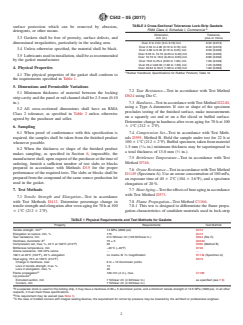
5. Dimensions and Permissible Variations
7.2 Tear Resistance—Test in accordance with Test Method
5.1 Minimum thickness of material between the locking
D624 using Die C.
strip cavity and the panel or rail channel shall be 2.5 mm (0.10
7.3 Hardness—TestinaccordancewithTestMethodD2240,
in.).
using a Type A durometer. If size or shape of the specimen
5.2 All cross-sectioned dimensions shall have an RMA
precludes testing of the finished surface, make measurements
Class 2 tolerance, as specified in Table 2 unless otherwise
on a squarely cut end or on a flat sliced or buffed surface.
agreed by the purchaser and seller.
Determine change in hardness after oven aging for 70 h at 100
6 1°C (212 6 2°F).
6. Sampling
6.1 When proof of conformance with this specification is 7.4 Compression Set—Test in accordance with Test Meth-
ods D395, Method B. Hold the sample under test for 22 h at
required, the samples shall be taken from the finished product
whenever possible. 100 6 1°C (212 6 2°F). Buffed specimen, taken from material
1.5 mm ( ⁄16 in.) minimum thickness may be superimposed to
6.2 When the thickness or shape of the finished product
a total thickness of 13.0 mm ( ⁄2 in.).
makes sampling, as specified in Section 6, impossible, the
7.5 Brittleness Temperature—Test in accordance with Test
manufacturershall,uponrequestofthepurchaseratthetimeof
Method D746.
ordering, furnish a sufficient number of test slabs or blocks
prepared in accordance with Methods D15 for the proper
7.6 OzoneResistance—TestinaccordancewithTestMethod
performance of the required tests. The slabs or blocks shall be
D1149 (SpecimenA). Use an ozone concentration of 100 mPa,
prepared from the compound of the same source production lot
an exposure time of 40 6 2°C (104 6 3.6°F), and a specimen
used in the gasket.
elongation of 20 %.
7. Test Methods 7.7 HeatAging—Testtheeffectsofheataginginaccordance
with Test
...