

ASTM D8509/D8509M-23
(Guide)Standard Guide for Test Method Selection and Test Specimen Design for Bolted Joint Related Properties
General Information
- Abstract
SCOPE
1.1 This guide covers the test method selection and associated test specimen design to produce test data to be used for typical bolted joint analyses. These test methods are limited to use with multi-directional polymer matrix composite laminates reinforced by high-modulus fibers. This standard is intended to be used by persons requesting these test types.
1.2 Test requestors designing these specimens need to be familiar with the referenced Test Method and Practice standards, CMH-17 Volume 3 Chapter 11, and the stress analysis methods that will use the resulting design data.
1.3 Units—The values stated in either SI units or inch-pound units are to be regarded separately as standard. The values stated in each system are not necessarily exact equivalents; therefore, to ensure conformance with the standard, each system shall be used independently of the other, and values from the two systems shall not be combined.
1.3.1 Within the text the inch-pound units are shown in brackets.
1.4 This standard does not purport to address all of the safety concerns, if any, associated with its use. It is the responsibility of the user of this standard to establish appropriate safety, health, and environmental practices and determine the applicability of regulatory limitations prior to use.
1.5 This international standard was developed in accordance with internationally recognized principles on standardization established in the Decision on Principles for the Development of International Standards, Guides and Recommendations issued by the World Trade Organization Technical Barriers to Trade (TBT) Committee.
- Status
- Published
- Publication Date
- 30-Apr-2023
- Technical Committee
- D30 - Composite Materials
- Drafting Committee
- D30.05 - Structural Test Methods
Overview
ASTM D8509/D8509M-23, published by ASTM International, provides a comprehensive guide for selecting appropriate test methods and designing specimens to characterize the properties of bolted joints in multi-directional polymer matrix composite laminates reinforced with high-modulus fibers. This standard ensures that test data generated are suitable for use in typical bolted joint analyses, crucial for industries involved in high-performance composite structures such as aerospace, automotive, and civil engineering.
The guide is intended for test requestors, engineers, and designers who need to obtain and apply reliable data for stress analysis and performance evaluation of bolted composite joints. It emphasizes the importance of familiarity with referenced test method standards, industry handbooks (such as CMH-17), and relevant stress analysis techniques to accurately utilize the resulting data.
Key Topics
- Test Method Selection: Guidance on choosing the appropriate ASTM test methods for evaluating various properties related to bolted joints, such as open-hole and filled-hole strengths, bearing, and bearing-bypass interaction.
- Specimen Design: Recommendations on specimen geometry, including parameters like hole size, stacking sequence, and fastener types, aligned with industry best practices for reproducibility and performance assessment.
- Terminology: Clear definitions for critical terms such as bearing area, edge distance ratio, end distance ratio, bearing stress, and net/gross bypass stress, ensuring accurate interpretation and communication.
- Units of Measurement: Both SI and inch-pound units are supported, with explicit instructions that each system should be applied independently without combining values from both.
- Environmental Considerations: Recognition that test results, such as strength properties or failure modes, may be influenced by environmental conditions (e.g., temperature, humidity) and should be assessed for each material system and stacking sequence.
- Failure Modes and Data Analysis: Identification of acceptable failure modes for various tests to ensure meaningful results, and discussion of properties extractable from different test methods, including tensile, compressive, and fatigue responses.
- Safety and Compliance: User responsibility for establishing appropriate safety, health, and environmental practices, along with adherence to regulatory guidelines.
Applications
- Composite Structure Design: Enables engineers to develop robust design allowables for bolted joints in composite materials, supporting reliable structural analysis and performance predictions.
- Material Characterization: Facilitates the evaluation of multi-directional laminates’ behavior under different loading scenarios, including tension, compression, bearing, and bypass scenarios-vital for qualifying new materials or composite systems.
- Quality Assurance and Specification Development: Provides a standardized basis for material specifications and quality control processes, ensuring that test data are consistent and comparable across projects or organizations.
- Research and Development: Supports innovation in fastener technology, laminate stacking sequences, and joint configurations by providing up-to-date methodologies for testing and analysis.
- Industry Sectors: Widely applicable in aerospace, automotive, marine, civil infrastructure, and other sectors relying on high-modulus polymer matrix composites and mechanically fastened joints.
Related Standards
- ASTM D3039/D3039M: Test Method for Tensile Properties of Polymer Matrix Composite Materials
- ASTM D4762: Guide for Testing Polymer Matrix Composite Materials
- ASTM D5961/D5961M: Test Method for Bearing Response of Polymer Matrix Composite Laminates
- ASTM D6742/D6742M: Practice for Filled-Hole Tension and Compression Testing of Polymer Matrix Composite Laminates
- ASTM D7248/D7248M: Test Method for High Bearing - Low Bypass Interaction Response
- ASTM D7332/D7332M: Test Method for Measuring the Fastener Pull-Through Resistance
- ASTM D7615/D7615M: Practice for Open-Hole Fatigue Response of Polymer Matrix Composite Laminates
- CMH-17 Composite Materials Handbook, Volume 3 Chapter 11: Reference for industry best practices and supplementary guidance in composite testing.
By following ASTM D8509/D8509M-23, organizations ensure consistency, reproducibility, and international compliance in the assessment of bolted joint-related properties in advanced composite materials, optimizing performance and safety in critical applications.
Relations
- Effective Date
- 01-Feb-2024
- Effective Date
- 15-Nov-2023
- Effective Date
- 01-Nov-2023
- Effective Date
- 01-Sep-2023
- Effective Date
- 01-Sep-2023
- Effective Date
- 01-Sep-2023
- Effective Date
- 01-Sep-2023
- Effective Date
- 01-Sep-2023
- Effective Date
- 01-Sep-2023
- Effective Date
- 01-Sep-2023
- Effective Date
- 15-May-2021
- Effective Date
- 01-Jan-2020
- Effective Date
- 15-Oct-2019
- Effective Date
- 01-Aug-2019
- Effective Date
- 15-Apr-2019
Frequently Asked Questions
ASTM D8509/D8509M-23 is a guide published by ASTM International. Its full title is "Standard Guide for Test Method Selection and Test Specimen Design for Bolted Joint Related Properties". This standard covers: SCOPE 1.1 This guide covers the test method selection and associated test specimen design to produce test data to be used for typical bolted joint analyses. These test methods are limited to use with multi-directional polymer matrix composite laminates reinforced by high-modulus fibers. This standard is intended to be used by persons requesting these test types. 1.2 Test requestors designing these specimens need to be familiar with the referenced Test Method and Practice standards, CMH-17 Volume 3 Chapter 11, and the stress analysis methods that will use the resulting design data. 1.3 Units—The values stated in either SI units or inch-pound units are to be regarded separately as standard. The values stated in each system are not necessarily exact equivalents; therefore, to ensure conformance with the standard, each system shall be used independently of the other, and values from the two systems shall not be combined. 1.3.1 Within the text the inch-pound units are shown in brackets. 1.4 This standard does not purport to address all of the safety concerns, if any, associated with its use. It is the responsibility of the user of this standard to establish appropriate safety, health, and environmental practices and determine the applicability of regulatory limitations prior to use. 1.5 This international standard was developed in accordance with internationally recognized principles on standardization established in the Decision on Principles for the Development of International Standards, Guides and Recommendations issued by the World Trade Organization Technical Barriers to Trade (TBT) Committee.
SCOPE 1.1 This guide covers the test method selection and associated test specimen design to produce test data to be used for typical bolted joint analyses. These test methods are limited to use with multi-directional polymer matrix composite laminates reinforced by high-modulus fibers. This standard is intended to be used by persons requesting these test types. 1.2 Test requestors designing these specimens need to be familiar with the referenced Test Method and Practice standards, CMH-17 Volume 3 Chapter 11, and the stress analysis methods that will use the resulting design data. 1.3 Units—The values stated in either SI units or inch-pound units are to be regarded separately as standard. The values stated in each system are not necessarily exact equivalents; therefore, to ensure conformance with the standard, each system shall be used independently of the other, and values from the two systems shall not be combined. 1.3.1 Within the text the inch-pound units are shown in brackets. 1.4 This standard does not purport to address all of the safety concerns, if any, associated with its use. It is the responsibility of the user of this standard to establish appropriate safety, health, and environmental practices and determine the applicability of regulatory limitations prior to use. 1.5 This international standard was developed in accordance with internationally recognized principles on standardization established in the Decision on Principles for the Development of International Standards, Guides and Recommendations issued by the World Trade Organization Technical Barriers to Trade (TBT) Committee.
ASTM D8509/D8509M-23 is classified under the following ICS (International Classification for Standards) categories: 21.060.01 - Fasteners in general. The ICS classification helps identify the subject area and facilitates finding related standards.
ASTM D8509/D8509M-23 has the following relationships with other standards: It is inter standard links to ASTM D883-24, ASTM D6641/D6641M-23, ASTM D883-23, ASTM D8387/D8387M-23, ASTM D7615/D7615M-23, ASTM D7332/D7332M-23, ASTM D6742/D6742M-23, ASTM D4762-23, ASTM D7248/D7248M-23, ASTM D6484/D6484M-23, ASTM D7248/D7248M-21, ASTM D883-20, ASTM D3878-19a, ASTM D883-19c, ASTM D883-19a. Understanding these relationships helps ensure you are using the most current and applicable version of the standard.
ASTM D8509/D8509M-23 is available in PDF format for immediate download after purchase. The document can be added to your cart and obtained through the secure checkout process. Digital delivery ensures instant access to the complete standard document.
Standards Content (Sample)
This international standard was developed in accordance with internationally recognized principles on standardization established in the Decision on Principles for the
Development of International Standards, Guides and Recommendations issued by the World Trade Organization Technical Barriers to Trade (TBT) Committee.
Designation: D8509/D8509M − 23
Standard Guide for
Test Method Selection and Test Specimen Design for Bolted
Joint Related Properties
This standard is issued under the fixed designation D8509/D8509M; the number immediately following the designation indicates the
year of original adoption or, in the case of revision, the year of last revision. A number in parentheses indicates the year of last
reapproval. A superscript epsilon (´) indicates an editorial change since the last revision or reapproval.
1. Scope 2. Referenced Documents
2.1 ASTM Standards:
1.1 This guide covers the test method selection and associ-
D883 Terminology Relating to Plastics
ated test specimen design to produce test data to be used for
D3039/D3039M Test Method for Tensile Properties of Poly-
typical bolted joint analyses. These test methods are limited to
mer Matrix Composite Materials
use with multi-directional polymer matrix composite laminates
D3878 Terminology for Composite Materials
reinforced by high-modulus fibers. This standard is intended to
D4762 Guide for Testing Polymer Matrix Composite Mate-
be used by persons requesting these test types.
rials
1.2 Test requestors designing these specimens need to be
D5687/D5687M Guide for Preparation of Flat Composite
familiar with the referenced Test Method and Practice Panels with Processing Guidelines for Specimen Prepara-
standards, CMH-17 Volume 3 Chapter 11, and the stress tion
D5766/D5766M Test Method for Open-Hole Tensile
analysis methods that will use the resulting design data.
Strength of Polymer Matrix Composite Laminates
1.3 Units—The values stated in either SI units or inch-
D5961/D5961M Test Method for Bearing Response of Poly-
pound units are to be regarded separately as standard. The
mer Matrix Composite Laminates
values stated in each system are not necessarily exact equiva-
D6484/D6484M Test Method for Open-Hole Compressive
lents; therefore, to ensure conformance with the standard, each
Strength of Polymer Matrix Composite Laminates
system shall be used independently of the other, and values
D6641/D6641M Test Method for Compressive Properties of
from the two systems shall not be combined.
Polymer Matrix Composite Materials Using a Combined
1.3.1 Within the text the inch-pound units are shown in Loading Compression (CLC) Test Fixture
D6742/D6742M Practice for Filled-Hole Tension and Com-
brackets.
pression Testing of Polymer Matrix Composite Laminates
1.4 This standard does not purport to address all of the
D6873/D6873M Practice for Bearing Fatigue Response of
safety concerns, if any, associated with its use. It is the
Polymer Matrix Composite Laminates
responsibility of the user of this standard to establish appro-
D7248/D7248M Test Method for High Bearing - Low By-
priate safety, health, and environmental practices and deter-
pass Interaction Response of Polymer Matrix Composite
mine the applicability of regulatory limitations prior to use.
Laminates Using 2-Fastener Specimens
1.5 This international standard was developed in accor-
D7332/D7332M Test Method for Measuring the Fastener
dance with internationally recognized principles on standard-
Pull-Through Resistance of a Fiber-Reinforced Polymer
ization established in the Decision on Principles for the
Matrix Composite
Development of International Standards, Guides and Recom-
D7615/D7615M Practice for Open-Hole Fatigue Response
mendations issued by the World Trade Organization Technical
of Polymer Matrix Composite Laminates
Barriers to Trade (TBT) Committee.
D8066/D8066M Practice Unnotched Compression Testing
of Polymer Matrix Composite Laminates
D8387/D8387M Test Method for High Bypass – Low Bear-
ing Interaction Response of Polymer Matrix Composite
Laminates
This test method is under the jurisdiction of ASTM Committee D30 on
Composite Materials and is the direct responsibility of Subcommittee D30.05 on For referenced ASTM standards, visit the ASTM website, www.astm.org, or
Structural Test Methods. contact ASTM Customer Service at service@astm.org. For Annual Book of ASTM
Current edition approved May 1, 2023. Published June 2023. DOI: 10.1520/ Standards volume information, refer to the standard’s Document Summary page on
D8509_D8509M-23. the ASTM website.
Copyright © ASTM International, 100 Barr Harbor Drive, PO Box C700, West Conshohocken, PA 19428-2959. United States
D8509/D8509M − 23
E739 Guide for Statistical Analysis of Linear or Linearized 3.2.6.1 Discussion—The end distance ratio is often impre-
Stress-Life (S-N) and Strain-Life (ε-N) Fatigue Data cisely referred as “edge distance ratio”. The end distance ratio
may be either a nominal value determined from nominal
2.2 Other Documents:
dimensions or an actual value determined from measured
CMH-17 Composite Materials Handbook-17, Polymer Ma-
dimensions.
trix Composites, Volume 3, Chapter 11
3.2.7 nominal value, n—a value, existing in name only,
3. Terminology
assigned to a measurable property for the purpose of conve-
nient designation. Tolerances may be applied to a nominal
3.1 Definitions:
3.1.1 Terminology D3878 defines terms relating to high- value to define an acceptable range for the property.
modulus fibers and their composites. Terminology D883 de-
3.2.8 width-to-diameter ratio, w/D [nd], n—the ratio of the
fines terms relating to plastics. In the event of a conflict
specimen width to the hole diameter.
between terms, Terminology D3878 shall have precedence.
3.2.8.1 Discussion—The width-to-diameter ratio may be
either a nominal value determined from nominal dimensions or
NOTE 1—If the term represents a physical quantity, its analytical
dimensions are stated immediately following the term (or letter symbol) in an actual value determined from measured dimensions.
fundamental dimension form, using the following ASTM standard sym-
bology for fundamental dimensions, shown within square brackets: [M] Bearing Terms:
for mass, [L] for length, [T] for time, [θ] for thermodynamic temperature,
br -1 -2
3.2.9 bearing chord stiffness, E [ML T ], n—the chord
and [nd] for non-dimensional quantities. Use of these symbols is restricted
stiffness between two specific bearing stress or bearing strain
to analytical dimensions when used with square brackets, as the symbols
may have other definitions when used without the brackets. points in the linear portion of the bearing stress/bearing strain
curve.
3.2 Definitions of Terms Specific to This Standard:
3.2.10 bearing force, P [MLT ], n—the total force carried
Geometry Terms:
by a bearing specimen.
3.2.1 bearing area, [L ], n—the area of that portion of a
br
3.2.11 bearing strain, ε [nd], n—the normalized hole
bearing specimen used to normalize applied loading into an
deformation in a bearing specimen, equal to the deformation of
effective bearing stress; equal to the diameter of the loaded
the bearing hole in the direction of the bearing force, divided
hole multiplied by the thickness of the specimen.
by the diameter of the hole.
3.2.2 countersink depth, n—depth of countersinking re-
br -1 -2
3.2.12 bearing strength, F [ML T ], n—the value of
x
quired to properly install a countersunk fastener, such that
bearing stress occurring at a significant event (maximum force,
countersink flushness is nominally zero. Countersink depth is
significant force drop, or defined bearing strain level) on the
nominally equivalent to the height of the fastener head.
bearing stress/bearing strain curve.
3.2.3 countersink flushness, n—depth or protrusion of coun-
3.2.12.1 Discussion—Two types of bearing strengths are
tersunk fastener head relative to the laminate surface after
commonly identified, and noted by an additional superscript:
installation. A positive value indicates protrusion of the fas-
offset strength and ultimate strength.
tener head above the laminate surface; a negative value
br -1 -2
3.2.13 bearing stress, F [ML T ], n—the bearing force
indicates depth below the surface.
divided by the bearing area.
3.2.4 diameter-to-thickness ratio, D/h [nd], n—the ratio of
bro -1 -2
3.2.14 offset bearing strength, F [ML T ], n—the value
the hole diameter to the specimen thickness. x
of bearing stress, in the direction specified by the subscript, at
3.2.4.1 Discussion—The diameter-to-thickness ratio may be
the point where a bearing chord stiffness line, offset along the
either a nominal value determined from nominal dimensions or
bearing strain axis by a specified bearing strain value, inter-
an actual value determined from measured dimensions.
sects the bearing stress/bearing strain curve.
3.2.5 edge distance ratio, edge/D [nd], n—the ratio of the
3.2.14.1 Discussion—Unless otherwise specified, an offset
distance between the center of the hole and the specimen edge
bearing strain of 2 % is to be used in this test method.
to the hole diameter. The edge distance is measured perpen-
bru -1 -2
3.2.15 ultimate bearing strength, F [ML T ], n—the
dicular to the primary bypass loading or normal to the applied
x
value of bearing stress, in the direction specified by the
bearing load direction. The edge/D ratio is typically one-half of
subscript, at the maximum force capability of a bearing
the w/D ratio.
specimen.
3.2.5.1 Discussion—The edge distance ratio may be either a
nominal value determined from nominal dimensions or an
Bypass Terms:
actual value determined from measured dimensions. Two
gr_byp -1 -2
3.2.16 gross bypass stress, f [ML T ], n—the gross
distance ratios are typically considered during the design of
bypass stress for tensile loadings is calculated from the total
composite parts: edge distance ratio and end distance ratio.
force bypassing the fastener hole.
Design requirements for these ratios may be different.
net_byp -1 -2
3.2.6 end distance ratio, e/D [nd], n—the ratio of the 3.2.17 net bypass stress, f [ML T ], n—the net by-
pass stress for tensile loading is calculated from the force
distance between the center of the hole and the specimen end
to the hole diameter. The end distance is measured parallel to bypassing the fastener hole minus the force reacted in bearing
at the fastener.
the primary bypass loading direction or the applied bearing
load direction. 3.2.17.1 Discussion—For compressive loadings the gross
D8509/D8509M − 23
and net bypass stresses are equal and are calculated using the 4. Summary of Guide
force that bypasses the fastener hole (since for the compressive
4.1 This guide provides information for selecting and de-
loading case the bearing stress reaction is on the same side of
signing test specimens to determine the laminate strength
the fastener as the applied force, the force reacted in bearing
properties related to bolted joint analyses, including tension
does not bypass the fastener hole). Several alternate definitions
and compression laminate strength for open and filled hole
for gross and net bypass stress have been used historically in
configurations, laminate bearing strength, and laminate
the aerospace industry. Comparison of data from tests con-
bearing/bypass interaction strength. It also covers open hole
forming to this standard with historical data may need to
and bearing fatigue specimens. This guide compiles and
account for differences in the bypass definitions.
updates information for test requestors that was previously
gr_byp -1 -2
3.2.18 ultimate gross bypass strength, F [ML T ], located in the referenced Test Method and Practice standards.
x
n—the value of gross bypass stress, in the direction specified
4.2 Users of this guide should also review Guide D4762, as
by the subscript, at the maximum force capability of the
well as the referenced test method standards.
specimen.
4.3 Users of this guide should be familiar with the stress
net_byp -1 -2
3.2.19 ultimate net bypass strength, F [ML T ]—the
x analysis methods that will use the resulting design data. The
value of net bypass stress, in the direction specified by the
following references discuss these methods and associated test
subscript, at the maximum force capability of the specimen.
data for composite structures:
4.3.1 CMH-17, Volume 1 Chapter 2 (1) ,
Fatigue Terms:
4.3.2 CMH-17, Volume 1 Chapter 7 (1),
3.2.20 constant amplitude loading, n—a loading in which
4.3.3 CMH-17, Volume 3 Chapter 11 (1),
all of the peak values of force (stress) are equal and all of the
4.3.4 Esp, Chapter 11 (2), and
valley values of force (stress) are equal.
4.3.5 ASM Handbook (3).
3.2.21 fatigue loading transition, n—in the beginning of
5. Test Method Selection and Usage
fatigue loading, the number of cycles before the force (stress)
reaches the desired peak and valley values.
5.1 This section describes the test methods covered by this
guide, and how the data is typically used for analysis in the
3.2.22 force (stress) ratio, R [nd], n—the ratio of the
aerospace industry.
minimum applied force (stress) to the maximum applied force
(stress).
5.2 Open Hole Tests:
T-1
5.2.1 Open hole tension (Test Method D5766/D5766M) and
3.2.23 frequency, f [ ], n—the number of force (stress)
open hole compression (Test Method D6484/D6484M) tests on
cycles completed in 1 s (Hz).
multi-directional composite laminates are often conducted for
3.2.24 hole elongation, ΔD [L], n—the permanent change in
material characterization (see CMH-17 Vol. 1, Chapter 2),
hole diameter in a bearing coupon caused by damage
material specifications and quality assurance, design allow-
formation, equal to the difference between the hole diameter in
ables covering manufacturing defects and accidental damage
the direction of the bearing force after a prescribed loading and
(see CMH-17 Vol. 3, Chapter 12), and design allowables for
the hole diameter prior to loading.
bolted joints bearing/bypass interaction analysis (see CMH-17
Vol. 3, Chapter 11). These tests involve a uniaxially loaded test
3.2.25 peak, n—the occurrence where the first derivative of
of a balanced, symmetric laminate with a centrally located
the force (stress) versus time changes from positive to negative
hole.
sign; the point of maximum force (stress) in constant amplitude
5.2.2 Ultimate strength for open hole tests is calculated
loading.
based on the gross cross-sectional area, disregarding the
-2
3.2.26 residual strength, [MLT ], n—the value of force
presence of the hole. While the hole causes a stress concen-
(stress) required to cause failure of a specimen under quasi-
tration and reduced net section, it is common aerospace
static loading conditions after the specimen is subjected to
practice to develop notched design allowable strengths based
fatigue loading.
on gross section stress to account for various stress concentra-
3.2.27 run-out, n—an upper limit on the number of force
tions (fastener holes, free edges, flaws, damage, and so forth)
cycles to be applied.
not explicitly modeled in the stress analysis.
5.2.3 Open hole strengths are affected by the environmental
3.2.28 spectrum loading, n—a loading in which the peak
conditions under which the tests are conducted. Laminates
values of force (stress) are not equal or the valley values of
tested in various environments can exhibit significant differ-
force (stress) are not equal (also known as variable amplitude
ences in failure force. Experience has demonstrated that cold
loading or irregular loading).
temperature environments are generally critical for open-hole
3.2.29 valley, n—the occurrence where the first derivative of
tensile strength, while humidity pre-conditioned, elevated tem-
the force (stress) versus time changes from negative to positive
perature environments are generally critical for open-hole
sign; the point of minimum force (stress) in constant amplitude
loading.
3.2.30 wave form, n—the shape of the peak-to-peak varia-
The boldface numbers in parentheses refer to a list of references at the end of
tion of the force (stress) as a function of time. this standard.
D8509/D8509M − 23
compressive strength. However, critical environments must be Note that in some cases, open hole test data has been used
assessed independently for each material system and stacking instead of filled hole test data to define the bypass ends of the
sequence tested. interaction. For some materials, layups, fastener torque level
5.2.4 The only acceptable failure mode for ultimate open- and environments, OHT strength values are lower than FHT
hole strength is one which passes through the hole in the test values, while for others there is the opposite relation. Under
specimen. Properties that may be derived from these test tensile loading, with a close tolerance hole, the fastener hole
methods include the following: filling effect reduces the deformation of the hole transverse to
5.2.4.1 Open-hole (notched) tensile strength (OHT), and the loading direction thereby changing the hole stress concen-
5.2.4.2 Open-hole (notched) compressive strength (OHC). tration. OHC strengths are always lower than FHC strengths,
with the latter sometimes approaching unnotched compression
5.3 Bolted Joint Bearing-Bypass Interaction Static Tests:
strength. Under compressive loading with a close tolerance
5.3.1 Bearing/Bypass Interaction—Analysis of bolted joints
hole, the fastener hole filling effect results in axial load being
in composite materials is typically performed using methods
transferred directly through the fastener, relieving the hole
that interact the fastener bearing stresses and the laminate
stress concentration.
stresses (or strains) that “bypass” the fastener hole (1-5).
5.3.3 More complicated test setups have been used to
Definition of the uniaxial bearing/bypass interaction response
develop data across the full range of bearing/bypass interac-
requires data for varying amounts of bearing and bypass forces
tion. Test procedures for cases where the bearing and bypass
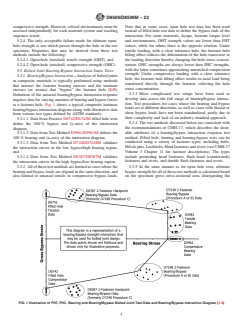
at a fastener hole. Fig. 1 shows a typical composite laminate
loads act at different directions, as well as cases with biaxial or
bearing/bypass interaction diagram along with illustrative data
shear bypass loads have not been standardized, partly due to
from various test types defined by ASTM standards:
their complexity and lack of an industry standard approach.
5.3.1.1 Data from Practice D6742/D6742M filled hole tests
5.3.4 The test methods discussed below are consistent with
define the 100 % bypass end (y-axis) of the interaction
the recommendations of CMH-17, which describes the desir-
diagram,
able attributes of a bearing/bypass interaction response test
5.3.1.2 Data from Test Method D5961/D5961M defines the
method. Filled hole, bearing and bearing-bypass tests can be
100 % bearing end (x-axis) of the interaction diagram,
conducted using a variety of fastener types, including bolts,
5.3.1.3 Data from Test Method D7248/D7248M validates
HiLok pins, Lockbolts, blind fasteners and rivets (see CMH-17
the interaction curves in the low bypass/high bearing region,
Volume 3 Chapter 11 for fastener descriptions). The types
and
include protruding head fasteners, flush head (countersunk)
5.3.1.4 Data from Test Method D8387/D8387M validates
fasteners and rivets, and double flush fasteners and rivets.
the interaction curves in the high bypass/low bearing region.
5.3.2 All of these test methods are limited to cases where the 5.3.5 In the same manner as for open hole tests, ultimate
bearing and bypass loads are aligned in the same direction, and bypass strength for all of these test methods is calculated based
also limited to uniaxial tensile or compressive bypass loads. on the specimen gross cross-sectional area, disregarding the
FIG. 1 Illustration of FHT, FHC, Bearing and Bearing/Bypass Bolted Joint Test Data and Bearing/Bypass Interaction Diagram (1-5)
D8509/D8509M − 23
presence of the hole. While the hole causes a stress concen- 5.4.5 The only acceptable failure mode for ultimate filled-
tration and reduced net section, it is common industry practice hole tension strength is one which passes through the hole in
to develop notched design allowable strengths based on gross the test specimen. The property that results is the following:
fhtu
section stress to account for various stress concentrations 5.4.5.1 Filled-hole tensile (FHT) strength, F .
x
(fastener holes, free edges, flaws, damage, and so forth) not 5.4.6 The acceptable failure modes for ultimate filled-hole
explicitly modeled in the stress analysis. Bearing strength is
compression strength are those which pass through or close to
calculated using the nominal hole diameter (not the fastener the hole in the test specimen. The property that results is the
diameter or actual hole diameter) to be consistent with typical
following:
fhcu
bolted joint stress analysis methods.
5.4.6.1 Filled-hole compressive (FHC) strength, F .
x
5.3.6 Filled hole, bearing and bearing/bypass strengths are
5.5 Bearing Tests:
affected by the environmental conditions under which the tests
5.5.1 Bearing failure mode tests can be conducted by a
are conducted. Laminates tested in various environments can
number of test specimen configurations. Test Method D5961/
exhibit significant differences in both failure force and failure
D5961M includes the following test procedures (refer to the
mode. Experience has demonstrated that cold temperature
drawings in the standard):
environments are generally critical for filled-hole and bypass
5.5.1.1 Double-shear tensile loading (Procedure A). A flat,
tensile strengths, while humidity pre-conditioned, elevated
constant rectangular cross-section test specimen with a single
temperature environments are generally critical for filled-hole
centerline hole located near the end of the specimen is loaded
and bypass compressive strengths and for bearing strength.
at the hole in bearing. The bearing force is applied through a
However, critical environments must be assessed indepen-
fastener (or pin) that is reacted in double shear.
dently for each material system, stacking sequence, and torque
5.5.1.2 Single-shear tensile or compressive loading of a
condition tested.
two-piece specimen (Procedure B). A flat, constant rectangular
cross-section test specimen is composed of two like laminates
5.4 Filled Hole Tests:
fastened together through one or two centerline holes located
5.4.1 Filled hole tension (FHT) or filled hole compression
near one end of each laminate. The eccentricity in applied force
(FHC) tests (Practice D6742/D6742M) involves uniaxial load-
that would otherwise result is minimized by a doubler bonded
ing of a balanced, symmetric laminate with a centrally located
to, or frictionally retained against each grip end of the
hole with a close-tolerance fastener or pin installed in the hole.
specimen, resulting in a force line-of-action along the interface
Filled hole tests on multi-directional composite laminates are
between the specimen halves.
often conducted for material characterization (see CMH-17
5.5.1.3 Single-shear tensile loading of a one-piece specimen
Vol. 1, Chapter 2), and design allowables for bolted joints
(Procedure C). A flat, constant rectangular cross-section test
bearing/bypass interaction analysis (see CMH-17 Vol. 3, Chap-
specimen with a centerline hole located near the end of the
ter 11).
specimen is loaded at the hole in bearing. The bearing force is
5.4.2 Ultimate strength for filled hole tests is calculated
applied through a fastener reacted in single shear by a robust
based on the gross cross-sectional area, disregarding the
fixture that reduces eccentricity effects.
presence of the hole. While the hole causes a stress concen-
5.5.1.4 Double-shear compressive loading (Procedure D). A
tration and reduced net section, it is common aerospace
flat, constant rectangular cross-section test specimen with a
practice to develop notched design allowable strengths based
centerline hole located near the end of the specimen is loaded
on gross section stress to account for various stress concentra-
at the hole in bearing. The bearing force is applied through a
tions (fastener holes, free edges, flaws, damage, and so forth)
fastener reacted in double shear by a robust fixture.
not explicitly modeled in the stress analysis.
5.5.2 See CMH-17 Volume 1 Chapter 7 and Volume 3
5.4.3 Filled hole strengths are affected by the environmental
Chapter 11 for discussions regarding the use of each test
conditions under which the tests are conducted. Laminates
configuration. The double shear configurations cannot be used
tested in various environments can exhibit significant differ-
to test flush head fasteners. The Procedure B two fastener test
ences in failure force. Experience has demonstrated that cold
can produce either bearing, fastener or bypass (net section)
temperature environments are generally critical for filled-hole
failure modes. Bearing and fastener failure modes are covered
tensile strength, while humidity pre-conditioned, elevated tem-
by Test Method D5961/D5961M; bypass failure modes are
perature environments are generally critical for filled-hole
covered by Test Method D7248/D7248M (see below).
compressive strength. However, critical environments must be
5.5.3 The resulting bearing response data is used for mate-
assessed independently for each material system and stacking
rial characterization, research and development, and structural
sequence tested.
design and analysis. The standard configuration for each
5.4.4 Some materials, particularly fabrics, may exhibit FHC
procedure is very specific and is intended primarily for
strength > unnotched compression (UNC) strength for the development of quantitative double- and single-shear bearing
same laminate. This is not a true measure of material behavior, response data for material comparison and structural design.
but rather an artifact of differing test specimen geometries Procedures A and D, the double-shear configurations, with a
(often seen when Test Method D6641/D6641M is used to single fastener loaded in shear and reacted by laminate tension
measure UNC strength). In order to mitigate this phenomenon, or compression, are particularly recommended for basic mate-
either measure UNC using Practice D8066/D8066M or con- rial evaluation and comparison. Procedures B and C, the
servatively assume FHC = UNC strength. single-shear, single- or double- fastener configurations are
D8509/D8509M − 23
more useful in evaluation of specific joint configurations, curve starts to deviate from the initial straight-line response.
including fastener failure modes. The Procedure B specimen This result is not included in Test Method D5961/D5961M but
may be tested in either an unstabilized (no support fixture) or is sometimes used in the aerospace industry.
stabilized configuration. The unstabilized configuration is in- 5.5.7.2 Offset bearing strength is determined as the bearing
tended for tensile loading and the stabilized configuration is
stress value at the point where the bearing chord stiffness line,
intended for compressive loading (although stabilized tensile offset along the bearing strain axis by 2 % bearing strain,
loading is permitted, and will produce less conservative bear-
intersects the bearing stress/bearing strain curve.
ing results). The Procedure C specimen is particularly well-
5.5.7.3 Ultimate bearing strength is determined from the
suited for development of countersunk-fastener bearing
maximum force carried prior to test termination.
strength data where a near-double-shear fastener rotational
Refer to CMH-17, Volume 3, Chapter 11 for discussions on
stiffness is desired. These Procedure B and C configurations
the use of these bearing strength values in stress analysis of
have been extensively used in the development of aerospace
bolted joints.
industry design allowables data.
5.5.8 In addition to the bearing strength values, the follow-
5.5.4 It is important to note that these four procedures, using ing properties may be obtained from this test method:
the standard test configurations, will generally result in bearing 5.5.8.1 Bearing stress/bearing strain curve, which can be
strength mean values that are not of the same statistical useful for non-linear bolted joint analyses; and,
shu
population, and thus not in any way a “basic material prop- 5.5.8.2 Ultimate fastener shear force, P , for fastener
erty.” Typically, Procedure D will yield slightly higher
failure modes, which is used to characterize fasteners and
strengths than Procedure A (due to the finite end distance, e, in provide fastener shear allowable strengths.
Procedure A); while Procedure C will yield significantly higher
5.6 Low Bypass – High Bearing Interaction Tests:
strengths than Procedure B (due to the larger fastener rotation
5.6.1 Test Method D7248/D7248M is designed to produce
and higher peak bearing stress in Procedure B). For protruding
bearing/bypass interaction response data for research and
head fasteners, Procedure D will typically yield somewhat
development, and for structural design and analysis. Test
higher results than Procedure C (due to both stress peaking and
specimens consist of two or three fastener double or single
finite end distance in Procedure C), and Procedures A and C
shear configurations. The standard configuration for each
yield roughly equivalent results.
procedure is very specific and is intended as a baseline
5.5.5 It is also important to note that the parameter varia-
configuration for developing structural design data.
tions of the four procedures (tabulated in Section 6 below)
5.6.1.1 Procedure A, the bypass/high bearing double-shear
provide flexibility in the conduct of the test, allowing adapta-
configuration is recommended for developing data for specific
tion of the test setup to a specific application. However, the
applications which involve double shear joints.
flexibility of test parameters allowed by these variations makes
5.6.1.2 Procedure B, the bypass/high bearing single-shear
meaningful comparison between datasets difficult if the data-
configuration is more useful in the evaluation of typical joint
sets were not tested using the same procedure and identical test
configurations. The specimen may be tested in either an
parameters.
unstabilized (no support fixture) or stabilized configuration.
5.5.6 For all bearing test configurations, both the applied
The unstabilized configuration is intended for tensile loading
force and the associated deformation of the hole are monitored.
and the stabilized configuration is intended for both tensile and
The hole deformation is normalized by the hole diameter to
compressive loading. The stabilization fixture is often used in
create an effective bearing strain. Likewise, the applied force is
tensile loading to more accurately represent joint behavior in
normalized by the projected hole area to create an effective
actual structural configurations. These configurations, particu-
bearing stress. The specimen is loaded until a maximum force
larly the stabilized configuration, have been extensively used in
has clearly been reached, whereupon the test may be termi-
the development of design allowables data. The variants of
nated to prevent masking of the true failure mode by large-
either procedure provide flexibility in the conduct of the test,
scale hole distortion, in order to provide a more representative
allowing adaptation of the test setup to a specific application.
failure mode assessment; the test requestor should be closely
However, the flexibility of test parameters allowed by the
involved in all decisions regarding when to terminate the
variants makes meaningful comparison between datasets diffi-
specimen loading. Bearing stress versus bearing strain for the
cult if the datasets were not tested using identical test param-
entire loading regime is plotted, and failure mode noted.
eters.
Should the test specimen fail in a bypass (net section) failure
5.6.2 Both the applied force and the associated deformation
mode rather than the desired bearing mode (which includes
of the hole are monitored. The applied force is normalized by
shearout, cleavage and bearing modes as detailed in the
the projected hole area to create an effective bearing stress. The
standard), then the test should be considered to be a bearing/
specimen is loaded until a two part failure is achieved. Should
bypass test, and the data reduction and reporting procedures of
the test specimen fail in a bearing failure mode rather than the
Test Method D7248/D7248M should be used instead.
desired bypass (net tension or compression) mode, then the test
5.5.7 Several “bearing strength” values for the composite
should be considered to be a bearing dominated bearing/bypass
laminate or laminate-fastener joint can be determined from the
test, and the data reduction and reporting procedures of Test
results:
Method D5961/D5961M should be used instead.
5.5.7.1 Onset of non-linearity bearing strength is deter- 5.6.3 Properties, in the test direction, which may be ob-
mined as the point at which the bearing stress/bearing strain tained from this test method include the following:
D8509/D8509M − 23
5.6.3.1 Filled hole tensile bearing/bypass interaction 5.8.1.1 Procedure A, Compressive-Loaded Fixture: two
strength, laminate plates are fastened together with a single centrally
located fastener. Holes in the plates allow a “spider” type
5.6.3.2 Filled hole compressive bearing/bypass interaction
fixture to press the two plates apart, inducing an axial tensile
strength, and
load on the fastener.
5.6.3.3 Bearing stress/bypass strain curve.
5.8.1.2 Procedure B, Tensile-Loaded Fixture: a single lami-
5.7 High Bypass – Low Bearing Interaction Tests:
nate plate is fastened to a loading yoke or cup with a single
5.7.1 Test Method D8387/D8387M is designed to produce
fastener. A support fixture with a circular opening is used to
uniaxial high bypass – low bearing interaction response data
react the applied tensile force on the yoke.
for research and development, and for structural design and
5.8.2 See CMH-17 Volume 1 Chapter 7 and Volume 3
analysis. Specimens use a two fastener, double shear configu-
Chapter 11 for discussions regarding the use of each test
ration. The standard configuration for this procedure is very
configuration. The Procedure A specimen is not widely used
specific and is intended as a baseline configuration for devel-
due to its cost, complexity, and greater potential for undesirable
oping structural design data. The high bypass/low bearing
laminate bending failure modes.
double-shear hardpoint configuration is recommended for de-
5.8.3 Test Method D7332/D7332M is designed to produce
termining the effect of low bearing stress levels on bypass
fastener pull-through resistance data for structural design
strength. While a similar single-shear configuration could be
allowables, research and development. The procedures may be
tested, there is insufficient experience with a single-shear
used to assess pull-through resistance for a variety of compos-
configuration to recommend its use at this time.
ite laminate thicknesses, fastener diameters, and fastener head
5.7.2 The specimen may be tested in either an unstabilized
styles. However, the flexibility of test parameters allowed by
(no support fixture) or stabilized configuration. The unstabi-
the variants makes meaningful comparison between datasets
lized configuration is intended for tensile loading and the
difficult if the datasets were not generated using identical test
stabilized configuration is intended for compressive loading.
parameters.
Note that the doubler plates, depending on their design, will not
5.8.4 Early composite pull-through tests using fasteners
allow the Test Method D5961/D5961M support fixture assem-
common to metal structures led to premature joint failures, and
bly to contact the test specimen, requiring the use of additional
resulted in the development of fasteners specific for composite
spacers at each end of the specimen.
applications. These fasteners have larger heads and tails to
5.7.3 Both the applied force and the associated deformation
reduce through-thickness compression stresses on the compos-
of the hole(s) are monitored. The applied force is normalized
ite laminate.
by the projected hole area to yield an effective bearing stress.
5.8.5 With both procedures, force is applied until failure of
The specimen is loaded until a two part failure is achieved.
the composite specimen, the fastener, or both occurs. Applied
5.7.4 This test method requires careful specimen design,
force and crosshead displacement are recorded while loading.
instrumentation, data measurement and data analysis. The use
For both procedures, preferred failure modes are those associ-
of this test method requires close coordination between the test
ated with failure of the composite at the fastener hole.
requestor and the test lab personnel. Test requestors need to be
Pull-through failure modes are typically interlaminar shear
familiar with the data analysis procedures of this test method
dominated, with some bending failure modes possible in
and should not expect test labs who are unfamiliar with this test
thinner specimens. Unacceptable failure modes include those
method to be able to produce acceptable results without close
associated with the fastener (such as head, shank, or thread
coordination.
failure), unless installed fastener strength is the specific intent
5.7.5 Properties, in the test direction, which may be ob-
of the testing, or failure of the composite away from the
tained from this test method include the following:
fastener hole.
5.7.5.1 Filled hole tensile bearing/bypass interaction
5.9 Open Hole Fatigue Tests:
strength,
5.9.1 Open hole fatigue tests involve cyclic loading of a
5.7.5.2 Filled hole compressive bearing/bypass interaction
uniaxial test of an open hole specimen with either constant
strength, and
amplitude or spectrum fatigue loading. Practice D7615/
5.7.5.3 Bearing stress/bypass strain curve.
D7615M provides supplemental instructions for using Test
5.8 Fastener Pull-Through Tests:
Methods D5766/D5766M or D6484/D6484M to obtain fatigue
5.8.1 Fastener pull-through tests on multi-directional com- data under constant amplitude loading. The test procedure
posite laminates are often conducted for material characteriza- involves cycling the specimen between minimum and maxi-
tion (see CMH-17 Vol. 1, Chapter 2), and design allowables for mum axial forces (stresses) at a specified frequency. At
bolted joints analysis (see CMH-17 Vol. 3, Chapter 11). selected cyclic intervals, the specimen stiffness can be deter-
Fastener pull-through can involve either the fastener head or mined from a force versus deformation curve obtained by
the fastener tail (nut, collar, blind tail, etc.) being pulled quasi-statically loading the specimen through one tension,
through a laminate due to applied axial fastener force or due to compression, or tension-compression cycle as applicable. The
bending moments applied to the joined laminates which number of force cycles at which failure occurs (or at which a
introduce a prying force on the fastener. Test Method D7332/ predetermined change in specimen stiffness is observed) is
D7332M contains two procedures for applying an axial force to determined for a specimen subjected to a specific force (stress)
an installed fastener (refer to the drawings in the standard): ratio and stress magnitude.
D8509/D8509M − 23
5.9.2 Open-hole fatigue data may be used for research and statistical analysis of fatigue data, such as determination of
development, and material design allowables. The primary linearized stress life (S-N) curves, can be found in Practice
E739.
property that results is the fatigue life of the test specimen
under a specific loading and environmental condition. Repli- 5.10.3 Bearing fatigue testing can be used to study the static
strength effect of cyclic loading (fatigue) induced bearing
cate tests may be used to obtain a distribution of fatigue life for
damage in a polymer matrix composite specimen. The reduc-
specific material types, laminate stacking sequences,
tion in static bearing strength associated with fatigue damage
environments, and loading conditions. Guidance in statistical
may be determined by discontinuing cyclic loading to obtain
analysis of fatigue data, such as determination of linearized
the residual static strength using Test Method D5961/D5961M.
stress life (S-N) curves, can be found in Practice E739.
5.10.4 The practice may be used as a guide to conduct
5.9.3 Open hole fatigue testing can be used to study fatigue
variable amplitude loading. This information can be useful in
damage in a polymer matrix composite open-hole specimen
the understanding of fatigue behavior of composite structures
such as the occurrence of microscopic cracks, fiber fractures, or
under spectrum loading conditions, but is not covered in the
delaminations. The change in strength associated with fatigue
standard.
damage may be determined by discontinuing cyclic loading to
5.10.5 Bearing fatigue results are affected by the environ-
obtain the residual static strength using Test Methods D5766/
mental conditions under which the tests are conducted. Lami-
D5766M or D6484/D6484M.
nates tested in various environments can exhibit significant
5.9.4 The practice may be used as a guide to conduct
differences in hole elongation behavior, joint stiffness response,
variable amplitude loading. This information can be useful in
and failure mode. Experience has demonstrated that humidity
the understanding of fatigue behavior of composite structures
pre-conditioned, elevated temperature conditions are generally
under spectrum loading conditions, but is not covered in this
critical for bearing fatigue-induced hole elongation (6-9).
standard.
However, critical environments must be assessed indepen-
5.9.5 Properties that result include the following:
dently for each material system, stacking sequence, and torque
condition tested.
5.9.5.1 Specimen stiffness versus fatigue load cycle curves
5.10.6 Properties that result include the following:
for selected normal stress values,
5.10.6.1 Hole elongation versus fatigue load cycle curves
5.9.5.2 Normal stress versus specimen stiffness curves at
for selected bearing stress values,
selected cyclic intervals, and
5.10.6.2 Percent joint stiffness reduction versus fatigue load
5.9.5.3 Normal stress versus fatigue life curves for selected
cycle curves for selected bearing stress values,
stress ratio values.
5.10.6.3 Bearing stress versus hole elongation curves at
5.10 Bolted Joint Fatigue Tests: selected cyclic intervals,
5.10.6.4 Bearing stress versus percent joint stiffness reduc-
5.10.1 Bearing fatigue tests involve cyclic loading of a
tion curves at selected cyclic intervals,
uniaxial test of a bearing specimen with either constant
5.10.6.5 Bearing stress versus fatigue life curves for se-
amplitude or spectrum fatigue loading. Practice D6873/
lected hole elongation values, and
D6873M provides supplemental instructions for using Test
5.10.6.6 Bearing stress versus fatigue life curves for se-
Method D5961/D5961M to obtain bearing fatigue data under
lected percent joint stiffness reduction values.
constant amplitude loading. The test procedure involves cy-
cling the specimen between minimum and maximum axial
6. Test Specimen Design Considerations
forces (stresses) at a specified frequency. At selected cyclic
This section describes factors that should be considered
intervals, hole elongation can be determined either through
when designing and specifying test specimens for the test
direct measurement or from a force (stress) versus deformation
methods covered by this guide. Section 7 covers general
curve obtained by quasi-statically loading the specimen
interferences resulting from the associated test procedures.
through one tension-compression cycle. If hole elongation is
6.1 General:
determined from a force (stress) versus deformation curve, the
6.1.1 Factors that influence all of the tests discussed in this
percent joint stiffness reduction is determined using the force
guide that should be considered by the test requestor and be
versus deformation data. The number of force cycles at which
reported include the following: material, methods of material
failure occurs, or at which a predetermined hole elongation or
fabrication, accuracy of lay-up, laminate stacking sequence and
percent joint stiffness reduction is achieved, is determined for
overall thickness, specimen geometry (including hole diameter,
a specimen s
...