

ASTM C33/C33M-23
(Specification)Standard Specification for Concrete Aggregates
General Information
- Abstract
ABSTRACT
This specification defines the requirements for grading and quality of fine and coarse aggregate for use in concrete. Fine aggregate shall consist of natural sand, manufactured sand, or a combination thereof. Fine aggregate shall be free of injurious amounts of organic impurities. Fine aggregate for use in concrete that will be subject to wetting, extended exposure to humid atmosphere, or contact with moist ground shall not contain any materials that are deleteriously reactive with the alkalis in the cement in amount sufficient to cause excessive expansion of mortar or concrete. Fine aggregate subjected to five cycles of the soundness test shall have a required weighted average loss. Coarse aggregate shall consist of gravel, crushed gravel, crushed stone, air-cooled blast furnace slag, or crushed hydraulic-cement concrete, or a combination thereof. The sampling and test methods shall be done with grading and fineness modulus test, organic impurities test, effect of organic impurities on strength test, soundness test, clay lumps and friable particles test, coal and lignite test, bulk density of slag test, abrasion of coarse aggregate test, reactive aggregate test, freezing and thawing test, and chert test method.
SCOPE
1.1 This specification defines the requirements for grading and quality of fine and coarse aggregate (other than lightweight or heavyweight aggregate) for use in concrete.2
1.2 This specification is for use by a contractor, concrete supplier, or other purchaser as part of the purchase document describing the material to be furnished.
Note 1: This specification is regarded as adequate to ensure satisfactory materials for most concrete. It is recognized that, for certain work or in certain regions, it may be either more or less restrictive than needed. For example, where aesthetics are important, more restrictive limits may be considered regarding impurities that would stain the concrete surface. The specifier should ascertain that aggregates specified are or can be made available in the area of the work, with regard to grading, physical, or chemical properties, or combination thereof.
1.3 This specification is also for use in project specifications to define the quality of aggregate, the nominal maximum size of the aggregate, and other specific grading requirements. Those responsible for selecting the proportions for the concrete mixture shall have the responsibility of determining the proportions of fine and coarse aggregate and the addition of blending aggregate sizes if required or approved.
1.4 The values stated in either SI units or inch-pound units are to be regarded separately as standard. The values stated in each system may not be exact equivalents; therefore, each system shall be used independently of the other. Combining values from the two systems may result in non-conformance with the standard.
1.5 The text of this standard refers to notes and footnotes that provide explanatory material. These notes and footnotes (excluding those in tables and figures) shall not be considered as requirements of this standard.
1.6 This international standard was developed in accordance with internationally recognized principles on standardization established in the Decision on Principles for the Development of International Standards, Guides and Recommendations issued by the World Trade Organization Technical Barriers to Trade (TBT) Committee.
- Status
- Published
- Publication Date
- 31-Jul-2023
- Technical Committee
- C09 - Concrete and Concrete Aggregates
- Drafting Committee
- C09.20 - Aggregates
Overview
ASTM C33/C33M-23: Standard Specification for Concrete Aggregates is a key international standard issued by ASTM International. It establishes requirements for the grading and quality of fine and coarse aggregates used in concrete. This specification is widely referenced by contractors, concrete suppliers, and project specifiers to ensure materials meet essential performance and durability criteria. Following ASTM C33/C33M-23 guarantees that aggregates used in concrete construction contribute to structural integrity, longevity, and desired concrete properties for a range of applications.
Key Topics
- Aggregate Types: Specifies fine aggregates (natural or manufactured sand, recycled materials) and coarse aggregates (gravel, crushed stone, crushed concrete, air-cooled slag, and combinations thereof).
- Quality and Grading: Outlines grading limits, fineness modulus requirements and permissible variations, ensuring consistency for concrete mix designs.
- Deleterious Substances: Sets maximum limits for harmful materials such as clay lumps, coal, lignite, and organic impurities, which can negatively affect concrete durability and appearance.
- Testing Requirements: Details methods for sampling and testing aggregates, including:
- Sieve analysis for grading
- Determining material finer than the 75-μm (No. 200) sieve
- Organic impurities and soundness tests
- Testing for alkali-aggregate reactivity
- Abrasion and bulk density of aggregates
- Weathering Regions: Provides aggregate classification based on expected severity of exposure-severe, moderate, and negligible weathering regions, which affect performance requirements.
- Project Specifying Guidance: Offers protocols on how to include ASTM C33/C33M-23 requirements in purchase orders and project specifications, ensuring clarity for suppliers and contractors.
Applications
ASTM C33/C33M-23 is applied across the construction industry to assure aggregate quality for ready-mix, precast, and cast-in-place concrete. Typical uses include:
- Commercial and residential buildings: Foundations, columns, slabs, and structural elements
- Infrastructure projects: Bridges, highways, pavements, curbs, sidewalks, and retaining walls
- Architectural and decorative concrete: Where surface finish and appearance are critical
- Specialty concrete: Exposed concrete in severe climates, where resistance to freezing, thawing, and chemical exposure is required
Following this specification helps prevent mix problems such as excessive bleeding, poor workability, or premature deterioration, particularly in concrete structures subject to weather extremes or deicing chemicals.
Related Standards
ASTM C33/C33M-23 is closely related to other industry standards and test methods, supporting comprehensive quality control for concrete aggregates:
- ASTM C29/C29M - Bulk density and voids in aggregate
- ASTM C40/C40M - Organic impurities in fine aggregates
- ASTM C88/C88M - Soundness of aggregate by use of sodium or magnesium sulfate
- ASTM C117 - Materials finer than 75-μm sieve
- ASTM C131/C131M - Abrasion resistance of small-size coarse aggregate
- ASTM C136/C136M - Sieve analysis of aggregates
- ASTM C142/C142M - Clay lumps and friable particles in aggregate
- ASTM C1778 - Guide for reducing risk of alkali-aggregate reaction
- ASTM C666/C666M - Resistance of concrete to rapid freezing and thawing
Implementing ASTM C33/C33M-23 alongside these related standards supports durable, reliable, and sustainable concrete construction across diverse environments and project types.
Relations
- Effective Date
- 01-Jan-2024
- Effective Date
- 15-Dec-2023
- Effective Date
- 01-Dec-2023
- Effective Date
- 15-Nov-2023
- Refers
ASTM C29/C29M-23 - Standard Test Method for Bulk Density (“Unit Weight”) and Voids in Aggregate - Effective Date
- 01-Oct-2023
- Refers
ASTM C142/C142M-17(2023) - Standard Test Method for Clay Lumps and Friable Particles in Aggregates - Effective Date
- 01-Oct-2023
- Effective Date
- 15-Feb-2020
- Effective Date
- 01-Jan-2020
- Effective Date
- 15-Dec-2019
- Effective Date
- 01-Dec-2019
- Effective Date
- 01-Nov-2019
- Effective Date
- 01-Aug-2019
- Effective Date
- 15-Jun-2019
- Effective Date
- 01-Jun-2019
- Effective Date
- 01-Jan-2019
Get Certified
Connect with accredited certification bodies for this standard

DIBt (Deutsches Institut für Bautechnik)
German Institute for Building Technology.
DIN CERTCO
DIN Group product certification.

Aboma Certification B.V.
Specialized in construction, metal, and transport sectors.
Sponsored listings
Frequently Asked Questions
ASTM C33/C33M-23 is a technical specification published by ASTM International. Its full title is "Standard Specification for Concrete Aggregates". This standard covers: ABSTRACT This specification defines the requirements for grading and quality of fine and coarse aggregate for use in concrete. Fine aggregate shall consist of natural sand, manufactured sand, or a combination thereof. Fine aggregate shall be free of injurious amounts of organic impurities. Fine aggregate for use in concrete that will be subject to wetting, extended exposure to humid atmosphere, or contact with moist ground shall not contain any materials that are deleteriously reactive with the alkalis in the cement in amount sufficient to cause excessive expansion of mortar or concrete. Fine aggregate subjected to five cycles of the soundness test shall have a required weighted average loss. Coarse aggregate shall consist of gravel, crushed gravel, crushed stone, air-cooled blast furnace slag, or crushed hydraulic-cement concrete, or a combination thereof. The sampling and test methods shall be done with grading and fineness modulus test, organic impurities test, effect of organic impurities on strength test, soundness test, clay lumps and friable particles test, coal and lignite test, bulk density of slag test, abrasion of coarse aggregate test, reactive aggregate test, freezing and thawing test, and chert test method. SCOPE 1.1 This specification defines the requirements for grading and quality of fine and coarse aggregate (other than lightweight or heavyweight aggregate) for use in concrete.2 1.2 This specification is for use by a contractor, concrete supplier, or other purchaser as part of the purchase document describing the material to be furnished. Note 1: This specification is regarded as adequate to ensure satisfactory materials for most concrete. It is recognized that, for certain work or in certain regions, it may be either more or less restrictive than needed. For example, where aesthetics are important, more restrictive limits may be considered regarding impurities that would stain the concrete surface. The specifier should ascertain that aggregates specified are or can be made available in the area of the work, with regard to grading, physical, or chemical properties, or combination thereof. 1.3 This specification is also for use in project specifications to define the quality of aggregate, the nominal maximum size of the aggregate, and other specific grading requirements. Those responsible for selecting the proportions for the concrete mixture shall have the responsibility of determining the proportions of fine and coarse aggregate and the addition of blending aggregate sizes if required or approved. 1.4 The values stated in either SI units or inch-pound units are to be regarded separately as standard. The values stated in each system may not be exact equivalents; therefore, each system shall be used independently of the other. Combining values from the two systems may result in non-conformance with the standard. 1.5 The text of this standard refers to notes and footnotes that provide explanatory material. These notes and footnotes (excluding those in tables and figures) shall not be considered as requirements of this standard. 1.6 This international standard was developed in accordance with internationally recognized principles on standardization established in the Decision on Principles for the Development of International Standards, Guides and Recommendations issued by the World Trade Organization Technical Barriers to Trade (TBT) Committee.
ABSTRACT This specification defines the requirements for grading and quality of fine and coarse aggregate for use in concrete. Fine aggregate shall consist of natural sand, manufactured sand, or a combination thereof. Fine aggregate shall be free of injurious amounts of organic impurities. Fine aggregate for use in concrete that will be subject to wetting, extended exposure to humid atmosphere, or contact with moist ground shall not contain any materials that are deleteriously reactive with the alkalis in the cement in amount sufficient to cause excessive expansion of mortar or concrete. Fine aggregate subjected to five cycles of the soundness test shall have a required weighted average loss. Coarse aggregate shall consist of gravel, crushed gravel, crushed stone, air-cooled blast furnace slag, or crushed hydraulic-cement concrete, or a combination thereof. The sampling and test methods shall be done with grading and fineness modulus test, organic impurities test, effect of organic impurities on strength test, soundness test, clay lumps and friable particles test, coal and lignite test, bulk density of slag test, abrasion of coarse aggregate test, reactive aggregate test, freezing and thawing test, and chert test method. SCOPE 1.1 This specification defines the requirements for grading and quality of fine and coarse aggregate (other than lightweight or heavyweight aggregate) for use in concrete.2 1.2 This specification is for use by a contractor, concrete supplier, or other purchaser as part of the purchase document describing the material to be furnished. Note 1: This specification is regarded as adequate to ensure satisfactory materials for most concrete. It is recognized that, for certain work or in certain regions, it may be either more or less restrictive than needed. For example, where aesthetics are important, more restrictive limits may be considered regarding impurities that would stain the concrete surface. The specifier should ascertain that aggregates specified are or can be made available in the area of the work, with regard to grading, physical, or chemical properties, or combination thereof. 1.3 This specification is also for use in project specifications to define the quality of aggregate, the nominal maximum size of the aggregate, and other specific grading requirements. Those responsible for selecting the proportions for the concrete mixture shall have the responsibility of determining the proportions of fine and coarse aggregate and the addition of blending aggregate sizes if required or approved. 1.4 The values stated in either SI units or inch-pound units are to be regarded separately as standard. The values stated in each system may not be exact equivalents; therefore, each system shall be used independently of the other. Combining values from the two systems may result in non-conformance with the standard. 1.5 The text of this standard refers to notes and footnotes that provide explanatory material. These notes and footnotes (excluding those in tables and figures) shall not be considered as requirements of this standard. 1.6 This international standard was developed in accordance with internationally recognized principles on standardization established in the Decision on Principles for the Development of International Standards, Guides and Recommendations issued by the World Trade Organization Technical Barriers to Trade (TBT) Committee.
ASTM C33/C33M-23 is classified under the following ICS (International Classification for Standards) categories: 91.100.30 - Concrete and concrete products. The ICS classification helps identify the subject area and facilitates finding related standards.
ASTM C33/C33M-23 has the following relationships with other standards: It is inter standard links to ASTM C88/C88M-24, ASTM C123/C123M-23, ASTM C1778-23, ASTM C117-23, ASTM C29/C29M-23, ASTM C142/C142M-17(2023), ASTM C131/C131M-20, ASTM C637-20, ASTM C125-19a, ASTM C1778-19b, ASTM D75/D75M-19, ASTM C295/C295M-19, ASTM C1778-19a, ASTM C1778-19, ASTM C125-19. Understanding these relationships helps ensure you are using the most current and applicable version of the standard.
ASTM C33/C33M-23 is available in PDF format for immediate download after purchase. The document can be added to your cart and obtained through the secure checkout process. Digital delivery ensures instant access to the complete standard document.
Standards Content (Sample)
This international standard was developed in accordance with internationally recognized principles on standardization established in the Decision on Principles for the
Development of International Standards, Guides and Recommendations issued by the World Trade Organization Technical Barriers to Trade (TBT) Committee.
Designation: C33/C33M − 23
Standard Specification for
Concrete Aggregates
This standard is issued under the fixed designation C33/C33M; the number immediately following the designation indicates the year of
original adoption or, in the case of revision, the year of last revision. A number in parentheses indicates the year of last reapproval. A
superscript epsilon (´) indicates an editorial change since the last revision or reapproval.
1. Scope* ization established in the Decision on Principles for the
Development of International Standards, Guides and Recom-
1.1 This specification defines the requirements for grading
mendations issued by the World Trade Organization Technical
and quality of fine and coarse aggregate (other than lightweight
2 Barriers to Trade (TBT) Committee.
or heavyweight aggregate) for use in concrete.
1.2 This specification is for use by a contractor, concrete 2. Referenced Documents
supplier, or other purchaser as part of the purchase document 3
2.1 ASTM Standards:
describing the material to be furnished.
C29/C29M Test Method for Bulk Density (“Unit Weight”)
and Voids in Aggregate
NOTE 1—This specification is regarded as adequate to ensure satisfac-
tory materials for most concrete. It is recognized that, for certain work or
C40/C40M Test Method for Organic Impurities in Fine
in certain regions, it may be either more or less restrictive than needed. For
Aggregates for Concrete
example, where aesthetics are important, more restrictive limits may be
C87/C87M Test Method for Effect of Organic Impurities in
considered regarding impurities that would stain the concrete surface. The
Fine Aggregate on Strength of Mortar
specifier should ascertain that aggregates specified are or can be made
available in the area of the work, with regard to grading, physical, or C88/C88M Test Method for Soundness of Aggregates by
chemical properties, or combination thereof.
Use of Sodium Sulfate or Magnesium Sulfate
C117 Test Method for Materials Finer than 75-μm (No. 200)
1.3 This specification is also for use in project specifications
Sieve in Mineral Aggregates by Washing
to define the quality of aggregate, the nominal maximum size
C123/C123M Test Method for Lightweight Particles in Ag-
of the aggregate, and other specific grading requirements.
gregate (Withdrawn 2023)
Those responsible for selecting the proportions for the concrete
C125 Terminology Relating to Concrete and Concrete Ag-
mixture shall have the responsibility of determining the pro-
gregates
portions of fine and coarse aggregate and the addition of
C131/C131M Test Method for Resistance to Degradation of
blending aggregate sizes if required or approved.
Small-Size Coarse Aggregate by Abrasion and Impact in
1.4 The values stated in either SI units or inch-pound units
the Los Angeles Machine
are to be regarded separately as standard. The values stated in
C136/C136M Test Method for Sieve Analysis of Fine and
each system may not be exact equivalents; therefore, each
Coarse Aggregates
system shall be used independently of the other. Combining
C142/C142M Test Method for Clay Lumps and Friable
values from the two systems may result in non-conformance
Particles in Aggregates
with the standard.
C294 Descriptive Nomenclature for Constituents of Con-
1.5 The text of this standard refers to notes and footnotes
crete Aggregates
that provide explanatory material. These notes and footnotes
C295/C295M Guide for Petrographic Examination of Ag-
(excluding those in tables and figures) shall not be considered
gregates for Concrete
as requirements of this standard.
C330/C330M Specification for Lightweight Aggregates for
Structural Concrete
1.6 This international standard was developed in accor-
C331/C331M Specification for Lightweight Aggregates for
dance with internationally recognized principles on standard-
Concrete Masonry Units
C332 Specification for Lightweight Aggregates for Insulat-
This specification is under the jurisdiction of ASTM Committee C09 on ing Concrete
Concrete and Concrete Aggregates and is the direct responsibility of Subcommittee
C09.20 on Aggregates.
Current edition approved Aug. 1, 2023. Published August 2023. Originally For referenced ASTM standards, visit the ASTM website, www.astm.org, or
approved in 1921. Last previous edition approved in 2018 as C33/C33M – 18. DOI: contact ASTM Customer Service at service@astm.org. For Annual Book of ASTM
10.1520/C0033_C0033M-23. Standards volume information, refer to the standard’s Document Summary page on
For lightweight aggregates, see Specifications C330/C330M, C331/C331M, the ASTM website.
and C332; for heavyweight aggregates see Specification C637 and Descriptive The last approved version of this historical standard is referenced on
Nomenclature C638. www.astm.org.
*A Summary of Changes section appears at the end of this standard
Copyright © ASTM International, 100 Barr Harbor Drive, PO Box C700, West Conshohocken, PA 19428-2959. United States
C33/C33M − 23
C535 Test Method for Resistance to Degradation of Large- 4.2.4.3 The appropriate limit for material finer than 75-μm
Size Coarse Aggregate by Abrasion and Impact in the Los (No. 200) sieve (see Table 1). If not stated, the 3.0 % limit shall
Angeles Machine apply,
C637 Specification for Aggregates for Radiation-Shielding 4.2.4.4 The appropriate limit for coal and lignite (see Table
Concrete 2). If not stated, the 1.0 % limit shall apply,
C638 Descriptive Nomenclature of Constituents of Aggre- 4.2.5 When the order is for coarse aggregate:
gates for Radiation-Shielding Concrete 4.2.5.1 The grading (size number) (see 10.1 and Table 3), or
C666/C666M Test Method for Resistance of Concrete to alternate grading as agreed between the purchaser and aggre-
Rapid Freezing and Thawing gate supplier.
C1778 Guide for Reducing the Risk of Deleterious Alkali- 4.2.5.2 The appropriate limit for material finer than 75 μm
Aggregate Reaction in Concrete (No. 200) sieve (see Table 3). If not stated, the 1.0 % limit shall
D75/D75M Practice for Sampling Aggregates apply,
D422 Test Method for Particle-Size Analysis of Soils (With- 4.2.5.3 The class designation (see 11.1 and Table 4),
drawn 2016) 4.2.5.4 Requirements for alkali-aggregate reactivity (see
D2419 Test Method for Sand Equivalent Value of Soils and 11.2),
Fine Aggregate 4.2.5.5 In the case of the sulfate soundness test (see Table
D3665 Practice for Random Sampling of Construction Ma- 4), which salt is to be used. If none is stated, either sodium
terials sulfate or magnesium sulfate shall be used, and
E11 Specification for Woven Wire Test Sieve Cloth and Test 4.2.6 Any exceptions or additions to this specification (see
Sieves Note 1).
2.2 Other Standards: 4.3 Include in project specifications for aggregates the
AASHTO T 330 Method of Test for the Qualitative Detec- following information, as applicable:
tion of Harmful Clays of the Smectite Group in Aggre- 4.3.1 Reference to this specification, as C33____.
gates Using Methylene Blue 4.3.2 When the aggregate being described is fine aggregate:
4.3.2.1 Requirements for alkali-aggregate reactivity (see
7.3),
3. Terminology
4.3.2.2 In the case of the sulfate soundness test (see 8.1)
3.1 For definitions of terms used in this standard, refer to
which salt is to be used. If none is stated, either sodium sulfate
Terminology C125.
or magnesium sulfate shall be used.
3.2 Definitions of Terms Specific to This Standard:
4.3.2.3 The appropriate limit for material finer than the
3.2.1 aggregate, recycled, n—granular material that has
75 μm (No. 200) sieve (see Table 1). If not stated, the 3.0 %
been diverted, separated, or removed from the solid waste
limit shall apply, and
stream, and processed for use in the form of raw materials or
4.3.2.4 The limit that applies with regard to coal and lignite
products.
(Table 2). If not stated, the 1.0 % limit shall apply.
4.3.3 When the aggregate being described is coarse
4. Ordering and Specifying Information
aggregate, include:
4.3.3.1 The nominal maximum size or sizes permitted,
4.1 The direct purchaser of aggregates shall include the
based on thickness of section or spacing of reinforcing bars or
information in 4.2 in the purchase order as applicable. A project
other criteria. In lieu of stating the nominal maximum size, the
specifier shall include in the project documents information to
specifier shall designate an appropriate size number or numbers
describe the aggregate to be used in the project from the
(see 10.1 and Table 3). Designation of a size number to indicate
applicable items in 4.3.
a nominal size shall not restrict the person responsible for
4.2 Include in the purchase order for aggregates the follow-
selecting proportions from combining two or more gradings of
ing information, as applicable:
4.2.1 Reference to this specification, as C33____,
4.2.2 Whether the order is for fine aggregate or for coarse
TABLE 1 Grading Requirements for Fine Aggregate
aggregate,
Sieve (Specification E11) Percent Passing
4.2.3 Quantity, in metric tons or tons,
9.5-mm ( ⁄8-in.) 100
4.75-mm (No. 4) 95 to 100
4.2.4 When the order is for fine aggregate:
2.36-mm (No. 8) 80 to 100
4.2.4.1 Requirements for alkali-aggregate reactivity (see
1.18-mm (No. 16) 50 to 85
7.3),
600-μm (No. 30) 25 to 60
300-μm (No. 50) 5 to 30
4.2.4.2 In the case of the sulfate soundness test (see 8.1)
150-μm (No. 100) 0 to 10
which salt is to be used. If none is stated, either sodium sulfate
A,B
75-μm (No. 200) 0 to 3.0
or magnesium sulfate shall be used,
A
For concrete not subject to abrasion, the limit for material finer than the 75-μm
(No. 200) sieve shall be 5.0 % maximum.
B
For manufactured fine or other recycled aggregate, if the material finer than the
75-μm (No. 200) sieve consists of the dust of fracture, essentially free of clay or
AASHTO Standard Specifications, Part 2B: Tests. Available from American
shale, this limit shall be 5.0% for concrete subject to abrasion, and 7% maximum
Association of State Highway and Transportation Officials (AASHTO), 444 N.
for concrete not subject to abrasion.
Capitol St., NW, Suite 249, Washington, DC 20001, http://www.transportation.org.
C33/C33M − 23
TABLE 2 Limits for Deleterious Substances in Fine Aggregate for
shall be selected from a source having an acceptable perfor-
Concrete
mance record in similar concrete construction.
Mass Percent
NOTE 4—Manufactured fine aggregate having elevated proportions of
Item of Total Sample,
max material passing the 75-μm (No. 200) sieve may need further evaluation to
ensure that material passing the 75 μm (No. 200) sieve is essentially
Clay lumps and friable particles 3.0
composed of dust of fracture derived from the parent rock in the crushing
Coal and lignite:
operation, and does not contain an appreciable level of clay minerals or
Where surface appearance of concrete 0.5
is of importance
other deleterious constituents as described in Descriptive Nomenclature
All other concrete 1.0
C294. Because some of the dust of fracture may occur in the clay size
range, defined here as material finer than 2 μm, care must be taken to
properly differentiate these clay-sized materials from clay minerals.
Natural fine aggregate with elevated proportions of material passing the
aggregate to obtain a desired grading, provided that the
75 μm (No. 200) sieve may have higher potential for clay mineral content.
gradings are not otherwise restricted by the project specifier
Various means are available for characterizing these fines, such as
and the nominal maximum size indicated by the size number is
petrographic analysis (Guide C295/C295M), sand equivalent determina-
tion (Test Method D2419), hydrometer analysis (Test Method D422),
not exceeded,
methylene blue adsorption determination (AASHTO T 330) and X-ray
4.3.3.2 The class designation (see 11.1 and Table 4),
diffraction analysis. While these techniques are useful for investigative
4.3.3.3 Requirements for alkali-aggregate reactivity (see
purposes, no specific limits have been established for prediction of
11.2),
performance of these materials in concrete under various intended service
4.3.3.4 In the case of the sulfate soundness test (see Table
conditions. Methylene blue adsorption and hydrometer analyses are
believed to be two relatively quick and reliable tests for characterization
4), which salt is to be used. If none is stated, either sodium
of material passing the 75 μm (No. 200) sieve to determine suitability for
sulfate or magnesium sulfate shall be used, and
use in concrete. Research (1,2) has indicated that manufactured fine
4.3.4 The person responsible for selecting the concrete
aggregate with less than 4 % by mass finer than 2 μm, and with methylene
proportions if other than the concrete producer.
blue adsorption values less than 5 mg/g generally is suitable for use in
4.3.5 Any exceptions or additions to this specification (see concrete. Fine aggregate that exceeds these values also may be suitable for
use provided that fresh and hardened concrete properties are shown to be
Note 1).
acceptable.
NOTE 5—Fine aggregate that conforms to the grading requirements of
FINE AGGREGATE
a specification, prepared by another organization such as a state transpor-
tation agency, which is in general use in the area, should be considered as
5. General Characteristics
having a satisfactory service record with regard to those concrete
5.1 Fine aggregate shall consist of natural sand, manufac- properties affected by grading.
NOTE 6—Relevant properties are those properties of the concrete that
tured sand, or other recycled aggregate, or a combination
are important to the particular application being considered. STP 169D
thereof.
provides a discussion of important concrete properties.
NOTE 2—This standard only addresses properties of aggregates consid-
6.4 For continuing shipments of fine aggregate from a given
ered necessary for use in concrete and the associated test methods
source, the fineness modulus shall not vary more than 0.20
contained within this standard. Certain recycled aggregate sources may
from the base fineness modulus. The base fineness modulus
contain materials and properties not addressed as part of the document
specifications, limits, or test methods. Recycled aggregates may require shall be that value that is typical of the source. The purchaser
evaluation for environmental considerations (air quality, water quality,
or specifier has the authority to approve a change in the base
storage) using the appropriate local, state, and federal test methods in
fineness modulus.
effect at the time of use.
NOTE 7—The base fineness modulus should be determined from
6. Grading
previous tests, or if no previous tests exist, from the average of the
fineness modulus values for the first ten samples (or all preceding samples
6.1 Sieve Analysis—Fine aggregate, except as provided in
if less than ten) on the order. The proportioning of a concrete mixture may
6.2 and 6.3 shall be graded within the limits in Table 1.
be dependent on the base fineness modulus of the fine aggregate to be
NOTE 3—Concrete with fine aggregate gradings near the minimums for
used. Therefore, when it appears that the base fineness modulus is
percent passing the 300 μm (No.50) and 150 μm (No.100) sometimes have
considerably different from the value used in the concrete mixture, a
difficulties with workability, pumping or excessive bleeding. The addition
suitable adjustment in the mixture may be necessary.
of entrained air, additional cement, or the addition of an approved mineral
admixture to supply the deficient fines, are methods used to alleviate such
7. Deleterious Substances
difficulties.
7.1 The amount of deleterious substances in fine aggregate
6.2 The fine aggregate shall have not more than 45 %
shall not exceed the limits prescribed in Table 2.
passing any sieve and retained on the next consecutive sieve of
those shown in 6.1, and its fineness modulus shall be not less
7.2 Organic Impurities:
than 2.3 nor more than 3.1.
7.2.1 Fine aggregate shall be free of injurious amounts of
organic impurities. Except as herein provided, aggregates
6.3 Fine aggregate failing to meet these grading require-
subjected to the test for organic impurities and producing a
ments shall meet the requirements of this section provided that
color darker than the standard shall be rejected.
the supplier can demonstrate to the purchaser or specifier that
concrete of the class specified, made with fine aggregate under
consideration, will have relevant properties (see Note 6) at
least equal to those of concrete made with the same
Significance of Tests and Properties of Concrete and Concrete Making
ingredients, with the exception that the reference fine aggregate Materials, STP 169D, ASTM, 2006.
C33/C33M − 23
TABLE 3 Grading Requirements for Coarse Aggregates
Amounts Finer than Each Laboratory Sieve (Square-Openings), Mass Percent
Nominal Size
100 90 mm 75 mm 63 mm 50 mm 37.5 mm 25.0 mm 19.0 mm 12.5 mm 9.5 mm 4.75 mm 2.36 mm 1.18 mm 300 μm 75 μm
Size Number (Sieves with
1 1 1 3 1 3
mm (3 ⁄2 in.) (3 in.) (2 ⁄2 in.) (2 in.) (1 ⁄2 in.) (1 in.) ( ⁄4 in.) ( ⁄2 in.) ( ⁄8 in.) (No. 4) (No. 8) (No. 16) (No.50) (No.200)
Square Openings)
(4 in.)
B
1 90 to 37.5
...
This document is not an ASTM standard and is intended only to provide the user of an ASTM standard an indication of what changes have been made to the previous version. Because
it may not be technically possible to adequately depict all changes accurately, ASTM recommends that users consult prior editions as appropriate. In all cases only the current version
of the standard as published by ASTM is to be considered the official document.
Designation: C33/C33M − 18 C33/C33M − 23
Standard Specification for
Concrete Aggregates
This standard is issued under the fixed designation C33/C33M; the number immediately following the designation indicates the year of
original adoption or, in the case of revision, the year of last revision. A number in parentheses indicates the year of last reapproval. A
superscript epsilon (´) indicates an editorial change since the last revision or reapproval.
1. Scope*
1.1 This specification defines the requirements for grading and quality of fine and coarse aggregate (other than lightweight or
heavyweight aggregate) for use in concrete.
1.2 This specification is for use by a contractor, concrete supplier, or other purchaser as part of the purchase document describing
the material to be furnished.
NOTE 1—This specification is regarded as adequate to ensure satisfactory materials for most concrete. It is recognized that, for certain work or in certain
regions, it may be either more or less restrictive than needed. For example, where aesthetics are important, more restrictive limits may be considered
regarding impurities that would stain the concrete surface. The specifier should ascertain that aggregates specified are or can be made available in the
area of the work, with regard to grading, physical, or chemical properties, or combination thereof.
1.3 This specification is also for use in project specifications to define the quality of aggregate, the nominal maximum size of the
aggregate, and other specific grading requirements. Those responsible for selecting the proportions for the concrete mixture shall
have the responsibility of determining the proportions of fine and coarse aggregate and the addition of blending aggregate sizes
if required or approved.
1.4 The values stated in either SI units or inch-pound units are to be regarded separately as standard. The values stated in each
system may not be exact equivalents; therefore, each system shall be used independently of the other. Combining values from the
two systems may result in non-conformance with the standard.
1.5 The text of this standard references refers to notes and footnotes whichthat provide explanatory material. These notes and
footnotes (excluding those in tables and figures) shall not be considered as requirements of this standard.
1.6 This international standard was developed in accordance with internationally recognized principles on standardization
established in the Decision on Principles for the Development of International Standards, Guides and Recommendations issued
by the World Trade Organization Technical Barriers to Trade (TBT) Committee.
2. Referenced Documents
2.1 ASTM Standards:
This specification is under the jurisdiction of ASTM Committee C09 on Concrete and Concrete Aggregates and is the direct responsibility of Subcommittee C09.20 on
Aggregates.
Current edition approved March 15, 2018Aug. 1, 2023. Published April 2018August 2023. Originally approved in 1921. Last previous edition approved in 20162018 as
ε1
C33/C33M – 1618. . DOI: 10.1520/C0033_C0033M-18.10.1520/C0033_C0033M-23.
For lightweight aggregates, see Specifications C330/C330M, C331/C331M, and C332; for heavyweight aggregates see Specification C637 and Descriptive Nomenclature
C638.
For referenced ASTM standards, visit the ASTM website, www.astm.org, or contact ASTM Customer Service at service@astm.org. For Annual Book of ASTM Standards
volume information, refer to the standard’s Document Summary page on the ASTM website.
*A Summary of Changes section appears at the end of this standard
Copyright © ASTM International, 100 Barr Harbor Drive, PO Box C700, West Conshohocken, PA 19428-2959. United States
C33/C33M − 23
C29/C29M Test Method for Bulk Density (“Unit Weight”) and Voids in Aggregate
C40/C40M Test Method for Organic Impurities in Fine Aggregates for Concrete
C87/C87M Test Method for Effect of Organic Impurities in Fine Aggregate on Strength of Mortar
C88C88/C88M Test Method for Soundness of Aggregates by Use of Sodium Sulfate or Magnesium Sulfate
C117 Test Method for Materials Finer than 75-μm (No. 200) Sieve in Mineral Aggregates by Washing
C123/C123M Test Method for Lightweight Particles in Aggregate (Withdrawn 2023)
C125 Terminology Relating to Concrete and Concrete Aggregates
C131/C131M Test Method for Resistance to Degradation of Small-Size Coarse Aggregate by Abrasion and Impact in the Los
Angeles Machine
C136/C136M Test Method for Sieve Analysis of Fine and Coarse Aggregates
C142/C142M Test Method for Clay Lumps and Friable Particles in Aggregates
C294 Descriptive Nomenclature for Constituents of Concrete Aggregates
C295/C295M Guide for Petrographic Examination of Aggregates for Concrete
C330/C330M Specification for Lightweight Aggregates for Structural Concrete
C331/C331M Specification for Lightweight Aggregates for Concrete Masonry Units
C332 Specification for Lightweight Aggregates for Insulating Concrete
C535 Test Method for Resistance to Degradation of Large-Size Coarse Aggregate by Abrasion and Impact in the Los Angeles
Machine
C637 Specification for Aggregates for Radiation-Shielding Concrete
C638 Descriptive Nomenclature of Constituents of Aggregates for Radiation-Shielding Concrete
C666/C666M Test Method for Resistance of Concrete to Rapid Freezing and Thawing
C1778 Guide for Reducing the Risk of Deleterious Alkali-Aggregate Reaction in Concrete
D75/D75M Practice for Sampling Aggregates
D422 Test Method for Particle-Size Analysis of Soils (Withdrawn 2016)
D2419 Test Method for Sand Equivalent Value of Soils and Fine Aggregate
D3665 Practice for Random Sampling of Construction Materials
E11 Specification for Woven Wire Test Sieve Cloth and Test Sieves
2.2 Other Standards:
AASHTO T 330 Method of Test for the Qualitative Detection of Harmful Clays of the Smectite Group in Aggregates Using
Methylene Blue
3. Terminology
3.1 For definitions of terms used in this standard, refer to Terminology C125.
3.2 Definitions of Terms Specific to This Standard:
3.2.1 aggregate, recycled, n—granular material that has been diverted, separated, or removed from the solid waste stream, and
processed for use in the form of raw materials or products.
4. Ordering and Specifying Information
4.1 The direct purchaser of aggregates shall include the information in 4.2 in the purchase order as applicable. A project specifier
shall include in the project documents information to describe the aggregate to be used in the project from the applicable items
in 4.3.
4.2 Include in the purchase order for aggregates the following information, as applicable:
4.2.1 Reference to this specification, as C33____,
4.2.2 Whether the order is for fine aggregate or for coarse aggregate,
4.2.3 Quantity, in metric tons or tons,
4.2.4 When the order is for fine aggregate:
The last approved version of this historical standard is referenced on www.astm.org.
AASHTO Standard Specifications, Part 2B: Tests. Available from American Association of State Highway and Transportation Officials (AASHTO), 444 N. Capitol St.,
NW, Suite 249, Washington, DC 20001, http://www.transportation.org.
C33/C33M − 23
4.2.4.1 Requirements for alkali-aggregate reactivity (see 7.3),
4.2.4.2 In the case of the sulfate soundness test (see 8.1) which salt is to be used. If none is stated, either sodium sulfate or
magnesium sulfate shall be used,
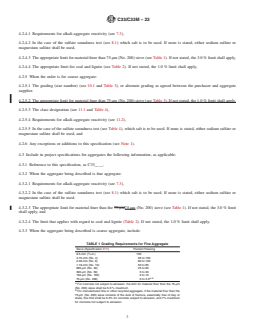
4.2.4.3 The appropriate limit for material finer than 75-μm (No. 200) sieve (see Table 1). If not stated, the 3.0 % limit shall apply,
4.2.4.4 The appropriate limit for coal and lignite (see Table 2). If not stated, the 1.0 % limit shall apply,
4.2.5 When the order is for coarse aggregate:
4.2.5.1 The grading (size number) (see 10.1 and Table 3), or alternate grading as agreed between the purchaser and aggregate
supplier.
4.2.5.2 The appropriate limit for material finer than 75 μm (No. 200) sieve (see Table 3). If not stated, the 1.0 % limit shall apply,
4.2.5.3 The class designation (see 11.1 and Table 4),
4.2.5.4 Requirements for alkali-aggregate reactivity (see 11.2),
4.2.5.5 In the case of the sulfate soundness test (see Table 4), which salt is to be used. If none is stated, either sodium sulfate or
magnesium sulfate shall be used, and
4.2.6 Any exceptions or additions to this specification (see Note 1).
4.3 Include in project specifications for aggregates the following information, as applicable:
4.3.1 Reference to this specification, as C33____.
4.3.2 When the aggregate being described is fine aggregate:
4.3.2.1 Requirements for alkali-aggregate reactivity (see 7.3),
4.3.2.2 In the case of the sulfate soundness test (see 8.1) which salt is to be used. If none is stated, either sodium sulfate or
magnesium sulfate shall be used.
4.3.2.3 The appropriate limit for material finer than the 75-μm75 μm (No. 200) sieve (see Table 1). If not stated, the 3.0 % limit
shall apply, and
4.3.2.4 The limit that applies with regard to coal and lignite (Table 2). If not stated, the 1.0 % limit shall apply.
4.3.3 When the aggregate being described is coarse aggregate, include:
TABLE 1 Grading Requirements for Fine Aggregate
Sieve (Specification E11) Percent Passing
9.5-mm ( ⁄8-in.) 100
4.75-mm (No. 4) 95 to 100
2.36-mm (No. 8) 80 to 100
1.18-mm (No. 16) 50 to 85
600-μm (No. 30) 25 to 60
300-μm (No. 50) 5 to 30
150-μm (No. 100) 0 to 10
A,B
75-μm (No. 200) 0 to 3.0
A
For concrete not subject to abrasion, the limit for material finer than the 75-μm
(No. 200) sieve shall be 5.0 % maximum.
B
For manufactured fine or other recycled aggregate, if the material finer than the
75-μm (No. 200) sieve consists of the dust of fracture, essentially free of clay or
shale, this limit shall be 5.0% for concrete subject to abrasion, and 7% maximum
for concrete not subject to abrasion.
C33/C33M − 23
TABLE 2 Limits for Deleterious Substances in Fine Aggregate for
Concrete
Mass Percent
Item of Total Sample,
max
Clay lumps and friable particles 3.0
Coal and lignite:
Where surface appearance of concrete 0.5
is of importance
All other concrete 1.0
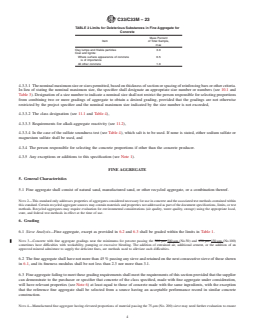
4.3.3.1 The nominal maximum size or sizes permitted, based on thickness of section or spacing of reinforcing bars or other criteria.
In lieu of stating the nominal maximum size, the specifier shall designate an appropriate size number or numbers (see 10.1 and
Table 3). Designation of a size number to indicate a nominal size shall not restrict the person responsible for selecting proportions
from combining two or more gradings of aggregate to obtain a desired grading, provided that the gradings are not otherwise
restricted by the project specifier and the nominal maximum size indicated by the size number is not exceeded,
4.3.3.2 The class designation (see 11.1 and Table 4),
4.3.3.3 Requirements for alkali-aggregate reactivity (see 11.2),
4.3.3.4 In the case of the sulfate soundness test (see Table 4), which salt is to be used. If none is stated, either sodium sulfate or
magnesium sulfate shall be used, and
4.3.4 The person responsible for selecting the concrete proportions if other than the concrete producer.
4.3.5 Any exceptions or additions to this specification (see Note 1).
FINE AGGREGATE
5. General Characteristics
5.1 Fine aggregate shall consist of natural sand, manufactured sand, or other recycled aggregate, or a combination thereof.
NOTE 2—This standard only addresses properties of aggregates considered necessary for use in concrete and the associated test methods contained within
this standard. Certain recycled aggregate sources may contain materials and properties not addressed as part of the document specifications, limits, or test
methods. Recycled aggregates may require evaluation for environmental considerations (air quality, water quality, storage) using the appropriate local,
state, and federal test methods in effect at the time of use.
6. Grading
6.1 Sieve Analysis—Fine aggregate, except as provided in 6.2 and 6.3 shall be graded within the limits in Table 1.
NOTE 3—Concrete with fine aggregate gradings near the minimums for percent passing the 300 μm 300 μm (No.50) and 150 μm 150 μm (No.100)
sometimes have difficulties with workability, pumping or excessive bleeding. The addition of entrained air, additional cement, or the addition of an
approved mineral admixture to supply the deficient fines, are methods used to alleviate such difficulties.
6.2 The fine aggregate shall have not more than 45 % passing any sieve and retained on the next consecutive sieve of those shown
in 6.1, and its fineness modulus shall be not less than 2.3 nor more than 3.1.
6.3 Fine aggregate failing to meet these grading requirements shall meet the requirements of this section provided that the supplier
can demonstrate to the purchaser or specifier that concrete of the class specified, made with fine aggregate under consideration,
will have relevant properties (see Note 6) at least equal to those of concrete made with the same ingredients, with the exception
that the reference fine aggregate shall be selected from a source having an acceptable performance record in similar concrete
construction.
NOTE 4—Manufactured fine aggregate having elevated proportions of material passing the 75-μm (No. 200) sieve may need further evaluation to ensure
C33/C33M − 23
TABLE 3 Grading Requirements for Coarse Aggregates
Amounts Finer than Each Laboratory Sieve (Square-Openings), Mass Percent
Nominal Size
100 90 mm 75 mm 63 mm 50 mm 37.5 mm 25.0 mm 19.0 mm 12.5 mm 9.5 mm 4.75 mm 2.36 mm 1.18 mm 300 μm 75 μm
Size Number (Sieves with
1 1 1 3 1 3
mm (3 ⁄2 in.) (3 in.) (2 ⁄2 in.) (2 in.) (1 ⁄2 in.) (1 in.) ( ⁄4 in.) ( ⁄2 in.) ( ⁄8 in.) (No. 4) (No. 8) (No. 16) (No.50) (No.200)
Square Openings)
(4 in.)
B
1 90 to 37.5 mm 100 90 to 100 . 25 to 60 . 0 to 15 . 0 to 5 . . . . . . 0 to 1.0
1 1
(3 ⁄2 to 1 ⁄2 in.)
B
2 63 to 37.5 mm . . 100 90 to 100 35 to 70 0 to 15 . 0 to 5 . . . . . . 0 to 1.0
1 1
(2 ⁄2 to 1 ⁄2 in.)
B
3 50 to 25.0 mm . . . 100 90 to 100 35 to 70 0 to 15 . 0 to 5 . . . . . 0 to 1.0
(2 to 1 in.)
B
357 50 to 4.75 mm . . . 100 95 to 100 . 35 to 70 . 10 to 30 . 0 to 5 . . . 0 to 1.0
(2 in. to No. 4)
B
4 37.5 to 19.0 mm . . . . 100 90 to 100 20 to 55 0 to 15 . 0 to 5 . . . . 0 to 1.0
1 3
(1 ⁄2 to ⁄4 in.)
B
467 37.5 to 4.75 mm . . . . 100 95 to 100 . 35 to 70 . 10 to 30 0 to 5 . . . 0 to 1.0
(1 ⁄2 in. to No. 4)
B
5 25.0 to 12.5 mm . . . . . 100 90 to 100 20 to 55 0 to 10 0 to 5 . . . . 0 to 1.0
(1 to ⁄2 in.)
B
56 25.0 to 9.5 mm . . . . . 100 90 to 100 40 to 85 10 to 40 0 to 15 0 to 5 . . . 0 to 1.0
(1 to ⁄8 in.)
B
57 25.0 to 4.75 mm . . . . . 100 95 to 100 . 25 to 60 . 0 to 10 0 to 5 . . 0 to 1.0
(1 in. to No. 4)
B
6 19.0 to 9.5 mm . . . . . . 100 90 to 100 20 to 55 0 to 15 0 to 5 . . . 0 to 1.0
3 3
( ⁄4 to ⁄8 in.)
B
67 19.0 to 4.75 mm . . . . . . 100 90 to 100 . 20 to 55 0 to 10 0 to 5 . . 0 to 1.0
( ⁄4 in. to No. 4)
B
7 12.5 to 4.75 mm . . . . . . . 100 90 to 100 40 to 70 0 to 15 0 to 5 . . 0 to 1.0
( ⁄2 in. to No. 4)
B
8 9.5 to 2.36 mm . . . . . . . . 100 85 to 100 10 to 30 0 to 10 0 to 5 . 0 to 1.0
( ⁄8 in. to No. 8)
B
89 9.5 to 1.18 mm . . . . . . . . 100 90 to 100 20 to 55 5 to 30 0 to 10 0 to 5 0 to 1.0
( ⁄8 in. to No. 16)
A B
9 4.75 to 1.18 mm . . . . . . . . . 100 85 to 100 10 to 40 0 to 10 0 to 5 0 to 1.0
(No. 4 to No. 16)
A
Size number 9 aggregate is defined in Terminology C125 as a fine aggregate. It is included as a coarse aggregate when it is combined with a size number 8 material to create a size number 89, which is a coarse
aggregate as defined by Terminology C125.
B
This percentage under either of the following conditions: (1) is permitted to be increased to 1.5 if the material is essentially free of clay or shale; or (2) if the source of the fine aggregate to be used in the concrete is
known to contain less than the specified maximum amount passing the 75 μm (No. 200) sieve Table 1 the percentage limit (L) on the amount in the coarse aggregate is permitted to be increased to L = 1 + [(P)/(100 –
P)] (T – A), where P = percentage of sand in the concrete as a percent of total aggregate, T = the Table 1 limit for the amount permitted in the fine aggregate, and A = the actual amount in the fine aggregate. (This
provides a weighted calculation designed to limit the maximum mass of material passing the 75 μm (No. 200) sieve in the concrete to that which would be obtained if both the fine and coarse aggregate were supplied
at the maximum tabulated percentage for each of these ingredients.)
C33/C33M − 23
TABLE 4 Limits for Deleterious Substances and Physical Property Requirements of Coarse Aggregate for Concrete
NOTE 1—See Fig. 1 for the location of the weathering regions and Note 12 for guidance in using the map. The weathering regions are defined as follows:
(S) Severe Weathering Region—A cold climate where concrete is exposed to deicing chemicals or other aggressive agents, or
where concrete may become saturated by continued contact with moisture or free water prior to repeated freezing and thawing.
(M) Moderate Weathering Region—A climate where occasional freezing is expected, but where concrete in outdoor service will not
be continually exposed to freezing and thawing in the presence of moisture or to deicing chemicals.
(N) Negligible Weathering Region—A climate where concrete is rarely exposed to freezing in the presence of moisture.
Maximum Allowable, %
Sum of Clay
Lumps, Fri-
Material
Clay able Magnesium
Class Type or Location of Concrete
Chert (Less Finer
Lumps and Particles, Coal and Sulfate
A
Designation Construction
Than 2.40 sp Than 75-μm Abrasion
Friable Par- and Lignite Soundness
gr SSD) (No. 200)
B
ticles Chert (Less (5 cycles)
Sieve
Than 2.40 sp
gr SSD)
Severe Weathering Regions
C
1S Footings, foundations, columns and 10.0 . . 1.0 1.0 50 .
beams not exposed to the weather, in-
terior floor slabs to be given coverings
1S Footings, foundations, columns and 10.0 . . 1.0 50 .
beams not exposed to the weather, in-
terior floor slabs to be given coverings
C
2S Interior floors without coverings 5.0 . . 1.0 0.5 50 .
2S Interior floors without coverings 5.0 . . 0.5 50 .
C
3S Foundation walls above grade, retaining 5.0 5.0 7.0 1.0 0.5 50 18
walls, abutments, piers, girders, and
beams exposed to the weather
3S Foundation walls above grade, retaining 5.0 5.0 7.0 0.5
...