


ASTM D6083/D6083M-24
(Specification)Standard Specification for Liquid-Applied Acrylic Coating Used in Roofing
Standard Specification for Liquid-Applied Acrylic Coating Used in Roofing
SCOPE
1.1 This specification covers liquid-applied water-dispersed acrylic latex elastomeric protective roof coatings.
1.2 This specification does not provide guidance for application.
1.3 The values stated in either SI units or inch-pound units are to be regarded separately as standard. The values stated in each system may not be exact equivalents; therefore, each system shall be used independently of the other. Combining values from the two systems may result in nonconformance with the standard.
1.4 This standard does not purport to address all of the safety concerns, if any, associated with its use. It is the responsibility of the user of this standard to establish appropriate safety, health, and environmental practices and determine the applicability of regulatory limitations prior to use.
1.5 This international standard was developed in accordance with internationally recognized principles on standardization established in the Decision on Principles for the Development of International Standards, Guides and Recommendations issued by the World Trade Organization Technical Barriers to Trade (TBT) Committee.
General Information
- Status
- Published
- Publication Date
- 31-Dec-2023
- Technical Committee
- D08 - Roofing and Waterproofing
Relations
- Replaces
ASTM D6083/D6083M-21 - Standard Specification for Liquid-Applied Acrylic Coating Used in Roofing - Effective Date
- 01-Jan-2024
- Effective Date
- 01-Jan-2024
- Effective Date
- 01-Aug-2023
- Effective Date
- 01-Jan-2024
Overview
ASTM D6083/D6083M-24, Standard Specification for Liquid-Applied Acrylic Coating Used in Roofing, defines the requirements for water-dispersed, acrylic latex elastomeric protective roof coatings. Developed by ASTM International, this standard ensures that liquid-applied acrylic coatings meet specific physical properties and performance criteria when used for roofing applications. The standard is applicable internationally and aligns with widely recognized principles for roof coatings standardization.
This specification covers both the liquid and cured states of acrylic latex elastomeric coatings and specifies essential guidelines for manufacturers, suppliers, and end-users seeking consistent product quality and roofing system performance.
Key Topics
Material Composition
- Water-based acrylic latex elastomeric emulsion as the primary component
- Includes pigments and additives for targeted physical properties
Product Types
- Two main types of coating, classified by physical characteristics in both liquid and cured states
Physical Property Requirements
- Separate standards for liquid (e.g., viscosity, solids content) and cured films (e.g., elongation, tensile strength, water permeability)
- Testing methods for adhesion, tear resistance, low-temperature flexibility, and resistance to weathering and fungi
Test Methods and Inspection
- Relies on referenced ASTM test methods for properties like tensile strength (D2370), water vapor transmission (D1653), and more
- Inspection protocols and provisions for rejection and resubmittal if requirements are not met
Packaging and Identification
- Requires clear labeling with manufacturer details, batch, type, and shelf-life for traceability
International Applicability
- Recognized as in compliance with global trade principles and international standardization best practices
Applications
Liquid-applied acrylic roof coatings specified by ASTM D6083/D6083M-24 are widely utilized in modern roofing systems. Their primary function is to serve as protective barriers, extending the service life of roofing substrates and improving energy efficiency by providing reflective surfaces. Major applications include:
- Commercial and Industrial Roofing
- Suitable for flat or low-slope roofs made of metal, concrete, or other compatible materials
- Restoration of Existing Roofs
- Used to recoat and upgrade older roofs, improving waterproofing and durability without complete replacement
- Waterproofing and Weather Resistance
- Prevents water infiltration, and provides resistance to UV, temperature fluctuations, and biological growth
- Maintenance Solutions
- Offers a cost-effective way for building owners to maintain and protect roof integrity over time
Professionals such as roofing contractors, architects, facility managers, coating formulators, and manufacturers use this standard to ensure product efficacy and compliance in real-world roofing projects.
Related Standards
ASTM D6083/D6083M-24 references several other standards essential for testing and terminology, including:
- ASTM D16 - Terminology for Paint, Related Coatings, Materials, and Applications
- ASTM D471 - Test Method for Rubber Property-Effect of Liquids
- ASTM D522/D522M - Test Methods for Mandrel Bend Test of Attached Organic Coatings
- ASTM D624 - Test Method for Tear Strength of Conventional Vulcanized Rubber and Thermoplastic Elastomers
- ASTM D903 - Test Method for Peel or Stripping Strength of Adhesive Bonds
- ASTM D1644 - Test Method for Nonvolatile Content of Varnishes
- ASTM D1653 - Test Methods for Water Vapor Transmission of Organic Coating Films
- ASTM D2196 - Test Methods for Rheological Properties of Non-Newtonian Materials by Rotational Viscometer
- ASTM D2370 - Test Method for Tensile Properties of Organic Coatings
- ASTM D2697 - Test Method for Volume Nonvolatile Matter in Clear or Pigmented Coatings
- ASTM D4798/D4798M - Practice for Accelerated Weathering Test Conditions and Procedures for Bituminous Materials
- ASTM G21 - Practice for Determining Resistance of Synthetic Polymeric Materials to Fungi
Consult these related standards for detailed test procedures and additional technical terminology supporting roofing coatings applications.
Keywords: ASTM D6083, liquid-applied acrylic coating, elastomeric roof coating, roofing standards, acrylic latex, roof protection, ASTM roofing standard, roof waterproofing, roof restoration
Buy Documents


ASTM D6083/D6083M-24 - Standard Specification for Liquid-Applied Acrylic Coating Used in Roofing

REDLINE ASTM D6083/D6083M-24 - Standard Specification for Liquid-Applied Acrylic Coating Used in Roofing
Get Certified
Connect with accredited certification bodies for this standard

ICC Evaluation Service
Building products evaluation and certification.

National Aerospace and Defense Contractors Accreditation Program (NADCAP)
Global cooperative program for special process quality in aerospace.

QAI Laboratories
Building and construction product testing and certification.
Sponsored listings
Frequently Asked Questions
ASTM D6083/D6083M-24 is a technical specification published by ASTM International. Its full title is "Standard Specification for Liquid-Applied Acrylic Coating Used in Roofing". This standard covers: SCOPE 1.1 This specification covers liquid-applied water-dispersed acrylic latex elastomeric protective roof coatings. 1.2 This specification does not provide guidance for application. 1.3 The values stated in either SI units or inch-pound units are to be regarded separately as standard. The values stated in each system may not be exact equivalents; therefore, each system shall be used independently of the other. Combining values from the two systems may result in nonconformance with the standard. 1.4 This standard does not purport to address all of the safety concerns, if any, associated with its use. It is the responsibility of the user of this standard to establish appropriate safety, health, and environmental practices and determine the applicability of regulatory limitations prior to use. 1.5 This international standard was developed in accordance with internationally recognized principles on standardization established in the Decision on Principles for the Development of International Standards, Guides and Recommendations issued by the World Trade Organization Technical Barriers to Trade (TBT) Committee.
SCOPE 1.1 This specification covers liquid-applied water-dispersed acrylic latex elastomeric protective roof coatings. 1.2 This specification does not provide guidance for application. 1.3 The values stated in either SI units or inch-pound units are to be regarded separately as standard. The values stated in each system may not be exact equivalents; therefore, each system shall be used independently of the other. Combining values from the two systems may result in nonconformance with the standard. 1.4 This standard does not purport to address all of the safety concerns, if any, associated with its use. It is the responsibility of the user of this standard to establish appropriate safety, health, and environmental practices and determine the applicability of regulatory limitations prior to use. 1.5 This international standard was developed in accordance with internationally recognized principles on standardization established in the Decision on Principles for the Development of International Standards, Guides and Recommendations issued by the World Trade Organization Technical Barriers to Trade (TBT) Committee.
ASTM D6083/D6083M-24 is classified under the following ICS (International Classification for Standards) categories: 25.220.60 - Organic coatings; 91.100.50 - Binders. Sealing materials. The ICS classification helps identify the subject area and facilitates finding related standards.
ASTM D6083/D6083M-24 has the following relationships with other standards: It is inter standard links to ASTM D6083/D6083M-21, ASTM D16-24, ASTM D16-23, ASTM E2785-14(2022). Understanding these relationships helps ensure you are using the most current and applicable version of the standard.
ASTM D6083/D6083M-24 is available in PDF format for immediate download after purchase. The document can be added to your cart and obtained through the secure checkout process. Digital delivery ensures instant access to the complete standard document.
Standards Content (Sample)
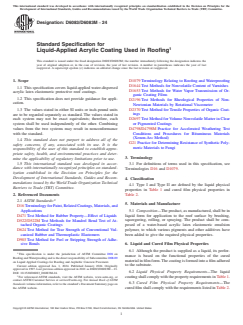
This international standard was developed in accordance with internationally recognized principles on standardization established in the Decision on Principles for the
Development of International Standards, Guides and Recommendations issued by the World Trade Organization Technical Barriers to Trade (TBT) Committee.
Designation: D6083/D6083M − 24
Standard Specification for
Liquid-Applied Acrylic Coating Used in Roofing
This standard is issued under the fixed designation D6083/D6083M; the number immediately following the designation indicates the
year of original adoption or, in the case of revision, the year of last revision. A number in parentheses indicates the year of last
reapproval. A superscript epsilon (´) indicates an editorial change since the last revision or reapproval.
1. Scope D1079 Terminology Relating to Roofing and Waterproofing
D1644 Test Methods for Nonvolatile Content of Varnishes
1.1 This specification covers liquid-applied water-dispersed
D1653 Test Methods for Water Vapor Transmission of Or-
acrylic latex elastomeric protective roof coatings.
ganic Coating Films
1.2 This specification does not provide guidance for appli-
D2196 Test Methods for Rheological Properties of Non-
cation.
Newtonian Materials by Rotational Viscometer
1.3 The values stated in either SI units or inch-pound units D2370 Test Method for Tensile Properties of Organic Coat-
ings
are to be regarded separately as standard. The values stated in
each system may not be exact equivalents; therefore, each D2697 Test Method for Volume Nonvolatile Matter in Clear
or Pigmented Coatings
system shall be used independently of the other. Combining
values from the two systems may result in nonconformance D4798/D4798M Practice for Accelerated Weathering Test
Conditions and Procedures for Bituminous Materials
with the standard.
(Xenon-Arc Method)
1.4 This standard does not purport to address all of the
G21 Practice for Determining Resistance of Synthetic Poly-
safety concerns, if any, associated with its use. It is the
meric Materials to Fungi
responsibility of the user of this standard to establish appro-
priate safety, health, and environmental practices and deter-
3. Terminology
mine the applicability of regulatory limitations prior to use.
1.5 This international standard was developed in accor-
3.1 For definitions of terms used in this specification, see
dance with internationally recognized principles on standard-
Terminologies D16 and D1079.
ization established in the Decision on Principles for the
Development of International Standards, Guides and Recom-
4. Classification
mendations issued by the World Trade Organization Technical
4.1 Type I and Type II are defined by the liquid physical
Barriers to Trade (TBT) Committee.
properties in Table 1 and cured film physical properties in
Table 2.
2. Referenced Documents
2.1 ASTM Standards:
5. Materials and Manufacture
D16 Terminology for Paint, Related Coatings, Materials, and
Applications 5.1 Composition—The product, as manufactured, shall be in
D471 Test Method for Rubber Property—Effect of Liquids liquid form for application to the roof surface by brushing,
D522/D522M Test Methods for Mandrel Bend Test of At- squeegeeing, rolling, or spraying. The product shall be com-
tached Organic Coatings posed of a water-based acrylic latex elastomeric emulsion
D624 Test Method for Tear Strength of Conventional Vul- polymer, to which various pigments and other additives have
been added to give the required physical properties.
canized Rubber and Thermoplastic Elastomers
D903 Test Method for Peel or Stripping Strength of Adhe-
sive Bonds 6. Liquid and Cured Film Physical Properties
6.1 Although the product is supplied as a liquid, its perfor-
This specification is under the jurisdiction of ASTM Committee D08 on
mance is based on the functional properties of the cured
Roofing and Waterproofing and is the direct responsibility of Subcommittee D08.09
material in film form. The coating is formed into a film adhered
on Liquid Applied Coatings for Roofing and Asphaltic Concrete Pavement.
Current edition approved Jan. 1, 2024. Published January 2024. Originally to the substrate.
approved in 1997. Last previous edition approved in 2021 as D6083/D6083M – 21.
6.2 Liquid Physical Property Requirements—The liquid
DOI: 10.1520/D6083_D6083M-24.
For referenced ASTM standards, visit the ASTM website, www.astm.org, or coating shall comply with the property requirements in Table 1.
contact ASTM Customer Service at service@astm.org. For Annual Book of ASTM
6.3 Cured Film Physical Property Requirements—The
Standards volume information, refer to the standard’s Document Summary page on
the ASTM website. cured film shall comply with the requirements listed in Table 2.
Copyright © ASTM International, 100 Barr Harbor Drive, PO Box C700, West Conshohocken, PA 19428-2959. United States
D6083/D6083M − 24
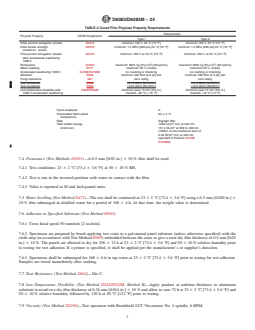
TABLE 1 Liquid Physical Property Requirements
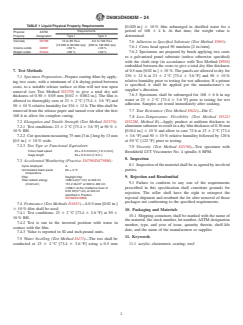
[0.020 in.] 6 10 % film submerged in distilled water for a
Requirements period of 168 6 4 h. At that time, the weight value is
Physical ASTM
Property Designation
Type I Type II determined.
Viscosity D2196 12 to 85 Pa·s 0.2 to 100 Pa·s
7.6 Adhesion to Specified Substrate (Test Method D903):
[12 000 to 85 000 cps] [200 to 100 000 cps]
7.6.1 Cross head speed 50 mm/min [2 in./min].
Volume solids D2697 $50 % $45 %
Weight solids D1644 $60 % $50 % 7.6.2 Specimens are prepared by brush applying two coats
to a galvanized panel substrate (unless otherwise specified)
with the cloth strip (in accordance with Test Method D903)
embedded between the coats to give a total dry film thickness
7. Test Methods of 0.5 mm [0.02 in.] 6 10 %. The panels are allowed to dry for
336 6 12 h at 23 6 2 °C [73.4 6 3.6 °F] and 50 6 10 %
7.1
...
This document is not an ASTM standard and is intended only to provide the user of an ASTM standard an indication of what changes have been made to the previous version. Because
it may not be technically possible to adequately depict all changes accurately, ASTM recommends that users consult prior editions as appropriate. In all cases only the current version
of the standard as published by ASTM is to be considered the official document.
Designation: D6083/D6083M − 21 D6083/D6083M − 24
Standard Specification for
Liquid-Applied Acrylic Coating Used in Roofing
This standard is issued under the fixed designation D6083/D6083M; the number immediately following the designation indicates the
year of original adoption or, in the case of revision, the year of last revision. A number in parentheses indicates the year of last
reapproval. A superscript epsilon (´) indicates an editorial change since the last revision or reapproval.
1. Scope
1.1 This specification covers liquid-applied water-dispersed acrylic latex elastomeric protective roof coatings.
1.2 This specification does not provide guidance for application.
1.3 The values stated in either SI units or inch-pound units are to be regarded separately as standard. The values stated in each
system may not be exact equivalents; therefore, each system shall be used independently of the other. Combining values from the
two systems may result in nonconformance with the standard.
1.4 This standard does not purport to address all of the safety concerns, if any, associated with its use. It is the responsibility
of the user of this standard to establish appropriate safety, health, and environmental practices and determine the applicability of
regulatory limitations prior to use.
1.5 This international standard was developed in accordance with internationally recognized principles on standardization
established in the Decision on Principles for the Development of International Standards, Guides and Recommendations issued
by the World Trade Organization Technical Barriers to Trade (TBT) Committee.
2. Referenced Documents
2.1 ASTM Standards:
D16 Terminology for Paint, Related Coatings, Materials, and Applications
D471 Test Method for Rubber Property—Effect of Liquids
D522/D522M Test Methods for Mandrel Bend Test of Attached Organic Coatings
D624 Test Method for Tear Strength of Conventional Vulcanized Rubber and Thermoplastic Elastomers
D903 Test Method for Peel or Stripping Strength of Adhesive Bonds
D1079 Terminology Relating to Roofing and Waterproofing
D1644 Test Methods for Nonvolatile Content of Varnishes
D1653 Test Methods for Water Vapor Transmission of Organic Coating Films
D2196 Test Methods for Rheological Properties of Non-Newtonian Materials by Rotational Viscometer
D2370 Test Method for Tensile Properties of Organic Coatings
D2697 Test Method for Volume Nonvolatile Matter in Clear or Pigmented Coatings
D4798/D4798M Practice for Accelerated Weathering Test Conditions and Procedures for Bituminous Materials (Xenon-Arc
Method)
G21 Practice for Determining Resistance of Synthetic Polymeric Materials to Fungi
This specification is under the jurisdiction of ASTM Committee D08 on Roofing and Waterproofing and is the direct responsibility of Subcommittee D08.09 on
Bituminous EmulsionsLiquid Applied Coatings for Roofing and Asphaltic Concrete Pavement.
Current edition approved Feb. 15, 2021Jan. 1, 2024. Published February 2021January 2024. Originally approved in 1997. Last previous edition approved in 20182021
as D6083/D6083M – 18.D6083/D6083M – 21. DOI: 10.1520/D6083_D6083M-21.10.1520/D6083_D6083M-24.
For referenced ASTM standards, visit the ASTM website, www.astm.org, or contact ASTM Customer Service at service@astm.org. For Annual Book of ASTM Standards
volume information, refer to the standard’s Document Summary page on the ASTM website.
Copyright © ASTM International, 100 Barr Harbor Drive, PO Box C700, West Conshohocken, PA 19428-2959. United States
D6083/D6083M − 24
3. Terminology
3.1 For definitions of terms used in this specification, see Terminologies D16 and D1079.
4. Classification
4.1 Type I and Type II are defined by the liquid physical properties in Table 1 and cured film physical properties in Table 2.
5. Materials and Manufacture
5.1 Composition—The product, as manufactured, shall be in liquid form for application to the roof surface by brushing,
squeegeeing, rolling, or spraying. The product shall be composed of a water-based acrylic latex elastomeric emulsion polymer, to
which various pigments and other additives have been added to give the required physical properties.
6. Liquid and Cured Film Physical Properties
6.1 Although the product is supplied as a liquid, its performance is based on the functional properties of the cured material in film
form. The coating is formed into a film adhered to the substrate.
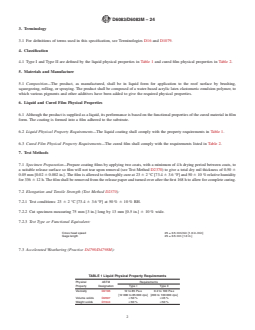
6.2 Liquid Physical Property Requirements—The liquid coating shall comply with the property requirements in Table 1.
6.3 Cured Film Physical Property Requirements—The cured film shall comply with the requirements listed in Table 2.
7. Test Methods
7.1 Specimen Preparation—Prepare coating films by applying two coats, with a minimum of 4 h drying period between coats, to
a suitable release surface so film will not tear upon removal (see Test Method D2370) to give a total dry mil thickness of 0.50 6
0.05 mm [0.02 6 0.002 in.]. The film is allowed to thoroughly cure at 23 6 2 °C [73.4 6 3.6 °F] and 50 6 10 % relative humidity
for 336 6 12 h. The film shall be removed from the release paper and turned over after the first 168 h to allow for complete curing.
7.2 Elongation and Tensile Strength (Test Method D2370):
7.2.1 Test conditions: 23 6 2 °C [73.4 6 3.6 °F] at 50 % 6 10 % RH.
7.2.2 Cut specimen measuring 75 mm [3 in.] long by 13 mm [0.5 in.] 6 10 % wide.
7.2.3 Test Type or Functional Equivalent:
Cross head speed 25 ± 0.5 mm/min [1.0 in./min]
Gage length 25
...
Questions, Comments and Discussion
Ask us and Technical Secretary will try to provide an answer. You can facilitate discussion about the standard in here.
Loading comments...