

ASTM E3245-20e1
(Guide)Standard Guide for Systematic Approach to the Extraction, Analysis, and Classification of Ignitable Liquids and Ignitable Liquid Residues in Fire Debris Samples
General Information
- Abstract
SIGNIFICANCE AND USE
5.1 This guide is applicable for all ignitable liquids as defined by Test Method E1618.
5.2 This guide is applicable to solid and liquid samples (burned and unburned), which are packaged in a closed vapor-tight container (typically a can, fire debris bag, jar, or vial).
5.3 This guide is to be used in conjunction with the referenced documents by an analyst familiar with the limitations and applicability of each technique used.
5.4 This guide does not attempt to address all the issues regarding sample extraction and analysis. There could be additional laboratory validated or verified tests, extractions or analyses that can be performed to provide further discrimination and classification of ignitable liquids and ignitable liquid residues present in samples.
5.5 This guide is intended to be used in conjunction with generally accepted forensic accreditation requirements including documentation and records.
SCOPE
1.1 This guide describes a systematic approach to the extraction, analysis, and classification of ignitable liquids and their residues in solid (for example, fire debris) and liquid samples.
1.2 This guide addresses evidence handling, extraction methodologies, instrumental analysis techniques, and analytical data interpretation.
1.3 This guide cannot replace knowledge, skill, or ability acquired through appropriate education, training, and experience and should be used in conjunction with sound professional judgment.
1.4 This standard does not purport to address all of the safety concerns, if any, associated with its use. It is the responsibility of the user of this standard to establish appropriate safety, health, and environmental practices and determine the applicability of regulatory limitations prior to use.
1.5 This international standard was developed in accordance with internationally recognized principles on standardization established in the Decision on Principles for the Development of International Standards, Guides and Recommendations issued by the World Trade Organization Technical Barriers to Trade (TBT) Committee.
- Status
- Published
- Publication Date
- 31-May-2020
- Technical Committee
- E30 - Forensic Sciences
- Drafting Committee
- E30.01 - Criminalistics
Overview
ASTM E3245-20e1, titled "Standard Guide for Systematic Approach to the Extraction, Analysis, and Classification of Ignitable Liquids and Ignitable Liquid Residues in Fire Debris Samples," provides a comprehensive framework for forensic laboratories and analysts handling fire debris evidence. Developed by ASTM International, this guide outlines accepted practices for the extraction, analysis, and classification of ignitable liquids and their residues in both solid (e.g., fire debris) and liquid samples. Its systematic approach enhances reliability and consistency across laboratory investigations and is vital for fire scene examinations, insurance investigations, and legal proceedings related to suspected arson.
Key Topics
- Applicability: The standard applies to all ignitable liquids as defined by ASTM E1618, covering both burned and unburned solid and liquid samples stored in vapor-tight containers (e.g., cans, fire debris bags, jars).
- Evidence Handling: Provides requirements for the proper collection, packaging, and storage to prevent contamination and preserve sample integrity, including special considerations for substrate materials.
- Sample Preparation: Outlines extraction methodologies such as static and dynamic headspace analysis, passive headspace concentration, solvent extraction, liquid-liquid extraction, and solid phase microextraction. Selection of technique depends on sample type and volatility.
- Instrumental Analysis: Emphasizes the use of gas chromatography-mass spectrometry (GC-MS) as a primary tool, while discussing supplementary methods like GC-flame ionization detection (GC-FID), flash point testing, and FTIR for additional information.
- Data Interpretation: Stresses the importance of confirmatory analytical data and professional judgment in classifying ignitable liquids or residues, along with re-extraction protocols if needed.
- Reporting and Documentation: Aligns with forensic accreditation standards to ensure proper record-keeping, documentation, and reporting in compliance with established ASTM practices.
Applications
ASTM E3245-20e1 is a critical resource for:
- Forensic Laboratories: Used during fire debris analysis to systematically assess, extract, and identify traces of ignitable liquids and their residues.
- Fire and Arson Investigations: Supports investigators in differentiating between accidental and intentional fires by identifying potential accelerants.
- Legal Proceedings: Underpins the scientific credibility of evidence presented in court regarding the presence or absence of ignitable liquid residues.
- Accredited Testing Facilities: Ensures compliance with internationally recognized forensic standards and accreditation requirements.
- Insurance and Regulatory Compliance: Aids in claim assessments and regulatory reviews related to fire damage and arson cases.
Related Standards
The guide works in conjunction with a range of other key ASTM and NFPA standards essential for forensic fire debris analysis:
- ASTM E1618: Test method for ignitable liquid residues in extracts from fire debris by GC-MS.
- ASTM E1492: Practice for receiving, documenting, storing, and retrieving evidence in a forensic science laboratory.
- ASTM E1388, E3189: Practices for static headspace sampling and concentration from fire debris samples.
- ASTM E1412, E1413, E2154: Practices for passive and dynamic headspace concentration and solid phase microextraction.
- ASTM E1386: Practice for solvent extraction in fire debris analysis.
- ASTM E1459: Guide for physical evidence labeling and documentation.
- ASTM E2451: Practice for preserving ignitable liquids and extracts.
- NFPA 921: Guide for fire and explosion investigations, providing investigative context and sample collection best practices.
- Terminologies: ASTM E1732 and E3197 for relevant definitions in forensic science and fire debris examination.
Practical Value
Adherence to ASTM E3245-20e1 helps laboratories conduct defensible, reproducible analyses of ignitable liquids and residues, ensuring high-quality forensic results and facilitating standardized communication within the scientific and legal communities. This standard is foundational for effective fire debris analysis, supports accreditation, and upholds evidentiary integrity throughout the investigative process.
Keywords: ASTM E3245, ignitable liquids, fire debris, forensic science, sample extraction, GC-MS analysis, fire investigation, arson evidence, laboratory accreditation, forensic standards.
Relations
- Refers
ASTM E1388-24 - Standard Practice for Static Headspace Sampling of Vapors from Fire Debris Samples - Effective Date
- 01-Mar-2024
- Effective Date
- 01-Feb-2024
- Effective Date
- 15-Jan-2019
- Effective Date
- 01-Nov-2018
- Effective Date
- 01-Jun-2018
- Effective Date
- 15-May-2018
- Effective Date
- 01-Sep-2017
- Effective Date
- 15-Jan-2016
- Effective Date
- 01-Mar-2015
- Effective Date
- 01-Jul-2014
- Effective Date
- 15-Aug-2013
- Effective Date
- 01-Jun-2013
- Effective Date
- 01-Jun-2013
- Effective Date
- 15-Feb-2013
- Effective Date
- 15-Jun-2012
Get Certified
Connect with accredited certification bodies for this standard

CIS Institut d.o.o.
Personal Protective Equipment (PPE) certification body. Notified Body NB-2890 for EU Regulation 2016/425 PPE.

Kiwa BDA Testing
Building and construction product certification.
Kmetijski inštitut Slovenije
Agricultural Institute of Slovenia. Soil testing, plant health, agricultural product analysis.
Sponsored listings
Frequently Asked Questions
ASTM E3245-20e1 is a guide published by ASTM International. Its full title is "Standard Guide for Systematic Approach to the Extraction, Analysis, and Classification of Ignitable Liquids and Ignitable Liquid Residues in Fire Debris Samples". This standard covers: SIGNIFICANCE AND USE 5.1 This guide is applicable for all ignitable liquids as defined by Test Method E1618. 5.2 This guide is applicable to solid and liquid samples (burned and unburned), which are packaged in a closed vapor-tight container (typically a can, fire debris bag, jar, or vial). 5.3 This guide is to be used in conjunction with the referenced documents by an analyst familiar with the limitations and applicability of each technique used. 5.4 This guide does not attempt to address all the issues regarding sample extraction and analysis. There could be additional laboratory validated or verified tests, extractions or analyses that can be performed to provide further discrimination and classification of ignitable liquids and ignitable liquid residues present in samples. 5.5 This guide is intended to be used in conjunction with generally accepted forensic accreditation requirements including documentation and records. SCOPE 1.1 This guide describes a systematic approach to the extraction, analysis, and classification of ignitable liquids and their residues in solid (for example, fire debris) and liquid samples. 1.2 This guide addresses evidence handling, extraction methodologies, instrumental analysis techniques, and analytical data interpretation. 1.3 This guide cannot replace knowledge, skill, or ability acquired through appropriate education, training, and experience and should be used in conjunction with sound professional judgment. 1.4 This standard does not purport to address all of the safety concerns, if any, associated with its use. It is the responsibility of the user of this standard to establish appropriate safety, health, and environmental practices and determine the applicability of regulatory limitations prior to use. 1.5 This international standard was developed in accordance with internationally recognized principles on standardization established in the Decision on Principles for the Development of International Standards, Guides and Recommendations issued by the World Trade Organization Technical Barriers to Trade (TBT) Committee.
SIGNIFICANCE AND USE 5.1 This guide is applicable for all ignitable liquids as defined by Test Method E1618. 5.2 This guide is applicable to solid and liquid samples (burned and unburned), which are packaged in a closed vapor-tight container (typically a can, fire debris bag, jar, or vial). 5.3 This guide is to be used in conjunction with the referenced documents by an analyst familiar with the limitations and applicability of each technique used. 5.4 This guide does not attempt to address all the issues regarding sample extraction and analysis. There could be additional laboratory validated or verified tests, extractions or analyses that can be performed to provide further discrimination and classification of ignitable liquids and ignitable liquid residues present in samples. 5.5 This guide is intended to be used in conjunction with generally accepted forensic accreditation requirements including documentation and records. SCOPE 1.1 This guide describes a systematic approach to the extraction, analysis, and classification of ignitable liquids and their residues in solid (for example, fire debris) and liquid samples. 1.2 This guide addresses evidence handling, extraction methodologies, instrumental analysis techniques, and analytical data interpretation. 1.3 This guide cannot replace knowledge, skill, or ability acquired through appropriate education, training, and experience and should be used in conjunction with sound professional judgment. 1.4 This standard does not purport to address all of the safety concerns, if any, associated with its use. It is the responsibility of the user of this standard to establish appropriate safety, health, and environmental practices and determine the applicability of regulatory limitations prior to use. 1.5 This international standard was developed in accordance with internationally recognized principles on standardization established in the Decision on Principles for the Development of International Standards, Guides and Recommendations issued by the World Trade Organization Technical Barriers to Trade (TBT) Committee.
ASTM E3245-20e1 is classified under the following ICS (International Classification for Standards) categories: 13.220.40 - Ignitability and burning behaviour of materials and products. The ICS classification helps identify the subject area and facilitates finding related standards.
ASTM E3245-20e1 has the following relationships with other standards: It is inter standard links to ASTM E1388-24, ASTM E1732-24, ASTM E1732-19, ASTM E1732-18b, ASTM E1732-18a, ASTM E1732-18, ASTM E1732-17, ASTM E1412-16, ASTM E2154-15, ASTM E1618-14, ASTM E1413-13, ASTM E2881-13, ASTM E2881-13e1, ASTM E1459-13, ASTM E1732-12. Understanding these relationships helps ensure you are using the most current and applicable version of the standard.
ASTM E3245-20e1 is available in PDF format for immediate download after purchase. The document can be added to your cart and obtained through the secure checkout process. Digital delivery ensures instant access to the complete standard document.
Standards Content (Sample)
This international standard was developed in accordance with internationally recognized principles on standardization established in the Decision on Principles for the
Development of International Standards, Guides and Recommendations issued by the World Trade Organization Technical Barriers to Trade (TBT) Committee.
´1
Designation: E3245 −20 An American National Standard
Standard Guide for
Systematic Approach to the Extraction, Analysis, and
Classification of Ignitable Liquids and Ignitable Liquid
Residues in Fire Debris Samples
This standard is issued under the fixed designation E3245; the number immediately following the designation indicates the year of
original adoption or, in the case of revision, the year of last revision. A number in parentheses indicates the year of last reapproval. A
superscript epsilon (´) indicates an editorial change since the last revision or reapproval.
ε NOTE—Editorial corrections were made throughout in July 2020.
1. Scope E1388 Practice for Static Headspace Sampling of Vapors
from Fire Debris Samples
1.1 This guide describes a systematic approach to the
E1412 Practice for Separation of Ignitable Liquid Residues
extraction, analysis, and classification of ignitable liquids and
from Fire Debris Samples by Passive Headspace Concen-
their residues in solid (for example, fire debris) and liquid
tration with Activated Charcoal
samples.
E1413 Practice for Separation of Ignitable Liquid Residues
1.2 This guide addresses evidence handling, extraction
from Fire Debris Samples by Dynamic Headspace Con-
methodologies, instrumental analysis techniques, and analyti-
centration onto an Adsorbent Tube
cal data interpretation.
E1459 Guide for Physical Evidence Labeling and Related
1.3 This guide cannot replace knowledge, skill, or ability
Documentation
acquired through appropriate education, training, and experi-
E1492 Practice for Receiving, Documenting, Storing, and
ence and should be used in conjunction with sound profes-
Retrieving Evidence in a Forensic Science Laboratory
sional judgment.
E1618 TestMethodforIgnitableLiquidResiduesinExtracts
1.4 This standard does not purport to address all of the
from Fire Debris Samples by Gas Chromatography-Mass
safety concerns, if any, associated with its use. It is the
Spectrometry
responsibility of the user of this standard to establish appro-
E1732 Terminology Relating to Forensic Science
priate safety, health, and environmental practices and deter-
E2154 Practice for Separation and Concentration of Ignit-
mine the applicability of regulatory limitations prior to use.
able Liquid Residues from Fire Debris Samples by Pas-
1.5 This international standard was developed in accor-
sive Headspace Concentration with Solid Phase Microex-
dance with internationally recognized principles on standard-
traction (SPME)
ization established in the Decision on Principles for the
E2451 Practice for Preserving Ignitable Liquids and Ignit-
Development of International Standards, Guides and Recom-
able Liquid Residue Extracts from Fire Debris Samples
mendations issued by the World Trade Organization Technical
E2881 Test Method for Extraction and Derivatization of
Barriers to Trade (TBT) Committee.
Vegetable Oils and Fats from Fire Debris and Liquid
Samples with Analysis by Gas Chromatography-Mass
2. Referenced Documents
Spectrometry
2.1 ASTM Standards:
E2997 Test Method for Analysis of Biodiesel Products by
E620 Practice for Reporting Opinions of Scientific or Tech-
Gas Chromatography-Mass Spectrometry
nical Experts
E3189 Practice for Separation of Ignitable Liquid Residues
E1386 Practice for Separation of Ignitable Liquid Residues
from Fire Debris Samples by Static Headspace Concen-
from Fire Debris Samples by Solvent Extraction
tration onto an Adsorbent Tube
E3197 Terminology Relating to Examination of Fire Debris
This guide is under the jurisdiction of ASTM Committee E30 on Forensic
2.2 NFPA Standards:
Sciences and is the direct responsibility of Subcommittee E30.01 on Criminalistics.
NFPA 921 Guide for Fire and Explosion Investigation
Current edition approved June 1, 2020. Published July 2020. DOI: 10.1520/
E3245-20E01.
For referenced ASTM standards, visit the ASTM website, www.astm.org, or
contact ASTM Customer Service at service@astm.org. For Annual Book of ASTM
Standards volume information, refer to the standard’s Document Summary page on Available from National Fire Protection Association (NFPA), 1 Batterymarch
the ASTM website. Park, Quincy, MA 02169-7471, http://www.nfpa.org.
Copyright © ASTM International, 100 Barr Harbor Drive, PO Box C700, West Conshohocken, PA 19428-2959. United States
´1
E3245 − 20
2.3 Other Resources: 6.2.1 Review papers on fire debris analysis were compiled
National Center for Forensic Science Ignitable Liquids by Pert, Baron and Birkett (10), Zadora and Borusiewicz (11),
Reference Collection (NCFS-ILRC) and Substrates Data- Sandercock (12), Viitala and Kakko (13), Viitala and Hyyppä
base (14), Baerncopf and Hutches (15), and Stauffer (16).
6.2.2 A comprehensive list of references covering all as-
3. Terminology
pects of ignitable liquid and ignitable liquid residue extraction
and analysis is available on the Organization of ScientificArea
3.1 Definitions:
Committees (OSAC) website (17).
3.1.1 For definitions of terms used in this guide, refer to
Terminologies E1732 and E3197.
7. Initial Assessment of Case and Evidence
7.1 Evaluate the case information and the requested exami-
4. Summary of Guide
nation type(s) to determine whether the evidence can be
4.1 This guide describes a systematic approach for the
accepted (Practice E1492) and analyzed within the requested
analysis of ignitable liquids and their residues in fire debris or
timeline.
other samples.
7.2 Identify special considerations that can affect the initial
4.2 This guide highlights some of the considerations asso-
approach to the evidence, including the need for multiple
ciated with each step in the process: evidence assessment,
analyses, or special safety measures.
preliminary screening, sample preparation, instrumental analy-
7.2.1 Materials submitted for analysis could contain
sis techniques, data analysis and interpretation, reporting, and
chemical, biological, or physical hazards that require special
preservation of evidence.
safety measures.
7.2.2 Consider only relevant information about the case that
5. Significance and Use
pertains to the submitted samples and avoid basing interpreta-
5.1 This guide is applicable for all ignitable liquids as
tions and conclusions on cognitively biasing information, such
defined by Test Method E1618.
as an investigator’s hypotheses or contextual cues not related
specifically to the analysis of ignitable liquids. Examples of
5.2 This guide is applicable to solid and liquid samples
contextual cues irrelevant to the analysis include a fatality, the
(burned and unburned), which are packaged in a closed
insurance status of a building or the removal of valuable items
vapor-tight container (typically a can, fire debris bag, jar, or
prior to a fire (18).
vial).
7.3 Evaluatetheevidencetodeterminewhetheritissuitable
5.3 This guide is to be used in conjunction with the
for analysis.
referenced documents by an analyst familiar with the limita-
7.3.1 Specificsuitabilityrequirementsforfiredebrisinclude
tions and applicability of each technique used.
proper vapor-tight packaging and storage (NFPA 921).
5.4 This guide does not attempt to address all the issues
7.3.2 Store the evidence in a manner that will avoid con-
regarding sample extraction and analysis. There could be
tamination and minimize degradation.
additional laboratory validated or verified tests, extractions or
7.3.2.1 Items believed to contain substrate materials likely
analyses that can be performed to provide further discrimina-
to contribute to the degradation of ignitable liquids, such as
tion and classification of ignitable liquids and ignitable liquid
vegetation or soil, should be refrigerated or frozen at the
residues present in samples.
laboratory until the time of analysis if the analysis cannot be
5.5 This guide is intended to be used in conjunction with expedited (NFPA 921) (19-23).
generally accepted forensic accreditation requirements includ-
7.3.3 Determine if the content of the evidence is in agree-
ing documentation and records. ment with its description on the accompanying documentation.
Document and resolve discrepancies as necessary.
6. General Analytical Approach
7.3.3.1 Examine the content of the evidence prior to or after
analysis.
6.1 A general approach for the analysis of ignitable liquids
and their residues in fire debris and related samples is outlined
8. Preliminary Evaluation of Evidence (Screening)
in Fig. 1.
8.1 The preliminary tests listed below are considered op-
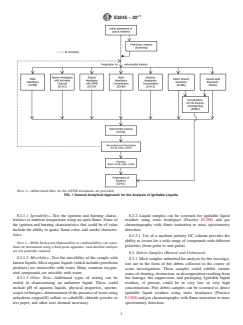
6.1.1 Within Fig. 1, reference is made to applicable ASTM
tional but can provide an indication as to the presence of an
documents.
ignitable liquid or ignitable liquid residue, as well as guidance
6.2 General approaches to fire debris analysis are exten-
in the selection of the best extraction method(s) for analysis.A
sively covered in textbooks by Bertsch, Holzer, and Sellers
preliminary evaluation shall not be used as the sole method to
(1); Almirall and Furton (2); Stauffer, Dolan and Newman (3);
establish a conclusion. Preliminary test results shall be sup-
Saferstein (4); DeHaan and Icove (5); Lentini (6); Siegel and
ported by additional analyses as detailed in Section 9.
Saukko (7); Hendrikse, Grutters, Schäfer (8); and Houck (9).
8.2 Liquid Samples:
8.2.1 Liquid samples submitted by fire investigators for
analysis or comparison could consist of one or more layers. A
Available from http://ilrc.ucf.edu.
portion from each layer should be independently examined by
The boldface numbers in parentheses refer to a list of references at the end of
this standard. performing one or more of the following tests:
´1
E3245 − 20
NOTE 1—Abbreviated titles for the ASTM documents are provided.
FIG. 1 General Analytical Approach for the Analysis of Ignitable Liquids.
8.2.1.1 Ignitability—Test the ignition and burning charac- 8.2.2 Liquid samples can be screened for ignitable liquid
teristics at ambient temperature using an open flame. Some of residues using static headspace (Practice E1388) and gas
the ignition and burning characteristics that could be of value chromatography with flame ionization or mass spectrometry
include the ability to ignite, flame color, and smoke character- detection.
istics.
8.2.2.1 Use of a medium polarity GC column provides the
ability to screen for a wide range of compounds with different
NOTE 1—While flash point (flammability or combustibility) can some-
polarities (from polar to non-polar).
times be determined using a flash point apparatus, such detailed analyses
are not generally required.
8.3 Debris Samples (Burned and Unburned):
8.2.1.2 Miscibility—Test the miscibility of the sample with
8.3.1 Most samples submitted for analysis by fire investiga-
knownliquids.Mostorganicliquids(whichincludespetroleum
tors are in the form of fire debris collected in the course of
products) are immiscible with water. Many common oxygen-
scene investigations. These samples could exhibit various
ated compounds are miscible with water.
states of charring, destruction, or decomposition resulting from
8.2.1.3 Other Tests—Additional types of testing can be fire damage, fire suppression, and packaging. Ignitable liquid
useful in characterizing an unknown liquid. These could residues, if present, could be in very low or very high
include pH of aqueous liquids, physical properties, spectro- concentrations. Fire debris samples can be screened to detect
scopictechniques,determinationofthepresenceofwaterusing ignitable liquid residues using static headspace (Practice
anhydrous copper(II) sulfate or cobalt(II) chloride powder or E1388) and gas chromatography with flame ionization or mass
test paper, and other tests deemed necessary. spectrometry detection.
´1
E3245 − 20
8.3.1.1 The initial use of a medium polarity GC column activated carbon orTenax TA, can recover compounds having
provides the ability to screen for a wide range of compounds a broad range of boiling points. One disadvantage could
with different polarities (from polar to non-polar). include limited recovery of compounds with carbon number
lessthan n-C andgreaterthan n-C ,dependingonconditions.
6 16
8.4 Follow health and safety precautions when handling
9.2.7 Dynamic Headspace Concentration (Practice
evidentiary materials.
E1413)—Dynamic headspace concentration using an
8.4.1 Human olfactory analysis can pose a health risk and is
adsorbent, such as activated carbon, can recover compounds
not recommended. Unavoidable odors should be noted, as they
having a broad range of boiling points. Dynamic headspace
could assist in the selection of an extraction scheme.
concentration is amenable to extract preservation. Disadvan-
tages could include displacement of ignitable liquid com-
9. Sample Preparation for Instrumental Analysis
pounds and breakthrough.
9.1 There is no single extraction technique or set of param-
9.2.8 Solid Phase Microextraction (Practice E2154)—Solid
eters within a technique that is ideal for all types of samples
phase microextraction (SPME) can be used for headspace
(24, 25). Some samples require more than one extraction or
concentration and sampling compounds having a broad range
analytical evaluation before a conclusion about the classifica-
of boiling points. SPME is not amenable to extract preserva-
tion of the ignitable liquid or ignitable liquid residue can be tion. Disadvantages could include displacement of ignitable
made. For this reason, select the least destructive procedures
liquid compounds and limited recovery of compounds with
first. carbon number greater than n-C .
9.2 Liquid Samples: 9.3 Debris Samples (Burned or Unburned):
9.3.1 Static Headspace Sampling (Practice E1388)—Static
9.2.1 Static Headspace Sampling (Practice E1388)—Static
headspace analysis can provide the analyst with preliminary
headspacesamplingisusefulforhighlyvolatileliquidsamples,
information concerning the detection of an ignitable liquid or
and for aqueous liquid samples with small quantities of
ignitable liquid residue, its classification, and its relative
ignitable liquid residues. This technique does not recover
concentration. It is most appropriate for the analysis of very
compounds of lower volatility.
volatile compounds such as ethers or alcohols. The disadvan-
9.2.2 Direct Injection—Direct injection can provide a more
tages of this technique include limited sensitivity and the
accurate representation of a liquid’s components. (Warning—
inability to recover less volatile compounds. This technique
The volume and concentration of an ignitable liquid specimen
provides no mechanism for extract preservation.
injected and the instrumental conditions affects the GC-MS
9.3.2 Passive Headspace Concentration (Practice E1412)—
data.)
Passive headspace concentration (PHC) using an adsorbent,
9.2.3 Simple Dilution—Simple dilution is the most common
such as activated carbon, can be used to extract debris samples
technique for preparation of organic liquid samples. A dilute
with compounds having a broad range of boiling points.
solution in a miscible organic solvent is generally recom-
Depending on the adsorbent used, PHC is amenable to extract
mended. Select a solvent that will not mask the compounds of
preservation. Disadvantages could include displacement of
interest.
ignitable liquid compounds, competitive adsorption of com-
9.2.4 Liquid-Liquid Extraction—Liquid-liquid extraction is
pounds of differing chemical properties with the substrate, and
a technique used to extract ignitable liquid residues from
dependent on conditions, limited recovery of compounds with
aqueous samples. An appropriate organic solvent, such as
carbon number greater than n-C .
pentane, carbon disulfide, diethyl ether or dichloromethane, is
9.3.3 Static Headspace Concentration (Practice E3189)—
added to a portion of the aqueous layer of the sam
...