

ASTM D425-17
(Test Method)Standard Test Method for Centrifuge Moisture Equivalent of Soils
General Information
- Abstract
SIGNIFICANCE AND USE
5.1 All water contained in a saturated soil cannot be removed by gravity drainage alone. The amount of water retained after gravity drainage is usually expressed as the water holding capacity or specific retention of the soil. These values may be influenced by elapsed time, the particle-size distribution and the plasticity of the soil. In most cases, as the plasticity increases so does the moisture equivalent value.
5.2 The centrifuge moisture equivalent is determined by applying a centrifugal force great enough to reduce the capillary fringe zone sufficiently so that it can be ignored without introducing error. The centrifical force is maintained sufficiently low as not to withdraw a large proportion of the water that is held securely above the capillary fringe (see Note 1).
5.3 It has been determined that for at least medium-textured soils (sandy to silty particle-size distribution) the centrifuge moisture equivalent approximates the water holding capacity and when combined with the bulk density can be used to calculate an approximate specific retention and specific yield. These properties when combined with porosity can be used to estimate aquifer storage coefficient.
Note 1: If a soil will hold water 100 mm by capillarity acting against gravity, the soil will theoretically be able to hold the water only 0.1 mm against a centrifugal force that is 1000 times greater than the force of gravity.
Note 2: The statements on precision and bias contained in this test method; the precision of this test method is dependent on the competence of the personnel performing it, and the suitability of the equipment and facilities used. Agencies that meet the criteria of Practice D3740 are generally considered capable of competent and objective testing. Users of this test method are cautioned that compliance with Practice D3740 does not in itself assure reliable testing. Reliable testing depends on many factors; Practice D3740 provides a means of evaluating some of these ...
SCOPE
1.1 This test method covers the determination of the moisture equivalent of soil in the laboratory by means of a centrifuge technique.
1.2 This test method is limited to specimens of coarse-grained sandy soils having a maximum particle size of less than 2.00 mm and with fines of low plasticity. Soils having a unified soil classification, based upon procedures outlined in Practice D2488 such as SP, SW, SC-SM, or SM are considered acceptable for the test method.
1.2.1 For soils that are predominantly fine-grained, coarse-grained soils with medium to high plasticity, intact specimens or soils being tested at a specific density or unit weight refer to Test Methods D6836.
1.3 This test method is intended to be performed in a constant temperature environment. Variations in temperature exceeding the range outlined in 8.7 may influence the test data.
1.4 Units—The values stated in SI units are to be regarded as the standard except for sieve designations, which also include the “alternative” system in accordance with E11.
1.5 All recorded and calculated values shall conform to the guide for significant digits and rounding established in Practice D6026.
1.6 The procedures used to specify how data are collected/recorded and calculated in this standard are regarded as the industry standard. In addition, they are representative of the significant digits that generally should be retained. The procedures used do not consider material variation, purpose for obtaining data, special purpose studies, or any considerations for the user’s objectives; and it is common practice to increase or reduce significant digits of reported data to commensurate with these considerations. It is beyond the scope of these test methods to consider significant digits used in analysis methods for engineering design.
1.7 This standard does not purport to address all of the safety concerns, if any, associated with its use. It is the responsi...
- Status
- Published
- Publication Date
- 14-Jan-2017
- Technical Committee
- D18 - Soil and Rock
- Drafting Committee
- D18.03 - Texture, Plasticity and Density Characteristics of Soils
Overview
ASTM D425-17 is the internationally recognized standard test method for determining the centrifuge moisture equivalent of soils in the laboratory. Developed by ASTM International, this standard provides a reliable procedure to measure the amount of water retained by soil after the application of significant centrifugal force. The measurement is crucial for understanding the water holding capacity, specific retention, and other hydraulic properties of coarse-grained sandy soils with low plasticity fines. By using a controlled centrifuge method, this standard enables laboratories to achieve consistent and comparable results that are critical for engineering, geotechnical, and hydrogeological studies.
Key Topics
- Centrifuge Moisture Equivalent: Defines the water content of soil after saturation and then exposure to a centrifugal force 1000 times gravity for a standardized period.
- Soil Types Covered: Applicable to coarse-grained sandy soils (particle size < 2.00 mm) with low plasticity fines, such as those classified as SP, SW, SC-SM, or SM under the Unified Soil Classification System.
- Laboratory Conditions: Requires test execution in a constant temperature environment (20 ± 1°C) to ensure accuracy and repeatability of results.
- Relevant Properties: Moisture equivalent values are influenced by soil plasticity, particle-size distribution, and elapsed time. Increased plasticity generally results in a higher moisture equivalent.
- Precision Considerations: Reliable results depend on trained personnel, suitable equipment, and adherence to specified procedures. Precision can be affected by laboratory practices and environmental conditions.
Applications
- Water Retention Analysis: The centrifuge moisture equivalent closely approximates the water holding capacity of sandy to silty soils. This property is vital for assessing the ability of soil to retain water after saturation and drainage, crucial for agricultural planning, irrigation design, and environmental reclamation.
- Hydrogeological Studies: When used alongside properties such as bulk density and porosity, the moisture equivalent allows for estimation of specific retention, specific yield, and aquifer storage coefficients. These calculations support groundwater resource management, aquifer modeling, and water balance analyses.
- Geotechnical Engineering: Understanding the moisture retention characteristics of soil is essential in civil engineering, particularly in foundation design, slope stability assessments, and earthwork planning.
- Soil Classification: The test supports classification and evaluation of soil samples for construction, land development, and remediation projects.
Related Standards
- ASTM D653: Terminology relating to soil, rock, and contained fluids.
- ASTM D2216: Test methods for laboratory determination of water (moisture) content of soil and rock by mass.
- ASTM D2487 & D2488: Unified soil classification and manual procedures for soil identification.
- ASTM D3740: Minimum requirements for agencies conducting soil and rock testing.
- ASTM D6836: Alternative methods for moisture characteristic curves for soils not covered by ASTM D425-17.
- ASTM D4753: Guidelines for balances and standard masses in soil testing.
- ASTM E11: Specifications for woven wire test sieves used in particle-size analysis.
- ASTM D6026: Practice for using significant digits in geotechnical data.
Practical Value
By following the procedures in ASTM D425-17, laboratories and professionals gain a consistent methodology for evaluating soil moisture retention, supporting the design and maintenance of infrastructure and natural resource management. The standard enhances data comparability, quality assurance, and decision-making across civil engineering, hydrogeology, and environmental disciplines.
Keywords: ASTM D425-17, centrifuge moisture equivalent, soil moisture retention, water holding capacity, soil testing standards, specific retention, specific yield, laboratory soil analysis, hydrogeology, geotechnical engineering, Unified Soil Classification System.
Relations
- Effective Date
- 15-Jan-2017
- Effective Date
- 01-Feb-2024
- Effective Date
- 01-Nov-2023
- Effective Date
- 01-Oct-2019
- Effective Date
- 01-Mar-2019
- Effective Date
- 15-Dec-2017
- Effective Date
- 15-Dec-2017
- Effective Date
- 15-Jul-2017
- Effective Date
- 15-Nov-2016
- Effective Date
- 01-May-2015
- Effective Date
- 01-Aug-2014
- Effective Date
- 01-Oct-2013
- Effective Date
- 01-May-2012
- Effective Date
- 01-Mar-2012
- Effective Date
- 01-Sep-2011
Get Certified
Connect with accredited certification bodies for this standard

Zavod za gradbeništvo Slovenije (ZAG) - Inšpekcija
ZAG inspection body for construction products, structures, and materials.
Sponsored listings
Frequently Asked Questions
ASTM D425-17 is a standard published by ASTM International. Its full title is "Standard Test Method for Centrifuge Moisture Equivalent of Soils". This standard covers: SIGNIFICANCE AND USE 5.1 All water contained in a saturated soil cannot be removed by gravity drainage alone. The amount of water retained after gravity drainage is usually expressed as the water holding capacity or specific retention of the soil. These values may be influenced by elapsed time, the particle-size distribution and the plasticity of the soil. In most cases, as the plasticity increases so does the moisture equivalent value. 5.2 The centrifuge moisture equivalent is determined by applying a centrifugal force great enough to reduce the capillary fringe zone sufficiently so that it can be ignored without introducing error. The centrifical force is maintained sufficiently low as not to withdraw a large proportion of the water that is held securely above the capillary fringe (see Note 1). 5.3 It has been determined that for at least medium-textured soils (sandy to silty particle-size distribution) the centrifuge moisture equivalent approximates the water holding capacity and when combined with the bulk density can be used to calculate an approximate specific retention and specific yield. These properties when combined with porosity can be used to estimate aquifer storage coefficient. Note 1: If a soil will hold water 100 mm by capillarity acting against gravity, the soil will theoretically be able to hold the water only 0.1 mm against a centrifugal force that is 1000 times greater than the force of gravity. Note 2: The statements on precision and bias contained in this test method; the precision of this test method is dependent on the competence of the personnel performing it, and the suitability of the equipment and facilities used. Agencies that meet the criteria of Practice D3740 are generally considered capable of competent and objective testing. Users of this test method are cautioned that compliance with Practice D3740 does not in itself assure reliable testing. Reliable testing depends on many factors; Practice D3740 provides a means of evaluating some of these ... SCOPE 1.1 This test method covers the determination of the moisture equivalent of soil in the laboratory by means of a centrifuge technique. 1.2 This test method is limited to specimens of coarse-grained sandy soils having a maximum particle size of less than 2.00 mm and with fines of low plasticity. Soils having a unified soil classification, based upon procedures outlined in Practice D2488 such as SP, SW, SC-SM, or SM are considered acceptable for the test method. 1.2.1 For soils that are predominantly fine-grained, coarse-grained soils with medium to high plasticity, intact specimens or soils being tested at a specific density or unit weight refer to Test Methods D6836. 1.3 This test method is intended to be performed in a constant temperature environment. Variations in temperature exceeding the range outlined in 8.7 may influence the test data. 1.4 Units—The values stated in SI units are to be regarded as the standard except for sieve designations, which also include the “alternative” system in accordance with E11. 1.5 All recorded and calculated values shall conform to the guide for significant digits and rounding established in Practice D6026. 1.6 The procedures used to specify how data are collected/recorded and calculated in this standard are regarded as the industry standard. In addition, they are representative of the significant digits that generally should be retained. The procedures used do not consider material variation, purpose for obtaining data, special purpose studies, or any considerations for the user’s objectives; and it is common practice to increase or reduce significant digits of reported data to commensurate with these considerations. It is beyond the scope of these test methods to consider significant digits used in analysis methods for engineering design. 1.7 This standard does not purport to address all of the safety concerns, if any, associated with its use. It is the responsi...
SIGNIFICANCE AND USE 5.1 All water contained in a saturated soil cannot be removed by gravity drainage alone. The amount of water retained after gravity drainage is usually expressed as the water holding capacity or specific retention of the soil. These values may be influenced by elapsed time, the particle-size distribution and the plasticity of the soil. In most cases, as the plasticity increases so does the moisture equivalent value. 5.2 The centrifuge moisture equivalent is determined by applying a centrifugal force great enough to reduce the capillary fringe zone sufficiently so that it can be ignored without introducing error. The centrifical force is maintained sufficiently low as not to withdraw a large proportion of the water that is held securely above the capillary fringe (see Note 1). 5.3 It has been determined that for at least medium-textured soils (sandy to silty particle-size distribution) the centrifuge moisture equivalent approximates the water holding capacity and when combined with the bulk density can be used to calculate an approximate specific retention and specific yield. These properties when combined with porosity can be used to estimate aquifer storage coefficient. Note 1: If a soil will hold water 100 mm by capillarity acting against gravity, the soil will theoretically be able to hold the water only 0.1 mm against a centrifugal force that is 1000 times greater than the force of gravity. Note 2: The statements on precision and bias contained in this test method; the precision of this test method is dependent on the competence of the personnel performing it, and the suitability of the equipment and facilities used. Agencies that meet the criteria of Practice D3740 are generally considered capable of competent and objective testing. Users of this test method are cautioned that compliance with Practice D3740 does not in itself assure reliable testing. Reliable testing depends on many factors; Practice D3740 provides a means of evaluating some of these ... SCOPE 1.1 This test method covers the determination of the moisture equivalent of soil in the laboratory by means of a centrifuge technique. 1.2 This test method is limited to specimens of coarse-grained sandy soils having a maximum particle size of less than 2.00 mm and with fines of low plasticity. Soils having a unified soil classification, based upon procedures outlined in Practice D2488 such as SP, SW, SC-SM, or SM are considered acceptable for the test method. 1.2.1 For soils that are predominantly fine-grained, coarse-grained soils with medium to high plasticity, intact specimens or soils being tested at a specific density or unit weight refer to Test Methods D6836. 1.3 This test method is intended to be performed in a constant temperature environment. Variations in temperature exceeding the range outlined in 8.7 may influence the test data. 1.4 Units—The values stated in SI units are to be regarded as the standard except for sieve designations, which also include the “alternative” system in accordance with E11. 1.5 All recorded and calculated values shall conform to the guide for significant digits and rounding established in Practice D6026. 1.6 The procedures used to specify how data are collected/recorded and calculated in this standard are regarded as the industry standard. In addition, they are representative of the significant digits that generally should be retained. The procedures used do not consider material variation, purpose for obtaining data, special purpose studies, or any considerations for the user’s objectives; and it is common practice to increase or reduce significant digits of reported data to commensurate with these considerations. It is beyond the scope of these test methods to consider significant digits used in analysis methods for engineering design. 1.7 This standard does not purport to address all of the safety concerns, if any, associated with its use. It is the responsi...
ASTM D425-17 is classified under the following ICS (International Classification for Standards) categories: 93.020 - Earthworks. Excavations. Foundation construction. Underground works. The ICS classification helps identify the subject area and facilitates finding related standards.
ASTM D425-17 has the following relationships with other standards: It is inter standard links to ASTM D425-88(2008), ASTM D4753-24, ASTM D3740-23, ASTM D3740-19, ASTM D2216-19, ASTM D2487-17, ASTM D2487-17e1, ASTM D2488-17, ASTM D6836-16, ASTM D4753-15, ASTM D653-14, ASTM E11-13, ASTM D3740-12a, ASTM D3740-12, ASTM D653-11. Understanding these relationships helps ensure you are using the most current and applicable version of the standard.
ASTM D425-17 is available in PDF format for immediate download after purchase. The document can be added to your cart and obtained through the secure checkout process. Digital delivery ensures instant access to the complete standard document.
Standards Content (Sample)
This international standard was developed in accordance with internationally recognized principles on standardization established in the Decision on Principles for the
Development of International Standards, Guides and Recommendations issued by the World Trade Organization Technical Barriers to Trade (TBT) Committee.
Designation: D425 − 17
Standard Test Method for
Centrifuge Moisture Equivalent of Soils
This standard is issued under the fixed designation D425; the number immediately following the designation indicates the year of
original adoption or, in the case of revision, the year of last revision. A number in parentheses indicates the year of last reapproval. A
superscript epsilon (´) indicates an editorial change since the last revision or reapproval.
1. Scope* responsibility of the user of this standard to establish appro-
priate safety and health practices and determine the applica-
1.1 This test method covers the determination of the mois-
bility of regulatory limitations prior to use.
ture equivalent of soil in the laboratory by means of a
centrifuge technique.
2. Referenced Documents
1.2 This test method is limited to specimens of coarse-
grainedsandysoilshavingamaximumparticlesizeoflessthan 2.1 ASTM Standards:
2.00 mm and with fines of low plasticity. Soils having a unified D653 Terminology Relating to Soil, Rock, and Contained
soil classification, based upon procedures outlined in Practice
Fluids
D2488 such as SP, SW, SC-SM, or SM are considered D2216 Test Methods for Laboratory Determination of Water
acceptable for the test method.
(Moisture) Content of Soil and Rock by Mass
1.2.1 For soils that are predominantly fine-grained, coarse-
D2487 Practice for Classification of Soils for Engineering
grained soils with medium to high plasticity, intact specimens
Purposes (Unified Soil Classification System)
or soils being tested at a specific density or unit weight refer to
D2488 Practice for Description and Identification of Soils
Test Methods D6836.
(Visual-Manual Procedure)
D3740 Practice for Minimum Requirements for Agencies
1.3 This test method is intended to be performed in a
Engaged in Testing and/or Inspection of Soil and Rock as
constant temperature environment. Variations in temperature
Used in Engineering Design and Construction
exceeding the range outlined in 8.7 may influence the test data.
D4753 Guide for Evaluating, Selecting, and Specifying Bal-
1.4 Units—The values stated in SI units are to be regarded
ances and Standard Masses for Use in Soil, Rock, and
as the standard except for sieve designations, which also
Construction Materials Testing
include the “alternative” system in accordance with E11.
D6026 Practice for Using Significant Digits in Geotechnical
1.5 All recorded and calculated values shall conform to the
Data
guide for significant digits and rounding established in Practice
D6836 Test Methods for Determination of the Soil Water
D6026.
Characteristic Curve for Desorption Using Hanging
1.6 The procedures used to specify how data are collected/
Column, Pressure Extractor, Chilled Mirror Hygrometer,
recorded and calculated in this standard are regarded as the
or Centrifuge
industry standard. In addition, they are representative of the
E11 Specification for Woven Wire Test Sieve Cloth and Test
significant digits that generally should be retained. The proce-
Sieves
dures used do not consider material variation, purpose for
obtaining data, special purpose studies, or any considerations
3. Terminology
for the user’s objectives; and it is common practice to increase
3.1 Definitions:
or reduce significant digits of reported data to commensurate
3.1.1 For definitions of common technical terms used in this
with these considerations. It is beyond the scope of these test
standard, refer to Terminology D653.
methods to consider significant digits used in analysis methods
for engineering design.
3.2 Definitions of Terms Specific to This Standard:
1.7 This standard does not purport to address all of the
3.2.1 capillary fringe zone—the zone above the free water
safety concerns, if any, associated with its use. It is the
elevation in which water is held by capillary action.
ThistestmethodisunderthejurisdictionofASTMCommitteeD18onSoiland
Rock and is the direct responsibility of Subcommittee D18.03 on Texture, Plasticity
and Density Characteristics of Soils. For referenced ASTM standards, visit the ASTM website, www.astm.org, or
Current edition approved Jan. 15, 2017. Published January 2017. Originally contact ASTM Customer Service at service@astm.org. For Annual Book of ASTM
approved in 1935. Last previous edition approved in 2008 as D425 – 88 (2008). Standards volume information, refer to the standard’s Document Summary page on
DOI: 10.1520/D0425-17. the ASTM website.
*A Summary of Changes section appears at the end of this standard
Copyright © ASTM International, 100 Barr Harbor Drive, PO Box C700, West Conshohocken, PA 19428-2959. United States
D425 − 17
3.2.2 centrifuge moisture equivalent—the water content of a 6. Apparatus
soilafterithasbeensaturatedwithwaterandthensubjectedfor
6.1 Centrifuge—A centrifuge capable of generating a force
one hour to a centrifugal force equal to 1000 times that of
equalto1000timestheforceofgravityonthecenterofgravity
gravity.
ofthesoilspecimenforaperiodof1h.Thecentrifugechamber
shall be capable of maintaining a controlled temperature of 20
3.2.3 specific retention—the ratio of the volume of water
61°C.Inplaceofatemperaturecontrolledchamber,theentire
that cannot be drained from a saturated soil under the action of
centrifuge may be operated in a controlled environment ca-
force of gravity to the total volume of voids.
pable of meeting the temperature requirement of 20 6 1°C.
3.2.4 water-holding capacity—the smallest value to which
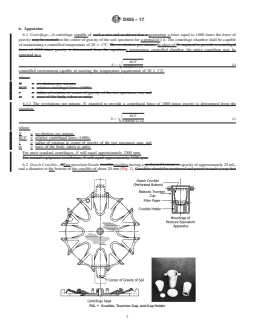
6.1.1 The revolutions per minute, N, required to provide a
the water content of soil or rock can be reduced by gravity
centrifugal force of 1000 times gravity is determined from the
drainage.
equation:
4. Summary of Test Method RCF
N 5 (1)
Œ
0.00000111 rm
4.1 The centrifuge moisture equivalent of soils is deter-
where:
mined by initially air-drying the soil sample. Two 5-g test
specimens are selected from the sample and thoroughly soaked
N = revolutions per minute,
RCF = relative centrifugal force (1000),
in distilled or deionized water. The specimens are centrifuged
r = radius of rotation to center of gravity of the test
for1hata force equal to 1000 times that of gravity at a
specimen, mm, and
constant temperature of 20 6 1°C. The moisture content is
m = mass of the body, taken as unity.
determined after centrifuging in accordance with Test Methods
D2216. The average of the two water contents is the moisture
For most standard centrifuges, N will equal approximately
equivalent of the soil.
2300 rpm.
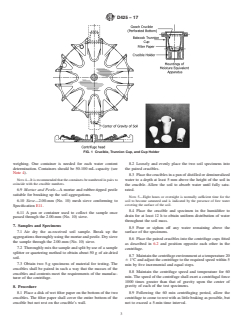
6.2 Gooch Crucible—Two procelain Gooch crucibles hav-
5. Significance and Use
ing a capacity of approximately 25 mL, and a diameter at the
bottom of the crucible of about 20 mm (Fig. 1). The crucible
5.1 All water contained in a saturated soil cannot be
shall have a perforated bottom and be compatible for use with
removed by gravity drainage alone. The amount of water
the centrifuge being used.
retainedaftergravitydrainageisusuallyexpressedasthewater
holding capacity or specific retention of the soil. These values
6.3 Babcock Trunnion Cups—At least two centrifuge cups
may be influenced by elapsed time, the particle-size distribu-
with caps and with a crucible holder for supporting the Gooch
tionandtheplasticityofthesoil.Inmostcases,astheplasticity
crucible above the bottom of the cup (Fig. 1). The holder shall
increases so does the moisture equivalent value.
have sufficient clearance to fit fully within the cup and support
the cup in such a manner that the water removed during the
5.2 The centrifuge moisture equivalent is determined by
centrifuging operation does not come in contact with the
applying a centrifugal force great enough to reduce the
crucible and soil. Cups and crucible holders shall be balanced
capillary fringe zone sufficiently so that it can be ignored
in pairs opposite each other in the centrifuge.
without introducing error. The centrifical force is maintained
sufficiently low as not to withdraw a large proportion of the
6.4 Filter Paper—A circular piece of filter paper of suffi-
water that is held securely above the capillary fringe (see Note
cient size to cover the inside bottom of the Gooch crucible (see
1). Note 3).
5.3 It has been determined that for at least medium-textured NOTE 3—A medium speed, high wet strength (hardened) filter paper is
recommended.
soils (sandy to silty particle-size distribution) the centrifuge
moisture equivalent approximates the water holding capacity
6.5 Balance—A balance having a readability of 0.01 g, and
and when combined with the bulk density can be used to
accurate to 60.03 g, conforming to Specification D4753.
calculate an approximate specific retention and specific yield.
6.6 Humidifier—A cabinet or large jar with water i
...
This document is not an ASTM standard and is intended only to provide the user of an ASTM standard an indication of what changes have been made to the previous version. Because
it may not be technically possible to adequately depict all changes accurately, ASTM recommends that users consult prior editions as appropriate. In all cases only the current version
of the standard as published by ASTM is to be considered the official document.
Designation: D425 − 88 (Reapproved 2008) D425 − 17
Standard Test Method for
Centrifuge Moisture Equivalent of Soils
This standard is issued under the fixed designation D425; the number immediately following the designation indicates the year of
original adoption or, in the case of revision, the year of last revision. A number in parentheses indicates the year of last reapproval. A
superscript epsilon (´) indicates an editorial change since the last revision or reapproval.
1. Scope Scope*
1.1 This test method covers the determination of the moisture equivalent of soil in the laboratory by means of a centrifuge
technique.
1.2 This test method is limited to disturbed specimens of coarse-grained soils having sandy soils having a maximum particle
size of less than 2.00 mm and with fines of low plasticity plasticity. Soils having a unified soil classification, based upon procedures
outlined in Practice D2488 such as SP, SW, SC-SM, or SM soils. The test is limited to soils passing the 2.00-mm sieve or that
fraction of a soil passing a 2.00-mm sieve. are considered acceptable for the test method.
NOTE 1—Test Method D3152 or Test Method D2325 should be used to evaluate the capillary-moisture relations of fine-grained soils and coarse-grained
soils having fines of medium to high plasticity, undisturbed soils, and soils at specific desired units weights.
1.2.1 For soils that are predominantly fine-grained, coarse-grained soils with medium to high plasticity, intact specimens or soils
being tested at a specific density or unit weight refer to Test Methods D6836.
1.3 TheThis test method is temperature-dependent, and consistent comparable results can be obtained only if the tests are
performed under a constant-temperature condition.intended to be performed in a constant temperature environment. Variations in
temperature exceeding the range outlined in 8.7 may influence the test data.
1.4 Units—The values stated in SI units are to be regarded as the standard.standard except for sieve designations, which also
include the “alternative” system in accordance with E11.
1.5 All recorded and calculated values shall conform to the guide for significant digits and rounding established in Practice
D6026.
1.6 The procedures used to specify how data are collected/recorded and calculated in this standard are regarded as the industry
standard. In addition, they are representative of the significant digits that generally should be retained. The procedures used do not
consider material variation, purpose for obtaining data, special purpose studies, or any considerations for the user’s objectives; and
it is common practice to increase or reduce significant digits of reported data to commensurate with these considerations. It is
beyond the scope of these test methods to consider significant digits used in analysis methods for engineering design.
1.7 This standard does not purport to address all of the safety concerns, if any, associated with its use. It is the responsibility
of the user of this standard to establish appropriate safety and health practices and determine the applicability of regulatory
limitations prior to use.
2. Referenced Documents
2.1 ASTM Standards:
D653 Terminology Relating to Soil, Rock, and Contained Fluids
D2216 Test Methods for Laboratory Determination of Water (Moisture) Content of Soil and Rock by Mass
D2325D2487 Test Method for Capillary-Moisture Relationships for Coarse- and Medium-Textured Soils by Porous-Plate
ApparatusPractice for Classification of Soils for Engineering Purposes (Unified Soil Classification System) (Withdrawn 2007)
D2488 Practice for Description and Identification of Soils (Visual-Manual Procedure)
D3152D3740 Test Method for Capillary-Moisture Relationships for Fine-Textured Soils by Pressure-Membrane ApparatusPrac-
tice for Minimum Requirements for Agencies Engaged in Testing and/or Inspection of Soil and Rock as Used in Engineering
This test method is under the jurisdiction of ASTM Committee D18 on Soil and Rock and is the direct responsibility of Subcommittee D18.03 on Texture, Plasticity
and Density Characteristics of Soils.
Current edition approved Feb. 1, 2008Jan. 15, 2017. Published March 2008January 2017. Originally approved in 1935. Last previous edition approved in 20012008 as
D425 – 88 (2008). (2001). DOI: 10.1520/D0425-88R08.10.1520/D0425-17.
For referenced ASTM standards, visit the ASTM website, www.astm.org, or contact ASTM Customer Service at service@astm.org. For Annual Book of ASTM Standards
volume information, refer to the standard’s Document Summary page on the ASTM website.
*A Summary of Changes section appears at the end of this standard
Copyright © ASTM International, 100 Barr Harbor Drive, PO Box C700, West Conshohocken, PA 19428-2959. United States
D425 − 17
Design and Construction (Withdrawn 2007)
D4753 Guide for Evaluating, Selecting, and Specifying Balances and Standard Masses for Use in Soil, Rock, and Construction
Materials Testing
D6026 Practice for Using Significant Digits in Geotechnical Data
D6836 Test Methods for Determination of the Soil Water Characteristic Curve for Desorption Using Hanging Column, Pressure
Extractor, Chilled Mirror Hygrometer, or Centrifuge
E11 Specification for Woven Wire Test Sieve Cloth and Test Sieves
3. Terminology
3.1 All definitions are in accordance with Terminology D653. Terms of particular significance are as follows:Definitions:
3.1.1 For definitions of common technical terms used in this standard, refer to Terminology D653.
3.2 capillary fringe zone—the zone above the free water elevation in which water is held by capillary action.
3.2 Definitions of Terms Specific to This Standard:
3.2.1 capillary fringe zone—the zone above the free water elevation in which water is held by capillary action.
3.2.2 centrifuge moisture equivalent—the water content of a soil after it has been saturated with water and then subjected for
one hour to a centrifugal force equal to 1000 times that of gravity.
3.2.3 specific retention—the ratio of the volume of water that cannot be drained from a saturated soil under the action of force
of gravity to the total volume of voids.
3.2.4 water-holding capacity—the smallest value to which the water content of soil or rock can be reduced by gravity drainage.
3.3 centrifuge moisture equivalent—the water content of a soil after it has been saturated with water and then subjected for one
hour to a centrifugal force equal to 1000 times that of gravity.
3.4 specific retention—the ratio of the volume of water that cannot be drained from a saturated soil under the action of force
of gravity to the total volume of voids.
3.5 water-holding capacity—the smallest value to which the water content of soil or rock can be reduced by gravity drainage.
4. Summary of Test Method
4.1 The centrifuge moisture equivalent of soils is determined by initially air-drying the soil, selecting two 5-g test specimens,
thoroughly soaking each test specimen, and then determining the water content of each specimen after it has been soil sample. Two
5-g test specimens are selected from the sample and thoroughly soaked in distilled or deionized water. The specimens are
centrifuged for 1 h at a force equal to 1000 times that of gravity at a controlledconstant temperature of 20 6 1°C. The moisture
content is determined after centrifuging in accordance with Test Methods D2216. The average of the two water contents is the
moisture equivalent of the soil.
5. Significance and Use
5.1 Not all All water contained in a saturated soil cancannot be removed by gravity drainage. drainage alone. The amount of
water retained after gravity drainage is usually expressed as the water holding capacity or specific retention. It varies with time,
and with retention of the soil. These values may be influenced by elapsed time, the particle-size distribution and the plasticity of
the soil (in general, increasing in value with increasing plasticity index). soil. In most cases, as the plasticity increases so does the
moisture equivalent value.
5.2 The centrifuge moisture equivalent is determined by applying a centrifugal force great enough to reduce the capillary fringe
zone sufficiently so that it can be ignored without introducing error. The centrifical force is maintained sufficiently low as not to
withdraw a large proportion of the water that is held securely above the capillary fringe (see Note 1).
5.3 In general, the centrifuge moisture equivalent is based on the theory of applying a centrifugal force great enough to reduce
the capillary fringe zone enough that it can be ignored without introducing much error, even in small specimens, and yet not so
great as to withdraw a large proportion of the water that is held securely above the capillary fringe. For example, if a soil will hold
water 100 mm by capillarity acting against gravity, the soil will theoretically be able to hold the water only 0.1 mm against a
centrifugal force that is 1000 times greater than the force of gravity. It has been determined that for at least medium-textured soils
(sandy to silty particle-size distribution) the centrifuge moisture equivalent approximates the water holding capacity and when
combined with the bulk density can be used to calculate an approximate specific retention and specific yield. These properties when
combined with porosity can be used to estimate aquifer storage coefficient.
NOTE 1—If a soil will hold water 100 mm by capillarity acting against gravity, the soil will theoretically be able to hold the water only 0.1 mm against
a centrifugal force that is 1000 times greater than the force of gravity.
NOTE 2—The statements on precision and bias contained in this test method; the precision of this test method is dependent on the competence of the
personnel performing it, and the suitability of the equipment and facilities used. Agencies that meet the criteria of Practice D3740 are generally considered
capable of competent and objective testing. Users of this test method are cautioned that compliance with Practice D3740 does not in itself assure reliable
testing. Reliable testing depends on many factors; Practice D3740 provides a means of evaluating some of these factors.
D425 − 17
6. Apparatus
6.1 Centrifuge—A centrifuge capable of such a size and so driven that a generating a force equal to 1000 times the force of
gravity may be exerted on the center of gravity of the soil specimen for a period of 1 h. The centrifuge chamber shall be capable
of maintaining a controlled temperature of 20 6 1°C. The revolutions per minute, In place of N, required to provide a centrifugal
force of 1000 times gravity is determined from the equation:a temperature controlled chamber, the entire centrifuge may be
operated in a
RCF
N 5Π(1)
0.0000111 rm
controlled environment capable of meeting the temperature requirement of 20 6 1°C.
where:
N = revolutions per minute,
RCF = relative centrifugal force (1000),
r = radius of rotation to center of gravity of the test specimen, cm, and
m = mass of the body, taken as unity.
6.1.1 The revolutions per minute, N, required to provide a centrifugal force of 1000 times gravity is determined from the
equation:
RCF
N 5Π(1)
0.00000111 rm
where:
N = revolutions per minute,
RCF = relative centrifugal force (1000),
r = radius of rotation to center of gravity of the test specimen, mm, and
m = mass of the body, taken as unity.
For most standard centrifuges, N will equal approximately 2300 rpm.
For normal equipment installation, N will equal approximately 2300 rpm.
6.2 Gooch Crucible—ATwo procelain Gooch cruciblecrucibles having a perforated bottom, a capacity of approximately 25 mL,
and a diameter at the bottom of the crucible of about 20 mm (Fig. 1). Crucibles should be number
...