

ASTM G107-95(2020)e1
(Guide)Standard Guide for Formats for Collection and Compilation of Corrosion Data for Metals for Computerized Database Input
General Information
- Abstract
SIGNIFICANCE AND USE
4.1 The guide is intended to facilitate the recording of corrosion test results and does not imply or endorse any particular database design or schema. It provides a useful reference to be consulted before initiating a corrosion test to be sure plans are made to record all relevant data.
4.2 Corrosion tests are usually performed following a prescribed test procedure that is often not a standard test method. Most corrosion tests involve concurrent exposure of multiple specimens of one or more materials (refer to 6.1.1).
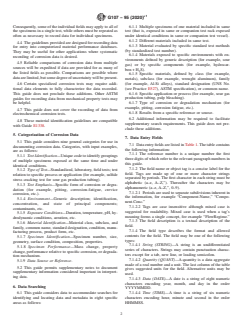
4.3 This guide is designed to record data for individual specimens with groupings by separate tests (as contrasted to separate test methods) as described in 4.2 and 6.1.1. Consequently, some of the individual fields may apply to all of the specimens in a single test, while others must be repeated as often as necessary to record data for individual specimens.
4.4 The guidelines provided are designed for recording data for entry into computerized material performance databases. They may be useful for other applications where systematic recording of corrosion data is desired.
4.5 Reliable comparisons of corrosion data from multiple sources will be expedited if data are provided for as many of the listed fields as possible. Comparisons are possible where data are limited, but some degree of uncertainty will be present.
4.6 Certain specialized corrosion tests may require additional data elements to fully characterize the data recorded. This guide does not preclude these additions. Other ASTM guides for recording data from mechanical property tests may be helpful.
4.7 This guide does not cover the recording of data from electrochemical corrosion tests.
4.8 These material identification guidelines are compatible with Guide E1338.
SCOPE
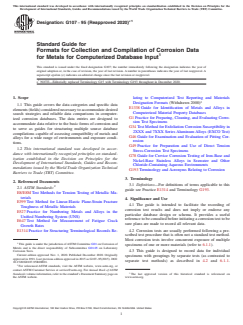
1.1 This guide covers the data categories and specific data elements (fields) considered necessary to accommodate desired search strategies and reliable data comparisons in computerized corrosion databases. The data entries are designed to accommodate data relative to the basic forms of corrosion and to serve as guides for structuring multiple source database compilations capable of assessing compatibility of metals and alloys for a wide range of environments and exposure conditions.
1.2 This international standard was developed in accordance with internationally recognized principles on standardization established in the Decision on Principles for the Development of International Standards, Guides and Recommendations issued by the World Trade Organization Technical Barriers to Trade (TBT) Committee.
- Status
- Published
- Publication Date
- 31-Oct-2020
- Technical Committee
- G01 - Corrosion of Metals
- Drafting Committee
- G01.05 - Laboratory Corrosion Tests
Overview
ASTM G107-95(2020)e1 is the Standard Guide for Formats for Collection and Compilation of Corrosion Data for Metals for Computerized Database Input, developed by ASTM International. This guide specifies standardized data categories and elements essential for capturing, organizing, and comparing corrosion test data for metals and alloys, particularly for computerized material performance databases. By implementing this guide, organizations can improve the consistency, reliability, and accessibility of corrosion test results, supporting effective data management and analysis.
Key Topics
- Systematic Data Collection: The standard provides a comprehensive framework for recording corrosion test results, ensuring all relevant fields are captured for individual specimens and test groupings.
- Database Compatibility: Data entry formats are designed for use in computerized material property databases, supporting diverse search requirements and reliable data comparison across multiple sources.
- Corrosion Test Documentation: The guide addresses documentation for various corrosion test types, environments, specimen characteristics, material identification, exposure conditions, and resultant performance metrics.
- Flexible Structure: Categories and fields accommodate data for basic corrosion forms and allow additional data elements for specialized tests, without prescribing a specific database schema.
- Metadata Management: Elements include information about test methods, materials, environments, and data sources or references, facilitating robust metadata documentation.
- International Alignment: Developed per internationally recognized standardization principles (WTO TBT Committee), making it suitable for global application.
- Data Searchability: The format enables efficient searching and retrieval of corrosion data, supporting multi-parameter queries including material, test type, environment, and degradation mechanism.
Applications
The ASTM G107 standard has broad practical value for users who manage corrosion test data for metals, including:
- Laboratory Data Management: Laboratories can use the guide to structure corrosion test reports from single or multiple specimens, ensuring completeness and traceability.
- Corrosion Database Development: Organizations building or maintaining corrosion databases benefit from the standardized fields, improving data consistency and facilitating integration from multiple sources.
- Material Compatibility Studies: By enabling reliable comparisons of corrosion performance across different materials and environments, the guide supports decision-making in material selection, process design, and lifecycle management.
- Quality Assurance: Consistent and detailed data documentation enhances auditability and confidence in reported corrosion test results.
- Supplementary Applications: The format can be used in non-database applications where systematic recording of corrosion data is important, such as technical reporting or regulatory submissions.
Related Standards
ASTM G107 references and is compatible with several related standards that support comprehensive corrosion data documentation and analysis, including:
- ASTM E1338: Guide for Identification of Metals and Alloys in Computerized Material Property Databases
- ASTM G1: Practice for Preparing, Cleaning, and Evaluating Corrosion Test Specimens
- ASTM G34: Test Method for Exfoliation Corrosion Susceptibility in 2XXX and 7XXX Series Aluminum Alloys
- ASTM G46: Guide for Examination and Evaluation of Pitting Corrosion
- ASTM G49: Practice for Preparation and Use of Direct Tension Stress-Corrosion Test Specimens
- ASTM G78: Guide for Crevice Corrosion Testing of Iron-Base and Nickel-Base Stainless Alloys
- ASTM G193: Terminology and Acronyms Relating to Corrosion
- ASTM E8/E8M: Test Methods for Tension Testing of Metallic Materials
- ASTM E527: Practice for Numbering Metals and Alloys in the Unified Numbering System (UNS)
Keywords: Corrosion data, metals, database input, ASTM G107, material performance, corrosion test reporting, corrosion database, data management, material identification, corrosion performance evaluation.
Relations
- Effective Date
- 01-Jan-2024
- Effective Date
- 01-Dec-2023
- Effective Date
- 15-Nov-2023
- Effective Date
- 01-Nov-2023
- Effective Date
- 15-Jul-2016
- Effective Date
- 01-Feb-2015
- Effective Date
- 15-Oct-2013
- Effective Date
- 15-Oct-2013
- Effective Date
- 01-Jun-2013
- Effective Date
- 01-May-2013
- Effective Date
- 01-May-2013
- Effective Date
- 15-Jan-2013
- Effective Date
- 15-Jan-2013
- Effective Date
- 15-Nov-2012
- Effective Date
- 15-Nov-2012
Get Certified
Connect with accredited certification bodies for this standard

BSI Group
BSI (British Standards Institution) is the business standards company that helps organizations make excellence a habit.

NYCE
Mexican standards and certification body.
Sponsored listings
Frequently Asked Questions
ASTM G107-95(2020)e1 is a guide published by ASTM International. Its full title is "Standard Guide for Formats for Collection and Compilation of Corrosion Data for Metals for Computerized Database Input". This standard covers: SIGNIFICANCE AND USE 4.1 The guide is intended to facilitate the recording of corrosion test results and does not imply or endorse any particular database design or schema. It provides a useful reference to be consulted before initiating a corrosion test to be sure plans are made to record all relevant data. 4.2 Corrosion tests are usually performed following a prescribed test procedure that is often not a standard test method. Most corrosion tests involve concurrent exposure of multiple specimens of one or more materials (refer to 6.1.1). 4.3 This guide is designed to record data for individual specimens with groupings by separate tests (as contrasted to separate test methods) as described in 4.2 and 6.1.1. Consequently, some of the individual fields may apply to all of the specimens in a single test, while others must be repeated as often as necessary to record data for individual specimens. 4.4 The guidelines provided are designed for recording data for entry into computerized material performance databases. They may be useful for other applications where systematic recording of corrosion data is desired. 4.5 Reliable comparisons of corrosion data from multiple sources will be expedited if data are provided for as many of the listed fields as possible. Comparisons are possible where data are limited, but some degree of uncertainty will be present. 4.6 Certain specialized corrosion tests may require additional data elements to fully characterize the data recorded. This guide does not preclude these additions. Other ASTM guides for recording data from mechanical property tests may be helpful. 4.7 This guide does not cover the recording of data from electrochemical corrosion tests. 4.8 These material identification guidelines are compatible with Guide E1338. SCOPE 1.1 This guide covers the data categories and specific data elements (fields) considered necessary to accommodate desired search strategies and reliable data comparisons in computerized corrosion databases. The data entries are designed to accommodate data relative to the basic forms of corrosion and to serve as guides for structuring multiple source database compilations capable of assessing compatibility of metals and alloys for a wide range of environments and exposure conditions. 1.2 This international standard was developed in accordance with internationally recognized principles on standardization established in the Decision on Principles for the Development of International Standards, Guides and Recommendations issued by the World Trade Organization Technical Barriers to Trade (TBT) Committee.
SIGNIFICANCE AND USE 4.1 The guide is intended to facilitate the recording of corrosion test results and does not imply or endorse any particular database design or schema. It provides a useful reference to be consulted before initiating a corrosion test to be sure plans are made to record all relevant data. 4.2 Corrosion tests are usually performed following a prescribed test procedure that is often not a standard test method. Most corrosion tests involve concurrent exposure of multiple specimens of one or more materials (refer to 6.1.1). 4.3 This guide is designed to record data for individual specimens with groupings by separate tests (as contrasted to separate test methods) as described in 4.2 and 6.1.1. Consequently, some of the individual fields may apply to all of the specimens in a single test, while others must be repeated as often as necessary to record data for individual specimens. 4.4 The guidelines provided are designed for recording data for entry into computerized material performance databases. They may be useful for other applications where systematic recording of corrosion data is desired. 4.5 Reliable comparisons of corrosion data from multiple sources will be expedited if data are provided for as many of the listed fields as possible. Comparisons are possible where data are limited, but some degree of uncertainty will be present. 4.6 Certain specialized corrosion tests may require additional data elements to fully characterize the data recorded. This guide does not preclude these additions. Other ASTM guides for recording data from mechanical property tests may be helpful. 4.7 This guide does not cover the recording of data from electrochemical corrosion tests. 4.8 These material identification guidelines are compatible with Guide E1338. SCOPE 1.1 This guide covers the data categories and specific data elements (fields) considered necessary to accommodate desired search strategies and reliable data comparisons in computerized corrosion databases. The data entries are designed to accommodate data relative to the basic forms of corrosion and to serve as guides for structuring multiple source database compilations capable of assessing compatibility of metals and alloys for a wide range of environments and exposure conditions. 1.2 This international standard was developed in accordance with internationally recognized principles on standardization established in the Decision on Principles for the Development of International Standards, Guides and Recommendations issued by the World Trade Organization Technical Barriers to Trade (TBT) Committee.
ASTM G107-95(2020)e1 is classified under the following ICS (International Classification for Standards) categories: 35.240.50 - IT applications in industry. The ICS classification helps identify the subject area and facilitates finding related standards.
ASTM G107-95(2020)e1 has the following relationships with other standards: It is inter standard links to ASTM E8/E8M-24, ASTM G34-23, ASTM E647-23b, ASTM G49-85(2023)e1, ASTM E8/E8M-16, ASTM E8/E8M-15, ASTM E647-13ae1, ASTM E647-13a, ASTM E8/E8M-13, ASTM G46-94(2013), ASTM G34-01(2013), ASTM E647-13e1, ASTM E647-13, ASTM E399-12e3, ASTM E399-12e1. Understanding these relationships helps ensure you are using the most current and applicable version of the standard.
ASTM G107-95(2020)e1 is available in PDF format for immediate download after purchase. The document can be added to your cart and obtained through the secure checkout process. Digital delivery ensures instant access to the complete standard document.
Standards Content (Sample)
This international standard was developed in accordance with internationally recognized principles on standardization established in the Decision on Principles for the
Development of International Standards, Guides and Recommendations issued by the World Trade Organization Technical Barriers to Trade (TBT) Committee.
´1
Designation: G107 − 95 (Reapproved 2020)
Standard Guide for
Formats for Collection and Compilation of Corrosion Data
for Metals for Computerized Database Input
This standard is issued under the fixed designation G107; the number immediately following the designation indicates the year of
original adoption or, in the case of revision, the year of last revision. A number in parentheses indicates the year of last reapproval. A
superscript epsilon (´) indicates an editorial change since the last revision or reapproval.
ε NOTE—Editorially replaced Terminology G15 with Terminology G193 throughout in December 2020.
1. Scope lating to Computerized Test Reporting and Materials
Designation Formats (Withdrawn 2000)
1.1 This guide covers the data categories and specific data
E1338 Guide for Identification of Metals and Alloys in
elements(fields)considerednecessarytoaccommodatedesired
Computerized Material Property Databases
search strategies and reliable data comparisons in computer-
G1 Practice for Preparing, Cleaning, and Evaluating Corro-
ized corrosion databases. The data entries are designed to
sion Test Specimens
accommodate data relative to the basic forms of corrosion and
G34 Test Method for Exfoliation Corrosion Susceptibility in
to serve as guides for structuring multiple source database
2XXX and 7XXX Series Aluminum Alloys (EXCO Test)
compilations capable of assessing compatibility of metals and
G46 Guide for Examination and Evaluation of Pitting Cor-
alloys for a wide range of environments and exposure condi-
rosion
tions.
G49 Practice for Preparation and Use of Direct Tension
1.2 This international standard was developed in accor-
Stress-Corrosion Test Specimens
dance with internationally recognized principles on standard-
G78 Guide for Crevice Corrosion Testing of Iron-Base and
ization established in the Decision on Principles for the
Nickel-Base Stainless Alloys in Seawater and Other
Development of International Standards, Guides and Recom-
Chloride-Containing Aqueous Environments
mendations issued by the World Trade Organization Technical
G193 Terminology and Acronyms Relating to Corrosion
Barriers to Trade (TBT) Committee.
3. Terminology
2. Referenced Documents
3.1 Definitions—For definitions of terms applicable to this
2.1 ASTM Standards:
guide see Practice E1314 and Terminology G193.
E8/E8M Test Methods for Tension Testing of Metallic Ma-
terials
4. Significance and Use
E399 Test Method for Linear-Elastic Plane-Strain Fracture
4.1 The guide is intended to facilitate the recording of
Toughness of Metallic Materials
corrosion test results and does not imply or endorse any
E527 Practice for Numbering Metals and Alloys in the
particular database design or schema. It provides a useful
Unified Numbering System (UNS)
reference to be consulted before initiating a corrosion test to be
E647 Test Method for Measurement of Fatigue Crack
sure plans are made to record all relevant data.
Growth Rates
4.2 Corrosion tests are usually performed following a pre-
E1314 Practice for Structuring Terminological Records Re-
scribed test procedure that is often not a standard test method.
Most corrosion tests involve concurrent exposure of multiple
This guide is under the jurisdiction ofASTM Committee G01 on Corrosion of
specimens of one or more materials (refer to 6.1.1).
Metals and is the direct responsibility of Subcommittee G01.05 on Laboratory
Corrosion Tests. 4.3 This guide is designed to record data for individual
Current edition approved Nov. 1, 2020. Published December 2020. Originally
specimens with groupings by separate tests (as contrasted to
approved in 1991. Last previous edition approved in 2015 as G107–95(2015). DOI:
separate test methods) as described in 4.2 and 6.1.1.
10.1520/G0107-95R20E01.
For referenced ASTM standards, visit the ASTM website, www.astm.org, or
contact ASTM Customer Service at service@astm.org. For Annual Book of ASTM
Standards volume information, refer to the standard’s Document Summary page on The last approved version of this historical standard is referenced on
the ASTM website. www.astm.org.
Copyright © ASTM International, 100 Barr Harbor Drive, PO Box C700, West Conshohocken, PA 19428-2959. United States
´1
G107 − 95 (2020)
Consequently, some of the individual fields may apply to all of 6.1.1 Multiple specimens of one material included in same
the specimens in a single test, while others must be repeated as test (that is, exposed in same or companion test rack exposed
often as necessary to record data for individual specimens. under identical conditions in same or companion test vessel).
6.1.2 Different materials included in same test.
4.4 The guidelines provided are designed for recording data
6.1.3 Material evaluated by specific standard test methods
for entry into computerized material performance databases.
(by standardized test number).
They may be useful for other applications where systematic
6.1.4 Materials exposed to specific environments with en-
recording of corrosion data is desired.
vironments defined by generic description (for example, sour
4.5 Reliable comparisons of corrosion data from multiple
gas) or by specific components (for example, hydrocar-
sources will be expedited if data are provided for as many of
bon+H S).
the listed fields as possible. Comparisons are possible where
6.1.5 Specific materials, defined by class (for example,
dataarelimited,butsomedegreeofuncertaintywillbepresent.
metals), subclass (for example, wrought aluminum), family
(for example, Al-Si alloys), standard designation (UNS No.
4.6 Certain specialized corrosion tests may require addi-
tional data elements to fully characterize the data recorded. (see Practice E527), ASTM specification), or common name.
This guide does not preclude these additions. Other ASTM 6.1.6 Specific application or process (for example, sour gas
production tubing, pulp bleaching).
guides for recording data from mechanical property tests may
be helpful. 6.1.7 Type of corrosion or degradation mechanism (for
example, pitting, corrosion fatigue, etc.).
4.7 This guide does not cover the recording of data from
6.1.8 Results from a specific reference or source.
electrochemical corrosion tests.
6.2 Additional information may be required to facilitate
4.8 These material identification guidelines are compatible
supplementary search requirements. This guide does not pre-
with Guide E1338.
clude these additions.
5. Categorization of Corrosion Data
7. Data Entry Fields
5.1 This guide considers nine general categories for use in
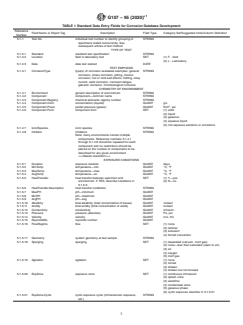
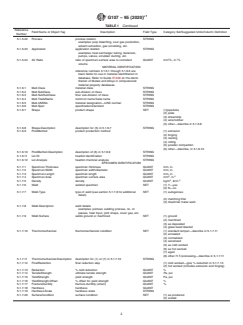
7.1 Data entry fields are listed in Table 1.The table contains
documenting corrosion data. Categories, with input examples,
the following information:
are as follows:
7.1.1 The reference number is a unique number the first
5.1.1 Test Identification—Unique code to identify groupings
threedigitsofwhichrefertotherelevantparagraphnumbersin
of multiple specimens exposed at the same time and under
this guide.
identical conditions.
7.1.2 The field name or object tag is a concise label for the
5.1.2 Type of Test—Standardized, laboratory, field tests; test
field. Tags are made up of one or more character strings
relation to specific process or application (for example, sulfide
separated by periods. The first character in each string must be
stress cracking test for sour gas production tubing).
alphabetic (a–z, A–Z,”). Thereafter the characters may be
5.1.3 Test Emphasis—Specific form of corrosion or degra-
alphanumeric (a–z, A–Z,”, 0–9).
dation (for example, pitting, corrosion-fatigue, crevice
7.1.2.1 Periods are used to separate subdivisions inherent in
corrosion, etc.).
the information, for example “Component.Name,” “Compo-
5.1.4 Environment—Generic description; identification,
nent.Conc.”
concentration, and state of principal components;
7.1.2.2 Tags are case insensitive although mixed case is
contaminants, etc.
suggested for readability. Mixed case is used when a tag’s
5.1.5 Exposure Conditions—Duration, temperature, pH, hy-
meaning forms a single concept, for example “FlowRegime.”
drodynamic conditions, aeration, etc.
7.1.3 The field description is a textual description of the
5.1.6 Material Identification—Material class, subclass, and
field.
family, common name, standard designation, condition, manu-
7.1.4 The field type describes the format and allowed
facturing process, product form, etc.
contents for the field. The field may be one of the following
5.1.7 Specimen Identification—Specimen number, size,
types:
geometry, surface condition, composition, properties.
7.1.4.1 String (STRING)—A string is an undifferentiated
5.1.8 Specimen Performance—Mass change, property
series of characters. Strings may contain punctuation charac-
change, performance relative to specific corrosion, or degrada-
ters except for a tab, new line, or leading semicolon.
tion mechanism.
7.1.4.2 Quantity (QUANT)—A quantity is a data aggregate
5.1.9 Data Source or Reference.
made of a real number and a unit. The last column of the table
5.2 This guide permits supplementary notes to document
gives suggested units for the field. Alternative units may be
supplementary information considered important in interpret-
used.
ing data.
7.1.4.3 Data (DATE)—A date is a string of eight numeric
characters encoding year, month, and day in the order
6. Data Searching
YYYYMMDD.
6.1 This guide considers data to accommodate searches for 7.1.4.4 Time (TIME)—A time is a string of six numeric
identifying and locating data and metadata in eight specific characters encoding hour, minute and second in the order
areas as follows: HHMMSS.
´1
G107 − 95 (2020)
TABLE 1 Standard Data Entry Fields for Corrosion Database Development
Reference
Field Name or Object Tag Description Field Type Category Set/Suggested Units/Column Definition
Number
5.1.1 Test No individual test number to identify grouping of STRING
specimens tested concurrently. See
subsequent entries of test method
TYPE OF TEST
5.1.2.1 Standard standard test specification STRING
5.1.2.2 Location field or laboratory test SET (1) F - field
(2) L - Laboratory
5.1.2.3 Date date test started DATE
TEST EMPHASIS
5.1.3.1 CorrosionType type(s) of corrosion evaluated examples: general STRING
corrosion, stress corrosion, pitting, crevice
corrosion, hot or cold wall effects, fretting, stray
current, weld corrosion, corrosion-fatigue,
galvanic corrosion, microbiological corrosion
CHEMISTRY OF ENVIRONMENT
5.1.4.1 Environment generic description of environment STRING
5.1.4.2 Component component—common name STRING
5.1.4.3 Component.Registry chemical abstracts registry number STRING
5.1.4.4 Component.Conc concentration (liquids) QUANT g/L
5.1.4.5 Component.Press partial pressure (gases) QUANT N/m , psi
5.1.4.6 Component.Form component form SET (1) solid
(2) liquid
(3) gaseous
(4) aqueous liquid
(5) non-aqueous solutions or emulsions
5.1.4.7 IonicSpecies ionic species STRING
5.1.4.8 Inhibitor inhibitors STRING
Note: many environments contain multiple
components. Reference numbers 5.1.4.1
through 5.1.4.8 should be repeated for each
component and no restrictions should be
placed on the number of components to be
described for any given environment.
<<>>
EXPOSURE CONDITIONS
5.1.5.1 Duration exposure duration QUANT days
5.1.5.2 MinTemp temperature—min QUANT °C, °F
5.1.5.3 MaxTemp temperature—max QUANT °C, °F
5.1.5.4 AvgTemp temperature—av QUANT °C, °F
5.1.5.5 HeatTransfer heat transfer between specimen and SET (1) Y—yes
environment. If YES, describe conditions in (2) N—no
5.1.5.6
5.1.5.6 HeatTransfer.Description heat transfer conditions STRING
5.1.5.7 MaxPH pH—minimum QUANT
5.1.5.8 MinPH pH—maximum QUANT
5.1.5.9 AvgPH pH—avg QUANT
5.1.5.10 Alkalinity total alkalinity (total concent
...