

ASTM D4707-09(2017)
(Test Method)Standard Test Method for Measuring Paint Spatter Resistance During Roller Application
General Information
- Abstract
SIGNIFICANCE AND USE
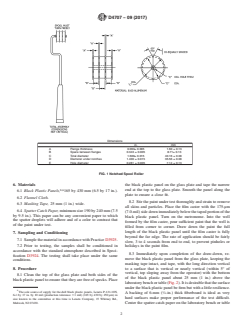
4.1 Paint spatter generated by roller application is dependent on the properties of both the paint being applied and the paint roller cover used for the application. To eliminate the influence of the paint roller cover as a variable, and thus restrict the spatter-inducing variable to the paint under test only, the paint roller cover is replaced by a standard notched spool roller to generate spatter by a mechanism that simulates that of a paint-applying roller cover.
4.2 Although most of the development work to establish this test method was undertaken using latex paints, sufficient work was also done to show its applicability to solvent-reducible paints.
4.3 Tests during the development of this test method showed that the spattering properties of paints, like other physical properties, may in time change. Therefore, the results of this test are valid only for the time when the test is run.
SCOPE
1.1 This test method covers the determination of the tendency of a paint to spatter when applied with a paint roller to a substrate.
1.2 This standard does not purport to address all of the safety concerns, if any, associated with its use. It is the responsibility of the user of this standard to establish appropriate safety and health practices and determine the applicability of regulatory limitations prior to use.
1.3 This international standard was developed in accordance with internationally recognized principles on standardization established in the Decision on Principles for the Development of International Standards, Guides and Recommendations issued by the World Trade Organization Technical Barriers to Trade (TBT) Committee.
- Status
- Published
- Publication Date
- 31-May-2017
- Technical Committee
- D01 - Paint and Related Coatings, Materials, and Applications
- Drafting Committee
- D01.42 - Architectural Coatings
Overview
ASTM D4707-09(2017), titled "Standard Test Method for Measuring Paint Spatter Resistance During Roller Application," is an internationally recognized ASTM standard designed to assess the tendency of paint to spatter during roller application. Paint spatter can significantly impact the quality and cleanliness of a paint job, making consistent measurement crucial for manufacturers, contractors, and testing laboratories. This standard provides a reliable laboratory procedure for evaluating paint spatter resistance, addressing both latex and solvent-reducible paints.
Key Topics
- Objective: The test method aims to determine how likely a paint is to spatter when applied to a surface with a roller, removing the roller cover variability by using a standard notched spool roller.
- Applicability: Originally developed for latex paints but proven suitable for solvent-reducible coatings.
- Reproducibility: Ensures reliable, comparable results by using fixed procedures, controlled conditions, and standardized reference materials.
- Rating System: Paints are rated against standardized photographic benchmarks to provide objective and meaningful spatter resistance scores.
- Sampling and Conditioning: Paint samples are prepared and conditioned in controlled laboratory environments to eliminate external influences.
- Test Apparatus: Employs specific tools such as a notched spool roller, black plastic panels, metronome, film caster, and spatter catch paper for consistent testing.
Applications
ASTM D4707-09(2017) is widely used in the following areas:
- Paint and Coating Manufacturers: Quality control during R&D, production, and batch verification to meet customer and regulatory expectations for spatter resistance.
- Architectural Coatings: Assists product formulators in optimizing paints intended for interior and exterior walls to reduce splatter and cleanup effort during roller application.
- Regulatory Compliance: Provides an industry-accepted benchmark for compliance with architectural and professional quality standards.
- Performance Comparison: Enables side-by-side evaluation of different paints, supporting purchasing decisions for contractors and providing data for marketing and labeling claims.
- Specification Verification: Used by independent testing laboratories and third-party certifiers to objectively verify product claims relating to low-spatter or easy-clean paints.
Related Standards
Several other ASTM standards and international guidelines complement ASTM D4707-09(2017):
- ASTM D3924: Specification for Environment for Conditioning and Testing Paint, Varnish, Lacquer, and Related Materials.
- ASTM D3925: Practice for Sampling Liquid Paints and Related Pigmented Coatings.
- Pictorial Standards of Paint Roller Spatter: Used for grading paint spatter resistance in conjunction with ASTM D4707-09(2017).
- ISO Paint Testing Standards: International equivalents and referenced procedures for paint performance and application characteristics.
Practical Value
ASTM D4707-09(2017) delivers practical value by reducing variability in test results, ensuring consistency across the coatings industry, and helping manufacturers produce low-spatter paints. The standardized procedure both improves end-user satisfaction through cleaner applications and supports competitive differentiation for high-performing products. By adopting ASTM D4707-09(2017), stakeholders across the paint and coatings industry can benchmark products, enhance formulation strategies, and confidently communicate spatter resistance performance to the market.
Keywords: paint spatter resistance, roller application, ASTM standard, architectural coatings, paint testing, spattering, laboratory evaluation, quality control, coating performance.
Relations
- Effective Date
- 01-Jun-2017
- Effective Date
- 01-Apr-2016
- Effective Date
- 01-Jun-2011
- Refers
ASTM D3925-02(2010) - Standard Practice for Sampling Liquid Paints and Related Pigmented Coatings - Effective Date
- 01-Dec-2010
- Effective Date
- 01-Feb-2005
- Effective Date
- 10-Aug-2002
- Effective Date
- 01-Jan-1996
- Refers
ASTM D3925-91(1996) - Standard Practice for Sampling Liquid Paints and Related Pigmented Coatings - Effective Date
- 15-Sep-1991
- Effective Date
- 01-Jun-2017
- Effective Date
- 01-Jun-2017
- Effective Date
- 01-Jun-2017
- Effective Date
- 01-Jun-2017
Frequently Asked Questions
ASTM D4707-09(2017) is a standard published by ASTM International. Its full title is "Standard Test Method for Measuring Paint Spatter Resistance During Roller Application". This standard covers: SIGNIFICANCE AND USE 4.1 Paint spatter generated by roller application is dependent on the properties of both the paint being applied and the paint roller cover used for the application. To eliminate the influence of the paint roller cover as a variable, and thus restrict the spatter-inducing variable to the paint under test only, the paint roller cover is replaced by a standard notched spool roller to generate spatter by a mechanism that simulates that of a paint-applying roller cover. 4.2 Although most of the development work to establish this test method was undertaken using latex paints, sufficient work was also done to show its applicability to solvent-reducible paints. 4.3 Tests during the development of this test method showed that the spattering properties of paints, like other physical properties, may in time change. Therefore, the results of this test are valid only for the time when the test is run. SCOPE 1.1 This test method covers the determination of the tendency of a paint to spatter when applied with a paint roller to a substrate. 1.2 This standard does not purport to address all of the safety concerns, if any, associated with its use. It is the responsibility of the user of this standard to establish appropriate safety and health practices and determine the applicability of regulatory limitations prior to use. 1.3 This international standard was developed in accordance with internationally recognized principles on standardization established in the Decision on Principles for the Development of International Standards, Guides and Recommendations issued by the World Trade Organization Technical Barriers to Trade (TBT) Committee.
SIGNIFICANCE AND USE 4.1 Paint spatter generated by roller application is dependent on the properties of both the paint being applied and the paint roller cover used for the application. To eliminate the influence of the paint roller cover as a variable, and thus restrict the spatter-inducing variable to the paint under test only, the paint roller cover is replaced by a standard notched spool roller to generate spatter by a mechanism that simulates that of a paint-applying roller cover. 4.2 Although most of the development work to establish this test method was undertaken using latex paints, sufficient work was also done to show its applicability to solvent-reducible paints. 4.3 Tests during the development of this test method showed that the spattering properties of paints, like other physical properties, may in time change. Therefore, the results of this test are valid only for the time when the test is run. SCOPE 1.1 This test method covers the determination of the tendency of a paint to spatter when applied with a paint roller to a substrate. 1.2 This standard does not purport to address all of the safety concerns, if any, associated with its use. It is the responsibility of the user of this standard to establish appropriate safety and health practices and determine the applicability of regulatory limitations prior to use. 1.3 This international standard was developed in accordance with internationally recognized principles on standardization established in the Decision on Principles for the Development of International Standards, Guides and Recommendations issued by the World Trade Organization Technical Barriers to Trade (TBT) Committee.
ASTM D4707-09(2017) is classified under the following ICS (International Classification for Standards) categories: 87.040 - Paints and varnishes. The ICS classification helps identify the subject area and facilitates finding related standards.
ASTM D4707-09(2017) has the following relationships with other standards: It is inter standard links to ASTM D4707-09(2013), ASTM D3924-16, ASTM D3924-80(2011), ASTM D3925-02(2010), ASTM D3924-80(2005), ASTM D3925-02, ASTM D3924-80(1996), ASTM D3925-91(1996), ASTM D5324-16(2022), ASTM D7073-20, ASTM D3730-17(2022), ASTM D5146-10(2019). Understanding these relationships helps ensure you are using the most current and applicable version of the standard.
ASTM D4707-09(2017) is available in PDF format for immediate download after purchase. The document can be added to your cart and obtained through the secure checkout process. Digital delivery ensures instant access to the complete standard document.
Standards Content (Sample)
This international standard was developed in accordance with internationally recognized principles on standardization established in the Decision on Principles for the
Development of International Standards, Guides and Recommendations issued by the World Trade Organization Technical Barriers to Trade (TBT) Committee.
Designation: D4707 − 09 (Reapproved 2017)
Standard Test Method for
Measuring Paint Spatter Resistance During Roller
Application
This standard is issued under the fixed designation D4707; the number immediately following the designation indicates the year of
original adoption or, in the case of revision, the year of last revision. A number in parentheses indicates the year of last reapproval. A
superscript epsilon (´) indicates an editorial change since the last revision or reapproval.
1. Scope onanessentiallyverticalsurfaceaboveasheetofpaperusedto
catch any spatter. A specially designed notched spool roller
1.1 This test method covers the determination of the ten-
(see 5.1) is rolled through the film following a defined
dency of a paint to spatter when applied with a paint roller to
procedure, tending to generate spatter. Any spatter falls upon
a substrate.
the spatter catch paper and, after drying, is rated against the
1.2 This standard does not purport to address all of the
pictorial standards.
safety concerns, if any, associated with its use. It is the
responsibility of the user of this standard to establish appro-
4. Significance and Use
priate safety and health practices and determine the applica-
4.1 Paint spatter generated by roller application is depen-
bility of regulatory limitations prior to use.
dent on the properties of both the paint being applied and the
1.3 This international standard was developed in accor-
paint roller cover used for the application. To eliminate the
dance with internationally recognized principles on standard-
influenceofthepaintrollercoverasavariable,andthusrestrict
ization established in the Decision on Principles for the
the spatter-inducing variable to the paint under test only, the
Development of International Standards, Guides and Recom-
paint roller cover is replaced by a standard notched spool roller
mendations issued by the World Trade Organization Technical
to generate spatter by a mechanism that simulates that of a
Barriers to Trade (TBT) Committee.
paint-applying roller cover.
2. Referenced Documents
4.2 Althoughmostofthedevelopmentworktoestablishthis
test method was undertaken using latex paints, sufficient work
2.1 ASTM Standards:
was also done to show its applicability to solvent-reducible
D3924 Specification for Environment for Conditioning and
paints.
Testing Paint, Varnish, Lacquer, and Related Materials
(Withdrawn 2016)
4.3 Tests during the development of this test method
D3925 Practice for Sampling Liquid Paints and Related
showed that the spattering properties of paints, like other
Pigmented Coatings
physical properties, may in time change. Therefore, the results
2.2 Other Document:
of this test are valid only for the time when the test is run.
Pictorial Standards of Paint Roller Spatter
5. Apparatus
3. Summary of Test Method
5,6
5.1 Notched Spool Test Roller (Fig. 1).
3.1 The test paint is applied to a black plastic panel by
5.2 Glass Plate—at least 230 by 485 mm (9 by 19 in.) by 6
draw-down. The coated plastic panel is immediately mounted
mm (0.25 in.) thick.
7,6
5.3 U-shaped Film Caster, having a 175-µm (7-mil) clear-
This test method is under the jurisdiction of ASTM Committee D01 on Paint
ance by 135 mm (5.25 in.) wide.
and Related Coatings, Materials, andApplications and is the direct responsibility of
Subcommittee D01.42 on Architectural Coatings.
5.4 Metronome, adjusted to 80 beats per min.
Current edition approved June 1, 2017. Published June 2017. Originally
approved in 1987. Last previous edition approved in 2013 as D4707 – 09 (2013).
DOI: 10.1520/D4707-09R17.
2 5
For referenced ASTM standards, visit the ASTM website, www.astm.org, or The sole source of supply for the notched spool test roller known to the
contact ASTM Customer Service at service@astm.org. For Annual Book of ASTM committee at this time is Precision Gage and Tool Co., 28 VolkenandAve., Dayton,
Standards volume information, refer to the standard’s Document Summary page on OH 45410.
the ASTM website. If you are aware of alternative suppliers, please provide this information to
The last approved version of this historical standard is referenced on ASTM International Headquarters. Your comments will receive careful consider-
www.astm.org. ation at a meeting of the responsible technical committee, which you may attend.
Copies of the pictorial photographic reference standards are contained in The sole source of supply for the Dow film caster known to the committee at
Pictorial Standards of Coatings Defects and may be obtained from the Federation this time is BYK–Gardner, Inc., Gardner Laboratory, 2435 Linden Lane, Silver
of Societies For Coatings Technology, 492 Norristown Rd., Blue Bell, PA 19422. Spring, MD 20910.
Copyright © ASTM International, 100 Barr Harbor Drive, PO Box C700, West Conshohocken, PA 19428-2959. United States
D4707 − 09 (2017)
Dimensions
in. mm
A Flange thickness 0.063± 0.005 1.60 ± 0.13
B Space between flanges 0.343 ± 0.005 8.71± 0.13
C Total diameter 1.600± 0.015 40.16 ± 0.38
D Diameter under notches 1.400 ± 0.015 35.56 ± 0.38
E Hole diameter 0.281 ± 0.005 7.14 ± 0.13
FIG. 1 Notched Spool Roller
6. Materials the black plastic panel on the glass plate and tape the narrow
8,6
end at the top to the glass plate. Smooth the panel along the
6.1 Black Plastic Panels, 165 by 430 mm (6.5 by 17 in.).
plate to ensure a close fit.
6.2 Flannel Cloth.
8.2 Stir the paint under test thoroughly and strain to remove
6.3 Masking Tape, 25 mm (1 in.) wide.
all skins and particles. Place the film caster with the 175-µm
6.4 SpatterCatchPaper,minimumsize190by240mm(7.5
(7.0-mil)sidedownimmediatelybelowthetapedportionofthe
by 9.5 in.). This paper can be any convenient paper to which
black plastic panel. Turn on the metronome. Into the well
the spatter droplets will adhere and of a color to contrast that
formed by the film caster, pour sufficient paint that the well is
of the paint under test.
filled from corner to corner. Draw down the paint the full
length of the black plastic panel until the film caster is fully
7. Sampling and Conditioning
beyond the far edge. The rate of application should be fairly
7.1 Sample the material in accordance with Practice D3925.
slow, 3 to 4 seconds from end to end, to prevent pinholes or
7.2 Prior to testing, the samples shall be conditioned in
holidays in the paint film.
accordance with the standard atmosphere described in Speci-
8.3 Immediately upon completion of the draw-down, re-
fication D3924. The testing shall take place under the same
move the black plastic panel from the glass plate, keeping the
conditions.
masking tape intact, and tape, with the long direction vertical
8. Procedure to a surface that is vertical or nearly vertical (within 5° of
vertical, top sloping away from the operator) with the bottom
8.1 Clean the top of the
...