

ASTM G133-22
(Test Method)Standard Test Method for Linearly Reciprocating Ball-on-Flat Sliding Wear
General Information
- Abstract
SIGNIFICANCE AND USE
5.1 This test method is designed to simulate the geometry and motions that are experienced in many types of rubbing components whose normal operation results in periodic reversals in the direction of relative sliding. The wear resulting from this mode of movement may differ from that experienced by the same materials sliding continuously in only one direction (unidirectional sliding, for example, using Test Method G99) even for comparable durations of contact. This is particularly true for liquid-lubricated tests where the reversal of motion means that the entrainment velocity transitions through zero but also in unlubricated tests in which stress reversal occurs. The normal load(s) and sliding speed(s) to be used during testing are to be determined by the severity of the proposed application or purpose of the testing. Either of two sets of testing conditions (designated Procedures A and B) may be used.
SCOPE
1.1 This test method covers laboratory procedures for determining the sliding wear of ceramics, metals, and other candidate wear-resistant materials using a linear, reciprocating ball-on-flat plane geometry. The direction of the relative motion between sliding surfaces reverses in a periodic fashion such that the sliding occurs back and forth and in a straight line. The principal quantities of interest are the wear volumes of the contacting ball and flat specimen materials; however, the coefficient of kinetic friction may also be measured using the method described. This test method encompasses both unlubricated and lubricated testing procedures. The scope of this test method does not include testing in corrosive or chemically aggressive environments or extremes of temperature and humidity.
1.2 The values stated in SI units are to be regarded as standard. The values given in parentheses after SI units are provided for information only and are not considered standard.
1.3 This standard does not purport to address all of the safety concerns, if any, associated with its use. It is the responsibility of the user of this standard to establish appropriate safety, health, and environmental practices and determine the applicability of regulatory limitations prior to use.
1.4 This international standard was developed in accordance with internationally recognized principles on standardization established in the Decision on Principles for the Development of International Standards, Guides and Recommendations issued by the World Trade Organization Technical Barriers to Trade (TBT) Committee.
- Status
- Published
- Publication Date
- 31-Oct-2022
- Technical Committee
- G02 - Wear and Erosion
- Drafting Committee
- G02.40 - Non-Abrasive Wear
Overview
ASTM G133-22, titled Standard Test Method for Linearly Reciprocating Ball-on-Flat Sliding Wear, is an internationally recognized wear testing method published by ASTM International. This standard specifies laboratory procedures for determining the sliding wear behavior of ceramics, metals, and similar wear-resistant materials using a linear, back-and-forth (reciprocating) motion, where a spherically-ended ball slides against a flat specimen. The test simulates operating conditions where components encounter periodic reversals in sliding direction, distinct from continuous unidirectional sliding.
Key parameters measured include wear volume for both ball and flat specimens, with optional measurement of coefficient of kinetic friction. The method is applicable to both lubricated and unlubricated conditions but excludes testing in chemically aggressive or extreme environments. Consistent with global harmonization, this standard adopts SI units as primary and aligns with the World Trade Organization’s TBT principles.
Key Topics
- Test Geometry: Ball-on-flat, linearly reciprocating contact, representing real-world sliding systems with direction reversals.
- Materials Covered: Ceramics, metals, composites, and other candidate wear-resistant materials.
- Test Parameters: Includes normal load, sliding speed, stroke length, oscillation frequency, temperature, and ambient humidity, tailored to the desired severity or industrial application.
- Lubrication: Procedures address both lubricated (full immersion) and unlubricated conditions.
- Data Collected: Wear volumes for the ball and flat, coefficient of kinetic friction (optional), and description/images of wear scars.
- Test Procedures: Two standardized procedures (A and B) outline test conditions for unlubricated (room temperature) and lubricated (elevated temperature) scenarios.
- Calibration and Reporting: Detailed guidance on apparatus calibration, specimen preparation, environmental control, and comprehensive reporting for consistent data quality.
Applications
ASTM G133-22 is widely employed for:
- Material Screening: Evaluating relative wear resistance of engineering materials before selection for bearings, gears, seals, and sliding contacts.
- Research and Development: Supporting tribological studies for new materials, coatings, and lubricants by providing reproducible, standardized testing.
- Quality Control: Used by manufacturers to monitor consistency in wear behavior across production batches.
- Failure Analysis: Investigation of wear mechanisms in failed components by replicating service conditions in the laboratory.
- Product Comparison: Enabling direct, quantitative comparison of materials or surface treatments under controlled reciprocating wear.
Typical industries utilizing this wear test method include automotive, aerospace, manufacturing, biomedical devices, energy, and materials science. Both unlubricated and lubricated test options allow simulation of dry and wet (e.g., oil-immersed) operating environments, providing practical value for applications ranging from piston rings to prosthetic joints.
Related Standards
- ASTM G99 - Standard Test Method for Wear Testing with a Pin-on-Disk Apparatus: for unidirectional sliding wear.
- ASTM G115 - Guide for Measuring and Reporting Friction Coefficients.
- ASTM G117 - Guide for Calculating and Reporting Measures of Precision Using Data from Interlaboratory Wear or Erosion Tests.
- ASTM E112 - Standard Test Methods for Determining Average Grain Size.
- ASTM E1181 - Test Methods for Characterizing Duplex Grain Sizes.
- ASTM G40 - Terminology Relating to Wear and Erosion.
These related standards complement ASTM G133-22 by providing alternative geometries, standardized terminology, and guidelines for data analysis and reporting within wear testing.
Keywords: sliding wear, reciprocating wear test, ball-on-flat, friction testing, ASTM G133-22, lubricated wear, wear of ceramics, wear of metals, wear testing standards.
Relations
- Effective Date
- 01-Nov-2023
- Effective Date
- 01-Jun-2018
- Effective Date
- 01-Jan-2017
- Effective Date
- 01-Jun-2016
- Effective Date
- 01-Nov-2015
- Effective Date
- 01-May-2015
- Effective Date
- 15-Nov-2013
- Effective Date
- 01-Aug-2013
- Effective Date
- 01-Jun-2013
- Effective Date
- 15-Nov-2012
- Effective Date
- 01-May-2012
- Effective Date
- 01-Dec-2010
- Effective Date
- 01-Nov-2010
- Effective Date
- 01-Jul-2010
- Effective Date
- 15-Jun-2010
Get Certified
Connect with accredited certification bodies for this standard

IMP NDT d.o.o.
Non-destructive testing services. Radiography, ultrasonic, magnetic particle, penetrant, visual inspection.
Inštitut za kovinske materiale in tehnologije
Institute of Metals and Technology. Materials testing, metallurgical analysis, NDT.
Q Techna d.o.o.
NDT and quality assurance specialist. 30+ years experience. NDT personnel certification per ISO 9712, nuclear and thermal power plant inspections, QA/
Sponsored listings
Frequently Asked Questions
ASTM G133-22 is a standard published by ASTM International. Its full title is "Standard Test Method for Linearly Reciprocating Ball-on-Flat Sliding Wear". This standard covers: SIGNIFICANCE AND USE 5.1 This test method is designed to simulate the geometry and motions that are experienced in many types of rubbing components whose normal operation results in periodic reversals in the direction of relative sliding. The wear resulting from this mode of movement may differ from that experienced by the same materials sliding continuously in only one direction (unidirectional sliding, for example, using Test Method G99) even for comparable durations of contact. This is particularly true for liquid-lubricated tests where the reversal of motion means that the entrainment velocity transitions through zero but also in unlubricated tests in which stress reversal occurs. The normal load(s) and sliding speed(s) to be used during testing are to be determined by the severity of the proposed application or purpose of the testing. Either of two sets of testing conditions (designated Procedures A and B) may be used. SCOPE 1.1 This test method covers laboratory procedures for determining the sliding wear of ceramics, metals, and other candidate wear-resistant materials using a linear, reciprocating ball-on-flat plane geometry. The direction of the relative motion between sliding surfaces reverses in a periodic fashion such that the sliding occurs back and forth and in a straight line. The principal quantities of interest are the wear volumes of the contacting ball and flat specimen materials; however, the coefficient of kinetic friction may also be measured using the method described. This test method encompasses both unlubricated and lubricated testing procedures. The scope of this test method does not include testing in corrosive or chemically aggressive environments or extremes of temperature and humidity. 1.2 The values stated in SI units are to be regarded as standard. The values given in parentheses after SI units are provided for information only and are not considered standard. 1.3 This standard does not purport to address all of the safety concerns, if any, associated with its use. It is the responsibility of the user of this standard to establish appropriate safety, health, and environmental practices and determine the applicability of regulatory limitations prior to use. 1.4 This international standard was developed in accordance with internationally recognized principles on standardization established in the Decision on Principles for the Development of International Standards, Guides and Recommendations issued by the World Trade Organization Technical Barriers to Trade (TBT) Committee.
SIGNIFICANCE AND USE 5.1 This test method is designed to simulate the geometry and motions that are experienced in many types of rubbing components whose normal operation results in periodic reversals in the direction of relative sliding. The wear resulting from this mode of movement may differ from that experienced by the same materials sliding continuously in only one direction (unidirectional sliding, for example, using Test Method G99) even for comparable durations of contact. This is particularly true for liquid-lubricated tests where the reversal of motion means that the entrainment velocity transitions through zero but also in unlubricated tests in which stress reversal occurs. The normal load(s) and sliding speed(s) to be used during testing are to be determined by the severity of the proposed application or purpose of the testing. Either of two sets of testing conditions (designated Procedures A and B) may be used. SCOPE 1.1 This test method covers laboratory procedures for determining the sliding wear of ceramics, metals, and other candidate wear-resistant materials using a linear, reciprocating ball-on-flat plane geometry. The direction of the relative motion between sliding surfaces reverses in a periodic fashion such that the sliding occurs back and forth and in a straight line. The principal quantities of interest are the wear volumes of the contacting ball and flat specimen materials; however, the coefficient of kinetic friction may also be measured using the method described. This test method encompasses both unlubricated and lubricated testing procedures. The scope of this test method does not include testing in corrosive or chemically aggressive environments or extremes of temperature and humidity. 1.2 The values stated in SI units are to be regarded as standard. The values given in parentheses after SI units are provided for information only and are not considered standard. 1.3 This standard does not purport to address all of the safety concerns, if any, associated with its use. It is the responsibility of the user of this standard to establish appropriate safety, health, and environmental practices and determine the applicability of regulatory limitations prior to use. 1.4 This international standard was developed in accordance with internationally recognized principles on standardization established in the Decision on Principles for the Development of International Standards, Guides and Recommendations issued by the World Trade Organization Technical Barriers to Trade (TBT) Committee.
ASTM G133-22 is classified under the following ICS (International Classification for Standards) categories: 19.060 - Mechanical testing. The ICS classification helps identify the subject area and facilitates finding related standards.
ASTM G133-22 has the following relationships with other standards: It is inter standard links to ASTM G99-23, ASTM G115-10(2018), ASTM G99-17, ASTM G99-05(2016), ASTM G40-15, ASTM G118-02(2015), ASTM G115-10(2013), ASTM G117-13, ASTM G40-13, ASTM E112-12, ASTM G40-12, ASTM G40-10b, ASTM E112-10, ASTM G40-10a, ASTM G115-10. Understanding these relationships helps ensure you are using the most current and applicable version of the standard.
ASTM G133-22 is available in PDF format for immediate download after purchase. The document can be added to your cart and obtained through the secure checkout process. Digital delivery ensures instant access to the complete standard document.
Standards Content (Sample)
This international standard was developed in accordance with internationally recognized principles on standardization established in the Decision on Principles for the
Development of International Standards, Guides and Recommendations issued by the World Trade Organization Technical Barriers to Trade (TBT) Committee.
Designation: G133 − 22
Standard Test Method for
Linearly Reciprocating Ball-on-Flat Sliding Wear
This standard is issued under the fixed designation G133; the number immediately following the designation indicates the year of
original adoption or, in the case of revision, the year of last revision.Anumber in parentheses indicates the year of last reapproval.A
superscript epsilon (´) indicates an editorial change since the last revision or reapproval.
1. Scope E1181Test Methods for Characterizing Duplex Grain Sizes
G40Terminology Relating to Wear and Erosion
1.1 This test method covers laboratory procedures for de-
G99Test Method for Wear Testing with a Pin-on-Disk
termining the sliding wear of ceramics, metals, and other
Apparatus
candidate wear-resistant materials using a linear, reciprocating
G115Guide for Measuring and Reporting Friction Coeffi-
ball-on-flat plane geometry. The direction of the relative
cients
motion between sliding surfaces reverses in a periodic fashion
G117Guide for Calculating and Reporting Measures of
such that the sliding occurs back and forth and in a straight
Precision Using Data from Interlaboratory Wear or Ero-
line. The principal quantities of interest are the wear volumes
sion Tests (Withdrawn 2016)
ofthecontactingballandflatspecimenmaterials;however,the
G118Guide for Recommended Format of Wear Test Data
coefficient of kinetic friction may also be measured using the
Suitable for Databases (Withdrawn 2016)
method described. This test method encompasses both unlu-
bricated and lubricated testing procedures. The scope of this
3. Terminology
test method does not include testing in corrosive or chemically
3.1 Definitions:
aggressive environments or extremes of temperature and hu-
3.1.1 Definitions used in this test method are given in
midity.
Terminology G40. The following definitions of important
1.2 The values stated in SI units are to be regarded as
termsusedinthistestmethodarecitedfromTerminologyG40.
standard. The values given in parentheses after SI units are
3.1.2 friction force, n—the resisting force tangential to the
providedforinformationonlyandarenotconsideredstandard.
interface between two bodies when, under the action of an
1.3 This standard does not purport to address all of the
externalforce,onebodymovesortendstomoverelativetothe
safety concerns, if any, associated with its use. It is the
other.
responsibility of the user of this standard to establish appro-
3.1.3 Hertzian contact pressure, n—the magnitude of the
priate safety, health, and environmental practices and deter-
pressure at any specified location in a Hertzian contact area, as
mine the applicability of regulatory limitations prior to use.
calculated from Hertz’s equations of elastic deformation.
1.4 This international standard was developed in accor-
3.1.4 wear, n—damage to a solid surface, generally involv-
dance with internationally recognized principles on standard-
ing the progressive loss of material due to relative motion
ization established in the Decision on Principles for the
between that surface and a contacting surface or surfaces.
Development of International Standards, Guides and Recom-
3.1.5 wear rate, n—the rate of material removal or dimen-
mendations issued by the World Trade Organization Technical
Barriers to Trade (TBT) Committee. sional change due to wear per unit of exposure parameter, for
example, quantity removed (mass, volume, thickness) in unit
2. Referenced Documents distance of sliding or unit time.
2.1 ASTM Standards:
4. Summary of Test Method
E112Test Methods for Determining Average Grain Size
4.1 This test method involves two specimens—a flat speci-
menandasphericallyendedspecimen(hereincalledthe“ball”
specimen, but the terms “pin” and “.spherical tip” are also
This test method is under the jurisdiction of ASTM Committee G02 on Wear
and Erosion and is the direct responsibility of Subcommittee G02.40 on Non- acceptable and in common use) that slide against the flat
Abrasive Wear.
specimen. These specimens move relative to one another in a
Current edition approved Nov. 1, 2022. Published November 2022. Originally
linear,backandforthslidingmotion(“linearlyreciprocating”),
approved in 1995. Last previous edition approved in 2016 as G133–05 (2016).
under a prescribed set of conditions.
DOI: 10.1520/G0133-22.
For referenced ASTM standards, visit the ASTM website, www.astm.org, or
contact ASTM Customer Service at service@astm.org. For Annual Book of ASTM
Standards volume information, refer to the standard’s Document Summary page on The last approved version of this historical standard is referenced on
the ASTM website. www.astm.org.
Copyright © ASTM International, 100 Barr Harbor Drive, PO Box C700, West Conshohocken, PA 19428-2959. United States
G133 − 22
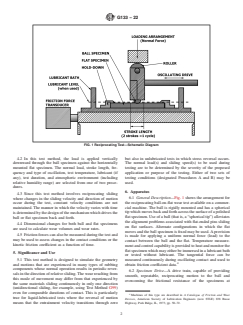
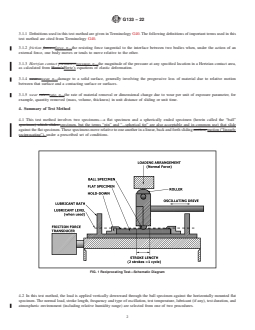
FIG. 1 Reciprocating Test—Schematic Diagram
4.2 In this test method, the load is applied vertically but also in unlubricated tests in which stress reversal occurs.
downward through the ball specimen against the horizontally The normal load(s) and sliding speed(s) to be used during
mounted flat specimen. The normal load, stroke length, fre- testing are to be determined by the severity of the proposed
quency and type of oscillation, test temperature, lubricant (if application or purpose of the testing. Either of two sets of
any), test duration, and atmospheric environment (including testing conditions (designated Procedures A and B) may be
relative humidity range) are selected from one of two proce- used.
dures.
6. Apparatus
4.3 Since this test method involves reciprocating sliding
6.1 General Description—Fig. 1 shows the arrangement for
where changes in the sliding velocity and direction of motion
the reciprocating ball-on-flat wear test available on a commer-
occur during the test, constant velocity conditions are not
cial machine. The ball is rigidly mounted and has a spherical
maintained.The manner in which the velocity varies with time
tipwhichmovesbackandforthacrossthesurfaceofapolished
isdeterminedbythedesignofthemechanismwhichdrivesthe
flatspecimen.Useofaball(thatis,a“sphericaltip”)alleviates
ball or flat specimen back and forth.
the alignment problems associated with flat-ended pins sliding
4.4 Dimensional changes for both ball and flat specimens
on flat surfaces. Alternate configurations in which the flat
are used to calculate wear volumes and wear rates.
movesandtheballspecimenisfixedmaybeused.Aprovision
4.5 Friction forces can also be measured during the test and
is made for applying a uniform normal force (load) to the
may be used to assess changes in the contact conditions or the
contact between the ball and the flat. Temperature measure-
kinetic friction coefficient as a function of time.
mentandcontrolcapabilityisprovidedtoheatandmonitorthe
flatspecimenwhichmayeitherbeimmersedinalubricantbath
5. Significance and Use
or tested without lubricant. The tangential force can be
5.1 This test method is designed to simulate the geometry
measured continuously during oscillating contact and used to
and motions that are experienced in many types of rubbing
obtain friction coefficient data.
components whose normal operation results in periodic rever-
6.2 Specimen Drive—A drive train, capable of providing
salsinthedirectionofrelativesliding.Thewearresultingfrom
smooth, repeatable, reciprocating motion to the ball and
this mode of movement may differ from that experienced by
overcoming the frictional resistance of the specimens at
the same materials sliding continuously in only one direction
(unidirectional sliding, for example, using Test Method G99)
even for comparable durations of contact. This is particularly
Machines of this type are described in A Catalogue of Friction and Wear
true for liquid-lubricated tests where the reversal of motion
Devices, American Society of Lubrication Engineers (now STLE) 838 Busse
means that the entrainment velocity transitions through zero Highway, Park Ridge, IL, 1973, pp. 50–72.
G133 − 22
maximum load, is required. For example, a Scotch yoke drive mens as reasonably possible, in such a way that the air
mechanism can provide a smooth, sinusoidal velocity profile movement conditions are the same for humidity sensor as for
for the ball specimen relative to the flat specimen without the the test specimens.
need for the motor to stop and reverse direction periodically. 6.5.4 Temperature—The ambient temperature, in degrees
Stepper-typemotorsmayalsobeusedprovidedthatthemotion Celsius, shall be measured and reported during room tempera-
is smooth and uniform. ture tests. In full immersion, liquid-lubricated tests, the bath
temperature shall be measured, with consideration taken to a
6.3 BallandBallSpecimenHolder—Theballspecimenmay
uniformtemperaturedistributionbeingachieved,andreported.
be a fixed bearing ball or any spherically tipped specimen as
For unlubricated tests, use of a thermocouple on the surface of
longastheslidingcontactisequivalenttoaballonaflatplane.
the specimen, positioned not to impede the reciprocating
If a bearing ball is used, it shall be clamped tightly enough to
motion, should be considered.
preventslippageduringthetest.Theballholdershouldberigid
enough so that the periodic reversal in the sliding direction
7. Calibration
does not result in tilting or other misalignment of the contact.
7.1 Thepartsoftheapparatusthatrequirecalibrationare(1)
6.4 Flat Specimen Holder—The flat specimen is secured to
the loading system, (2) the motion drive (speed and stroke
the base of the machine to prevent slippage or buckling during
length), and (3) the friction force sensor.
the test. A variety of shapes and configurations for the flat
7.1.1 Loading System—The load (normal force) applied to
specimen are possible. The primary criterion is that the flat
thespecimenshallbecheckedperiodically.Inmachineswhich
specimen presents a flat, horizontal surface to the ball speci-
apply the load by a spring/lever arrangement and indicate the
men.
load on a dial gage, this can be done by substituting a
6.5 Instrumentation:
previously calibrated compression load cell for the specimen
6.5.1 Friction Force—A tension-compression load cell or
and checking the applied load indicated on the loading dial
similar force-sensing device may be used to measure the
against the calibrated load cell output. Statically applied loads
friction forces generated during sliding. Calibration of the
shall be kept constant within a maximum deviation of 62.0%
frictionforce(seesubsection7.1.3)inbothforwardandreverse
ofthetestload.Forexample,permittedstaticerrorofa25.0N
slidingdirectionsisrequired.Sincethedirectionofthefriction
normal force would be 60.5 N. During oscillating tests, the
force changes rapidly during the test, traditional strip-chart-
normalforcemayvaryslightlyaboutthemeanvalueduetothe
typerecordersmaybetooslowtofollowthesechangesathigh
dynamics of the machine.This variation is to be expected and,
frequencies of reciprocation, therefore, modern data acquisi-
for unlubricated tests, it is suggested that sacrificial test
tion systems capable of sampling frequencies well in excess
specimens are used to conduct a preliminary test in order to
(an order of magnitude is suggested) of the reciprocating
assess the magnitude of this variation.
frequency of the test being conducted are preferred. The
7.1.2 Motion Drive—The oscillating frequency of the mov-
method of sensing and recording friction force during the test
ing specimen shall be checked periodically against the drive
shall be described in the testing report.
motor setting to ensure that the rate of oscillation is known.
6.5.2 Test Duration—In this test method, test duration is
(Warning—Due to inertial effects, differences in the loading
specifiedinseconds.Tocomputetheslidingdistanceinmetres
andfixturingmethodbecomemoresignificantastheoscillating
or number of cycles, use the following:
frequency of the test is increased, and harmonic frequencies
characteristic of the test machine must be avoided when
X 50.002 3t 3f 3L (1)
selecting the oscillating frequency.)
or
7.1.3 Friction Force Sensor—Thefrictionforcesensorshall
N 5 t 3f (2)
be calibrated periodically (as advised by the manufacturer, if
available) in both directions of load application and with
where:
consideration of the temperature(s) at which testing is to be
X = total sliding distance of the ball, m,
conducted. Depending on the machine, a fixture that applies a
N = number of cycles in the test,
fixed calibrating load in line with the normal point of contact
t = test time, s,
between the ball and flat should be used.
f = oscillating frequency, Hz (cycles/s), and
L = length of stroke, mm.
8. Procedure
A cycle is defined as two stroke lengths (up and back).
8.1 Specimen Preparation—The ball specimen and flat
Manual, or feedback-controlled, electronic timers can be used
specimen shall be used either in a polished condition, or in a
to terminate the test. If a physical, electronic, or software-
specified condition consistent with the application of interest.
based, cycle-counter is available, this may be used instead of
In a polished condition, the surface should be as free as
the timer, in which case Eq 2 will be used.
possible from preparation artifacts such as grinding-induced
6.5.3 Humidity—The wear and friction of many materials is
cracks, gross grinding marks, and grain pull-out. Surface
significantly affected by the moisture in the air. It is, therefore,
roughnesses of 0.02µm to 0.05µm R (arithmetic roughness)
a
requiredthattherelativehumidity(toanaccuracyof 63%)be
are typical.
measured before and during the test. Humidity can vary with
air flow and in different parts of the same room, so the 8.2 Clean the specimens using the following procedure:
humidity sensor should be located as close to the test speci- 8.2.1 Wash with a mild liquid laboratory glassware cleaner,
G133 − 22
8.2.2 Hot air dry, (8)Lubrication,fullimmersionundertheselectedlubricant
(see Note 2).
8.2.3 Ultrasonically clean in acetone (2 min),
8.2.4 Hot air dry,
NOTE 2—This procedure requires full-immersion lubrication. If other
8.2.5 Ultrasonically clean in methanol (2 min), and
methods, such a controlled drip feeding system, are used to simulate
certain applications, the provisions of 8.6 will apply.
8.2.6 Hot air dry.
8.5.2 When heated, liquid-lubricated tests are being
8.2.7 If there is considerable porosity in the specimens, it is
necessary that they be baked dry for4hata temperature conducted, as in Procedure B, apply the lubricant and heat the
specimens to the selected temperature allowing them to equili-
greater than 150°C in a clean oven.
brate for not less than 5 min before applying the load and
NOTE 1—Certain materials could be adversely affected by cleaning in
starting the test. Bath temperature shall be controlled to within
solvents. Similarly, for metal specimens that have significant porosity,
amaximumdeviationof 62.0°Cfromthedesiredtemperature.
such as those obtained by means of powder metallurgy (sintering) or
Afreshsupplyoflubricantshallbeusedforeachtestunlessthe
additive manufacturing processes are likely to be susceptible to consid-
erable oxidation during baking. Deviations from the prescribed prepara-
objectiveistoevaluatetheeffectsofusedlubricantsonfriction
tion procedure are permitted, but they shall be described in the report.
and wear.
8.3 Clean the specimens after they are secured in place in 8.5.3 Set the timer (or cycle counter), if available, for the
thetestfixturebywipingwithacetoneandthenwithmethanol- selected test duration.
moistened cotton swabs. It is possible that during mounting,
8.5.4 Start the friction (and temperature) recording equip-
somecontaminationwasinadvertentlyplacedonthem,andthis
ment and initiate the test.
final cleaning will help alleviate the problem. Inspect the ball
8.5.5 After the prescribed duration, stop the motor. Remove
surfacewithahandlensafteritismountedtoensurethatthere
the normal force to recheck the zero point on the friction force
is no damage in the contact area.
recording system.
8.5.6 Allow specimens to cool, if heated, then remove the
8.4 Gently lower the ball specimen upon the flat specimen,
testspecimens.Tomeasurethewear,itisnecessarytocleanthe
and ensure that the reciprocating drive shaft motion is hori-
specimens in such a way that the surface features are not
zontal and parallel to the surface of the flat specimen. The
altered. For unlubricated tests, debris should be collected or
height of the specimen or mount may require adjustment to
imaged for analysis, if desired, then a concentrated jet of air
ensure that this condition is fulfilled.Apply the prescribed test
may be used to dispel the debris from the worn area of the
load. Confirm that the desired oscillating speed has been set
specimens. For liquid-lubricated specimens, ultrasonic clean-
before turning on the motor.
ing in a suitable solvent may be used. Specimens shall be
8.5 Two possible testing procedures, one for unlubricated
thoroughly dried.
tests (ProcedureA), and one for liquid-lubricated tests at high
8.5.7 Examinetheballspecimentoensurethatnorollingor
contact stress and elevated temperature (Procedure B), are
other slippage has taken place.Any ball movement within the
given in 8.5.1. The procedure appropriate for the given
holderduringthetestinvalidatesthetestresults.Similarly,any
materials and test severity should be selected. If neither
slippage of the flat specimen in its fixture invalidates the test
procedure in 8.5.1 is determined to be suitable, other condi-
results.
tions may be used, but testing will not be in compliance with
8.6 Alternative Testing Procedures—To achieve certain
this test method. See the reporting requirements in Section 10
simulation conditions, or for other technical reasons, Proce-
for reporting exceptions to Procedures A and B.
dures A and B may not be suitable for a given reciprocating
8.5.1 The two testing procedures are as follows.
wear testing project. Modifications to the specific test condi-
8.5.1.1 Procedure A—Unlubricated wear testing at room
tions prescribed in Procedures A and B may be used for
temperature.
conducting such tests; however, in reporting the results, the
(1)Ball radius, 4.76 mm ( ⁄16 in.),
specific parameters which are not in compliance with one of
(2)Normal force, 25.0 N,
the standard testing procedures shall be specifically noted. A
(3)Stroke length, 10.0 mm,
statementsuchasthefollowingmaythenbeused:“Thesetests
(4)Oscillating frequency, 5.0 Hz,
are not in full compliance with the provisions of Test Method
(5)Test duration, 16 min 40 s (sliding distance 100 m),
G133,ProcedureA,becausethenormalforceinthesetestswas
(6)Ambient temperature, 22°C 6 3°C,
50.0N,insteadof25.0Nasprescribedbythestandard,andthe
(7)Relative humidity, 40% to 60%, and
strokelengthwas5.0mm,insteadof10.0mmasprescribedby
(8)Lubrication, none applied.
the standard. All other provisions of Test Method G133 have
8.5.1.2 Procedure B—Lubricated wear testing at elevated
been followed.”
temperature.
(1)Ball radius, 4.76 mm ( ⁄16 in.),
9. Measurement and Calculation of Wear
(2)Normal force, 200.0 N,
(3)Stroke length, 10.0 mm, 9.1 Depending upon the relative wear of ball and flat
(4)Oscillating frequency, 10.0 Hz, specimens, various assumptions about the geometric irregular-
(5)Test duration, 33 min 20 s (sliding distance 400 m), ityofthewearscarscanbemade.Fig.2showsseveralpossible
(6)Temperature, 150°C 6 2°C, wear conditions. In Fig. 2(a), the flat material is much more
(7)Relative humidity, 40% to 60%, and wear-resistant than the ball material. In Fig. 2(b), the ball
G133 − 22
FIG. 2 Possible Situations for Differing Wear Resistance of Ball and Flat Specimens
material is much more wear-resistant than the flat material. In (Warning—For lubricated tests in which there is minimal
Fig. 2(c), measurable wear occurs on both ball and flat wear, it is possible to be misled in reading the apparent wear
materials. scar diameter of the ball tip optically because of elastic
recovery.Asmall, shallow annulus surrounding the elastically
9.2 Wear of the Ball Specimen—Owing to the nature of this
deformed area may give the impression of wear, whereas little
typeoftest,thewearscarontheballspecimenmaynotalways
ornoappreciablewearhasactuallyoccurred.Profilometrymay
be circular or flat. Refer to the following which applies.
be used to determine whether the wear scar is flat and
9.2.1 If the end of the ball appears flat, but not circular, the
consequently whether (Eq 3) and (Eq 4) can be used.)
average of the maximum and minimum dimensions of the scar
9.2.2 Iftheballisobviouslyworn,buttheweartrackprofile
shall be computed and this value used as the effective ball scar
on the flat specimen indicates that the ball is not entirely flat,
diameter (D). Ball scar measurements may be made by
as in Fig. 2(c), note those facts and either measure volume by
remov
...
This document is not an ASTM standard and is intended only to provide the user of an ASTM standard an indication of what changes have been made to the previous version. Because
it may not be technically possible to adequately depict all changes accurately, ASTM recommends that users consult prior editions as appropriate. In all cases only the current version
of the standard as published by ASTM is to be considered the official document.
Designation: G133 − 05 (Reapproved 2016) G133 − 22
Standard Test Method for
Linearly Reciprocating Ball-on-Flat Sliding Wear
This standard is issued under the fixed designation G133; the number immediately following the designation indicates the year of
original adoption or, in the case of revision, the year of last revision. A number in parentheses indicates the year of last reapproval. A
superscript epsilon (´) indicates an editorial change since the last revision or reapproval.
1. Scope
1.1 This test method covers laboratory procedures for determining the sliding wear of ceramics, metals, and other candidate
wear-resistant materials using a linear, reciprocating ball-on-flat plane geometry. The direction of the relative motion between
sliding surfaces reverses in a periodic fashion such that the sliding occurs back and forth and in a straight line. The principal
quantities of interest are the wear volumes of the contacting ball and flat specimen materials; however, the coefficient of kinetic
friction may also be measured using the method described. This test method encompasses both unlubricated and lubricated testing
procedures. The scope of this test method does not include testing in corrosive or chemically aggressive environments.environ-
ments or extremes of temperature and humidity.
1.2 The values stated in SI units are to be regarded as the standard. The values given in parentheses are for information only.after
SI units are provided for information only and are not considered standard.
1.3 This standard does not purport to address all of the safety concerns, if any, associated with its use. It is the responsibility
of the user of this standard to establish appropriate safety safety, health, and healthenvironmental practices and determine the
applicability of regulatory limitations prior to use.
1.4 This international standard was developed in accordance with internationally recognized principles on standardization
established in the Decision on Principles for the Development of International Standards, Guides and Recommendations issued
by the World Trade Organization Technical Barriers to Trade (TBT) Committee.
2. Referenced Documents
2.1 ASTM Standards:
E112 Test Methods for Determining Average Grain Size
E1181 Test Methods for Characterizing Duplex Grain Sizes
G40 Terminology Relating to Wear and Erosion
G99 Test Method for Wear Testing with a Pin-on-Disk Apparatus
G115 Guide for Measuring and Reporting Friction Coefficients
G117 Guide for Calculating and Reporting Measures of Precision Using Data from Interlaboratory Wear or Erosion Tests
(Withdrawn 2016)
G118 Guide for Recommended Format of Wear Test Data Suitable for Databases (Withdrawn 2016)
3. Terminology
3.1 Definitions:
This test method is under the jurisdiction of ASTM Committee G02 on Wear and Erosion and is the direct responsibility of Subcommittee G02.40 on Non-Abrasive Wear.
Current edition approved June 1, 2016Nov. 1, 2022. Published June 2016November 2022. Originally approved in 1995. Last previous edition approved in 20102016 as
G133 – 05 (2010).(2016). DOI: 10.1520/G0133-05R16.10.1520/G0133-22.
For referenced ASTM standards, visit the ASTM website, www.astm.org, or contact ASTM Customer Service at service@astm.org. For Annual Book of ASTM Standards
volume information, refer to the standard’sstandard’s Document Summary page on the ASTM website.
The last approved version of this historical standard is referenced on www.astm.org.
Copyright © ASTM International, 100 Barr Harbor Drive, PO Box C700, West Conshohocken, PA 19428-2959. United States
G133 − 22
3.1.1 Definitions used in this test method are given in Terminology G40. The following definitions of important terms used in this
test method are cited from Terminology G40.
3.1.2 friction force—force, n—the resisting force tangential to the interface between two bodies when, under the action of an
external force, one body moves or tends to move relative to the other.
3.1.3 Hertzian contact pressure—pressure, n—the magnitude of the pressure at any specified location in a Hertzian contact area,
as calculated from Hertz’sHertz’s equations of elastic deformation.
3.1.4 wear—wear, n—damage to a solid surface, generally involving the progressive loss of material due to relative motion
between that surface and a contacting surface or surfaces.
3.1.5 wear rate—rate, n—the rate of material removal or dimensional change due to wear per unit of exposure parameter, for
example, quantity removed (mass, volume, thickness) in unit distance of sliding or unit time.
4. Summary of Test Method
4.1 This test method involves two specimens—a flat specimen and a spherically ended specimen (herein called the “ball”
specimen) which slides specimen, but the terms “pin” and “.spherical tip” are also acceptable and in common use) that slide
against the flat specimen. These specimens move relative to one another in a linear, back and forth sliding motion, motion (“linearly
reciprocating”), under a prescribed set of conditions.
FIG. 1 Reciprocating Test—Schematic Diagram
4.2 In this test method, the load is applied vertically downward through the ball specimen against the horizontally mounted flat
specimen. The normal load, stroke length, frequency and type of oscillation, test temperature, lubricant (if any), test duration, and
atmospheric environment (including relative humidity range) are selected from one of two procedures.
G133 − 22
4.3 Since this test method involves reciprocating sliding where changes in the sliding velocity and direction of motion occur
during the test, constant velocity conditions are not maintained. The manner in which the velocity varies with time is determined
by the design of the mechanism which drives the ball or flat specimen back and forth.
4.4 Dimensional changes for both ball and flat specimens are used to calculate wear volumes and wear rates.
4.5 Friction forces are can also be measured during the test and may be used to assess changes in the contact conditions or the
kinetic friction coefficient as a function of time.
5. Significance and Use
5.1 This test method is designed to simulate the geometry and motions that are experienced in many types of rubbing components
whose normal operation results in periodic reversals in the direction of relative sliding. The wear resulting from this mode of
movement may differ from that experienced by the same materials sliding continuously in only one direction (unidirectional
sliding) sliding, for example, using Test Method G99) even for comparable durations of contact. Test loads and speeds This is
particularly true for liquid-lubricated tests where the reversal of motion means that the entrainment velocity transitions through
zero but also in unlubricated tests in which stress reversal occurs. The normal load(s) and sliding speed(s) to be used during testing
are to be determined by the severity of the proposed application or purpose of the testing. Either of two sets of testing conditions
(designated Procedures A and B) may be used.
6. Apparatus
6.1 General Description—Fig. 1 shows the arrangement for the reciprocating ball-on-flat wear test available on a commercial
machine. The ball is rigidly mounted and has a spherical tip which moves back and forth across the surface of a polished flat
specimen. Use of a spherical tip ball (that is, a “spherical tip”) alleviates the alignment problems associated with flat-ended
ballspins sliding on flat surfaces. Alternate configurations in which the flat moves and the ball specimen is fixed may be used. A
provision is made for applying a uniform normal force (load) to the contact between the ball and the flat. Temperature measurement
and control capability is provided to heat and monitor the flat specimen which may either be immersed in a lubricant bath or tested
without lubricant. The tangential force can be measured continuously during oscillating contact and used to obtain friction
coefficient data.
6.2 Specimen Drive—A drive train, capable of providing smooth, repeatable, reciprocating motion to the ball and overcoming the
frictional resistance of the specimens at maximum load, is required. For example, a Scotch yoke drive mechanism can provide a
smooth, sinusoidal velocity profile for the ball specimen relative to the flat specimen without the need for the motor to stop and
reverse direction periodically. Stepper-type motors may also be used provided that the motion is smooth and uniform.
6.3 Ball and Ball Specimen Holder—The ball specimen may be a fixed bearing ball or any spherically tipped specimen as long
as the sliding contact is equivalent to a ball on a flat plane. If a bearing ball is used, it shall be clamped tightly enough to prevent
slippage during the test. The ball holder should be rigid enough so that the periodic reversal in the sliding direction does not result
in tilting or other misalignment of the contact.
6.4 Flat Specimen Holder—The flat specimen is secured to the base of the machine to prevent slippage or buckling during the test.
A variety of shapes and configurations for the flat specimen are possible. The primary criterion is that the coupon present flat
specimen presents a flat, horizontal surface to the ball specimen.
6.5 Instrumentation:
6.5.1 Friction Force—A tension-compression load cell or similar force-sensing device may be used to measure the friction forces
generated during sliding. Calibration of the friction force (see subsection 7.1.3) in both forward and reverse sliding directions is
required. Since the direction of the friction force changes rapidly during the test, traditional strip-chart-type recorders may be too
slow to follow these changes at high frequencies of reciprocation. A commercial version of this machine is available with a signal
conditioner to rectify, and output the root-mean-square friction force to a strip-chart-recorder or to a computerized data acquisition
Machines of this type are described in A Catalogue of Friction and Wear Devices, American Society of Lubrication Engineers (now STLE) 838 Busse Highway, Park
Ridge, IL, 1973, pp. 50–72.
G133 − 22
system. reciprocation, therefore, modern data acquisition systems capable of sampling frequencies well in excess (an order of
magnitude is suggested) of the reciprocating frequency of the test being conducted are preferred. The method of sensing and
recording friction force during the test shall be described in the testing report.
6.5.2 Test Duration—In this test method, test duration is specified in seconds. To compute the sliding distance in metres or number
of cycles, use the following:
X 5 0.002 3t 3f 3L (1)
or
N 5 t 3f (2)
where:
where:
X = total sliding distance of the ball, m,
N = number of cycles in the test,
t = test time, s,
f = oscillating frequency, Hz (cycles/s), and
L = length of stroke, mm.
A cycle is defined as two stroke lengths (up and back). Electronic Manual, or feedback-controlled, electronic timers can be used
to terminate the test. If a physical, electronic, or software-based, cycle-counter is available, this may be used instead of the timer,
in which case Eq 2 will be used.
6.5.3 Humidity—The wear and friction of many materials is significantly affected by the moisture in the air. It is thereforeis,
therefore, required that the relative humidity (to an accuracy of 63 %) be measured before and during the test. Humidity can vary
with air flow and in different parts of the same room, so the humidity sensor should be located as close to the test specimens as
reasonably possible, in such a way that the air movement conditions are the same for humidity sensor as for the test specimens.
6.5.4 Temperature—The ambient temperature, in degrees Celsius, shall be measured and reported during room temperature tests.
In full immersion, liquid-lubricated tests, the bath temperature shall be measured and reported.measured, with consideration taken
to a uniform temperature distribution being achieved, and reported. For unlubricated tests, use of a thermocouple on the surface
of the specimen, positioned not to impede the reciprocating motion, should be considered.
7. Calibration
7.1 TheThe parts of the apparatus that require calibration are (1) the loading system, (2) the motion drive (speed and stroke
length), and (3) the friction force sensor.
7.1.1 Loading System—The load (normal force) applied to the specimen shall be checked periodically. In machines which apply
the load by a spring/lever arrangement and indicate the load on a dial gage, this can be done by substituting a previously calibrated
compression load cell for the specimen and checking the applied load indicated on the loading dial against the calibrated load cell
output. Statically applied loads shall be kept constant within a maximum deviation of 62.0 % of the test load. For example,
permitted static error of a 25.0-N25.0 N normal force would be 60.5 N. During oscillating tests, the normal force may vary slightly
about the mean value due to the dynamics of the machine. This variation is to be expected.expected and, for unlubricated tests,
it is suggested that sacrificial test specimens are used to conduct a preliminary test in order to assess the magnitude of this variation.
7.1.2 Motion Drive—The oscillating frequency of the moving specimen shall be checked periodically against the drive motor
setting to ensure that the rate of oscillation is known. (Warning—Due to inertial effects, differences in the loading and fixturing
method become more significant as the oscillating frequency of the test is increased, and harmonic frequencies characteristic of
the test machine must be avoided when selecting the oscillating frequency.)
7.1.3 Friction Force Sensor—The friction force sensor shall be calibrated periodically (as advised by the manufacturer, if
available) in both directions of load application. application and with consideration of the temperature(s) at which testing is to be
conducted. Depending on the machine, a fixture whichthat applies a fixed calibrating load in line with the normal point of contact
between the ball and flat should be used.
8. Procedure
8.1 Specimen Preparation—The ball specimen and flat specimen shall be used either in a polished condition, or in a specified
G133 − 22
condition consistent with the application of interest. In a polished condition, the surface should be as free as possible from
preparation artifacts such as grinding-induced cracks, gross grinding marks, and grain pull-out. Surface roughnesses of
0.020.02 μm to 0.05-μm0.05 μm R (arithmetic roughness) are typical.
a
8.2 Clean the specimens using the following procedure:
8.2.1 Wash with a mild liquid laboratory glassware cleaner,
8.2.2 Hot air dry,
8.2.3 Ultrasonically clean in acetone (2 min),
8.2.4 Hot air dry,
8.2.5 Ultrasonically clean in methanol (2 min), and
8.2.6 Hot air dry.
8.2.7 If there is considerable porosity in the specimens, it is necessary that they be baked dry for 4 h at a temperature greater than
150°C150 °C in a clean oven.
NOTE 1—Certain materials could be adversely affected by cleaning in solvents. Similarly, for metal specimens that have significant porosity, such as those
obtained by means of powder metallurgy (sintering) or additive manufacturing processes are likely to be susceptible to considerable oxidation during
baking. Deviations from the prescribed cleaningpreparation procedure are permitted, but they shall be described in the report.
8.3 Clean the specimens after they are secured in place in the test fixture by wiping with acetone and then with
methanol-moistened cotton swabs. It is possible that during mounting, some contamination was inadvertently placed on them, and
this final cleaning will help alleviate the problem. Inspect the ball tipsurface with a hand lens after it is mounted to ensure that there
areis no defectsdamage in the contact area.
8.4 Gently lower the ball specimen upon the flat specimen, and ensure that the reciprocating drive shaft motion is horizontal and
parallel to the surface of the flat specimen. The height of the specimen or mount may require adjustment to ensure that this
condition is fulfilled. Apply the prescribed test load. Confirm that the desired oscillating speed has been set before turning on the
motor.
8.5 Two possible testing procedures, one for unlubricated tests (Procedure A), and one for high-contact stress-lubricated
liquid-lubricated tests at high contact stress and elevated temperature (Procedure B), are given in 8.5.1. The procedure appropriate
for the given materials and test severity should be selected. If neither procedure in 8.5.1 is determined to be suitable, other
conditions may be used, but testing will not be in compliance with this test method. See the reporting requirements in Section 10
for reporting exceptions to Procedures A and B.
8.5.1 The two testing procedures are as follows.
8.5.1.1 Procedure A—Unlubricated wear testing at room temperature.
(1) Pin tip Ball radius, 4.76 mm ( ⁄16 in.),
(2) Normal force, 25.0 N,
(3) Stroke length, 10.0 mm,
(4) Oscillating frequency, 5.0 Hz,
(5) Test duration, 16 min 40 s (sliding distance 100 m),
(6) Ambient temperature, 2222 °C 6 3°C,3 °C,
(7) Relative humidity, 4040 % to 60 %, and
(8) Lubrication, none applied.
8.5.1.2 Procedure B—Lubricated wear testing at elevated temperature.
(1) Pin tip Ball radius, 4.76 mm ( ⁄16 in.),
(2) Normal force, 200.0 N,
(3) Stroke length, 10.0 mm,
G133 − 22
(4) Oscillating frequency, 10.0 Hz,
(5) Test duration, 33 min 20 s (sliding distance 400 m),
(6) Temperature, 150150 °C 6 2°C,2 °C,
(7) Relative humidity, 4040 % to 60 %, and
(8) Lubrication, full immersion under the selected lubricant (see Note 2).
NOTE 2—This procedure requires full-immersion lubrication. If other methods, such a controlled drip feeding system, are used to simulate certain
applications, the provisions of 8.6 will apply.
8.5.2 When heated, liquid-lubricated tests are being conducted, as in Procedure B, apply the lubricant and heat the specimens to
the selected temperature allowing them to equilibrate for not less than 5 min before applying the load and starting the test. Bath
temperature shall be controlled to within a maximum deviation of 62.0°C from the desired temperature. A fresh supply of lubricant
shall be used for each test unless the objective is to evaluate the effects of used lubricants on friction and wear.
8.5.3 Set the timer (or cycle counter), if available, for the selected test duration.
8.5.4 Start the friction (and temperature) recording equipment and initiate the test.
8.5.5 After the prescribed duration, stop the motor. Remove the normal force to recheck the zero point on the friction force
recording system.
8.5.6 Allow specimens to cool, if heated, then remove the test specimens. To measure the wear, it is necessary to clean the
specimens in such a way that the surface features are not altered. For unlubricated tests, debris should be collected or imaged for
analysis, if desired, then a concentrated jet of air may be used to dispel the debris from the worn area of the specimens. For
liquid-lubricated specimens, ultrasonic cleaning in a suitable solvent may be used. Specimens shall be thoroughly dried.
8.5.7 Examine the tip of the ball specimen to ensure that no rolling or other slippage has taken place. Any ball movement within
the holder during the test invalidates the test results. Similarly, any slippage of the flat specimen in its fixture invalidates the test
results.
8.6 Alternative Testing Procedures—To achieve certain simulation conditions, or for other technical reasons, Procedures A and B
may not be suitable for a given reciprocating wear testing project. Modifications to the specific test conditions prescribed in
Procedures A and B may be used for conducting such tests; however, in reporting the results, the specific parameters which are
not in compliance with one of the standard testing procedures shall be specifically noted. A statement such as the following may
then be used: “These tests are not in full compliance with the provisions of Test Method G133, Procedure A, because the normal
force in these tests was 50.0 N, instead of 25.0 N as prescribed by the standard, and the stroke length was 5.0 mm, instead of 10.0
mm as prescribed by the standard. All other provisions of Test Method G133 have been followed.”
9. Measurement and Calculation of Wear
9.1 Depending upon the relative wear of ball and flat specimens, various assumptions about the geometric irregularity of the wear
scars can be made. Fig. 2 shows several possible wear conditions. In Fig. 2(a), the flat material is much more wear-resistant than
the ball material. In Fig. 2(b), the ball material is much more wear-resistant than the flat material. In Fig. 2(c), measurable wear
occurs on both ball and flat materials.
9.2 Wear of the Ball Specimen—Owing to the nature of this type of test, the wear scar on the ball specimen may not always be
circular or flat. Refer to the following which applies.
9.2.1 If the end of the ball appears flat, but not circular, the average of the maximum and minimum dimensions of the scar shall
be computed and this value used as the effective ball scar diameter (D). PinBall scar measurements may be made by removing the
ball specimen holder and placing the wear scar portion under a reflecting microscope. A calibrated ocular or ocular, a
photomicrograph of known magnification magnification, or a calibrated image measurement software may be used to measure scar
dimensions. Due to the typically high reflectivity of the ball surface, the use of an optical, noncontact profilometer may prove
difficult.
9.2.1.1 The wear volume (V ) for a flat ball wear scar of effective diameter D (the case in Fig. 2(a)), is found from the same
p
relationship given in Test Method G99, Appendix X1.1.1:
...