

ASTM D7905/D7905M-19e1
(Test Method)Standard Test Method for Determination of the Mode II Interlaminar Fracture Toughness of Unidirectional Fiber-Reinforced Polymer Matrix Composites
General Information
- Abstract
SIGNIFICANCE AND USE
5.1 Susceptibility to delamination is one of the major design concerns for many advanced laminated composite structures. Knowledge of a laminated composite material’s resistance to interlaminar fracture is useful for product development and material selection. Furthermore, a measurement of the mode II interlaminar fracture toughness that is independent of specimen geometry or method of force introduction is useful for establishing design allowables used in damage tolerance analyses of composite structures. Knowledge of both the non-precracked and precracked toughnesses allows the appropriate value to be used for the application of interest.
5.2 This test method can serve the following purposes:
5.2.1 To establish quantitatively the effect of fiber surface treatment, local variations in fiber volume fraction, and processing and environmental variables on GIIc of a particular composite material;
5.2.2 To compare quantitatively the relative values of GIIc for composite materials with different constituents;
5.2.3 To compare quantitatively the values of GIIc obtained from different batches of a specific composite material, for example, to use as a material screening criterion or to develop a design allowable; and
5.2.4 To develop delamination failure criteria for composite damage tolerance and durability analyses.
SCOPE
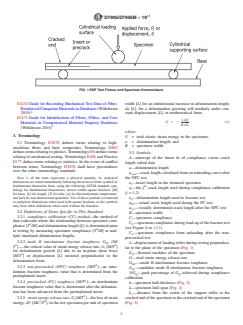
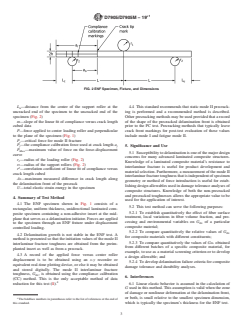
1.1 This test method covers the determination of the mode II interlaminar fracture toughness, GIIc, of unidirectional fiber-reinforced polymer matrix composite laminates under mode II shear loading using the end-notched flexure (ENF) test (Fig. 1).
FIG. 1 ENF Test Fixture and Specimen Nomenclature
1.2 This method is limited to use with composites consisting of unidirectional carbon-fiber- and glass-fiber-reinforced laminates. This limited scope reflects the experience gained in round robin testing. This test method may prove useful for other types and classes of composite materials; however, certain interferences have been noted (see Section 6).
1.3 The values stated in either SI units or inch-pound units are to be regarded separately as standard. The values stated in each system are not necessarily exact equivalents; therefore, to ensure conformance with the standard, each system shall be used independently of the other, and values from the two systems shall not be combined.
1.3.1 Within the text the inch-pound units are shown in brackets.
1.4 This standard does not purport to address all of the safety concerns, if any, associated with its use. It is the responsibility of the user of this standard to establish appropriate safety, health, and environmental practices and determine the applicability of regulatory limitations prior to use.
1.5 This international standard was developed in accordance with internationally recognized principles on standardization established in the Decision on Principles for the Development of International Standards, Guides and Recommendations issued by the World Trade Organization Technical Barriers to Trade (TBT) Committee.
- Status
- Published
- Publication Date
- 14-Mar-2019
- Technical Committee
- D30 - Composite Materials
- Drafting Committee
- D30.06 - Interlaminar Properties
Overview
ASTM D7905/D7905M-19e1 is a widely recognized standard developed by ASTM International for assessing the mode II interlaminar fracture toughness (GIIc) of unidirectional fiber-reinforced polymer matrix composites. This test method employs the End-Notched Flexure (ENF) test to provide crucial data for understanding a composite material’s resistance to delamination-a major consideration in the design and structural integrity of advanced laminated composites. The standard is particularly relevant for unidirectional composites reinforced with carbon or glass fibers, though its methodology may offer value for other composite types as well.
Key Topics
- Purpose and Significance: The ENF test is essential for quantifying the susceptibility of advanced composites to delamination, directly impacting product development, material selection, and the formulation of design allowables for damage tolerance analyses.
- Test Scope: Focuses on unidirectional carbon- and glass-fiber-reinforced polymer composites under shear loading, using SI or inch-pound units. Each measurement system should be used independently to ensure accuracy.
- Fracture Toughness Evaluation: The method details how to obtain mode II interlaminar fracture toughness (GIIc) values both for non-precracked and precracked specimens, facilitating the use of the most appropriate value based on application needs.
- Data Reporting: Emphasizes measuring and reporting variations due to fiber surface treatment, fiber volume fraction, processing, and environmental conditions to ensure the reliability and comparability of GIIc values.
- Testing Consistency: The recommendation for at least five specimens per condition supports statistically significant data, and conditioning protocols are detailed for ensuring environmental consistency.
- Safety and Standardization: Outlines user responsibilities regarding safety, health, and regulatory limitations, and aligns with international standardization principles endorsed by the World Trade Organization.
Applications
The ASTM D7905/D7905M-19e1 standard finds practical application in industries where advanced polymer matrix composites are critical, such as:
- Aerospace: Essential for qualifying materials in aircraft structures where delamination resistance is crucial for safety and durability.
- Automotive: Supports the selection and validation of lightweight composite materials for high-performance vehicles.
- Wind Energy: Enables the assessment of composite blade materials for wind turbines, where load-induced delaminations can impact structural performance.
- Marine Structures: Useful for evaluating composites in shipbuilding and offshore platforms exposed to harsh environments.
Key users include materials engineers, QA professionals, and test laboratories involved in:
- Comparing materials with different constituents or processing histories.
- Developing design allowables for simulation and analysis of composite structures.
- Screening new batches of composite materials for consistency and quality control.
- Generating data for durability and damage tolerance analysis.
Related Standards
ASTM D7905/D7905M-19e1 is closely associated with several other ASTM standards relevant to composite materials testing and characterization, including:
- ASTM D792 – Density and Specific Gravity of Plastics
- ASTM D883 – Terminology Relating to Plastics
- ASTM D2584 – Ignition Loss of Cured Reinforced Resins
- ASTM D2734 – Void Content of Reinforced Plastics
- ASTM D3171 – Constituent Content of Composite Materials
- ASTM D3878 – Terminology for Composite Materials
- ASTM D5229/D5229M – Moisture Absorption Properties of Polymer Matrix Composites
- ASTM D7264/D7264M – Flexural Properties of Polymer Matrix Composite Materials
These documents provide essential procedures and terminology that complement the fracture toughness testing methodology outlined in ASTM D7905/D7905M, ensuring uniformity and reliability across composite material evaluations.
By adhering to ASTM D7905/D7905M-19e1, organizations ensure reliable assessment of interlaminar fracture toughness in polymer matrix composites, supporting better design, material selection, and quality assurance in advanced structural applications.
Relations
- Effective Date
- 15-Mar-2019
- Effective Date
- 01-Feb-2024
- Effective Date
- 01-Nov-2023
- Effective Date
- 01-Oct-2023
- Effective Date
- 01-Apr-2022
- Effective Date
- 01-Mar-2020
- Effective Date
- 01-Jan-2020
- Effective Date
- 15-Oct-2019
- Effective Date
- 01-Aug-2019
- Effective Date
- 15-Apr-2019
- Effective Date
- 15-Apr-2019
- Effective Date
- 01-Feb-2019
- Effective Date
- 01-Dec-2018
- Effective Date
- 01-Nov-2018
- Effective Date
- 15-Sep-2018
Get Certified
Connect with accredited certification bodies for this standard

DIN CERTCO
DIN Group product certification.

Smithers Quality Assessments
US management systems and product certification.
Sponsored listings
Frequently Asked Questions
ASTM D7905/D7905M-19e1 is a standard published by ASTM International. Its full title is "Standard Test Method for Determination of the Mode II Interlaminar Fracture Toughness of Unidirectional Fiber-Reinforced Polymer Matrix Composites". This standard covers: SIGNIFICANCE AND USE 5.1 Susceptibility to delamination is one of the major design concerns for many advanced laminated composite structures. Knowledge of a laminated composite material’s resistance to interlaminar fracture is useful for product development and material selection. Furthermore, a measurement of the mode II interlaminar fracture toughness that is independent of specimen geometry or method of force introduction is useful for establishing design allowables used in damage tolerance analyses of composite structures. Knowledge of both the non-precracked and precracked toughnesses allows the appropriate value to be used for the application of interest. 5.2 This test method can serve the following purposes: 5.2.1 To establish quantitatively the effect of fiber surface treatment, local variations in fiber volume fraction, and processing and environmental variables on GIIc of a particular composite material; 5.2.2 To compare quantitatively the relative values of GIIc for composite materials with different constituents; 5.2.3 To compare quantitatively the values of GIIc obtained from different batches of a specific composite material, for example, to use as a material screening criterion or to develop a design allowable; and 5.2.4 To develop delamination failure criteria for composite damage tolerance and durability analyses. SCOPE 1.1 This test method covers the determination of the mode II interlaminar fracture toughness, GIIc, of unidirectional fiber-reinforced polymer matrix composite laminates under mode II shear loading using the end-notched flexure (ENF) test (Fig. 1). FIG. 1 ENF Test Fixture and Specimen Nomenclature 1.2 This method is limited to use with composites consisting of unidirectional carbon-fiber- and glass-fiber-reinforced laminates. This limited scope reflects the experience gained in round robin testing. This test method may prove useful for other types and classes of composite materials; however, certain interferences have been noted (see Section 6). 1.3 The values stated in either SI units or inch-pound units are to be regarded separately as standard. The values stated in each system are not necessarily exact equivalents; therefore, to ensure conformance with the standard, each system shall be used independently of the other, and values from the two systems shall not be combined. 1.3.1 Within the text the inch-pound units are shown in brackets. 1.4 This standard does not purport to address all of the safety concerns, if any, associated with its use. It is the responsibility of the user of this standard to establish appropriate safety, health, and environmental practices and determine the applicability of regulatory limitations prior to use. 1.5 This international standard was developed in accordance with internationally recognized principles on standardization established in the Decision on Principles for the Development of International Standards, Guides and Recommendations issued by the World Trade Organization Technical Barriers to Trade (TBT) Committee.
SIGNIFICANCE AND USE 5.1 Susceptibility to delamination is one of the major design concerns for many advanced laminated composite structures. Knowledge of a laminated composite material’s resistance to interlaminar fracture is useful for product development and material selection. Furthermore, a measurement of the mode II interlaminar fracture toughness that is independent of specimen geometry or method of force introduction is useful for establishing design allowables used in damage tolerance analyses of composite structures. Knowledge of both the non-precracked and precracked toughnesses allows the appropriate value to be used for the application of interest. 5.2 This test method can serve the following purposes: 5.2.1 To establish quantitatively the effect of fiber surface treatment, local variations in fiber volume fraction, and processing and environmental variables on GIIc of a particular composite material; 5.2.2 To compare quantitatively the relative values of GIIc for composite materials with different constituents; 5.2.3 To compare quantitatively the values of GIIc obtained from different batches of a specific composite material, for example, to use as a material screening criterion or to develop a design allowable; and 5.2.4 To develop delamination failure criteria for composite damage tolerance and durability analyses. SCOPE 1.1 This test method covers the determination of the mode II interlaminar fracture toughness, GIIc, of unidirectional fiber-reinforced polymer matrix composite laminates under mode II shear loading using the end-notched flexure (ENF) test (Fig. 1). FIG. 1 ENF Test Fixture and Specimen Nomenclature 1.2 This method is limited to use with composites consisting of unidirectional carbon-fiber- and glass-fiber-reinforced laminates. This limited scope reflects the experience gained in round robin testing. This test method may prove useful for other types and classes of composite materials; however, certain interferences have been noted (see Section 6). 1.3 The values stated in either SI units or inch-pound units are to be regarded separately as standard. The values stated in each system are not necessarily exact equivalents; therefore, to ensure conformance with the standard, each system shall be used independently of the other, and values from the two systems shall not be combined. 1.3.1 Within the text the inch-pound units are shown in brackets. 1.4 This standard does not purport to address all of the safety concerns, if any, associated with its use. It is the responsibility of the user of this standard to establish appropriate safety, health, and environmental practices and determine the applicability of regulatory limitations prior to use. 1.5 This international standard was developed in accordance with internationally recognized principles on standardization established in the Decision on Principles for the Development of International Standards, Guides and Recommendations issued by the World Trade Organization Technical Barriers to Trade (TBT) Committee.
ASTM D7905/D7905M-19e1 is classified under the following ICS (International Classification for Standards) categories: 83.080.01 - Plastics in general. The ICS classification helps identify the subject area and facilitates finding related standards.
ASTM D7905/D7905M-19e1 has the following relationships with other standards: It is inter standard links to ASTM D7905/D7905M-19, ASTM D883-24, ASTM D883-23, ASTM D2734-23, ASTM E456-13a(2022)e1, ASTM D5229/D5229M-20, ASTM D883-20, ASTM D3878-19a, ASTM D883-19c, ASTM D883-19a, ASTM D3878-19, ASTM D883-19, ASTM D883-18a, ASTM D883-18, ASTM D2584-18. Understanding these relationships helps ensure you are using the most current and applicable version of the standard.
ASTM D7905/D7905M-19e1 is available in PDF format for immediate download after purchase. The document can be added to your cart and obtained through the secure checkout process. Digital delivery ensures instant access to the complete standard document.
Standards Content (Sample)
This international standard was developed in accordance with internationally recognized principles on standardization established in the Decision on Principles for the
Development of International Standards, Guides and Recommendations issued by the World Trade Organization Technical Barriers to Trade (TBT) Committee.
´1
Designation: D7905/D7905M − 19
Standard Test Method for
Determination of the Mode II Interlaminar Fracture
Toughness of Unidirectional Fiber-Reinforced Polymer
Matrix Composites
This standard is issued under the fixed designation D7905/D7905M; the number immediately following the designation indicates the
year of original adoption or, in the case of revision, the year of last revision. A number in parentheses indicates the year of last
reapproval. A superscript epsilon (´) indicates an editorial change since the last revision or reapproval.
ε NOTE—Editorial changes were made to Table 1 in November 2019.
1. Scope 2. Referenced Documents
1.1 ThistestmethodcoversthedeterminationofthemodeII 2.1 ASTM Standards:
interlaminar fracture toughness, G , of unidirectional fiber- D792 Test Methods for Density and Specific Gravity (Rela-
IIc
tive Density) of Plastics by Displacement
reinforced polymer matrix composite laminates under mode II
shearloadingusingtheend-notchedflexure(ENF)test(Fig.1). D883 Terminology Relating to Plastics
D2584 Test Method for Ignition Loss of Cured Reinforced
1.2 Thismethodislimitedtousewithcompositesconsisting
Resins
of unidirectional carbon-fiber- and glass-fiber-reinforced lami-
D2734 TestMethodsforVoidContentofReinforcedPlastics
nates. This limited scope reflects the experience gained in
D3171 Test Methods for Constituent Content of Composite
round robin testing. This test method may prove useful for
Materials
other types and classes of composite materials; however,
D3878 Terminology for Composite Materials
certain interferences have been noted (see Section 6).
D5229/D5229M TestMethodforMoistureAbsorptionProp-
erties and Equilibrium Conditioning of Polymer Matrix
1.3 The values stated in either SI units or inch-pound units
Composite Materials
are to be regarded separately as standard. The values stated in
D5687/D5687M Guide for Preparation of Flat Composite
each system are not necessarily exact equivalents; therefore, to
Panels with Processing Guidelines for Specimen Prepara-
ensure conformance with the standard, each system shall be
tion
used independently of the other, and values from the two
D7264/D7264M Test Method for Flexural Properties of
systems shall not be combined.
Polymer Matrix Composite Materials
1.3.1 Within the text the inch-pound units are shown in
E4 Practices for Force Verification of Testing Machines
brackets.
E6 Terminology Relating to Methods of Mechanical Testing
1.4 This standard does not purport to address all of the
E122 Practice for Calculating Sample Size to Estimate,With
safety concerns, if any, associated with its use. It is the
Specified Precision, the Average for a Characteristic of a
responsibility of the user of this standard to establish appro-
Lot or Process
priate safety, health, and environmental practices and deter-
E177 Practice for Use of the Terms Precision and Bias in
mine the applicability of regulatory limitations prior to use.
ASTM Test Methods
1.5 This international standard was developed in accor- E456 Terminology Relating to Quality and Statistics
dance with internationally recognized principles on standard-
E691 Practice for Conducting an Interlaboratory Study to
ization established in the Decision on Principles for the Determine the Precision of a Test Method
Development of International Standards, Guides and Recom- E1309 Guide for Identification of Fiber-Reinforced
mendations issued by the World Trade Organization Technical Polymer-Matrix Composite Materials in Databases (With-
Barriers to Trade (TBT) Committee. drawn 2015)
1 2
This test method is under the jurisdiction of ASTM Committee D30 on For referenced ASTM standards, visit the ASTM website, www.astm.org, or
Composite Materials and is the direct responsibility of Subcommittee D30.06 on contact ASTM Customer Service at service@astm.org. For Annual Book of ASTM
Interlaminar Properties. Standards volume information, refer to the standard’s Document Summary page on
Current edition approved March 15, 2019. Published June 2019. Originally the ASTM website.
approved in 2014. Last previous edition approved in 2014 as D7905/D7905M – 14. The last approved version of this historical standard is referenced on
DOI: 10.1520/D7905_D7905M-19E01. www.astm.org.
Copyright © ASTM International, 100 Barr Harbor Drive, PO Box C700, West Conshohocken, PA 19428-2959. United States
´1
D7905/D7905M − 19
FIG. 1 ENF Test Fixture and Specimen Nomenclature
E1434 Guide for Recording Mechanical Test Data of Fiber- width [L] for an infinitesimal increase in delamination length,
ReinforcedCompositeMaterialsinDatabases(Withdrawn da [L], for a delamination growing self-similarly under con-
2015) stant displacement [L]; in mathematical form,
E1471 Guide for Identification of Fibers, Fillers, and Core
1 dU
G52 (1)
Materials in Computerized Material Property Databases
B da
(Withdrawn 2015)
where:
3. Terminology
U = total elastic strain energy in the specimen;
a = delamination length; and
3.1 Terminology D3878 defines terms relating to high-
B = specimen width.
modulous fibers and their composites. Terminology D883
definestermsrelatingtoplastics.TerminologyE6definesterms
3.3 Symbols:
relating to mechanical testing. Terminology E456 and Practice
A—intercept of the linear fit of compliance versus crack
E177 define terms relating to statistics. In the event of conflict
length cubed data
between terms, Terminology D3878 shall have precendence
a—delamination length
over the other terminology standards.
a —crack length calculated from an unloading curve after
calc
the NPC test
NOTE 1—If the term represents a physical quantity, its analytical
dimensionsarestatedimmediatelyfollowingtheterm(orlettersymbol)in
a—insert length in the trimmed specimen
i
th
fundamental dimension form, using the following ASTM standard sym-
a—the j crack length used during compliance calibration
j
bology for fundamental dimensions, shown within square brackets: [M]
(j = 1,2)
for mass, [L] for length, [T] for time, [u] for thermodynamic temperature,
a —delamination length used in fracture test
and[nd]fornon-dimensionalquantities.Useofthesesymbolsisrestricted
o
to analytical dimensions when used with square brackets, as the symbols
a —actual crack length used during the PC test
PC
may have other definitions when used without the brackets.
a —visually determined crack length after the NPC test
vis
3.2 Definitions of Terms Specific to This Standard:
B—specimen width
3.2.1 compliance calibration (CC) method—the method of
C—specimen compliance
data reduction where the relationship between specimen com-
C —specimencomplianceduringload-upofthefracturetest
pliance [T /M] and delamination length [L] is determined prior
(see Figure 6 in 13.1)
to testing by measuring specimen compliance [T /M] at mul-
C —specimen compliance from unloading after the non-
u
tiple simulated delamination lengths.
precracked test
3.2.2 mode II interlaminar fracture toughness, G [M/
IIc δ—displacement of loading roller during testing perpendicu-
2 2
T ]–—the critical value of strain energy release rate, G,[M/T ]
lar to the plane of the specimen (Fig. 1)
for delamination growth [L] due to an in-plane shear force
E —flexural modulus of the specimen
1f
[M/T ] or displacement [L] oriented perpendicular to the
G—total strain energy release rate
delamination front.
G —mode II interlaminar fracture toughness
IIC
3.2.3 non-precracked (NPC) toughness [M/T ]—an inter-
G —candidate mode II interlaminar fracture toughness
Q
laminar fracture toughness value that is determined from the
%G —peak percentage of G achieved during compliance
Q Q
preimplanted insert.
calibration
3.2.4 precracked (PC) toughness [M/T ]—an interlaminar
h—specimen half-thickness (Fig. 2)
fracture toughness value that is determined after the delamina-
L—specimen half-span (Fig. 2)
tion has been advanced from the preimplanted insert.
L —distance from the center of the support roller at the
c
3.2.5 strainenergyreleaserate,G[M/T ]—thelossofstrain crackedendofthespecimentothecrackedendofthespecimen
2 2
energy, dU [ML /T ], in the test specimen per unit of specimen (Fig. 2)
´1
D7905/D7905M − 19
FIG. 2 ENF Specimen, Fixture, and Dimensions
L —distance from the center of the support roller at the 4.4 This standard recommends that static mode II precrack-
u
uncracked end of the specimen to the uncracked end of the ing is performed and a recommended method is described.
specimen (Fig. 2) Other precracking methods may be used provided that a record
m—slope of the linear fit of compliance versus crack length of the shape of the precracked delamination front is obtained
cubed data prior to the PC test. Precracking methods that typically leave
P—force applied to center loading roller and perpendicular crack front markings for post-test evaluation of these values
to the plane of the specimen (Fig. 1) include mode I and fatigue mode II.
P —critical force for mode II fracture
c
P—the compliance calibration force used at crack length a 5. Significance and Use
j j
P —maximum value of force on the force-displacement
Max
5.1 Susceptibilitytodelaminationisoneofthemajordesign
curve
concerns for many advanced laminated composite structures.
r —radius of the loading roller (Fig. 2)
Knowledge of a laminated composite material’s resistance to
r —radius of the support rollers (Fig. 2)
interlaminar fracture is useful for product development and
r —correlation coefficient of linear fit of compliance versus
material selection. Furthermore, a measurement of the mode II
crack length cubed
interlaminarfracturetoughnessthatisindependentofspecimen
∆s—maximum measured difference in crack length along
geometry or method of force introduction is useful for estab-
the delamination front of the precrack
lishing design allowables used in damage tolerance analyses of
U—total elastic strain energy in the specimen
composite structures. Knowledge of both the non-precracked
and precracked toughnesses allows the appropriate value to be
4. Summary of Test Method
used for the application of interest.
4.1 The ENF specimen shown in Fig. 1 consists of a
5.2 This test method can serve the following purposes:
rectangular, uniform thickness, unidirectional laminated com-
5.2.1 To establish quantitatively the effect of fiber surface
posite specimen containing a non-adhesive insert at the mid-
treatment, local variations in fiber volume fraction, and pro-
plane that serves as a delamination initiator. Forces are applied
cessing and environmental variables on G of a particular
to the specimen through an ENF fixture under displacement IIc
composite material;
controlled loading.
5.2.2 To compare quantitatively the relative values of G
IIc
4.2 Delamination growth is not stable in the ENF test. A
for composite materials with different constituents;
method is presented so that the initiation values of the mode II
5.2.3 To compare quantitatively the values of G obtained
IIc
interlaminar fracture toughness are obtained from the preim-
from different batches of a specific composite material, for
planted insert as well as from a precrack.
example, to use as a material screening criterion or to develop
4.3 A record of the applied force versus center roller
a design allowable; and
displacement is to be obtained using an x-y recorder or
5.2.4 To develop delamination failure criteria for composite
equivalent real-time plotting device, or else it may be obtained
damage tolerance and durability analyses.
and stored digitally. The mode II interlaminar fracture
toughness, G , is obtained using the compliance calibration
IIc
6. Interferences
(CC) method. This is the only acceptable method of data
6.1 Linear elastic behavior is assumed in the calculation of
reduction for this test (1).
G used in this method. This assumption is valid when the zone
of damage or nonlinear deformation at the delamination front,
or both, is small relative to the smallest specimen dimension,
The boldface numbers in parentheses refer to the list of references at the end of
this standard. which is typically the specimen’s thickness for the ENF test.
´1
D7905/D7905M − 19
6.2 G is obtained for both non-precracked and precracked 6.7 The toughness measured using this method is sensitive
IIc
specimens based on the maximum load point. G based on the to reinforcement volume and void content. Consequently, the
IIc
test results may reflect manufacturing quality as much as
nonlinear load point or other measures, such as a compliance
offset, may also be obtained if desired. However, definitions of material properties.
this type have not been related to any specific physical
6.8 Number of Points for CC—The use of a three-point CC
occurrences in the ENF test.
was studied extensively in References (2, 4) and resulted in the
recommended approach (11.9). However, equivalent results
6.3 The three loading noses in the ENF test fixture may be
will be obtained with a five-point CC, and one may use this
fixed, rotatable, or rolling. Fixed loading noses or pins sup-
approach following Note 4 (11.9).
ported in a v-groove are recommended, and loading noses of
this type were used in the interlaboratory test program that was
6.9 The toughness values obtained by this test method for
conducted in support of this standard.The type of supports that
delamination growth at 0°/0° interfaces may not be represen-
are used is to be reported as described in Section 14. The
tative of the toughness required for delamination growth at
loading noses should uniformly contact the specimen across its
interfaces with different relative ply orientations.
width. Lack of uniform contact can affect results, most com-
monly due to non-uniform loading across the width of the 7. Apparatus
specimen. Formulas used in this standard assume a uniform
7.1 Testing Machine—A properly calibrated test machine
line loading across the entire specimen width at the loading
shall be used which can be operated in a displacement control
nose and at the specimen supports; deviations from this type of
mode with a constant displacement rate in the range from
loading are beyond the scope of this standard.
0.025 to 1.6 mm⁄min [0.001 to 0.063 in.⁄min]. The testing ma-
chine will conform to the requirements of Practices E4.
6.4 There is an inherent error associated with the use of Eq
7 to obtain the calculated crack length, and it is not expected
7.2 The testing machine shall be equipped with a loading
that the calculated crack length will exactly correspond to the
fixture as shown in Fig. 1 and Fig. 2.
true length of the precrack. However, since toughness is
7.2.1 A fixture geometry with a nominal specimen span
computed by CC, it has been shown (2) that this error in crack
length (2L) of 100 mm [4 in.] and a nominal half-span length
length will not affect the accuracy of the computed toughness
(L) of 50 mm [2 in.] is required.
provided that the recommended approach is followed.
7.2.2 The cylindrical loading surface shall have a radius, r ,
in the range of 4.7 to 9.6 mm [0.185 to 0.378 in.]. The
6.5 For very tough composites, large deformations at the
cylindrical supporting surfaces shall have the same radius, r ,
onset of delamination growth could affect the accuracy of the
which shall be in the range of 3.0 to 6.4 mm [0.118 to
ENF test. For typical unidirectional glass and carbon rein-
0.250 in.]. The loading surface shall be centered between the
forcedunidirectionalcomposites,ithasbeenshown (1)thatthe
two supporting surfaces (Fig. 2).All load and support surfaces
combined effects of friction and geometric nonlinearities will
shall be finely ground and free of indentation and burrs with all
affect the accuracy of the recommended approach by approxi-
sharp edges relieved, with a hardness of 55 HRC or greater.
mately 2.5 % or less for glass-reinforced polymer matrix
2 Loading and support surfaces may be arranged in a fixed,
composites with toughnesses up to 1.45 kJ⁄m [8.28 in.-
2 rotatable, or rolling arrangement, where rotation may occur
lbf⁄in. ]andby3 %orlessforpolymermatrixcompositeswith
2 only about the cylindrical surfaces’center points as viewed in
carbon reinforcement with toughnesses up to 2.10 kJ⁄m
2 the orientation of Fig. 1 and Fig. 2.All other movement of the
[12.0 in.-lbf⁄in. ]. Testing of composites that exhibit greater
supporting surfaces shall be restrained, and loading surface
toughness may produce somewhat larger errors. One means of
shall only be free to move vertically when viewed in the
checking for nonlinearities is to examine the difference be-
orientation of Fig. 1 and Fig. 2 (that is, perpendicular to the
tween the nonlinear point and the maximum load point. If this
plane of the specimen).
is found to be greater than approximately 5 % of P , further
Max
7.2.3 The system compliance, defined as the compliance of
investigations may be in order to determine the reason for the
the load frame with the test fixture installed, shall be less than
discrepancy, for example, material nonlinearity, geometric
3 % of the measured compliance of the specimens that are
nonlinearity, or subcritical crack advance. The results of this
tested.The system compliance shall be determined by using an
investigation may be used to choose a new test geometry, for
essentially rigid calibration bar with the ENF test fixture and a
example to eliminate geometric nonlinearities, or to choose a
span length (2L) of 100 mm [4.0 in.]. It is recommended that
definition of critical load that is different from P , for
Max
the calibration bar is at least as stiff as a steel bar with a
example in the case of subcritical crack advance.
4 4
moment of inertia, I, equal to 6 cm [0.144 in. ]. When this is
6.6 A precracking method that only produces a short crack
the case, the system compliance can be determined as the slope
“jump,” for example, by positioning a specimen with a crack of the deflection versus force data from the test of the
tip close to the center loading roller, may produce precracked calibration bar in the ENF fixture. For calibration bars with a
toughness values that are significantly higher than those that lower moment of inertia, the bar’s compliance should be
will be produced for a long crack jump following the recom- accounted for. Here, the system compliance may be computed
mended procedure (2, 3). as the slope of the deflection versus force data from the test of
´1
D7905/D7905M − 19
the calibration bar minus the compliance of the calibration bar, 8. Sampling and Test Specimens
defined as L /(6EI), where L is the half-span length and E and
8.1 Sampling—Test at least five specimens per test condi-
I are theYoung’s modulus and moment of inertia, respectively,
tion unless valid results can be gained through the use of fewer
of the calibration bar. The system compliance shall then be
specimens, such as the case of a designed experiment. For
compared to the minimum compliance from all specimens
statistically significant data, the procedures outlined in Practice
tested to ensure that the 3 % requirement is met. It is
E122 should be consulted. The method of sampling shall be
recommended that the system compliance tests be performed
reported.
with a nominal loading rate of 0.05 mm⁄min [0.002 in.⁄min],
8.2 Specimen and Test Configuration—Test laminates must
but rates in the range of 0.02 to 0.08 mm⁄min [0.0008 to
contain an even number of plies and must be unidirectional,
0.003 in.⁄min] are acceptable.
with delamination growth occurring in the 0° (zero degree)
7.2.4 The fixture cannot have rotational bearings that allow
direction. Specimen dimensions shall conform to those pre-
rotation about an axis parallel to the length direction of the
sented in Fig. 3 and Fig. 4, which are chosen such that
specimen.
placement of the specimen within the fixture will be as defined
7.2.5 It is recommended that the test fixture be equipped
in Table 1 and Fig. 2.
with alignment features to ensure that (1) the loading and
8.3 Manufacturing:
supportrollersareparallel,and (2)thelongitudinaldirectionof
8.3.1 A flat composite plate shall be manufactured with a
the specimen is perpendicular to the roller direction (3).
preimplanted non-adhesive film insert. Specimens are to be cut
7.3 Force Indicator—The testing machine’s force-sensing
fromtheseplatesasshowninFig.3andFig.4.Fabricationand
device shall be capable of indicating the total force carried by
machining are to be performed following Guide D5687/
the test specimen. This device shall be essentially free from
D5687M.
inertia-lag at the specified rate of testing and shall indicate the
8.3.2 A non-adhesive film insert shall be implanted at the
force with an accuracy over the force range(s) of interest of
midplane of the laminate during layup to form an initiation site
within 61 % of the indicated value. Forces are dependent on
for the delamination (Fig. 3 and Fig. 4). The film thickness
the specimen geometry and toughness. A method to calculate
shall be no greater than 13 µm [0.0005 in.]. A polymer film is
the expected forces can be found in Annex A1.
recommended for the insert to avoid problems with folding or
crimping at the cut end of the insert. For epoxy matrix
7.4 Load Point Displacement Indicator—The load point
compositescuredatorbelow177 °C[350 °F],athinfilmmade
displacementmaybeobtainedfromthecrossheadseparationof
of polytetrafluoroethylene (PTFE) is recommended. For com-
the load frame provided that the compliance requirement of
posites with polyimide, bismaleimide, or thermoplastic matri-
7.2.3 is satisfied. Otherwise, the load point displacement shall
ces that are manufactured at relatively high temperatures, that
be taken from a properly calibrated external gauge or trans-
is, greater than 177 °C [350 °F], a thin polyimide film is
ducer or a stiffer test fixture, or both, or load frame should be
recommended. If a polyimide film is used, the film shall be
used, or both. The load point displacement indicator shall
painted or sprayed with a mold release agent before it is
indicate the load point displacement with an accuracy of 61%
inserted in the laminate. Caution should be used, as mold
at the displacement at which delamination growth occurs.
release agents containing silicone may contaminate the lami-
nate by migration through the individual layers. It is often
7.5 Force versus Load Point Displacement Record—Adigi-
helpful to coat the film at least once and then bake the film
tal record of force versus load point displacement shall be
before placing the film on the composite. This will help to
stored for subsequent post-processing.
preventsiliconemigrationwithinthecomposite.Italsoisoften
7.6 Micrometers and Calipers—A micrometer witha4to
necessary to decohere the light bond that might form between
7 mm[0.16to0.28 in.]nominaldiameterballinterfaceoraflat
the insert and the composite (2). For materials outside the
anvil interface shall be used to measure the specimen thick-
scope of this standard, different film materials and procedures
ness. A ball interface is recommended for thickness measure-
may be required.
ments when at least one surface is irregular (for example, a
8.3.3 The plate shall be made in such a way that the
course peel ply surface, which is neither smooth nor flat). A
specimen dimensions presented in Fig. 3 and Fig. 4 may be
micrometer or caliper with a flat anvil interface shall be used
achieved. Manufacturing large panels with a full-width insert
for measuring length, width, and other machined surface
in the center of the length direction is recommended to prevent
dimensions. The use of alternative measurement devices is
thickness variations in the test specimens. After manufacture,
permitted if specified (or agreed to) by the test requestor and
these panels are cut width-wise along the centerline of the
reported by the testing laboratory. The accuracy of the instru- insert to create two plates, each with an edge view as shown in
ment(s) shall be suitable for reading to within 1 % of the
Fig. 3 and Fig. 4. A typical panel would be 400 mm [16 in.]
specimen dimensions. For typical specimen geometries, an longinthe0°directionwitha100mm[4in.]insert.Depending
instrument with an accuracy of 60.0025 mm [60.0001 in.] is on the saw blade and amount trimmed at the edges, this will
yield two plates that are approximately 200 mm [8 in.] long
adequateforthicknessmeasurements,whileaninstrumentwith
withaninitialinsertlength(a)ofapproximately50mm[2in.].
an accuracy of 60.025 mm [60.001 in.] is adequate for
i
measurement of length, width, and other machined surface
8.3.4 Priortocuttingtheplateintospecimens,theendofthe
dimensions. insert should be accurately located and marked, and markings
´1
D7905/D7905M − 19
FIG. 3 Specimen—ENF Test (SI Units)
should be placed on the plate such that location of each 9. Calibration
specimen relative to the original plate geometry will be
9.1 The accuracy of all measuring equipment shall have
identifiable subsequent to cutting.
certified calibrations that are current at the time of use of the
8.3.5 Individual specimens are to be cut such that they fall
equipment.
within the range of allowable lengths and widths specified in
10. Conditioning
Fig. 3 and Fig. 4.
8.3.6 Subsequent to cutting, measure the width, B, at the
10.1 The recommended pre-test condition is effective mois-
three points of each specimen that will correspond to the
ture equilibrium at a specific relative humidity as established
contact locations of the three rollers when the specimen is
byTest Method D5229/D5229M; however, if the test requestor
tested in the non-precracked configuration. Measure the
doesnotexplicitlyspecifyapre-testconditioningenvironment,
thickness, 2h, of each specimen at six points, with two
no conditioning is required and the test specimens may be
thickness measurements at each of the points where the width
tested as prepared.
was measured; one on the left side and one on the right side.
10.2 The pre-test specimen conditioning process, to include
The individual and average values of the three width measure-
specified environmental exposure levels and resulting moisture
ments and the six thickness measurements shall be recorded.
content, shall be reported with the test data.
The variation in specimen width among all measurements shall
not exceed 0.5 mm [0.02 in.], and the variation in specimen NOTE 2—The term “moisture,” as used in Test Method D5229/
D5229M, includes not only the vapor of a liquid and its condensate, but
thickness shall not exceed 5 % of the mean value.
the liquid itself in large quantities, as for immersion.
8.4 Labeling—Label the specimens so that they will be
10.3 If no explicit conditioning process is performed the
distinct from each other and traceable back to the raw material,
specimen conditioning process shall be reported as “uncondi-
and in a manner that will both be unaffected by the test and not
tioned” and the moisture content as “unknown.”
influence the test.
11. Procedure
8.5 Void Content—It is recommended that void content and
fiber volume be reported. Void content may be determined 11.1 Parameters to be Specified Prior to Test:
using Test Methods D2734 and fiber volume fraction may be 11.1.1 The specimen sampling method, specimen geometry,
determined using Test Methods D3171. and conditioning travelers (if required);
´1
D7905/D7905M − 19
FIG. 4 Specimen—ENF Test (Inch-pound Units)
TABLE 1 Test Dimensions
a 0.5 mm [0.02 in.] diameter lead or smaller. The edges shall
Parameter Value or Range then be marked with three vertical compliance calibration
L 50 mm [2.0 in.] markings,withinthecrackedregion,atdistancesof20,30,and
L $15 mm [$ 0.6 in.]
c
40 mm [0.8, 1.2, and 1.6 in.] from the tip of the insert.
L $45 mm [$1.8 in.] when the same specimen is to
u
11.3.3 If specific gravity, density, reinforcement volume, or
be used for non-precracked and precracked testing.
Otherwise:
void volume, or combinations thereof, are to be reported, then
$15 mm [$0.6 in.]
obtain these samples from the same panels being tested.
a 30 mm [1.2 in.]
o
SpecificgravityanddensitymaybeevaluatedbymeansofTest
Methods D792. Volume percent of the constituents may be
evaluated by one of the matrix digestion procedures of Test
MethodsD3171,or,forcertainreinforcementmaterialssuchas
11.1.2 The properties and data reporting format desired;
glass and ceramics, by the matrix burn-off technique of Test
11.1.3 The environmental conditioning test parameters; and
Method D2584. The void content equations of Test Method
11.1.4 If performed, the sampling method, specimen
D2734 are applicable to both Test Method D2584 and the
geometry, and test parameters used to determine density and
matrix digestion procedures.
constituent volumes.
11.2 Condition the specimens as required. Store the speci- 11.4 Test Environment—If possible, test the specimen under
mens in the conditioned environment until test time, if the test the same fluid exposure level used for conditioning. However,
environment is different than the conditioning environment. cases such as elevated temperature testing of a moist specimen
place unrealistic requirements on the capabilities of common
11.3 Specimen Preparation:
testing machine environmental chambers. In such cases, the
11.3.1 Measure and record the width and thickness of each
mechanical test environment may need to be modified, for
specimen as specified in 8.3.6.
example, by testing at elevated temperature with no fluid
11.3.2 A light coating of white or silver spray paint, or
exposure control, but with a specified limit on time to failure
equivalent, shall be applied to the specimen edges. This is to
from withdrawal from the conditioning chamber. Record any
assist in the visual detection of the delamination tip and in
modifications to the test environment.
making compliance calibration (CC) markings (Fig. 2). Once
the paint is dry, the tip of the insert shall be marked with a thin
NOTE 3—When testing a conditioned specimen at elevated temperature
vertical pencil line made with a mechanical pencil containing with no fluid exposure control, the percentage moisture loss of the
´1
D7905/D7905M − 19
specimen prior to test completion may be estimated by placing a
during the NPC test creates the precrack that is used for the PC
conditioned traveler of known weight within the test chamber at the same
test. The approach has been shown to produce accurate NPC
time the specimen is placed in the chamber. The traveler should be
and PC toughnesses with a PC G that is within or approach-
IIc
configured to mimic the specimen, such that moisture evaporation is
ing the “minimum toughness plateau” that some materials
comparable to that of the test specimen. Upon completion of the test, the
evidence, that is, when G decreases to a minimum plateau
travelerisremovedfromthechamber,weighed,andthepercentageweight
IIc
calculated and reported.
value with the amount of dynamic advance that occurs during
precracking (2-4). The approach also ensures that any differ-
11.5 The specimen shall be placed in the fixture so that its
ences between the location of the true and calculated crack tip
longitudinal direction is perpendicular to the loading rollers
do not affect the accuracy of G (2).
(see 7.2.5). IIc
11.9.1.1 Non-Precracked CC—With reference to Fig. 2, the
11.6 Loading for all CC and fracture tests shall be per-
specimen is placed in the fixture so that the CC mark that is
formed in displacement control at a nominal rate of
farthest from the cracked end is aligned with the center of the
0.5 mm⁄min [0.02 in.⁄min], although rates between 0.10 and
support roller at the cracked end. The first CC test is then
0.80 mm⁄min [0.004 to 0.031 in.⁄min] are acceptable. Unless
performed with a crack length, a, equal to 20 mm [0.8 in.],
otherwise specified, unloading shall also be in displacement
following the procedure defined in 11.8. The specimen is then
control at a rate between 0.10 and 1.6 mm⁄min [0.004 to
repositioned such that a = 40 mm [1.6 in.], that is, so that the
0.063 in.⁄min].
CC mark that is closest to the cracked end is aligned with the
11.7 Peak forces during CC are equal to 50 % of the
center of the support roller at the cracked end. The second CC
expected value of the critical force (P ) at that particular crack
c
test is then performed as defined in 11.8.
length; these are chosen to correspond to approximately 25 %
11.9.1.2 Non-Precracked Fracture Test—Following NPC
ofG .Thatis,thepeakCCforcevarieswithcracklength.The
IIc
CC, the specimen shall be repositioned in the fixture so that
method of determining the peak force for each crack length
a = 30 mm. This shall correspond to placing the center CC
during CC is presented in Annex A2.
mark over the center of the support
...