

ASTM E3004-22
(Specification)Standard Specification for Preparation and Verification of Clay Blocks Used in Ballistic-Resistance Testing of Torso Body Armor
General Information
- Abstract
ABSTRACT
This specification describes a standardized method for preparation and verification of backing assemblies used in ballistic-resistant torso body armor testing and for reducing variability within and between laboratories. Included in this specification are the equipment used for preparation and verification of clay blocks, namely: backing fixture, backing fixture liner, bridge gauge, conditioning chamber, impactor, striking device, template, test setup, and velocity measurement equipment.
This specification also covers procedures for characterization of clay block verification test setup, clay block preparation, clay block verification procedure prior to ballistic testing, clay block repair, clay block verification between test items, and clay block verification after final shot on clay block.
SCOPE
1.1 The purpose of this specification is to provide standardized methods for preparation and verification of backing assemblies used in ballistic-resistant torso body armor testing and to reduce variability within and between laboratories.
1.2 The backing assembly is a clay block that contains ROMA Plastilina No. 1®2 clay as the backing material. The clay serves as a witness material and provides a measurable indication of test item performance.
1.3 This specification identifies two clay-verification impactors that may be used: (1) cylindrical and (2) spherical. Purchasers and other users will specify the clay-verification impactor to be used.
1.4 This specification is primarily directed toward test laboratories but may be applicable to body armor manufacturers, researchers, and end users performing ballistic-resistance testing of body armor.
1.5 Units—The values stated in SI units are to be regarded as standard. The values given in parentheses are mathematical conversions to non-SI units that are provided for information only.
1.6 This standard does not purport to address all of the safety concerns, if any, associated with its use. It is the responsibility of the user of this standard to establish appropriate safety, health, and environmental practices and determine the applicability of regulatory limitations prior to use.
1.7 This international standard was developed in accordance with internationally recognized principles on standardization established in the Decision on Principles for the Development of International Standards, Guides and Recommendations issued by the World Trade Organization Technical Barriers to Trade (TBT) Committee.
- Status
- Published
- Publication Date
- 30-Sep-2022
- Technical Committee
- E54 - Homeland Security Applications
- Drafting Committee
- E54.04 - Public Safety Equipment
Buy Documents
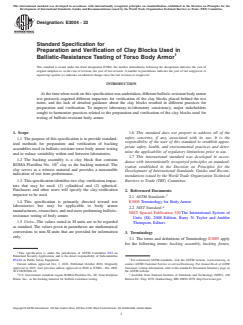
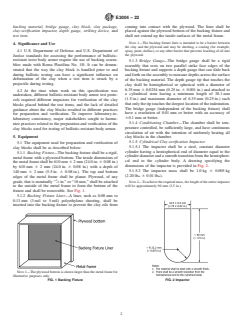
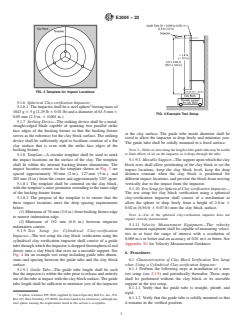
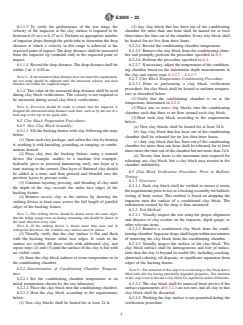
ASTM E3004-22 - Standard Specification for Preparation and Verification of Clay Blocks Used in Ballistic-Resistance Testing of Torso Body Armor
REDLINE ASTM E3004-22 - Standard Specification for Preparation and Verification of Clay Blocks Used in Ballistic-Resistance Testing of Torso Body Armor
Overview
ASTM E3004-22 is the leading international standard titled Standard Specification for Preparation and Verification of Clay Blocks Used in Ballistic-Resistance Testing of Torso Body Armor. Developed by ASTM International, this specification defines a consistent, repeatable method for preparing and verifying the clay blocks used as backing assemblies in ballistic-resistance testing. Its primary purpose is to reduce variability in test results between different laboratories, ensuring reliable assessment of body armor performance.
The standard addresses every stage of the clay block process: from preparing the backing assembly, verifying clay properties prior to testing, performing in-test verifications, to post-test procedures. The clay block, commonly made of ROMA Plastilina No. 1®, serves as a witness material, capturing deformation from non-penetrating ballistic impacts and providing critical data for evaluating body armor effectiveness.
Key Topics
Standardized Preparation of Clay Blocks
Guidance on softening, layering, pressing, and smoothing clay to achieve proper consistency and ensure uniformity.Verification Procedure
Required use of impactors (cylindrical or spherical) to create indentations, which are then measured to confirm the block’s suitability for testing.Test Equipment
Specification of essential equipment, including backing fixtures, liners, bridge gauges, conditioning chambers, striking devices, drop templates, and velocity measurement systems.Acceptance Criteria
Defined depth measurements for indentation based on impactor type, ensuring the clay's response is within strict acceptable ranges.Routine Checks and Repairs
Steps for repairing clay blocks, criteria for removing blocks from service, and verification protocols between test items and after testing, helping to maintain data integrity.Temperature Conditioning
Procedures for conditioning clay blocks at controlled temperatures prior to and during testing, enhancing consistency of test outcomes.Safety and Quality Considerations
Emphasis on safety, health, and environmental practices applicable to laboratories and testing personnel.
Applications
Ballistic-Resistance Testing of Body Armor
The core use is in evaluating torso body armor using standardized clay blocks as a backing assembly, ensuring comparable results across manufacturers, research institutes, and certification labs.Quality Assurance and Compliance
This standard facilitates compliance with U.S. Department of Defense and Department of Justice test protocols, supporting procurement and certification processes for personal protective equipment (PPE).Research and Product Development
Researchers and developers in personal protective equipment rely on ASTM E3004-22 for consistent, repeatable methodologies in body armor R&D and product validation.Laboratory Accreditation
Laboratories conducting ballistic resistance tests must adhere to E3004-22 guidelines to ensure uniformity, credibility, and recognition in their test results.
Related Standards
ASTM E3005 – Terminology for Body Armor
Provides critical definitions utilized in ballistic testing and referenced throughout E3004-22.NIST Special Publication 330 – The International System of Units (SI)
Used for measurement standards to ensure global alignment in unit usage and conversion.Regulatory Compliance Standards
U.S. Government and international standards requiring the use of specific backing materials and verification procedures for body armor performance assessment.
By implementing ASTM E3004-22, laboratories and manufacturers bolster the reliability and accuracy of ballistic-resistance testing, support regulatory compliance, and help advance the safety and effectiveness of torso body armor. This standard remains an essential reference for anyone involved in the assessment, certification, or development of ballistic-resistant PPE.
Relations
- Effective Date
- 01-Apr-2024
- Effective Date
- 01-Feb-2020
- Effective Date
- 01-Oct-2018
- Effective Date
- 01-Nov-2015
Buy Documents
ASTM E3004-22 - Standard Specification for Preparation and Verification of Clay Blocks Used in Ballistic-Resistance Testing of Torso Body Armor
REDLINE ASTM E3004-22 - Standard Specification for Preparation and Verification of Clay Blocks Used in Ballistic-Resistance Testing of Torso Body Armor
Get Certified
Connect with accredited certification bodies for this standard

CIS Institut d.o.o.
Personal Protective Equipment (PPE) certification body. Notified Body NB-2890 for EU Regulation 2016/425 PPE.

Kiwa BDA Testing
Building and construction product certification.
Kmetijski inštitut Slovenije
Agricultural Institute of Slovenia. Soil testing, plant health, agricultural product analysis.
Sponsored listings
Frequently Asked Questions
ASTM E3004-22 is a technical specification published by ASTM International. Its full title is "Standard Specification for Preparation and Verification of Clay Blocks Used in Ballistic-Resistance Testing of Torso Body Armor". This standard covers: ABSTRACT This specification describes a standardized method for preparation and verification of backing assemblies used in ballistic-resistant torso body armor testing and for reducing variability within and between laboratories. Included in this specification are the equipment used for preparation and verification of clay blocks, namely: backing fixture, backing fixture liner, bridge gauge, conditioning chamber, impactor, striking device, template, test setup, and velocity measurement equipment. This specification also covers procedures for characterization of clay block verification test setup, clay block preparation, clay block verification procedure prior to ballistic testing, clay block repair, clay block verification between test items, and clay block verification after final shot on clay block. SCOPE 1.1 The purpose of this specification is to provide standardized methods for preparation and verification of backing assemblies used in ballistic-resistant torso body armor testing and to reduce variability within and between laboratories. 1.2 The backing assembly is a clay block that contains ROMA Plastilina No. 1®2 clay as the backing material. The clay serves as a witness material and provides a measurable indication of test item performance. 1.3 This specification identifies two clay-verification impactors that may be used: (1) cylindrical and (2) spherical. Purchasers and other users will specify the clay-verification impactor to be used. 1.4 This specification is primarily directed toward test laboratories but may be applicable to body armor manufacturers, researchers, and end users performing ballistic-resistance testing of body armor. 1.5 Units—The values stated in SI units are to be regarded as standard. The values given in parentheses are mathematical conversions to non-SI units that are provided for information only. 1.6 This standard does not purport to address all of the safety concerns, if any, associated with its use. It is the responsibility of the user of this standard to establish appropriate safety, health, and environmental practices and determine the applicability of regulatory limitations prior to use. 1.7 This international standard was developed in accordance with internationally recognized principles on standardization established in the Decision on Principles for the Development of International Standards, Guides and Recommendations issued by the World Trade Organization Technical Barriers to Trade (TBT) Committee.
ABSTRACT This specification describes a standardized method for preparation and verification of backing assemblies used in ballistic-resistant torso body armor testing and for reducing variability within and between laboratories. Included in this specification are the equipment used for preparation and verification of clay blocks, namely: backing fixture, backing fixture liner, bridge gauge, conditioning chamber, impactor, striking device, template, test setup, and velocity measurement equipment. This specification also covers procedures for characterization of clay block verification test setup, clay block preparation, clay block verification procedure prior to ballistic testing, clay block repair, clay block verification between test items, and clay block verification after final shot on clay block. SCOPE 1.1 The purpose of this specification is to provide standardized methods for preparation and verification of backing assemblies used in ballistic-resistant torso body armor testing and to reduce variability within and between laboratories. 1.2 The backing assembly is a clay block that contains ROMA Plastilina No. 1®2 clay as the backing material. The clay serves as a witness material and provides a measurable indication of test item performance. 1.3 This specification identifies two clay-verification impactors that may be used: (1) cylindrical and (2) spherical. Purchasers and other users will specify the clay-verification impactor to be used. 1.4 This specification is primarily directed toward test laboratories but may be applicable to body armor manufacturers, researchers, and end users performing ballistic-resistance testing of body armor. 1.5 Units—The values stated in SI units are to be regarded as standard. The values given in parentheses are mathematical conversions to non-SI units that are provided for information only. 1.6 This standard does not purport to address all of the safety concerns, if any, associated with its use. It is the responsibility of the user of this standard to establish appropriate safety, health, and environmental practices and determine the applicability of regulatory limitations prior to use. 1.7 This international standard was developed in accordance with internationally recognized principles on standardization established in the Decision on Principles for the Development of International Standards, Guides and Recommendations issued by the World Trade Organization Technical Barriers to Trade (TBT) Committee.
ASTM E3004-22 is classified under the following ICS (International Classification for Standards) categories: 13.310 - Protection against crime; 13.340.01 - Protective equipment in general. The ICS classification helps identify the subject area and facilitates finding related standards.
ASTM E3004-22 has the following relationships with other standards: It is inter standard links to ASTM E3005-24, ASTM E3005-20, ASTM E3005-18, ASTM E3005-15. Understanding these relationships helps ensure you are using the most current and applicable version of the standard.
ASTM E3004-22 is available in PDF format for immediate download after purchase. The document can be added to your cart and obtained through the secure checkout process. Digital delivery ensures instant access to the complete standard document.
Standards Content (Sample)
This international standard was developed in accordance with internationally recognized principles on standardization established in the Decision on Principles for the
Development of International Standards, Guides and Recommendations issued by the World Trade Organization Technical Barriers to Trade (TBT) Committee.
Designation:E3004 −22
Standard Specification for
Preparation and Verification of Clay Blocks Used in
Ballistic-Resistance Testing of Torso Body Armor
This standard is issued under the fixed designation E3004; the number immediately following the designation indicates the year of
original adoption or, in the case of revision, the year of last revision. A number in parentheses indicates the year of last reapproval. A
superscript epsilon (´) indicates an editorial change since the last revision or reapproval.
INTRODUCTION
At the time when work on this specification was undertaken, different ballistic-resistant body armor
test protocols required different impactors for verification of the clay blocks placed behind the test
items, and the lack of detailed guidance about the clay blocks resulted in different practices for
preparation and verification. To improve laboratory-to-laboratory consistency, major stakeholders
sought to harmonize practices related to the preparation and verification of the clay blocks used for
testing of ballistic-resistant body armor.
1. Scope 1.6 This standard does not purport to address all of the
safety concerns, if any, associated with its use. It is the
1.1 The purpose of this specification is to provide standard-
responsibility of the user of this standard to establish appro-
ized methods for preparation and verification of backing
priate safety, health, and environmental practices and deter-
assemblies used in ballistic-resistant torso body armor testing
mine the applicability of regulatory limitations prior to use.
and to reduce variability within and between laboratories.
1.7 This international standard was developed in accor-
1.2 The backing assembly is a clay block that contains
dance with internationally recognized principles on standard-
ROMA Plastilina No. 1® clay as the backing material. The
ization established in the Decision on Principles for the
clay serves as a witness material and provides a measurable
Development of International Standards, Guides and Recom-
indication of test item performance.
mendations issued by the World Trade Organization Technical
1.3 Thisspecificationidentifiestwoclay-verificationimpac- Barriers to Trade (TBT) Committee.
tors that may be used: (1) cylindrical and (2) spherical.
Purchasers and other users will specify the clay-verification 2. Referenced Documents
impactor to be used.
2.1 ASTM Standards:
1.4 This specification is primarily directed toward test
E3005 Terminology for Body Armor
laboratories but may be applicable to body armor
2.2 NIST Standard:
manufacturers, researchers, and end users performing ballistic-
NIST Special Publication 330 The International System of
resistance testing of body armor.
Units (SI), 2008 Edition, Barry N. Taylor and Ambler
1.5 Units—The values stated in SI units are to be regarded
Thompson, Editors
as standard. The values given in parentheses are mathematical
conversions to non-SI units that are provided for information
3. Terminology
only.
3.1 The terms and definitions of Terminology E3005 apply
for the following terms: backing assembly, backing fixture,
This specification is under the jurisdiction of ASTM Committee E54 on
Homeland Security Applications and is the direct responsibility of Subcommittee
E54.04 on Public Safety Equipment. For referenced ASTM standards, visit the ASTM website, www.astm.org, or
Current edition approved Oct. 1, 2022. Published October 2022. Originally contact ASTM Customer Service at service@astm.org. For Annual Book of ASTM
approved in 2015. Last previous edition approved in 2020 as E3004 – 20a. DOI: Standards volume information, refer to the standard’s Document Summary page on
10.1520/E3004-22. the ASTM website.
2 4
U.S. Government standards require ROMA Plastilina No. 1®, from Sculpture Available from National Institute of Standards and Technology (NIST), 100
House, Inc., as the backing material for ballistic-resistance testing. Bureau Dr., Stop 1070, Gaithersburg, MD 20899-1070, http://www.nist.gov.
Copyright © ASTM International, 100 Barr Harbor Drive, PO Box C700, West Conshohocken, PA 19428-2959. United States
E3004−22
backing material, bridge gauge, clay block, clay package, coming into contact with the plywood. The liner shall be
clay-verification impactor, depth gauge, striking device, and placed against the plywood bottom of the backing fixture and
test item. shall not extend up the inside surfaces of the metal frame.
NOTE 1—The backing fixture liner is intended to be a barrier between
4. Significance and Use
the clay and the plywood and may be sheeting, a coating (for example,
4.1 U.S. Department of Defense and U.S. Department of
spray, paint, shellac), or any other barrier that prevents leaching of oil into
the plywood.
Justice standards for assessing the performance of ballistic-
resistant torso body armor require the use of backing assem-
5.1.3 Bridge Gauge—The bridge gauge shall be a rigid
blies made with Roma Plastilina No. 1®. It can be demon-
assembly that rests on two parallel strike face edges of the
strated that the way the clay block is handled prior to and
backing fixture and supports a depth gauge that can slide back
during ballistic testing can have a significant influence on
and forth on the assembly to measure depths across the surface
deformation of the clay when a test item is struck by a
of the backing material. The depth gauge tip that touches the
projectile during testing.
clay shall be hemispherical or spherical with a diameter of
6.35 mm 6 0.0254 mm (0.25 in. 6 0.001 in.) and attached to
4.2 At the time when work on this specification was
a cylindrical stem having a minimum length of 38.1 mm
undertaken, different ballistic-resistant body armor test proto-
(1.5 in.) and maximum diameter of 6.35 mm (0.25 in.) such
cols required different impactors for verification of the clay
thatonlythetiptouchesthedeepestlocationoftheindentation.
blocks placed behind the test items, and the lack of detailed
The bridge gauge (independent of the backing fixture) shall
guidance about the clay blocks resulted in different practices
have a resolution of 0.01 mm or better with an accuracy of
for preparation and verification. To improve laboratory-to-
60.1 mm or better.
laboratory consistency, major stakeholders sought to harmo-
5.1.4 Conditioning Chamber—The chamber shall be tem-
nize practices related to the preparation and verification of the
perature controlled, be sufficiently large, and have continuous
clay blocks used for testing of ballistic-resistant body armor.
circulation of air with the intention of uniformly heating all
5. Equipment
clay blocks in the chamber.
5.1.5 Cylindrical Clay-verification Impactor:
5.1 The equipment used for preparation and verification of
5.1.5.1 The impactor shall be a steel, constant diameter
clay blocks shall be as described below:
cylinder having a hemispherical end of diameter equal to the
5.1.1 Backing Fixture—The backing fixture shall be a rigid,
cylinderdiameterandasmoothtransitionfromthehemispheri-
metal frame with a plywood bottom. The inside dimensions of
cal end to the cylinder body. A drawing specifying the
the metal frame shall be 610 mm 6 2 mm (24.0 in. 6 0.08 in.)
dimensions of the impactor is provided in Fig. 2.
by 610 mm 6 2 mm (24.0 in. 6 0.08 in.) with a depth of
5.1.5.2 The impactor mass shall be 1.0 kg 6 0.005 kg
140 mm 6 2 mm (5.5 in. 6 0.08 in.). The top and bottom
(2.20 lb 6 0.01 lb ).
m m
edges of the metal frame shall be planar. Plywood, of any
grade, that is nominally “ ⁄4 in.” or “18 mm,” shall be attached
NOTE2—Toachievetherequiredmass,thelengthoftheentireimpactor
to the outside of the metal frame to form the bottom of the will be approximately 90 mm (3.5 in.).
fixture and shall be removable. See Fig. 1.
5.1.2 Backing Fixture Liner—A liner, such as 0.08 mm to
0.13 mm (3 mil to 5 mil) polyethylene sheeting, shall be
inserted into the backing fixture to prevent the clay oils from
NOTE 1—The plywood bottom is shown larger than the metal frame for
illustrative purposes only.
FIG. 1Backing Fixture FIG. 2Impactor
E3004−22
FIG. 3Template for Impact Locations
5.1.6 Spherical Clay-verification Impactor:
5.1.6.1 The impactor shall be a steel sphere having mass of
1043 g 6 5 g (2.29 lb 6 0.01 lb) and a diameter of 63.5 mm 6
FIG. 4Example Test Setup
0.05 mm (2.5 in. 6 0.001 in.).
5.1.7 Striking Device—The striking device shall be a metal,
straight-edged blade capable of spanning two parallel strike
face edges of the backing fixture so that the backing fixture
at the clay surface. The guide tube inside diameter shall be
serves as the reference for the clay block surface. The striking
sized to allow the impactor to drop freely and minimize yaw.
device shall be sufficiently rigid to facilitate creation of a flat
The guide tube shall be solidly mounted to a fixed surface.
clay surface that is even with the strike face edges of the
backing fixture. NOTE3—Holesorslotsalongthelengthoftheguidetubemaybeuseful
to limit effects of air on the impactor as it drops through the tube.
5.1.8 Template—A circular template shall be used to mark
the impact locations on the surface of the clay. The template
5.1.9.2 Movable Support—The support upon which the clay
shall fit within the internal backing fixture dimensions. The block rests shall allow positioning of the clay block to set the
impact location centers on the template shown in Fig. 3 are
impact locations, keep the clay block level, keep the drop
spaced approximately 50 mm (2 in.), 127 mm (5 in.), and distance constant when the clay block is positioned for
203 mm (8 in.) from the center and approximately 120° apart.
different impact locations, and prevent the block from moving
5.1.8.1 The template shall be centered on the clay block, vertically due to the impact from the impactor.
with the template’s outer perimeter extending to the inner edge
5.1.10 Test Setup for Spherical Clay-verification Impactor—
of the backing fixture frame. The test setup for clay block verification using a spherical
5.1.8.2 The purpose of the template is to ensure that the
clay-verification impactor shall consist of a mechanism to
three impact locations meet the drop spacing requirements allow the sphere to drop freely from a height of 2.0 m 6
below:
0.02 m (6.56 ft 6 0.07 ft) onto the clay block surface.
(1) Minimum of 76 mm (3.0 in.) from backing fixture edge
NOTE 4—Use of the spherical clay-verification impactor does not
to nearest indentation edge.
require velocity measurement.
(2) Minimum of 152 mm (6.0 in.) between impactor
5.1.11 Velocity Measurement Equipment—The velocity
indentation centers.
measurement equipment shall be capable of measuring veloci-
5.1.9 Test Setup for Cylindrical Clay-verification
ties in at least the range of interest with a resolution of
Impactor—The test setup for clay block verification using the
0.005 m⁄s or better and an accuracy of 0.01 m⁄s or better. See
cylindrical clay-verification impactor shall consist of a guide
Appendix X1 for Velocity Measurement Guidance.
tubethroughwhichtheimpactorisdropped(hemisphericalend
down) onto a clay block that rests on a movable support. See
6. Procedures
Fig. 4 for an example test setup including guide tube dimen-
sions and spacing between the guide tube and the clay block 6.1 Characterization of Clay Block Verification Test Setup
when Using a Cylindrical Clay-verification Impactor:
surface.
5.1.9.1 Guide Tube—The guide tube length shall be such 6.1.1 Perform the following steps at installation of a new
test setup (see 5.1.9) and periodically thereafter. These steps
that the impactor is within the tube prior to release and entirely
out of the tube at impact with the clay block surface.The guide shall be performed without the clay block or its movable
support in the test setup.
tube length shall be sufficient to minimize yaw of the impactor
6.1.1.1 Verify that the guide tube is straight, plumb, and
rigid.
Asphere, reference P/N 3606, supplied by Salem Specialty Ball Co., Inc., P.O.
6.1.1.2 Verify that the guide tube is solidly mounted so that
Box 145,West Simsbury, CT06092, has been found to be satisfactory, although any
steel sphere meeting the requirements listed in this section is acceptable. it remains in the verified position.
E3004−22
6.1.1.3 To verify the performance of the test setup, the (2) Any clay block that has been out of the conditioning
velocity of the impactor at the clay surface is required to be chamber for more than one hour shall be heated for at least
between 6.15 m⁄s to 6.27 m⁄s. Perform an appropriate number three times the time out of the chamber. Every clay block shall
of impactor drops through the guide tube to determine the drop be heated for no less than three hours.
distance at which a velocity in this range is achieved at the 6.2.2.4 Record the conditioning chamber temperature.
expected point of impact. The drop distance shall be measured 6.2.2.5 Remove the clay block from the conditioning cham-
from the impactor tip (rounded end) to the expected point of ber and promptly perform the procedure specified in 6.3.
impact. 6.2.2.6 Perform the procedure specified in 6.4.
6.1.1.4 Record the drop distance. The drop distance shall be
6.2.2.7 If necessary, adjust the temperature of the condition-
within 2 m 6 0.02 m. ing chamber based on the indentation depth measurements in
the clay and repeat steps 6.2.2.2 – 6.2.2.7.
NOTE 5—If the measured drop distance does not meet this requirement,
6.2.3 Clay Block Temperature Conditioning Procedure:
the test setup should be adjusted until the measured velocity and drop
distance are within the required ranges. 6.2.3.1 Prior to performing a clay block verification
procedure, the clay block shall be heated to uniform tempera-
6.1.2 The value of the measured drop distance shall be used
ture as described below:
during clay block verifications. The velocity is not required to
(1) Verify that the conditioning chamber is set to the
be measured during actual clay block verifications.
temperature determined in 6.2.2.
NOTE 6—Provision should be made to ensure that the impactor is
(2) Place one or more clay blocks into the conditioning
dropped the determined drop distance each time, such as by the use of a
chamber such that there is air flow around each clay block.
hard stop at the top of the guide tube.
(3) Heat each clay block according to the requirements
6.2 Clay Block Preparation Procedures:
below:
6.2.1 New Clay Block Assembly:
(a) New clay blocks shall be heated for at least 24 h.
6.2.1.1 Fill the backing fixture with clay following the steps
(b) Any clay block that has been out of the conditioning
below:
chamber shall be reheated for no less than three hours.
(1) Open each clay package, and soften the clay by heating
(c) Any clay block that has been out of the conditioning
it; working it with kneading, pounding, or tamping; or combi-
chamber for more than one hour shall be reheated for at least
...
This document is not an ASTM standard and is intended only to provide the user of an ASTM standard an indication of what changes have been made to the previous version. Because
it may not be technically possible to adequately depict all changes accurately, ASTM recommends that users consult prior editions as appropriate. In all cases only the current version
of the standard as published by ASTM is to be considered the official document.
Designation: E3004 − 20a E3004 − 22
Standard Specification for
Preparation and Verification of Clay Blocks Used in
Ballistic-Resistance Testing of Torso Body Armor
This standard is issued under the fixed designation E3004; the number immediately following the designation indicates the year of
original adoption or, in the case of revision, the year of last revision. A number in parentheses indicates the year of last reapproval. A
superscript epsilon (´) indicates an editorial change since the last revision or reapproval.
INTRODUCTION
At the time when work on this specification was undertaken, different ballistic-resistant body armor
test protocols required different impactors for verification of the clay blocks placed behind the test
items, and the lack of detailed guidance about the clay blocks resulted in different practices for
preparation and verification. To improve laboratory-to-laboratory consistency, major stakeholders
sought to harmonize practices related to the preparation and verification of the clay blocks used for
testing of ballistic-resistant body armor.
1. Scope
1.1 The purpose of this specification is to provide standardized methods for preparation and verification of backing assemblies
used in ballistic-resistant torso body armor testing and to reduce variability within and between laboratories.
1.2 The backing assembly is a clay block that contains ROMA Plastilina No. 1® clay as the backing material. The clay serves
as a witness material and provides a measurable indication of test item performance.
1.3 This specification identifies two clay-verification impactors that may be used: (1) cylindrical and (2) spherical. Purchasers and
other users will specify the clay-verification impactor to be used.
1.4 This specification is primarily directed toward test laboratories but may be applicable to body armor manufacturers,
researchers, and end users performing ballistic-resistance testing of body armor.
1.5 Units—The values stated in SI units are to be regarded as standard. The values given in parentheses are mathematical
conversions to non-SI units that are provided for information only.
1.6 This standard does not purport to address all of the safety concerns, if any, associated with its use. It is the responsibility
of the user of this standard to establish appropriate safety, health, and environmental practices and determine the applicability of
regulatory limitations prior to use.
1.7 This international standard was developed in accordance with internationally recognized principles on standardization
established in the Decision on Principles for the Development of International Standards, Guides and Recommendations issued
by the World Trade Organization Technical Barriers to Trade (TBT) Committee.
This specification is under the jurisdiction of ASTM Committee E54 on Homeland Security Applications and is the direct responsibility of Subcommittee E54.04 on
Personal ProtectivePublic Safety Equipment (PPE).
Current edition approved July 1, 2020Oct. 1, 2022. Published July 2020October 2022. Originally approved in 2015. Last previous edition approved in 2020 as
E3004 – 20.E3004 – 20a. DOI: 10.1520/E3004-20A.10.1520/E3004-22.
U.S. Government standards require ROMA Plastilina No. 1®, from Sculpture House, Inc., as the backing material for ballistic-resistance testing.
Copyright © ASTM International, 100 Barr Harbor Drive, PO Box C700, West Conshohocken, PA 19428-2959. United States
E3004 − 22
2. Referenced Documents
2.1 ASTM Standards:
E3005 Terminology for Body Armor
2.2 NIST Standard:
NIST Special Publication 330 The International System of Units (SI), 2008 Edition, Barry N. Taylor and Ambler Thompson,
Editors
3. Terminology
3.1 The terms and definitions of Terminology E3005 apply for the following terms: backing assembly, backing fixture, backing
material, bridge gauge, clay block, clay package, clay-verification impactor, depth gauge, striking device, and test item.
4. Significance and Use
4.1 U.S. Department of Defense and U.S. Department of Justice standards for assessing the performance of ballistic-resistant torso
body armor require the use of backing assemblies made with Roma Plastilina No. 1®. It can be demonstrated that the way the clay
block is handled prior to and during ballistic testing can have a significant influence on deformation of the clay when a test item
is struck by a projectile during testing.
4.2 At the time when work on this specification was undertaken, different ballistic-resistant body armor test protocols required
different impactors for verification of the clay blocks placed behind the test items, and the lack of detailed guidance about the clay
blocks resulted in different practices for preparation and verification. To improve laboratory-to-laboratory consistency, major
stakeholders sought to harmonize practices related to the preparation and verification of the clay blocks used for testing of
ballistic-resistant body armor.
5. Equipment
5.1 The equipment used for preparation and verification of clay blocks shall be as described below:
5.1.1 Backing Fixture—The backing fixture shall be a rigid, metal frame with a plywood bottom. The inside dimensions of the
metal frame shall be 610610 mm 6 2 mm (24.0(24.0 in. 6 0.08 in.) 0.08 in.) by 610610 mm 6 2 mm (24.0(24.0 in. 6 0.08 in.)
with a depth of 140 6 2 mm (5.5 6 0.08 in.). 140 mm 6 2 mm (5.5 in. 6 0.08 in.). The top and bottom edges of the metal frame
shall be planar. Plywood, of any grade, that is nominally “ ⁄4 in.” or “18 mm,” in.” or “18 mm,” shall be attached to the outside
of the metal frame to form the bottom of the fixture and shall be removable. See Fig. 1.
5.1.2 Backing Fixture Liner—A liner, such as 0.08 to 0.13 mm (3 to 5 mil) 0.08 mm to 0.13 mm (3 mil to 5 mil) polyethylene
sheeting, shall be inserted into the backing fixture to prevent the clay oils from coming into contact with the plywood. The liner
shall be placed against the plywood bottom of the backing fixture and shall not extend up the inside surfaces of the metal frame.
NOTE 1—The plywood bottom is shown larger than the metal frame for illustrative purposes only.
FIG. 1 Backing Fixture
For referenced ASTM standards, visit the ASTM website, www.astm.org, or contact ASTM Customer Service at service@astm.org. For Annual Book of ASTM Standards
volume information, refer to the standard’s Document Summary page on the ASTM website.
Available from National Institute of Standards and Technology (NIST), 100 Bureau Dr., Stop 1070, Gaithersburg, MD 20899-1070, http://www.nist.gov.
E3004 − 22
NOTE 1—The backing fixture liner is intended to be a barrier between the clay and the plywood and may be sheeting, a coating (for example, spray, paint,
shellac), or any other barrier that prevents leaching of oil into the plywood.
5.1.3 Bridge Gauge—The bridge gauge shall be a rigid assembly that rests on two parallel strike face edges of the backing fixture
and supports a depth gauge that can slide back and forth on the assembly to measure depths across the surface of the backing
material. The depth gauge tip that touches the clay shall be hemispherical or spherical with a diameter of 6.35 6 0.0254 mm (0.25
6 0.001 in.) 6.35 mm 6 0.0254 mm (0.25 in. 6 0.001 in.) and attached to a cylindrical stem having a minimum length of 38.1
mm (1.5 in.) 38.1 mm (1.5 in.) and maximum diameter of 6.35 mm (0.25 in.) 6.35 mm (0.25 in.) such that only the tip touches the
deepest location of the indentation. The bridge gauge (independent of the backing fixture) shall have a resolution of 0.01 mm
0.01 mm or better with an accuracy of 60.1 mm or better.
5.1.4 Conditioning Chamber—The chamber shall be temperature controlled, be sufficiently large, and have continuous circulation
of air with the intention of uniformly heating all clay blocks in the chamber.
5.1.5 Cylindrical Clay-verification Impactor:
5.1.5.1 The impactor shall be a steel, constant diameter cylinder having a hemispherical end of diameter equal to the cylinder
diameter and a smooth transition from the hemispherical end to the cylinder body. A drawing specifying the dimensions of the
impactor is provided in Fig. 2.
5.1.5.2 The impactor mass shall be 1.01.0 kg 6 0.005 kg0.005 kg (2.20 lb (2.20 6 0.01 lb0.01 lb ).
m m
NOTE 2—To achieve the required mass, the length of the entire impactor will be approximately 90 mm (3.5 in.).
FIG. 2 Impactor
E3004 − 22
FIG. 3 Template for Impact Locations
5.1.6 Spherical Clay-verification Impactor:
5.1.6.1 The impactor shall be a steel sphere having mass of 1043 6 5 g (2.29 6 0.01 lb) 1043 g 6 5 g (2.29 lb 6 0.01 lb) and
a diameter of 63.5 6 0.05 mm (2.5 6 0.001 in.).63.5 mm 6 0.05 mm (2.5 in. 6 0.001 in.).
5.1.7 Striking Device—The striking device shall be a metal, straight-edged blade capable of spanning two parallel strike face edges
of the backing fixture so that the backing fixture serves as the reference for the clay block surface. The striking device shall be
sufficiently rigid to facilitate creation of a flat clay surface that is even with the strike face edges of the backing fixture.
5.1.8 Template—A circular template shall be used to mark the impact locations on the surface of the clay. The template shall fit
within the internal backing fixture dimensions. The impact location centers on the template shown in Fig. 3 are spaced
approximately 50 mm (2 in.), 127 mm (5 in.), and 203 mm (8 in.) 50 mm (2 in.), 127 mm (5 in.), and 203 mm (8 in.) from the
center and approximately 120° apart.
5.1.8.1 The template shall be centered on the clay block, with the template’s outer perimeter extending to the inner edge of the
backing fixture frame.
5.1.8.2 The purpose of the template is to ensure that the three impact locations meet the drop spacing requirements below:
(1) Minimum of 76 mm (3.0 in.) from backing fixture edge to nearest indentation edge.
(2) Minimum of 152 mm (6.0 in.) between impactor indentation centers.
5.1.9 Test Setup for Cylindrical Clay-verification Impactor—The test setup for clay block verification using the cylindrical
clay-verification impactor shall consist of a guide tube through which the impactor is dropped (hemispherical end down) onto a
clay block that rests on a movable support. See Fig. 4 for an example test setup including guide tube dimensions and spacing
between the guide tube and the clay block surface.
5.1.9.1 Guide Tube—The guide tube length shall be such that the impactor is within the tube prior to release and entirely out of
the tube at impact with the clay block surface. The guide tube length shall be sufficient to minimize yaw of the impactor at the
clay surface. The guide tube inside diameter shall be sized to allow the impactor to drop freely and minimize yaw. The guide tube
shall be solidly mounted to a fixed surface.
NOTE 3—Holes or slots along the length of the guide tube may be useful to limit effects of air on the impactor as it drops through the tube.
5.1.9.2 Movable Support—The support upon which the clay block rests shall allow positioning of the clay block to set the impact
locations, keep the clay block level, keep the drop distance constant when the clay block is positioned for different impact
locations, and prevent the block from moving vertically due to the impact from the impactor.
A sphere, reference P/N 3606, supplied by Salem Specialty Ball Co., Inc., P.O. Box 145, West Simsbury, CT 06092, has been found to be satisfactory, although any steel
sphere meeting the requirements listed in this section is acceptable.
E3004 − 22
FIG. 4 Example Test Setup
5.1.10 Test Setup for Spherical Clay-verification Impactor—The test setup for clay block verification using a spherical
clay-verification impactor shall consist of a mechanism to allow the sphere to drop freely from a height of 2.0 6 0.02 m (6.56 6
0.07 ft) 2.0 m 6 0.02 m (6.56 ft 6 0.07 ft) onto the clay block surface.
NOTE 4—Use of the spherical clay-verification impactor does not require velocity measurement.
5.1.11 Velocity Measurement Equipment—The velocity measurement equipment shall be capable of measuring velocities in at
least the range of interest with a resolution of 0.0050.005 m m/s ⁄s or better and an accuracy of 0.010.01 m m/s ⁄s or better. See
Appendix X1 for Velocity Measurement Guidance.
6. Procedures
6.1 Characterization of Clay Block Verification Test Setup when Using a Cylindrical Clay-verification Impactor:
6.1.1 Perform the following steps at installation of a new test setup (see 5.1.9) and periodically thereafter. These steps shall be
performed without the clay block or its movable support in the test setup.
6.1.1.1 Verify that the guide tube is straight, plumb, and rigid.
6.1.1.2 Verify that the guide tube is solidly mounted so that it remains in the verified position.
6.1.1.3 To verify the performance of the test setup, the velocity of the impactor at the clay surface is required to be between
6.156.15 m ⁄s to 6.276.27 m m/s. ⁄s. Perform an appropriate number of impactor drops through the guide tube to determine the drop
distance at which a velocity in this range is achieved at the expected point of impact. The drop distance shall be measured from
the impactor tip (rounded end) to the expected point of impact.
6.1.1.4 Record the drop distance. The drop distance shall be within 22 m 6 0.02 m.0.02 m.
NOTE 5—If the measured drop distance does not meet this requirement, the test setup should be adjusted until the measured velocity and drop distance
are within the required ranges.
6.1.2 The value of the measured drop distance shall be used during clay block verifications. The velocity is not required to be
measured during actual clay block verifications.
NOTE 6—Provision should be made to ensure that the impactor is dropped the determined drop distance each time, such as by the use of a hard stop at
the top of the guide tube.
E3004 − 22
6.2 Clay Block Preparation Procedures:
6.2.1 New Clay Block Assembly:
6.2.1.1 Fill the backing fixture with clay following the steps below:
(1) Open each clay package, and soften the clay by heating it; working it with kneading, pounding, or tamping; or combinations
thereof.
(2) Press clay into the backing fixture, using a manual device (for example, mallet) or a machine (for example, hydraulic press
or powered hammering tool), one layer at a time starting in the corners. One layer of flattened clay should be added at a time, and
then pressed and blended into the previous layers to prevent voids.
(3) Continue layering, pressing, and blending of clay until the depth of the clay exceeds the strike face edges of the backing
fixture.
(4) Remove excess clay at the surface by drawing the striking device at least once across the full length of parallel edges of
the backing fixture.
NOTE 7—The striking device should be drawn across the same edges that the bridge gauge rests on during measuring and should be drawn in the same
direction every time.
NOTE 8—If the striking device is drawn more than once and in orthogonal directions, the resultant clay surface must be planar.
(5) Visually verify that the clay surface is flat and flush with the backing fixture strike face edges. If voids in the surface are
visible, fill those voids with additional clay, and repeat steps (4) and (5) until the surface of the clay is flat with no visible voids.
(6) Store the clay block indoors at room temperature or in the conditioning chamber.
6.2.2 Determination of Co
...