

ASTM D4822-88(2019)
(Guide)Standard Guide for Selection of Methods of Particle Size Analysis of Fluvial Sediments (Manual Methods)
General Information
- Abstract
SIGNIFICANCE AND USE
5.1 This guide is general and useful in helping the user to determine an appropriate manual test method for determining the particle size distribution of fluvial sediments. The suggested test methods are not described in this guide, but references are given so that the user may obtain more information about each test method.
5.2 It should be noted that different test methods may and often times do produce different particle size distributions for the same sample. This is due in part to the different test methods requiring native or distilled water, differences in dispersion methods used, and differences in what the test method is measuring, that is, physical or sedimentation diameter.
SCOPE
1.1 This guide covers the selection of methods for determining the size distribution of fluvial sediments particles in the range greater than 0.45 μm using manual methods. Manual methods are defined as those methods that require the operator to do some actual measurements and calculations. An automated method would be one which, after the sample is prepared and inserted into an instrument, the instrument (machine) does the measuring and calculations, not the operator. Not all manual methods are presented in this guide. However, where available, at least two methods for each particle size range are given.
1.2 The values stated in SI units are to be regarded as standard. No other units of measurement are included in this standard.
1.3 This standard does not purport to address all of the safety concerns, if any, associated with its use. It is the responsibility of the user of this standard to establish appropriate safety, health, and environmental practices and determine the applicability of regulatory limitations prior to use.
1.4 This international standard was developed in accordance with internationally recognized principles on standardization established in the Decision on Principles for the Development of International Standards, Guides and Recommendations issued by the World Trade Organization Technical Barriers to Trade (TBT) Committee.
- Status
- Published
- Publication Date
- 31-Oct-2019
- Technical Committee
- D19 - Water
- Drafting Committee
- D19.07 - Sediments, Geomorphology, and Open-Channel Flow


Overview
ASTM D4822-88(2019), Standard Guide for Selection of Methods of Particle Size Analysis of Fluvial Sediments (Manual Methods), provides guidance on selecting appropriate manual methods for determining the particle size distribution of fluvial sediments. Applicable to sediment particles greater than 0.45 μm, this standard is essential for environmental scientists, engineers, and laboratory technicians tasked with analyzing sediment characteristics in water environments, especially rivers and streams.
The guide is designed to help users identify the relevant manual test methods, referencing authoritative sources for more detailed procedural information. Developed under internationally recognized principles, ASTM D4822 ensures harmonized approaches in the analysis and reporting of sediment particle size, fostering consistency across related projects and studies.
Key Topics
- Manual Methods for Particle Size Analysis: The guide differentiates between manual and automated methods. Manual methods require operator involvement in measurements and calculations, while automated methods rely on instrument-driven analysis post sample preparation.
- Range of Analysis: Covers particle sizes greater than 0.45 μm, including clay, silt, sand, gravel, cobbles, and boulders.
- Selection Process: Offers a structured approach for choosing methods based on sample particle size range and desired reporting units (such as percent by mass, number, or volume).
- Method Variability: Highlights that different test methods may yield different results for the same sample, due to factors like water source, dispersion techniques, and what the method measures (physical size vs. sedimentation diameter).
- Sampling Guidelines: Recommends collecting samples in accordance with ASTM D4411 or equivalent field methods to ensure representativeness and reliability.
- Precision and Bias: Notes that each manual method has unique precision ranges and biases; users are encouraged to consult referenced documents for specific performance characteristics.
Applications
- Riverine and Streambed Studies: Used by hydrologists and geomorphologists to quantify sediment composition in flowing water bodies.
- Environmental Impact Assessments: Supports sediment analysis in studies investigating pollution, dredging activities, or habitat restoration.
- Infrastructure Projects: Critical for civil engineers designing bridges, dams, and other structures where understanding sediment dynamics is essential for risk assessment and planning.
- Academic Research: Serves universities and research institutions involved in the physical characterization of waterborne sediments.
- Regulatory Compliance: Facilitates environmental monitoring programs that track sediment transport and deposition trends for compliance with local, national, or international guidelines.
Related Standards
- ASTM D4411 - Guide for Sampling Fluvial Sediment in Motion: Provides methods for obtaining representative sediment samples from active flows.
- ASTM D4410 - Terminology for Fluvial Sediment: Offers definitions and terms used throughout sediment analysis literature.
- ASTM D1129 - Terminology Relating to Water: A reference for water-related terminology in environmental and laboratory standards.
- ASTM D422 (Withdrawn 2016) - Test Method for Particle-Size Analysis of Soils: Previously used for soil and sediment grading, still referenced for historical context.
- ASTM E20 (Withdrawn 1994) - Practice for Particle Size Analysis by Optical Microscopy: Relevant for specific microscopic analysis protocols.
- Referenced Manuals: Includes a range of authoritative references from the U.S. Geological Survey and water resources committees, detailing field and laboratory techniques for particle size measurement.
Practical Value
By helping users select the most suitable manual methods for particle size analysis of fluvial sediments, ASTM D4822-88(2019) ensures accurate and repeatable results. Consistent adherence to this standard enables reliable sediment characterization for environmental evaluations, engineering designs, and scientific research. Its cross-reference system streamlines access to detailed procedures, enhancing both efficiency and data quality in sediment analysis workflows.
Keywords: ASTM D4822, particle size analysis, fluvial sediments, manual methods, sediment characterization, river sediment analysis, water quality standards, ASTM sediment standard.
Relations
- Effective Date
- 01-Nov-2019
- Effective Date
- 01-May-2020
- Effective Date
- 01-Nov-2019
- Effective Date
- 01-Jan-2016
- Effective Date
- 01-Jan-2014
- Effective Date
- 01-Jan-2014
- Effective Date
- 01-Mar-2010
- Effective Date
- 01-Feb-2010
- Effective Date
- 01-Oct-2008
- Effective Date
- 15-Oct-2007
- Refers
ASTM D422-63(2007)e2 - Standard Test Method for Particle-Size Analysis of Soils (Withdrawn 2016) - Effective Date
- 15-Oct-2007
- Effective Date
- 01-Sep-2006
- Effective Date
- 01-Sep-2006
- Effective Date
- 15-Feb-2006
- Effective Date
- 01-Mar-2004
Get Certified
Connect with accredited certification bodies for this standard

CIS Institut d.o.o.
Personal Protective Equipment (PPE) certification body. Notified Body NB-2890 for EU Regulation 2016/425 PPE.

Kiwa BDA Testing
Building and construction product certification.
Kmetijski inštitut Slovenije
Agricultural Institute of Slovenia. Soil testing, plant health, agricultural product analysis.
Sponsored listings
Frequently Asked Questions
ASTM D4822-88(2019) is a guide published by ASTM International. Its full title is "Standard Guide for Selection of Methods of Particle Size Analysis of Fluvial Sediments (Manual Methods)". This standard covers: SIGNIFICANCE AND USE 5.1 This guide is general and useful in helping the user to determine an appropriate manual test method for determining the particle size distribution of fluvial sediments. The suggested test methods are not described in this guide, but references are given so that the user may obtain more information about each test method. 5.2 It should be noted that different test methods may and often times do produce different particle size distributions for the same sample. This is due in part to the different test methods requiring native or distilled water, differences in dispersion methods used, and differences in what the test method is measuring, that is, physical or sedimentation diameter. SCOPE 1.1 This guide covers the selection of methods for determining the size distribution of fluvial sediments particles in the range greater than 0.45 μm using manual methods. Manual methods are defined as those methods that require the operator to do some actual measurements and calculations. An automated method would be one which, after the sample is prepared and inserted into an instrument, the instrument (machine) does the measuring and calculations, not the operator. Not all manual methods are presented in this guide. However, where available, at least two methods for each particle size range are given. 1.2 The values stated in SI units are to be regarded as standard. No other units of measurement are included in this standard. 1.3 This standard does not purport to address all of the safety concerns, if any, associated with its use. It is the responsibility of the user of this standard to establish appropriate safety, health, and environmental practices and determine the applicability of regulatory limitations prior to use. 1.4 This international standard was developed in accordance with internationally recognized principles on standardization established in the Decision on Principles for the Development of International Standards, Guides and Recommendations issued by the World Trade Organization Technical Barriers to Trade (TBT) Committee.
SIGNIFICANCE AND USE 5.1 This guide is general and useful in helping the user to determine an appropriate manual test method for determining the particle size distribution of fluvial sediments. The suggested test methods are not described in this guide, but references are given so that the user may obtain more information about each test method. 5.2 It should be noted that different test methods may and often times do produce different particle size distributions for the same sample. This is due in part to the different test methods requiring native or distilled water, differences in dispersion methods used, and differences in what the test method is measuring, that is, physical or sedimentation diameter. SCOPE 1.1 This guide covers the selection of methods for determining the size distribution of fluvial sediments particles in the range greater than 0.45 μm using manual methods. Manual methods are defined as those methods that require the operator to do some actual measurements and calculations. An automated method would be one which, after the sample is prepared and inserted into an instrument, the instrument (machine) does the measuring and calculations, not the operator. Not all manual methods are presented in this guide. However, where available, at least two methods for each particle size range are given. 1.2 The values stated in SI units are to be regarded as standard. No other units of measurement are included in this standard. 1.3 This standard does not purport to address all of the safety concerns, if any, associated with its use. It is the responsibility of the user of this standard to establish appropriate safety, health, and environmental practices and determine the applicability of regulatory limitations prior to use. 1.4 This international standard was developed in accordance with internationally recognized principles on standardization established in the Decision on Principles for the Development of International Standards, Guides and Recommendations issued by the World Trade Organization Technical Barriers to Trade (TBT) Committee.
ASTM D4822-88(2019) is classified under the following ICS (International Classification for Standards) categories: 13.060.60 - Examination of physical properties of water. The ICS classification helps identify the subject area and facilitates finding related standards.
ASTM D4822-88(2019) has the following relationships with other standards: It is inter standard links to ASTM D4822-88(2014), ASTM D1129-13(2020)e2, ASTM D4411-03(2019), ASTM D4410-16, ASTM D4411-03(2014)e1, ASTM D4411-03(2014), ASTM D1129-10, ASTM D4410-10, ASTM D4411-03(2008), ASTM D422-63(2007), ASTM D422-63(2007)e2, ASTM D1129-06a, ASTM D1129-06ae1, ASTM D1129-06, ASTM D1129-04e1. Understanding these relationships helps ensure you are using the most current and applicable version of the standard.
ASTM D4822-88(2019) is available in PDF format for immediate download after purchase. The document can be added to your cart and obtained through the secure checkout process. Digital delivery ensures instant access to the complete standard document.
Standards Content (Sample)
This international standard was developed in accordance with internationally recognized principles on standardization established in the Decision on Principles for the
Development of International Standards, Guides and Recommendations issued by the World Trade Organization Technical Barriers to Trade (TBT) Committee.
Designation: D4822 − 88 (Reapproved 2019)
Standard Guide for
Selection of Methods of Particle Size Analysis of Fluvial
Sediments (Manual Methods)
This standard is issued under the fixed designation D4822; the number immediately following the designation indicates the year of
original adoption or, in the case of revision, the year of last revision. A number in parentheses indicates the year of last reapproval. A
superscript epsilon (´) indicates an editorial change since the last revision or reapproval.
1. Scope D422 Test Method for Particle-SizeAnalysis of Soils (With-
drawn 2016)
1.1 This guide covers the selection of methods for deter-
D1129 Terminology Relating to Water
mining the size distribution of fluvial sediments particles in the
D4410 Terminology for Fluvial Sediment
range greater than 0.45 µm using manual methods. Manual
D4411 Guide for Sampling Fluvial Sediment in Motion
methods are defined as those methods that require the operator
E20 Practice for Particle Size Analysis of Particulate Sub-
to do some actual measurements and calculations. An auto-
stances in the Range of 0.2 to 75 Micrometres by Optical
mated method would be one which, after the sample is
Microscopy (Withdrawn 1994)
prepared and inserted into an instrument, the instrument
(machine) does the measuring and calculations, not the opera-
3. Terminology
tor. Not all manual methods are presented in this guide.
3.1 Definitions:
However, where available, at least two methods for each
3.1.1 For definitions of terms used in this standard, refer to
particle size range are given.
Terminologies D1129 and D4410.
1.2 The values stated in SI units are to be regarded as
3.2 Definitions of Terms Specific to This Standard:
standard. No other units of measurement are included in this
3.2.1 particle count, n—a method of particle size analysis in
standard.
which the number of particles in the various size ranges are
1.3 This standard does not purport to address all of the
counted manually.
safety concerns, if any, associated with its use. It is the
3.2.2 particle size, n—the diameter, usually the intermediate
responsibility of the user of this standard to establish appro-
diameter, of a particle measured by settling, sieving,
priate safety, health, and environmental practices and deter-
micrometric, or direct measurement methods (see 5.2).
mine the applicability of regulatory limitations prior to use.
3.2.3 particle size distribution, n—the relative amount of a
1.4 This international standard was developed in accor-
sediment sample in a range of specific sizes in terms of
dance with internationally recognized principles on standard-
percentages by mass, volume, or number, finer than a given
ization established in the Decision on Principles for the
particle size.
Development of International Standards, Guides and Recom-
mendations issued by the World Trade Organization Technical
4. Summary of Guide
Barriers to Trade (TBT) Committee.
4.1 This guide consists of suggested manual test methods
2. Referenced Documents
for analyzing fluvial sediment samples for particle size distri-
2 bution.
2.1 ASTM Standards:
5. Significance and Use
5.1 This guide is general and useful in helping the user to
determine an appropriate manual test method for determining
This guide is under the jurisdiction of ASTM Committee D19 on Water and is the particle size distribution of fluvial sediments. The sug-
the direct responsibility of Subcommittee D19.07 on Sediments, Geomorphology,
gested test methods are not described in this guide, but
and Open-Channel Flow.
references are given so that the user may obtain more infor-
Current edition approved Nov. 1, 2019. Published January 2020. Originally
mation about each test method.
approved in 1988. Last previous edition approved in 2014 as D4822 – 88 (2014).
DOI: 10.1520/D4822-88R19.
For referenced ASTM standards, visit the ASTM website, www.astm.org, or
contact ASTM Customer Service at service@astm.org. For Annual Book of ASTM
Standards volume information, refer to the standard’s Document Summary page on The last approved version of this historical standard is referenced on
the ASTM website. www.astm.org.
Copyright ©ASTM International, 100 Barr Harbor Drive, PO Box C700, West Conshohocken, PA19428-2959. United States
D4822 − 88 (2019)
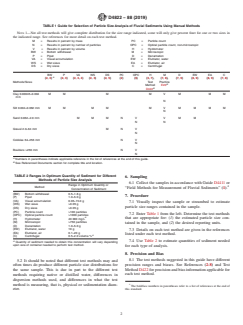
TABLE 1 Guide for Selection of Particle Size Analysis of Fluvial Sediments Using Manual Methods
NOTE 1—Not all test methods will give complete distribution for the size range indicated, some will only give percent finer for one or two sizes in
the indicated range. See references for more detail on each test method.
M = Results in percent by mass PC = Particle count
N = Results in percent by number of particles OPC = Optical particle count, non-microscopic
V = Results in percent by volume H = Hydrometer
BW = Bottom withdrawal M = Microscopic
P = Pipet D = Decantation
VA = Visual accumulation EW = Elutriator, water
WS = Wet sieve EA = Elutriator, air
DS = Dry sieve C = Centrifugal
BW P VA WS DS PC OPC H M D EW EA C
A
(2, 3) (2, 3) (2, 3, 4) (2, 3) (2, 5) (2) (6) (3, 7), (7, 8), (7, 9) (8, 9) (8, 9) (7, 8)
Methods/Sizes
...