

ASTM D7725-17(2023)
(Test Method)Standard Test Method for the Continuous Measurement of Turbidity Above 1 Turbidity Unit (TU)
General Information
- Abstract
SIGNIFICANCE AND USE
4.1 Turbidity is undesirable in drinking water, plant effluent waters, water for food and beverage processing, and for a large number of other water dependent manufacturing processes. Removal of suspended matter is accomplished by coagulation, settling, and filtration. Measurement of turbidity provides a rapid means of process control to determine when, how, and to what extent the water must be treated to meet specifications.
4.2 This test method is suitable for the on-line monitoring of turbidity such as that found in drinking water, process water, and high purity industrial waters.
4.3 The instrumentation used must allow for the continuous on-line monitoring of a sample stream.
4.4 When reporting the measured result, appropriate units should also be reported. The units are reflective of the technology used to generate the result, and if necessary, provide more adequate comparison to historical data sets.
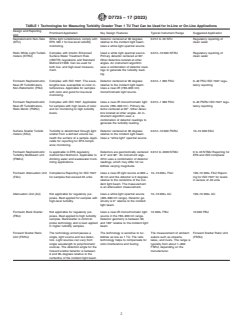
4.4.1 Table 1 describing technologies and reporting results. Those technologies listed are appropriate for the range of measurement prescribed in this test method are mentioned, though others may come available. Fig. X3.1 from Appendix X3 contains a flowchart to assist in technology selection.
4.4.2 For a specific design that falls outside of these reporting ranges, the turbidity should be reported in TU with a subscripted wavelength value to characterize the light source that was used.
4.4.3 Ratio white light turbidimeters are common as bench top instruments but not as a typical process instrument. However, if fitted with a flow-cell they meet the criteria of this test method.
SCOPE
1.1 This test method covers the on-line and in-line determination of high-level turbidity in water that is greater than 1.0 turbidity units (TU) in municipal, industrial and environmental usage.
1.2 In principle, there are three basic applications for on-line measurement set ups. This first is the slipstream (bypass) sample technique. For the slipstream sample technique a portion of sample is transported out of the process and through the measurement apparatus. It is then either transported back to the process or to waste. The second is the in-line measurement where the sensor is brought directly into the process (see Fig. 8). The third basic method is for in-situ monitoring of sample waters. This principle is based on the insertion of a sensor into the sample itself as the sample is being processed. The in-situ use in this test method is intended for the monitoring of water during any step within a processing train, including immediately before or after the process itself.
1.3 This test method is applicable to the measurement of turbidities greater than 1.0 TU. The absolute range is dictated by the technology that is employed.
1.4 The upper end of the measurement range is left undefined because different technologies described in this test method can cover very different ranges of turbidity.
1.5 Many of the turbidity units and instrument designs covered in this test method are numerically equivalent in calibration when a common calibration standard is applied across those designs listed in Table 1. Measurement of a common calibration standard of a defined value will also produce equivalent results across these technologies. This test method prescribes the assignment of a determined turbidity values to the technology used to determine those values. Numerical equivalence to turbidity standards is observed between different technologies but is not expected across a common sample. Improved traceability beyond the scope of this test method may be practiced and would include the listing of the make and model number of the instrument used to determine the turbidity values.
1.5.1 In this test method, calibration standards are often defined in NTU values, but the other assigned turbidity units, such as those in Table 1 are equivalent. For example, a 1 NTU formazin standard is also a 1...
- Status
- Published
- Publication Date
- 31-Oct-2023
- Technical Committee
- D19 - Water
Overview
ASTM D7725-17(2023): Standard Test Method for the Continuous Measurement of Turbidity Above 1 Turbidity Unit (TU) provides a comprehensive procedure for on-line and in-line determination of high-level turbidity in water. Developed by ASTM International, this standard is crucial for measuring, monitoring, and reporting turbidity values greater than 1.0 TU in municipal, industrial, and environmental water applications. Turbidity, the measure of suspended particulate matter in water, is a key quality parameter, especially in drinking water and process water systems, as excessive turbidity can indicate contamination and affect downstream processes.
Key Topics
- Continuous Monitoring of Turbidity: The standard specifies requirements for instruments used to continuously measure turbidity in water streams. These include sensors suitable for slipstream (bypass), in-line, and in-situ configurations.
- Measurement Techniques: Various technological approaches are outlined, such as nephelometric (NTU, FNU), ratiometric (NTRU, FNRU), surface scatter (SSU), and attenuation methods (FAU, AU).
- Calibration and Reporting: Calibration must use traceable standards, with results reported in units aligned with the employed measurement technology (e.g., NTU, FNU, SSU), ensuring comparability with regulatory or historical data.
- Interferences and Limitations: Recognizes factors affecting measurement accuracy, including bubbles, color, settling particles, cell contamination, condensation, and optical path length variations.
- Instrument Requirements: Instruments must allow detection of small turbidity differences, be capable of proper calibration, and be designed to minimize errors related to bubbles, fouling, and particle settling.
- Safety and Good Practice: Emphasizes the importance of safety equipment, clean labware, proper instrument set-up, and adherence to manufacturer recommendations and MSDS for chemicals.
Applications
ASTM D7725-17(2023) is widely applicable across industries and environmental monitoring where water quality assurance is critical at higher turbidity levels. Typical applications include:
- Drinking Water Treatment: On-line turbidity monitoring helps in maintaining regulatory quality, detecting process upsets, and optimizing filtration/coagulation processes.
- Industrial Process Water: Ensures process water meets operational specifications, preventing equipment fouling and product quality issues.
- Food and Beverage Production: Controls water clarity in processing environments to uphold safety and taste standards.
- Effluent and Environmental Monitoring: Provides early warning of contamination in plant effluent or natural water bodies, supporting regulatory compliance and environmental stewardship.
- High Purity Water Systems: Essential in sectors like semiconductor manufacturing, where particulate contamination can critically impact processes.
Related Standards
Many documents and standards are referenced for consistency and enhanced traceability:
- ASTM D1129: Terminology Relating to Water.
- ASTM D3370: Practices for Sampling Water from Flowing Process Streams.
- ASTM D3864: Guide for On-Line Monitoring Systems for Water Analysis.
- ASTM D7315: Test Method for Determination of Turbidity Above 1 TU in Static Mode.
- EPA 180.1: Methods for Chemical Analysis of Water and Wastes, Turbidity.
- ISO 7027: Water Quality - Determination of Turbidity.
- Standard Methods 2130B: Examination of Water and Wastewater.
Practical Value
Implementing ASTM D7725-17(2023) enables companies and utilities to:
- Achieve reliable, real-time data on water clarity for fast decision-making.
- Satisfy regulatory requirements and support compliance reporting.
- Optimize chemical dosing, filtration, and maintenance schedules, reducing operational costs.
- Detect process upsets or contamination events rapidly.
- Ensure high product quality and protect public and environmental health.
Adopting this standard supports robust quality control, enhanced traceability, and global recognition of water quality practices.
Keywords
ASTM D7725-17, turbidity measurement, continuous monitoring, water quality, on-line turbidity, in-line turbidity, turbidity units, industrial water monitoring, drinking water turbidity, process water, nephelometric, regulatory compliance, water treatment.
Relations
- Effective Date
- 01-Nov-2023
- Effective Date
- 01-Nov-2023
- Effective Date
- 01-May-2020
- Effective Date
- 01-May-2020
- Effective Date
- 01-Jul-2017
Get Certified
Connect with accredited certification bodies for this standard

CIS Institut d.o.o.
Personal Protective Equipment (PPE) certification body. Notified Body NB-2890 for EU Regulation 2016/425 PPE.

Kiwa BDA Testing
Building and construction product certification.
Kmetijski inštitut Slovenije
Agricultural Institute of Slovenia. Soil testing, plant health, agricultural product analysis.
Sponsored listings
Frequently Asked Questions
ASTM D7725-17(2023) is a standard published by ASTM International. Its full title is "Standard Test Method for the Continuous Measurement of Turbidity Above 1 Turbidity Unit (TU)". This standard covers: SIGNIFICANCE AND USE 4.1 Turbidity is undesirable in drinking water, plant effluent waters, water for food and beverage processing, and for a large number of other water dependent manufacturing processes. Removal of suspended matter is accomplished by coagulation, settling, and filtration. Measurement of turbidity provides a rapid means of process control to determine when, how, and to what extent the water must be treated to meet specifications. 4.2 This test method is suitable for the on-line monitoring of turbidity such as that found in drinking water, process water, and high purity industrial waters. 4.3 The instrumentation used must allow for the continuous on-line monitoring of a sample stream. 4.4 When reporting the measured result, appropriate units should also be reported. The units are reflective of the technology used to generate the result, and if necessary, provide more adequate comparison to historical data sets. 4.4.1 Table 1 describing technologies and reporting results. Those technologies listed are appropriate for the range of measurement prescribed in this test method are mentioned, though others may come available. Fig. X3.1 from Appendix X3 contains a flowchart to assist in technology selection. 4.4.2 For a specific design that falls outside of these reporting ranges, the turbidity should be reported in TU with a subscripted wavelength value to characterize the light source that was used. 4.4.3 Ratio white light turbidimeters are common as bench top instruments but not as a typical process instrument. However, if fitted with a flow-cell they meet the criteria of this test method. SCOPE 1.1 This test method covers the on-line and in-line determination of high-level turbidity in water that is greater than 1.0 turbidity units (TU) in municipal, industrial and environmental usage. 1.2 In principle, there are three basic applications for on-line measurement set ups. This first is the slipstream (bypass) sample technique. For the slipstream sample technique a portion of sample is transported out of the process and through the measurement apparatus. It is then either transported back to the process or to waste. The second is the in-line measurement where the sensor is brought directly into the process (see Fig. 8). The third basic method is for in-situ monitoring of sample waters. This principle is based on the insertion of a sensor into the sample itself as the sample is being processed. The in-situ use in this test method is intended for the monitoring of water during any step within a processing train, including immediately before or after the process itself. 1.3 This test method is applicable to the measurement of turbidities greater than 1.0 TU. The absolute range is dictated by the technology that is employed. 1.4 The upper end of the measurement range is left undefined because different technologies described in this test method can cover very different ranges of turbidity. 1.5 Many of the turbidity units and instrument designs covered in this test method are numerically equivalent in calibration when a common calibration standard is applied across those designs listed in Table 1. Measurement of a common calibration standard of a defined value will also produce equivalent results across these technologies. This test method prescribes the assignment of a determined turbidity values to the technology used to determine those values. Numerical equivalence to turbidity standards is observed between different technologies but is not expected across a common sample. Improved traceability beyond the scope of this test method may be practiced and would include the listing of the make and model number of the instrument used to determine the turbidity values. 1.5.1 In this test method, calibration standards are often defined in NTU values, but the other assigned turbidity units, such as those in Table 1 are equivalent. For example, a 1 NTU formazin standard is also a 1...
SIGNIFICANCE AND USE 4.1 Turbidity is undesirable in drinking water, plant effluent waters, water for food and beverage processing, and for a large number of other water dependent manufacturing processes. Removal of suspended matter is accomplished by coagulation, settling, and filtration. Measurement of turbidity provides a rapid means of process control to determine when, how, and to what extent the water must be treated to meet specifications. 4.2 This test method is suitable for the on-line monitoring of turbidity such as that found in drinking water, process water, and high purity industrial waters. 4.3 The instrumentation used must allow for the continuous on-line monitoring of a sample stream. 4.4 When reporting the measured result, appropriate units should also be reported. The units are reflective of the technology used to generate the result, and if necessary, provide more adequate comparison to historical data sets. 4.4.1 Table 1 describing technologies and reporting results. Those technologies listed are appropriate for the range of measurement prescribed in this test method are mentioned, though others may come available. Fig. X3.1 from Appendix X3 contains a flowchart to assist in technology selection. 4.4.2 For a specific design that falls outside of these reporting ranges, the turbidity should be reported in TU with a subscripted wavelength value to characterize the light source that was used. 4.4.3 Ratio white light turbidimeters are common as bench top instruments but not as a typical process instrument. However, if fitted with a flow-cell they meet the criteria of this test method. SCOPE 1.1 This test method covers the on-line and in-line determination of high-level turbidity in water that is greater than 1.0 turbidity units (TU) in municipal, industrial and environmental usage. 1.2 In principle, there are three basic applications for on-line measurement set ups. This first is the slipstream (bypass) sample technique. For the slipstream sample technique a portion of sample is transported out of the process and through the measurement apparatus. It is then either transported back to the process or to waste. The second is the in-line measurement where the sensor is brought directly into the process (see Fig. 8). The third basic method is for in-situ monitoring of sample waters. This principle is based on the insertion of a sensor into the sample itself as the sample is being processed. The in-situ use in this test method is intended for the monitoring of water during any step within a processing train, including immediately before or after the process itself. 1.3 This test method is applicable to the measurement of turbidities greater than 1.0 TU. The absolute range is dictated by the technology that is employed. 1.4 The upper end of the measurement range is left undefined because different technologies described in this test method can cover very different ranges of turbidity. 1.5 Many of the turbidity units and instrument designs covered in this test method are numerically equivalent in calibration when a common calibration standard is applied across those designs listed in Table 1. Measurement of a common calibration standard of a defined value will also produce equivalent results across these technologies. This test method prescribes the assignment of a determined turbidity values to the technology used to determine those values. Numerical equivalence to turbidity standards is observed between different technologies but is not expected across a common sample. Improved traceability beyond the scope of this test method may be practiced and would include the listing of the make and model number of the instrument used to determine the turbidity values. 1.5.1 In this test method, calibration standards are often defined in NTU values, but the other assigned turbidity units, such as those in Table 1 are equivalent. For example, a 1 NTU formazin standard is also a 1...
ASTM D7725-17(2023) is classified under the following ICS (International Classification for Standards) categories: 13.060.60 - Examination of physical properties of water. The ICS classification helps identify the subject area and facilitates finding related standards.
ASTM D7725-17(2023) has the following relationships with other standards: It is inter standard links to ASTM D7725-17, ASTM D7315-17(2023), ASTM D1129-13(2020)e2, ASTM D1129-13(2020)e1, ASTM D7315-17. Understanding these relationships helps ensure you are using the most current and applicable version of the standard.
ASTM D7725-17(2023) is available in PDF format for immediate download after purchase. The document can be added to your cart and obtained through the secure checkout process. Digital delivery ensures instant access to the complete standard document.
Standards Content (Sample)
This international standard was developed in accordance with internationally recognized principles on standardization established in the Decision on Principles for the
Development of International Standards, Guides and Recommendations issued by the World Trade Organization Technical Barriers to Trade (TBT) Committee.
Designation: D7725 − 17 (Reapproved 2023)
Standard Test Method for the
Continuous Measurement of Turbidity Above 1 Turbidity
Unit (TU)
This standard is issued under the fixed designation D7725; the number immediately following the designation indicates the year of
original adoption or, in the case of revision, the year of last revision. A number in parentheses indicates the year of last reapproval. A
superscript epsilon (´) indicates an editorial change since the last revision or reapproval.
1. Scope values to the technology used to determine those values.
Numerical equivalence to turbidity standards is observed
1.1 This test method covers the on-line and in-line determi-
between different technologies but is not expected across a
nation of high-level turbidity in water that is greater than 1.0
common sample. Improved traceability beyond the scope of
turbidity units (TU) in municipal, industrial and environmental
this test method may be practiced and would include the listing
usage.
of the make and model number of the instrument used to
1.2 In principle, there are three basic applications for on-line
determine the turbidity values.
measurement set ups. This first is the slipstream (bypass)
1.5.1 In this test method, calibration standards are often
sample technique. For the slipstream sample technique a
defined in NTU values, but the other assigned turbidity units,
portion of sample is transported out of the process and through
such as those in Table 1 are equivalent. For example, a 1 NTU
the measurement apparatus. It is then either transported back to
formazin standard is also a 1 FNU, a 1 FAU, a 1 BU, and so
the process or to waste. The second is the in-line measurement
forth.
where the sensor is brought directly into the process (see Fig.
1.6 This test method does not purport to cover all available
8). The third basic method is for in-situ monitoring of sample
waters. This principle is based on the insertion of a sensor into technologies for high-level turbidity measurement.
the sample itself as the sample is being processed. The in-situ
1.7 This test method was tested on different waters, and with
use in this test method is intended for the monitoring of water
standards that will serve as surrogates to samples. It is the
during any step within a processing train, including immedi-
user’s responsibility to ensure the validity of this test method
ately before or after the process itself.
for waters of untested matrices.
1.3 This test method is applicable to the measurement of
1.8 Those samples with the highest particle densities typi-
turbidities greater than 1.0 TU. The absolute range is dictated
cally prove to be the most difficult to measure. In these cases,
by the technology that is employed.
the process monitoring method can be considered with ad-
1.4 The upper end of the measurement range is left unde-
equate measurement protocols installed.
fined because different technologies described in this test
1.9 The values stated in SI units are to be regarded as
method can cover very different ranges of turbidity.
standard. No other units of measurement are included in this
1.5 Many of the turbidity units and instrument designs
standard.
covered in this test method are numerically equivalent in
1.10 This standard does not purport to address all of the
calibration when a common calibration standard is applied
safety concerns, if any, associated with its use. It is the
across those designs listed in Table 1. Measurement of a
responsibility of the user of this standard to establish appro-
common calibration standard of a defined value will also
priate safety, health, and environmental practices and deter-
produce equivalent results across these technologies. This test
mine the applicability of regulatory limitations prior to use.
method prescribes the assignment of a determined turbidity
Refer to the MSDSs for all chemicals used in this procedure.
1 1.11 This international standard was developed in accor-
This test method is under the jurisdiction of ASTM Committee D19 on Water
dance with internationally recognized principles on standard-
and is the direct responsibility of Subcommittee D19.03 on Sampling Water and
Water-Formed Deposits, Analysis of Water for Power Generation and Process Use,
ization established in the Decision on Principles for the
On-Line Water Analysis, and Surveillance of Water.
Development of International Standards, Guides and Recom-
Current edition approved Nov. 1, 2023. Published December 2023. Originally
mendations issued by the World Trade Organization Technical
approved in 2012. Last previous edition approved in 2017 as D7725 – 17. DOI:
10.1520/D7725-17R23. Barriers to Trade (TBT) Committee.
Copyright © ASTM International, 100 Barr Harbor Drive, PO Box C700, West Conshohocken, PA 19428-2959. United States
D7725 − 17 (2023)
TABLE 1 Technologies for Measuring Turbidity Greater Than 1 TU That Can be Used for In-Line or On-Line Applications
Design and Reporting
Prominent Application Key Design Features Typical Instrument Range Suggested Application
Unit
Nephelometric Non-Tatio White light turbidimeters comply with Detector centered at 90 degrees 0.012 to 40 NTU Regulatory reporting of
(NTU) EPA 180.1 for low-level turbidity relative to the incident light beam. clean water
monitoring. Uses a white light spectral source.
Ratio White Light Turbidi- Complies with Interim Enhanced Used a white light spectral source. 0.012–10 000 NTRU Regulatory reporting of
meters (NTRU) Surface Water Treatment Rule Primary detector centered at 90°. clean water
(ISWTR) regulations and Standard Other detectors located at other
Method 2130B. Can be used for angles. An instrument algorithm
both low- and high-level measure- uses a combination of detector read-
ment. ings to generate the turbidity read-
ing.
Formazin Nephelometric, Complies with ISO 7027. The wave- Detector centered at 90 degrees 0.012–1 000 FNU 0–40 FNU ISO 7027 regu-
Near-IR Turbidimeters, lengthis less susceptible to color in- relative to the incident light beam. latory reporting
Non-Ratiometric (FNU) terferences. Applicable for samples Uses a near-IR (780–900 nm)
with color and good for low-level monochromatic light source.
monitoring.
Formazin Nephelometric Complies with ISO 7027. Applicable Uses a near-IR monochromatic light 0.012–1 000 FNU 0–40 FNRU ISO 7027 regu-
Near-IR Turbidimeters, for samples with high levels of color source (780–900 nm). Primary de- latory reporting
Ratio Metric (FNRU) and for monitoring to high turbidity tector centered at 90°. Other detec-
levels. tors located at other angles. An in-
strument algorithm uses a
combination of detector readings to
generate the turbidity reading.
Surface Scatter Turbidi- Turbidity is determined through light Detector centered at 90 degrees 0.012–10 000 FNRU 10–10 000 SSU
meters (SSU) scatter from a defined volume be- relative to the incident light beam.
neath the surface of a sample. Appli- Uses a “white light” spectral source.
cable for reporting for EPA compli-
ance monitoring.
Formazin Nephelometric Is applicable to EPA regulatory Detectors are geometrically centered 0.012 to 4000 NTMU 0 to 40 NTMU Reporting for
Turbidity Multibeam unit method GLI Method 2. Applicable to at 0° and 90°. An instrument algo- EPA and ISO compliane
(FNMU) drinking water and wastewater moni- rithm uses a combination of detector
toring applications. readings, which may differ for tur-
bidities varying magnitude.
Formazin Attenuation Unit Compliance Reporting for ISO 7027 Uses a near-IR light source at 860 ± 10–10 000+ FAU 100–10 000+ FAU Report-
(FAU) for samples that exceed 40 units. 30 nm and the detector is 0 degrees ing for ISO 7027 for levels
relative to the centerline of the inci- in excess of 40 units
dent light beam. The measurement
is an attenuation measurement.
Attenuation Unit (AU) Not applicable for regulatory pur- Uses a white light spectral source 10–10 000+ AU 100–10 000+ AU
poses. Best applied for samples with (400–680 nm range). Detector ge-
high-level turbidity. ometry is 0° relative to the incident
light beam.
Formazin Back Scatter Not applicable for regulatory pur- Uses a near-IR monochromatic light 10 000+ FBU 10 000 FBU
(FBU) poses. Best applied to high turbidity source in the 780–900 nm range.
samples. Backscatter is common Detector geometry is between 90
probe technology and is best applied and 180° relative to the incident light
in higher turbidity samples. beam.
Forward Scatter Ratio The technology encompasses a The technology is sensitive to tur- The measurement of ambient Forward Scatter Ratio Unit
Unit (FSRU) single, light source and two detec- bidities as low as 1 TU. The ratio waters such as streams, (FSRU)
tors. Light sources can vary from technology helps to compensate for lakes, and rivers. The range is
single wavelength to polychromatic color interference and fouling. typically from about 1–800
sources. The detection angle for the FSRU, depending on the
forward scatter detector is between manufacturer.
0 and 90–degrees relative to the
centerline of the incident light beam.
D7725 − 17 (2023)
2. Referenced Documents 3.2.4 calibration-verification standards, n—defined stan-
2 dards used to verify the accuracy of a calibration in the
2.1 ASTM Standards:
measurement range of interest.
D1129 Terminology Relating to Water
3.2.4.1 Discussion—These standards may not be used to
D2777 Practice for Determination of Precision and Bias of
perform calibrations, only calibration verifications. Included
Applicable Test Methods of Committee D19 on Water
verification standards are opto-mechanical lightscatter devices,
D3370 Practices for Sampling Water from Flowing Process
gel-like standards, or any other type of stable-liquid standard.
Streams
Calibration verification standards may be instrument specific.
D3864 Guide for On-Line Monitoring Systems for Water
Analysis
3.2.5 detection angle, n—the angle formed with its apex at
D6698 Test Method for On-Line Measurement of Turbidity
the center of the analysis volume of the sample, and such that
Below 5 NTU in Water (Withdrawn 2023)
one vector coincides with the centerline of the incident light
D7315 Test Method for Determination of Turbidity Above 1
source’s emitted radiation and the second vector projects to the
Turbidity Unit (TU) in Static Mode
center of the primary detector’s view.
2.2 Other Publications:
3.2.5.1 Discussion—This angle is used for the differentia-
EPA 180.1 Methods for Chemical Analysis of Water and
tion of turbidity-measurement technologies that are used in this
Wastes, Turbidity
test method.
GLI Method 2 Great Lakes Instruments (GLI) — Turbidity
3.2.6 forward-scatter-detection angle, n—the angle that is
ISO 7027 Water Quality — Determination of Turbidity
formed between the incident light source and the primary
Standard Method 2130B Standard Methods for the Exami-
detector, and that is between 0 and 90-degrees.
nation of Water and Wastewater
3.2.6.1 Discussion—Most designs will have an angle be-
3. Terminology
tween 10 and 45 degrees.
3.1 Definitions:
3.2.7 nephelometric-detection angle, n—the angle that is
3.1.1 For definitions of terms used in this standard, refer to
formed between the incident light source and the detector, and
Terminology D1129.
that is at 90-degrees
3.2 Definitions of Terms Specific to This Standard:
3.2.8 nephelometric-turbidity measurement, n—the mea-
3.2.1 attenuation-detection angle, n—the angle that is
surement of light scatter from a sample in a direction that is at
formed between the incident light source and the primary
90° with respect to the centerline of the incident-light path.
detector, and that is at exactly 0-degrees.
3.2.8.1 Discussion—Units are NTU (nephelometric turbid-
3.2.1.1 Discussion—This is typically a transmission mea-
ity units). When ISO 7027 technology is employed units are
surement.
FNU (formazin nephelometric units).
3.2.2 backscatter-detection angle, n—the angle that is
3.2.9 ratio-turbidity measurement, n—the measurement de-
formed between the incident light source and the primary
rived through the use of a nephelometric detector that serves as
detector, and that is greater than 90-degrees and up to 180-
the primary detector, and one or more other detectors used to
degrees.
compensate for variation in incident-light fluctuation, stray
3.2.3 calibration turbidity standard, n—a turbidity standard
light, instrument noise, or sample color.
that is traceable and equivalent to the reference turbidity
3.2.10 reference-turbidity standard, n—a standard that is
standard to within statistical errors; calibration turbidity stan-
synthesized reproducibly from traceable raw materials by the
dards include commercially prepared 4000 NTU formazin,
user.
stabilized formazin, and styrenedivinylbenzene (SDVB).
3.2.10.1 Discussion—All other standards are traced back to
3.2.3.1 Discussion—These standards may be used to cali-
this standard. The reference standard for turbidity is formazin.
brate the instrument. Calibration turbidity standards may be
instrument specific.
3.2.11 seasoning, n—the process of conditioning labware
with the standard that will be diluted to a lower value.
3.2.11.1 Discussion—The process reduces contamination
For referenced ASTM standards, visit the ASTM website, www.astm.org, or
contact ASTM Customer Service at service@astm.org. For Annual Book of ASTM and dilution errors. See Appendix X2 for suggested procedure.
Standards volume information, refer to the standard’s Document Summary page on
3.2.12 slipstream, n—an on-line technique for analysis of a
the ASTM website.
The last approved version of this historical standard is referenced on
sample as it flows through a measurement chamber of an
www.astm.org.
instrument.
Available from United States Environmental Protection Agency (EPA), William
3.2.12.1 Discussion—The sample is transported from the
Jefferson Clinton Bldg., 1200 Pennsylvania Ave., NW, Washington, DC 20460,
http://www.epa.gov.
source into the instrument (for example a turbidimeter),
Available from Hach Company, P.O. Box 389, Loveland, Colorado 80539,
analyzed, and then transported to drain or back to the process
https://www.hach.com.
6 stream. The term is synonymous with the terms “on-line
Available from International Organization for Standardization (ISO), ISO
instrument” or “continuous-monitoring instrument.”
Central Secretariat, BIBC II, Chemin de Blandonnet 8, CP 401, 1214 Vernier,
Geneva, Switzerland, http://www.iso.org.
3.2.13 stray light, n—all light reaching the detector other
Available from American Public Health Association (APHA), 800 I St., NW,
Washington, DC 20001, http://www.apha.org. than that contributed by the sample.
D7725 − 17 (2023)
3.2.14 surface-scatter detection, n—a turbidity measure- 5.2 Follow all relevant safety guidelines.
ment that is determined through the detection of light scatter
5.3 Refer to instrument manuals for safety guidelines when
caused by particles within a defined volume beneath the
installing, calibrating, measuring or performing maintenance
surface of a sample.
with any of the respective instrumentation.
3.2.14.1 Discussion—Both the light source and detector are
5.4 Refer to all material safety data sheets (MSDSs) prior to
positioned above the surface of the sample. The angle formed
preparing or using standards and before calibrating or perform-
between the centerline of the light source and detector is
ing instrument maintenance.
typically at 90-degrees. Particles at the surface and in a volume
below the surface of the sample contribute to the turbidity
6. Interferences
reading.
6.1 Bubbles, although they cause turbidity, may result in
3.2.15 turbidimeter, n—an instrument that measures light
interferences in measured turbidity as determined by this test
scatter caused by particulates within a sample and converts the
method. Bubbles cause a positive interference and color
measurement to a turbidity value.
typically causes a negative interference.
3.2.15.1 Discussion—The detected light is quantitatively
converted to a numeric value that is traced to a light-scatter
6.2 Color is characterized by absorption of specific wave-
standard. See Test Method D7315.
lengths of light. If the wavelengths of incident light are
3.2.16 turbidity, n—an expression of the optical properties significantly absorbed, a negative interference will result un-
of a sample that cause light rays to be scattered and absorbed less the instrument has special compensation features. Depend-
rather than transmitted in straight lines through the sample. ing on the application color may or may not be considered an
3.2.16.1 Discussion—Turbidity of water is caused by the interference. Some instrument designs are intended to remove
presence of matter such as clay, silt, finely divided organic the effect that color imparts on a turbidity measurement. Other
matter, plankton, other microscopic organisms, organic acids, designs do not remove the effects of color.
and dyes. 6.2.1 Those designs where color effects can be reduced or
eliminated include nephelometric-based designs with incident
4. Significance and Use
light sources in the 780–900 nm range. Those designs that have
4.1 Turbidity is undesirable in drinking water, plant effluent
additional detectors, such as ratioing instruments also help to
waters, water for food and beverage processing, and for a large
reduce the effects of color regardless of the light source. Single
number of other water dependent manufacturing processes.
detector systems with light sources below 780 nm will be more
Removal of suspended matter is accomplished by coagulation,
impacted by the effects of color in the sample, that is, color
settling, and filtration. Measurement of turbidity provides a
visible to the naked eye. Color can have a significant impact on
rapid means of process control to determine when, how, and to
attenuation-based instruments if it has absorption spectrum that
what extent the water must be treated to meet specifications.
overlaps the spectral output of the incident light source.
6.2.2 Dissolved material that imparts a color to the water
4.2 This test method is suitable for the on-line monitoring of
may cause errors in pure nephelometric readings, unless the
turbidity such as that found in drinking water, process water,
instrument has special compensating features to reduce these
and high purity industrial waters.
interferences.
4.3 The instrumentation used must allow for the continuous
on-line monitoring of a sample stream. 6.3 Absorbing Particles—Particles such as carbon,
anthracite, fire residue will absorb incident light and bias
4.4 When reporting the measured result, appropriate units
readings to be negative.
should also be reported. The units are reflective of the
technology used to generate the result, and if necessary,
6.4 Scratches, finger marks, or dirt on the walls of the
provide more adequate comparison to historical data sets.
sample cell or windows of the sample chamber may give
4.4.1 Table 1 describing technologies and reporting results.
erroneous readings, especially at lower turbidity levels. Sample
Those technologies listed are appropriate for the range of
cells or windows should be kept scrupulously clean both inside
measurement prescribed in this test method are mentioned,
and outside and cells should be discarded when they become
though others may come available. Fig. X3.1 from Appendix
etched or scratched. The sample cells or windows must not be
X3 contains a flowchart to assist in technology selection.
handled where light strikes them in the measurement chamber.
4.4.2 For a specific design that falls outside of these
6.5 Sample cell caps and liners (if applicable for process
reporting ranges, the turbidity should be reported in TU with a
turbidimeters), and sample chambers must also be scrupulously
subscripted wavelength value to characterize the light source
clean to prevent contamination of the sample. Seasoning of the
that was used.
sample cells or sample chamber should be performed each time
4.4.3 Ratio white light turbidimeters are common as bench
a new sample is measured.
top instruments but not as a typical process instrument.
6.6 The optical quality and geometry of the sample cells can
However, if fitted with a flow-cell they meet the criteria of this
also impact results. At all turbidity levels, sample cells that are
test method.
not optically consistent can result in error. Errors greater than
5. Safety
10 % relative to the turbidity value can be reduced through
5.1 Wear appropriate personal protection equipment at all indexing or replacement of the cells. See Section 14.2 for
times. additional information.
D7725 − 17 (2023)
6.6.1 Sample cells that are used in process instruments 7. Apparatus
should be optically matched or a single cell should be used to
7.1 The sensor used for the monitoring of turbidity is
perform calibrations and measurements.
designed for continuous monitoring of the sample stream.
6.7 Particle size distribution can be considered a interfer-
7.2 The instrument design should eliminate signal spikes
ence but is typically considered an inherent part of the sample.
resulting from bubbles present in samples through the use of
The particle-size distribution in a sample, and operating
either internal or external bubble rejection chambers (traps),
spectrum will affect the relative sensitivity of turbidimeters.
sample pressurization, electronic rejection methods, or combi-
The intensity of light scattered from a water sample depends,
nation thereof.
among other factors, on the ratio of particle diameter to light
wavelength. Since the operating wavelength of a turbidimeter 7.3 The instrument design should allow for effective flow
is fixed, particle size is the controlling variable. passage so that the settling of particulate materials does not
occur in the measurement chamber.
6.8 The path-length of the sample cell or equivalent will
impact the sensitivity of measurements. A shorter path length
7.4 The sensor must be designed to be calibrated. The
will extend the range and reduce the interference proportion-
calibration should be performed by following the manufactur-
ally. However, use of a shorter path-length will reduce the
er’s recommended procedures. If a calibration algorithm for
sensitivity of the measurement.
the instrument is used, it should be derived through the use of
6.8.1 Ideally, the same indexed sample cell should be used
a reference or calibration turbidity standard.
first for standardization and then for measurement in process
7.5 The instrument should permit detection of turbidity
instruments. If this is not possible, then sample cells must be
differences of 0.10 TU or less in waters with turbidity between
matched. Refer to the instrument manual or the instrument
1.0 and 5.0 TU (see 13.1).
manufacturer for instructions regarding the matching of sample
cells.
7.6 Instrument Types—Two types of instruments are avail-
able for the nephelometric turbidity method, the nephelometer
NOTE 1—Indexing of the sample cell to the instrument chamber is
and ratio nephelometer.
accomplished by placing a mark on the top of the sample cell and a similar
mark on the upper surface of the sample chamber so that the sample cell
7.6.1 The Photoelectric Nephelometer—(see Fig. 1). This
can be placed in repeatable position each time.
instrument uses a light source for illuminating the sample and
6.9 Condensation on optical elements, windows, or sample a single photo-detector with a readout device to indicate the
cells can lead to severe errors in measurement.
intensity of light scattered at 90° to the centerline of the path of
the incident light. The photoelectric nephelometer should be
6.10 Fouling of optical elements or windows will cause
designed so that minimal stray light reaches the detector in the
severe errors in measurement. Inspection of sample chambers
absence of turbidity and should be free from significant drift
for fouling should be conducted in a timely manner.
after a short warm-up period. The light source should be a
6.11 Rapidly settling particles are also an interference.
Tungsten lamp operated at a color temperature between 2200
Particles such as sand can settle rapidly and cause false high or
and 3000 K. Light emitting diodes (LEDs) and laser diodes in
false low turbidity readings. The user of this test method must
defined wavelengths ranging from 400–900 nm may also be
use care to ensure particles are suspended in solution the
used. If LEDs or laser diodes are used, then the LED or laser
instant the measurement it taken.
diode should be coupled with a monitor detection device to
6.12 Certain turbulent motions also create unstable reading achieve a consistent energy output. The total distance traversed
conditions of nephelometers. by incident light and scattered light within the sample is not to
NOTE 1—Monitor detector is optional (not shown) and its use is typically with LED light sources.
FIG. 1 The Photoelectric Nephelometer
D7725 − 17 (2023)
exceed 10 cm. Angle of light acceptance to the detector: 7.6.2.1 Differences in physical design of ratio photoelectric
centered at 90° to the centerline of the incident light path and nephelometers will cause slight differences in measured values
not to exceed 610° from the 90° scatter path center line. The for turbidity even when the same suspension is used for
detector must have a spectral response that is sensitive to the calibrations. Comparability of measurements made using in-
spectral output of the incident light used. struments differing in optical and physical design is not
7.6.1.1 Differences in physical design of photoelectric neph- recommended.
elometers will cause slight differences in measured values for
7.7 Surface Scatter Turbidimeters—Surface scatter turbidi-
turbidity even though the same suspension is used for calibra-
meters determine the turbidity through the scatter of light from
tions. Comparability of measurements made using instruments
a defined volume beneath the surface of a flowing sample
differing in optical and physical design is not recommended.
stream. The incident light strikes the surface of a sample at an
7.6.2 Ratio Photoelectric Nephelometer—(see Fig. 2 for
angle and the detector of scattered light is also at a different
single beam design; see Fig. 3 for multiple beam design). This
angle but in the same plane with the incident light source. The
instrument uses the measurement derived through the use of a
detection angle is 90 degrees relative to the centerline of the
nephelometric detector that serves as the primary detector and
incident light beam, prior to it striking the surface of the
one or more other detectors used to compensate for variation in
sample. Surface scatter turbidimeters have a high operating
incident light fluctuation, stray light, instrument noise, or
range and allow for high flow rates (see Fig. 4).
sample color. As needed by the design, additional photodetec-
tors may be used to sense the intensity of light scattered at
7.8 Formazin Backscatter Turbidimeters—This technology
other angles. The signals from these additional photodetectors utilizes a near-IR monochromatic light source in the 780-900
may be used to compensate for variations in incident light
nm range. The detector geometry is any angle between 90° and
fluctuation, instrument stray light, instrument noise, sample 180° relative to the incident light beam (see Fig. 5).
color, or combination thereof. The ratio photoelectric nephelo-
7.9 Forward Scatter Technologies—This technology en-
meter should be designed so that minimal stray light reaches
compasses a single, solid-state light source and either a single
the detector(s), and should be free from significant drift after a
detector or multiple detectors (ratio). The detection angle for
short warm-up period. The light source should be a tungsten
the forward scatter detector is greater than 0-degrees but less
lamp, operated at a color temperature between 2200 and 3000
than 90-degrees relative to the centerline of the incident light
K. LEDs and laser diodes in defined wavelengths ranging from
beam. A second ratioing detector may be incorporated into
400 to 900 nm may also be used. If an LED or a laser diode is
some designs (see Fig. 6).
used in the single beam design, then the LED or laser diode
should be coupled with a monitor detection device to achieve
8. Purity of Reagents
a consistent energy output. The distance traversed by incident
light and scattered light within the sample is not to exceed 10
8.1 ACS grade chemicals of high purity (99+ %) shall be
cm. The angle of light acceptance to the nephelometric
used in all tests. Unless otherwise indicated, it is intended that
detector(s) should be centered at 90° to the centerline of the
all reagents shall conform to the specifications of the Commit-
incident light path and should not exceed 610° from the scatter
tee on Analytical Reagents of the American Chemical Society,
path center line. The detector must have a spectral response
where such specifications are available. Other grades may be
that is sensitive to the spectral output of the incident light used.
used providing it is first ascertained that the reagent is of
The instrument calibration (algorithm) must be designed such
sufficiently high purity to permit its use without lessening the
that the scaleable reading is from the nephelometric
accuracy of the determination.
detector(s), and other detectors are used to compensate for
NOTE 2—Refer to product MSDS for possible health exposure con-
instrument variation described in 3.2.8. cerns.
NOTE 1—The monitor detector (not shown) is optional and it typically used with LED light sources.
FIG. 2 The Ratio Photoelectric Turbidimeter
D7725 − 17 (2023)
NOTE 1—Incident light path is in red and scattered light paths are in blue.
FIG. 3 Multiple Beam Design Utilizes Two Detectors and Two Light Sources
NOTE 1—Left figure displays the application of the technology and sample flow. Right figure displays the measurement technology for surface scatter
detection. (Photos courtesy of Hach Company, Loveland, Colorado.)
FIG. 4 Surface Scatter Design
FIG. 5 Backscatter Measurement Design
8.2 Standard dilution, reagent and rinse waters shall be within one hour of use to reduce background turbidity. Reverse
prepared by filtration of Type III water, or better, through a osmosis (RO) water is acceptable and preferred in this test
0.22 microns or smaller membrane or other suitable filter method.
D7725 − 17 (2023)
FIG. 6 Forward Scatter Design
9. Reagents 9.2.2 Stabilized formazin turbidity standards are prepared
stable suspensions of the formazin polymer. Preparation is
9.1 Reagent, dilution, and final rinsing water, see 8.2.
limited to inverting the container to re-suspend the formazin
9.2 Turbidity Standards:
polymer. These standards require no dilution and are used as
received from the manufacturer.
NOTE 3—A standard with a turbidity of 1.0 NTU is the lowest formazin
turbidity standard that should be produced on the bench. Preparation of 9.2.3 SDVB polymer turbidity standards are prepared stable
formazin standards shall be performed by skilled laboratory personnel
suspensions, which are used as received from manufacturer or
with experience in quantitative analysis. Close adherence to the instruc-
distributor. These standards exhibit calibration performance
tions within this section is required in order to accurately prepare
characteristics that are specific to instrument design.
low-level turbidity standards.
9.2.4 Formazin Turbidity Suspension, Standard (40 NTU)—
9.2.1 Equivalent, commercially-available, calibration stan-
All labware shall be seasoned (see Appendix X2). Invert
dards may be used. These standards, such as stabilized for-
4000-NTU stock suspension 25 times to mix (one second
mazin and SDVB, have a specified turbidity value and accu-
inversion cycle); immediately pipette, using a Class A pipette,
racy. Such standards must be referenced (traceable) to
10.00 mL of mixed 4000-NTU stock into a 1000 mL Class A
formazin. Follow specific manufacturer’s calibration proce-
volumetric flask and dilute with water to mark. The turbidity of
dures.
this suspension is defined as 40 NTU. This 40-NTU suspension
NOTE 4—All volumetric glassware must be scrupulously clean. The
must be prepared weekly.
necessary level of cleanliness can be achieved by performing all of the
9.2.5 Dilute Formazin Turbidity Suspension Standard (1.0
following steps: washing glassware with laboratory detergent followed by
NTU)—Prepare this standard dilution daily by inverting the
3 tap water rinses; then rinse with portions of 1:4 HCl followed by at least
40-NTU stock suspension 25 times to mix (one second
3 tap water rinses; finally, rinse 3 times with rinse water as defined in 8.2.
inversion cycle) and immediately pipetting a volume of the
Reference formazin turbidity standard (4000 NTU) is synthesized on the
bench.
40.0-NTU standard (9.2.4). All labware shall be seasoned (see
Appendix X2).
9.2.1.1 Dissolve 5.000 g of ACS grade hydrazine sulfate
(99.5 % + purity) (N H · H SO into approximately 400 mL
2 4 2 4
NOTE 5—The instructions below result in the preparation of 200 mL of
of dilution water (see 8.2) contained in a 1 L Class A
formazin standard. Users of this test method will need different volumes
of the standard to meet their instrument’s individual needs; glassware and
volumetric flask.
reagent volumes shall be adjusted accordingly.
9.2.1.2 Dissolve 50.000 g of ACS grade hexamethylenete-
tramine (99 %+ purity) in approximately 400 mL of dilution 9.2.5.1 Within one day of use, rinse both a glass Class A
water (see 8.2) contained in another flask. Filter this solution 5.00 mL pipette and a glass Class A 200 mL volumetric flask
through a 0.2-mm filter. with laboratory glassware detergent or 1:1 hydrochloric acid
9.2.1.3 Quantitatively pour the filtered hexamethylenete- solution. Follow with at least ten rinses with rinse water.
tramine solution into the flask containing the hydrazine sulfate. 9.2.5.2 Using the cleaned glassware, pipette 5.00 mL of
Dilute this mixture to 1 L using dilution water (see 8.2). mixed 40.0 NTU formazin suspension (9.2.4) into the 200 mL
Stopper and mix for at least five minutes, and no more than ten flask and dilute to volume with the dilution water. Stopper and
minutes. invert 25 times to mix (one second inversion cycle). The
9.2.1.4 Allow the solution to stand for 24 hours at 25 °C 6 turbidity of this prepared standard is 1.0 NTU.
1 °C. The 4000 NTU formazin suspension develops during this 9.2.6 Miscellaneous Dilute Formazin Turbidity Suspension
time. Standard—Prepare all turbidity standards with values below
9.2.1.5 This suspension, if stored at 20 °C to 25 °C in amber 40.0 NTU daily. All labware shall be seasoned (see Appendix
polyethylene bottles, is stable for one year; it is stable for one X2). Standards with values above 40.0 NTU have a useful life
month if stored in glass at 20 °C to 25 °C. of one week. Use Class A glassware that has been cleaned in
D7725 − 17 (2023)
accordance with the instructions in 9.2.5.1 and prepare each 10.1.2.3 Soft or porous tubing that could harbor the growth
dilution by pipetting the volume of 40 NTU (9.2.4) into a of micro-organisms or contribute turbidity to the sample should
100 mL volumetric flask and diluting to mark with dilution not be used.
water (8.2). For example, prepare so that 50.0 mL of 40 NTU 10.1.3 Sampling:
diluted to 100 mL is 20.0 NTU and 10.0 mL of 40 NTU diluted
10.1.3.1 A sample tap should project into the center of the
to 100 mL is 4.00 NTU. pipe to minimize interference from air bubbles or pipeline
bottom sediment. See Fig. 7 for proper sample taps or review
10. Instrument Installation, Sample Lines and Sampling
instrument manual.
NOTE 6—In principle there are three sampling methods for on-line
10.1.3.2 Run sample lines directly from the sample point to
measurement set ups: slipstream (bypass), in-line, and in-situ. For the
the turbidimeter sensor to minimize sample flow lag time
slipstream sampling method, a sample is continuously transported out of
the process and through the measurement apparatus, and is then either (response time) or refer to instrument manual.
transported back to the process or to waste. For the in-line sampling
10.1.3.3 Adjust the flow rate to minimize particle fallout in
method, the sensor is brought directly into the process (see Fig. 7). For the
the sample lines while maximizing bubble removal so bubbles
in-situ sampling method, the sensor is placed directly into a sample that is
are not carried through the sensor or refer to instrument
in the environment. The in-situ does not measure a sample that is in the
manual. The best practice is to determine the maximum
process of being transported (that is, such as through a pipe).
allowable sample flow in which bubble removal is still
10.1 Slipstream Sample Technique:
effective. This maximum flow will provide the best condition
10.1.1 Instrument Installation—Proper location of the sen-
to prevent sample settling.
sor and the instrument will help assure accurate results.
Assuring that the sensor sees a flowing, bubble free and NOTE 7—There will be some instances where the sample flow rate will
be inadequate in the prevention of particle settling. In such cases, a
representative sample is essential for accurate results. Refer to
different technique should be used that allows for more rapid passage of
the instrument manufacturer for proper instrument set-up and
sample through the instrument. Or, the user should consider an in-situ
installation; also see Practices D3370.
measurement technique.
10.1.1.1 Locate the sensor as close to the sample location as
Refer to the instrument installation procedures from the
possible to minimize sample response time. Additionally,
manufacturer for optimization of sample flow rates through the
locate the instrument for safe, easy access for maintenance and
instrument.
calibration. The location must also provide adequate flow at a
10.1.4 The use of either internal or external bubble removal
rate that particulate settling will not take place in the sample
devices (bubble traps) prior to performing measurement of the
lines, instrument, or drain lines.
sample is recommended. Reference Practices D3370 and
10.1.1.2 Locate the instrument so external interferences
Guide D3864.
such as vibration, ambient light, humidity, and extreme condi-
10.1.4.1 When using bubble removal devices, flow must be
tions are minimized.
sufficient to prevent particulate settling within these devices. If
10.1.1.3 Position the instrument so it is level and stable to
particle settling cannot be prevented, then the bubble removal
ensure the sample stream is consistent and adequate over long
device should be abandoned.
periods of time.
10.2 In-line Measurement Technique:
10.1.2 Sample Lines—Refer to the instrument manufacturer
10.2.1 The principal set up for an in-line turbidity measure-
for recommended sampling procedures for the respective
instrument. ment is shown below.
10.2.2 For proper set-up and installation of sensor and
10.1.2.1 Sample inlet lines should be a minimum of 4 mm
inner diameter, rigid or semi-rigid tubing to allow easy passage transmitter refer to the instrument manufacturer. Some general
recommendations for the installation should be followed:
of large particles and to minimize the possibility of air lock.
10.1.2.2 Examples of tubing that can be used for sample 10.2.2.1 The sensor should be mounted into process lines so
lines include but are not limited to: polyethylene, nylon, that the sample flow is consistent and adequate to minimize
polypropylene, or TFE-fluorocarbon–lined tubing. interference from air bubbles or pipeline bottom sediment.
FIG. 7 Illustration of Proper and Improper Sampling Techniques
D7725 − 17 (2023)
FIG. 8 Principal Set-Up for In-line Turbidity Measurement
Avoid dead spots in flow or areas where the flow through the with static methods (Test Method D7315). Take a representa-
line slows significantly. tive sample and dilute it with one or more equal volumes of
10.2.2.2 Install sensor surface at an angle with respect to turbidity-free water, recording the volume of water used for
medium flow so that flow increases self cleaning effects of dilution.
optical parts and repels air bubbles.
10.4 When taking an aliquot for dilution from an on-line
10.2.2.3 The sensor should be installed with maximized
technology, it is important to use the same technology to
wall distance to reduce backscattered or reflective signal (see
measure the dilution. If a different technology is used, the
Fig. 8).
measurements may not be comparable.
10.2.2.4 Locate transmitter and sensor so that there is easy
10.4.1 Quality Control—Periodically check instrument per-
access for maintenance or calibration.
formance by placing a primary or secondary calibration solu-
10.2.2.5 Adjust the flow rate to minimize particle fallout in
tion in the instrument storage vessel and comparing the
the sample lines while maximizing bubble removal.
standard value with the reading displayed. Record in the
10.2.2.6 Measurement should be done under pressure to
instrument maintenance logbook all the readings obtained.
avoid degassing.
Re-calibrate if the following criteria are exceeded: 60.5
10.2.2.7 The location of the in-line sensor should be such
turbidity unit or 65 % of the measured value, whichever is
that the sensor can be easily removed from the process for
greater.
servicing.
10.3 The In-Situ Measurement Technique:
11. Calibration and Calibration Verification
10.3.1 Before making an in-situ turbidity determination,
11.1 Calibration of In-line and On-Line Turbidimeters:
ensure that the instrument to be used has been cleaned, verified,
11.1.1 Determine if the instrument requires any mainte-
and or calibrated properly, if need be, and that the verification/
nance such as cleaning the sample chamber, bubble removal
calibration process has been accurately documented.
devices, or flow-through cell, adjusting sample flow rates,
10.3.2 Guidelines for long-term instrument deployment fall
wiper maintenance, and so on. Follow the manufacturer’s
under the topic of continuous monitors; refer to the manufac-
instructions for any required instrument maintenance prior to
turer’s instructions and recommendations.
calibration.
10.3.3 Perform a calibration verification on the instrument
11.1.2 Follow the manufacturer’s instructions for calibra-
in the laboratory or on-site using a calibration solution before
tion and operation. Calibrate the instrument to assure proper
inserting it into the process and if verification does not confirm
operation for the range of interest with appropriate standards.
the calibration is still within 5 %, then re-calibrate.
10.3.3.1 Allow at least 60 seconds (or follow the manufac- NOTE 8—Close adherence to the calibration procedure and to the
rinsing/seasoning techniques is very important to ensure the data remains
turer’s guidelines) for sensors to equilibrate with sample water.
consistent across all locations with all of the turbidimeters.
Take instrument readings until the stabilization criteria of
610 % is met. Record the median of the final three or more 11.1.3 Formazin-based calibration standards should be re-
readings as the value to be reported for that measurement point. suspended through inversion (one second inversion cycle) 25
(Some instruments may require as much as 10–20 minutes times followed by a 2–10 minute wait to allow for bubble
removal. Standards of 40 NTU or below will remain suspended
warm-up time.) Stability is reached if values for three or more
sequential readings, spaced at regular time increments, are for up to 30 minutes; standards greater than 40 NTU may
require resuspension more frequently.
within 10 %.
10.3.3.2 Document verification readings and any metadata, 11.1.3.1 The relationship between turbidity and nephelo-
including the instrument manufacturer and model. Use report- metric light scatter is known to be linear only up to 40 NTU.
ing units appropriate for the instrument, as described in Table Above 40 NTU, the relationship may become non-linear and
1. additional calibration standa
...