

ASTM D7937-15(2023)
(Test Method)Standard Test Method for In-situ Determination of Turbidity Above 1 Turbidity Unit (TU) in Surface Water
General Information
- Abstract
SIGNIFICANCE AND USE
5.1 Turbidity is monitored to help control processes, monitor the health and biology of aquatic environments and to determine the impact of environmental events such as storms, floods, runoff, etc. Turbidity is undesirable in drinking water, plant-effluent waters, water for food and beverage production, and for a large number of other water-dependent manufacturing processes. Turbidity is often reduced by coagulation, sedimentation and water filtration. The measurement of turbidity may indicate the presence of particle-bound contaminants and is vital for monitoring the completion of a particle-waste settling process. Significant uses of turbidity measurements include:
5.1.1 Compliance with permits, water-quality guidelines, and regulations;
5.1.2 Determination of transport and fate of particles and associated contaminants in aquatic systems;
5.1.3 Conservation, protection and restoration of surface waters;
5.1.4 Measure performance of water and land-use management;
5.1.5 Monitor waterside construction, mining, and dredging operations;
5.1.6 Characterization of wastewater and energy-production effluents;
5.1.7 Tracking water-well completion including development and use; and
5.1.8 As a surrogate for other constituents in water including sediment and sediment-associated constituents.
5.2 The calibration range of a turbidimeter shall exceed the expected range of TU values for an application but shall not exceed the measurement range specified by the manufacturer.
5.3 Designs described in this standard detect and respond to a combination of relative absorption, intensity of light scattering, and transmittance. However, they do not measure these absolute physical units as defined in 3.2.15 and 3.2.19.
5.4 Several different turbidimeter designs may be used for this test method and one design may be better suited for a specific type of sample or monitoring application than another. The selection flowchart in Annex A1 provides guidance for th...
SCOPE
1.1 This test method covers the in-situ field measurements of turbidity in surface water. The measurement range is greater than 1 TU and the lesser of 10 000 TU or the maximum measurable TU value specified by the turbidimeter manufacturer.
1.1.1 Precision data was conducted on both real world and surrogate turbidity samples up to about 1000 TU. Many of the technologies listed in this test method are capable of measuring above that provided in the precision section (see Section 16).
1.2 “In-situ measurement” refers in this test method to applications where the turbidimeter sensor is placed directly in the surface water in the field and does not require transport of a sample to or from the sensor. Surface water refers to springs, lakes, reservoirs, settling ponds, streams and rivers, estuaries, and the ocean.
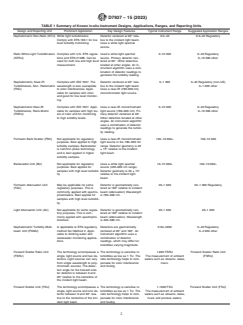
1.3 Many of the turbidity units and instrument designs covered in this test method are numerically equivalent in calibration when a common calibration standard is applied across those designs listed in Table 1. Measurement of a common calibration standard of a defined value will also produce equivalent results across these technologies. This test method prescribes the assignment of a determined turbidity values to the technology used to determine those values. Numerical equivalence to turbidity standards is observed between different technologies but is not expected across a common sample. Improved traceability beyond the scope of this test method may be practiced and would include the listing of the make and model number of the instrument used to determine the turbidity values.
1.4 In this test method, calibration standards are often defined in NTU values, but the other assigned turbidity units, such as those in Table 1 are equivalent. For example, a 1 NTU formazin standard is also a 1 FNU, a 1 FAU, a 1 BU, and so forth.
1.5 This test method was tested on different natural waters and with standards th...
- Status
- Published
- Publication Date
- 30-Jun-2023
- Technical Committee
- D19 - Water
- Drafting Committee
- D19.07 - Sediments, Geomorphology, and Open-Channel Flow
Overview
ASTM D7937-15(2023): Standard Test Method for In-situ Determination of Turbidity Above 1 Turbidity Unit (TU) in Surface Water is a key international standard developed by ASTM for measuring turbidity directly in the field. This standard specifically covers the in-situ field measurement of turbidity in surface waters-including springs, lakes, reservoirs, streams, rivers, estuaries, and oceans-using sensors placed directly in the water. It is applicable for measurements greater than 1 TU up to the maximum range specified by the turbidimeter manufacturer.
Turbidity is an essential water quality parameter, reflecting the presence of suspended and dissolved materials that scatter and absorb light. Regular monitoring of turbidity is critical for the protection of public health, aquatic ecosystems, regulatory compliance, and assessing the impact of environmental events such as storms or runoff.
Key Topics
In-situ Measurement: The method entails deploying a turbidimeter sensor directly in natural surface waters, eliminating the need for sample transportation and improving data accuracy.
Measurement Range: Suitable for turbidity readings from >1 TU up to 10,000 TU or as dictated by the instrument’s specifications, offering broad applicability across a range of water types.
Turbidimeter Designs: The standard recognizes multiple designs such as nephelometric, ratio, backscatter, attenuation, and forward scatter turbidimeters, each suited for specific applications and water matrices.
Calibration and Reporting: Emphasizes the use of calibration standards like formazin. Measurements and reporting units (e.g., NTU, FNU, FAU, BU) are tied to the specific turbidimeter design and light source used.
Interferences: Addresses potential measurement interferences from bubbles, color, particle size, temperature, and flow conditions, guiding users on method limitations and best practices to mitigate errors.
Applications
Implementing ASTM D7937-15(2023) brings high practical value for a wide variety of sectors:
- Regulatory Compliance: Monitoring surface water turbidity for adherence to permits, water quality guidelines, and environmental regulations.
- Aquatic Health & Environmental Monitoring: Assessing how events like storms, floods, or construction activities impact water clarity and aquatic habitats.
- Industrial Process Control: Protecting water-dependent manufacturing operations, including food/beverage production and wastewater treatment, by ensuring process water remains within turbidity limits.
- Resource Management & Restoration: Supporting conservation and restoration projects by tracking particle transport, erosion, sediment loads, and the effectiveness of land and water management practices.
- Construction, Mining, and Dredging: Monitoring the environmental impact of waterside operations and ensuring compliance during disruptive activities.
- Infrastructure Projects: Evaluating water-well development and completion, and serving as a surrogate parameter for sediment and particle-bound contaminant levels in water.
Related Standards
ASTM D7937-15(2023) references and complements several other important standards:
- ASTM D1129 - Terminology Relating to Water
- ASTM D1193 - Specification for Reagent Water
- ASTM D3864 - Guide for On-Line Monitoring Systems for Water Analysis
- ASTM D4411 - Guide for Sampling Fluvial Sediment in Motion
- ASTM D7315 - Test Method for Determination of Turbidity Above 1 TU in Static Mode
- EPA 180.1 - Determination of Turbidity by Nephelometry
- ISO 7027 - Water Quality for the Determination of Turbidity
These referenced documents ensure consistent terminology, test methods, and calibration procedures, enhancing traceability and international compatibility in water quality monitoring.
Keywords: ASTM D7937-15(2023), in-situ turbidity measurement, surface water turbidity, water quality standard, field turbidimeter, NTU, formazin calibration, water quality compliance, environmental monitoring, surface water analysis.
Relations
- Effective Date
- 01-Nov-2023
- Effective Date
- 01-May-2020
- Effective Date
- 01-Nov-2019
- Effective Date
- 01-May-2014
- Effective Date
- 01-Jan-2014
- Effective Date
- 01-Jan-2014
- Effective Date
- 01-May-2013
- Effective Date
- 01-May-2013
- Effective Date
- 15-Jun-2012
- Effective Date
- 01-Jun-2012
- Effective Date
- 01-Nov-2011
- Effective Date
- 01-Oct-2010
- Effective Date
- 01-Mar-2010
- Effective Date
- 01-Oct-2008
- Effective Date
- 01-Oct-2008
Get Certified
Connect with accredited certification bodies for this standard

CIS Institut d.o.o.
Personal Protective Equipment (PPE) certification body. Notified Body NB-2890 for EU Regulation 2016/425 PPE.

Kiwa BDA Testing
Building and construction product certification.
Kmetijski inštitut Slovenije
Agricultural Institute of Slovenia. Soil testing, plant health, agricultural product analysis.
Sponsored listings
Frequently Asked Questions
ASTM D7937-15(2023) is a standard published by ASTM International. Its full title is "Standard Test Method for In-situ Determination of Turbidity Above 1 Turbidity Unit (TU) in Surface Water". This standard covers: SIGNIFICANCE AND USE 5.1 Turbidity is monitored to help control processes, monitor the health and biology of aquatic environments and to determine the impact of environmental events such as storms, floods, runoff, etc. Turbidity is undesirable in drinking water, plant-effluent waters, water for food and beverage production, and for a large number of other water-dependent manufacturing processes. Turbidity is often reduced by coagulation, sedimentation and water filtration. The measurement of turbidity may indicate the presence of particle-bound contaminants and is vital for monitoring the completion of a particle-waste settling process. Significant uses of turbidity measurements include: 5.1.1 Compliance with permits, water-quality guidelines, and regulations; 5.1.2 Determination of transport and fate of particles and associated contaminants in aquatic systems; 5.1.3 Conservation, protection and restoration of surface waters; 5.1.4 Measure performance of water and land-use management; 5.1.5 Monitor waterside construction, mining, and dredging operations; 5.1.6 Characterization of wastewater and energy-production effluents; 5.1.7 Tracking water-well completion including development and use; and 5.1.8 As a surrogate for other constituents in water including sediment and sediment-associated constituents. 5.2 The calibration range of a turbidimeter shall exceed the expected range of TU values for an application but shall not exceed the measurement range specified by the manufacturer. 5.3 Designs described in this standard detect and respond to a combination of relative absorption, intensity of light scattering, and transmittance. However, they do not measure these absolute physical units as defined in 3.2.15 and 3.2.19. 5.4 Several different turbidimeter designs may be used for this test method and one design may be better suited for a specific type of sample or monitoring application than another. The selection flowchart in Annex A1 provides guidance for th... SCOPE 1.1 This test method covers the in-situ field measurements of turbidity in surface water. The measurement range is greater than 1 TU and the lesser of 10 000 TU or the maximum measurable TU value specified by the turbidimeter manufacturer. 1.1.1 Precision data was conducted on both real world and surrogate turbidity samples up to about 1000 TU. Many of the technologies listed in this test method are capable of measuring above that provided in the precision section (see Section 16). 1.2 “In-situ measurement” refers in this test method to applications where the turbidimeter sensor is placed directly in the surface water in the field and does not require transport of a sample to or from the sensor. Surface water refers to springs, lakes, reservoirs, settling ponds, streams and rivers, estuaries, and the ocean. 1.3 Many of the turbidity units and instrument designs covered in this test method are numerically equivalent in calibration when a common calibration standard is applied across those designs listed in Table 1. Measurement of a common calibration standard of a defined value will also produce equivalent results across these technologies. This test method prescribes the assignment of a determined turbidity values to the technology used to determine those values. Numerical equivalence to turbidity standards is observed between different technologies but is not expected across a common sample. Improved traceability beyond the scope of this test method may be practiced and would include the listing of the make and model number of the instrument used to determine the turbidity values. 1.4 In this test method, calibration standards are often defined in NTU values, but the other assigned turbidity units, such as those in Table 1 are equivalent. For example, a 1 NTU formazin standard is also a 1 FNU, a 1 FAU, a 1 BU, and so forth. 1.5 This test method was tested on different natural waters and with standards th...
SIGNIFICANCE AND USE 5.1 Turbidity is monitored to help control processes, monitor the health and biology of aquatic environments and to determine the impact of environmental events such as storms, floods, runoff, etc. Turbidity is undesirable in drinking water, plant-effluent waters, water for food and beverage production, and for a large number of other water-dependent manufacturing processes. Turbidity is often reduced by coagulation, sedimentation and water filtration. The measurement of turbidity may indicate the presence of particle-bound contaminants and is vital for monitoring the completion of a particle-waste settling process. Significant uses of turbidity measurements include: 5.1.1 Compliance with permits, water-quality guidelines, and regulations; 5.1.2 Determination of transport and fate of particles and associated contaminants in aquatic systems; 5.1.3 Conservation, protection and restoration of surface waters; 5.1.4 Measure performance of water and land-use management; 5.1.5 Monitor waterside construction, mining, and dredging operations; 5.1.6 Characterization of wastewater and energy-production effluents; 5.1.7 Tracking water-well completion including development and use; and 5.1.8 As a surrogate for other constituents in water including sediment and sediment-associated constituents. 5.2 The calibration range of a turbidimeter shall exceed the expected range of TU values for an application but shall not exceed the measurement range specified by the manufacturer. 5.3 Designs described in this standard detect and respond to a combination of relative absorption, intensity of light scattering, and transmittance. However, they do not measure these absolute physical units as defined in 3.2.15 and 3.2.19. 5.4 Several different turbidimeter designs may be used for this test method and one design may be better suited for a specific type of sample or monitoring application than another. The selection flowchart in Annex A1 provides guidance for th... SCOPE 1.1 This test method covers the in-situ field measurements of turbidity in surface water. The measurement range is greater than 1 TU and the lesser of 10 000 TU or the maximum measurable TU value specified by the turbidimeter manufacturer. 1.1.1 Precision data was conducted on both real world and surrogate turbidity samples up to about 1000 TU. Many of the technologies listed in this test method are capable of measuring above that provided in the precision section (see Section 16). 1.2 “In-situ measurement” refers in this test method to applications where the turbidimeter sensor is placed directly in the surface water in the field and does not require transport of a sample to or from the sensor. Surface water refers to springs, lakes, reservoirs, settling ponds, streams and rivers, estuaries, and the ocean. 1.3 Many of the turbidity units and instrument designs covered in this test method are numerically equivalent in calibration when a common calibration standard is applied across those designs listed in Table 1. Measurement of a common calibration standard of a defined value will also produce equivalent results across these technologies. This test method prescribes the assignment of a determined turbidity values to the technology used to determine those values. Numerical equivalence to turbidity standards is observed between different technologies but is not expected across a common sample. Improved traceability beyond the scope of this test method may be practiced and would include the listing of the make and model number of the instrument used to determine the turbidity values. 1.4 In this test method, calibration standards are often defined in NTU values, but the other assigned turbidity units, such as those in Table 1 are equivalent. For example, a 1 NTU formazin standard is also a 1 FNU, a 1 FAU, a 1 BU, and so forth. 1.5 This test method was tested on different natural waters and with standards th...
ASTM D7937-15(2023) is classified under the following ICS (International Classification for Standards) categories: 13.060.60 - Examination of physical properties of water. The ICS classification helps identify the subject area and facilitates finding related standards.
ASTM D7937-15(2023) has the following relationships with other standards: It is inter standard links to ASTM D7315-17(2023), ASTM D1129-13(2020)e2, ASTM D4411-03(2019), ASTM E177-14, ASTM D4411-03(2014), ASTM D4411-03(2014)e1, ASTM E177-13, ASTM E691-13, ASTM D2777-12, ASTM D7315-12, ASTM E691-11, ASTM E177-10, ASTM D1129-10, ASTM E177-08, ASTM E691-08. Understanding these relationships helps ensure you are using the most current and applicable version of the standard.
ASTM D7937-15(2023) is available in PDF format for immediate download after purchase. The document can be added to your cart and obtained through the secure checkout process. Digital delivery ensures instant access to the complete standard document.
Standards Content (Sample)
This international standard was developed in accordance with internationally recognized principles on standardization established in the Decision on Principles for the
Development of International Standards, Guides and Recommendations issued by the World Trade Organization Technical Barriers to Trade (TBT) Committee.
Designation: D7937 − 15 (Reapproved 2023)
Standard Test Method for
In-situ Determination of Turbidity Above 1 Turbidity Unit
(TU) in Surface Water
This standard is issued under the fixed designation D7937; the number immediately following the designation indicates the year of
original adoption or, in the case of revision, the year of last revision. A number in parentheses indicates the year of last reapproval. A
superscript epsilon (´) indicates an editorial change since the last revision or reapproval.
1. Scope such as those in Table 1 are equivalent. For example, a 1 NTU
formazin standard is also a 1 FNU, a 1 FAU, a 1 BU, and so
1.1 This test method covers the in-situ field measurements
forth.
of turbidity in surface water. The measurement range is greater
than 1 TU and the lesser of 10 000 TU or the maximum 1.5 This test method was tested on different natural waters
measurable TU value specified by the turbidimeter manufac- and with standards that served as surrogates for samples. It is
turer. recommended to validate the method response for waters of
1.1.1 Precision data was conducted on both real world and untested matrices.
surrogate turbidity samples up to about 1000 TU. Many of the
1.6 This standard does not purport to address all of the
technologies listed in this test method are capable of measuring
safety concerns, if any, associated with its use. It is the
above that provided in the precision section (see Section 16).
responsibility of the user of this standard to establish appro-
priate safety, health, and environmental practices and deter-
1.2 “In-situ measurement” refers in this test method to
mine the applicability of regulatory limitations prior to use.
applications where the turbidimeter sensor is placed directly in
1.7 This international standard was developed in accor-
the surface water in the field and does not require transport of
dance with internationally recognized principles on standard-
a sample to or from the sensor. Surface water refers to springs,
ization established in the Decision on Principles for the
lakes, reservoirs, settling ponds, streams and rivers, estuaries,
Development of International Standards, Guides and Recom-
and the ocean.
mendations issued by the World Trade Organization Technical
1.3 Many of the turbidity units and instrument designs
Barriers to Trade (TBT) Committee.
covered in this test method are numerically equivalent in
calibration when a common calibration standard is applied
2. Referenced Documents
across those designs listed in Table 1. Measurement of a
2.1 ASTM Standards:
common calibration standard of a defined value will also
D1129 Terminology Relating to Water
produce equivalent results across these technologies. This test
D1193 Specification for Reagent Water
method prescribes the assignment of a determined turbidity
D2777 Practice for Determination of Precision and Bias of
values to the technology used to determine those values.
Applicable Test Methods of Committee D19 on Water
Numerical equivalence to turbidity standards is observed
D3864 Guide for On-Line Monitoring Systems for Water
between different technologies but is not expected across a
Analysis
common sample. Improved traceability beyond the scope of
D4411 Guide for Sampling Fluvial Sediment in Motion
this test method may be practiced and would include the listing
D7315 Test Method for Determination of Turbidity Above 1
of the make and model number of the instrument used to
Turbidity Unit (TU) in Static Mode
determine the turbidity values.
E177 Practice for Use of the Terms Precision and Bias in
1.4 In this test method, calibration standards are often
ASTM Test Methods
defined in NTU values, but the other assigned turbidity units,
E691 Practice for Conducting an Interlaboratory Study to
Determine the Precision of a Test Method
This test method is under the jurisdiction of ASTM Committee D19 on Water
and is the direct responsibility of Subcommittee D19.07 on Sediments,
Geomorphology, and Open-Channel Flow. For referenced ASTM standards, visit the ASTM website, www.astm.org, or
Current edition approved July 1, 2023. Published July 2023. Originally approved contact ASTM Customer Service at service@astm.org. For Annual Book of ASTM
in 2015. Last previous edition approved in 2015 as D7937 – 15. DOI: 10.1520/ Standards volume information, refer to the standard’s Document Summary page on
D7937-15R23. the ASTM website.
Copyright © ASTM International, 100 Barr Harbor Drive, PO Box C700, West Conshohocken, PA 19428-2959. United States
D7937 − 15 (2023)
TABLE 1 Summary of Known in-situ Instrument Designs, Applications, Ranges, and Reporting Units
Design and Reporting Unit Prominent Application Key Design Features Typical Instrument Range Suggested Application Ranges
Nephelometric Non-Ratio (NTU) White light turbidimeters Detector centered at 90° rela- 0.0–40 0.0–40 Regulatory
Comply with EPA 180.1 for low tive to the incident light beam.
level turbidity monitoring. Uses a white light spectral
source.
Ratio White Light Turbidimeters Complies with U.S. EPA regula- Used a white light spectral 0–10 000 0–40 Regulatory
(NTRU) tions and EPA 2130B. Can be source. Primary detector cen- 0–10 000 other
used for both low and high level tered at 90°. Other detectors
measurement. located at other angles. An in-
strument algorithm uses a com-
bination of detector readings to
generate the turbidity reading.
Nephelometric, Near-IR Complies with ISO 7027. The Detector centered at 90° rela- 0–1 000 0–40 Regulatory (non-US)
Turbidimeters, Non- Ratiometric wavelength is less susceptible tive to the incident light beam. 0–1 000 other
(FNU) to color interferences. Appli- Uses a near-IR (780-900 nm)
cable for samples with color monochromatic light source.
and good for low level monitor-
ing.
Nephelometric Near-IR Complies with ISO 7027. Appli- Uses a near-IR monochromatic 0–10 000 0–40 Regulatory
Turbidimeters, Ratio Metric cable for samples with high lev- light source (780–900 nm). Pri- 0–10 000 other
(FNRU) els of color and for monitoring mary detector centered at 90°.
to high turbidity levels. Other detectors located at other
angles. An instrument algorithm
uses a combination of detector
readings to generate the turbid-
ity reading.
Formazin Back Scatter (FBU) Not applicable for regulatory Uses a near-IR monochromatic 100–10 000+ 100–10 000
purposes. Best applied to high light source in the 780–900 nm
turbidity samples. Backscatter range. Detector geometry is 30
is common probe technology ± 15° relative to the incident
and is best applied in higher light beam.
turbidity samples.
Backscatter Unit (BU) Not applicable for regulatory Uses a white light spectral 10–10 000+ 100–10 000+
purposes. Best applied for source (400–680 nm range).
samples with high level turbidid- Detector geometry is 30 ± 15°
ity. relative to the incident light
beam.
Formazin Attenuation Unit May be applicable for some Detector is geometrically cen- 20–1 000 20–1 000 Regulatory
(FAU) regulatory purposes. This is tered at 180° relative to incident
commonly applied with spectro- beam (attenuation) Wavelength
photometers. Best applied for is 780–900 nm.
samples with high level turbidid-
ity.
Light Attenuation Unit (AU) Not applicable for some regula- Detector is geometrically cen- 20–1 000 20–1 000
tory purposes. This is com- tered at 180° relative to incident
monly applied with spectropho- beam (attenuation). Wavelength
tometers. is 400–680 nm.
Nephelometric Turbidity Multi- Is applicable to EPA regulatory Detectors are geometrically 0.02–4000 0–40 Regulatory
beam Unit (FNMU) method GLI Method 2. Appli- centered at 90° and 180°. An 0–4 000 other
cable to drinking water and instrument algorithm uses a
wastewater monitoring applica- combination of detector
tions. readings, which may differ for
turbidities varying magnitude.
Forward Scatter Ratio Unit The technology encompasses a The technology is sensitive to 1-800 FSRU Forward Scatter Ratio Unit
(FSRU) single, light source and two de- turbidities as low as 1 TU. The The measurement of ambient (FSRU)
tectors. Light sources can vary ratio technology helps to com- waters such as streams, lakes,
from single wavelength to poly- pensate for color interference rivers.
chromatic sources. The detec- and fouling.
tion angle for the forward scat-
ter detector is between 0 and
90° relative to the centerline of
the incident light beam.
Forward Scatter Unit (FSU) The technology encompasses a The technology is sensitive to 1-1000 FSU Forward Scatter Unit (FSU)
single, light source and one de- turbidities as low as 1 TU. The The measurement of ambient
tector between 0 and 90° rela- ratio technology helps to com- waters such as streams, lakes,
tive to the centerline of the inci- pensate for color interference rivers and process waters.
dent light beam. and fouling.
D7937 − 15 (2023)
2.2 Other Referenced Standards: 3.2.6 calibration-verification standards, n—defined stan-
EPA 180.1 Determination of Turbidity by Nephelometry dards used to verify the instrument performance in the mea-
EPA 2130B Analytical Method For Turbidity Measurement surement range of interest.
ISO 7027 (International Organization for Standardization) 3.2.6.1 Discussion—Calibration-verification standards may
Water Quality for the Determination of Turbidity not be used to adjust instrument calibration, but only to check
GLI Method 2 Turbidity that the instrument measurements are in the expected range.
Examples of calibration-verification standards are opto-
3. Terminology
mechanical light-scatter devices, gel-like standards, or any
other type of stable liquid standard. Calibration-verification
3.1 Definitions—For definitions of terms used in this test
standards may be instrument-design specific.
method, refer to Terminology D1129.
3.2.7 color, n—the hue (red, yellow, blue, etc.) of a water
3.2 Definitions of Terms Specific to This Standard—Unless
sample produced by the combination of: the selective absorp-
otherwise noted, the term ‘light’ means visible light or near-
tion of visible light, the spectral reflectivity, and the degree of
infrared (NIR) radiation or both.
darkness or blackness of suspended matter.
3.2.1 ambient light, n—light or optical path or both that does
3.2.7.1 Discussion—The combination above is defined by
not originate from the light source of a turbidimeter.
the Munsell (1) color-classification scheme.
3.2.2 attenuation, n—the amount of incident light that is
3.2.8 detector, n—a solid-state device that converts light
scattered and absorbed before reaching a detector, which is
into electrical current or voltage.
geometrically centered at 180° relative to the centerline of the
incident light beam.
3.2.9 detector angle, n—the angle between the axis of the
3.2.2.1 Discussion—Attenuation is inversely proportional to detector acceptance cone and the axis of the source light or
transmitted signal.
NIR beam.
3.2.9.1 Discussion—The detector angle equals 180° – θ (θ is
Attenuated Turbidity = Absorbed Light + Scattered Light
the scattering angle).
3.2.2.2 Discussion—The application of attenuation in this
3.2.10 narrow-band source, n—a light source with a full
test method is as a distinct means of measuring turbidity. When
bandwidth (at half of the source’s maximum intensity)
measured in the FAU or AU mode, the turbidity value is a
(FWHM) located at wavelengths less than 5 nm.
combination of scattered (attenuated) light plus absorbed light.
The scattered light is affected by particle size and is a positive
3.2.11 operating spectrum, n—the wavelength-by-
response. The absorption due to color is a negative response. wavelength products of source intensity, filter transmittance,
The sum of these two responses results in the turbidity value in
and detector sensitivity.
the appropriate unit. 3.2.11.1 Discussion—The operating spectrum determines
the relative contributions of wavelengths in the light-to-current
3.2.3 automatic power control (APC), n—the regulation of
conversions made by a turbidimeter.
light power from a source such that illumination of the sample
remains constant with time and temperature. 3.2.12 ratio turbidity measurement, n—the measurement
derived through the use of a primary detector and one or more
3.2.4 broadband, white-light source, n—a visible-light
other detectors to compensate for variation in incident-light
source that has a full bandwidth at half of the source’s
intensity, stray light, sample color, window transmittance, and
maximum intensity (FWHM) located at wavelengths greater
dissolved NIR-absorbing matter.
than 200 nm.
3.2.4.1 Discussion—Tungsten-filament lamps (TFLs) and 3.2.13 reference turbidity standard, n—a standard that is
white LEDs are examples of broadband sources. synthesized reproducibly from traceable raw materials by a
skilled analyst.
3.2.5 calibration turbidity standard, n—a turbidity standard
3.2.13.1 Discussion—All other standards are traced back to
that is traceable and equivalent to the reference turbidity
this standard. The reference standard for turbidity is formazin.
standard to within defined accuracy; commercially prepared
4000 NTU Formazin, stabilized formazin, and styrenedivinyl- 3.2.14 sample volume, n—the water-sample volume
benzene (SDVB) are calibration turbidity standards. wherein light from a turbidimeter source interacts with sus-
3.2.5.1 Discussion—These standards may be used to cali- pended particles and is subsequently detected.
brate the instrument. All meters should read equivalent values
3.2.15 scattering (also referred to as scatter), n—light
for formazin standards. SDVB-standard readings are instru-
interaction that alters the direction of light transport through a
ment specific and should not be used on meters that do not have
sample without changing the wavelength.
defined values specified for that instrument. Calibration stan-
3.2.15.1 Discussion—The light interaction can be with sus-
dards that exceed 10 000 turbidity units are commercially
pended particles, water molecules, and variations in the sam-
available.
ple’s refractive index.
3.2.16 scattering angle (θ), n—the angle between a source
light or NIR beam, and the scattered beam.
Available from United States Environmental Protection Agency (EPA), William
Jefferson Clinton Bldg., 1200 Pennsylvania Ave., NW, Washington, DC 20004,
http://www.epa.gov.
4 5
Available from American National Standards Institute (ANSI), 25 W. 43rd St., The boldface numbers in parentheses refer to the list of references at the end of
4th Floor, New York, NY 10036, http://www.ansi.org. this standard.
D7937 − 15 (2023)
3.2.17 forward-scattered radiation, n—the scattered inci- 3.4.19 TFL, n—tungsten-filament lamp
dent light that is detected at an angle between 0° and less than
3.4.20 TU, n—turbidity unit
90°, relative to the direction of the projected incident-light
NOTE 1—See Table 1 for description of all acronyms related to turbidity
beam.
reporting units.
3.2.17.1 Discussion—Most designs will have an angle be-
tween 0° and 45°.
4. Summary of Test Method
3.2.18 stray light, n—all light reaching the detector(s) other
4.1 Turbidity is a numerical expression, in relative units, of
than light that is scattered by the sample.
the optical properties that cause light to be scattered and
3.2.18.1 Discussion—Stray light could be ambient-light
absorbed rather than transmitted straight through a water
leakage, internal reflections, and divergent light in optical
sample. It is measured with a turbidimeter, which in simplest
systems. For this test method, stray light is likely to be
form has a light source to illuminate the water sample and light
negligible. The instrument design is intended to reduce or
detectors to measure the relative intensity of light scattered
eliminate stray light.
from the sample (2). In some meter designs, a second detector
3.2.19 transmittance, n—the ratio of light power transmitted
is positioned to respond to transmitted light and to give a
through a sample to the light power incident upon the sample.
relative measure of attenuation resulting from light absorption
3.2.20 turbidimeter design, n—an arrangement of optical
in the beam and the scattering of light from the beam.
(lenses, windows, filters, apertures, etc.) and optoelectronic
4.2 The area of illuminated particles, particle-volume con-
(light sources and detectors, etc.) components, mechanical
centration and the sample turbidity are directly proportional to
components, and electrical circuits for determining the turbid-
one another in the linear range of a turbidimeter. Depending on
ity of water.
meter design, the range can be as little as 40 TU or as large as
3.2.21 turbidity, n—an expression of a sample’s optical
10 000 TU. As the concentration of light-scattering particles
properties that cause light rays to be scattered and absorbed
increases, the relative intensity of scattered light will increase
rather than transmitted in straight lines through the sample.
linearly whereas the intensity of transmitted light will decrease
3.2.21.1 Discussion—Turbidity of water is caused by the
exponentially. Beyond the linear range, the indicated turbidity
presence of suspended and dissolved matter such as clay, silt,
value will be a nonlinear function of concentration. The linear
finely divided organic matter, plankton, other microscopic
range is larger for turbidimeters with closely spaced sources
organisms, organic acids, and dyes.
and detectors than for meters with wider source-detector
spacing.
3.3 Symbols:
4.3 The method is based upon a comparison of the intensity
A = amperes
of light scattered from and transmitted by a surface water
b = scattering coefficient
sample with the intensity of light scattered from and transmit-
θ = scattering angle
ted by a reference light-scattering suspension (turbidity cali-
W = Watts
bration or reference turbidity standard) using an in-situ turbidi-
3.4 Acronyms:
meter. Unlike static measurements for which sample vials are
3.4.1 APC, n—automatic power control
placed in a bench-top or portable turbidimeter, in-situ measure-
ments allow the meter to be placed in the water. A recent
3.4.2 AU, n—attenuation unit
ASTM precision and bias study (see Test Method D7315) and
3.4.3 BU, n—backscatter unit
independent research have demonstrated that different turbidi-
3.4.4 FAU, n—formazin attenuation unit
meters indicate different TU values for the same water sample
3.4.5 FBU, n—formazin backscatter unit
even when calibrated with the same turbidity calibration
standards. For some suspended matter, the indicated values can
3.4.6 FNMU, n—nephelometric turbidity multi-beam unit
differ by a factor of ten. These differences are caused by a
3.4.7 FNRU, n—formazin nephelometric ratio unit
number of factors including the instrument design, light source,
3.4.8 FNU, n—formazin nephelometric unit
detector orientation, sediment color and grain size characteris-
3.4.9 FSU, n—forward scatter unit
tics. It is therefore recommended that metadata, in the form of
reporting units and appended model numbers in certain cases,
3.4.10 FSRU, n—forward scatter ratio unit
be used when reporting TU values. In this way, data can be
3.4.11 FWHM, n—full bandwidth at half of the source’s
traced to the type of meter used, data compatibility will be
maximum intensity
enhanced, and long-term surface-water quality trends may be
3.4.12 IRED, n—infrared-emitting diode
more apparent.
3.4.13 LED, n—light-emitting diode
5. Significance and Use
3.4.14 NIR, adj—near infrared
5.1 Turbidity is monitored to help control processes, moni-
3.4.15 NTRU, n—nephelometric
tor the health and biology of aquatic environments and to
3.4.16 NTU, n—nephelometric turbidity unit
determine the impact of environmental events such as storms,
3.4.17 SDVB, n—styrenedivinylbenzene
floods, runoff, etc. Turbidity is undesirable in drinking water,
3.4.18 SSC, n—suspended sediment concentration plant-effluent waters, water for food and beverage production,
D7937 − 15 (2023)
and for a large number of other water-dependent manufactur- 6.2.1 Color has less effect on a turbidimeter with an NIR
ing processes. Turbidity is often reduced by coagulation, operating spectrum, however, particle and water color may
sedimentation and water filtration. The measurement of turbid- indicate the presence of NIR-absorbing matter as well as NIR
ity may indicate the presence of particle-bound contaminants reflectivity that can cause interferences. Particle reflectivity is
and is vital for monitoring the completion of a particle-waste considered an intrinsic turbidity factor. Those designs where
settling process. Significant uses of turbidity measurements color effects can be reduced or eliminated include
include: nephelometric-based designs with incident light sources in the
780 nm to 900 nm range. Those designs that have additional
5.1.1 Compliance with permits, water-quality guidelines,
detectors, such as ratioing instruments also help to reduce the
and regulations;
effects of color regardless of the light source. Single detector
5.1.2 Determination of transport and fate of particles and
systems with light sources below 780 nm will be more
associated contaminants in aquatic systems;
impacted by the effects of color in the sample, that is color
5.1.3 Conservation, protection and restoration of surface
visible to the naked eye. Color can have a significant impact on
waters;
attenuation-based instruments if it has absorption spectrum that
5.1.4 Measure performance of water and land-use manage-
overlaps the spectral output of the incident light source. In
ment;
some applications, the spectral reflectivity or color of sus-
5.1.5 Monitor waterside construction, mining, and dredging
pended matter and light-absorbing dissolved matter are con-
operations;
sidered to be part of a turbidity measurement and not an
5.1.6 Characterization of wastewater and energy-production
interference.
effluents;
NOTE 2—The user should not automatically assume that sample color
5.1.7 Tracking water-well completion including develop-
will interfere with turbidity measurements. The only way to reliably
determine whether or not it can is to filter the samples with 0.2 μm
ment and use; and
membrane filters and measure the absorbance spectra in the operating
5.1.8 As a surrogate for other constituents in water includ-
band of the turbidimeter with a spectrophotometer. If the integral of
ing sediment and sediment-associated constituents.
absorbance differs by more than 10 % from the integral of absorbance for
turbidity-free water in the same band, then measurable negative interfer-
5.2 The calibration range of a turbidimeter shall exceed the
ences from dissolved color can be expected.
expected range of TU values for an application but shall not
NOTE 3—Particle color becomes an interference when it changes in an
exceed the measurement range specified by the manufacturer.
application while other factors remain constant, that is, particle size,
shape, and composition. This can occur, for instance, during dredging
5.3 Designs described in this standard detect and respond to
operations and re-suspension events in settling ponds when light-colored
a combination of relative absorption, intensity of light
oxidized sediment overlies dark-colored anoxic material of similar size
scattering, and transmittance. However, they do not measure
and composition. In this situation, a turbidity spike occurs while light-
colored sediment is re-suspended followed by a turbidity sag while anoxic
these absolute physical units as defined in 3.2.15 and 3.2.19.
material is re-suspended. The spike-sag sequence will occur even when
5.4 Several different turbidimeter designs may be used for
the sediment concentration remains unchanged.
this test method and one design may be better suited for a
6.3 The particle-size distribution and operating spectrum
specific type of sample or monitoring application than another.
will affect the relative sensitivity of turbidimeters. The inten-
The selection flowchart in Annex A1 provides guidance for the
sity of light scattered from a water sample depends, among
selection of an appropriate turbidimeter design for a specific
other factors, on the ratio of particle diameter to light wave-
application.
length. Since the operating wavelength of a turbidimeter is
fixed, particle size is the controlling variable. Particle size can
5.5 Report turbidity in units that reflect the design of the
be a positive or negative interference when a user is unaware
turbidimeter used as recommended in 4.3. See Table 1 and
of decreases or increases in size while monitoring turbidity.
Section 7 for a discussion of the design criteria and derivation
of reporting units.
6.4 In-situ turbidimeters are intrusive devices that alter
water flow and turbulence intensity near the turbidimeter. Flow
5.6 Table 1 and Section 7 lists the turbidimeter designs
disruption can change the location of light-scattering particles
currently used for in-situ measurements. Future revisions of the
in the sampled water and the intensity of scattered light. The
method may include additional designs.
disturbed flow extends about three to five probe diameters
away from the meter. Flow around a turbidimeter might cause
6. Interferences
particles to separate from the water in the sample volume and
6.1 Bubbles may interfere with turbidity determined by this
decrease the indicated TU value, or conversely, flow stagnation
test method. Bubbles cause turbidity values to be higher than
can concentrate particles and cause the indicated TU values to
they would be in bubble-free water and result in a positive
increase.
interference.
6.5 A large temperature difference between a turbidimeter
6.2 Depending on the application color may or may not be and the surrounding water can result in measurement errors. In
considered as an interference. Color is characterized by ab- such situations, temperature can be an interference. Rapid
sorption of specific wavelengths of light. If the wavelengths of surveys of thermal plumes or profiling in thermally stratified
incident light are significantly absorbed, a lower turbidity water can produce temperature interferences. The user should
reading will result unless the instrument has special compen- establish the magnitude of temperature interference by alter-
sating features. nately testing water samples having the same turbidity but
D7937 − 15 (2023)
substantially different temperatures, ~20 °C. Fixed monitoring indicate the intensity of light scattered at right angle(s) (90°) to
sites in river and lakes are less susceptible to temperature the centerline of the path of the incident light. The photoelec-
fluctuations because they are gradual, typically less <1 °C per tric nephelometer should be designed so that minimal stray
hour and the probe has sufficient time to come to temperature light reaches the detector in the absence of turbidity and should
equilibrium with the stream temperature. be free from significant drift after a short warm-up period. The
light source shall be a Tungsten lamp operated at a color
NOTE 4—Ambient light is a positive interference with some sensor
temperature between 2200 K and 3000 K (EPA 180.1). Light
designs. Locate the sensor to minimize ambient light or surface
Emitting Diodes (LEDs) or laser diodes in defined wavelengths
reflections, or both.
ranging from 400 nm to 680 nm and 780 nm to 900 nm may
7. Apparatus
also be used if accurately characterized to be equivalent in
7.1 The turbidimeters discussed herein can be submerged in performance to tungsten using the same type of calibration and
water for extended periods (weeks to years). Many of them are calibration verification standards. It is important to note that
stand-alone instruments containing batteries, a microcontroller, new technologies may not be covered by this test method. If
and solid-state memory for data logging, whereas others are LEDs or laser diodes are used, then the LED or Laser diode
components of multiparameter instruments or must be con- should be coupled with a monitor detection device to achieve
a constant output. LEDs and laser diodes should be character-
nected to a host device such as a data logger or current meter
for power and data recording. ized by a wavelength of between 400 nm and 900 nm with a
bandwidth of less than 60 nm. The total distance traversed by
NOTE 5—Meters with processing capabilities may perform real-time
incident light and scattered light within the sample is not to
digital filtering, signal averaging, or smoothing that could obscure real
exceed 10 cm. The angle of light acceptance to the detector
transients in surface-water turbidity of interest to a user. For example, a
meter with signal averaging installed a stream to monitor waterside
shall be centered at 90° to the centerline of the incident light
construction could fail to record brief turbidity spikes caused by equip-
path and shall not exceed 610° from the 90° scatter path
ment operation. See manufacturer’s specifications and instruction on
centerline. The detector must have a spectral response that is
signal averaging or smoothing before selecting a meter for real-time
sensitive to the spectral output of the incident light used.
monitoring.
7.2.2 Differences in physical design of nephelometers may
7.1.1 There are several technologies that are capable of
cause differences in measured values for turbidity even though
measuring turbidity that exceed 1.0 turbidity unit. A summary
the same suspension is used for calibrations. Comparability of
of these technologies is provided in the Table 1. Within this
measurements made using instruments differing in optical and
table, suggested reporting units, which are representative to the
physical designs is not recommended. To minimize initial
technology, are included.
differences, the design criteria discussed herein should be
7.1.2 Clean optics are important in applications where
observed (see Fig. 1).
biofouling, chemical precipitation, or sedimentation can render
7.2.3 Report in units of NTU if a white light source was
a turbidimeter dysfunctional between service calls. Fouling is
used), or in units of FNU if a 780 nm to 900 nm light source
the biggest challenge facing users and manufacturers. Several
was used.
approaches have been devised to cope with it, including:
wipers, shutters, water and compressed-air jets, ultrasonic
7.3 Ratio Nephelometer:
shakers, and anti-foulant coatings. In this standard, they are
7.3.1 Ratio Nephelometer (see Fig. 2 for multiple beam
collectively referred to as automatic-cleaning/anti-fouling
design)—This instrument uses the measurement derived
(AC/AF) features. Tests in surface waters have shown that no
through the use of a nephelometric detector that serves as the
combination of AC/AF features performs satisfactorily in all
primary detector and one or more other detectors used to
environments for more than a few months. They can, however,
compensate for variation in incident light fluctuation, stray
prolong the time between service visits and field recalibrations
light, instrument noise, or sample color. As needed by the
from weeks to a few months, which makes them key meter-
design, additional photodetectors may be used to detect the
selection criteria for users who establish unattended monitoring
intensity of light scattered at other angles. The signals from
stations. The tradeoff between increased power consumption
these additional photodetectors may be used to compensate for
for automatic cleaners and extended service requirements
variations in incident light fluctuation, instrument stray light,
needs to be factored into the selection process.
and instrument noise and/or sample color. The ratio photoelec-
7.1.3 Because of the variety of turbidimeter designs and
tric nephelometer should be so designed that minimal stray
manufacturers, selection of a design for a particular application
light reaches the detector(s), and should be free from signifi-
is important. See 7.2 and 7.6 for a discussion of each of the
cant drift after a short warm-up period. The light source should
designs. Annex A1 provides guidance to assist a user in the
be a tungsten lamp, operated at a color temperature between
selection of a turbidimeter appropriate for a particular appli-
2200 K and 3000 K (EPA 180.1). LEDs and laser diodes in
cation. Appendix X1 provides detailed apparatus design con-
defined wavelengths ranging from 400 nm to 900 nm may also
siderations for in-situ turbidimeters. It is highly recommended
be used. If an LED or a laser diode is used in the single beam
that the user read these sections carefully before selecting a
design, then the LED or laser diode should be coupled with a
turbidimeter and using this test method.
monitor detection device to achieve a consistent output. The
7.2 The Nephelometer: distance traversed by incident light and scattered light within
7.2.1 This instrument uses a light source for illuminating the the sample is not to exceed 10 cm. The angle of light
sample and a single photodetector with a readout device to acceptance to the nephelometric detector(s) should be centered
D7937 − 15 (2023)
NOTE 1—Monitor detector is optional and its use is typically with LED light sources.
FIG. 1 The Photoelectric Nephelometer
NOTE 1—The monitor detector is optional and it typically used with LED light sources.
FIG. 2 The Ratio Photoelectric Turbidimeter
at 90° to the centerline of the incident light path and should not 7.3.2 Differences in physical design of ratio photoelectric
exceed 610° from the scatter path centerline. The detector nephelometers may cause differences in measured values for
must have a spectral response that is sensitive to the spectral
turbidity even when the same suspension is used for calibra-
output of the incident light used. The instrument calibration
tions. Comparability of measurements made using instruments
(algorithm) must be designed such that the scaleable reading is
differing in optical and physical design is not recommended. To
from the nephelometric detector(s), and other detectors are
minimize initial differences, the design criteria described in
used to compensate for instrument variation described in 7.2.1.
D7937 − 15 (2023)
7.3.1 should be observed (see Fig. 2 for a single beam design 7.6.2 The detection angle for the forward scatter detector is
and Fig. 3 for a multiple beam design). greater than 0° but less than 90° relative to the centerline of the
7.3.3 Report in the appropriate units using Table 1 as incident light beam.
guidance. 7.6.3 A second ratioing detector may be incorporated into
7.3.3.1 FNRU, and FNMU signify the use of an incident some designs. See Fig. 6.
light wavelength between 780 nm to 900 nm. NTRU and
NTMU signify the use of an incident light in the wavelength 8. Purity of Reagents and Materials
range of 400 nm to 680 nm for a ratio technology.
8.1 Purity of Reagents—Reagent grade chemicals shall be
7.4 Backscatter Turbidimeters: used in all tests. All reagents shall conform to the specifications
7.4.1 The instrumentation contains a light source that meets of the Committee on Analytical Reagents of the American
or exceeds the criteria specified in 7.2.1 for illumination of the Chemical Society, where such specifications are available.
sample. 8.1.1 ACS grade chemicals of high purity (99+ %) shall be
7.4.2 The response curve of the detector should be such that used in all tests. Unless otherwise indicated, it is intended that
all reagents shall conform to the specifications of the Commit-
it overlaps the output of the light source.
7.4.3 The detection angle for backscatter is to be set tee on Analytical Reagents of the American Chemical Society,
between 90° and 180° relative to the centerline of the incident where such specifications are available. Other grades may be
light beam. See Fig. 4. used providing it is first ascertained that the reagent is of
7.4.4 When reporting turbidity, report in units that best fit sufficiently high purity to permit its use without lessening the
the light source and detector in Table 1. Report in BU (white accuracy of the determination.
NOTE 6—Refer to product SDS for possible health exposure concerns.
light source) or FBU (if a 780 nm to 900 nm light source was
used).
8.2 Reverse osmosis (RO) water is acceptable and preferred
in this test method. Standard dilution waters and rinse waters
7.5 Attenuation-Based Turbidimeters:
should be prepared by filtration through a 0.22 μm or smaller
7.5.1 The instrument contains a light source that meets or
membrane filter or any other suitable filter within 1 h of use to
exceeds the criteria specified in 7.4.1 for illumination of the
reduce background turbidity. Type III water is also acceptable
sample. Examples include monochromatic light such as those
(see Specification D1193). These types of water should be used
generated in spectrophotometers.
in preparation of turbidity standards for calibration or verifi-
7.5.2 The detector response curve should overlap the inci-
cation.
dent light source.
7.5.3 The detection angle for attenuation is to be set at 180°
9. Reagents
relative to the centerline of the incident light beam. See Fig. 5.
7.5.4 When reporting turbidity, report in units that best fit
9.1 Dilution and final rinsing water, see 8.2.
the light source and detector in Table 1. Report in AU (white
light source) or FAU (if a 780 nm to 900 nm light source was
used).
ACS Reagent Chemicals, Specifications and Procedures for Reagents and
Standard-Grade Reference Materials, American Chemical Society, Washington,
7.6 Forward Scatter Turbidimeters:
DC. For suggestions on the testing of reagents not listed by the American Chemical
7.6.1 Forward Scatter Technologies—This technology en-
Society, see Analar Standards for Laboratory Chemicals, BDH Ltd., Poole, Dorset,
compasses a single, solid-state light source and either a single
U.K., and the United States Pharmacopeia and National Formulary, U.S. Pharma-
detector or multiple detectors (ratio). copeial Convention, Inc. (USPC), Rockville, MD.
NOTE 1—The incident light path is in red and the scattered light paths are in blue.
FIG. 3 Multiple Beam Design Utilizes Two Detectors and Two Light Sources
D7937 − 15 (2023)
FIG. 4 Backscatter Measurement Design
FIG. 5 Geometric Design of Attenuation for Turbidity Measurement
have a specified turbidity value and accuracy. Such standards must be
9.2 Turbidity Standards:
referenced (traceable) to bench-synthesized formazin (see 9.2.2). Follow
NOTE 7—A standard with a turbidity of 1.0 NTU is the lowest formazin
specific manufacturer’s calibration procedures.
turbidity standard that should be produced on the bench. Skilled labora-
tory personnel with experience in quantative analysis shall perform
9.2.1 All volumetric glassware must be scrupulously clean.
preparation of formazin standards. Close adherence to the instructions
The necessary level of cleanliness can be achieved by perform-
within this section is required in order to accurately prepare low-level
ing all of the following steps: washing glassware with labora-
turbidity standards.
tory detergent followed by 3 tap water rinses; then rinse with
NOTE 8—Equivalent, commercially available, calibration standards
may be used. These standards, such as stabilized formazin and SDVB,
D7937 − 15 (2023)
NOTE 1—The FSU design only includes the forward scatter detector. The FSRU design incorporates both the forward scatter and transmitted detectors.
FIG. 6 Forward Scatter (FSU) and Forward Scatter Ratio (FSRU) Measurement Designs
portions of 1:4 HCl followed by at least 3 tap water rinses; polymer. These standards require no dilution and are used as
finally, rinse with rinse water as defined in 8.2. received from the manufacturer.
9.2.2 Reference Formazin Reference Turbidity Standard,
9.2.4 SDVB standards are prepared stable suspensions of
4000 NTU—This standard is synthesized in the lab and is the
copolymer microspheres which are used as received from the
primary standard against which other standards are traced.
manufacturer or distributor. These standards exhibit calibration
9.2.2.1 Quantitatively transfer 5.000 g of reagent grade
performance characteristics that are specific to instrument
hydrazine sulfate (99.5 % + purity) (N H ·H SO ) into ap-
design.
2 4 2 4
proximately 400 mL of dilution water (see 8.2) contained in a
9.2.5 Formazin Turbidity Suspension, Standard (40 NTU)—
1 L Class A volumetric flask; stopper and completely dissolve
This is an example on how to prepare a calibration standard of
by swirling.
a specific turbidity value. All labware shall be seasoned (see
Appendix A4). Invert 4000 NTU stock suspension 25 times to
NOTE 9—To quantitatively transfer this powdered reagent, transfer the
mix (1 s inversion cycle); immediately pipette, using a Class A
hydrazine sulfate into the flask containing the dilution water. Rinse the
weighing bowl with dilution water, adding the rinsings to the flask. Repeat
pipette, 10.00 mL of mixed 4000 NTU stock into a 1000 mL
the rinsing again adding the second rinsings to the flask.
Class A volumetric flask and dilute with water to mark. The
9.2.2.2 Quantitatively transfer 50.000 g of reagent grade turbidity of this suspension is defined as 40 NTU. This
40-NTU suspension must be prepared weekly.
hexamethylenetetramine (99+ % purity) in approximately
400 mL of dilution water (see 8.2) contained in a clean flask; 9.2.6 Other Formazin Calibration Standards—Using a
stopper and completely dissolve by swirling. Filter this solu- similar procedure as in 9.2.5, prepare the appropriate standards
tion through a 0.2 μm filter into a clean flask. as required to calibrate the instrument as instructed by the
9.2.2.3 Quantitatively transfer the filtered hexamethylenete- instrument calibration protocol.
tramine into the flask containing the hydrazine sulfate. Dilute
9.2.7 Dilute Formazin Turbidity Suspension Standard (1.0
this mixture to 1 L using dilution water (see 8.2). Stopper and
NTU)—Prepare this standard daily by inverting the 40 NTU
mix for at least 5 min, and no more than 10 min.
(9.2.5) stock suspension 25 times to mix (1 s inversion cycle)
and immediately pipet a volume of 40 NTU standard. All
NOTE 10—To quantitatively transfer this liquid mixture, transfer the
glassware shall be seasoned (see Appendix A4).
hexamethylenetetramine into the flask containing the hydrazine sulfate.
Rinse this flask two times using 50 mL aliquots of dilution water, adding
NOTE 12—The instructions below result in the preparation of 200 mL of
each rinsing to the flask containing the hydrazine sulfate.
a 1-NTU formazin standard. Users of this test method will need different
9.2.2.4 Allow the solution to stand for at least 24 h at 25 °C
volumes of the standard to meet their instrument’s individual needs;
glassware and reagent volumes shall be adjusted accordingly.
6 1 °C. The 4000 NTU Formazin suspension develops during
this time.
9.2.7.1 Within one day of use, rinse both a glass Class A
5.00 mL pipette and a glass Class A 200 mL volumetric flask
NOTE 11—This suspension, if stored at 20 °C to 25 °C in amber
polyethylene bottles, is stable for 1 year; it is stable for 1 month if stored with laboratory glassware detergent or 1:1 hydrochloric acid
in glass at 20 °C to 25 °C.
solution. Follow with at least ten rinses with rinse water. Cap
and store in a clean environment until use.
9.2.3 Stabilized formazin turbidity standards are prepared
stable suspensions of the formazin polymer. Preparation is 9.2.7.2 Using the cleaned glassware, pipet 5.00 mL of
limited to inverting the container to re-suspend the formazin well-mixed 40.0 NTU formazin suspension (9.2.5) into the
D7937 − 15 (2023)
TABLE 2 Equipment and Supplies Used for Measuring Turbidity
200 mL flask and dilute to volume with the dilution rinse water.
Stopper and invert (1 s inversion cycle) 25 times to mix. The Turbidimeter, spectrophotometer, or submersible-sensor instrument
(such as a multi-parameter instrument with a turbidity sensor).
turbidity of this standard is 1.0 NTU.
9.2.8 Miscellaneous Dilute Formazin Turbidity Suspension
Calibration turbidity stock solutions and standards
Standard—Prepare all tur
...