

ASTM D2688-23
(Test Method)Standard Test Method for Determination of Corrosion Rate in a Water System in the Absence of Heat Transfer (Weight Loss Method)
General Information
- Abstract
SIGNIFICANCE AND USE
4.1 Since the two tendencies are inseparable for a metal to corrode and for water and the materials it contains to promote or inhibit corrosion, the corrosion rate of a material in water is determined in relative, rather than absolute, terms. The relative tendency for a material to corrode is determined by measuring its rate of corrosion and comparing it with the corrosion rates of other materials in the same water environment. Conversely, the relative tendency of water to promote or inhibit corrosion can be determined by comparing the corrosion rate of a material in the water with the corrosion rates of the same material in other waters. Such tests are useful, for example, for evaluating the effects of corrosion inhibitors added to the water. Examples of systems in which this method can be used include, but are not limited to, open recirculating cooling water, closed chilled water, and hydronic heating systems.
SCOPE
1.1 This test method covers the determination of the corrosion rate in a water system, in the absence of heat transfer.
1.1.1 This is accomplished by measuring the weight loss of metal specimens, also called coupons, and evaluating pitting. Weight loss provides the means to calculate the average corrosion rate. Pitting is a form of localized corrosion.
1.1.2 The rate of corrosion of a metal immersed in water is a function of both the characteristics of the water itself and the materials it contains to promote or inhibit corrosion.
1.2 The test method employs flat, rectangular-shaped metal coupons which are mounted on pipe plugs and exposed to the water flowing in piping in municipal, building, and industrial water systems using a side stream corrosion specimen rack.
1.3 The values stated in SI units are to be regarded as standard. The values given in parentheses are mathematical conversions to inch-pound units that are provided for information only and are not considered standard.
1.4 This standard does not purport to address all of the safety concerns, if any, associated with its use. It is the responsibility of the user of this standard to establish appropriate safety, health, and environmental practices and determine the applicability of regulatory limitations prior to use.
1.5 This international standard was developed in accordance with internationally recognized principles on standardization established in the Decision on Principles for the Development of International Standards, Guides and Recommendations issued by the World Trade Organization Technical Barriers to Trade (TBT) Committee.
- Status
- Published
- Publication Date
- 30-Nov-2023
- Technical Committee
- D19 - Water
Buy Documents
ASTM D2688-23 - Standard Test Method for Determination of Corrosion Rate in a Water System in the Absence of Heat Transfer (Weight Loss Method)
REDLINE ASTM D2688-23 - Standard Test Method for Determination of Corrosion Rate in a Water System in the Absence of Heat Transfer (Weight Loss Method)
Overview
ASTM D2688-23: Standard Test Method for Determination of Corrosion Rate in a Water System in the Absence of Heat Transfer (Weight Loss Method) is an internationally recognized ASTM standard developed to quantify and compare metal corrosion rates in water systems under isothermal conditions. Using weight loss measurements of metallic coupons exposed to flowing water, this test method provides a reliable approach for evaluating the general and localized (pitting) corrosion behaviors of materials commonly used in municipal, industrial, and building piping systems.
Key Benefits:
- Assesses the relative corrosion resistance of various metals
- Compares corrosivity of different water qualities
- Evaluates effectiveness of corrosion inhibitors
Key Topics
- Corrosion Rate Determination: The standard outlines procedures to measure the average and localized (pitting) corrosion of metal specimens (coupons) through weight loss and visual analysis after exposure to water.
- Test Specimen Preparation: Guidelines for preparing, handling, and marking metal coupons consistent with the material used in the water system. Specimens should be fabricated and treated to minimize artifacts from cold-working or surface imperfections.
- Exposure and Flow Conditions: Coupons are mounted in side stream racks to simulate service conditions in piping systems. Flow velocity is carefully regulated to match operational scenarios.
- Types of Corrosion Addressed: Includes uniform corrosion, pitting, crevice corrosion, edge corrosion, and impingement attack. The standard also accounts for the influence of water-formed deposits.
- Data Analysis: Provides formulas for calculating corrosion rate (typically in millimeters per year) and pitting rates, using precise measurements of weight loss and pit depth.
- Quality Control and Sources of Error: Emphasizes specimen consistency, handling, and accurate measurement, and discusses potential errors related to metal composition, flow variation, specimen preparation, and cleaning practices.
Applications
ASTM D2688-23 is widely used across industries where water systems play a critical role. Key applications include:
- Municipal Water Distribution: Assessing the durability of materials and water corrosivity for potable water lines.
- Building and Facility Management: Monitoring corrosion in closed-loop chilled water systems and hydronic heating circuits.
- Industrial Process Water: Evaluating corrosion control strategies in cooling towers, recirculating systems, and plant process water lines.
- Corrosion Inhibitor Evaluation: Testing the effectiveness of chemical additives in mitigating corrosion under controlled water chemistry.
- Maintenance Planning: Informing proactive maintenance and material selection based on comparative corrosion data.
This standard is essential for water treatment professionals, corrosion engineers, facility managers, and manufacturers of piping systems aiming to optimize asset life and reduce unexpected failures.
Related Standards
ASTM D2688-23 references and aligns with several key ASTM standards and guides for corrosion assessment in water systems:
- ASTM G1: Practice for Preparing, Cleaning, and Evaluating Corrosion Test Specimens
- ASTM G31: Guide for Laboratory Immersion Corrosion Testing of Metals
- ASTM D1129: Terminology Relating to Water
- ASTM D2331: Practices for Preparation and Preliminary Testing of Water-Formed Deposits
- ASTM D2777: Practice for Determination of Precision and Bias of Applicable Test Methods of Committee D19 on Water
- ASTM G16: Guide for Applying Statistics to Analysis of Corrosion Data
These companion documents support consistent coupon preparation, data interpretation, and reporting of corrosion rate results, contributing to reliable water system management and regulatory compliance.
Keywords: corrosion rate, water system corrosion, ASTM D2688-23, weight loss method, corrosion coupons, cooling water, building water systems, industrial piping, water quality, corrosion control, pitting corrosion, corrosion inhibition.
Relations
- Effective Date
- 01-Dec-2023
- Effective Date
- 01-May-2020
- Effective Date
- 01-May-2020
Buy Documents
ASTM D2688-23 - Standard Test Method for Determination of Corrosion Rate in a Water System in the Absence of Heat Transfer (Weight Loss Method)
REDLINE ASTM D2688-23 - Standard Test Method for Determination of Corrosion Rate in a Water System in the Absence of Heat Transfer (Weight Loss Method)
Get Certified
Connect with accredited certification bodies for this standard

CIS Institut d.o.o.
Personal Protective Equipment (PPE) certification body. Notified Body NB-2890 for EU Regulation 2016/425 PPE.

Kiwa BDA Testing
Building and construction product certification.
Kmetijski inštitut Slovenije
Agricultural Institute of Slovenia. Soil testing, plant health, agricultural product analysis.
Sponsored listings
Frequently Asked Questions
ASTM D2688-23 is a standard published by ASTM International. Its full title is "Standard Test Method for Determination of Corrosion Rate in a Water System in the Absence of Heat Transfer (Weight Loss Method)". This standard covers: SIGNIFICANCE AND USE 4.1 Since the two tendencies are inseparable for a metal to corrode and for water and the materials it contains to promote or inhibit corrosion, the corrosion rate of a material in water is determined in relative, rather than absolute, terms. The relative tendency for a material to corrode is determined by measuring its rate of corrosion and comparing it with the corrosion rates of other materials in the same water environment. Conversely, the relative tendency of water to promote or inhibit corrosion can be determined by comparing the corrosion rate of a material in the water with the corrosion rates of the same material in other waters. Such tests are useful, for example, for evaluating the effects of corrosion inhibitors added to the water. Examples of systems in which this method can be used include, but are not limited to, open recirculating cooling water, closed chilled water, and hydronic heating systems. SCOPE 1.1 This test method covers the determination of the corrosion rate in a water system, in the absence of heat transfer. 1.1.1 This is accomplished by measuring the weight loss of metal specimens, also called coupons, and evaluating pitting. Weight loss provides the means to calculate the average corrosion rate. Pitting is a form of localized corrosion. 1.1.2 The rate of corrosion of a metal immersed in water is a function of both the characteristics of the water itself and the materials it contains to promote or inhibit corrosion. 1.2 The test method employs flat, rectangular-shaped metal coupons which are mounted on pipe plugs and exposed to the water flowing in piping in municipal, building, and industrial water systems using a side stream corrosion specimen rack. 1.3 The values stated in SI units are to be regarded as standard. The values given in parentheses are mathematical conversions to inch-pound units that are provided for information only and are not considered standard. 1.4 This standard does not purport to address all of the safety concerns, if any, associated with its use. It is the responsibility of the user of this standard to establish appropriate safety, health, and environmental practices and determine the applicability of regulatory limitations prior to use. 1.5 This international standard was developed in accordance with internationally recognized principles on standardization established in the Decision on Principles for the Development of International Standards, Guides and Recommendations issued by the World Trade Organization Technical Barriers to Trade (TBT) Committee.
SIGNIFICANCE AND USE 4.1 Since the two tendencies are inseparable for a metal to corrode and for water and the materials it contains to promote or inhibit corrosion, the corrosion rate of a material in water is determined in relative, rather than absolute, terms. The relative tendency for a material to corrode is determined by measuring its rate of corrosion and comparing it with the corrosion rates of other materials in the same water environment. Conversely, the relative tendency of water to promote or inhibit corrosion can be determined by comparing the corrosion rate of a material in the water with the corrosion rates of the same material in other waters. Such tests are useful, for example, for evaluating the effects of corrosion inhibitors added to the water. Examples of systems in which this method can be used include, but are not limited to, open recirculating cooling water, closed chilled water, and hydronic heating systems. SCOPE 1.1 This test method covers the determination of the corrosion rate in a water system, in the absence of heat transfer. 1.1.1 This is accomplished by measuring the weight loss of metal specimens, also called coupons, and evaluating pitting. Weight loss provides the means to calculate the average corrosion rate. Pitting is a form of localized corrosion. 1.1.2 The rate of corrosion of a metal immersed in water is a function of both the characteristics of the water itself and the materials it contains to promote or inhibit corrosion. 1.2 The test method employs flat, rectangular-shaped metal coupons which are mounted on pipe plugs and exposed to the water flowing in piping in municipal, building, and industrial water systems using a side stream corrosion specimen rack. 1.3 The values stated in SI units are to be regarded as standard. The values given in parentheses are mathematical conversions to inch-pound units that are provided for information only and are not considered standard. 1.4 This standard does not purport to address all of the safety concerns, if any, associated with its use. It is the responsibility of the user of this standard to establish appropriate safety, health, and environmental practices and determine the applicability of regulatory limitations prior to use. 1.5 This international standard was developed in accordance with internationally recognized principles on standardization established in the Decision on Principles for the Development of International Standards, Guides and Recommendations issued by the World Trade Organization Technical Barriers to Trade (TBT) Committee.
ASTM D2688-23 is classified under the following ICS (International Classification for Standards) categories: 13.060.60 - Examination of physical properties of water. The ICS classification helps identify the subject area and facilitates finding related standards.
ASTM D2688-23 has the following relationships with other standards: It is inter standard links to ASTM D2688-15e1, ASTM D1129-13(2020)e2, ASTM D1129-13(2020)e1. Understanding these relationships helps ensure you are using the most current and applicable version of the standard.
ASTM D2688-23 is available in PDF format for immediate download after purchase. The document can be added to your cart and obtained through the secure checkout process. Digital delivery ensures instant access to the complete standard document.
Standards Content (Sample)
This international standard was developed in accordance with internationally recognized principles on standardization established in the Decision on Principles for the
Development of International Standards, Guides and Recommendations issued by the World Trade Organization Technical Barriers to Trade (TBT) Committee.
Designation: D2688 − 23
Standard Test Method for
Determination of Corrosion Rate in a Water System in the
Absence of Heat Transfer (Weight Loss Method)
This standard is issued under the fixed designation D2688; the number immediately following the designation indicates the year of
original adoption or, in the case of revision, the year of last revision. A number in parentheses indicates the year of last reapproval. A
superscript epsilon (´) indicates an editorial change since the last revision or reapproval.
1. Scope* 2. Referenced Documents
1.1 This test method covers the determination of the corro- 2.1 ASTM Standards:
sion rate in a water system, in the absence of heat transfer. D1129 Terminology Relating to Water
1.1.1 This is accomplished by measuring the weight loss of D2331 Practices for Preparation and Preliminary Testing of
metal specimens, also called coupons, and evaluating pitting. Water-Formed Deposits
Weight loss provides the means to calculate the average D2777 Practice for Determination of Precision and Bias of
corrosion rate. Pitting is a form of localized corrosion. Applicable Test Methods of Committee D19 on Water
1.1.2 The rate of corrosion of a metal immersed in water is G1 Practice for Preparing, Cleaning, and Evaluating Corro-
a function of both the characteristics of the water itself and the sion Test Specimens
materials it contains to promote or inhibit corrosion. G16 Guide for Applying Statistics to Analysis of Corrosion
Data
1.2 The test method employs flat, rectangular-shaped metal
G31 Guide for Laboratory Immersion Corrosion Testing of
coupons which are mounted on pipe plugs and exposed to the
Metals
water flowing in piping in municipal, building, and industrial
water systems using a side stream corrosion specimen rack.
3. Terminology
1.3 The values stated in SI units are to be regarded as
3.1 Definitions—For definitions of terms used in this
standard. The values given in parentheses are mathematical
standard, refer to Terminology D1129.
conversions to inch-pound units that are provided for informa-
tion only and are not considered standard.
4. Significance and Use
1.4 This standard does not purport to address all of the
4.1 Since the two tendencies are inseparable for a metal to
safety concerns, if any, associated with its use. It is the
corrode and for water and the materials it contains to promote
responsibility of the user of this standard to establish appro-
or inhibit corrosion, the corrosion rate of a material in water is
priate safety, health, and environmental practices and deter-
determined in relative, rather than absolute, terms. The relative
mine the applicability of regulatory limitations prior to use.
tendency for a material to corrode is determined by measuring
1.5 This international standard was developed in accor-
its rate of corrosion and comparing it with the corrosion rates
dance with internationally recognized principles on standard-
of other materials in the same water environment. Conversely,
ization established in the Decision on Principles for the
the relative tendency of water to promote or inhibit corrosion
Development of International Standards, Guides and Recom-
can be determined by comparing the corrosion rate of a
mendations issued by the World Trade Organization Technical
material in the water with the corrosion rates of the same
Barriers to Trade (TBT) Committee.
material in other waters. Such tests are useful, for example, for
evaluating the effects of corrosion inhibitors added to the
water. Examples of systems in which this method can be used
This test method is under the jurisdiction of ASTM Committee D19 on Water
and is the direct responsibility of Subcommittee D19.03 on Sampling Water and
Water-Formed Deposits, Analysis of Water for Power Generation and Process Use,
On-Line Water Analysis, and Surveillance of Water. For referenced ASTM standards, visit the ASTM website, www.astm.org, or
Current edition approved Dec. 1, 2023. Published January 2024. Originally contact ASTM Customer Service at service@astm.org. For Annual Book of ASTM
ɛ1
approved in 1969. Last previous edition approved in 2015 as D2688 – 15 . DOI: Standards volume information, refer to the standard’s Document Summary page on
10.1520/D2688-23. the ASTM website.
*A Summary of Changes section appears at the end of this standard
Copyright © ASTM International, 100 Barr Harbor Drive, PO Box C700, West Conshohocken, PA 19428-2959. United States
D2688 − 23
include, but are not limited to, open recirculating cooling most common constituents will be calcium, magnesium,
water, closed chilled water, and hydronic heating systems. aluminum, zinc, copper, iron, carbonate, phosphate, sulfate,
chloride, and silica.
5. Composition of Specimens
9. Summary of Test Method
5.1 The specimens (coupons) shall be similar in composi-
tion to the piping in the system in which the corrosion test is
9.1 Carefully prepared, weighed metal coupons are
being made.
installed, fully-immersed in contact with flowing water, for a
measured length of time. After removal from the system, these
6. Effect of Cold Working on Corrosion
coupons are examined, cleaned, and reweighed. The corrosion
6.1 Cold working can be important in causing localized
rate in the water system is determined from the difference in
corrosion; however, plastic deformation can be minimized in
coupon weight. The depth and distribution of pits, and the
specimen preparation by following proper machining practices
weight and characteristics of the foreign matter on the coupons
(1) (for example, drilling, reaming, and cutting specimens).
offer additional subjective information.
7. Types of Corrosion
10. Interferences
7.1 The following is a list of the most common types of
10.1 Deviation in metal composition or surface preparation
corrosion. It is not intended to be all-inclusive.
of the coupons can influence the precision of the results.
7.2 General Corrosion—Characterized by uniform attack of
10.2 The presence of different metals in close proximity to
the metal over the entire surface.
the coupon (within 76 mm (3 in.)), even if they are insulated
7.3 Pitting—A form of localized corrosion, the depth, from the coupon, can constitute a source of error in the results.
number, size, shape, and distribution of pits being pertinent
10.3 Deviations in the velocity and direction of flow past the
characteristics. It may be evaluated by counting the number, by
coupons can influence the precision of the results.
noting the size, shape, and distribution, and by measuring the
10.4 Results are directly comparable only for the water
depth of pits in representative areas. Both sides of the coupons
temperature to which the coupon is exposed.
must be examined.
7.3.1 A system may be devised for grading pitting (2).
10.5 Crevices, deposits, or biological growths can alter local
corrosion effects and should therefore be interpreted with
7.4 Crevice Corrosion—A pertinent factor to consider in
caution.
corrosion testing, since active corrosion sites can develop in
such locations. Crevices can exist at threads and joints and
11. Apparatus
under deposits, as well as in corrosion specimens. In this
method, crevice corrosion can be in evidence where the
11.1 Coupon Specimens—Prepare coupons in accordance
specimen is fastened to the holder and at coupon markings.
with Section 13.
Providing a large specimen surface area relative to the crevice
11.2 Insulating Washer, Screw, and Nut—Use for attaching
area reduces this influence on the overall corrosion results.
the coupon to the mounting rod. The insulating washer has a
7.5 Edge Corrosion—The increased corrosion that occurs at
sleeve that fits into the coupon hole and around the screw.
edges of corrosion specimens, where the metal might be of
NOTE 1—The insulating washer can be eliminated if a non-metal screw
different composition or structure, must be given attention. In
and nut are used. Screws and nuts of nylon or TFE fluorocarbon have been
this method, specimens of a high ratio of surface area to edge
found satisfactory for this purpose.
area reduce this effect. If an abnormally high degree of edge
11.3 Specimen Mounting Apparatus—Use a 152 mm (6-in.)
corrosion is observed, the effect can be evaluated by measure-
length of 9.5 mm (0.375-in.) outside diameter PVC, CPVC, or
ment of the specimen dimensions previous to and following
TFE fluorocarbon rod, or equivalent, attached at one end to a
exposure. Use of a specimen of less thickness can also reduce
drilled PVC, CPVC, or malleable iron pipe plug. The other end
the edge effect in weight loss.
is to have a flat surface and a hole at the other end suitable for
7.6 Impingement Attack (Erosion-Corrosion), associated
attachment of the test specimen. The pipe plug shall have a
with turbulent and high-velocity flow, particularly when soft
suitable witness mark to indicate the orientation of the test
metals and copper are involved, is characterized by continuous
specimen when it is mounted in the bypass rack. The specimen
broader-type pits and bright metal from which protective films
mounting apparatus is shown in Fig. 1.
have been scoured away. Some under-cutting also might be
11.4 Bypass Specimen Rack, as illustrated in Fig. 1, for
present.
installation of coupon specimens. The piping, valves, and
fittings of the corrosion rack shall be constructed of 2.5 cm
8. Water-Formed Deposits
(1 in.) Schedule 40 carbon steel, stainless steel, or Schedule 80
8.1 Water-formed deposits observed on the specimens may
PVC or CPVC pipe. If necessary, the rack can be constructed
be analyzed by the methods listed in Practices D2331. The
of 16.8 mm ( ⁄4-in.) Schedule 40 carbon steel, stainless steel, or
Schedule 80 PVC or CPVC pipe. This allows for a lower flow
rate to achieve adequate velocity but leaves less clearance
The boldface numbers in parentheses refer to the list of references at the end of
this standard. around the coupon and can trap more debris. If a 16.8 mm
D2688 − 23
FIG. 1 Installation of Corrosion Coupons
( ⁄4-in.) rack is used, a strainer should be installed ahead of the 13. Test Specimen Preparation
rack to prevent debris from entering the rack.
13.1 Test specimens should be manufactured from the
11.5 Dial Depth Gauge—A gauge with a knife-edge base,
material of interest, or a close approximation, to ensure that
pointed probe, and dial indicator for measurement of pit depth.
their corrosion behavior is consistent with that of the structure
11.6 Emery Paper, Number 0.
of interest.
12. Materials NOTE 2—Sheet stock is typically used for test specimens because it
lends itself to most manufacturing processes and is an economical
12.1 Vapor Phase Inhibitor Paper—Envelopes constructed
solution. However, specimens can be manufactured from structural
of vapor phase inhibitor paper are commercially available.
components such as tank plate, pipe wall, or a finished casting. This
Vapor phase inhibitor paper for wrapping coupons is also
approach is more costly but can be necessary when commercially
commercially available. available sheet materials do not provide a close enough match.
D2688 − 23
TABLE 1 Flow versus Velocity
Schedule 40 Rack Steel or Stainless Steel Rack Schedule 80 Rack PVC Rack
3 3
19 mm ( ⁄4 in.) Nominal Pipe 25 mm (1 in.) Nominal Pipe 19 mm ( ⁄4 in.) Nominal Pipe 25 mm (1 in.) Nominal Pipe
Flow Rate
Size; m/sec (ft/sec) Size; m/sec (ft/sec) Size; m/sec (ft/sec) Size; m/sec (ft/sec)
8 lpm (2 gpm) 0.37 (1.20) 0.23 (0.74) 0.45 (1.48) 0.27 (0.89)
11 lpm (3 gpm) 0.55 (1.80) 0.34 (1.11) 0.68 (2.22) 0.41 (1.34)
15 lpm (4 gpm) 0.73 (2.40) 0.45 (1.48) 0.90 (2.96) 0.54 (1.78)
19 lpm (5 gpm) 0.91 (3.00) 0.56 (1.85) 1.13 (3.71) 0.68 (2.23)
26 lpm (7 gpm) 1.28 (4.21) 0.79 (2.60) 1.58 (5.19) 0.95 (3.12)
38 lpm (10 gpm) 1.83 (6.01) 1.13 (3.71) 2.26 (7.41) 1.36 (4.45)
45 lpm (12 gpm) 2.20 (7.21) 1.36 (4.45) 2.71 (8.89) 1.63 (5.35)
53 lpm (14 gpm) 2.56 (8.41) 1.58 (5.19) 3.16 (10.37) 1.90 (6.24)
61 lpm (16 gpm) 2.93 (9.61) 1.81 (5.93) 3.61 (11.86) 2.17 (7.13)
64 lpm (17 gpm) 3.12 (10.22) 1.92 (6.30) 3.84 (12.60) 2.31 (7.57)
13.2 Specimens are manufactured to a size and shape that 13.8 Protect the specimens from corrosion during storage by
can be easily installed into the bypass rack. Additionally, the wrapping them in a suitable VCI material.
specimens have one or more mounting holes that are sized and
14. Procedure
spaced to properly mate with the holder, fasteners, and insu-
lators (if used.)
14.1 Weigh the clean, dry specimens on an analytical
balance to the nearest 0.0001 g.
NOTE 3—A rectangular specimen with a size of 13 mm by 76 mm
(0.5 in. by 3.0 in.) is commonly used and will fit most bypass systems. A
14.2 After weighing, store the specimens in a desiccator
typical thickness is 1.6 mm (0.0625 in.) for specimens made from sheet
until ready for use. If storing in a desiccator is inconvenient or
stock, whereas specimens made from plate, pipe, and casting may be left
impractical, use an alternative method for providing a
thicker to reduce the amount of machining required to achieve the final
corrosion-free atmosphere.
thickness. Specimens from these forms are typically left at a thickness of
3 mm (0.125 in.).
14.3 Store coupons in separate envelopes made from vapor
13.3 Specimens and mounting holes can be cut using
phase inhibitor-impregnated paper or in envelopes and
standard manufacturing processes. However, consideration
wrapped in vapor-phase inhibitor-impregnated paper.
should be given to the process selected and any possible impact
14.4 Attach the coupon to the mounting rod using a plastic
it might have on the material being cut, such as cold-working,
screw and nut, or using a metal screw and nut with insulating
a heat affected zone, or a recast layer. Under certain conditions
washers to prevent metal-to-metal contact between the coupon
these things can lead to edge attack on test specimens. If edge
and fasteners.
attack is noted on specimens after exposure, it might be
14.5 The coupons should be placed into the corrosion
desirable to use a different cutting process on future test
coupon rack following the galvanic series in seawater. This
specimens, or to utilize some method to dress the affected
means that the most active (least noble) metal be first in the
edges after manufacturing.
flow path. Other coupons follow the galvanic series. This
13.4 Deburr the specimen edges, including the mounting
prevents the more noble metal from cathodically depositing on
hole rim(s).
the more active metal or alloy.
13.5 Specimens should be uniquely identified to ensure that
14.6 Install the holder and coupon assembly in a suitable
they can be tied back to their initial weight after exposure. This
line or in a bypass piping arrangement as shown in Fig. 1.
is typically done by marking the specimen directly, but when
14.7 Adjust the rate of flow of water in the test piping to a
this is not possible or practical, specimens can be marked using
rate that gives a flow velocity that corresponds to the
...
This document is not an ASTM standard and is intended only to provide the user of an ASTM standard an indication of what changes have been made to the previous version. Because
it may not be technically possible to adequately depict all changes accurately, ASTM recommends that users consult prior editions as appropriate. In all cases only the current version
of the standard as published by ASTM is to be considered the official document.
´1
Designation: D2688 − 15 D2688 − 23
Standard Test Method for
Corrosivity of Water Determination of Corrosion Rate in a
Water System in the Absence of Heat Transfer (Weight Loss
Method)
This standard is issued under the fixed designation D2688; the number immediately following the designation indicates the year of
original adoption or, in the case of revision, the year of last revision. A number in parentheses indicates the year of last reapproval. A
superscript epsilon (´) indicates an editorial change since the last revision or reapproval.
ε NOTE—An editorial correction was made to 13.3.2 in July 2016.
1. Scope Scope*
1.1 This test method covers the determination of the corrosivity of water by evaluating pitting and by measuring the weight loss
of metal specimens. Pitting is a form of localized corrosion: weight loss is a measure of the average corrosion rate. The rate of
corrosion of a metal immersed in water is a function of the tendency for the metal to corrode and is also a function of the tendency
for water and the materials it contains to promote (or inhibit) corrosion.corrosion rate in a water system, in the absence of heat
transfer.
1.1.1 This is accomplished by measuring the weight loss of metal specimens, also called coupons, and evaluating pitting. Weight
loss provides the means to calculate the average corrosion rate. Pitting is a form of localized corrosion.
1.1.2 The rate of corrosion of a metal immersed in water is a function of both the characteristics of the water itself and the
materials it contains to promote or inhibit corrosion.
1.2 The test method employs flat, rectangular-shaped metal coupons which are mounted on pipe plugs and exposed to the water
flowing in metal piping in municipal, building, and industrial water systems using a side stream corrosion specimen rack.
1.3 The values stated in SI units are to be regarded as standard. The values given in parentheses are mathematical conversions to
inch-pound units that are provided for information only and are not considered standard.
1.4 This standard does not purport to address all of the safety concerns, if any, associated with its use. It is the responsibility
of the user of this standard to establish appropriate safety, health, and environmental practices and determine the applicability of
regulatory limitations prior to use.
1.5 This international standard was developed in accordance with internationally recognized principles on standardization
established in the Decision on Principles for the Development of International Standards, Guides and Recommendations issued
by the World Trade Organization Technical Barriers to Trade (TBT) Committee.
This test method is under the jurisdiction of ASTM Committee D19 on Water and is the direct responsibility of Subcommittee D19.03 on Sampling Water and
Water-Formed Deposits, Analysis of Water for Power Generation and Process Use, On-Line Water Analysis, and Surveillance of Water.
Current edition approved June 1, 2015Dec. 1, 2023. Published June 2015January 2024. Originally approved in 1969. Last previous edition approved in 20112015 as
ɛ1
D2688 – 11.D2688 – 15 . DOI: 10.1520/D2688-15E01.10.1520/D2688-23.
*A Summary of Changes section appears at the end of this standard
Copyright © ASTM International, 100 Barr Harbor Drive, PO Box C700, West Conshohocken, PA 19428-2959. United States
D2688 − 23
2. Referenced Documents
2.1 ASTM Standards:
D1129 Terminology Relating to Water
D2331 Practices for Preparation and Preliminary Testing of Water-Formed Deposits
D2777 Practice for Determination of Precision and Bias of Applicable Test Methods of Committee D19 on Water
G1 Practice for Preparing, Cleaning, and Evaluating Corrosion Test Specimens
G16 Guide for Applying Statistics to Analysis of Corrosion Data
G31 Guide for Laboratory Immersion Corrosion Testing of Metals
3. Terminology
3.1 Definitions—For definitions of terms used in this standard, refer to Terminology D1129.
4. Significance and Use
4.1 Since the two tendencies are inseparable for a metal to corrode and for water and the materials it contains to promote or inhibit
corrosion, the corrosiveness corrosion rate of a material or the corrosivity of water must be in water is determined in relative, rather
than absolute, terms. The relative tendency for a material to corrode is normally determined by measuring its rate of corrosion and
comparing it with the corrosion rates of other materials in the same water environment. Conversely, the relative corrosivity of water
may tendency of water to promote or inhibit corrosion can be determined by comparing the corrosion rate of a material in the water
with the corrosion rates of the same material in other waters. Such tests are useful, for example, for evaluating the effects of
corrosion inhibitors on the corrosivity of water. Although this test methods is intended to determine the corrosivity of water, it is
equally useful for determining corrosiveness and corrosion rate of materials. added to the water. Examples of systems in which
this method maycan be used include, but are not limited to, open recirculating cooling water and water, closed chilled water, and
hydronic heating systems.
5. Composition of Specimens
5.1 The specimens (coupons) shall be similar in composition to the piping in the system in which the corrosion test is being made.
6. Effect of Cold Working on Corrosion
6.1 Cold working can be important in causing localized corrosion; however, plastic deformation can be minimized in specimen
preparation by following proper machining practices (1) (for example, drilling, reaming, and cutting specimens).
7. Types of Corrosion
7.1 The following is a list of the most common types of corrosion. It is not intended to be all-inclusive.
7.2 General Corrosion—Characterized by uniform attack of the metal over the entire surface.
7.3 Pitting—A form of localized corrosion, the depth, number, size, shape, and distribution of pits being pertinent characteristics.
It may be evaluated by counting the number, by noting the size, shape, and distribution, and by measuring the depth of pits in
representative areas. Both sides of the coupons must be examined.
7.3.1 A system may be devised for grading pitting (2).
7.4 Crevice Corrosion—A pertinent factor to consider in corrosion testing, since active corrosion sites maycan develop in such
locations. Crevices maycan exist at threads and joints and under deposits, as well as in corrosion specimens. In this method, crevice
corrosion maycan be in evidence where the specimen is fastened to the holder and at coupon markings. Providing a large specimen
surface area relative to the crevice area reduces this influence on the overall corrosion results. Light sanding is necessary to remove
edges of coupon marking.
For referenced ASTM standards, visit the ASTM website, www.astm.org, or contact ASTM Customer Service at service@astm.org. For Annual Book of ASTM Standards
volume information, refer to the standard’s Document Summary page on the ASTM website.
The boldface numbers in parentheses refer to the list of references at the end of this standard.
D2688 − 23
7.5 Edge Corrosion—The increased corrosion that occurs at edges of corrosion specimens, where the metal maymight be of
different composition or structure, must be given attention. In this method, specimens of a high ratio of surface area to edge area
reduce this effect. If an abnormally high degree of edge corrosion is observed, the effect maycan be evaluated by measurement of
the specimen dimensions previous to and following exposure. Use of a specimen of less thickness maycan also reduce the edge
effect in weight loss.
7.6 Impingement Attack (Erosion-Corrosion), associated with turbulent and high-velocity flow, particularly when soft metals and
copper are involved, is characterized by continuous broader-type pits and bright metal from which protective films have been
scoured away. Some under-cutting also maymight be present.
8. Water-Formed Deposits
8.1 Water-formed deposits observed on the specimens may be analyzed by the methods listed in Practices D2331. The most
common constituents will be calcium, magnesium, aluminum, zinc, copper, iron, carbonate, phosphate, sulfate, chloride, and silica.
9. Summary of Test Method
9.1 Carefully prepared, weighed metal coupons are installed installed, fully-immersed in contact with flowing water, for a
measured length of time. After removal from the system, these coupons are examined, cleaned, and reweighed. The corrosivity and
fouling characteristics of the water are corrosion rate in the water system is determined from the difference in weight, the coupon
weight. The depth and distribution of pits, and the weight and characteristics of the foreign matter on the coupons.coupons offer
additional subjective information.
10. Interferences
10.1 Deviation in metal composition or surface preparation of the coupons maycan influence the precision of the results.
10.2 The presence of different metals in close proximity to the coupon,coupon (within 76 mm (3 in.)), even if they are insulated
from the coupon, constitutes can constitute a source of error in the results.
10.3 Deviations in the velocity and direction of flow past the coupons maycan influence the precision of the results.
10.4 Results are directly comparable only for the water temperature to which the coupon is exposed.
10.5 Crevices, deposits, or biological growths may affect local corrosivity; results can alter local corrosion effects and should
therefore be interpreted with caution.
11. Apparatus
11.1 Coupon Specimens—Prepare coupons in accordance with Section 13.
11.2 Insulating Washer, Screw, and Nut—Use for attaching the coupon to the mounting rod. The insulating washer has a sleeve
that fits into the coupon hole and around the screw.
NOTE 1—The insulating washer maycan be eliminated if a non-metal screw and nut are used. Screws and nuts of nylon or TFE fluorocarbon have been
found satisfactory for this purpose.
11.3 Specimen Mounting Plug—Apparatus—Use a 152-mm152 mm (6-in.) length of 9.5-mm9.5 mm (0.375-in.) outside diameter
PVC, CPVC, or TFE fluorocarbon rod, or equivalent, attached at one end to a drilled PVC, CPVC, or malleable iron pipe plug,
and having plug. The other end is to have a flat surface and a hole at the other end suitable for attachment of the test specimen.
The pipe plug shall have a saw slot or other suitable witness mark to indicate the orientation of the test specimen when it is
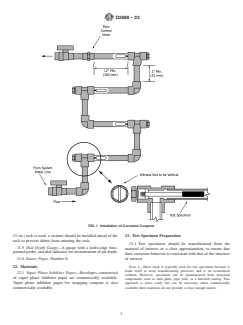
mounted in the bypass rack. The specimen mounting apparatus is shown in Fig. 1.
11.4 Bypass Specimen Rack, as illustrated in Fig. 1, for installation of coupon specimens. The piping, valves, and fittings of the
D2688 − 23
FIG. 1 Installation of Corrosion Coupons
corrosion rack shall be constructed of 2.5 cm (1 in.) (1 in.) Schedule 40 carbon steel, stainless steel, or Schedule 80 PVC or CPVC
pipe. If necessary, the rack can be constructed of 16.8-mm16.8 mm ( ⁄4-in.) Schedule 40 carbon steel, stainless steel, or Schedule
80 PVC or CPVC pipe. This allows for a lower flow rate to achieve adequate velocity but leaves less clearance around the coupon
and maycan trap more debris. If a 16.8-mm16.8 mm ( ⁄4-in.) rack is used, a strainer should be installed ahead of the rack to prevent
debris from entering the rack.
11.5 Dial Depth Gage—Gauge—A gagegauge with a knife-edge base, pointed probe, and dial indicator for measurement of pit
depth.
11.6 Emery Paper, Number 0.
D2688 − 23
12. Materials
12.1 Vapor Phase Inhibitor Paper—Envelopes constructed of vapor phase inhibitor paper are commercially available. Vapor phase
inhibitor paper for wrapping coupons is also commercially available.
13. Coupon Test Specimen Preparation
13.1 In this procedure, coupons are to be made principally from sheet metal; however, in a few cases, as with cast iron or cast
bronze, it may be necessary to prepare coupons from castings.Test specimens should be manufactured from the material of interest,
or a close approximation, to ensure that their corrosion behavior is consistent with that of the structure of interest.
NOTE 2—Sheet stock is typically used for test specimens because it lends itself to most manufacturing processes and is an economical solution. However,
specimens can be manufactured from structural components such as tank plate, pipe wall, or a finished casting. This approach is more costly but can be
necessary when commercially available sheet materials do not provide a close enough match.
13.2 Use a coupon size of 13 by 76 by 1.6 mm (0.5 by 3.0 by 0.0625 in.) for all sheet metals; and a 13 by 76 by 3 mm (0.5 by
3.0 by 0.125 in.) for cast metals. Other sizes are suitable, providing the total area is about 259 mmSpecimens are manufactured
to a size and shape that can be easily installed into the bypass rack. Additionally, the specimens have one or more mounting (4
in.holes that ), the principal requirement being to keep the flat area large compared to the edge area. are sized and spaced to
properly mate with the holder, fasteners, and insulators (if used.)
NOTE 3—A rectangular specimen with a size of 13 mm by 76 mm (0.5 in. by 3.0 in.) is commonly used and will fit most bypass systems. A typical
thickness is 1.6 mm (0.0625 in.) for specimens made from sheet stock, whereas specimens made from plate, pipe, and casting may be left thicker to reduce
the amount of machining required to achieve the final thickness. Specimens from these forms are typically left at a thickness of 3 mm (0.125 in.).
13.3 Sheet Metal Coupon Preparation—Obtain sheet metal of the type desired except for stainless steel; use cold-rolled steel free
of rust spots for ferrous metal. Obtain stainless steel with a No. 4 finishSpecimens and mounting holes can be cut using standard
manufacturing processes. However, consideration should be given to the process selected and any possible impact it might have
on the material being cut, such as cold-working, a heat affected zone, or a recast layer. Under certain conditions these things can
lead to edge attack on test specimens. If edge attack is noted on specimens after exposure, it might be desirable to use a different
cutting process on future test specimens, or to utilize some method to dress the affected (edges3). after manufacturing.
13.3.1 Shear 14-gage sheet metal material to the dimensions of 13 by 75 mm (0.5 by 3.0 in.).
13.3.2 Drill or punch a 5 mm (0.19 in.) hole with its center about 3 mm ( ⁄8 in.) from one end of the coupon.
13.3.3 Deburr all sharp edges on the coupon specimen using a file or emery belt, and deburr the hole with an oversize drill.
13.3.4 Stamp identifying numbers or letters on the coupon area below the mounting hole.
13.4 Deburr the specimen edges, including the mounting hole rim(s).
13.5 Specimens should be uniquely identified to ensure that they can be tied back to their initial weight after exposure. This is
typically done by marking the specimen directly, but when this is not possible or practical, specimens can be marked using
removable (non-adhesive) tags.
NOTE 4—Impact stenciling is the most common way to mark coupons because it provides good legibility, and the characters are deep enough that they
remain legible after considerable corrosion of the specimen has occurred. However, other marking methods are acceptable, provided that they do not
significantly affect the corrosion behavior of the specimen in some way.
13.6 Cast Metal Coupon Preparation—Obtain rough castings of the desired metal, measuring about 19 by 114 by 6 mm
3 1
(Specimens can be used in the unfinished condition, or they can have a surface finish applied. Unfinished ⁄4 by 4specimens will ⁄2
byhave ⁄4 in.) from a commercial foundry or elsewhere.more imperfections and can more accurately depict the corrosion behavior
of a pipe or vessel wall. However, a specimen with an applied finish will provide a more consistent and repeatable result.
13.4.1 Surface grind to the dimensions of 13 by 102 by 3 mm (0.5 by 4.0 by 0.125 in.) and a surface roughness of about 124 μin.
D2688 − 23
TABLE 1 Flow versus Velocity
Schedule 40 Rack Steel or Stainless Steel Rack Schedule 80 Rack PVC Rack
3 3
19 mm ( ⁄4 in.) Nominal Pipe 25 mm (1 in.) Nominal Pipe 19 mm ( ⁄4 in.) Nominal Pipe 25 mm (1 in.) Nominal Pipe
Flow Rate
Size; m/sec (ft/sec) Size; m/sec (ft/sec) Size; m/sec (ft/sec) Size; m/sec (ft/sec)
8 lpm (2 gpm) 0.37 (1.20) 0.23 (0.74) 0.45 (1.48) 0.27 (0.89)
11 lpm (3 gpm) 0.55 (1.80) 0.34 (1.11) 0.68 (2.22) 0.41 (1.34)
15 lpm (4 gpm) 0.73 (2.40) 0.45 (1.48) 0.90 (2.96) 0.54 (1.78)
19 lpm (5 gpm) 0.91 (3.00) 0.56 (1.85) 1.13 (3.71) 0.68 (2.23)
26 lpm (7 gpm) 1.28 (4.21) 0.79 (2.60) 1.58 (5.19) 0.95 (3.12)
38 lpm (10 gpm) 1.83 (6.01) 1.13 (3.71) 2.26 (7.41) 1.36 (4.45)
45 lpm (12 gpm) 2.20 (7.21) 1.36 (4.45) 2.71 (8.89) 1.63 (5.35)
53 lpm (14 gpm) 2.56 (8.41) 1.58 (5.19) 3.16 (10.37) 1.90 (6.24)
61 lpm (16 gpm) 2.93 (9.61) 1.81 (5.93) 3.61 (11.86) 2.17 (7.13)
64 lpm (17 gpm) 3.12 (10.22) 1.92 (6.30) 3.84 (12.60) 2.31 (7.57)
9 5
13.4.2 Drill a 7-mm ( ⁄32-in.) hole with its center about 8 mm ( ⁄16 in.) from one end of the coupon.
13.4.3 Deburr all sharp edges on the coupon specimen using a file or emery belt, and deburr the hole with an oversize drill.
13.4.4 Stamp identifying numbers or letters on the small coupon area between the edge and the mounting hole.
13.4.5 The approximate weight of metal coupons, g, is as follows:
Steel 10.35
Cast Iron 11.65
Copper 13.33
Zinc 8.7
Lead 16.60
13.7 Cleaning Metal Coupons—Degrease and clean corrosion in specimens in accordance with Practice G1. After cleaning, the
specimens should not be handled with bare skin.
13.8 Protect the specimens from corrosion during storage by wrapping them in a suitable VCI material.
14. Procedure
14.1 Weigh the clean, dry specimens on an analytical balance to the nearest 0.0001 g.
14.2 After weighing, store the specimens in a desiccator until ready for use. If storing in a desiccator is inconvenient or
impractical, use an alternative method for providing a corrosion-free atmosphere.
14.3 Store coupons in separate envelope
...